

.avif)
.avif)

Legal Transcription Outsourcing Guide 2026


.svg)

Quick Summary: Legal transcription outsourcing converts spoken legal proceedings into accurate written documents while reducing costs and improving efficiency. Law firms can choose between human transcriptionists (99-100% accuracy), AI solutions ($0.25-$1.00/min), or hybrid approaches depending on sensitivity, budget, and turnaround needs.
What Is Legal Transcription Outsourcing?
Legal transcription outsourcing is the process of converting spoken legal content—depositions, court hearings, client interviews, dictations—into written documents by engaging external service providers rather than handling the work in-house. Firms send audio or video files to a transcription vendor, which then returns formatted, searchable documents ready for case files and legal review.
The key distinction: legal transcription differs from court reporting. Court reporters create real-time transcripts during proceedings and can administer oaths. Legal transcriptionists work from recordings after the fact, transforming raw audio into polished written records without the authority to swear witnesses.
Most legal transcriptionists cannot certify transcripts themselves—though some vendors like Ditto Transcripts carry specialized insurance allowing them to certify for future litigation use. Others remain 100% remote, which ultimately saves clients money on overhead.
Why Law Firms Are Outsourcing Legal Transcription
The shift toward outsourcing transcription services reflects broader efficiency trends in the legal sector. Rather than maintaining in-house staff or burdening attorneys with typing work, firms delegate this task to specialized providers who do it faster and cheaper.
Real talk: handling transcription in-house drains billable hours. A partner or paralegal spending time typing is revenue lost. Outsourced services typically range from $1.50 to $5.00 per minute of recorded audio, making it far more cost-effective than hiring dedicated employees. That $3 billion in U.S. business processing outsourcing recorded in 2005 (reflecting a 65% increase from the prior year) shows the outsourcing trend wasn't a fluke—it's how modern operations work.
Types of Legal Transcription Services Available
Human Transcription
Human legal transcriptionists deliver 99% to 100% accuracy. They understand legal terminology, capture speaker identification, and produce documents formatted for court filing. The trade-off? Slightly longer turnaround (24 hours to several days depending on urgency) and higher per-minute costs.
AI Transcription
Automated transcription tools cost significantly less—typically $0.25 to $1.00 per minute—and offer near-instant turnaround. But raw AI transcripts need extensive editing; accuracy remains inconsistent, especially with multiple speakers, accents, or legal jargon. Most firms use AI as a first draft, then hire humans to review and correct.
Hybrid Approaches
The smartest firms combine both. Start with AI to capture initial content, then route through human editors for quality control. This balances speed, cost, and accuracy—ideal when dealing with large volumes of less-sensitive material.
Key Factors When Choosing an Outsourcing Provider
Accuracy Standards
Look for vendors guaranteeing 99%+ accuracy. Ask how they measure it—do they use multi-step review? What happens if mistakes slip through? Reputable services often certify accuracy rates and stand behind them.
Confidentiality & Security
Legal files contain sensitive client data. Confirm the vendor uses encrypted file transfer, secure storage, and non-disclosure agreements. Ask about their data retention policies and whether they comply with relevant privacy standards. This is non-negotiable for protected information.
Turnaround Time Options
Define what "urgent" means for your practice. Do you need a same-day turnaround? 24 hours? 48 hours? Providers typically offer tiered pricing for rush jobs. Document your needs upfront—track which jobs caused bottlenecks or rework so you can size the right service level.
Audio Quality & Speaker Identification
Noisy recordings, multiple speakers, and overlapping dialogue increase transcription complexity and cost. Tell vendors about typical audio quality (clean, noisy, multi-speaker) and speaker count. Ensure the service identifies speakers clearly—critical for depositions and court filings.
Specialized Legal Expertise
Not all transcriptionists understand legal terminology. Court, contract, medical-legal, and patent language requires specialized knowledge. Work with agencies that hire transcriptionists trained in your practice area.

Add Legal Transcription Support with NeoWork
Legal transcription outsourcing works best when the team can handle audio-to-text work, records, documents, and repetitive legal admin tasks with attention to detail. NeoWork provides transcriptionist staff and legal outsourcing support, including legal transcription and records management tasks.
This can be useful for law firms, legal teams, and companies that need help turning recordings or spoken content into written records while keeping documentation workflows organized. NeoWork’s 91% annualized teammate retention rate and 3.2% candidate selectivity rate improve consistency, accuracy, and a clear understanding of formatting expectations.
Legal transcription work NeoWork can support:
- transcription of audio into written records
- records management tasks
- document and admin support for workflows
Contact NeoWork to add legal transcription support that helps keep records, documents, and routine legal admin work easier to manage.
Outsourced vs. In-House: The Cost Reality
Outsourced legal transcription usually wins on cost. A full-time in-house transcriptionist costs $35,000–$55,000+ annually in salary, benefits, and workspace. Outsourcing at $1.50–$5.00 per minute covers maybe 40–100 hours of work per month, depending on audio length and complexity.
The break-even math is simple: if your firm transcribes fewer than 200 hours of audio monthly, outsourcing is cheaper. Beyond that, in-house might pencil out—but you also gain flexibility, no hiring/training burden, and the ability to scale up or down seasonally.
In-house transcription makes sense only if you handle highly sensitive matters requiring ironclad confidentiality controls, need extremely tight workflow integration, or have predictable, high-volume work every single month. Most practices benefit from outsourcing.
Security & Confidentiality Concerns
Outsourcing introduces data risk. Client information, case details, and witness statements leave your office. But this is manageable. Ask vendors about encryption (in transit and at rest), employee background checks, non-disclosure agreements, and whether they allow you to audit their facilities.
Consider India-based outsourcing carefully. While reputable firms operate there, data protection enforcement can be inconsistent. In 2005, U.S. companies outsourced approximately $3 billion in business processing—including transcription—to places like India, but data breaches highlighted vulnerabilities in enforcement regimes. Vet any offshore vendor thoroughly.
Many firms now prefer nearshore or domestic transcription vendors to minimize risk. Yes, it costs slightly more, but peace of mind is worth it.
How to Evaluate Vendors
Setting Realistic Expectations
Turnaround varies widely. A clean, one-speaker audio file might transcribe overnight. A chaotic deposition with three attorneys, a witness, and court reporter interruptions could take days even with human review. Communicate expected timelines upfront and allow for revisions—nearly all vendors offer one round of corrections at no extra charge.
Audio quality matters. Provide clear files when possible. Muffled recordings, background noise, and heavy accents all slow transcription and reduce accuracy. Some vendors charge premium rates for difficult audio; others absorb the cost. Clarify this upfront.
Common Outsourcing Scenarios
Large Firms
High-volume practices often negotiate volume discounts with multiple vendors or maintain standing accounts with one trusted provider. Some use AI for initial drafts of routine depositions, then reserve human transcription for complex or sensitive work.
Solo & Small Practices
Lower volume makes outsourcing ideal. A solo attorney might spend $200–$500 per month on transcription services—far cheaper than hiring even a part-time person. Online vendors make ordering simple: upload audio, specify turnaround, receive polished documents.
Specialized Practice Areas
Patent, medical-legal, and intellectual property practices need vendors with domain expertise. Generic services won't cut it. Seek specialists in your field—they command a premium but deliver far fewer corrections.
Final Thoughts on Legal Transcription Outsourcing
Outsourcing transcription is a smart move for almost every law practice. The cost savings alone justify it—$1.50–$5.00 per minute beats hiring staff. Add in accuracy (99%+), turnaround flexibility, and zero training overhead, and the case becomes stronger.
Start small. Try one vendor with a test project. Evaluate their accuracy, responsiveness, and communication. Once you find a fit, scale up. Most firms end up using a combination: AI for rough drafts of routine work, human transcription for sensitive or complex audio.
Security is the only real concern. Vet vendors carefully, use encryption, and maintain written agreements. Done right, outsourcing transforms transcription from a costly bottleneck into a streamlined, affordable process.
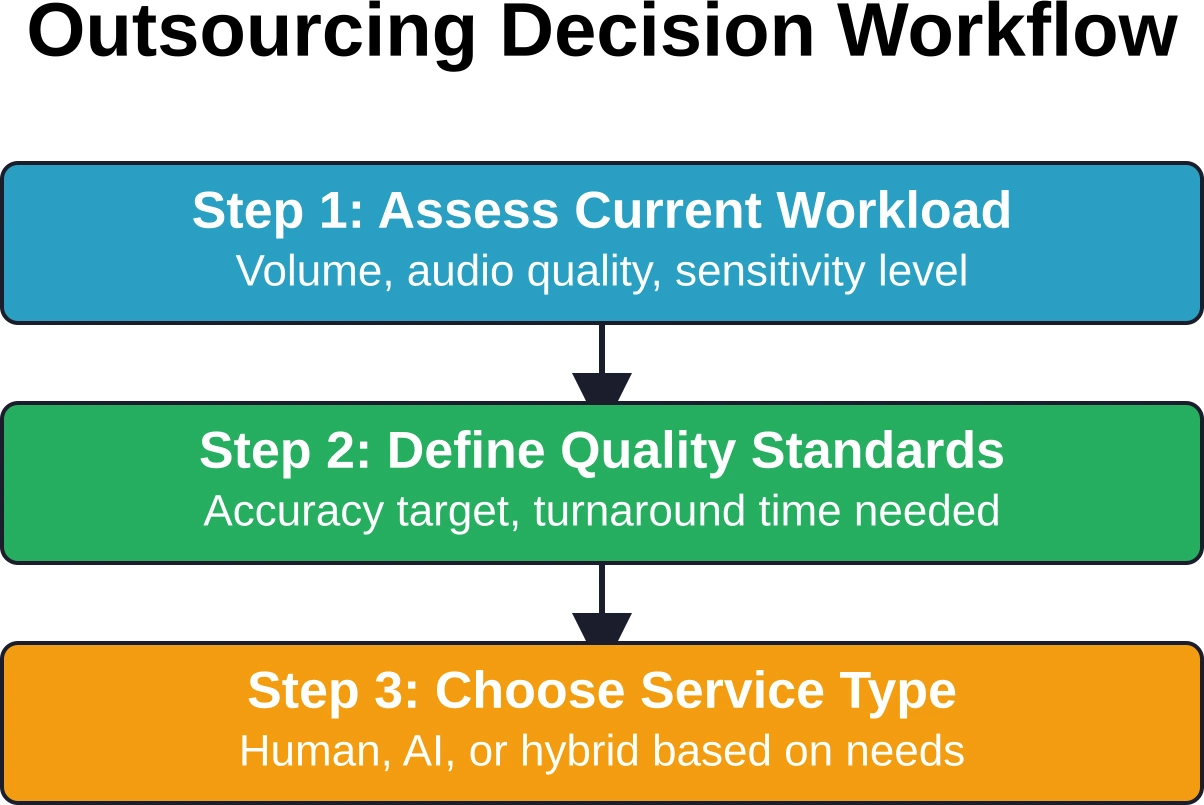
Ready to outsource? Start by assessing your current workload, defining quality standards, and requesting quotes from 2–3 specialized vendors. Within weeks, you'll wonder how you managed without it.
FAQ: Legal Transcription Outsourcing
Topics
Legal Transcription Outsourcing Guide 2026

Quick Summary: Legal transcription outsourcing converts spoken legal proceedings into accurate written documents while reducing costs and improving efficiency. Law firms can choose between human transcriptionists (99-100% accuracy), AI solutions ($0.25-$1.00/min), or hybrid approaches depending on sensitivity, budget, and turnaround needs.
What Is Legal Transcription Outsourcing?
Legal transcription outsourcing is the process of converting spoken legal content—depositions, court hearings, client interviews, dictations—into written documents by engaging external service providers rather than handling the work in-house. Firms send audio or video files to a transcription vendor, which then returns formatted, searchable documents ready for case files and legal review.
The key distinction: legal transcription differs from court reporting. Court reporters create real-time transcripts during proceedings and can administer oaths. Legal transcriptionists work from recordings after the fact, transforming raw audio into polished written records without the authority to swear witnesses.
Most legal transcriptionists cannot certify transcripts themselves—though some vendors like Ditto Transcripts carry specialized insurance allowing them to certify for future litigation use. Others remain 100% remote, which ultimately saves clients money on overhead.
Why Law Firms Are Outsourcing Legal Transcription
The shift toward outsourcing transcription services reflects broader efficiency trends in the legal sector. Rather than maintaining in-house staff or burdening attorneys with typing work, firms delegate this task to specialized providers who do it faster and cheaper.
Real talk: handling transcription in-house drains billable hours. A partner or paralegal spending time typing is revenue lost. Outsourced services typically range from $1.50 to $5.00 per minute of recorded audio, making it far more cost-effective than hiring dedicated employees. That $3 billion in U.S. business processing outsourcing recorded in 2005 (reflecting a 65% increase from the prior year) shows the outsourcing trend wasn't a fluke—it's how modern operations work.
Types of Legal Transcription Services Available
Human Transcription
Human legal transcriptionists deliver 99% to 100% accuracy. They understand legal terminology, capture speaker identification, and produce documents formatted for court filing. The trade-off? Slightly longer turnaround (24 hours to several days depending on urgency) and higher per-minute costs.
AI Transcription
Automated transcription tools cost significantly less—typically $0.25 to $1.00 per minute—and offer near-instant turnaround. But raw AI transcripts need extensive editing; accuracy remains inconsistent, especially with multiple speakers, accents, or legal jargon. Most firms use AI as a first draft, then hire humans to review and correct.
Hybrid Approaches
The smartest firms combine both. Start with AI to capture initial content, then route through human editors for quality control. This balances speed, cost, and accuracy—ideal when dealing with large volumes of less-sensitive material.
Key Factors When Choosing an Outsourcing Provider
Accuracy Standards
Look for vendors guaranteeing 99%+ accuracy. Ask how they measure it—do they use multi-step review? What happens if mistakes slip through? Reputable services often certify accuracy rates and stand behind them.
Confidentiality & Security
Legal files contain sensitive client data. Confirm the vendor uses encrypted file transfer, secure storage, and non-disclosure agreements. Ask about their data retention policies and whether they comply with relevant privacy standards. This is non-negotiable for protected information.
Turnaround Time Options
Define what "urgent" means for your practice. Do you need a same-day turnaround? 24 hours? 48 hours? Providers typically offer tiered pricing for rush jobs. Document your needs upfront—track which jobs caused bottlenecks or rework so you can size the right service level.
Audio Quality & Speaker Identification
Noisy recordings, multiple speakers, and overlapping dialogue increase transcription complexity and cost. Tell vendors about typical audio quality (clean, noisy, multi-speaker) and speaker count. Ensure the service identifies speakers clearly—critical for depositions and court filings.
Specialized Legal Expertise
Not all transcriptionists understand legal terminology. Court, contract, medical-legal, and patent language requires specialized knowledge. Work with agencies that hire transcriptionists trained in your practice area.
Add Legal Transcription Support with NeoWork
Legal transcription outsourcing works best when the team can handle audio-to-text work, records, documents, and repetitive legal admin tasks with attention to detail. NeoWork provides transcriptionist staff and legal outsourcing support, including legal transcription and records management tasks.
This can be useful for law firms, legal teams, and companies that need help turning recordings or spoken content into written records while keeping documentation workflows organized. NeoWork’s 91% annualized teammate retention rate and 3.2% candidate selectivity rate improve consistency, accuracy, and a clear understanding of formatting expectations.
Legal transcription work NeoWork can support:
- transcription of audio into written records
- records management tasks
- document and admin support for workflows
Contact NeoWork to add legal transcription support that helps keep records, documents, and routine legal admin work easier to manage.
Outsourced vs. In-House: The Cost Reality
Outsourced legal transcription usually wins on cost. A full-time in-house transcriptionist costs $35,000–$55,000+ annually in salary, benefits, and workspace. Outsourcing at $1.50–$5.00 per minute covers maybe 40–100 hours of work per month, depending on audio length and complexity.
The break-even math is simple: if your firm transcribes fewer than 200 hours of audio monthly, outsourcing is cheaper. Beyond that, in-house might pencil out—but you also gain flexibility, no hiring/training burden, and the ability to scale up or down seasonally.
In-house transcription makes sense only if you handle highly sensitive matters requiring ironclad confidentiality controls, need extremely tight workflow integration, or have predictable, high-volume work every single month. Most practices benefit from outsourcing.
Security & Confidentiality Concerns
Outsourcing introduces data risk. Client information, case details, and witness statements leave your office. But this is manageable. Ask vendors about encryption (in transit and at rest), employee background checks, non-disclosure agreements, and whether they allow you to audit their facilities.
Consider India-based outsourcing carefully. While reputable firms operate there, data protection enforcement can be inconsistent. In 2005, U.S. companies outsourced approximately $3 billion in business processing—including transcription—to places like India, but data breaches highlighted vulnerabilities in enforcement regimes. Vet any offshore vendor thoroughly.
Many firms now prefer nearshore or domestic transcription vendors to minimize risk. Yes, it costs slightly more, but peace of mind is worth it.
How to Evaluate Vendors
Setting Realistic Expectations
Turnaround varies widely. A clean, one-speaker audio file might transcribe overnight. A chaotic deposition with three attorneys, a witness, and court reporter interruptions could take days even with human review. Communicate expected timelines upfront and allow for revisions—nearly all vendors offer one round of corrections at no extra charge.
Audio quality matters. Provide clear files when possible. Muffled recordings, background noise, and heavy accents all slow transcription and reduce accuracy. Some vendors charge premium rates for difficult audio; others absorb the cost. Clarify this upfront.
Common Outsourcing Scenarios
Large Firms
High-volume practices often negotiate volume discounts with multiple vendors or maintain standing accounts with one trusted provider. Some use AI for initial drafts of routine depositions, then reserve human transcription for complex or sensitive work.
Solo & Small Practices
Lower volume makes outsourcing ideal. A solo attorney might spend $200–$500 per month on transcription services—far cheaper than hiring even a part-time person. Online vendors make ordering simple: upload audio, specify turnaround, receive polished documents.
Specialized Practice Areas
Patent, medical-legal, and intellectual property practices need vendors with domain expertise. Generic services won't cut it. Seek specialists in your field—they command a premium but deliver far fewer corrections.
Final Thoughts on Legal Transcription Outsourcing
Outsourcing transcription is a smart move for almost every law practice. The cost savings alone justify it—$1.50–$5.00 per minute beats hiring staff. Add in accuracy (99%+), turnaround flexibility, and zero training overhead, and the case becomes stronger.
Start small. Try one vendor with a test project. Evaluate their accuracy, responsiveness, and communication. Once you find a fit, scale up. Most firms end up using a combination: AI for rough drafts of routine work, human transcription for sensitive or complex audio.
Security is the only real concern. Vet vendors carefully, use encryption, and maintain written agreements. Done right, outsourcing transforms transcription from a costly bottleneck into a streamlined, affordable process.
Ready to outsource? Start by assessing your current workload, defining quality standards, and requesting quotes from 2–3 specialized vendors. Within weeks, you'll wonder how you managed without it.
FAQ: Legal Transcription Outsourcing
Topics
Related Blogs
Related Podcasts


.webp)
.webp)



