

.avif)
.avif)

Logistics BPO Services Guide 2026: Cost & Efficiency


.svg)

Quick Summary: Logistics BPO services let companies delegate freight management, documentation, order processing, and customer support to specialized providers. Organizations that outsource logistics back-office operations see 40-60% lower costs, 20-30% improved efficiency, and 98% compliance accuracy while freeing internal teams for strategic growth initiatives. This guide covers what logistics BPO includes, how to choose a provider, implementation steps, and real-world cost savings.
Logistics operations drain resources. Between freight documentation, order tracking, carrier coordination, and customer inquiries about delayed shipments, back-office logistics work piles up fast.
That's exactly where logistics BPO services come in. Business process outsourcing for logistics means handing specific operational tasks—freight management, data entry, invoice processing, customer service—to specialized external providers who do nothing but logistics support all day, every day.
And the numbers tell the story. Companies report operational cost reductions between 40-60% when they outsource logistics back-office functions. Efficiency improvements land in the 20-30% range, while compliance accuracy hits 98% when specialized BPO teams handle regulatory documentation.
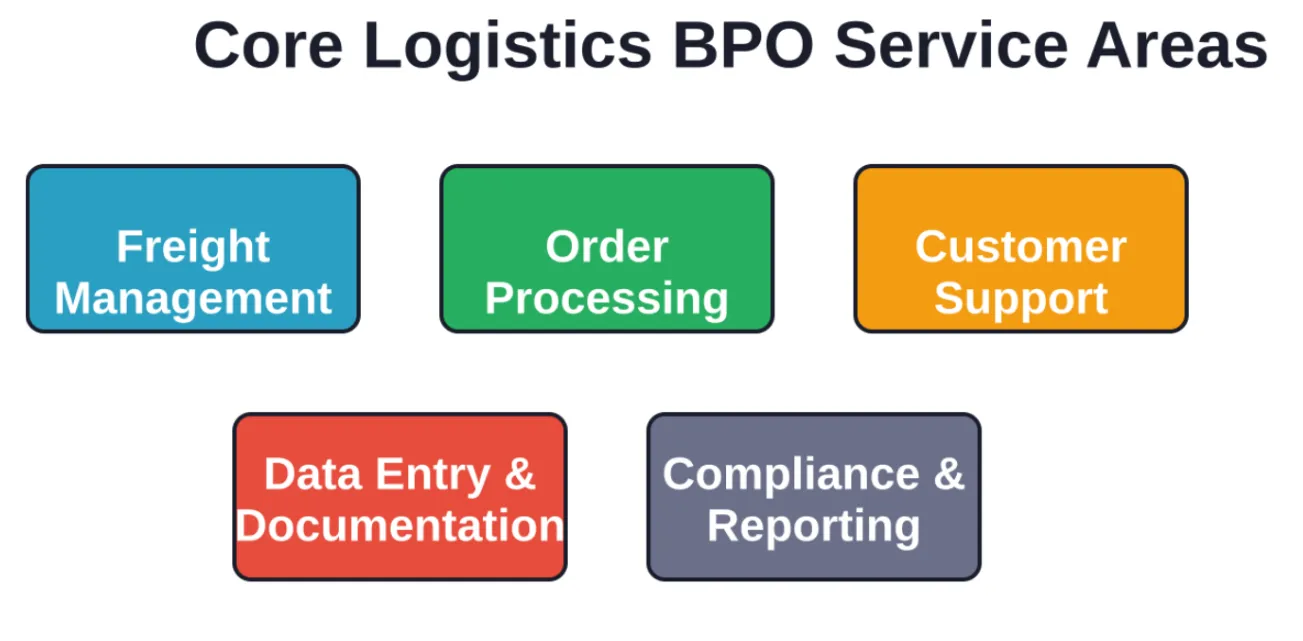
What Logistics BPO Services Actually Include
Logistics BPO isn't one monolithic service. It's a suite of back-office operations that keep supply chains moving without requiring your internal team to handle every detail.
Freight Management and Documentation
Freight paperwork is tedious and error-prone. BPO providers handle bills of lading, customs declarations, commercial invoices, packing lists, and certificates of origin. They track regulatory changes across jurisdictions and update documentation templates to maintain that 98% compliance accuracy benchmark.
The logistics industry deals with constantly changing regulations. Specialized BPO teams monitor these shifts and adjust processes accordingly to minimize legal risks.
Order Processing and Tracking
From the moment an order enters the system until it reaches the customer's doorstep, BPO teams manage the data flow. Order entry, validation, warehouse coordination, carrier assignment, tracking number generation, and status updates all fall under this umbrella.
Processing time improvements of 20-35% come from standardized workflows and dedicated personnel who handle nothing but order operations.
Customer Service for Logistics
"Where is my order?" That question floods customer service channels. BPO providers staff support teams across 45 languages through phone, email, chat, video, and social media channels.
Inquiry handling capacity increases 45-50% when specialized logistics customer service teams take over. They know carrier terminology, understand tracking systems, and can resolve shipment issues without escalating to your core team.
Data Entry and System Management
Logistics generates mountains of data. Shipment details, carrier rates, delivery confirmations, proof of delivery documents, and invoice information all need accurate entry into transportation management systems, warehouse management systems, and ERP platforms.
BPO teams handle this repetitive work with error rates below 2%, freeing your internal staff for analysis and strategy rather than data input.
Why Companies Choose Logistics BPO Solutions
The decision to outsource logistics back-office work stems from specific operational pain points. Here's what drives that choice.
Cost Reduction That Shows Up on the Bottom Line
Maintaining an in-house logistics back-office team means salaries, benefits, office space, software licenses, training, and management overhead. BPO providers operate at scale, spreading those fixed costs across multiple clients.
The result? Operational cost reductions between 40-60% are standard. A company spending $500,000 annually on internal logistics administration might cut that to $200,000-$300,000 through outsourcing.
Scalability for Demand Spikes
Logistics doesn't operate at steady state. Peak seasons hit, contracts expand, product launches create volume surges. Building internal capacity for peak demand means paying for idle staff during quiet periods.
BPO providers scale up and down on demand. When December holiday shipping volume triples, the provider adds staff. When January slows, they shift resources to other clients. Organizations pay for actual usage rather than maintaining excess capacity year-round.
Focus Internal Teams on Strategic Work
Efficiency improvements of 20-30% come partly from BPO provider expertise, but also from freeing internal logistics managers to focus on carrier negotiations, route optimization, network design, and cost reduction initiatives instead of drowning in paperwork.
Strategic logistics work moves the business forward. Data entry doesn't.
Access to Specialized Technology
Modern BPO providers invest in automation tools, AI-powered document processing, robotic process automation for repetitive tasks, and analytics dashboards for performance monitoring. Small and mid-sized logistics operations can't justify those technology investments internally.
Through BPO partnerships, companies access enterprise-grade logistics technology without capital expenditure.
How to Choose a Logistics BPO Provider
Not all BPO companies understand logistics. Transportation and supply chain operations have unique requirements that generic back-office providers miss.
Look for Logistics-Specific Experience
Does the provider know what a bill of lading is? Can they explain Incoterms? Do they understand the difference between FTL and LTL shipping?
Logistics terminology and processes are specialized. Providers with freight forwarding, 3PL, or transportation management backgrounds will onboard faster and make fewer errors than those learning logistics concepts from scratch.
Verify Technology Integration Capabilities
Modern BPO providers use cloud-based platforms for real-time data sharing, automation tools for repetitive tasks, and analytics dashboards for performance tracking. But they also need to integrate with your existing systems.
Ask about API connections, EDI capabilities, and experience with your specific transportation management system or warehouse management system. Smooth data flow between your platforms and the BPO provider's systems prevents manual reconciliation work.
Examine Service Level Agreement Structure
According to the U.S. International Trade Administration, properly structured SLAs reduce operational disputes by 40%. Clear expectations prevent conflicts.
Service level agreements should specify response times, accuracy targets, escalation procedures, reporting frequency, and penalty clauses for missed benchmarks. Vague SLAs create friction later.
Assess Compliance Knowledge
Logistics operations cross borders, triggering customs regulations, trade compliance requirements, dangerous goods rules, and industry-specific mandates. That 98% compliance accuracy benchmark only happens when BPO teams stay current on regulatory changes.
Ask providers how they monitor regulation updates, train staff on compliance changes, and maintain audit trails for documentation.
Test Communication Infrastructure
Time zones matter. If your logistics operations run 24/7 but your BPO provider only staffs during their local business hours, gaps appear. Look for providers offering overlapping coverage or true round-the-clock support depending on operational needs.
Language capabilities extend beyond English. If shipments move through multiple countries, multilingual support prevents communication breakdowns with carriers, customers, and customs officials.

Add Logistics Operations Support With NeoWork
Logistics workflows depend on information moving clearly between customers, systems, vendors, and internal teams. As volume grows, customer updates, coordination steps, reporting routines, procurement tasks, and admin follow-ups can become harder to manage. NeoWork can help logistics companies add remote teammates for these recurring support tasks. They point to a 91% annualized teammate retention rate and a 3.2% candidate selectivity rate, which supports a model built around more stable remote staffing.
NeoWork can bring in support for:
- Customer updates and service communication
- Operations admin and coordination support
- Data entry and reporting support
- Procurement or vendor coordination support
- Virtual assistant follow-ups
- Manual workflow support
Contact NeoWork to add logistics support capacity.
Implementing Logistics BPO: Step-by-Step Process
Transitioning logistics operations to a BPO provider requires planning. Rush the implementation, and errors multiply. Follow a structured approach instead.
Step 1: Map Current Processes
Document everything before handing it off. What information flows where? Which systems contain master data? Who handles exceptions? What are the decision points in each workflow?
Process documentation serves as the handoff blueprint. It also reveals inefficiencies worth fixing before outsourcing rather than automating broken processes.
Step 2: Define Scope and Boundaries
What stays internal and what transfers to the BPO provider? Some companies outsource everything except carrier negotiations. Others keep customer escalations in-house but delegate tier-one support.
Clear boundaries prevent overlap and confusion. The provider needs to know where their responsibility begins and ends.
Step 3: Pilot with Limited Scope
Don't hand over all logistics operations on day one. Start with one process—maybe freight documentation for a single lane or order processing for one product category.
Pilot programs reveal integration issues, communication gaps, and process mismatches before they affect the entire operation. Fix problems at a small scale, then expand.
Step 4: Establish Performance Metrics
What defines success? Order processing time? Documentation error rates? Customer service response speed? First-contact resolution percentage?
Metrics must be specific, measurable, and tracked from day one. Baseline current performance, then monitor improvement as the BPO provider takes over.
Step 5: Build Feedback Loops
Weekly review calls during the first month, bi-weekly after that, then monthly once operations stabilize. Regular check-ins surface issues early when they're easy to fix rather than letting problems compound.
Feedback flows both directions. The BPO provider should flag process inefficiencies they discover, and internal teams should communicate business changes that affect logistics operations.
.webp)
Common Challenges and How to Avoid Them
Logistics BPO implementations hit predictable obstacles. Knowing them in advance means building preventive measures into the plan.
Data Security Concerns
Logistics data includes customer information, shipment details, carrier contracts, and pricing. That's sensitive business intelligence.
Look for BPO providers with ISO 27001 certification for information security management. Verify they use encrypted data transmission, role-based access controls, and regular security audits. Data protection agreements should specify liability for breaches.
Knowledge Transfer Gaps
Internal teams carry institutional knowledge in their heads. "We always do it this way" doesn't translate into documented procedures.
Build extra time into the process documentation phase. Shadow current staff, record their decision logic, and capture the "why" behind each step, not just the "what."
System Integration Friction
Legacy transportation management systems don't always play nice with modern BPO platforms. Manual workarounds defeat the purpose of outsourcing.
Technical integration planning needs to happen before the contract signature, not after. Test API connections during the pilot phase with small data volumes before scaling up.
Cultural and Communication Differences
BPO teams often operate from different countries with different work cultures. Communication styles vary, holiday schedules differ, and assumptions about "normal business practices" may not align.
Explicit communication norms help. Document response time expectations, preferred communication channels, meeting frequency, and decision-making authority clearly.
The Future of Logistics BPO Services
Logistics BPO isn't static. Technology advancement and market pressure are reshaping what outsourced logistics services look like.
AI and Automation Integration
Robotic process automation handles repetitive data entry tasks without human intervention. AI-powered document processing extracts information from bills of lading and invoices automatically. Machine learning algorithms flag potential compliance issues before documents reach customs.
BPO providers investing in these technologies deliver faster processing times and higher accuracy rates. That 98% compliance accuracy benchmark will become table stakes, not a differentiator.
Predictive Analytics Capabilities
Forward-thinking BPO providers don't just process transactions—they analyze patterns. Which carriers consistently deliver late? Which lanes generate the most documentation errors? Where do customer service inquiries spike?
These insights help logistics teams make better decisions about carrier selection, process improvement, and resource allocation.
Sustainability Reporting Requirements
Carbon footprint tracking, emissions reporting, and sustainability compliance are becoming mandatory in many industries. Logistics operations generate significant environmental impact data.
BPO providers are building sustainability reporting into their service offerings, tracking shipment emissions, consolidation opportunities, and modal shift impacts as part of standard documentation workflows.
Frequently Asked Questions
Making the Decision: Is Logistics BPO Right for Your Operation?
Logistics BPO services deliver measurable benefits. Cost reductions of 40-60%, efficiency improvements of 20-30%, and compliance accuracy of 98% represent real operational gains.
But outsourcing isn't an automatic success. It requires careful provider selection, structured implementation, clear performance metrics, and ongoing management. Organizations that treat BPO as "set it and forget it" often face disappointment.
The decision framework is straightforward. If logistics back-office work consumes resources that could drive strategic value elsewhere, if demand variability makes fixed staffing inefficient, or if specialized technology and compliance requirements exceed internal capabilities, logistics BPO deserves serious evaluation.
Start with process documentation. Map what happens now, identify pain points, and quantify current costs. Then approach providers with specific requirements rather than vague hopes for improvement.
The logistics industry moves fast. Regulations change, technology evolves, and customer expectations rise. Specialized BPO providers invest in staying current because that's their entire business. For many companies, that focused expertise delivers more value than trying to maintain those capabilities internally.
Ready to explore logistics BPO for your operations? Begin with a thorough process audit, define clear scope boundaries, and approach providers with specific performance expectations. The 40-60% cost savings are real—but only when implementation is done right.
Topics
Logistics BPO Services Guide 2026: Cost & Efficiency

Quick Summary: Logistics BPO services let companies delegate freight management, documentation, order processing, and customer support to specialized providers. Organizations that outsource logistics back-office operations see 40-60% lower costs, 20-30% improved efficiency, and 98% compliance accuracy while freeing internal teams for strategic growth initiatives. This guide covers what logistics BPO includes, how to choose a provider, implementation steps, and real-world cost savings.
Logistics operations drain resources. Between freight documentation, order tracking, carrier coordination, and customer inquiries about delayed shipments, back-office logistics work piles up fast.
That's exactly where logistics BPO services come in. Business process outsourcing for logistics means handing specific operational tasks—freight management, data entry, invoice processing, customer service—to specialized external providers who do nothing but logistics support all day, every day.
And the numbers tell the story. Companies report operational cost reductions between 40-60% when they outsource logistics back-office functions. Efficiency improvements land in the 20-30% range, while compliance accuracy hits 98% when specialized BPO teams handle regulatory documentation.
What Logistics BPO Services Actually Include
Logistics BPO isn't one monolithic service. It's a suite of back-office operations that keep supply chains moving without requiring your internal team to handle every detail.
Freight Management and Documentation
Freight paperwork is tedious and error-prone. BPO providers handle bills of lading, customs declarations, commercial invoices, packing lists, and certificates of origin. They track regulatory changes across jurisdictions and update documentation templates to maintain that 98% compliance accuracy benchmark.
The logistics industry deals with constantly changing regulations. Specialized BPO teams monitor these shifts and adjust processes accordingly to minimize legal risks.
Order Processing and Tracking
From the moment an order enters the system until it reaches the customer's doorstep, BPO teams manage the data flow. Order entry, validation, warehouse coordination, carrier assignment, tracking number generation, and status updates all fall under this umbrella.
Processing time improvements of 20-35% come from standardized workflows and dedicated personnel who handle nothing but order operations.
Customer Service for Logistics
"Where is my order?" That question floods customer service channels. BPO providers staff support teams across 45 languages through phone, email, chat, video, and social media channels.
Inquiry handling capacity increases 45-50% when specialized logistics customer service teams take over. They know carrier terminology, understand tracking systems, and can resolve shipment issues without escalating to your core team.
Data Entry and System Management
Logistics generates mountains of data. Shipment details, carrier rates, delivery confirmations, proof of delivery documents, and invoice information all need accurate entry into transportation management systems, warehouse management systems, and ERP platforms.
BPO teams handle this repetitive work with error rates below 2%, freeing your internal staff for analysis and strategy rather than data input.
Why Companies Choose Logistics BPO Solutions
The decision to outsource logistics back-office work stems from specific operational pain points. Here's what drives that choice.
Cost Reduction That Shows Up on the Bottom Line
Maintaining an in-house logistics back-office team means salaries, benefits, office space, software licenses, training, and management overhead. BPO providers operate at scale, spreading those fixed costs across multiple clients.
The result? Operational cost reductions between 40-60% are standard. A company spending $500,000 annually on internal logistics administration might cut that to $200,000-$300,000 through outsourcing.
Scalability for Demand Spikes
Logistics doesn't operate at steady state. Peak seasons hit, contracts expand, product launches create volume surges. Building internal capacity for peak demand means paying for idle staff during quiet periods.
BPO providers scale up and down on demand. When December holiday shipping volume triples, the provider adds staff. When January slows, they shift resources to other clients. Organizations pay for actual usage rather than maintaining excess capacity year-round.
Focus Internal Teams on Strategic Work
Efficiency improvements of 20-30% come partly from BPO provider expertise, but also from freeing internal logistics managers to focus on carrier negotiations, route optimization, network design, and cost reduction initiatives instead of drowning in paperwork.
Strategic logistics work moves the business forward. Data entry doesn't.
Access to Specialized Technology
Modern BPO providers invest in automation tools, AI-powered document processing, robotic process automation for repetitive tasks, and analytics dashboards for performance monitoring. Small and mid-sized logistics operations can't justify those technology investments internally.
Through BPO partnerships, companies access enterprise-grade logistics technology without capital expenditure.
How to Choose a Logistics BPO Provider
Not all BPO companies understand logistics. Transportation and supply chain operations have unique requirements that generic back-office providers miss.
Look for Logistics-Specific Experience
Does the provider know what a bill of lading is? Can they explain Incoterms? Do they understand the difference between FTL and LTL shipping?
Logistics terminology and processes are specialized. Providers with freight forwarding, 3PL, or transportation management backgrounds will onboard faster and make fewer errors than those learning logistics concepts from scratch.
Verify Technology Integration Capabilities
Modern BPO providers use cloud-based platforms for real-time data sharing, automation tools for repetitive tasks, and analytics dashboards for performance tracking. But they also need to integrate with your existing systems.
Ask about API connections, EDI capabilities, and experience with your specific transportation management system or warehouse management system. Smooth data flow between your platforms and the BPO provider's systems prevents manual reconciliation work.
Examine Service Level Agreement Structure
According to the U.S. International Trade Administration, properly structured SLAs reduce operational disputes by 40%. Clear expectations prevent conflicts.
Service level agreements should specify response times, accuracy targets, escalation procedures, reporting frequency, and penalty clauses for missed benchmarks. Vague SLAs create friction later.
Assess Compliance Knowledge
Logistics operations cross borders, triggering customs regulations, trade compliance requirements, dangerous goods rules, and industry-specific mandates. That 98% compliance accuracy benchmark only happens when BPO teams stay current on regulatory changes.
Ask providers how they monitor regulation updates, train staff on compliance changes, and maintain audit trails for documentation.
Test Communication Infrastructure
Time zones matter. If your logistics operations run 24/7 but your BPO provider only staffs during their local business hours, gaps appear. Look for providers offering overlapping coverage or true round-the-clock support depending on operational needs.
Language capabilities extend beyond English. If shipments move through multiple countries, multilingual support prevents communication breakdowns with carriers, customers, and customs officials.
Add Logistics Operations Support With NeoWork
Logistics workflows depend on information moving clearly between customers, systems, vendors, and internal teams. As volume grows, customer updates, coordination steps, reporting routines, procurement tasks, and admin follow-ups can become harder to manage. NeoWork can help logistics companies add remote teammates for these recurring support tasks. They point to a 91% annualized teammate retention rate and a 3.2% candidate selectivity rate, which supports a model built around more stable remote staffing.
NeoWork can bring in support for:
- Customer updates and service communication
- Operations admin and coordination support
- Data entry and reporting support
- Procurement or vendor coordination support
- Virtual assistant follow-ups
- Manual workflow support
Contact NeoWork to add logistics support capacity.
Implementing Logistics BPO: Step-by-Step Process
Transitioning logistics operations to a BPO provider requires planning. Rush the implementation, and errors multiply. Follow a structured approach instead.
Step 1: Map Current Processes
Document everything before handing it off. What information flows where? Which systems contain master data? Who handles exceptions? What are the decision points in each workflow?
Process documentation serves as the handoff blueprint. It also reveals inefficiencies worth fixing before outsourcing rather than automating broken processes.
Step 2: Define Scope and Boundaries
What stays internal and what transfers to the BPO provider? Some companies outsource everything except carrier negotiations. Others keep customer escalations in-house but delegate tier-one support.
Clear boundaries prevent overlap and confusion. The provider needs to know where their responsibility begins and ends.
Step 3: Pilot with Limited Scope
Don't hand over all logistics operations on day one. Start with one process—maybe freight documentation for a single lane or order processing for one product category.
Pilot programs reveal integration issues, communication gaps, and process mismatches before they affect the entire operation. Fix problems at a small scale, then expand.
Step 4: Establish Performance Metrics
What defines success? Order processing time? Documentation error rates? Customer service response speed? First-contact resolution percentage?
Metrics must be specific, measurable, and tracked from day one. Baseline current performance, then monitor improvement as the BPO provider takes over.
Step 5: Build Feedback Loops
Weekly review calls during the first month, bi-weekly after that, then monthly once operations stabilize. Regular check-ins surface issues early when they're easy to fix rather than letting problems compound.
Feedback flows both directions. The BPO provider should flag process inefficiencies they discover, and internal teams should communicate business changes that affect logistics operations.
Common Challenges and How to Avoid Them
Logistics BPO implementations hit predictable obstacles. Knowing them in advance means building preventive measures into the plan.
Data Security Concerns
Logistics data includes customer information, shipment details, carrier contracts, and pricing. That's sensitive business intelligence.
Look for BPO providers with ISO 27001 certification for information security management. Verify they use encrypted data transmission, role-based access controls, and regular security audits. Data protection agreements should specify liability for breaches.
Knowledge Transfer Gaps
Internal teams carry institutional knowledge in their heads. "We always do it this way" doesn't translate into documented procedures.
Build extra time into the process documentation phase. Shadow current staff, record their decision logic, and capture the "why" behind each step, not just the "what."
System Integration Friction
Legacy transportation management systems don't always play nice with modern BPO platforms. Manual workarounds defeat the purpose of outsourcing.
Technical integration planning needs to happen before the contract signature, not after. Test API connections during the pilot phase with small data volumes before scaling up.
Cultural and Communication Differences
BPO teams often operate from different countries with different work cultures. Communication styles vary, holiday schedules differ, and assumptions about "normal business practices" may not align.
Explicit communication norms help. Document response time expectations, preferred communication channels, meeting frequency, and decision-making authority clearly.
The Future of Logistics BPO Services
Logistics BPO isn't static. Technology advancement and market pressure are reshaping what outsourced logistics services look like.
AI and Automation Integration
Robotic process automation handles repetitive data entry tasks without human intervention. AI-powered document processing extracts information from bills of lading and invoices automatically. Machine learning algorithms flag potential compliance issues before documents reach customs.
BPO providers investing in these technologies deliver faster processing times and higher accuracy rates. That 98% compliance accuracy benchmark will become table stakes, not a differentiator.
Predictive Analytics Capabilities
Forward-thinking BPO providers don't just process transactions—they analyze patterns. Which carriers consistently deliver late? Which lanes generate the most documentation errors? Where do customer service inquiries spike?
These insights help logistics teams make better decisions about carrier selection, process improvement, and resource allocation.
Sustainability Reporting Requirements
Carbon footprint tracking, emissions reporting, and sustainability compliance are becoming mandatory in many industries. Logistics operations generate significant environmental impact data.
BPO providers are building sustainability reporting into their service offerings, tracking shipment emissions, consolidation opportunities, and modal shift impacts as part of standard documentation workflows.
Frequently Asked Questions
Making the Decision: Is Logistics BPO Right for Your Operation?
Logistics BPO services deliver measurable benefits. Cost reductions of 40-60%, efficiency improvements of 20-30%, and compliance accuracy of 98% represent real operational gains.
But outsourcing isn't an automatic success. It requires careful provider selection, structured implementation, clear performance metrics, and ongoing management. Organizations that treat BPO as "set it and forget it" often face disappointment.
The decision framework is straightforward. If logistics back-office work consumes resources that could drive strategic value elsewhere, if demand variability makes fixed staffing inefficient, or if specialized technology and compliance requirements exceed internal capabilities, logistics BPO deserves serious evaluation.
Start with process documentation. Map what happens now, identify pain points, and quantify current costs. Then approach providers with specific requirements rather than vague hopes for improvement.
The logistics industry moves fast. Regulations change, technology evolves, and customer expectations rise. Specialized BPO providers invest in staying current because that's their entire business. For many companies, that focused expertise delivers more value than trying to maintain those capabilities internally.
Ready to explore logistics BPO for your operations? Begin with a thorough process audit, define clear scope boundaries, and approach providers with specific performance expectations. The 40-60% cost savings are real—but only when implementation is done right.
Topics
Related Blogs
Related Podcasts


.webp)

.webp)
.webp)



