

.avif)
.avif)

Logistics Data Entry Outsourcing Guide 2026


.svg)

Quick Summary: Logistics data entry outsourcing helps companies reduce operational costs, improve accuracy, and scale their warehouse and supply chain operations without building expensive in-house teams. This guide covers key benefits, service types, cost considerations, and practical steps to selecting the right outsourcing partner for your logistics workflows.
What Is Logistics Data Entry Outsourcing?
Logistics teams handle massive amounts of information every single day. Orders, shipments, inventory levels, customer addresses, tracking numbers—the data flows constantly. When even small mistakes slip through, the entire supply chain can slow down.
Logistics data entry outsourcing transfers these critical data management tasks to specialized third-party providers. Instead of maintaining a large internal team of data entry clerks, companies partner with offshore or nearshore vendors who manage orders, inventory records, shipping documentation, and other logistics workflows with speed and precision.
This approach converts fixed staffing costs into flexible, variable expenses. Businesses scale up or down based on seasonal demand without the overhead of hiring and training new employees.
Why Outsource the Data Entry Process?
The core reason is simple: data entry is critical but resource-intensive. Warehouses and logistics operations cannot afford accuracy lapses, yet hiring dedicated internal teams for these tasks drains budgets and attention from core business activities.
Cost Reduction Without Compromise
By partnering with a data entry outsourcing company, organizations eliminate costs associated with recruiting, training, and maintaining an in-house data entry team. No employee benefits, office space, or equipment expenses. Offshore data entry specialists in countries with lower costs of living typically charge a fraction of what domestic hires would demand.
Speed and Accuracy Improvements
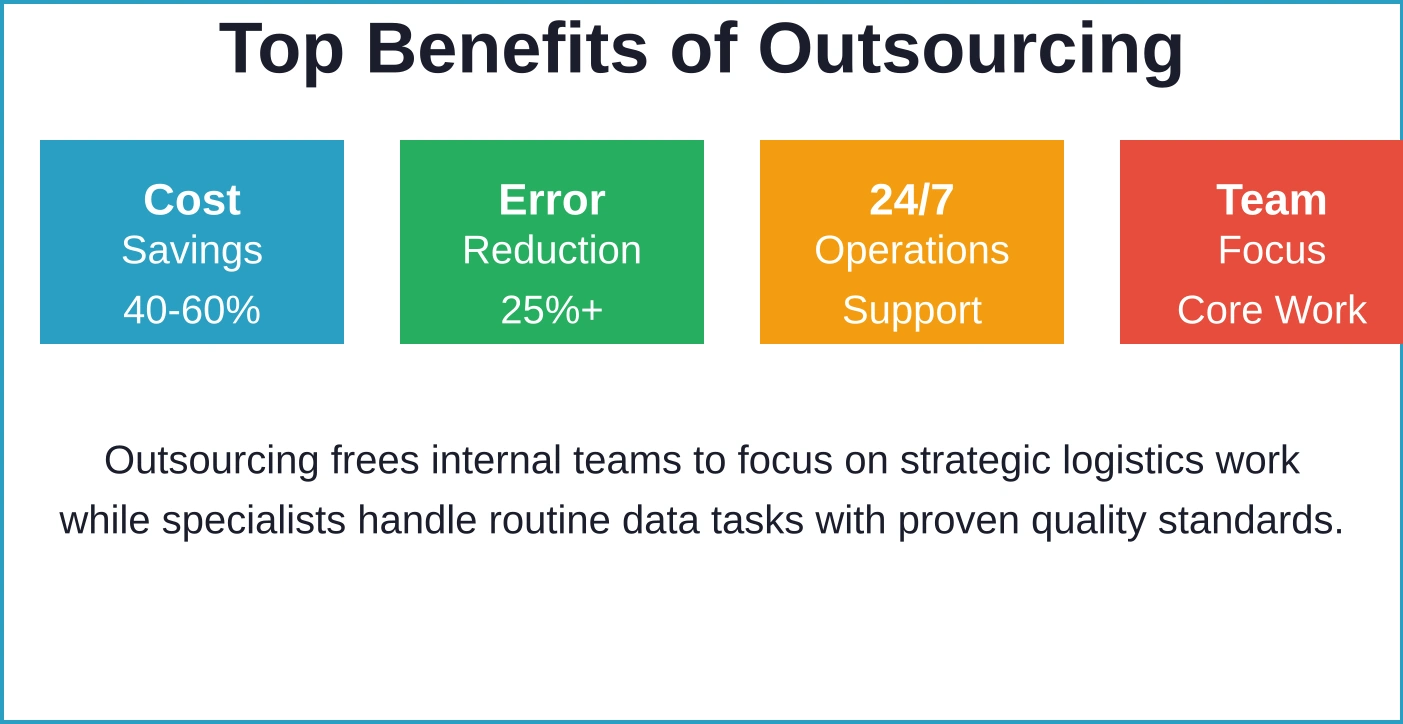
Professional outsourcing providers are equipped with quality management frameworks and standardized processes. A 2024 analysis found that outsourced data entry services improved error rates by over 25%. When logistics data is accurate, shipments move faster and customer satisfaction rises.
Scalability for Seasonal Fluctuations
Peak seasons in retail, e-commerce, and manufacturing create data entry bottlenecks. Outsourced teams scale instantly to handle volume spikes without overloading permanent staff.
Key Benefits of Logistics Data Entry Outsourcing
Focus on Strategic Work
When data entry is handled by external partners, your internal logistics team can concentrate on optimization, vendor management, and supply chain planning—activities that directly drive revenue and competitiveness.
Access to Advanced Systems
Reputable outsourcing providers invest in modern data entry platforms, automation tools, and quality assurance software. Companies get access to technology without purchasing expensive licenses or infrastructure.
Regulatory Compliance and Security
Third-party specialists maintain compliance frameworks for industries ranging from healthcare to manufacturing. They handle data security, encryption, and confidentiality protocols that protect sensitive logistics information.
Types of Logistics Data Entry Services
Outsourcing vendors offer different service models tailored to specific logistics needs.
Cost Considerations and ROI
Cost savings depend on several factors: volume of data, complexity of workflows, geographic location of the provider, and required turnaround times.
Typical Pricing Models
Most providers offer three options. Per-transaction pricing works for occasional, variable workloads. Dedicated team models suit companies with consistent daily data entry needs—a fixed monthly cost for a team of 5-10 people. Project-based pricing covers one-time migrations or seasonal surges.
What Companies Actually Save
Eliminating costs for recruiting, training, and maintaining internal data entry teams typically reduces expenses by 40-60% annually. The exact figure varies based on current staffing costs and provider selection.
How to Choose the Right Outsourcing Partner
Selecting a provider is more nuanced than picking the lowest bid. Here's what matters.
Industry Experience and Track Record
Look for vendors with proven success in logistics, supply chain, or warehouse operations. Ask for case studies, client references, and specific examples of how they've handled similar workflows.
Security and Compliance Standards
Verify certifications like ISO 27001 (information security), GDPR compliance, or industry-specific standards. Confirm they have non-disclosure agreements and data encryption protocols in place.
Quality Assurance Processes
Request details about their QA framework. How do they catch and prevent errors? What's their error rate? Do they offer accuracy guarantees or SLAs?
Technology and Integration Capabilities
Your outsourcing partner should integrate seamlessly with existing logistics software: warehouse management systems (WMS), enterprise resource planning (ERP), or e-commerce platforms. API connectivity and EDI support matter.
Scalability and Communication
Can they scale up during peak seasons? What's the communication structure—dedicated account manager, reporting dashboards, real-time status updates? How responsive are they to urgent requests?

Organize Logistics Data Entry with NeoWork
Logistics data entry can become a bottleneck when teams have to keep shipment records, customer updates, supplier details, order information, and internal systems accurate at the same time. NeoWork can support companies with data entry, back-office operations, customer service, and logistics support staff who help keep routine information updated.
NeoWork reports a 91% annualized teammate retention rate and a 3.2% candidate selectivity rate. For logistics data entry, that matters because recurring record updates, order details, shipment information, and customer communication require consistency, process knowledge, and fewer handoff mistakes.
Logistics data entry tasks NeoWork can support:
- database and record updates
- supplier and customer communication records
- back-office tasks for recurring logistics workflows
Contact NeoWork to add logistics data entry support that keeps records cleaner, reduces repetitive admin work, and helps internal teams manage daily logistics information more consistently.
Common Challenges and How to Overcome Them
Data Security Concerns
Outsourcing partners access sensitive logistics information. Mitigate risk by conducting thorough background checks, requiring compliance certifications, enforcing role-based access controls, and auditing vendor security practices regularly.
Quality Variability
Not all outsourcing providers maintain consistent accuracy. Define clear quality metrics upfront, establish SLAs with penalties for misses, and request performance reports monthly.
Communication Delays
Timezone differences and language barriers can create friction. Choose vendors with U.S.-based account management, or clarify working hours and escalation procedures in your contract.
Hidden or Unexpected Costs
Get detailed pricing breakdowns in writing. Clarify what's included, what incurs extra fees, and what happens if volume fluctuates seasonally.
Getting Started: Practical Next Steps
Step 1: Audit Your Current Workflow
Map out all logistics data entry tasks: daily volume, types of data, current error rates, and time spent. This baseline helps vendors give accurate quotes and timelines.
Step 2: Define Requirements and SLAs
Document what accuracy looks like (e.g., 99.5% accuracy), expected turnaround times, and any compliance requirements specific to your industry.
Step 3: Request Proposals from Multiple Providers
Invite at least 3-5 vendors to bid. Compare pricing, capabilities, certifications, and references—not just cost.
Step 4: Pilot a Small Project
Before committing long-term, run a trial with a subset of work. This reveals whether the partnership will work well operationally and culturally.
Step 5: Establish Governance and Reporting
Once live, set up weekly check-ins, monthly performance reviews, and escalation procedures. Clear communication prevents problems from snowballing.
Final Thoughts
Logistics data entry is unglamorous but absolutely mission-critical. Small errors compound across the supply chain, slowing shipments, frustrating customers, and damaging margins.
Outsourcing these tasks to specialized providers offers a practical solution: lower costs, fewer errors, and faster processing—all without building expensive in-house teams. The key is choosing a partner with genuine logistics experience, proven security practices, and strong quality controls.
Start by auditing your current workflow and defining clear requirements. Then test a small project with your top candidates before committing long-term. Done right, logistics data entry outsourcing becomes a competitive advantage, not just a cost-cutting measure.
Ready to explore this opportunity? Begin by identifying your most time-consuming data entry tasks and reaching out to providers for detailed proposals. Your logistics team will thank you when routine data work is handled by specialists, freeing them to drive real operational improvements.
Frequently Asked Questions
Topics
Logistics Data Entry Outsourcing Guide 2026

Quick Summary: Logistics data entry outsourcing helps companies reduce operational costs, improve accuracy, and scale their warehouse and supply chain operations without building expensive in-house teams. This guide covers key benefits, service types, cost considerations, and practical steps to selecting the right outsourcing partner for your logistics workflows.
What Is Logistics Data Entry Outsourcing?
Logistics teams handle massive amounts of information every single day. Orders, shipments, inventory levels, customer addresses, tracking numbers—the data flows constantly. When even small mistakes slip through, the entire supply chain can slow down.
Logistics data entry outsourcing transfers these critical data management tasks to specialized third-party providers. Instead of maintaining a large internal team of data entry clerks, companies partner with offshore or nearshore vendors who manage orders, inventory records, shipping documentation, and other logistics workflows with speed and precision.
This approach converts fixed staffing costs into flexible, variable expenses. Businesses scale up or down based on seasonal demand without the overhead of hiring and training new employees.
Why Outsource the Data Entry Process?
The core reason is simple: data entry is critical but resource-intensive. Warehouses and logistics operations cannot afford accuracy lapses, yet hiring dedicated internal teams for these tasks drains budgets and attention from core business activities.
Cost Reduction Without Compromise
By partnering with a data entry outsourcing company, organizations eliminate costs associated with recruiting, training, and maintaining an in-house data entry team. No employee benefits, office space, or equipment expenses. Offshore data entry specialists in countries with lower costs of living typically charge a fraction of what domestic hires would demand.
Speed and Accuracy Improvements
Professional outsourcing providers are equipped with quality management frameworks and standardized processes. A 2024 analysis found that outsourced data entry services improved error rates by over 25%. When logistics data is accurate, shipments move faster and customer satisfaction rises.
Scalability for Seasonal Fluctuations
Peak seasons in retail, e-commerce, and manufacturing create data entry bottlenecks. Outsourced teams scale instantly to handle volume spikes without overloading permanent staff.
Key Benefits of Logistics Data Entry Outsourcing
Focus on Strategic Work
When data entry is handled by external partners, your internal logistics team can concentrate on optimization, vendor management, and supply chain planning—activities that directly drive revenue and competitiveness.
Access to Advanced Systems
Reputable outsourcing providers invest in modern data entry platforms, automation tools, and quality assurance software. Companies get access to technology without purchasing expensive licenses or infrastructure.
Regulatory Compliance and Security
Third-party specialists maintain compliance frameworks for industries ranging from healthcare to manufacturing. They handle data security, encryption, and confidentiality protocols that protect sensitive logistics information.
Types of Logistics Data Entry Services
Outsourcing vendors offer different service models tailored to specific logistics needs.
Cost Considerations and ROI
Cost savings depend on several factors: volume of data, complexity of workflows, geographic location of the provider, and required turnaround times.
Typical Pricing Models
Most providers offer three options. Per-transaction pricing works for occasional, variable workloads. Dedicated team models suit companies with consistent daily data entry needs—a fixed monthly cost for a team of 5-10 people. Project-based pricing covers one-time migrations or seasonal surges.
What Companies Actually Save
Eliminating costs for recruiting, training, and maintaining internal data entry teams typically reduces expenses by 40-60% annually. The exact figure varies based on current staffing costs and provider selection.
How to Choose the Right Outsourcing Partner
Selecting a provider is more nuanced than picking the lowest bid. Here's what matters.
Industry Experience and Track Record
Look for vendors with proven success in logistics, supply chain, or warehouse operations. Ask for case studies, client references, and specific examples of how they've handled similar workflows.
Security and Compliance Standards
Verify certifications like ISO 27001 (information security), GDPR compliance, or industry-specific standards. Confirm they have non-disclosure agreements and data encryption protocols in place.
Quality Assurance Processes
Request details about their QA framework. How do they catch and prevent errors? What's their error rate? Do they offer accuracy guarantees or SLAs?
Technology and Integration Capabilities
Your outsourcing partner should integrate seamlessly with existing logistics software: warehouse management systems (WMS), enterprise resource planning (ERP), or e-commerce platforms. API connectivity and EDI support matter.
Scalability and Communication
Can they scale up during peak seasons? What's the communication structure—dedicated account manager, reporting dashboards, real-time status updates? How responsive are they to urgent requests?
Organize Logistics Data Entry with NeoWork
Logistics data entry can become a bottleneck when teams have to keep shipment records, customer updates, supplier details, order information, and internal systems accurate at the same time. NeoWork can support companies with data entry, back-office operations, customer service, and logistics support staff who help keep routine information updated.
NeoWork reports a 91% annualized teammate retention rate and a 3.2% candidate selectivity rate. For logistics data entry, that matters because recurring record updates, order details, shipment information, and customer communication require consistency, process knowledge, and fewer handoff mistakes.
Logistics data entry tasks NeoWork can support:
- database and record updates
- supplier and customer communication records
- back-office tasks for recurring logistics workflows
Contact NeoWork to add logistics data entry support that keeps records cleaner, reduces repetitive admin work, and helps internal teams manage daily logistics information more consistently.
Common Challenges and How to Overcome Them
Data Security Concerns
Outsourcing partners access sensitive logistics information. Mitigate risk by conducting thorough background checks, requiring compliance certifications, enforcing role-based access controls, and auditing vendor security practices regularly.
Quality Variability
Not all outsourcing providers maintain consistent accuracy. Define clear quality metrics upfront, establish SLAs with penalties for misses, and request performance reports monthly.
Communication Delays
Timezone differences and language barriers can create friction. Choose vendors with U.S.-based account management, or clarify working hours and escalation procedures in your contract.
Hidden or Unexpected Costs
Get detailed pricing breakdowns in writing. Clarify what's included, what incurs extra fees, and what happens if volume fluctuates seasonally.
Getting Started: Practical Next Steps
Step 1: Audit Your Current Workflow
Map out all logistics data entry tasks: daily volume, types of data, current error rates, and time spent. This baseline helps vendors give accurate quotes and timelines.
Step 2: Define Requirements and SLAs
Document what accuracy looks like (e.g., 99.5% accuracy), expected turnaround times, and any compliance requirements specific to your industry.
Step 3: Request Proposals from Multiple Providers
Invite at least 3-5 vendors to bid. Compare pricing, capabilities, certifications, and references—not just cost.
Step 4: Pilot a Small Project
Before committing long-term, run a trial with a subset of work. This reveals whether the partnership will work well operationally and culturally.
Step 5: Establish Governance and Reporting
Once live, set up weekly check-ins, monthly performance reviews, and escalation procedures. Clear communication prevents problems from snowballing.
Final Thoughts
Logistics data entry is unglamorous but absolutely mission-critical. Small errors compound across the supply chain, slowing shipments, frustrating customers, and damaging margins.
Outsourcing these tasks to specialized providers offers a practical solution: lower costs, fewer errors, and faster processing—all without building expensive in-house teams. The key is choosing a partner with genuine logistics experience, proven security practices, and strong quality controls.
Start by auditing your current workflow and defining clear requirements. Then test a small project with your top candidates before committing long-term. Done right, logistics data entry outsourcing becomes a competitive advantage, not just a cost-cutting measure.
Ready to explore this opportunity? Begin by identifying your most time-consuming data entry tasks and reaching out to providers for detailed proposals. Your logistics team will thank you when routine data work is handled by specialists, freeing them to drive real operational improvements.
Frequently Asked Questions
Topics
Related Blogs
Related Podcasts


.webp)
.webp)



