
.avif)
.avif)

Offshore Staff Augmentation Guide: Scale Teams Fast in 2026


.svg)

Quick Summary: Offshore staff augmentation is a flexible hiring model that allows businesses to quickly scale their teams by engaging skilled professionals from other countries, maintaining direct oversight while significantly reducing costs by 40-60%. Companies leverage this approach to access specialized expertise, accelerate project delivery, and fill skill gaps without the overhead of full-time hiring. The global IT staff augmentation market grew from $92.5 billion pre-pandemic to $132.9 billion post-pandemic, reflecting its rising strategic importance.
Finding the right technical expertise at the right time has become one of the most critical—and difficult—challenges for modern businesses. Traditional hiring processes stretch for months while project deadlines loom. Budgets get slashed while salary expectations climb. The talent shortage isn't just inconvenient anymore. It's actively blocking business growth.
Leading brands like Microsoft and IBM have already found their answer: offshore staff augmentation. This approach lets companies bring skilled professionals on board without the overhead of full-time hires, maintaining control while dramatically cutting costs and time-to-hire.
But here's the thing—offshore staff augmentation isn't just about finding cheaper developers. When done right, it's about strategically accessing global expertise, scaling at the pace your projects demand, and building flexible teams that adapt to market changes. When done wrong, it becomes a coordination nightmare.
This guide walks through everything needed to make offshore staff augmentation work: the models that fit different business needs, the real cost comparisons, the legal frameworks that matter, and the criteria for selecting partners who won't disappear when problems arise.
What Is Offshore Staff Augmentation?
Offshore staff augmentation involves engaging skilled professionals from other countries to work as an extension of the existing in-house team. Unlike outsourcing—where an external company takes full responsibility for project delivery—staff augmentation keeps management control internal.
The augmented professionals integrate directly into existing workflows. They attend team meetings, use the same tools, follow the same processes, and report to internal project managers. The difference is geographical: they work from a different country, typically one with lower labor costs.
Three core characteristics define this model:
- Direct management and oversight remain with the hiring company
- Augmented staff work as temporary or contract-based team members
- Engagement scales up or down based on project needs
The distinction between offshore, nearshore, and onshore augmentation comes down to distance and time zones. Offshore typically refers to distant locations with significant time zone differences—think a U.S. company hiring developers from India or the Philippines. Nearshore means geographically closer countries with smaller time zone gaps—like U.S. companies working with talent in Latin America.
How It Differs From Traditional Outsourcing
The difference matters more than semantics suggest. With traditional outsourcing, a company hands over an entire project or function to an external vendor. That vendor manages the team, makes implementation decisions, and delivers finished work. Control shifts outward.
Staff augmentation works differently. The hiring company maintains direct control over daily tasks, priorities, methodologies, and quality standards. Augmented professionals become temporary team members, not external contractors operating independently.
This distinction shapes everything from pricing models to risk distribution. Staff augmentation charges for time and talent. Outsourcing charges for deliverables and results.
The Business Case: Why Companies Choose Offshore Augmentation
The numbers tell the story clearly. According to research, the global IT staff augmentation market grew from $92.5 billion pre-pandemic to $132.9 billion post-pandemic. In the U.S., the market was valued at $32.5 billion in 2021 and is projected to reach $43.68 billion by 2027.
That growth reflects businesses confronting real operational constraints. Here's what drives the decision.
Access to Specialized Expertise
Certain technical skills exist in concentrated pockets worldwide. Machine learning specialists cluster in specific tech hubs. Blockchain developers emerge from communities that formed around particular platforms. Finding niche expertise locally can take six months—or prove impossible.
Offshore augmentation opens access to these global talent pools immediately. A company needing three months of DevOps expertise for a cloud migration doesn't need to hire a full-time employee. They can engage a specialist who's worked on similar migrations dozens of times, complete the project, and conclude the engagement.
Significant Cost Reduction
Labor cost differences between countries create substantial savings. Industry analyses indicate offshore staff augmentation can reduce hiring costs by 40-60% compared to local hiring in high-cost markets.
The savings compound beyond just salaries. Offshore augmentation eliminates or reduces:
- Recruitment costs and lengthy hiring processes
- Benefits packages, insurance, and retirement contributions
- Office space, equipment, and infrastructure overhead
- Long-term employment commitments and severance obligations
Real talk: cost reduction is often the initial driver, but it shouldn't be the only consideration. Cheapest doesn't mean best. The value comes from accessing quality expertise at a better price point—not from cutting corners that compromise project outcomes.
Faster Time-to-Hire and Market Speed
Traditional tech hiring drags on for months. Sourcing candidates, conducting multiple interview rounds, negotiating offers, waiting out notice periods—the timeline stretches to 12-16 weeks on average.
Offshore staff augmentation can cut that to 2-4 weeks. Established augmentation partners maintain pre-vetted talent pools. They've already screened candidates, verified skills, and checked references. When a client needs a React developer with three years of experience, the partner can present qualified candidates within days.
That speed translates to competitive advantage. Products launch sooner. Features ship faster. Opportunities get captured before they vanish.
Flexibility and Scalability Without Long-Term Commitment
Business needs fluctuate. A product launch requires ten additional developers for four months. A system upgrade needs two database specialists for six weeks. A seasonal spike demands extra support staff for a quarter.
Hiring full-time employees for temporary needs makes no financial sense. Offshore augmentation provides the flexibility to scale teams precisely to project requirements, then scale back when those needs conclude. No layoffs. No awkward restructuring. Just contracts that end as planned.
Offshore Staff Augmentation Working Models
Not all offshore augmentation arrangements work the same way. Three primary models dominate, each suited to different business contexts and project requirements.
Dedicated Team Model
The dedicated team model assigns a group of offshore professionals to work exclusively on a client's projects. This team functions as a remote extension of the in-house staff, fully integrated into company processes and culture.
Key characteristics:
- Team members work exclusively for one client
- Long-term engagement, typically 6-12 months or longer
- Deep integration with internal teams and processes
- Client has direct communication and management authority
This model works best for ongoing development needs, product maintenance, or situations requiring extensive domain knowledge. When a company needs sustained capacity—not just a short-term fix—dedicated teams provide consistency and institutional memory.
The trade-off? Higher commitment and cost compared to project-based approaches. But that investment pays off through reduced onboarding overhead and better long-term productivity.
Project-Based Model
Project-based augmentation brings in offshore talent for a specific initiative with defined scope, timeline, and deliverables. Once the project concludes, the engagement ends.
This model suits:
- Short-term initiatives with clear requirements (3-6 months typically)
- Specific technical needs like migrations, upgrades, or feature builds
- Proof-of-concept development before full commitment
- Situations where specialized expertise is needed temporarily
Project-based augmentation offers maximum flexibility. Scale up for the project, scale down when it completes. No long-term obligations. But this approach requires strong project definition upfront. Ambiguous scope leads to friction and scope creep.
Hybrid Model
The hybrid model combines elements of both approaches. A core dedicated team handles ongoing work while additional project-based resources join for specific initiatives.
For example: a company might maintain a dedicated team of five developers handling product maintenance and incremental features, then augment with three additional specialists for a major platform migration lasting four months.
This model provides both stability and flexibility. The dedicated core builds institutional knowledge and maintains consistency. Project-based additions provide surge capacity and specialized skills exactly when needed.
Sound familiar? Many successful long-term augmentation relationships evolve into hybrid arrangements naturally as trust builds and business needs become clearer.

Expand Your Workforce with NeoWork’s Offshore Staff
Offshore staff augmentation allows companies to add professionals to existing teams without handling every part of recruitment and ongoing teammate support internally. NeoWork provides individual contributors and dedicated offshore teams that integrate into the client’s existing tools, workflows, and management structure. The company reports a 91% annualized teammate retention rate and a 3.2% candidate selectivity rate, which matters when new teammates need time to understand established processes and remain consistent.
NeoWork’s offshore staffing model includes:
- individual contributors who join existing teams
- dedicated teams for ongoing workflows
- recruitment, benefits, training, and teammate support
- integration with the client’s systems and processes
Contact NeoWork to add offshore professionals who can expand your team and support recurring operational or technical work.
Choosing the Right Offshore Destination
Geography matters in offshore augmentation—but not just for cost reasons. Time zones, cultural alignment, language proficiency, legal frameworks, and talent pool depth all factor into the decision.
Popular Offshore Regions and Their Characteristics
Different regions offer distinct advantages and trade-offs:
The "best" destination depends on specific business priorities. Maximum cost savings? India and Southeast Asia lead. Need real-time collaboration during US business hours? Latin America makes sense. European data residency requirements? Eastern Europe provides compliance with proximity.
Time Zone Management Strategies
Time zone differences create both challenges and opportunities. Challenges include reduced real-time communication windows and potential delays in getting answers to blocking questions. But here's where it gets interesting: time zone differences also enable follow-the-sun development, where work continues around the clock.
Effective strategies for managing time zones:
- Establish core overlap hours when both onshore and offshore teams are available (even if it's just 2-3 hours daily)
- Use asynchronous communication tools effectively—detailed tickets, recorded video updates, comprehensive documentation
- Rotate meeting times occasionally so neither team always accommodates the other's schedule
- Build buffer time into project schedules to account for question-and-answer delays
Teams that master asynchronous workflows often find they prefer it. Written documentation becomes clearer. Decisions get recorded. Interruptions decrease. Productivity actually improves.
Legal and Compliance Considerations
Offshore staff augmentation crosses international borders, which means navigating different legal systems, labor laws, and regulatory requirements. Getting this wrong creates serious liability.
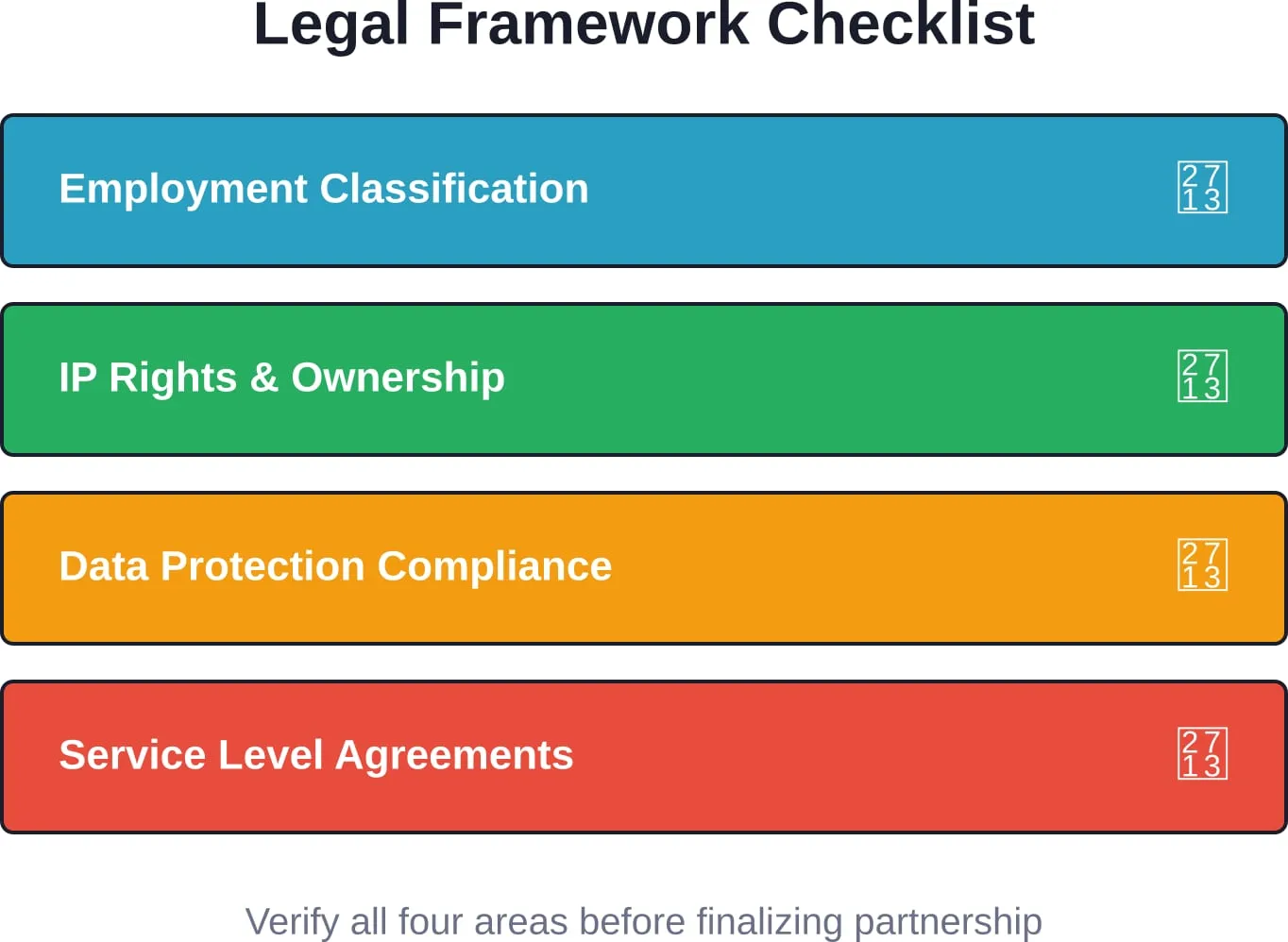
Employment Law and Classification
The U.S. Department of Labor administers and enforces more than 180 federal laws covering approximately 165 million workers and 11 million workplaces. When engaging offshore staff, classification matters enormously.
Misclassifying employees as contractors—or misunderstanding the employment relationship—creates risk. Staffing agencies themselves face significant enforcement action when they violate labor laws. In fiscal year 2023, the Department of Labor investigated 955 child labor violation cases involving 5,792 children and assessed $8 million in civil money penalties. A staffing agency faced penalties for child labor violations.
These enforcement actions, representing an 88% increase in child labor violation cases since 2019, underscore the seriousness with which labor law compliance is treated. While offshore augmentation engages adult professionals, the regulatory scrutiny on staffing arrangements has intensified across all categories.
When working with offshore augmentation partners, ensure they:
- Comply with local employment laws in their jurisdiction
- Properly classify workers according to local regulations
- Maintain appropriate worker protections and standards
- Provide transparency into their employment practices
Data Protection and Intellectual Property
Offshore team members often access sensitive business data, proprietary code, and confidential information. Protecting those assets requires clear contractual frameworks and technical controls.
Key protections include:
- Comprehensive Non-Disclosure Agreements (NDAs) covering all augmented staff
- Clear intellectual property assignment provisions ensuring work product belongs to the client
- Data processing agreements addressing how personal or sensitive data is handled
- Compliance with relevant data protection regulations (GDPR, CCPA, etc.)
- Technical security measures like VPNs, access controls, and monitoring
Most established augmentation partners have standard frameworks addressing these concerns. But don't assume—verify. Review contracts carefully and involve legal counsel familiar with international employment arrangements.
Contracts and Service Level Agreements
Clear contracts prevent misunderstandings that become disputes. At minimum, augmentation agreements should specify:
- Scope of work and expected deliverables
- Roles and responsibilities of both parties
- Payment terms, rates, and invoicing schedules
- Communication protocols and reporting requirements
- Confidentiality and IP ownership provisions
- Service level expectations and performance metrics
- Termination conditions and notice periods
- Dispute resolution mechanisms
Some companies rush through contracts to start work quickly. That creates problems later. Invest the time upfront to establish clear terms. The contract protects both parties.
Steps to Implement Offshore Staff Augmentation Successfully
Theory is one thing. Implementation is where most challenges emerge. Here's a practical framework for getting offshore augmentation right.
Step 1: Define Clear Requirements and Goals
Vague requirements produce disappointing results. Before approaching augmentation partners, document exactly what's needed:
- Specific technical skills and experience levels required
- Number of team members needed and engagement duration
- Project scope, deliverables, and success criteria
- Budget constraints and timeline expectations
- Integration requirements (tools, processes, communication channels)
The clearer the requirements, the easier it becomes to evaluate partner capabilities and candidate fit. Ambiguity leads to mismatched expectations and project friction.
Step 2: Evaluate and Select the Right Partner
Not all augmentation providers deliver equivalent quality. Selecting the wrong partner wastes time and money while putting projects at risk.
Key evaluation criteria include:
- Track record and experience: How long has the partner operated? What's their client retention rate? Can they provide references from similar engagements?
- Technical expertise: Do they have demonstrable experience in the required technology stack? Can they provide case studies or portfolio examples?
- Talent pool depth: How many developers do they have in the required skill areas? Can they scale quickly if needs increase?
- Vetting process: How do they screen and evaluate candidates? What's their acceptance rate? Do they conduct technical assessments?
- Communication capabilities: What's the English proficiency level (or other required language)? How do they handle time zone coordination?
- Infrastructure and tools: Do they have secure development environments? What project management and communication tools do they support?
- Pricing transparency: Are rates clear and predictable? What's included? Are there hidden fees for common requirements?
Request detailed proposals from 3-4 potential partners. Compare not just on price, but on overall capability and cultural fit. The cheapest option frequently becomes the most expensive through rework and delays.
Step 3: Conduct Thorough Candidate Interviews
Even when working with trusted partners, interview candidates directly before finalizing engagement. The partner's vetting catches basic qualifications, but direct interviews assess cultural fit, communication skills, and problem-solving approaches.
Structure interviews to evaluate:
- Technical competency through practical coding tests or architecture discussions
- Communication clarity and ability to explain complex concepts
- Problem-solving approach when facing ambiguous requirements
- Cultural alignment and work style compatibility
- Previous experience with similar projects or technologies
Include future teammates in the interview process. They'll work directly with augmented staff daily and can assess collaboration fit better than management alone.
Step 4: Establish Clear Communication Protocols
Communication makes or breaks distributed teams. Establish protocols before work begins:
- Daily stand-ups or async status updates at consistent times
- Weekly planning and retrospective meetings
- Defined response time expectations for different communication channels
- Clear escalation paths when blockers arise
- Documentation standards for decisions, architecture, and code
Over-communicate initially. As teams gel and trust builds, communication can become more informal. But start with structure.
Step 5: Onboard Effectively
Treat augmented staff like new employees. Provide comprehensive onboarding covering:
- Company background, culture, and values
- Product overview and technical architecture
- Development environment setup and access provisioning
- Code standards, review processes, and quality expectations
- Introduction to key team members and stakeholders
- First small task to build confidence and validate setup
Assign an onboarding buddy from the internal team to answer questions and provide guidance during the first few weeks. That personal connection accelerates integration dramatically.
Step 6: Monitor Performance and Iterate
Regular check-ins ensure augmented teams stay aligned with evolving project needs. Track both output metrics and relationship health:
- Velocity and throughput relative to expectations
- Code quality, bug rates, and technical debt trends
- Communication responsiveness and clarity
- Integration with internal team and cultural fit
- Stakeholder satisfaction with deliverables
Address issues immediately when they surface. Small misalignments compound quickly in distributed teams. Regular feedback—both positive recognition and constructive correction—maintains quality and morale.
Common Challenges and Practical Solutions
Even well-planned offshore augmentation faces predictable challenges. Knowing what to expect enables proactive mitigation.
Communication Barriers and Language Differences
Language proficiency varies widely among offshore professionals. Some communicate with near-native fluency while others struggle with idiomatic expressions or technical terminology.
Mitigation strategies:
- Prioritize communication skills during candidate selection—technical skills without communication ability create constant friction
- Use simple, direct language avoiding idioms and cultural references
- Supplement verbal communication with visual aids, diagrams, and written documentation
- Record meetings so non-native speakers can review at their own pace
- Encourage questions and create psychological safety around asking for clarification
The short answer? Overcommunicate and assume nothing is obvious. What seems clear in your head may not translate clearly across cultural and linguistic boundaries.
Time Zone Coordination Difficulties
When teams operate in opposite time zones, real-time collaboration becomes challenging. Questions sit unanswered for hours. Meetings happen at inconvenient times for someone.
That said, time zones also enable continuous development cycles. Work handoffs between onshore and offshore teams can maintain 24-hour productivity if structured properly.
Practical approaches:
- Identify a 2-3 hour daily overlap window and protect it fiercely for synchronous collaboration
- Structure work to minimize blocking dependencies that require immediate responses
- Maintain detailed task documentation so offshore teams can proceed independently
- Use asynchronous video updates (Loom recordings, etc.) to communicate context and decisions
- Rotate meeting times occasionally so burden is shared equitably
Cultural Differences and Work Style Mismatches
Workplace culture varies significantly across countries. Attitudes toward hierarchy, directness in feedback, meeting etiquette, and work-life boundaries differ. Assumptions based on local norms create misunderstandings.
For example, professionals from some cultures hesitate to contradict superiors or admit when they don't understand something. Others view lengthy meetings as wasteful while some expect extensive discussion before decisions.
Navigate these differences through:
- Explicit discussion of work style preferences and expectations during onboarding
- Cultural sensitivity training for both onshore and offshore team members
- Clear documentation of decision-making processes and authority structures
- Regular one-on-ones providing safe space for concerns and feedback
- Patience and benefit-of-the-doubt when misunderstandings occur
Cultural differences aren't obstacles to overcome—they're diversity to leverage. Different perspectives produce better solutions when teams create inclusive environments where all voices are heard.
Quality Control and Accountability
Maintaining quality standards across distributed teams requires deliberate effort. Distance can obscure problems until they become crises.
Effective quality mechanisms include:
- Code review processes where all changes receive scrutiny before merging
- Automated testing with clear coverage expectations and quality gates
- Regular demos and progress reviews with stakeholders
- Defined acceptance criteria for all work items before development begins
- Pair programming sessions between onshore and offshore developers
Accountability follows naturally from clear expectations and consistent feedback. When standards are explicit and progress is visible, quality issues surface quickly and get addressed.
Measuring Success: Key Performance Indicators
What gets measured gets managed. Defining success metrics for offshore augmentation clarifies expectations and enables course correction.
Quantitative Metrics
Hard numbers provide objective performance assessment:
- Velocity and throughput: Story points completed per sprint, features shipped per quarter, tickets resolved per week
- Code quality: Bug rates, code review cycle time, test coverage percentages, technical debt trends
- Time-to-delivery: Actual vs. estimated completion times, cycle time from task assignment to production
- Cost per output: Development cost per feature point or per delivered story point
- Availability and reliability: Response times, uptime for maintained systems, incident resolution speed
Qualitative Metrics
Numbers alone don't capture relationship quality and cultural integration:
- Stakeholder satisfaction: Regular feedback from product owners, project managers, and end users
- Team integration: Participation in meetings, contribution to discussions, collaboration with onshore colleagues
- Communication quality: Clarity of updates, proactive problem identification, effective use of channels
- Adaptability: Response to changing requirements, ability to learn new technologies or domains
Both quantitative and qualitative metrics matter. High velocity means nothing if stakeholders are dissatisfied with what gets delivered. Perfect code quality doesn't help if communication friction makes collaboration painful.
When Offshore Augmentation Makes Sense (and When It Doesn't)
Offshore staff augmentation solves specific problems effectively. But it's not universally applicable. Understanding when it fits—and when alternative approaches work better—prevents costly mistakes.
Ideal Use Cases
Offshore augmentation excels for:
- Filling specific skill gaps temporarily without permanent hiring
- Scaling development capacity rapidly for product launches or major initiatives
- Accessing specialized expertise unavailable or unaffordable locally
- Managing fluctuating workloads with flexible team sizing
- Reducing operational costs while maintaining quality standards
- Establishing presence in new markets with local talent
Poor Fit Scenarios
Offshore augmentation struggles when:
- Requirements remain highly ambiguous or constantly shift without clear direction
- The work requires constant real-time collaboration with zero asynchronous capability
- Deep domain knowledge of local market context is essential to success
- Regulatory requirements prohibit data access from certain jurisdictions
- Company culture strongly resists distributed work or external team members
- Projects are extremely short-term (under 4-6 weeks) where onboarding overhead exceeds productive time
Look, offshore augmentation isn't a silver bullet. When used appropriately for well-defined needs with realistic expectations, it delivers tremendous value. When forced into inappropriate contexts, it creates expensive failures.
Future Trends Shaping Offshore Staff Augmentation
The offshore augmentation landscape continues evolving. Several trends are reshaping how companies access global talent.
Rise of Remote-First Companies
The pandemic normalized remote work permanently. Companies increasingly operate as fully distributed organizations rather than headquarters-centric operations with remote exceptions. This shift reduces the distinction between onshore and offshore—everyone's remote, just in different locations.
This normalization makes offshore augmentation psychologically easier. When the entire company works distributed, adding offshore team members feels natural rather than experimental.
Automation and AI Augmentation
Artificial intelligence and automation tools are changing what tasks require human expertise versus what can be automated. As AI handles more routine coding tasks, the premium shifts toward higher-level skills like architecture design, complex problem-solving, and strategic technical decisions.
This trend doesn't eliminate offshore augmentation—it changes which skills companies seek. Offshore teams increasingly provide strategic technical leadership rather than just implementation capacity.
Specialized Skill Platforms
Traditional staffing agencies are being supplemented (not replaced) by specialized platforms connecting companies directly with pre-vetted professionals. These platforms offer more flexibility and faster engagement but require companies to manage relationships more actively.
The staffing industry is fragmenting into specialized niches. Instead of generalist augmentation providers, companies can now engage partners focused exclusively on specific technology stacks, industries, or engagement models.
Regulatory Evolution
Governments continue refining how they regulate cross-border work arrangements, data flows, and employment classification. Recent Department of Labor enforcement activity shows regulatory scrutiny on staffing arrangements is intensifying.
Staying compliant requires ongoing attention to evolving regulations across multiple jurisdictions. Partnership with augmentation providers that maintain strong legal compliance frameworks becomes increasingly valuable.
Frequently Asked Questions
Topics
Offshore Staff Augmentation Guide: Scale Teams Fast in 2026

Quick Summary: Offshore staff augmentation is a flexible hiring model that allows businesses to quickly scale their teams by engaging skilled professionals from other countries, maintaining direct oversight while significantly reducing costs by 40-60%. Companies leverage this approach to access specialized expertise, accelerate project delivery, and fill skill gaps without the overhead of full-time hiring. The global IT staff augmentation market grew from $92.5 billion pre-pandemic to $132.9 billion post-pandemic, reflecting its rising strategic importance.
Finding the right technical expertise at the right time has become one of the most critical—and difficult—challenges for modern businesses. Traditional hiring processes stretch for months while project deadlines loom. Budgets get slashed while salary expectations climb. The talent shortage isn't just inconvenient anymore. It's actively blocking business growth.
Leading brands like Microsoft and IBM have already found their answer: offshore staff augmentation. This approach lets companies bring skilled professionals on board without the overhead of full-time hires, maintaining control while dramatically cutting costs and time-to-hire.
But here's the thing—offshore staff augmentation isn't just about finding cheaper developers. When done right, it's about strategically accessing global expertise, scaling at the pace your projects demand, and building flexible teams that adapt to market changes. When done wrong, it becomes a coordination nightmare.
This guide walks through everything needed to make offshore staff augmentation work: the models that fit different business needs, the real cost comparisons, the legal frameworks that matter, and the criteria for selecting partners who won't disappear when problems arise.
What Is Offshore Staff Augmentation?
Offshore staff augmentation involves engaging skilled professionals from other countries to work as an extension of the existing in-house team. Unlike outsourcing—where an external company takes full responsibility for project delivery—staff augmentation keeps management control internal.
The augmented professionals integrate directly into existing workflows. They attend team meetings, use the same tools, follow the same processes, and report to internal project managers. The difference is geographical: they work from a different country, typically one with lower labor costs.
Three core characteristics define this model:
- Direct management and oversight remain with the hiring company
- Augmented staff work as temporary or contract-based team members
- Engagement scales up or down based on project needs
The distinction between offshore, nearshore, and onshore augmentation comes down to distance and time zones. Offshore typically refers to distant locations with significant time zone differences—think a U.S. company hiring developers from India or the Philippines. Nearshore means geographically closer countries with smaller time zone gaps—like U.S. companies working with talent in Latin America.
How It Differs From Traditional Outsourcing
The difference matters more than semantics suggest. With traditional outsourcing, a company hands over an entire project or function to an external vendor. That vendor manages the team, makes implementation decisions, and delivers finished work. Control shifts outward.
Staff augmentation works differently. The hiring company maintains direct control over daily tasks, priorities, methodologies, and quality standards. Augmented professionals become temporary team members, not external contractors operating independently.
This distinction shapes everything from pricing models to risk distribution. Staff augmentation charges for time and talent. Outsourcing charges for deliverables and results.
The Business Case: Why Companies Choose Offshore Augmentation
The numbers tell the story clearly. According to research, the global IT staff augmentation market grew from $92.5 billion pre-pandemic to $132.9 billion post-pandemic. In the U.S., the market was valued at $32.5 billion in 2021 and is projected to reach $43.68 billion by 2027.
That growth reflects businesses confronting real operational constraints. Here's what drives the decision.
Access to Specialized Expertise
Certain technical skills exist in concentrated pockets worldwide. Machine learning specialists cluster in specific tech hubs. Blockchain developers emerge from communities that formed around particular platforms. Finding niche expertise locally can take six months—or prove impossible.
Offshore augmentation opens access to these global talent pools immediately. A company needing three months of DevOps expertise for a cloud migration doesn't need to hire a full-time employee. They can engage a specialist who's worked on similar migrations dozens of times, complete the project, and conclude the engagement.
Significant Cost Reduction
Labor cost differences between countries create substantial savings. Industry analyses indicate offshore staff augmentation can reduce hiring costs by 40-60% compared to local hiring in high-cost markets.
The savings compound beyond just salaries. Offshore augmentation eliminates or reduces:
- Recruitment costs and lengthy hiring processes
- Benefits packages, insurance, and retirement contributions
- Office space, equipment, and infrastructure overhead
- Long-term employment commitments and severance obligations
Real talk: cost reduction is often the initial driver, but it shouldn't be the only consideration. Cheapest doesn't mean best. The value comes from accessing quality expertise at a better price point—not from cutting corners that compromise project outcomes.
Faster Time-to-Hire and Market Speed
Traditional tech hiring drags on for months. Sourcing candidates, conducting multiple interview rounds, negotiating offers, waiting out notice periods—the timeline stretches to 12-16 weeks on average.
Offshore staff augmentation can cut that to 2-4 weeks. Established augmentation partners maintain pre-vetted talent pools. They've already screened candidates, verified skills, and checked references. When a client needs a React developer with three years of experience, the partner can present qualified candidates within days.
That speed translates to competitive advantage. Products launch sooner. Features ship faster. Opportunities get captured before they vanish.
Flexibility and Scalability Without Long-Term Commitment
Business needs fluctuate. A product launch requires ten additional developers for four months. A system upgrade needs two database specialists for six weeks. A seasonal spike demands extra support staff for a quarter.
Hiring full-time employees for temporary needs makes no financial sense. Offshore augmentation provides the flexibility to scale teams precisely to project requirements, then scale back when those needs conclude. No layoffs. No awkward restructuring. Just contracts that end as planned.
Offshore Staff Augmentation Working Models
Not all offshore augmentation arrangements work the same way. Three primary models dominate, each suited to different business contexts and project requirements.
Dedicated Team Model
The dedicated team model assigns a group of offshore professionals to work exclusively on a client's projects. This team functions as a remote extension of the in-house staff, fully integrated into company processes and culture.
Key characteristics:
- Team members work exclusively for one client
- Long-term engagement, typically 6-12 months or longer
- Deep integration with internal teams and processes
- Client has direct communication and management authority
This model works best for ongoing development needs, product maintenance, or situations requiring extensive domain knowledge. When a company needs sustained capacity—not just a short-term fix—dedicated teams provide consistency and institutional memory.
The trade-off? Higher commitment and cost compared to project-based approaches. But that investment pays off through reduced onboarding overhead and better long-term productivity.
Project-Based Model
Project-based augmentation brings in offshore talent for a specific initiative with defined scope, timeline, and deliverables. Once the project concludes, the engagement ends.
This model suits:
- Short-term initiatives with clear requirements (3-6 months typically)
- Specific technical needs like migrations, upgrades, or feature builds
- Proof-of-concept development before full commitment
- Situations where specialized expertise is needed temporarily
Project-based augmentation offers maximum flexibility. Scale up for the project, scale down when it completes. No long-term obligations. But this approach requires strong project definition upfront. Ambiguous scope leads to friction and scope creep.
Hybrid Model
The hybrid model combines elements of both approaches. A core dedicated team handles ongoing work while additional project-based resources join for specific initiatives.
For example: a company might maintain a dedicated team of five developers handling product maintenance and incremental features, then augment with three additional specialists for a major platform migration lasting four months.
This model provides both stability and flexibility. The dedicated core builds institutional knowledge and maintains consistency. Project-based additions provide surge capacity and specialized skills exactly when needed.
Sound familiar? Many successful long-term augmentation relationships evolve into hybrid arrangements naturally as trust builds and business needs become clearer.
Expand Your Workforce with NeoWork’s Offshore Staff
Offshore staff augmentation allows companies to add professionals to existing teams without handling every part of recruitment and ongoing teammate support internally. NeoWork provides individual contributors and dedicated offshore teams that integrate into the client’s existing tools, workflows, and management structure. The company reports a 91% annualized teammate retention rate and a 3.2% candidate selectivity rate, which matters when new teammates need time to understand established processes and remain consistent.
NeoWork’s offshore staffing model includes:
- individual contributors who join existing teams
- dedicated teams for ongoing workflows
- recruitment, benefits, training, and teammate support
- integration with the client’s systems and processes
Contact NeoWork to add offshore professionals who can expand your team and support recurring operational or technical work.
Choosing the Right Offshore Destination
Geography matters in offshore augmentation—but not just for cost reasons. Time zones, cultural alignment, language proficiency, legal frameworks, and talent pool depth all factor into the decision.
Popular Offshore Regions and Their Characteristics
Different regions offer distinct advantages and trade-offs:
The "best" destination depends on specific business priorities. Maximum cost savings? India and Southeast Asia lead. Need real-time collaboration during US business hours? Latin America makes sense. European data residency requirements? Eastern Europe provides compliance with proximity.
Time Zone Management Strategies
Time zone differences create both challenges and opportunities. Challenges include reduced real-time communication windows and potential delays in getting answers to blocking questions. But here's where it gets interesting: time zone differences also enable follow-the-sun development, where work continues around the clock.
Effective strategies for managing time zones:
- Establish core overlap hours when both onshore and offshore teams are available (even if it's just 2-3 hours daily)
- Use asynchronous communication tools effectively—detailed tickets, recorded video updates, comprehensive documentation
- Rotate meeting times occasionally so neither team always accommodates the other's schedule
- Build buffer time into project schedules to account for question-and-answer delays
Teams that master asynchronous workflows often find they prefer it. Written documentation becomes clearer. Decisions get recorded. Interruptions decrease. Productivity actually improves.
Legal and Compliance Considerations
Offshore staff augmentation crosses international borders, which means navigating different legal systems, labor laws, and regulatory requirements. Getting this wrong creates serious liability.
Employment Law and Classification
The U.S. Department of Labor administers and enforces more than 180 federal laws covering approximately 165 million workers and 11 million workplaces. When engaging offshore staff, classification matters enormously.
Misclassifying employees as contractors—or misunderstanding the employment relationship—creates risk. Staffing agencies themselves face significant enforcement action when they violate labor laws. In fiscal year 2023, the Department of Labor investigated 955 child labor violation cases involving 5,792 children and assessed $8 million in civil money penalties. A staffing agency faced penalties for child labor violations.
These enforcement actions, representing an 88% increase in child labor violation cases since 2019, underscore the seriousness with which labor law compliance is treated. While offshore augmentation engages adult professionals, the regulatory scrutiny on staffing arrangements has intensified across all categories.
When working with offshore augmentation partners, ensure they:
- Comply with local employment laws in their jurisdiction
- Properly classify workers according to local regulations
- Maintain appropriate worker protections and standards
- Provide transparency into their employment practices
Data Protection and Intellectual Property
Offshore team members often access sensitive business data, proprietary code, and confidential information. Protecting those assets requires clear contractual frameworks and technical controls.
Key protections include:
- Comprehensive Non-Disclosure Agreements (NDAs) covering all augmented staff
- Clear intellectual property assignment provisions ensuring work product belongs to the client
- Data processing agreements addressing how personal or sensitive data is handled
- Compliance with relevant data protection regulations (GDPR, CCPA, etc.)
- Technical security measures like VPNs, access controls, and monitoring
Most established augmentation partners have standard frameworks addressing these concerns. But don't assume—verify. Review contracts carefully and involve legal counsel familiar with international employment arrangements.
Contracts and Service Level Agreements
Clear contracts prevent misunderstandings that become disputes. At minimum, augmentation agreements should specify:
- Scope of work and expected deliverables
- Roles and responsibilities of both parties
- Payment terms, rates, and invoicing schedules
- Communication protocols and reporting requirements
- Confidentiality and IP ownership provisions
- Service level expectations and performance metrics
- Termination conditions and notice periods
- Dispute resolution mechanisms
Some companies rush through contracts to start work quickly. That creates problems later. Invest the time upfront to establish clear terms. The contract protects both parties.
Steps to Implement Offshore Staff Augmentation Successfully
Theory is one thing. Implementation is where most challenges emerge. Here's a practical framework for getting offshore augmentation right.
Step 1: Define Clear Requirements and Goals
Vague requirements produce disappointing results. Before approaching augmentation partners, document exactly what's needed:
- Specific technical skills and experience levels required
- Number of team members needed and engagement duration
- Project scope, deliverables, and success criteria
- Budget constraints and timeline expectations
- Integration requirements (tools, processes, communication channels)
The clearer the requirements, the easier it becomes to evaluate partner capabilities and candidate fit. Ambiguity leads to mismatched expectations and project friction.
Step 2: Evaluate and Select the Right Partner
Not all augmentation providers deliver equivalent quality. Selecting the wrong partner wastes time and money while putting projects at risk.
Key evaluation criteria include:
- Track record and experience: How long has the partner operated? What's their client retention rate? Can they provide references from similar engagements?
- Technical expertise: Do they have demonstrable experience in the required technology stack? Can they provide case studies or portfolio examples?
- Talent pool depth: How many developers do they have in the required skill areas? Can they scale quickly if needs increase?
- Vetting process: How do they screen and evaluate candidates? What's their acceptance rate? Do they conduct technical assessments?
- Communication capabilities: What's the English proficiency level (or other required language)? How do they handle time zone coordination?
- Infrastructure and tools: Do they have secure development environments? What project management and communication tools do they support?
- Pricing transparency: Are rates clear and predictable? What's included? Are there hidden fees for common requirements?
Request detailed proposals from 3-4 potential partners. Compare not just on price, but on overall capability and cultural fit. The cheapest option frequently becomes the most expensive through rework and delays.
Step 3: Conduct Thorough Candidate Interviews
Even when working with trusted partners, interview candidates directly before finalizing engagement. The partner's vetting catches basic qualifications, but direct interviews assess cultural fit, communication skills, and problem-solving approaches.
Structure interviews to evaluate:
- Technical competency through practical coding tests or architecture discussions
- Communication clarity and ability to explain complex concepts
- Problem-solving approach when facing ambiguous requirements
- Cultural alignment and work style compatibility
- Previous experience with similar projects or technologies
Include future teammates in the interview process. They'll work directly with augmented staff daily and can assess collaboration fit better than management alone.
Step 4: Establish Clear Communication Protocols
Communication makes or breaks distributed teams. Establish protocols before work begins:
- Daily stand-ups or async status updates at consistent times
- Weekly planning and retrospective meetings
- Defined response time expectations for different communication channels
- Clear escalation paths when blockers arise
- Documentation standards for decisions, architecture, and code
Over-communicate initially. As teams gel and trust builds, communication can become more informal. But start with structure.
Step 5: Onboard Effectively
Treat augmented staff like new employees. Provide comprehensive onboarding covering:
- Company background, culture, and values
- Product overview and technical architecture
- Development environment setup and access provisioning
- Code standards, review processes, and quality expectations
- Introduction to key team members and stakeholders
- First small task to build confidence and validate setup
Assign an onboarding buddy from the internal team to answer questions and provide guidance during the first few weeks. That personal connection accelerates integration dramatically.
Step 6: Monitor Performance and Iterate
Regular check-ins ensure augmented teams stay aligned with evolving project needs. Track both output metrics and relationship health:
- Velocity and throughput relative to expectations
- Code quality, bug rates, and technical debt trends
- Communication responsiveness and clarity
- Integration with internal team and cultural fit
- Stakeholder satisfaction with deliverables
Address issues immediately when they surface. Small misalignments compound quickly in distributed teams. Regular feedback—both positive recognition and constructive correction—maintains quality and morale.
Common Challenges and Practical Solutions
Even well-planned offshore augmentation faces predictable challenges. Knowing what to expect enables proactive mitigation.
Communication Barriers and Language Differences
Language proficiency varies widely among offshore professionals. Some communicate with near-native fluency while others struggle with idiomatic expressions or technical terminology.
Mitigation strategies:
- Prioritize communication skills during candidate selection—technical skills without communication ability create constant friction
- Use simple, direct language avoiding idioms and cultural references
- Supplement verbal communication with visual aids, diagrams, and written documentation
- Record meetings so non-native speakers can review at their own pace
- Encourage questions and create psychological safety around asking for clarification
The short answer? Overcommunicate and assume nothing is obvious. What seems clear in your head may not translate clearly across cultural and linguistic boundaries.
Time Zone Coordination Difficulties
When teams operate in opposite time zones, real-time collaboration becomes challenging. Questions sit unanswered for hours. Meetings happen at inconvenient times for someone.
That said, time zones also enable continuous development cycles. Work handoffs between onshore and offshore teams can maintain 24-hour productivity if structured properly.
Practical approaches:
- Identify a 2-3 hour daily overlap window and protect it fiercely for synchronous collaboration
- Structure work to minimize blocking dependencies that require immediate responses
- Maintain detailed task documentation so offshore teams can proceed independently
- Use asynchronous video updates (Loom recordings, etc.) to communicate context and decisions
- Rotate meeting times occasionally so burden is shared equitably
Cultural Differences and Work Style Mismatches
Workplace culture varies significantly across countries. Attitudes toward hierarchy, directness in feedback, meeting etiquette, and work-life boundaries differ. Assumptions based on local norms create misunderstandings.
For example, professionals from some cultures hesitate to contradict superiors or admit when they don't understand something. Others view lengthy meetings as wasteful while some expect extensive discussion before decisions.
Navigate these differences through:
- Explicit discussion of work style preferences and expectations during onboarding
- Cultural sensitivity training for both onshore and offshore team members
- Clear documentation of decision-making processes and authority structures
- Regular one-on-ones providing safe space for concerns and feedback
- Patience and benefit-of-the-doubt when misunderstandings occur
Cultural differences aren't obstacles to overcome—they're diversity to leverage. Different perspectives produce better solutions when teams create inclusive environments where all voices are heard.
Quality Control and Accountability
Maintaining quality standards across distributed teams requires deliberate effort. Distance can obscure problems until they become crises.
Effective quality mechanisms include:
- Code review processes where all changes receive scrutiny before merging
- Automated testing with clear coverage expectations and quality gates
- Regular demos and progress reviews with stakeholders
- Defined acceptance criteria for all work items before development begins
- Pair programming sessions between onshore and offshore developers
Accountability follows naturally from clear expectations and consistent feedback. When standards are explicit and progress is visible, quality issues surface quickly and get addressed.
Measuring Success: Key Performance Indicators
What gets measured gets managed. Defining success metrics for offshore augmentation clarifies expectations and enables course correction.
Quantitative Metrics
Hard numbers provide objective performance assessment:
- Velocity and throughput: Story points completed per sprint, features shipped per quarter, tickets resolved per week
- Code quality: Bug rates, code review cycle time, test coverage percentages, technical debt trends
- Time-to-delivery: Actual vs. estimated completion times, cycle time from task assignment to production
- Cost per output: Development cost per feature point or per delivered story point
- Availability and reliability: Response times, uptime for maintained systems, incident resolution speed
Qualitative Metrics
Numbers alone don't capture relationship quality and cultural integration:
- Stakeholder satisfaction: Regular feedback from product owners, project managers, and end users
- Team integration: Participation in meetings, contribution to discussions, collaboration with onshore colleagues
- Communication quality: Clarity of updates, proactive problem identification, effective use of channels
- Adaptability: Response to changing requirements, ability to learn new technologies or domains
Both quantitative and qualitative metrics matter. High velocity means nothing if stakeholders are dissatisfied with what gets delivered. Perfect code quality doesn't help if communication friction makes collaboration painful.
When Offshore Augmentation Makes Sense (and When It Doesn't)
Offshore staff augmentation solves specific problems effectively. But it's not universally applicable. Understanding when it fits—and when alternative approaches work better—prevents costly mistakes.
Ideal Use Cases
Offshore augmentation excels for:
- Filling specific skill gaps temporarily without permanent hiring
- Scaling development capacity rapidly for product launches or major initiatives
- Accessing specialized expertise unavailable or unaffordable locally
- Managing fluctuating workloads with flexible team sizing
- Reducing operational costs while maintaining quality standards
- Establishing presence in new markets with local talent
Poor Fit Scenarios
Offshore augmentation struggles when:
- Requirements remain highly ambiguous or constantly shift without clear direction
- The work requires constant real-time collaboration with zero asynchronous capability
- Deep domain knowledge of local market context is essential to success
- Regulatory requirements prohibit data access from certain jurisdictions
- Company culture strongly resists distributed work or external team members
- Projects are extremely short-term (under 4-6 weeks) where onboarding overhead exceeds productive time
Look, offshore augmentation isn't a silver bullet. When used appropriately for well-defined needs with realistic expectations, it delivers tremendous value. When forced into inappropriate contexts, it creates expensive failures.
Future Trends Shaping Offshore Staff Augmentation
The offshore augmentation landscape continues evolving. Several trends are reshaping how companies access global talent.
Rise of Remote-First Companies
The pandemic normalized remote work permanently. Companies increasingly operate as fully distributed organizations rather than headquarters-centric operations with remote exceptions. This shift reduces the distinction between onshore and offshore—everyone's remote, just in different locations.
This normalization makes offshore augmentation psychologically easier. When the entire company works distributed, adding offshore team members feels natural rather than experimental.
Automation and AI Augmentation
Artificial intelligence and automation tools are changing what tasks require human expertise versus what can be automated. As AI handles more routine coding tasks, the premium shifts toward higher-level skills like architecture design, complex problem-solving, and strategic technical decisions.
This trend doesn't eliminate offshore augmentation—it changes which skills companies seek. Offshore teams increasingly provide strategic technical leadership rather than just implementation capacity.
Specialized Skill Platforms
Traditional staffing agencies are being supplemented (not replaced) by specialized platforms connecting companies directly with pre-vetted professionals. These platforms offer more flexibility and faster engagement but require companies to manage relationships more actively.
The staffing industry is fragmenting into specialized niches. Instead of generalist augmentation providers, companies can now engage partners focused exclusively on specific technology stacks, industries, or engagement models.
Regulatory Evolution
Governments continue refining how they regulate cross-border work arrangements, data flows, and employment classification. Recent Department of Labor enforcement activity shows regulatory scrutiny on staffing arrangements is intensifying.
Staying compliant requires ongoing attention to evolving regulations across multiple jurisdictions. Partnership with augmentation providers that maintain strong legal compliance frameworks becomes increasingly valuable.
Frequently Asked Questions
Topics
Related Blogs
Related Podcasts