

.avif)
.avif)

Offshore Team Augmentation Guide: Models & Best Practices


.svg)

Quick Summary: Offshore team augmentation lets businesses fill skill gaps and scale quickly by hiring remote professionals from other countries—without the overhead of permanent staff. Cost savings of 50-70% are typical, and teams gain access to global talent pools with specialized expertise. The model works best when you match clear project needs with the right engagement structure and invest upfront in communication processes.
Access to specialized talent can make the difference between a project that ships on time and one that stalls for months. As demand for niche expertise grows—whether it's machine learning engineers, cloud architects, or blockchain developers—many teams hit a wall when local hiring falls short.
That's where offshore team augmentation enters the picture. Instead of posting another job requisition and waiting six months to fill it, companies tap into global talent pools. They hire the skills they need, when they need them, often at 50-70% lower cost than domestic equivalents.
But cost isn't the full story. The real value lies in speed and flexibility. Offshore augmentation lets you scale a team up for a product sprint, bring in specialists for a three-month migration, or backfill critical gaps without the long-term commitment of traditional hiring.
This guide walks through how offshore team augmentation actually works, the engagement models you'll encounter, the benefits and pitfalls, and the practical steps to make it work for your organization.
What Is Offshore Team Augmentation?
Offshore team augmentation is a staffing strategy where a company hires skilled professionals from another country to temporarily expand its existing team. These remote workers integrate directly into your workflows, collaborate with your in-house staff, and work under your direction.
Unlike traditional outsourcing—where you hand off an entire project to a third party—augmentation means you stay in control. The offshore professionals report to your managers, use your tools, and follow your processes. Think of them as an extension of your core team, not a separate vendor.
The model gained traction as remote work surged. According to research, remote work grew by 173% since 2005, with approximately 42% of the U.S. workforce working remotely at least part of the time by 2022. That shift normalized distributed collaboration and made offshore augmentation a practical option for companies of all sizes.
Key Characteristics of Offshore Augmentation
Several features distinguish this model from other staffing approaches:
- Direct integration: Offshore team members join your standups, use your Slack channels, and commit to your repos. They're part of the team, not a black box.
- Retained control: You manage priorities, assign tasks, and oversee quality. The engagement is collaborative, not transactional.
- Flexible duration: Contracts can run for weeks, months, or years. You scale up when demand spikes and scale down when projects wrap.
- Cost efficiency: Software engineers in regions like Eastern Europe, Latin America, and South Asia typically cost 50-70% less than U.S. equivalents, making offshore augmentation an attractive option for budget-conscious teams.
Offshore vs. Nearshore vs. Onshore Augmentation
Not all remote augmentation looks the same. The terms offshore, nearshore, and onshore describe where your augmented staff are located relative to your headquarters.
_converted.webp)
Onshore Augmentation
Onshore means hiring within your own country. Time zones align perfectly, cultural norms match, and communication happens in real time. The trade-off? Cost. Domestic contractors command rates comparable to full-time employees, which limits the financial upside.
Nearshore Augmentation
Nearshore refers to hiring from a neighboring or nearby region—say, a U.S. company working with developers in Mexico or Colombia. Time zone differences are minimal (usually 1-3 hours), travel is feasible, and cultural overlap tends to be higher than with distant regions.
Nearshore strikes a middle ground: costs run lower than onshore but higher than offshore, and coordination is easier than with teams halfway around the globe.
Offshore Augmentation
Offshore typically means working with talent in a region with significant time zone separation—Eastern Europe, Asia, or Africa for a U.S.-based company. Cost savings hit their peak here, often 50-70% below domestic rates. The challenge lies in managing asynchronous work and bridging cultural or language gaps.
Many teams find that well-structured offshore engagements deliver strong value. Research found that 80% of remote Scrum team respondents communicated daily with their teams, while 20% communicated weekly, suggesting that distributed collaboration—when done right—can maintain high engagement even across time zones.
Why Companies Choose Offshore Team Augmentation
The appeal of offshore augmentation boils down to three core benefits: cost efficiency, access to specialized skills, and the ability to scale quickly.
Cost Efficiency and Predictable Spend
The primary driver is economics. Software engineers in India or Eastern Europe cost 50-70% less than U.S. equivalents. For a company facing tight budgets or investor pressure to extend runway, that delta can mean the difference between shipping a product and running out of cash.
And it's not just salaries. Offshore augmentation eliminates many of the overhead costs tied to full-time hires—no benefits, no payroll taxes, no office space. You pay for the hours or deliverables you need, and that's it.
That said, cheap doesn't always mean valuable. If offshore deliverables require significant rework, the savings evaporate. The best offshore engagements invest upfront in clear processes and communication structures to avoid that trap.
Access to Specialized Talent
The global talent market is vast. Need a developer with experience in a niche framework? Struggling to find a data engineer who knows your industry's compliance requirements? Offshore augmentation opens doors to specialists who might not exist—or might not be available—in your local market.
This is particularly relevant as automation and AI reshape skill demands. According to SHRM data, 15.1% of U.S. jobs are at least 50% automated, while 7.8% rely heavily on generative AI. The skills required to build, deploy, and maintain these systems are in short supply domestically, making offshore markets a natural hunting ground for emerging expertise.
Speed and Scalability
Traditional hiring takes time—often months from job posting to signed offer. Offshore augmentation compresses that timeline. Many providers can onboard skilled professionals in weeks, sometimes days.
That speed translates into agility. When a new project lands, you can spin up a team without waiting for a lengthy recruiting cycle. When the project wraps, you scale down without the friction (and potential legal exposure) of layoffs.
For startups and fast-moving product teams, that flexibility is invaluable. You're not locked into headcount decisions that might look wrong six months later.
Common Offshore Team Augmentation Models
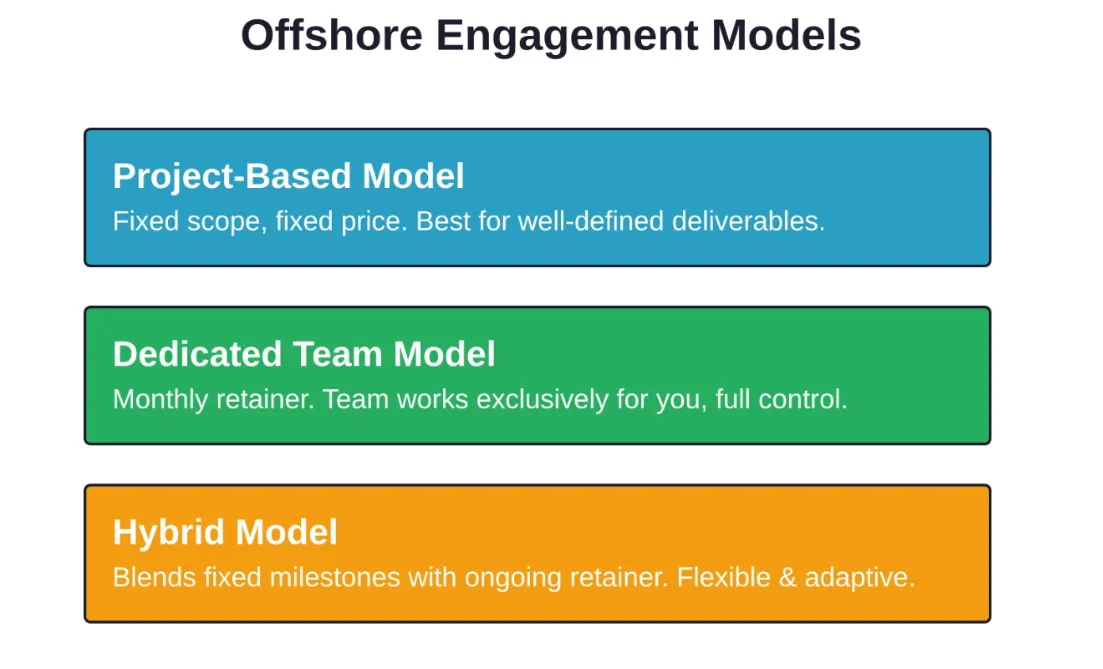
Offshore augmentation isn't one-size-fits-all. The engagement structure you choose shapes everything from pricing to oversight to risk. Three models dominate the market: project-based, dedicated team, and hybrid.
Project-Based Model
In a project-based arrangement, you define a scope of work upfront, agree on deliverables and timelines, and the offshore provider quotes a fixed price. This model works well for discrete projects with clear requirements—building a mobile app, migrating a database, or developing a set of APIs.
The advantage is predictability. You know what you'll pay and what you'll get. The risk is rigidity. If requirements change mid-project (and they often do), renegotiating scope can be messy and expensive.
Project-based engagements also place more risk on the vendor. If the team underestimates effort, they absorb the overrun. That can create misaligned incentives—vendors may cut corners to stay within budget.
Dedicated Team Model
The dedicated team model flips the script. Instead of buying a deliverable, you're hiring people. The offshore provider assembles a team—developers, QA engineers, designers—who work exclusively for you on a monthly retainer basis.
You direct their work, set priorities, and integrate them into your workflows. The team functions as an extension of your in-house staff. This model suits longer-term engagements, ongoing product development, or situations where requirements evolve frequently.
Control is the big win here. You manage day-to-day tasks and can pivot quickly without renegotiating contracts. The trade-off is that you bear more responsibility. If the team sits idle, you're still paying. If a developer underperforms, managing that falls on you.
Hybrid Model
Hybrid models blend elements of both approaches. You might have a dedicated core team on retainer, supplemented by project-based specialists for specific features or time-bound initiatives. Or you start with a fixed-price proof of concept, then transition to a dedicated team once the product gains traction.
Hybrid structures offer flexibility but require more active management to keep everyone aligned. Clear communication and well-defined handoffs between project-based and dedicated resources become critical.

Scale Operations with an Offshore Team from NeoWork
Offshore team augmentation allows companies to expand a department or operational function with remote professionals. NeoWork provides offshore teammates, with structures ranging from individual contributors to dedicated teams. NeoWork handles recruitment, benefits, training, and ongoing engagement, while teammates integrate into the client’s systems and workflows. Its 91% annualized teammate retention rate and 3.2% candidate selectivity rate reflect a focus on selective hiring and longer-term team stability.
NeoWork’s offshore team model offers:
- individual contributors or dedicated teams
- integration with the client’s tools and processes
- recruitment and ongoing teammate support
Contact NeoWork to create an offshore team that can take on recurring workflows and grow alongside your existing operations.
Key Benefits of Offshore Team Augmentation
Beyond cost and access to talent, offshore augmentation delivers several operational and strategic advantages that often fly under the radar.
Faster Time to Market
Speed matters. The faster you ship, the faster you learn, iterate, and capture market share. Offshore augmentation shortens timelines by letting you parallelize work. Your onshore team handles core architecture while an offshore squad builds out features, writes tests, or tackles technical debt.
This parallel execution model can compress development cycles by weeks or months, which is especially valuable in competitive markets where first-mover advantage counts.
Focus on Core Competencies
Not every task deserves your senior engineers' attention. Offshore augmentation lets you offload lower-leverage work—routine maintenance, bug fixes, integration tasks—freeing up your core team to focus on high-impact initiatives like product strategy, complex system design, or customer research.
Think of it as a forcing function for prioritization. When you're paying for offshore hours, you're more likely to ask whether each task truly requires your most expensive resources.
Risk Mitigation Through Diversification
Relying entirely on a local talent pool creates concentration risk. What happens if your city's tech scene heats up and half your team gets poached? Or a visa policy shift limits your access to immigrant talent?
Offshore augmentation diversifies your talent supply chain. You're less vulnerable to regional labor market shocks, and you build organizational muscle around managing distributed teams—a capability that's increasingly essential as remote work becomes the norm.
According to Nucleus Research, the right workforce management solution can reduce employee turnover by 45% and save an average of $650,000 over five years, underscoring the value of thoughtful talent strategies that span geographies.
Challenges and How to Address Them
Offshore augmentation isn't a silver bullet. The model introduces friction points that, if ignored, can erase the benefits. Here's what typically goes wrong and how to prevent it.
Communication and Time Zone Gaps
When your offshore team is eight time zones away, real-time collaboration becomes harder. Questions that would take two minutes to resolve in person can linger for a full day cycle.
The fix is to design for asynchronous work. That means:
- Detailed documentation: Write clear specs, maintain up-to-date wikis, and document decisions so offshore team members can find answers without waiting for you to wake up.
- Overlap hours: Schedule 2-3 hours of daily overlap where both teams are online. Use that window for standups, code reviews, and real-time problem-solving.
- Async-friendly tools: Leverage Loom for video walkthroughs, Slack threads for discussions, and project management tools with clear task descriptions and acceptance criteria.
Research cited on the Effective Altruism Forum shows that distributed teams rely more heavily on email (45.76% of task communication) compared to colocated teams (34%), highlighting the importance of structured written communication in remote settings.
Quality Control and Accountability
Maintaining quality standards across a distributed team requires intentional effort. Code reviews, automated testing, and CI/CD pipelines become non-negotiable. So do clear definitions of done and acceptance criteria for every task.
Regular check-ins help, too. Weekly retrospectives, sprint demos, and one-on-ones with offshore leads create visibility and accountability. If quality slips, you'll catch it early rather than discovering a mess at the end of a milestone.
Cultural and Language Differences
Cultural norms around communication, feedback, and hierarchy vary widely. In some cultures, openly disagreeing with a manager is considered disrespectful. In others, silence signals agreement, even when someone has concerns.
Bridging these gaps starts with explicit conversation. Set expectations around how your team communicates, how decisions get made, and how feedback flows. Encourage questions, and create psychological safety so offshore team members feel comfortable surfacing issues.
Language proficiency matters, too. Even when everyone speaks English, accents and idioms can cause misunderstandings. Favor written communication for critical details, and confirm understanding by asking team members to paraphrase key points back to you.
Data Security and IP Protection
Handing code or customer data to an offshore team introduces security risks. Mitigate them through contracts (strong NDAs and IP assignment clauses), technical controls (VPNs, access restrictions, audit logs), and vendor vetting (security certifications like ISO 27001 or SOC 2).
For highly sensitive projects, consider keeping critical IP onshore and offshoring only peripheral work. It's a balance between openness (which fosters collaboration) and protection (which guards your competitive advantage).
Steps to Implement Offshore Team Augmentation
Successfully launching an offshore augmentation engagement requires planning, clear criteria, and disciplined execution. Here's a step-by-step breakdown.
Step 1: Identify Your Needs and Goals
Start by defining exactly what you need. Are you filling a skill gap? Accelerating a specific project? Building long-term capacity? The answer shapes which model you choose and how you structure the engagement.
Be specific. Instead of "we need more developers," articulate "we need two React developers and one DevOps engineer to support a six-month feature buildout." Specificity makes vendor conversations more productive and ensures you get the right talent.
Step 2: Search for the Right Partner
Not all offshore providers are created equal. Vet candidates based on:
- Technical expertise: Do they have proven experience in your stack and domain?
- Communication quality: Are initial conversations clear, responsive, and professional?
- Client references: Can they connect you with past clients who had similar needs?
- Cultural fit: Do their working style and values align with yours?
- Security and compliance: Do they meet your industry's regulatory and data protection standards?
Request case studies, check online reviews, and conduct trial projects before committing to a large engagement. A two-week proof of concept can reveal misalignments that won't show up in sales pitches.
Step 3: Define Scope, Roles, and Expectations
Once you've chosen a partner, invest time in a detailed kickoff. Clarify deliverables, timelines, communication protocols, and success metrics. Document who owns what, how often you'll meet, and how you'll handle changes or escalations.
For dedicated teams, define roles explicitly. Who's the offshore team lead? Who's the onshore point of contact? How do tasks get assigned? Clear structure prevents confusion and duplication.
Step 4: Onboard and Integrate
Treat offshore team members like new hires. Provide access to repos, tools, and documentation. Walk them through your codebase, architecture, and workflows. Schedule intro calls with key stakeholders.
Good onboarding accelerates ramp-up and builds rapport. Offshore developers who understand your product and business context produce better work faster.
Step 5: Establish Communication Cadence
Set up recurring meetings: daily standups (during overlap hours), weekly sprint planning, and monthly retrospectives. Use video calls to build personal connections—faces and voices matter for trust.
Between meetings, default to async communication. Write detailed tickets, record video updates, and keep documentation current. Research found that 80% of remote Scrum team respondents communicated daily with their teams, proving that consistent cadence works when structured intentionally.
Step 6: Monitor, Iterate, and Optimize
Track progress against milestones and solicit feedback from both your onshore and offshore teams. What's working? What's not? Where are bottlenecks forming?
Use retrospectives to surface issues early and adjust processes accordingly. Maybe you need more overlap hours, or clearer acceptance criteria, or better tooling. Continuous improvement is the name of the game.
According to MIT Sloan Management Review research, effective offshore IT work relies on proven practices that emphasize learning, adaptation, and process discipline—capabilities that grow stronger with each iteration.
Choosing the Right Offshore Engagement Model
Selecting between project-based, dedicated team, and hybrid models hinges on a few key factors.
If your project has a fixed scope and timeline—say, building a mobile app with a well-defined feature set—project-based works well. You'll pay a known amount and receive a deliverable.
If you're building a SaaS product with continuous iteration, a dedicated team makes more sense. You retain control, can shift priorities sprint-to-sprint, and build long-term relationships with offshore developers who understand your product deeply.
Hybrid models suit organizations with mixed needs: a stable core team handling ongoing work, supplemented by specialists brought in for short bursts. This approach demands more coordination but offers maximum flexibility.
Real-World Use Cases for Offshore Team Augmentation
Offshore augmentation applies across industries and company stages. Here are a few scenarios where it shines.
Startup MVP Development
An early-stage startup needs to build a proof of concept quickly and cheaply to show investors. Hiring a full local team isn't feasible on a seed budget. The founders engage an offshore development shop on a project basis to build the MVP in three months, saving 60% compared to domestic rates. The product ships, they raise a Series A, and transition to a hybrid model—keeping the offshore team for feature development while hiring local product managers and designers.
Enterprise Digital Transformation
A Fortune 500 company decides to modernize its legacy systems. The internal IT team lacks cloud-native expertise and bandwidth. They partner with an offshore provider to supply a dedicated team of cloud architects and DevOps engineers. Over 18 months, the offshore team migrates workloads to AWS, implements CI/CD pipelines, and trains internal staff. The company gains critical capabilities without the multi-year hiring spree that would otherwise be required.
Agency Scaling for Client Demand
A digital agency wins a large client contract requiring double its usual development capacity. Rather than turning down the work or scrambling to hire locally, the agency taps an offshore partner for additional developers. The offshore team integrates seamlessly with the agency's workflows, delivers on time, and scales back down when the contract ends. The agency retains its lean core team while meeting client needs flexibly.
Offshore Team Augmentation and AI-Driven Workforce Trends
The rise of AI and automation is reshaping work in ways that amplify the value of offshore augmentation. SHRM data from 2024 reveals that 15.1% of U.S. jobs are at least 50% automated, and 7.8% rely heavily on generative AI. Among organizations using AI, nearly 30% have proactively trained employees to work alongside these tools.
Offshore teams often adopt new technologies faster than domestic teams, partly because competitive pressure in global markets pushes providers to differentiate on capability. That means offshore augmentation can become a vector for upskilling—your offshore partners bring AI, automation, and emerging tech expertise that your core team learns from and adopts.
At the same time, SHRM research indicates that HR professionals value human intelligence in an AI-augmented workplace. Offshore augmentation supports that shift by freeing up senior staff to focus on strategic, creative, and interpersonal work—areas where human judgment remains irreplaceable—while offshore teams handle execution-heavy or process-driven tasks.
The result is a workforce model that blends human expertise, AI-driven efficiency, and global talent access—a combination that's likely to define competitive advantage in the years ahead.
Best Practices for Managing Offshore Teams
Managing offshore teams well requires intentional habits and structures. Here are practices that consistently deliver results.
Invest in Relationship Building
Remote work makes it easy to treat offshore team members as interchangeable resources. Resist that. Learn their names, understand their career goals, celebrate wins, and provide constructive feedback. Strong relationships foster trust, which reduces friction and improves collaboration.
A 2024 Harvard Business School study found that U.S. tech workers were willing to forgo up to 25% of their salary for remote work flexibility, underscoring how much people value autonomy and flexibility. Offshore team members are no different—respect their time, give them meaningful work, and they'll deliver.
Establish Clear Metrics and Accountability
Define success metrics upfront. Is it velocity? Defect rate? Feature delivery? Cycle time? Whatever it is, measure it consistently and review it regularly. Transparency around performance builds accountability and helps everyone understand what good looks like.
Embrace Asynchronous Workflows
Real-time collaboration is nice but not always necessary. Design workflows that let people make progress independently. Write comprehensive tickets, record video demos, maintain living documentation, and use async standup tools like Geekbot or Slack's status updates.
Async work also respects time zones and life balance. Not every conversation needs to happen at 6 a.m. for one party and 10 p.m. for the other.
Rotate Onsite Visits When Possible
If budget allows, bring offshore team members onsite periodically—or travel to their location. Face-to-face time accelerates trust and understanding in ways video calls can't replicate. Even a single week together per quarter can dramatically improve collaboration.
Coinbase and Dropbox have both experimented with periodic in-person working sessions for distributed teams. Dropbox reported that 99% of participants felt these sessions delivered positive business outcomes, and 71% reported stronger team connections, according to the research.
Provide Growth Opportunities
Offshore developers want to grow their skills and careers just like onshore staff. Offer training, mentorship, and opportunities to work on challenging problems. When offshore team members feel invested in, turnover drops and quality rises.
SHRM research emphasizes that upskilling fortifies organizational resilience and propels operations forward. That principle applies equally to offshore and onshore teams.
Common Mistakes to Avoid
Even experienced teams stumble when launching offshore augmentation. Here are pitfalls to watch for.
Choosing Based Solely on Price
The cheapest provider is rarely the best. Low rates often correlate with inexperienced developers, poor communication, or inadequate processes. A slightly more expensive partner who delivers quality work on time will save you money (and headaches) in the long run.
Skipping the Trial Phase
Don't commit to a multi-year contract without testing the waters. Start with a small pilot project—a two-to-four-week engagement—to evaluate communication, technical skills, and cultural fit. If it goes well, scale up. If not, you've limited your exposure.
Under-Investing in Communication
Treating offshore teams as a black box ("just deliver this by Friday") leads to misunderstandings, rework, and frustration. Invest time in standups, check-ins, and documentation. The upfront cost pays dividends in quality and velocity.
Ignoring Cultural Nuances
Assuming everyone works the same way is a recipe for conflict. Take time to understand cultural norms around hierarchy, feedback, and conflict resolution. Adapt your management style accordingly.
Failing to Integrate Offshore Teams into Company Culture
Offshore developers who feel like outsiders produce outsider-quality work. Invite them to company meetings, include them in Slack social channels, and recognize their contributions publicly. Inclusion drives engagement, and engagement drives performance.
Future of Offshore Team Augmentation
Offshore augmentation is evolving rapidly, driven by technology, shifting work norms, and global talent mobility.
AI-Powered Talent Matching
Platforms are emerging that use AI to match companies with offshore developers based on technical skills, communication style, and cultural fit. These tools analyze code portfolios, interview transcripts, and past project outcomes to surface candidates who align with specific needs. Expect talent sourcing to become faster and more precise as these systems mature.
Increased Focus on Nearshore
As companies prioritize time zone alignment and real-time collaboration, nearshore markets in Latin America and Eastern Europe are gaining traction. Nearshore offers many of the cost benefits of offshore with fewer coordination headaches, making it an attractive middle path.
Hybrid and Distributed-First Models Becoming Standard
The lines between offshore, nearshore, and onshore are blurring. Many companies now operate as distributed-first organizations, where location is secondary to talent and contribution. Offshore augmentation is less an exception and more a default strategy for accessing global expertise.
According to peoinsider.org, distributed work is not a location policy but a philosophy of talent access and operational design. Organizations that embrace this mindset gain competitive advantage in a world where top talent can work from anywhere.
Frequently Asked Questions
Topics
Offshore Team Augmentation Guide: Models & Best Practices

Quick Summary: Offshore team augmentation lets businesses fill skill gaps and scale quickly by hiring remote professionals from other countries—without the overhead of permanent staff. Cost savings of 50-70% are typical, and teams gain access to global talent pools with specialized expertise. The model works best when you match clear project needs with the right engagement structure and invest upfront in communication processes.
Access to specialized talent can make the difference between a project that ships on time and one that stalls for months. As demand for niche expertise grows—whether it's machine learning engineers, cloud architects, or blockchain developers—many teams hit a wall when local hiring falls short.
That's where offshore team augmentation enters the picture. Instead of posting another job requisition and waiting six months to fill it, companies tap into global talent pools. They hire the skills they need, when they need them, often at 50-70% lower cost than domestic equivalents.
But cost isn't the full story. The real value lies in speed and flexibility. Offshore augmentation lets you scale a team up for a product sprint, bring in specialists for a three-month migration, or backfill critical gaps without the long-term commitment of traditional hiring.
This guide walks through how offshore team augmentation actually works, the engagement models you'll encounter, the benefits and pitfalls, and the practical steps to make it work for your organization.
What Is Offshore Team Augmentation?
Offshore team augmentation is a staffing strategy where a company hires skilled professionals from another country to temporarily expand its existing team. These remote workers integrate directly into your workflows, collaborate with your in-house staff, and work under your direction.
Unlike traditional outsourcing—where you hand off an entire project to a third party—augmentation means you stay in control. The offshore professionals report to your managers, use your tools, and follow your processes. Think of them as an extension of your core team, not a separate vendor.
The model gained traction as remote work surged. According to research, remote work grew by 173% since 2005, with approximately 42% of the U.S. workforce working remotely at least part of the time by 2022. That shift normalized distributed collaboration and made offshore augmentation a practical option for companies of all sizes.
Key Characteristics of Offshore Augmentation
Several features distinguish this model from other staffing approaches:
- Direct integration: Offshore team members join your standups, use your Slack channels, and commit to your repos. They're part of the team, not a black box.
- Retained control: You manage priorities, assign tasks, and oversee quality. The engagement is collaborative, not transactional.
- Flexible duration: Contracts can run for weeks, months, or years. You scale up when demand spikes and scale down when projects wrap.
- Cost efficiency: Software engineers in regions like Eastern Europe, Latin America, and South Asia typically cost 50-70% less than U.S. equivalents, making offshore augmentation an attractive option for budget-conscious teams.
Offshore vs. Nearshore vs. Onshore Augmentation
Not all remote augmentation looks the same. The terms offshore, nearshore, and onshore describe where your augmented staff are located relative to your headquarters.
Onshore Augmentation
Onshore means hiring within your own country. Time zones align perfectly, cultural norms match, and communication happens in real time. The trade-off? Cost. Domestic contractors command rates comparable to full-time employees, which limits the financial upside.
Nearshore Augmentation
Nearshore refers to hiring from a neighboring or nearby region—say, a U.S. company working with developers in Mexico or Colombia. Time zone differences are minimal (usually 1-3 hours), travel is feasible, and cultural overlap tends to be higher than with distant regions.
Nearshore strikes a middle ground: costs run lower than onshore but higher than offshore, and coordination is easier than with teams halfway around the globe.
Offshore Augmentation
Offshore typically means working with talent in a region with significant time zone separation—Eastern Europe, Asia, or Africa for a U.S.-based company. Cost savings hit their peak here, often 50-70% below domestic rates. The challenge lies in managing asynchronous work and bridging cultural or language gaps.
Many teams find that well-structured offshore engagements deliver strong value. Research found that 80% of remote Scrum team respondents communicated daily with their teams, while 20% communicated weekly, suggesting that distributed collaboration—when done right—can maintain high engagement even across time zones.
Why Companies Choose Offshore Team Augmentation
The appeal of offshore augmentation boils down to three core benefits: cost efficiency, access to specialized skills, and the ability to scale quickly.
Cost Efficiency and Predictable Spend
The primary driver is economics. Software engineers in India or Eastern Europe cost 50-70% less than U.S. equivalents. For a company facing tight budgets or investor pressure to extend runway, that delta can mean the difference between shipping a product and running out of cash.
And it's not just salaries. Offshore augmentation eliminates many of the overhead costs tied to full-time hires—no benefits, no payroll taxes, no office space. You pay for the hours or deliverables you need, and that's it.
That said, cheap doesn't always mean valuable. If offshore deliverables require significant rework, the savings evaporate. The best offshore engagements invest upfront in clear processes and communication structures to avoid that trap.
Access to Specialized Talent
The global talent market is vast. Need a developer with experience in a niche framework? Struggling to find a data engineer who knows your industry's compliance requirements? Offshore augmentation opens doors to specialists who might not exist—or might not be available—in your local market.
This is particularly relevant as automation and AI reshape skill demands. According to SHRM data, 15.1% of U.S. jobs are at least 50% automated, while 7.8% rely heavily on generative AI. The skills required to build, deploy, and maintain these systems are in short supply domestically, making offshore markets a natural hunting ground for emerging expertise.
Speed and Scalability
Traditional hiring takes time—often months from job posting to signed offer. Offshore augmentation compresses that timeline. Many providers can onboard skilled professionals in weeks, sometimes days.
That speed translates into agility. When a new project lands, you can spin up a team without waiting for a lengthy recruiting cycle. When the project wraps, you scale down without the friction (and potential legal exposure) of layoffs.
For startups and fast-moving product teams, that flexibility is invaluable. You're not locked into headcount decisions that might look wrong six months later.
Common Offshore Team Augmentation Models
Offshore augmentation isn't one-size-fits-all. The engagement structure you choose shapes everything from pricing to oversight to risk. Three models dominate the market: project-based, dedicated team, and hybrid.
Project-Based Model
In a project-based arrangement, you define a scope of work upfront, agree on deliverables and timelines, and the offshore provider quotes a fixed price. This model works well for discrete projects with clear requirements—building a mobile app, migrating a database, or developing a set of APIs.
The advantage is predictability. You know what you'll pay and what you'll get. The risk is rigidity. If requirements change mid-project (and they often do), renegotiating scope can be messy and expensive.
Project-based engagements also place more risk on the vendor. If the team underestimates effort, they absorb the overrun. That can create misaligned incentives—vendors may cut corners to stay within budget.
Dedicated Team Model
The dedicated team model flips the script. Instead of buying a deliverable, you're hiring people. The offshore provider assembles a team—developers, QA engineers, designers—who work exclusively for you on a monthly retainer basis.
You direct their work, set priorities, and integrate them into your workflows. The team functions as an extension of your in-house staff. This model suits longer-term engagements, ongoing product development, or situations where requirements evolve frequently.
Control is the big win here. You manage day-to-day tasks and can pivot quickly without renegotiating contracts. The trade-off is that you bear more responsibility. If the team sits idle, you're still paying. If a developer underperforms, managing that falls on you.
Hybrid Model
Hybrid models blend elements of both approaches. You might have a dedicated core team on retainer, supplemented by project-based specialists for specific features or time-bound initiatives. Or you start with a fixed-price proof of concept, then transition to a dedicated team once the product gains traction.
Hybrid structures offer flexibility but require more active management to keep everyone aligned. Clear communication and well-defined handoffs between project-based and dedicated resources become critical.
Scale Operations with an Offshore Team from NeoWork
Offshore team augmentation allows companies to expand a department or operational function with remote professionals. NeoWork provides offshore teammates, with structures ranging from individual contributors to dedicated teams. NeoWork handles recruitment, benefits, training, and ongoing engagement, while teammates integrate into the client’s systems and workflows. Its 91% annualized teammate retention rate and 3.2% candidate selectivity rate reflect a focus on selective hiring and longer-term team stability.
NeoWork’s offshore team model offers:
- individual contributors or dedicated teams
- integration with the client’s tools and processes
- recruitment and ongoing teammate support
Contact NeoWork to create an offshore team that can take on recurring workflows and grow alongside your existing operations.
Key Benefits of Offshore Team Augmentation
Beyond cost and access to talent, offshore augmentation delivers several operational and strategic advantages that often fly under the radar.
Faster Time to Market
Speed matters. The faster you ship, the faster you learn, iterate, and capture market share. Offshore augmentation shortens timelines by letting you parallelize work. Your onshore team handles core architecture while an offshore squad builds out features, writes tests, or tackles technical debt.
This parallel execution model can compress development cycles by weeks or months, which is especially valuable in competitive markets where first-mover advantage counts.
Focus on Core Competencies
Not every task deserves your senior engineers' attention. Offshore augmentation lets you offload lower-leverage work—routine maintenance, bug fixes, integration tasks—freeing up your core team to focus on high-impact initiatives like product strategy, complex system design, or customer research.
Think of it as a forcing function for prioritization. When you're paying for offshore hours, you're more likely to ask whether each task truly requires your most expensive resources.
Risk Mitigation Through Diversification
Relying entirely on a local talent pool creates concentration risk. What happens if your city's tech scene heats up and half your team gets poached? Or a visa policy shift limits your access to immigrant talent?
Offshore augmentation diversifies your talent supply chain. You're less vulnerable to regional labor market shocks, and you build organizational muscle around managing distributed teams—a capability that's increasingly essential as remote work becomes the norm.
According to Nucleus Research, the right workforce management solution can reduce employee turnover by 45% and save an average of $650,000 over five years, underscoring the value of thoughtful talent strategies that span geographies.
Challenges and How to Address Them
Offshore augmentation isn't a silver bullet. The model introduces friction points that, if ignored, can erase the benefits. Here's what typically goes wrong and how to prevent it.
Communication and Time Zone Gaps
When your offshore team is eight time zones away, real-time collaboration becomes harder. Questions that would take two minutes to resolve in person can linger for a full day cycle.
The fix is to design for asynchronous work. That means:
- Detailed documentation: Write clear specs, maintain up-to-date wikis, and document decisions so offshore team members can find answers without waiting for you to wake up.
- Overlap hours: Schedule 2-3 hours of daily overlap where both teams are online. Use that window for standups, code reviews, and real-time problem-solving.
- Async-friendly tools: Leverage Loom for video walkthroughs, Slack threads for discussions, and project management tools with clear task descriptions and acceptance criteria.
Research cited on the Effective Altruism Forum shows that distributed teams rely more heavily on email (45.76% of task communication) compared to colocated teams (34%), highlighting the importance of structured written communication in remote settings.
Quality Control and Accountability
Maintaining quality standards across a distributed team requires intentional effort. Code reviews, automated testing, and CI/CD pipelines become non-negotiable. So do clear definitions of done and acceptance criteria for every task.
Regular check-ins help, too. Weekly retrospectives, sprint demos, and one-on-ones with offshore leads create visibility and accountability. If quality slips, you'll catch it early rather than discovering a mess at the end of a milestone.
Cultural and Language Differences
Cultural norms around communication, feedback, and hierarchy vary widely. In some cultures, openly disagreeing with a manager is considered disrespectful. In others, silence signals agreement, even when someone has concerns.
Bridging these gaps starts with explicit conversation. Set expectations around how your team communicates, how decisions get made, and how feedback flows. Encourage questions, and create psychological safety so offshore team members feel comfortable surfacing issues.
Language proficiency matters, too. Even when everyone speaks English, accents and idioms can cause misunderstandings. Favor written communication for critical details, and confirm understanding by asking team members to paraphrase key points back to you.
Data Security and IP Protection
Handing code or customer data to an offshore team introduces security risks. Mitigate them through contracts (strong NDAs and IP assignment clauses), technical controls (VPNs, access restrictions, audit logs), and vendor vetting (security certifications like ISO 27001 or SOC 2).
For highly sensitive projects, consider keeping critical IP onshore and offshoring only peripheral work. It's a balance between openness (which fosters collaboration) and protection (which guards your competitive advantage).
Steps to Implement Offshore Team Augmentation
Successfully launching an offshore augmentation engagement requires planning, clear criteria, and disciplined execution. Here's a step-by-step breakdown.
Step 1: Identify Your Needs and Goals
Start by defining exactly what you need. Are you filling a skill gap? Accelerating a specific project? Building long-term capacity? The answer shapes which model you choose and how you structure the engagement.
Be specific. Instead of "we need more developers," articulate "we need two React developers and one DevOps engineer to support a six-month feature buildout." Specificity makes vendor conversations more productive and ensures you get the right talent.
Step 2: Search for the Right Partner
Not all offshore providers are created equal. Vet candidates based on:
- Technical expertise: Do they have proven experience in your stack and domain?
- Communication quality: Are initial conversations clear, responsive, and professional?
- Client references: Can they connect you with past clients who had similar needs?
- Cultural fit: Do their working style and values align with yours?
- Security and compliance: Do they meet your industry's regulatory and data protection standards?
Request case studies, check online reviews, and conduct trial projects before committing to a large engagement. A two-week proof of concept can reveal misalignments that won't show up in sales pitches.
Step 3: Define Scope, Roles, and Expectations
Once you've chosen a partner, invest time in a detailed kickoff. Clarify deliverables, timelines, communication protocols, and success metrics. Document who owns what, how often you'll meet, and how you'll handle changes or escalations.
For dedicated teams, define roles explicitly. Who's the offshore team lead? Who's the onshore point of contact? How do tasks get assigned? Clear structure prevents confusion and duplication.
Step 4: Onboard and Integrate
Treat offshore team members like new hires. Provide access to repos, tools, and documentation. Walk them through your codebase, architecture, and workflows. Schedule intro calls with key stakeholders.
Good onboarding accelerates ramp-up and builds rapport. Offshore developers who understand your product and business context produce better work faster.
Step 5: Establish Communication Cadence
Set up recurring meetings: daily standups (during overlap hours), weekly sprint planning, and monthly retrospectives. Use video calls to build personal connections—faces and voices matter for trust.
Between meetings, default to async communication. Write detailed tickets, record video updates, and keep documentation current. Research found that 80% of remote Scrum team respondents communicated daily with their teams, proving that consistent cadence works when structured intentionally.
Step 6: Monitor, Iterate, and Optimize
Track progress against milestones and solicit feedback from both your onshore and offshore teams. What's working? What's not? Where are bottlenecks forming?
Use retrospectives to surface issues early and adjust processes accordingly. Maybe you need more overlap hours, or clearer acceptance criteria, or better tooling. Continuous improvement is the name of the game.
According to MIT Sloan Management Review research, effective offshore IT work relies on proven practices that emphasize learning, adaptation, and process discipline—capabilities that grow stronger with each iteration.
Choosing the Right Offshore Engagement Model
Selecting between project-based, dedicated team, and hybrid models hinges on a few key factors.
If your project has a fixed scope and timeline—say, building a mobile app with a well-defined feature set—project-based works well. You'll pay a known amount and receive a deliverable.
If you're building a SaaS product with continuous iteration, a dedicated team makes more sense. You retain control, can shift priorities sprint-to-sprint, and build long-term relationships with offshore developers who understand your product deeply.
Hybrid models suit organizations with mixed needs: a stable core team handling ongoing work, supplemented by specialists brought in for short bursts. This approach demands more coordination but offers maximum flexibility.
Real-World Use Cases for Offshore Team Augmentation
Offshore augmentation applies across industries and company stages. Here are a few scenarios where it shines.
Startup MVP Development
An early-stage startup needs to build a proof of concept quickly and cheaply to show investors. Hiring a full local team isn't feasible on a seed budget. The founders engage an offshore development shop on a project basis to build the MVP in three months, saving 60% compared to domestic rates. The product ships, they raise a Series A, and transition to a hybrid model—keeping the offshore team for feature development while hiring local product managers and designers.
Enterprise Digital Transformation
A Fortune 500 company decides to modernize its legacy systems. The internal IT team lacks cloud-native expertise and bandwidth. They partner with an offshore provider to supply a dedicated team of cloud architects and DevOps engineers. Over 18 months, the offshore team migrates workloads to AWS, implements CI/CD pipelines, and trains internal staff. The company gains critical capabilities without the multi-year hiring spree that would otherwise be required.
Agency Scaling for Client Demand
A digital agency wins a large client contract requiring double its usual development capacity. Rather than turning down the work or scrambling to hire locally, the agency taps an offshore partner for additional developers. The offshore team integrates seamlessly with the agency's workflows, delivers on time, and scales back down when the contract ends. The agency retains its lean core team while meeting client needs flexibly.
Offshore Team Augmentation and AI-Driven Workforce Trends
The rise of AI and automation is reshaping work in ways that amplify the value of offshore augmentation. SHRM data from 2024 reveals that 15.1% of U.S. jobs are at least 50% automated, and 7.8% rely heavily on generative AI. Among organizations using AI, nearly 30% have proactively trained employees to work alongside these tools.
Offshore teams often adopt new technologies faster than domestic teams, partly because competitive pressure in global markets pushes providers to differentiate on capability. That means offshore augmentation can become a vector for upskilling—your offshore partners bring AI, automation, and emerging tech expertise that your core team learns from and adopts.
At the same time, SHRM research indicates that HR professionals value human intelligence in an AI-augmented workplace. Offshore augmentation supports that shift by freeing up senior staff to focus on strategic, creative, and interpersonal work—areas where human judgment remains irreplaceable—while offshore teams handle execution-heavy or process-driven tasks.
The result is a workforce model that blends human expertise, AI-driven efficiency, and global talent access—a combination that's likely to define competitive advantage in the years ahead.
Best Practices for Managing Offshore Teams
Managing offshore teams well requires intentional habits and structures. Here are practices that consistently deliver results.
Invest in Relationship Building
Remote work makes it easy to treat offshore team members as interchangeable resources. Resist that. Learn their names, understand their career goals, celebrate wins, and provide constructive feedback. Strong relationships foster trust, which reduces friction and improves collaboration.
A 2024 Harvard Business School study found that U.S. tech workers were willing to forgo up to 25% of their salary for remote work flexibility, underscoring how much people value autonomy and flexibility. Offshore team members are no different—respect their time, give them meaningful work, and they'll deliver.
Establish Clear Metrics and Accountability
Define success metrics upfront. Is it velocity? Defect rate? Feature delivery? Cycle time? Whatever it is, measure it consistently and review it regularly. Transparency around performance builds accountability and helps everyone understand what good looks like.
Embrace Asynchronous Workflows
Real-time collaboration is nice but not always necessary. Design workflows that let people make progress independently. Write comprehensive tickets, record video demos, maintain living documentation, and use async standup tools like Geekbot or Slack's status updates.
Async work also respects time zones and life balance. Not every conversation needs to happen at 6 a.m. for one party and 10 p.m. for the other.
Rotate Onsite Visits When Possible
If budget allows, bring offshore team members onsite periodically—or travel to their location. Face-to-face time accelerates trust and understanding in ways video calls can't replicate. Even a single week together per quarter can dramatically improve collaboration.
Coinbase and Dropbox have both experimented with periodic in-person working sessions for distributed teams. Dropbox reported that 99% of participants felt these sessions delivered positive business outcomes, and 71% reported stronger team connections, according to the research.
Provide Growth Opportunities
Offshore developers want to grow their skills and careers just like onshore staff. Offer training, mentorship, and opportunities to work on challenging problems. When offshore team members feel invested in, turnover drops and quality rises.
SHRM research emphasizes that upskilling fortifies organizational resilience and propels operations forward. That principle applies equally to offshore and onshore teams.
Common Mistakes to Avoid
Even experienced teams stumble when launching offshore augmentation. Here are pitfalls to watch for.
Choosing Based Solely on Price
The cheapest provider is rarely the best. Low rates often correlate with inexperienced developers, poor communication, or inadequate processes. A slightly more expensive partner who delivers quality work on time will save you money (and headaches) in the long run.
Skipping the Trial Phase
Don't commit to a multi-year contract without testing the waters. Start with a small pilot project—a two-to-four-week engagement—to evaluate communication, technical skills, and cultural fit. If it goes well, scale up. If not, you've limited your exposure.
Under-Investing in Communication
Treating offshore teams as a black box ("just deliver this by Friday") leads to misunderstandings, rework, and frustration. Invest time in standups, check-ins, and documentation. The upfront cost pays dividends in quality and velocity.
Ignoring Cultural Nuances
Assuming everyone works the same way is a recipe for conflict. Take time to understand cultural norms around hierarchy, feedback, and conflict resolution. Adapt your management style accordingly.
Failing to Integrate Offshore Teams into Company Culture
Offshore developers who feel like outsiders produce outsider-quality work. Invite them to company meetings, include them in Slack social channels, and recognize their contributions publicly. Inclusion drives engagement, and engagement drives performance.
Future of Offshore Team Augmentation
Offshore augmentation is evolving rapidly, driven by technology, shifting work norms, and global talent mobility.
AI-Powered Talent Matching
Platforms are emerging that use AI to match companies with offshore developers based on technical skills, communication style, and cultural fit. These tools analyze code portfolios, interview transcripts, and past project outcomes to surface candidates who align with specific needs. Expect talent sourcing to become faster and more precise as these systems mature.
Increased Focus on Nearshore
As companies prioritize time zone alignment and real-time collaboration, nearshore markets in Latin America and Eastern Europe are gaining traction. Nearshore offers many of the cost benefits of offshore with fewer coordination headaches, making it an attractive middle path.
Hybrid and Distributed-First Models Becoming Standard
The lines between offshore, nearshore, and onshore are blurring. Many companies now operate as distributed-first organizations, where location is secondary to talent and contribution. Offshore augmentation is less an exception and more a default strategy for accessing global expertise.
According to peoinsider.org, distributed work is not a location policy but a philosophy of talent access and operational design. Organizations that embrace this mindset gain competitive advantage in a world where top talent can work from anywhere.
Frequently Asked Questions
Topics
Related Blogs
Related Podcasts


.webp)

.webp)
.webp)



