

.avif)
.avif)

Online Marketing Outsourcing Guide 2026


.svg)

Quick Summary: Online marketing outsourcing connects businesses with external specialists to handle SEO, content creation, paid advertising, and other digital marketing functions. Companies typically outsource to access specialized expertise, reduce overhead costs, and scale campaigns faster than in-house teams allow. Success hinges on clear goals, transparent communication, and choosing partners whose skills align with measurable business outcomes.
Hiring a full-time in-house marketer costs an average of $101,000 a year. But here's the kicker: 37% of marketers admit they lack the skills to deliver results.
Outsourcing changes the game. Businesses get access to specialized talent, paid only by the hour or project, focused on delivering results rather than draining payroll budgets.
And the market reflects this shift. Industry analysis predicts that global retail e-commerce sales are expected to exceed $8 trillion by 2026. More businesses are competing for the same digital attention, which means marketing complexity keeps rising.
This guide walks through what online marketing outsourcing actually covers, when it makes sense, which services to delegate, how to choose the right partner, and how to avoid the most common pitfalls.
What Online Marketing Outsourcing Actually Includes
Online marketing outsourcing means hiring external agencies, freelancers, or specialized firms to handle specific marketing functions that would otherwise require in-house staff.
It's not about handing over the entire marketing department. Most businesses keep strategic oversight internal while delegating execution to experts who live and breathe specific channels.
Core Services Businesses Outsource
Search engine optimization remains one of the most commonly outsourced functions. SEO requires technical expertise, ongoing algorithm monitoring, and content production at scale—capabilities that stretch thin in-house teams.
Paid advertising management comes next. Running campaigns across Google Ads, Facebook, LinkedIn, and emerging platforms demands platform-specific knowledge, budget optimization skills, and constant A/B testing. Agencies that specialize in paid ads often deliver better ROI than generalist marketers.
Content creation and management represent another major category. This includes blog posts, video scripts, email newsletters, social media content, whitepapers, and case studies. Consistent content production at the volume modern marketing demands often exceeds what small teams can handle.
Social media management gets outsourced when businesses need daily posting, community engagement, influencer partnerships, and performance tracking across multiple platforms.
Marketing analytics and reporting also appear on outsourcing lists. Setting up proper tracking, building dashboards, interpreting data, and making optimization recommendations require analytical skills many teams lack.
Lead generation and qualification increasingly move to specialized partners. According to Forrester research, companies under $50M are 124% less likely to add lead qualification specialists than larger companies. By reallocating internal sales development representative roles to an outsourcing partner, one composite organization saved $16.2 million over three years from reduced salary and overhead costs.
Specialized Functions and Emerging Services
Beyond core services, businesses outsource conversion rate optimization, marketing automation setup, webinar production, podcast editing, graphic design, and video editing.
Generative AI integration has become a new outsourcing category. According to Forrester data from 2024, 61% of agencies use generative AI in marketing efforts, compared to only 17% of in-house agencies. External partners often bring more mature AI workflows and tools.
Email marketing campaigns, affiliate program management, and influencer outreach also frequently appear in outsourcing contracts.
When Outsourcing Makes Strategic Sense
Not every business should outsource everything. The decision depends on current capabilities, growth stage, budget constraints, and strategic priorities.
Budget Constraints and Cost Structures
Outsourcing typically delivers cost advantages when businesses need specialized skills but can't justify full-time salaries plus benefits, training, and overhead.
Most affordable outsourcing options show hourly rates ranging from $20–$100+, depending on geography and specialization. Moderate pricing for monthly retainers typically starts around a few thousand dollars, scaling with scope.
The math changes at different revenue stages. According to Forrester research from 2016, companies under $50M are 124% less likely to add lead qualification specialists than larger companies in the $51-250M range.
Real talk: if the business needs three months of intensive Facebook ad testing but won't need that capability again for six months, outsourcing beats hiring.
Skill Gaps and Expertise Access
Marketing channels evolve faster than most teams can retrain. SEO algorithm updates, new ad platform features, emerging social networks, and changing consumer behavior create constant skill gaps.
Agencies and specialists invest in ongoing education, certifications, and tool access because it's their core business. In-house teams struggle to maintain cutting-edge expertise across multiple channels while executing daily campaigns.
Specialized expertise particularly matters in technical SEO, programmatic advertising, advanced marketing automation, and data science applications like predictive modeling and customer lifetime value optimization.
Scaling Needs and Flexibility
Seasonal businesses, product launches, and growth spurts create temporary capacity needs that don't justify permanent headcount.
Outsourcing provides flexibility to scale up for Q4 holiday campaigns, scale down during slow periods, or pivot quickly when strategies change. This adaptability proves crucial in rapidly-evolving markets.
Businesses preparing for major initiatives—rebrands, new market entries, product launches—often lack the internal bandwidth to execute while maintaining business-as-usual marketing.
_converted.webp)
Which Marketing Services Make the Most Sense to Outsource
Some marketing functions outsource more successfully than others. The pattern depends on how much proprietary knowledge the work requires and how easily performance can be measured.
High-Value Outsourcing Candidates
SEO ranks among the top candidates because it combines technical complexity with measurable outcomes. Tracking keyword rankings, organic traffic, and conversion rates provides clear accountability.
Paid advertising follows close behind. Campaign performance metrics—cost per click, conversion rate, return on ad spend—make it straightforward to evaluate partner performance. Platform expertise and optimization experience deliver measurable ROI improvements.
Content production at scale works well when businesses provide detailed briefs, brand guidelines, and editorial oversight. Blog posts, social media content, email copy, and video scripts benefit from external creative talent and production capacity.
Marketing automation implementation and management suit outsourcing because platforms like HubSpot, Marketo, and Pardot require specialized technical knowledge that most businesses use intermittently.
Functions That Need Careful Consideration
Brand strategy and positioning typically stay in-house. Core brand identity, messaging architecture, and strategic positioning require deep business understanding that external partners struggle to replicate.
Customer research and voice-of-customer programs work best with hybrid models—external partners can execute research methodology, but internal teams need deep involvement in interpretation and application.
Community management and customer support require product knowledge and brand voice consistency that take time for external teams to develop. Some businesses successfully outsource these functions, but it demands significant training investment and ongoing oversight.
Product marketing often stays internal because it requires intimate product knowledge, cross-functional coordination with product and engineering teams, and rapid response to product changes.
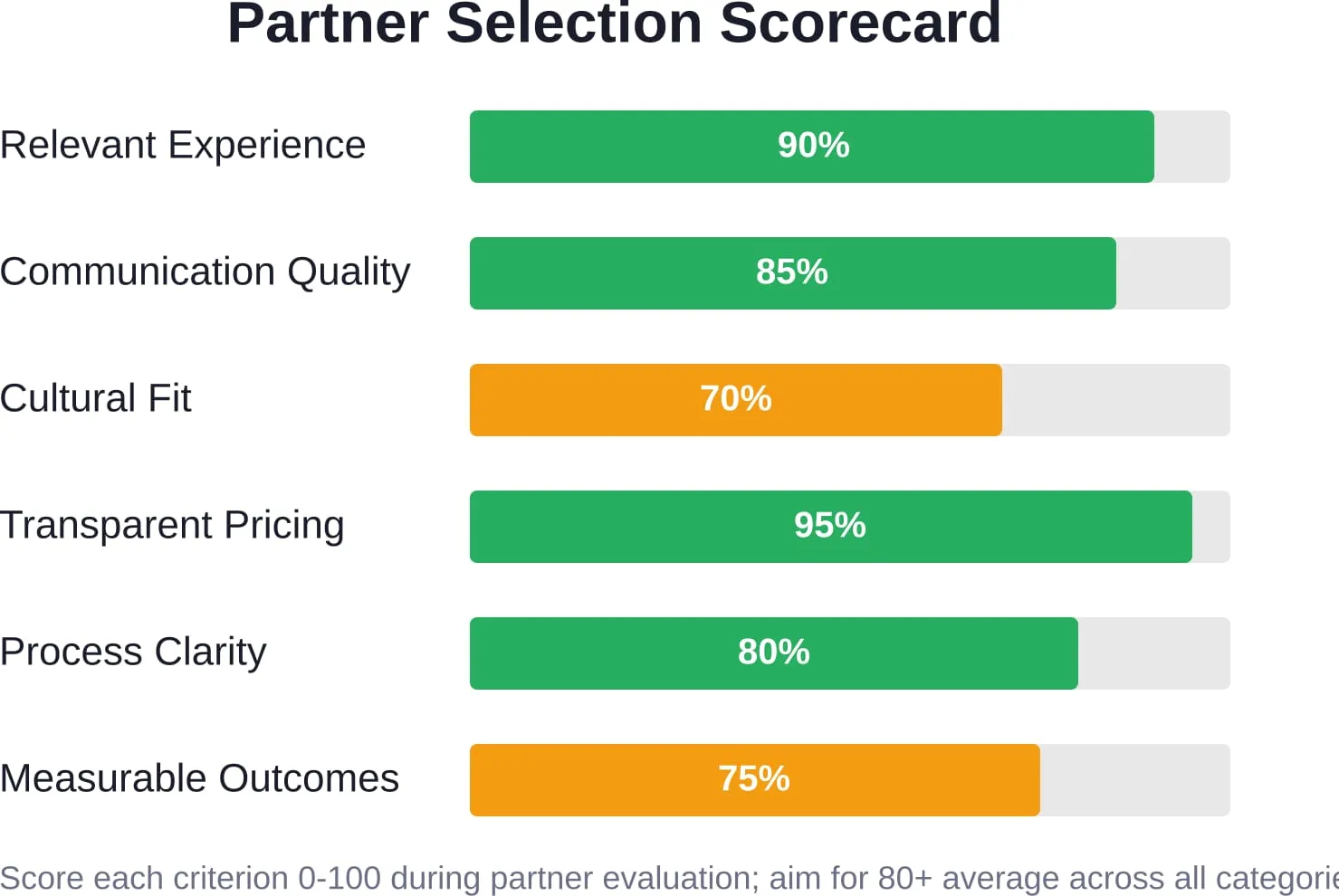
How to Choose the Right Marketing Partner
Partner selection determines whether outsourcing succeeds or becomes an expensive lesson in what not to do next time.
Define Requirements Before Starting the Search
Vague requirements produce vague results. Before contacting potential partners, document specific objectives, success metrics, budget parameters, and timeline constraints. Here is what to check:
- What specific business outcomes does the marketing work need to drive? Lead volume targets, revenue goals, cost per acquisition thresholds, or brand awareness metrics provide concrete evaluation criteria.
- Which channels and tactics matter most? A partner who excels at B2B LinkedIn advertising might struggle with direct-to-consumer TikTok campaigns.
- What level of strategic input versus tactical execution does the business need? Some partners function as strategic advisors who also execute; others excel at flawless execution when handed a detailed strategy.
Evaluate Experience and Specialization
Generalist agencies often sound appealing—one partner for everything—but specialists typically outperform in their domain.
Look for case studies and client testimonials from businesses at similar stages facing similar challenges. An agency that crushes it for enterprise clients might lack the scrappy resourcefulness small businesses need.
Industry expertise matters differently depending on the service. Technical SEO skills transfer across industries more easily than content strategy, which benefits enormously from sector knowledge.
Request references from current clients and ask specific questions:
- How do they handle missed deadlines?
- How transparent are they about what's working and what isn't?
- How quickly do they respond to urgent requests?
Assess Communication and Cultural Fit
Communication breakdowns kill more outsourcing relationships than skill gaps.
During initial conversations, notice how partners ask questions. Do they seek to understand business context and constraints, or do they jump straight to pitching their services?
Clarify communication preferences upfront: response time expectations, meeting frequency, reporting formats, and escalation procedures for problems.
Time zone differences matter. A 12-hour offset between business and partner creates coordination friction that slows everything down.
Cultural alignment around risk tolerance, decision-making speed, and feedback directness prevents frustration. Some businesses want partners who push back and challenge assumptions; others prefer partners who execute instructions without debate.
Understand Pricing Models and Contract Terms
Marketing outsourcing uses several pricing models, each with different risk profiles.
Hourly rates work well for projects with uncertain scope or exploratory work. They provide flexibility but require vigilant budget monitoring.
Monthly retainers suit ongoing relationships with predictable scope. Retainers align incentives for long-term success but can lead to complacency if accountability measures weaken.
Project-based pricing fits defined deliverables with clear endpoints—website redesigns, campaign launches, content production batches.
Performance-based models tie compensation to results. They sound appealing but require careful definition of what counts as performance, attribution methodology, and baseline assumptions.
Contract terms should address intellectual property ownership, confidentiality requirements, termination clauses, and transition procedures if the relationship ends.
Hire Dedicated Staff for Online Marketing Operations

Online marketing outsourcing can become difficult to manage when execution, reporting, and campaign coordination are handled across disconnected freelancers and short-term vendors. NeoWork provides embedded marketing and operational support teams, including digital marketing specialists, marketing coordinators, and content support staff, backed by a 91% annualized teammate retention rate and a 3.2% candidate selectivity rate.
Add Long-Term Support to Marketing Workflows
With NeoWork, businesses can get:
- dedicated online marketing support staff
- embedded teams aligned with existing workflows
- scalable support for ongoing campaign operations
👉Talk to NeoWork if your business needs more stable support for long-term online marketing execution.
Building an Effective Outsourcing Strategy
Throwing work over the fence to an external partner and hoping for magic rarely works. Successful outsourcing requires deliberate structure.
Start Small and Scale Based on Results
Begin with a limited pilot project rather than immediately outsourcing entire marketing functions. A three-month SEO engagement or a single campaign provides evidence before making larger commitments.
Pilot projects reveal how partners handle feedback, meet deadlines, communicate problems, and deliver on promises. They also expose integration friction points before they become expensive problems.
Success metrics for pilot projects should be specific and measurable. Vague goals like "increase brand awareness" make evaluation subjective and contentious.
Establish Clear Processes and Expectations
Document workflows, approval processes, brand guidelines, and quality standards before work begins. Assumptions cause most outsourcing failures.
Who reviews and approves deliverables? How many revision rounds are included? What's the expected turnaround time for feedback? When do urgent requests override the normal queue?
Regular check-in meetings—weekly for active projects, bi-weekly for ongoing retainers—keep everyone aligned and catch problems early.
Shared project management tools, communication channels, and file repositories eliminate the "I didn't see that email" problem.
Maintain Strategic Oversight
Outsourcing execution doesn't mean outsourcing responsibility for results. Internal teams need to maintain strategic direction, performance monitoring, and quality control.
Review performance data regularly. If an SEO partner reports rankings improved but organic traffic and conversions stayed flat, something's wrong.
Stay involved enough to catch when partners optimize for vanity metrics that don't drive business outcomes. Some agencies focus on metrics that make their reports look good rather than metrics that matter to the business.
Plan for Knowledge Transfer and Documentation
Outsourcing relationships eventually end. Build knowledge transfer into the process from the beginning.
Require documentation of strategies, processes, login credentials, and tactical decisions. If a partner gets hit by a bus—or simply moves on—the business shouldn't lose critical knowledge.
Periodic knowledge-sharing sessions where partners explain their work to internal teams, build internal capability, and make transitions smoother.
Common Outsourcing Pitfalls and How to Avoid Them
Even well-planned outsourcing arrangements hit predictable problems. Knowing what to watch for helps prevent expensive mistakes.
Misaligned Expectations and Unclear Goals
Vague objectives lead to partners optimizing for the wrong things. "Increase social media engagement" means something different to every marketer.
Fix this by defining specific, measurable outcomes tied to business results. Not "more engagement" but "increase qualified lead form submissions from social channels by 25% in Q2."
Insufficient Onboarding and Context
Partners can't succeed without understanding the business, customers, competitive landscape, and past marketing efforts.
Invest time upfront sharing customer personas, product positioning, brand voice examples, competitive intelligence, and historical performance data. This context investment pays dividends in output quality.
Over-Outsourcing Strategic Decisions
Partners bring expertise, but they don't know the business, customers, or industry better than internal teams. Blindly following partner recommendations without critical evaluation causes drift from core strategy.
Treat partner recommendations as informed perspectives that internal teams evaluate and approve. Partners should influence strategy, not own it outright.
Communication Breakdowns
Infrequent communication creates drift. Partners make assumptions, priorities shift without coordination, and small problems snowball.
Establish regular communication rhythms: weekly tactical check-ins, monthly strategic reviews, quarterly performance evaluations. Over-communicate early in relationships; dial back once patterns stabilize.
Ignoring Warning Signs
Missed deadlines, declining responsiveness, opaque reporting, and defensive reactions to feedback all signal relationship problems.
Address issues immediately rather than hoping they resolve themselves. Direct conversations about performance gaps, expectation mismatches, or process problems prevent small frustrations from becoming relationship-ending disasters.
Offshore vs. Nearshore vs. Onshore Outsourcing
Geography affects cost, communication, and cultural alignment. Each model suits different situations.
Offshore Outsourcing
Offshore partners—typically in Asia, Eastern Europe, or Latin America—offer the lowest costs. Hourly rates often range from $20-50 compared to $100-200+ for similar services domestically.
Cost savings come with trade-offs. Time zone differences complicate real-time collaboration. Cultural and language differences can create communication friction. Quality varies widely; vetting requires extra diligence.
Offshore outsourcing works best for well-defined tasks with clear specifications: graphic design, video editing, data entry, basic content production, and technical implementation.
Nearshore Outsourcing
Nearshore partners operate in neighboring countries with similar time zones—Latin America for U.S. businesses, Eastern Europe for Western Europe.
Costs fall between offshore and onshore. Time zone overlap enables real-time collaboration. Cultural similarities reduce friction.
Nearshore models suit marketing functions that need regular interaction: campaign management, content strategy, lead nurturing, and customer lifecycle marketing.
Onshore Outsourcing
Domestic partners cost more but offer same-time-zone collaboration, cultural alignment, and often deeper market understanding.
Strategic services that require nuanced communication—brand strategy, complex campaigns, executive-level reporting—often justify onshore costs.
Some businesses use hybrid models: strategic planning and creative direction onshore, production and execution offshore or nearshore.
Measuring Success and Optimizing Performance
What gets measured gets managed. Outsourcing relationships need clear success metrics and regular performance reviews.
Define Success Metrics Upfront
Different marketing functions require different measurement approaches.
SEO success typically tracks organic traffic growth, keyword ranking improvements, and conversions from organic channels. Leading indicators include content production volume, backlinks acquired, and technical issues resolved.
Paid advertising measures return on ad spend, cost per acquisition, conversion rate, and click-through rate. Platform-specific metrics—Facebook relevance score, Google Quality Score—provide optimization signals.
Content marketing looks at consumption metrics (views, time on page, scroll depth), engagement metrics (comments, shares, backlinks), and conversion metrics (email signups, demo requests from content).
Lead generation tracks lead volume, lead quality scores, cost per lead, and conversion rate from lead to opportunity to customer.
Regular Performance Reviews
Monthly performance reviews keep outsourcing relationships healthy. Compare actual results against goals, discuss what's working and what isn't, and adjust tactics accordingly.
Performance reviews should cover quantitative metrics and qualitative factors: communication quality, responsiveness, proactiveness, and strategic input.
Quarterly business reviews take a broader view: Are we getting the return we expected? Should we expand, maintain, or reduce the scope? What can we do differently to improve results?
Return on Efficiency Matters Too
Berkeley research highlights that focusing solely on revenue increases misses important value. Return on efficiency measures time savings and productivity gains.
When a marketing team reduces content creation time from hours to minutes, or when legal teams accelerate contract review by 60%, that efficiency gain creates capacity for higher-value work even if immediate revenue doesn't change.
Similarly, when customer service handles 20% more complex inquiries without additional staff using AI tools, the cost avoidance and quality improvement matter beyond pure revenue metrics.
_converted.webp)
The Role of AI and Automation in Outsourcing
Generative AI reshapes what makes sense to outsource and how outsourcing partners deliver value.
AI Adoption Rates Show Partner Advantage
Forrester data from 2024 reveals that 61% of agencies use generative AI in marketing efforts, compared to only 17% of in-house agencies. External partners adopt new technologies faster because their competitive advantage depends on it.
This gap means businesses that outsource often get access to more mature AI workflows, better prompts, and more refined processes than they could develop internally.
Contact Center Disruption
An average of 62% of contact centers in consumer-facing industries are outsourced, according to Forrester. Generative AI will displace 100,000 frontline agents from top global contact center outsourcers.
This displacement creates both risk and opportunity. Businesses that outsource contact centers need to understand how partners plan to integrate AI while maintaining service quality. Partners that simply cut headcount without reimagining workflows will struggle.
AI Changes What Humans Should Do
AI excels at first drafts, data analysis, pattern recognition, and repetitive tasks. Humans add strategic thinking, emotional intelligence, brand judgment, and creative direction.
Outsourcing relationships increasingly focus on strategy and judgment while AI handles production. A content partner might use AI to generate initial drafts, but humans refine voice, add insights, ensure accuracy, and optimize for conversion.
Frequently Asked Questions
Moving Forward with Marketing Outsourcing
Online marketing outsourcing succeeds when businesses match the right services to the right partners at the right time.
Start by honestly assessing internal capabilities, capacity constraints, and strategic priorities. Not every marketing function needs outsourcing—focus on areas where external expertise delivers clear advantage.
Define specific business outcomes before contacting partners. Vague goals produce vague results. Clear metrics create accountability and make performance evaluation straightforward.
Begin with pilot projects that test partner capabilities and cultural fit before making larger commitments. Three months provides enough time to evaluate execution quality, communication patterns, and results.
Build structure into relationships: regular check-ins, documented processes, clear approval workflows, and performance reviews. Outsourcing requires active management, not passive delegation.
But here's the thing: outsourcing is a tool, not a strategy. External partners bring skills and capacity, but they can't replace strategic thinking, customer understanding, and business judgment that only internal teams possess.
The most successful outsourcing relationships blend external execution excellence with internal strategic oversight. Partners who understand the business context and goals deliver exponentially better results than those who simply follow instructions.
Ready to explore outsourcing for specific marketing functions? Start by documenting current performance baselines, defining success metrics, and identifying which capabilities matter most for the next growth stage. Then find partners whose expertise matches those priorities and whose communication style fits the business culture.
Topics
Online Marketing Outsourcing Guide 2026

Quick Summary: Online marketing outsourcing connects businesses with external specialists to handle SEO, content creation, paid advertising, and other digital marketing functions. Companies typically outsource to access specialized expertise, reduce overhead costs, and scale campaigns faster than in-house teams allow. Success hinges on clear goals, transparent communication, and choosing partners whose skills align with measurable business outcomes.
Hiring a full-time in-house marketer costs an average of $101,000 a year. But here's the kicker: 37% of marketers admit they lack the skills to deliver results.
Outsourcing changes the game. Businesses get access to specialized talent, paid only by the hour or project, focused on delivering results rather than draining payroll budgets.
And the market reflects this shift. Industry analysis predicts that global retail e-commerce sales are expected to exceed $8 trillion by 2026. More businesses are competing for the same digital attention, which means marketing complexity keeps rising.
This guide walks through what online marketing outsourcing actually covers, when it makes sense, which services to delegate, how to choose the right partner, and how to avoid the most common pitfalls.
What Online Marketing Outsourcing Actually Includes
Online marketing outsourcing means hiring external agencies, freelancers, or specialized firms to handle specific marketing functions that would otherwise require in-house staff.
It's not about handing over the entire marketing department. Most businesses keep strategic oversight internal while delegating execution to experts who live and breathe specific channels.
Core Services Businesses Outsource
Search engine optimization remains one of the most commonly outsourced functions. SEO requires technical expertise, ongoing algorithm monitoring, and content production at scale—capabilities that stretch thin in-house teams.
Paid advertising management comes next. Running campaigns across Google Ads, Facebook, LinkedIn, and emerging platforms demands platform-specific knowledge, budget optimization skills, and constant A/B testing. Agencies that specialize in paid ads often deliver better ROI than generalist marketers.
Content creation and management represent another major category. This includes blog posts, video scripts, email newsletters, social media content, whitepapers, and case studies. Consistent content production at the volume modern marketing demands often exceeds what small teams can handle.
Social media management gets outsourced when businesses need daily posting, community engagement, influencer partnerships, and performance tracking across multiple platforms.
Marketing analytics and reporting also appear on outsourcing lists. Setting up proper tracking, building dashboards, interpreting data, and making optimization recommendations require analytical skills many teams lack.
Lead generation and qualification increasingly move to specialized partners. According to Forrester research, companies under $50M are 124% less likely to add lead qualification specialists than larger companies. By reallocating internal sales development representative roles to an outsourcing partner, one composite organization saved $16.2 million over three years from reduced salary and overhead costs.
Specialized Functions and Emerging Services
Beyond core services, businesses outsource conversion rate optimization, marketing automation setup, webinar production, podcast editing, graphic design, and video editing.
Generative AI integration has become a new outsourcing category. According to Forrester data from 2024, 61% of agencies use generative AI in marketing efforts, compared to only 17% of in-house agencies. External partners often bring more mature AI workflows and tools.
Email marketing campaigns, affiliate program management, and influencer outreach also frequently appear in outsourcing contracts.
When Outsourcing Makes Strategic Sense
Not every business should outsource everything. The decision depends on current capabilities, growth stage, budget constraints, and strategic priorities.
Budget Constraints and Cost Structures
Outsourcing typically delivers cost advantages when businesses need specialized skills but can't justify full-time salaries plus benefits, training, and overhead.
Most affordable outsourcing options show hourly rates ranging from $20–$100+, depending on geography and specialization. Moderate pricing for monthly retainers typically starts around a few thousand dollars, scaling with scope.
The math changes at different revenue stages. According to Forrester research from 2016, companies under $50M are 124% less likely to add lead qualification specialists than larger companies in the $51-250M range.
Real talk: if the business needs three months of intensive Facebook ad testing but won't need that capability again for six months, outsourcing beats hiring.
Skill Gaps and Expertise Access
Marketing channels evolve faster than most teams can retrain. SEO algorithm updates, new ad platform features, emerging social networks, and changing consumer behavior create constant skill gaps.
Agencies and specialists invest in ongoing education, certifications, and tool access because it's their core business. In-house teams struggle to maintain cutting-edge expertise across multiple channels while executing daily campaigns.
Specialized expertise particularly matters in technical SEO, programmatic advertising, advanced marketing automation, and data science applications like predictive modeling and customer lifetime value optimization.
Scaling Needs and Flexibility
Seasonal businesses, product launches, and growth spurts create temporary capacity needs that don't justify permanent headcount.
Outsourcing provides flexibility to scale up for Q4 holiday campaigns, scale down during slow periods, or pivot quickly when strategies change. This adaptability proves crucial in rapidly-evolving markets.
Businesses preparing for major initiatives—rebrands, new market entries, product launches—often lack the internal bandwidth to execute while maintaining business-as-usual marketing.
Which Marketing Services Make the Most Sense to Outsource
Some marketing functions outsource more successfully than others. The pattern depends on how much proprietary knowledge the work requires and how easily performance can be measured.
High-Value Outsourcing Candidates
SEO ranks among the top candidates because it combines technical complexity with measurable outcomes. Tracking keyword rankings, organic traffic, and conversion rates provides clear accountability.
Paid advertising follows close behind. Campaign performance metrics—cost per click, conversion rate, return on ad spend—make it straightforward to evaluate partner performance. Platform expertise and optimization experience deliver measurable ROI improvements.
Content production at scale works well when businesses provide detailed briefs, brand guidelines, and editorial oversight. Blog posts, social media content, email copy, and video scripts benefit from external creative talent and production capacity.
Marketing automation implementation and management suit outsourcing because platforms like HubSpot, Marketo, and Pardot require specialized technical knowledge that most businesses use intermittently.
Functions That Need Careful Consideration
Brand strategy and positioning typically stay in-house. Core brand identity, messaging architecture, and strategic positioning require deep business understanding that external partners struggle to replicate.
Customer research and voice-of-customer programs work best with hybrid models—external partners can execute research methodology, but internal teams need deep involvement in interpretation and application.
Community management and customer support require product knowledge and brand voice consistency that take time for external teams to develop. Some businesses successfully outsource these functions, but it demands significant training investment and ongoing oversight.
Product marketing often stays internal because it requires intimate product knowledge, cross-functional coordination with product and engineering teams, and rapid response to product changes.
How to Choose the Right Marketing Partner
Partner selection determines whether outsourcing succeeds or becomes an expensive lesson in what not to do next time.
Define Requirements Before Starting the Search
Vague requirements produce vague results. Before contacting potential partners, document specific objectives, success metrics, budget parameters, and timeline constraints. Here is what to check:
- What specific business outcomes does the marketing work need to drive? Lead volume targets, revenue goals, cost per acquisition thresholds, or brand awareness metrics provide concrete evaluation criteria.
- Which channels and tactics matter most? A partner who excels at B2B LinkedIn advertising might struggle with direct-to-consumer TikTok campaigns.
- What level of strategic input versus tactical execution does the business need? Some partners function as strategic advisors who also execute; others excel at flawless execution when handed a detailed strategy.
Evaluate Experience and Specialization
Generalist agencies often sound appealing—one partner for everything—but specialists typically outperform in their domain.
Look for case studies and client testimonials from businesses at similar stages facing similar challenges. An agency that crushes it for enterprise clients might lack the scrappy resourcefulness small businesses need.
Industry expertise matters differently depending on the service. Technical SEO skills transfer across industries more easily than content strategy, which benefits enormously from sector knowledge.
Request references from current clients and ask specific questions:
- How do they handle missed deadlines?
- How transparent are they about what's working and what isn't?
- How quickly do they respond to urgent requests?
Assess Communication and Cultural Fit
Communication breakdowns kill more outsourcing relationships than skill gaps.
During initial conversations, notice how partners ask questions. Do they seek to understand business context and constraints, or do they jump straight to pitching their services?
Clarify communication preferences upfront: response time expectations, meeting frequency, reporting formats, and escalation procedures for problems.
Time zone differences matter. A 12-hour offset between business and partner creates coordination friction that slows everything down.
Cultural alignment around risk tolerance, decision-making speed, and feedback directness prevents frustration. Some businesses want partners who push back and challenge assumptions; others prefer partners who execute instructions without debate.
Understand Pricing Models and Contract Terms
Marketing outsourcing uses several pricing models, each with different risk profiles.
Hourly rates work well for projects with uncertain scope or exploratory work. They provide flexibility but require vigilant budget monitoring.
Monthly retainers suit ongoing relationships with predictable scope. Retainers align incentives for long-term success but can lead to complacency if accountability measures weaken.
Project-based pricing fits defined deliverables with clear endpoints—website redesigns, campaign launches, content production batches.
Performance-based models tie compensation to results. They sound appealing but require careful definition of what counts as performance, attribution methodology, and baseline assumptions.
Contract terms should address intellectual property ownership, confidentiality requirements, termination clauses, and transition procedures if the relationship ends.
Hire Dedicated Staff for Online Marketing Operations
Online marketing outsourcing can become difficult to manage when execution, reporting, and campaign coordination are handled across disconnected freelancers and short-term vendors. NeoWork provides embedded marketing and operational support teams, including digital marketing specialists, marketing coordinators, and content support staff, backed by a 91% annualized teammate retention rate and a 3.2% candidate selectivity rate.
Add Long-Term Support to Marketing Workflows
With NeoWork, businesses can get:
- dedicated online marketing support staff
- embedded teams aligned with existing workflows
- scalable support for ongoing campaign operations
👉Talk to NeoWork if your business needs more stable support for long-term online marketing execution.
Building an Effective Outsourcing Strategy
Throwing work over the fence to an external partner and hoping for magic rarely works. Successful outsourcing requires deliberate structure.
Start Small and Scale Based on Results
Begin with a limited pilot project rather than immediately outsourcing entire marketing functions. A three-month SEO engagement or a single campaign provides evidence before making larger commitments.
Pilot projects reveal how partners handle feedback, meet deadlines, communicate problems, and deliver on promises. They also expose integration friction points before they become expensive problems.
Success metrics for pilot projects should be specific and measurable. Vague goals like "increase brand awareness" make evaluation subjective and contentious.
Establish Clear Processes and Expectations
Document workflows, approval processes, brand guidelines, and quality standards before work begins. Assumptions cause most outsourcing failures.
Who reviews and approves deliverables? How many revision rounds are included? What's the expected turnaround time for feedback? When do urgent requests override the normal queue?
Regular check-in meetings—weekly for active projects, bi-weekly for ongoing retainers—keep everyone aligned and catch problems early.
Shared project management tools, communication channels, and file repositories eliminate the "I didn't see that email" problem.
Maintain Strategic Oversight
Outsourcing execution doesn't mean outsourcing responsibility for results. Internal teams need to maintain strategic direction, performance monitoring, and quality control.
Review performance data regularly. If an SEO partner reports rankings improved but organic traffic and conversions stayed flat, something's wrong.
Stay involved enough to catch when partners optimize for vanity metrics that don't drive business outcomes. Some agencies focus on metrics that make their reports look good rather than metrics that matter to the business.
Plan for Knowledge Transfer and Documentation
Outsourcing relationships eventually end. Build knowledge transfer into the process from the beginning.
Require documentation of strategies, processes, login credentials, and tactical decisions. If a partner gets hit by a bus—or simply moves on—the business shouldn't lose critical knowledge.
Periodic knowledge-sharing sessions where partners explain their work to internal teams, build internal capability, and make transitions smoother.
Common Outsourcing Pitfalls and How to Avoid Them
Even well-planned outsourcing arrangements hit predictable problems. Knowing what to watch for helps prevent expensive mistakes.
Misaligned Expectations and Unclear Goals
Vague objectives lead to partners optimizing for the wrong things. "Increase social media engagement" means something different to every marketer.
Fix this by defining specific, measurable outcomes tied to business results. Not "more engagement" but "increase qualified lead form submissions from social channels by 25% in Q2."
Insufficient Onboarding and Context
Partners can't succeed without understanding the business, customers, competitive landscape, and past marketing efforts.
Invest time upfront sharing customer personas, product positioning, brand voice examples, competitive intelligence, and historical performance data. This context investment pays dividends in output quality.
Over-Outsourcing Strategic Decisions
Partners bring expertise, but they don't know the business, customers, or industry better than internal teams. Blindly following partner recommendations without critical evaluation causes drift from core strategy.
Treat partner recommendations as informed perspectives that internal teams evaluate and approve. Partners should influence strategy, not own it outright.
Communication Breakdowns
Infrequent communication creates drift. Partners make assumptions, priorities shift without coordination, and small problems snowball.
Establish regular communication rhythms: weekly tactical check-ins, monthly strategic reviews, quarterly performance evaluations. Over-communicate early in relationships; dial back once patterns stabilize.
Ignoring Warning Signs
Missed deadlines, declining responsiveness, opaque reporting, and defensive reactions to feedback all signal relationship problems.
Address issues immediately rather than hoping they resolve themselves. Direct conversations about performance gaps, expectation mismatches, or process problems prevent small frustrations from becoming relationship-ending disasters.
Offshore vs. Nearshore vs. Onshore Outsourcing
Geography affects cost, communication, and cultural alignment. Each model suits different situations.
Offshore Outsourcing
Offshore partners—typically in Asia, Eastern Europe, or Latin America—offer the lowest costs. Hourly rates often range from $20-50 compared to $100-200+ for similar services domestically.
Cost savings come with trade-offs. Time zone differences complicate real-time collaboration. Cultural and language differences can create communication friction. Quality varies widely; vetting requires extra diligence.
Offshore outsourcing works best for well-defined tasks with clear specifications: graphic design, video editing, data entry, basic content production, and technical implementation.
Nearshore Outsourcing
Nearshore partners operate in neighboring countries with similar time zones—Latin America for U.S. businesses, Eastern Europe for Western Europe.
Costs fall between offshore and onshore. Time zone overlap enables real-time collaboration. Cultural similarities reduce friction.
Nearshore models suit marketing functions that need regular interaction: campaign management, content strategy, lead nurturing, and customer lifecycle marketing.
Onshore Outsourcing
Domestic partners cost more but offer same-time-zone collaboration, cultural alignment, and often deeper market understanding.
Strategic services that require nuanced communication—brand strategy, complex campaigns, executive-level reporting—often justify onshore costs.
Some businesses use hybrid models: strategic planning and creative direction onshore, production and execution offshore or nearshore.
Measuring Success and Optimizing Performance
What gets measured gets managed. Outsourcing relationships need clear success metrics and regular performance reviews.
Define Success Metrics Upfront
Different marketing functions require different measurement approaches.
SEO success typically tracks organic traffic growth, keyword ranking improvements, and conversions from organic channels. Leading indicators include content production volume, backlinks acquired, and technical issues resolved.
Paid advertising measures return on ad spend, cost per acquisition, conversion rate, and click-through rate. Platform-specific metrics—Facebook relevance score, Google Quality Score—provide optimization signals.
Content marketing looks at consumption metrics (views, time on page, scroll depth), engagement metrics (comments, shares, backlinks), and conversion metrics (email signups, demo requests from content).
Lead generation tracks lead volume, lead quality scores, cost per lead, and conversion rate from lead to opportunity to customer.
Regular Performance Reviews
Monthly performance reviews keep outsourcing relationships healthy. Compare actual results against goals, discuss what's working and what isn't, and adjust tactics accordingly.
Performance reviews should cover quantitative metrics and qualitative factors: communication quality, responsiveness, proactiveness, and strategic input.
Quarterly business reviews take a broader view: Are we getting the return we expected? Should we expand, maintain, or reduce the scope? What can we do differently to improve results?
Return on Efficiency Matters Too
Berkeley research highlights that focusing solely on revenue increases misses important value. Return on efficiency measures time savings and productivity gains.
When a marketing team reduces content creation time from hours to minutes, or when legal teams accelerate contract review by 60%, that efficiency gain creates capacity for higher-value work even if immediate revenue doesn't change.
Similarly, when customer service handles 20% more complex inquiries without additional staff using AI tools, the cost avoidance and quality improvement matter beyond pure revenue metrics.
The Role of AI and Automation in Outsourcing
Generative AI reshapes what makes sense to outsource and how outsourcing partners deliver value.
AI Adoption Rates Show Partner Advantage
Forrester data from 2024 reveals that 61% of agencies use generative AI in marketing efforts, compared to only 17% of in-house agencies. External partners adopt new technologies faster because their competitive advantage depends on it.
This gap means businesses that outsource often get access to more mature AI workflows, better prompts, and more refined processes than they could develop internally.
Contact Center Disruption
An average of 62% of contact centers in consumer-facing industries are outsourced, according to Forrester. Generative AI will displace 100,000 frontline agents from top global contact center outsourcers.
This displacement creates both risk and opportunity. Businesses that outsource contact centers need to understand how partners plan to integrate AI while maintaining service quality. Partners that simply cut headcount without reimagining workflows will struggle.
AI Changes What Humans Should Do
AI excels at first drafts, data analysis, pattern recognition, and repetitive tasks. Humans add strategic thinking, emotional intelligence, brand judgment, and creative direction.
Outsourcing relationships increasingly focus on strategy and judgment while AI handles production. A content partner might use AI to generate initial drafts, but humans refine voice, add insights, ensure accuracy, and optimize for conversion.
Frequently Asked Questions
Moving Forward with Marketing Outsourcing
Online marketing outsourcing succeeds when businesses match the right services to the right partners at the right time.
Start by honestly assessing internal capabilities, capacity constraints, and strategic priorities. Not every marketing function needs outsourcing—focus on areas where external expertise delivers clear advantage.
Define specific business outcomes before contacting partners. Vague goals produce vague results. Clear metrics create accountability and make performance evaluation straightforward.
Begin with pilot projects that test partner capabilities and cultural fit before making larger commitments. Three months provides enough time to evaluate execution quality, communication patterns, and results.
Build structure into relationships: regular check-ins, documented processes, clear approval workflows, and performance reviews. Outsourcing requires active management, not passive delegation.
But here's the thing: outsourcing is a tool, not a strategy. External partners bring skills and capacity, but they can't replace strategic thinking, customer understanding, and business judgment that only internal teams possess.
The most successful outsourcing relationships blend external execution excellence with internal strategic oversight. Partners who understand the business context and goals deliver exponentially better results than those who simply follow instructions.
Ready to explore outsourcing for specific marketing functions? Start by documenting current performance baselines, defining success metrics, and identifying which capabilities matter most for the next growth stage. Then find partners whose expertise matches those priorities and whose communication style fits the business culture.
Topics
Related Blogs
Related Podcasts


.webp)

.webp)
.webp)



