

.avif)
.avif)

Paralegal Outsourcing Services Guide 2026


.svg)

Quick Summary: Paralegal outsourcing services enable law firms to reduce operational costs by 40–60% while maintaining scalability and efficiency. This guide covers the core benefits, service types, ethical considerations, and best practices for selecting and managing outsourced paralegal providers.
What Is Paralegal Outsourcing?
Paralegal outsourcing refers to contracting legal support work to external service providers rather than hiring in-house staff. These providers handle document review, legal research, case management, contract analysis, and administrative tasks that traditionally fall to paralegals.
The model differs from temporary staffing in a critical way: outsourced paralegal services are scalable, long-term, and typically cost-effective. Instead of committing to fixed salaries and benefits, firms pay for the services they actually use. This flexibility allows practices to ramp up during heavy caseloads and scale back during slower periods without the overhead of hiring and firing cycles.
Remote paralegals work from external locations, usually managed by specialized outsourcing firms that handle recruitment, training, and quality assurance. The service provider becomes an extension of the law firm's team.
Why Law Firms Are Shifting to Paralegal Outsourcing
The trend toward outsourcing legal support has accelerated significantly. Attorneys spend nearly 40% of their working hours on administrative tasks instead of billable legal work. Outsourcing redirects that time to higher-value client interactions and strategic practice development.
Small law firms face particular pressure. Many spend nearly 20–25% of their first-year budget on hiring and training staff. Outsourcing sidesteps this expense while still delivering quality support from day one.
Beyond cost control, outsourcing addresses hiring challenges. The legal market faces talent shortages in certain regions and skill sets. Partnering with an outsourcing provider gives firms immediate access to vetted, experienced paralegals without the recruitment burden.
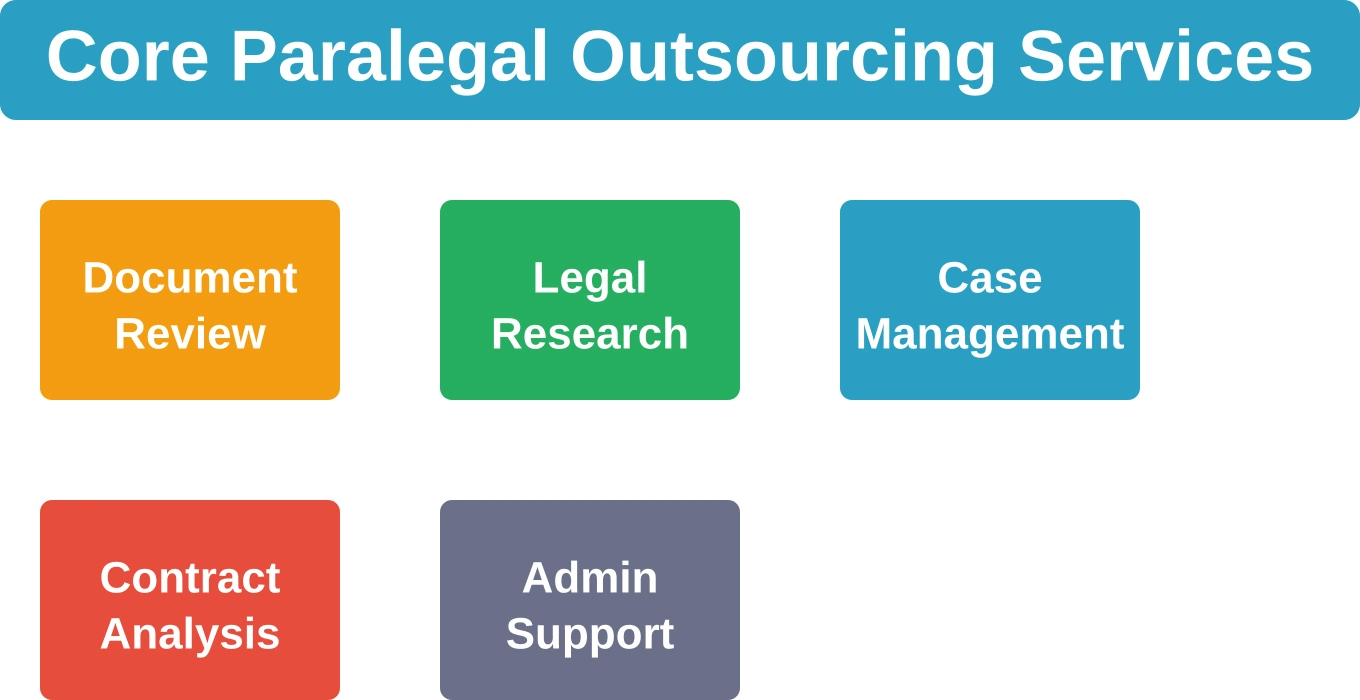
Core Paralegal Outsourcing Services
Reliable outsourcing providers typically offer a range of specialized services tailored to law firm needs.
Document Review and Preparation
This remains a cornerstone service. Outsourced paralegals review, organize, and prepare legal documents for litigation, discovery, and client delivery. They handle formatting, indexing, and quality checks that ensure compliance and accuracy.
Legal Research and Writing
Paralegals conduct case law research, summarize precedents, and draft memoranda on legal issues. This work demands attention to detail and familiarity with legal databases—skills that outsourcing teams are trained to deliver.
Case Management and File Organization
Managing complex case files requires systematic organization. Outsourced paralegals maintain timelines, track deadlines, organize exhibits, and ensure all materials are accessible to attorneys when needed.
Contract Analysis
Reviewing and abstracting contract terms is labor-intensive. Outsourced paralegals extract key provisions, identify obligations, and flag potential issues—freeing in-house teams to focus on negotiation and strategy.
Administrative Support
Billing, scheduling, conflict checks, and general administrative work round out most service offerings. This work, though necessary, is often the biggest drain on attorney productivity.
Support Legal Teams With NeoWork

NeoWork provides staffing and operations support for organizations that need help with legal administration and case-related workflows. Their teams can assist with document management, records organization, client communication, and other routine tasks that support legal professionals.
Need Additional Paralegal Support?
NeoWork can help with:
- legal document organization
- case administration support
- client communication and scheduling
- records management and data entry
👉 Contact NeoWork to discuss your legal support requirements.
4 Benefits of Paralegal Outsourcing Services
1. Significant Cost Reduction
Law firms can reduce legal support expenditures by 40–60% compared to full-time, in-house paralegals. Outsourced paralegals eliminate the burden of salaries, employee benefits, office space, and training costs. Small and mid-sized firms especially benefit from this flexibility, avoiding the fixed overhead of permanent staff.
2. Scalability Without Commitment
Workload fluctuations don't require hiring freezes or layoffs. Firms scale paralegal support up during discovery phases, trial preparation, or client surges, then scale back when demand decreases. This responsiveness is impossible with traditional in-house teams.
3. Focus on High-Value Work
When administrative and routine legal tasks move to outsourced providers, attorneys reclaim time for client counsel, strategy, and business development. Early cost control from outsourcing reduces hiring pressure on young firms and lets experienced practitioners concentrate on matters that drive revenue.
4. Access to Specialized Expertise
Outsourcing firms maintain teams trained in specific practice areas—intellectual property, real estate, litigation support, corporate law. Firms gain access to this expertise without the cost of permanent specialty hires.
Paralegal Outsourcing vs. Traditional Staffing Models
The comparison matters. In-house paralegals offer direct control and integration into firm culture, but they demand fixed costs regardless of workload. Temp staff scale quickly but come with premium hourly rates and no continuity.
Outsourced paralegals strike a middle ground: they're scalable like temps but stable like in-house staff. They maintain continuity across projects, undergo rigorous training by the provider, and typically cost 45–60% less than permanent hires. The tradeoff is less direct control and the need for clear communication protocols.
Ethical Considerations and Compliance
Law firms must navigate ethical rules around outsourcing. According to the North Carolina State Bar's 2007 Formal Ethics Opinion 12, lawyers may outsource legal support services to foreign lawyers or nonlawyers provided they properly select and supervise these providers, ensure client confidentiality, avoid conflicts of interest, and maintain professional responsibility.
Key compliance steps include: conducting due diligence on the provider's security practices, ensuring confidentiality agreements are in place, vetting the provider's compliance with data protection laws, and establishing clear supervision protocols. Attorneys remain liable for outsourced work—the provider is a tool, not a shield.
Real talk: selecting a reputable provider mitigates risk significantly. Established outsourcing firms have compliance frameworks, security certifications, and professional insurance. Startups or informal arrangements carry higher risk.
How to Find a Reliable Paralegal Outsourcing Service Provider
Verify Credentials and Experience
Check how long the provider has been in business, what practice areas they specialize in, and whether their paralegals hold relevant certifications. Request references from law firms similar in size and practice focus to yours.
Assess Security and Confidentiality
Ask about data encryption, secure file transfer protocols, and confidentiality agreements. The provider should carry professional liability insurance and comply with industry standards like SOC 2 or ISO 27001.
Evaluate Communication and Project Management
How do they handle status updates and feedback? Will you have a dedicated account manager? Are there clear escalation paths for issues? Transparent communication prevents misunderstandings and ensures quality.
Review Pricing Models
Understand whether the provider charges per hour, per project, or via retainer. Some models work better for firms with predictable workloads; others suit variable demand. Clarify what's included—training, revisions, quality assurance—so you avoid surprise costs.
Request a Trial Project
Start small. Assign a discrete project to assess quality, communication, and fit before committing to a larger engagement. This low-risk test protects both parties.
Best Practices for Managing Outsourced Paralegals
Success depends on clear expectations and ongoing communication.
- Set detailed project briefs that specify deliverables, deadlines, quality standards, and any special instructions. Vague requests lead to rework and frustration.
- Establish regular check-ins with your account manager or provider contact. Weekly or bi-weekly updates keep projects on track and allow you to catch issues early. Provide constructive feedback promptly—don't wait until the end of a project to address problems.
- Document your workflow and processes so the provider understands your firm's standards. The more explicit you are, the fewer revisions you'll need. Over time, this investment in clarity pays dividends in quality and efficiency.
- And here's something many firms overlook: build a feedback loop. If something isn't working—whether it's communication, quality, turnaround time, or cost—address it directly. Good providers want to improve and will adapt to better serve you.
The Bottom Line
Paralegal outsourcing services offer law firms a practical solution to rising operational costs and staffing challenges. By reducing legal support expenses by 40–60%, scaling support flexibly, and freeing attorneys to focus on billable and strategic work, outsourcing aligns with how modern law firms operate.
Success depends on partner selection, clear communication, and realistic expectations. Firms that approach outsourcing thoughtfully—vetting providers, establishing protocols, and maintaining oversight—consistently report improved efficiency and client satisfaction.
The shift toward outsourced legal support reflects a broader professionalization of the legal services industry. It's not about cutting corners; it's about working smarter. If your firm struggles with administrative overhead or lacks specialized expertise for certain tasks, exploring paralegal outsourcing with a reputable provider could be the efficiency boost you've been looking for.
Frequently Asked Questions
Topics
Paralegal Outsourcing Services Guide 2026

Quick Summary: Paralegal outsourcing services enable law firms to reduce operational costs by 40–60% while maintaining scalability and efficiency. This guide covers the core benefits, service types, ethical considerations, and best practices for selecting and managing outsourced paralegal providers.
What Is Paralegal Outsourcing?
Paralegal outsourcing refers to contracting legal support work to external service providers rather than hiring in-house staff. These providers handle document review, legal research, case management, contract analysis, and administrative tasks that traditionally fall to paralegals.
The model differs from temporary staffing in a critical way: outsourced paralegal services are scalable, long-term, and typically cost-effective. Instead of committing to fixed salaries and benefits, firms pay for the services they actually use. This flexibility allows practices to ramp up during heavy caseloads and scale back during slower periods without the overhead of hiring and firing cycles.
Remote paralegals work from external locations, usually managed by specialized outsourcing firms that handle recruitment, training, and quality assurance. The service provider becomes an extension of the law firm's team.
Why Law Firms Are Shifting to Paralegal Outsourcing
The trend toward outsourcing legal support has accelerated significantly. Attorneys spend nearly 40% of their working hours on administrative tasks instead of billable legal work. Outsourcing redirects that time to higher-value client interactions and strategic practice development.
Small law firms face particular pressure. Many spend nearly 20–25% of their first-year budget on hiring and training staff. Outsourcing sidesteps this expense while still delivering quality support from day one.
Beyond cost control, outsourcing addresses hiring challenges. The legal market faces talent shortages in certain regions and skill sets. Partnering with an outsourcing provider gives firms immediate access to vetted, experienced paralegals without the recruitment burden.
Core Paralegal Outsourcing Services
Reliable outsourcing providers typically offer a range of specialized services tailored to law firm needs.
Document Review and Preparation
This remains a cornerstone service. Outsourced paralegals review, organize, and prepare legal documents for litigation, discovery, and client delivery. They handle formatting, indexing, and quality checks that ensure compliance and accuracy.
Legal Research and Writing
Paralegals conduct case law research, summarize precedents, and draft memoranda on legal issues. This work demands attention to detail and familiarity with legal databases—skills that outsourcing teams are trained to deliver.
Case Management and File Organization
Managing complex case files requires systematic organization. Outsourced paralegals maintain timelines, track deadlines, organize exhibits, and ensure all materials are accessible to attorneys when needed.
Contract Analysis
Reviewing and abstracting contract terms is labor-intensive. Outsourced paralegals extract key provisions, identify obligations, and flag potential issues—freeing in-house teams to focus on negotiation and strategy.
Administrative Support
Billing, scheduling, conflict checks, and general administrative work round out most service offerings. This work, though necessary, is often the biggest drain on attorney productivity.
Support Legal Teams With NeoWork
NeoWork provides staffing and operations support for organizations that need help with legal administration and case-related workflows. Their teams can assist with document management, records organization, client communication, and other routine tasks that support legal professionals.
Need Additional Paralegal Support?
NeoWork can help with:
- legal document organization
- case administration support
- client communication and scheduling
- records management and data entry
👉 Contact NeoWork to discuss your legal support requirements.
4 Benefits of Paralegal Outsourcing Services
1. Significant Cost Reduction
Law firms can reduce legal support expenditures by 40–60% compared to full-time, in-house paralegals. Outsourced paralegals eliminate the burden of salaries, employee benefits, office space, and training costs. Small and mid-sized firms especially benefit from this flexibility, avoiding the fixed overhead of permanent staff.
2. Scalability Without Commitment
Workload fluctuations don't require hiring freezes or layoffs. Firms scale paralegal support up during discovery phases, trial preparation, or client surges, then scale back when demand decreases. This responsiveness is impossible with traditional in-house teams.
3. Focus on High-Value Work
When administrative and routine legal tasks move to outsourced providers, attorneys reclaim time for client counsel, strategy, and business development. Early cost control from outsourcing reduces hiring pressure on young firms and lets experienced practitioners concentrate on matters that drive revenue.
4. Access to Specialized Expertise
Outsourcing firms maintain teams trained in specific practice areas—intellectual property, real estate, litigation support, corporate law. Firms gain access to this expertise without the cost of permanent specialty hires.
Paralegal Outsourcing vs. Traditional Staffing Models
The comparison matters. In-house paralegals offer direct control and integration into firm culture, but they demand fixed costs regardless of workload. Temp staff scale quickly but come with premium hourly rates and no continuity.
Outsourced paralegals strike a middle ground: they're scalable like temps but stable like in-house staff. They maintain continuity across projects, undergo rigorous training by the provider, and typically cost 45–60% less than permanent hires. The tradeoff is less direct control and the need for clear communication protocols.
Ethical Considerations and Compliance
Law firms must navigate ethical rules around outsourcing. According to the North Carolina State Bar's 2007 Formal Ethics Opinion 12, lawyers may outsource legal support services to foreign lawyers or nonlawyers provided they properly select and supervise these providers, ensure client confidentiality, avoid conflicts of interest, and maintain professional responsibility.
Key compliance steps include: conducting due diligence on the provider's security practices, ensuring confidentiality agreements are in place, vetting the provider's compliance with data protection laws, and establishing clear supervision protocols. Attorneys remain liable for outsourced work—the provider is a tool, not a shield.
Real talk: selecting a reputable provider mitigates risk significantly. Established outsourcing firms have compliance frameworks, security certifications, and professional insurance. Startups or informal arrangements carry higher risk.
How to Find a Reliable Paralegal Outsourcing Service Provider
Verify Credentials and Experience
Check how long the provider has been in business, what practice areas they specialize in, and whether their paralegals hold relevant certifications. Request references from law firms similar in size and practice focus to yours.
Assess Security and Confidentiality
Ask about data encryption, secure file transfer protocols, and confidentiality agreements. The provider should carry professional liability insurance and comply with industry standards like SOC 2 or ISO 27001.
Evaluate Communication and Project Management
How do they handle status updates and feedback? Will you have a dedicated account manager? Are there clear escalation paths for issues? Transparent communication prevents misunderstandings and ensures quality.
Review Pricing Models
Understand whether the provider charges per hour, per project, or via retainer. Some models work better for firms with predictable workloads; others suit variable demand. Clarify what's included—training, revisions, quality assurance—so you avoid surprise costs.
Request a Trial Project
Start small. Assign a discrete project to assess quality, communication, and fit before committing to a larger engagement. This low-risk test protects both parties.
Best Practices for Managing Outsourced Paralegals
Success depends on clear expectations and ongoing communication.
- Set detailed project briefs that specify deliverables, deadlines, quality standards, and any special instructions. Vague requests lead to rework and frustration.
- Establish regular check-ins with your account manager or provider contact. Weekly or bi-weekly updates keep projects on track and allow you to catch issues early. Provide constructive feedback promptly—don't wait until the end of a project to address problems.
- Document your workflow and processes so the provider understands your firm's standards. The more explicit you are, the fewer revisions you'll need. Over time, this investment in clarity pays dividends in quality and efficiency.
- And here's something many firms overlook: build a feedback loop. If something isn't working—whether it's communication, quality, turnaround time, or cost—address it directly. Good providers want to improve and will adapt to better serve you.
The Bottom Line
Paralegal outsourcing services offer law firms a practical solution to rising operational costs and staffing challenges. By reducing legal support expenses by 40–60%, scaling support flexibly, and freeing attorneys to focus on billable and strategic work, outsourcing aligns with how modern law firms operate.
Success depends on partner selection, clear communication, and realistic expectations. Firms that approach outsourcing thoughtfully—vetting providers, establishing protocols, and maintaining oversight—consistently report improved efficiency and client satisfaction.
The shift toward outsourced legal support reflects a broader professionalization of the legal services industry. It's not about cutting corners; it's about working smarter. If your firm struggles with administrative overhead or lacks specialized expertise for certain tasks, exploring paralegal outsourcing with a reputable provider could be the efficiency boost you've been looking for.
Frequently Asked Questions
Topics
Related Blogs
Related Podcasts


.webp)
.webp)



