

.avif)
.avif)

Prior Authorization Outsourcing Guide 2026


.svg)

Quick Summary: Prior authorization outsourcing transfers the administrative burden of obtaining insurance approval to specialized vendors, reducing costs by up to 40%, accelerating approval timelines, and lowering denial rates. Healthcare providers implementing this strategy achieve significant operational efficiency while maintaining HIPAA compliance and meeting new CMS timeframe requirements.
Why Prior Authorization Has Become a Hidden Revenue Drain
Prior authorization—the process of obtaining insurance company approval before delivering certain medical services—has evolved into one of healthcare's costliest administrative functions. What started as a cost-control mechanism has become a barrier to care and a profit-eroding operational headache.
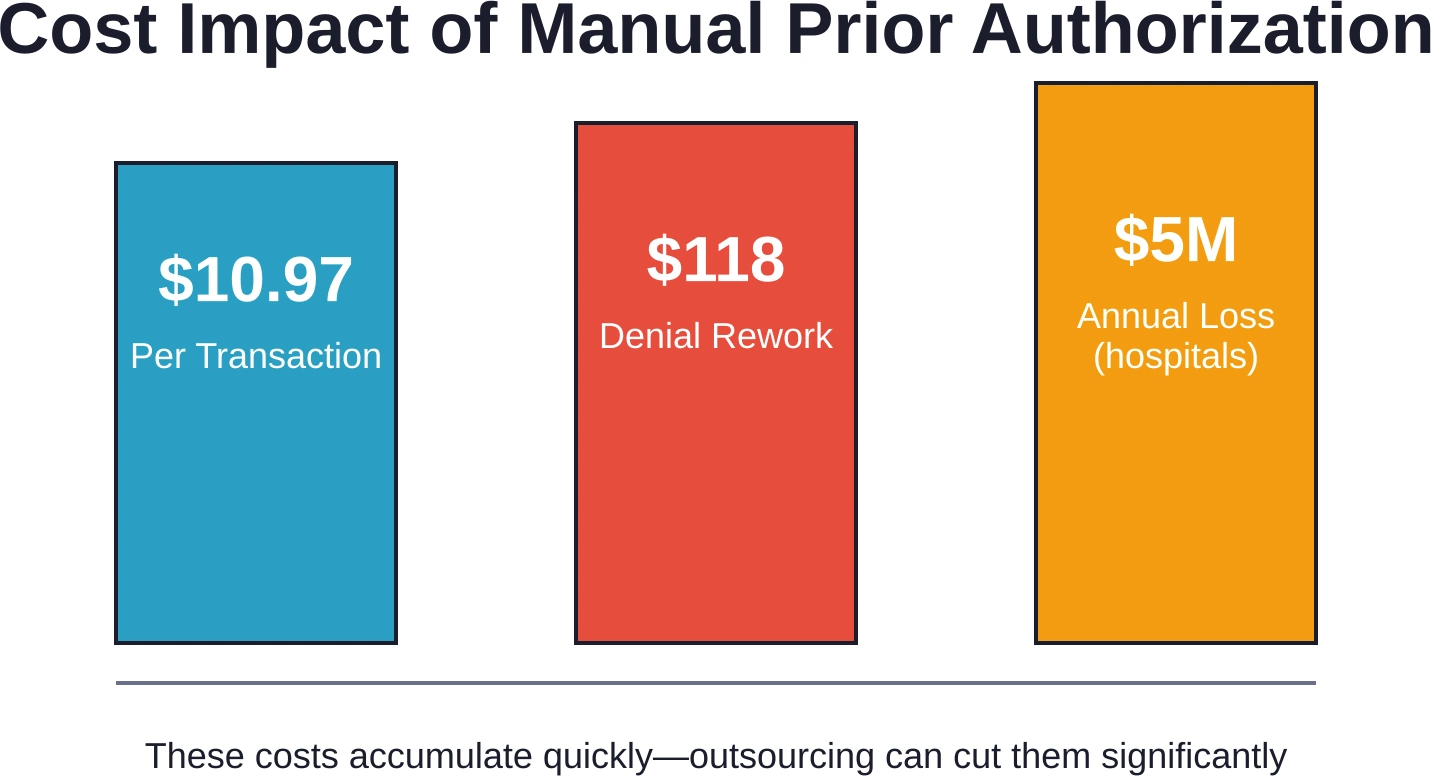
Manual prior authorization processing costs approximately $10.97 per transaction when accounting for labor, follow-ups, documentation errors, and resubmissions. At 75 requests per week, this translates to roughly $41,000 annually for a single practice. And that's just the direct labor cost.
The broader impact is staggering. Denial rework alone costs providers $118 per claim, according to 2017 AHIMA data. Healthcare organizations lose an average of $5 million annually due to unresolved claims denials, representing up to 5 percent of net patient revenue.
What Outsourced Prior Authorization Actually Is
Outsourcing prior authorization means delegating the entire approval request process to a specialized third-party vendor. Instead of your staff submitting requests, tracking responses, and following up on denials, the vendor handles every step.
The process flow is straightforward: your practice identifies a patient requiring authorization, submits the clinical documentation to the vendor, and the vendor manages all communication with insurance companies. When the insurer requests additional information, the vendor responds. When a request is denied, the vendor initiates appeals. Your staff receives status updates and final approval confirmations.
This separation of duties creates operational clarity. Your clinical teams focus on patient care. Your administrative staff handles scheduling and billing. The authorization vendor owns the insurance interface entirely.
The Financial Case for Outsourcing
The arithmetic is compelling. Healthcare providers implementing prior authorization outsourcing can reduce costs by approximately 40 percent when paying only for service volume rather than maintaining dedicated in-house staff.
Consider a practice with 300 prior authorization requests monthly. At $10.97 per transaction in labor costs, in-house processing costs roughly $3,291 monthly. Outsourcing vendors typically charge $5–$15 per request, depending on service level and contract terms. At $8 per request, 300 authorizations cost $2,400—a 27 percent reduction before factoring in eliminated denial rework, reduced resubmissions, and faster cash collections.
The real savings emerge when approval rates improve. Higher approval rates on first submission reduce rework volume and accelerate revenue cycle velocity. Denied claims that should be appealed get appealed consistently. Claims get paid faster.
Impact on Approval Rates and Denials
Prior authorization denial rates remain stubbornly high across healthcare. In 2024, Medicare Advantage plans denied approximately 7.7 percent of prior authorization requests—4.1 million denials total. Traditional Medicare showed even higher denial rates at 22.9 percent, though request volume is dramatically lower.
Only 11.5 percent of denied Medicare Advantage requests were appealed, yet when providers did appeal, 80.7 percent of appeals overturned the initial denial. This gap represents massive money left on the table.
Specialized authorization vendors achieve higher approval rates through several mechanisms: deeper familiarity with insurer requirements, proactive documentation strategies, and systematic appeal workflows. Practices report authorization approval rates exceeding 95 percent when working with experienced vendors—compared to 85–90 percent in-house.
Compliance Requirements and CMS Deadlines
The regulatory landscape shifted significantly with new CMS rules taking effect by January 2026. Medicare Advantage, Medicaid, and CHIP plans must now meet shortened timeframes:
- Standard decisions: 7 calendar days (down from 14)
- Expedited decisions: 72 hours (newly defined)
These compressed timelines demand operational precision. Delays in submitting documentation, incomplete information, or slow follow-up communication directly violate regulatory requirements. Outsourced vendors managing hundreds of practices daily develop workflows optimized for these exact timeframes.
Beyond timing, HIPAA compliance adds complexity. Vendors must be Business Associates under the Privacy Rule, maintain proper data safeguards, and document audit trails. Penalty ranges for HIPAA violations reach $127–$63,973 per violation, with annual calendar-year caps between $25,000–$1,919,173 depending on violation severity. Selecting a vendor with certified HIPAA compliance protects practices from exposure.
How to Select the Right Prior Authorization Vendor
Vendor selection determines the success of your outsourcing strategy. Several evaluation criteria matter:
Request references from practices in your specialty—cardiac, orthopedic, pain management, ASCs. Ask for metrics: what was their first-submission approval rate? How many denials were appealed? What percentage of appeals succeeded?

Strengthen Prior Authorization Support with NeoWork
Prior authorization can slow down healthcare teams when requests, payer checks, documentation, and follow-ups pile up. NeoWork supports healthcare companies with dedicated teammates who handle non-clinical administrative work and help keep routine processes moving.
This can include insurance verification, prior authorization processing, claims administration, documentation, patient follow-ups, and medical customer support. NeoWork reports a 91% annualized teammate retention rate and a 3.2% candidate selectivity rate, which matters for workflows where accuracy, consistency, and process knowledge are important.
Why healthcare teams may consider NeoWork:
- support with prior authorization and insurance verification
- help with claims, documentation, and patient follow-ups
- dedicated healthcare administrative teammates
- better continuity for repetitive, detail-heavy workflows
Contact NeoWork to add reliable prior authorization support, reduce admin bottlenecks, and give your internal team more time for patient-facing work.
Implementation and Transition Strategy
Moving authorization work from in-house to outsourced requires careful sequencing. Begin with a pilot phase using 50–100 monthly requests. This reveals integration challenges without disrupting your entire operation.
Ensure your staff understands the new workflow: what documentation gets submitted to the vendor, what triggers override manual handling, how to access status information. Most vendors provide training and a project manager during transition.
Don't eliminate your authorization staff immediately. Reassign them to monitor vendor performance, handling exceptions, and managing appeals that require clinical judgment. This creates continuity while demonstrating ROI to your team.
Measuring Success and ROI
Track these metrics monthly to quantify outsourcing impact:
- First-submission approval rate: Target 90%+ (vs. typical 85% in-house)
- Cost per authorization: Vendor cost vs. eliminated in-house labor
- Days to approval: Average time from request submission to insurer response
- Denial appeal rate: Percentage of denials escalated to appeals
- Appeal overturn rate: Percentage of appeals winning reinstatement
- Cash flow velocity: Days from service delivery to claim payment
Most practices see positive ROI within 90 days once workflows stabilize. Staff reduction, improved approval rates, and faster collections create a clear financial case for continuation.
Common Pitfalls to Avoid
Not all outsourcing implementations succeed. Practices often stumble on these points:
- Incomplete documentation: Vendors can only work with what your clinical teams provide. Poor documentation leads to denials regardless of vendor skill.
- Specialty mismatch: Choosing a vendor unfamiliar with your service lines leads to preventable denials and frustration.
- Poor communication protocols: Failing to establish clear escalation paths and exception-handling procedures creates confusion and delays.
- Ignoring payer relationships: Vendors work better when they understand your payers' specific requirements. Share your historical denial patterns and approval quirks.
Conclusion
Prior authorization outsourcing addresses a genuine operational crisis in modern healthcare. Rising denial rates, compressed regulatory timelines, and staffing constraints make maintaining in-house authorization teams increasingly untenable for many practices.
The case for outsourcing is financial, operational, and strategic. Vendors specializing in authorization achieve higher approval rates, faster decisions, and lower per-request costs than most practices can manage internally. Compliance risk decreases. Staff morale improves. Cash flow accelerates.
The implementation challenge isn't whether to outsource—it's selecting the right vendor and managing the transition effectively. Start with a pilot, establish clear metrics, and hold vendors accountable to performance targets. Done well, prior authorization outsourcing becomes one of the highest-ROI operational decisions your practice makes.
Ready to explore outsourcing options? Audit your current prior authorization costs, document your denial patterns over the past 90 days, and request proposals from three specialized vendors. The investment in evaluation pays dividends through improved metrics and staff capacity.
FAQs
Topics
Prior Authorization Outsourcing Guide 2026

Quick Summary: Prior authorization outsourcing transfers the administrative burden of obtaining insurance approval to specialized vendors, reducing costs by up to 40%, accelerating approval timelines, and lowering denial rates. Healthcare providers implementing this strategy achieve significant operational efficiency while maintaining HIPAA compliance and meeting new CMS timeframe requirements.
Why Prior Authorization Has Become a Hidden Revenue Drain
Prior authorization—the process of obtaining insurance company approval before delivering certain medical services—has evolved into one of healthcare's costliest administrative functions. What started as a cost-control mechanism has become a barrier to care and a profit-eroding operational headache.
Manual prior authorization processing costs approximately $10.97 per transaction when accounting for labor, follow-ups, documentation errors, and resubmissions. At 75 requests per week, this translates to roughly $41,000 annually for a single practice. And that's just the direct labor cost.
The broader impact is staggering. Denial rework alone costs providers $118 per claim, according to 2017 AHIMA data. Healthcare organizations lose an average of $5 million annually due to unresolved claims denials, representing up to 5 percent of net patient revenue.
What Outsourced Prior Authorization Actually Is
Outsourcing prior authorization means delegating the entire approval request process to a specialized third-party vendor. Instead of your staff submitting requests, tracking responses, and following up on denials, the vendor handles every step.
The process flow is straightforward: your practice identifies a patient requiring authorization, submits the clinical documentation to the vendor, and the vendor manages all communication with insurance companies. When the insurer requests additional information, the vendor responds. When a request is denied, the vendor initiates appeals. Your staff receives status updates and final approval confirmations.
This separation of duties creates operational clarity. Your clinical teams focus on patient care. Your administrative staff handles scheduling and billing. The authorization vendor owns the insurance interface entirely.
The Financial Case for Outsourcing
The arithmetic is compelling. Healthcare providers implementing prior authorization outsourcing can reduce costs by approximately 40 percent when paying only for service volume rather than maintaining dedicated in-house staff.
Consider a practice with 300 prior authorization requests monthly. At $10.97 per transaction in labor costs, in-house processing costs roughly $3,291 monthly. Outsourcing vendors typically charge $5–$15 per request, depending on service level and contract terms. At $8 per request, 300 authorizations cost $2,400—a 27 percent reduction before factoring in eliminated denial rework, reduced resubmissions, and faster cash collections.
The real savings emerge when approval rates improve. Higher approval rates on first submission reduce rework volume and accelerate revenue cycle velocity. Denied claims that should be appealed get appealed consistently. Claims get paid faster.
Impact on Approval Rates and Denials
Prior authorization denial rates remain stubbornly high across healthcare. In 2024, Medicare Advantage plans denied approximately 7.7 percent of prior authorization requests—4.1 million denials total. Traditional Medicare showed even higher denial rates at 22.9 percent, though request volume is dramatically lower.
Only 11.5 percent of denied Medicare Advantage requests were appealed, yet when providers did appeal, 80.7 percent of appeals overturned the initial denial. This gap represents massive money left on the table.
Specialized authorization vendors achieve higher approval rates through several mechanisms: deeper familiarity with insurer requirements, proactive documentation strategies, and systematic appeal workflows. Practices report authorization approval rates exceeding 95 percent when working with experienced vendors—compared to 85–90 percent in-house.
Compliance Requirements and CMS Deadlines
The regulatory landscape shifted significantly with new CMS rules taking effect by January 2026. Medicare Advantage, Medicaid, and CHIP plans must now meet shortened timeframes:
- Standard decisions: 7 calendar days (down from 14)
- Expedited decisions: 72 hours (newly defined)
These compressed timelines demand operational precision. Delays in submitting documentation, incomplete information, or slow follow-up communication directly violate regulatory requirements. Outsourced vendors managing hundreds of practices daily develop workflows optimized for these exact timeframes.
Beyond timing, HIPAA compliance adds complexity. Vendors must be Business Associates under the Privacy Rule, maintain proper data safeguards, and document audit trails. Penalty ranges for HIPAA violations reach $127–$63,973 per violation, with annual calendar-year caps between $25,000–$1,919,173 depending on violation severity. Selecting a vendor with certified HIPAA compliance protects practices from exposure.
How to Select the Right Prior Authorization Vendor
Vendor selection determines the success of your outsourcing strategy. Several evaluation criteria matter:
Request references from practices in your specialty—cardiac, orthopedic, pain management, ASCs. Ask for metrics: what was their first-submission approval rate? How many denials were appealed? What percentage of appeals succeeded?
Strengthen Prior Authorization Support with NeoWork
Prior authorization can slow down healthcare teams when requests, payer checks, documentation, and follow-ups pile up. NeoWork supports healthcare companies with dedicated teammates who handle non-clinical administrative work and help keep routine processes moving.
This can include insurance verification, prior authorization processing, claims administration, documentation, patient follow-ups, and medical customer support. NeoWork reports a 91% annualized teammate retention rate and a 3.2% candidate selectivity rate, which matters for workflows where accuracy, consistency, and process knowledge are important.
Why healthcare teams may consider NeoWork:
- support with prior authorization and insurance verification
- help with claims, documentation, and patient follow-ups
- dedicated healthcare administrative teammates
- better continuity for repetitive, detail-heavy workflows
Contact NeoWork to add reliable prior authorization support, reduce admin bottlenecks, and give your internal team more time for patient-facing work.
Implementation and Transition Strategy
Moving authorization work from in-house to outsourced requires careful sequencing. Begin with a pilot phase using 50–100 monthly requests. This reveals integration challenges without disrupting your entire operation.
Ensure your staff understands the new workflow: what documentation gets submitted to the vendor, what triggers override manual handling, how to access status information. Most vendors provide training and a project manager during transition.
Don't eliminate your authorization staff immediately. Reassign them to monitor vendor performance, handling exceptions, and managing appeals that require clinical judgment. This creates continuity while demonstrating ROI to your team.
Measuring Success and ROI
Track these metrics monthly to quantify outsourcing impact:
- First-submission approval rate: Target 90%+ (vs. typical 85% in-house)
- Cost per authorization: Vendor cost vs. eliminated in-house labor
- Days to approval: Average time from request submission to insurer response
- Denial appeal rate: Percentage of denials escalated to appeals
- Appeal overturn rate: Percentage of appeals winning reinstatement
- Cash flow velocity: Days from service delivery to claim payment
Most practices see positive ROI within 90 days once workflows stabilize. Staff reduction, improved approval rates, and faster collections create a clear financial case for continuation.
Common Pitfalls to Avoid
Not all outsourcing implementations succeed. Practices often stumble on these points:
- Incomplete documentation: Vendors can only work with what your clinical teams provide. Poor documentation leads to denials regardless of vendor skill.
- Specialty mismatch: Choosing a vendor unfamiliar with your service lines leads to preventable denials and frustration.
- Poor communication protocols: Failing to establish clear escalation paths and exception-handling procedures creates confusion and delays.
- Ignoring payer relationships: Vendors work better when they understand your payers' specific requirements. Share your historical denial patterns and approval quirks.
Conclusion
Prior authorization outsourcing addresses a genuine operational crisis in modern healthcare. Rising denial rates, compressed regulatory timelines, and staffing constraints make maintaining in-house authorization teams increasingly untenable for many practices.
The case for outsourcing is financial, operational, and strategic. Vendors specializing in authorization achieve higher approval rates, faster decisions, and lower per-request costs than most practices can manage internally. Compliance risk decreases. Staff morale improves. Cash flow accelerates.
The implementation challenge isn't whether to outsource—it's selecting the right vendor and managing the transition effectively. Start with a pilot, establish clear metrics, and hold vendors accountable to performance targets. Done well, prior authorization outsourcing becomes one of the highest-ROI operational decisions your practice makes.
Ready to explore outsourcing options? Audit your current prior authorization costs, document your denial patterns over the past 90 days, and request proposals from three specialized vendors. The investment in evaluation pays dividends through improved metrics and staff capacity.
FAQs
Topics
Related Blogs
Related Podcasts


.webp)
.webp)



