

.avif)
.avif)

Real Estate Customer Service Outsourcing Guide 2026


.svg)

Quick Summary: Real estate customer service outsourcing enables brokerages, property managers, and agencies to delegate client communication, lead management, and administrative tasks to specialized external providers. This guide covers benefits like cost savings of 50-60%, improved response times that boost referrals by 20-30%, and key considerations including provider selection, service scope, data security, and implementation best practices.
The housing market doesn't sleep. Leads arrive at midnight, clients expect instant responses, and administrative work piles up while agents chase closings. For real estate professionals juggling property showings, contract negotiations, and client relationships, operational tasks consume significant time weekly according to industry analyses.
That's where outsourcing steps in.
Real estate customer service outsourcing hands off routine client interactions, lead qualification, appointment scheduling, and back-office tasks to specialized external teams. The result? Agents reclaim time for high-value activities while clients get faster, more consistent communication.
But here's the thing—not all outsourcing arrangements deliver. Poor provider selection leads to quality erosion, security gaps, and disappointed clients. This guide walks through what works, what to avoid, and how to build an outsourcing strategy that actually scales operations without sacrificing service quality.
What Real Estate Customer Service Outsourcing Actually Covers
Real estate outsourcing isn't a single service. It's a spectrum of functions that external providers can handle, from simple call answering to complex transaction coordination.
Inbound Customer Support
External teams field incoming calls, emails, and chat messages from prospects and existing clients. This includes property inquiries, showing requests, contract questions, and general assistance.
Call centers handle initial screening—capturing lead details, qualifying interest level, and routing urgent matters to agents. According to National Association of Realtors resources, personalized communication strategies can drive engagement and participation.
Outbound Lead Management
Outsourced teams conduct proactive outreach: follow-up calls on submitted inquiries, appointment confirmations, feedback collection after showings, and nurture campaigns for cold leads.
Responding to inquiries within minutes instead of hours can improve client engagement and referral potential based on industry practice. Outbound campaigns keep the pipeline warm without pulling agents from active deals.
Administrative Support
Virtual assistants manage data entry, CRM updates, document preparation, listing coordination, and transaction paperwork. This category accounts for the bulk of that 80-85% operational time drain.
Tasks include uploading photos to MLS platforms, scheduling photographer appointments, preparing marketing materials, and maintaining client databases. These don't require an agent's license but consume hours daily.
Property Management Operations
For property managers, outsourcing extends to tenant screening, maintenance request triage, rent collection reminders, lease renewals, and owner communications.
External teams handle routine tenant questions, coordinate repair scheduling, and escalate urgent issues—freeing property managers to focus on portfolio growth and complex tenant situations.

Improve Real Estate Customer Service With NeoWork
Real estate businesses often handle inquiries from buyers, sellers, tenants, and property owners throughout the day. NeoWork provides staffing and operational support that can help teams manage customer communication and day-to-day service tasks.
Need Additional Real Estate Customer Support?
NeoWork can help with:
- customer communication
- tenant and client support
- appointment coordination
- administrative assistance
👉 Contact NeoWork to discuss your real estate support needs.
The Business Case: Why Real Estate Firms Outsource
Cost reduction drives initial interest, but the strategic benefits run deeper.
Direct Cost Savings
Hiring full-time staff for customer service roles in the U.S. typically requires significant annual salary investments, plus benefits, equipment, and office space. Outsourcing to the Philippines or India typically provides cost advantages compared to U.S.-based hiring.
This translates to substantially lower annual costs for a full-time equivalent—savings of 50-60% compared to U.S.-based employees. Eastern European providers offer regional pricing alternatives with cost advantages.
Virtual assistants typically offer cost advantages compared to local administrative hires. The math favors outsourcing particularly for routine, repeatable tasks that don't require physical presence.
Operational Flexibility
Markets fluctuate. Interest rate changes swing buyer demand, seasonal patterns affect inventory, and economic conditions create boom-bust cycles.
Outsourced teams scale quickly—adding capacity during busy seasons, reducing during slowdowns. No severance costs, no unemployment claims, no fixed overhead during lean periods. Strategic outsourcing substantially lowers risks and fixed investments, as MIT Sloan research on knowledge capabilities demonstrates.
Extended Coverage Hours
Offshore teams provide round-the-clock coverage without overtime costs. A Philippine team handles U.S. business hours during their daytime, while also capturing after-hours inquiries that local staff would miss.
Real estate doesn't respect 9-to-5 boundaries. Leads submit inquiries at 10 PM on Sunday. Outsourced teams respond immediately, capturing interest before it cools.
Quality and Consistency Improvements
Here's where it gets interesting. Properly managed outsourcing can actually improve service quality.
Deloitte case studies document quality improvements with structured outsourcing. One global delivery company reduced invoice audits from over 90% to much lower levels after implementing operational improvements, with productivity increases projected over 18 months.
Dedicated outsourced teams develop expertise, follow standardized scripts, and maintain consistent communication protocols. Internal staff juggling multiple priorities deliver uneven quality. Specialized external teams stick to their swim lane.
Cost Breakdown: What to Budget
Pricing varies widely based on geography, service complexity, and provider model.
Most providers require minimum commitments—typically 20-40 hours weekly or monthly retainers. Project-based pricing for virtual tours typically ranges from $200 to $500 when bundled with photography and floor plans according to NAR data.
Strategic outsourcing can enable significant productivity gains and revenue improvements as documented in MIT Sloan research on outsourcing best practices.
Selecting the Right Outsourcing Provider
Provider selection makes or breaks the initiative. Poor choices create more problems than they solve.
Real Estate Industry Experience
Generic call centers struggle with real estate terminology, transaction workflows, and regulatory nuances. Look for providers with real estate portfolios—teams that understand MLS systems, escrow processes, fair housing regulations, and local market dynamics.
Ask prospective providers about their real estate client roster, average agent tenure, and training programs specific to property transactions.
Technology Integration Capabilities
The provider must plug into existing systems: CRM platforms like Salesforce or Follow Up Boss, MLS databases, property management software, communication tools like Slack or Microsoft Teams.
Seamless integration means agents see real-time updates in their systems without manual transfers. Data flows automatically. Check integration lists and API capabilities before committing.
Communication Quality Standards
Language proficiency matters enormously. Request sample calls or chat transcripts. Assess accent clarity, grammar accuracy, and cultural fluency.
Some clients tolerate offshore accents for cost savings; others demand native-level communication. Match provider communication quality to customer base expectations. Premium U.S. clients often require nearshore or domestic outsourcing despite higher costs.
Security and Compliance Frameworks
Real estate transactions involve Social Security numbers, financial statements, property addresses, and personal client data. The Federal Trade Commission has prosecuted real estate services companies for inadequate data safeguards.
Verify providers maintain physical, electronic, and procedural safeguards. Look for SOC 2 certification, GDPR compliance for international clients, and clear data handling policies. Contracts must specify data ownership, breach notification procedures, and liability terms.
Scalability and Redundancy
What happens when call volume spikes? When a team member leaves? When local disasters disrupt provider operations?
Solid providers maintain excess capacity, cross-train team members, and operate multiple facilities for business continuity. Ask about surge capacity, backup communication channels, and disaster recovery protocols.
Implementation Best Practices
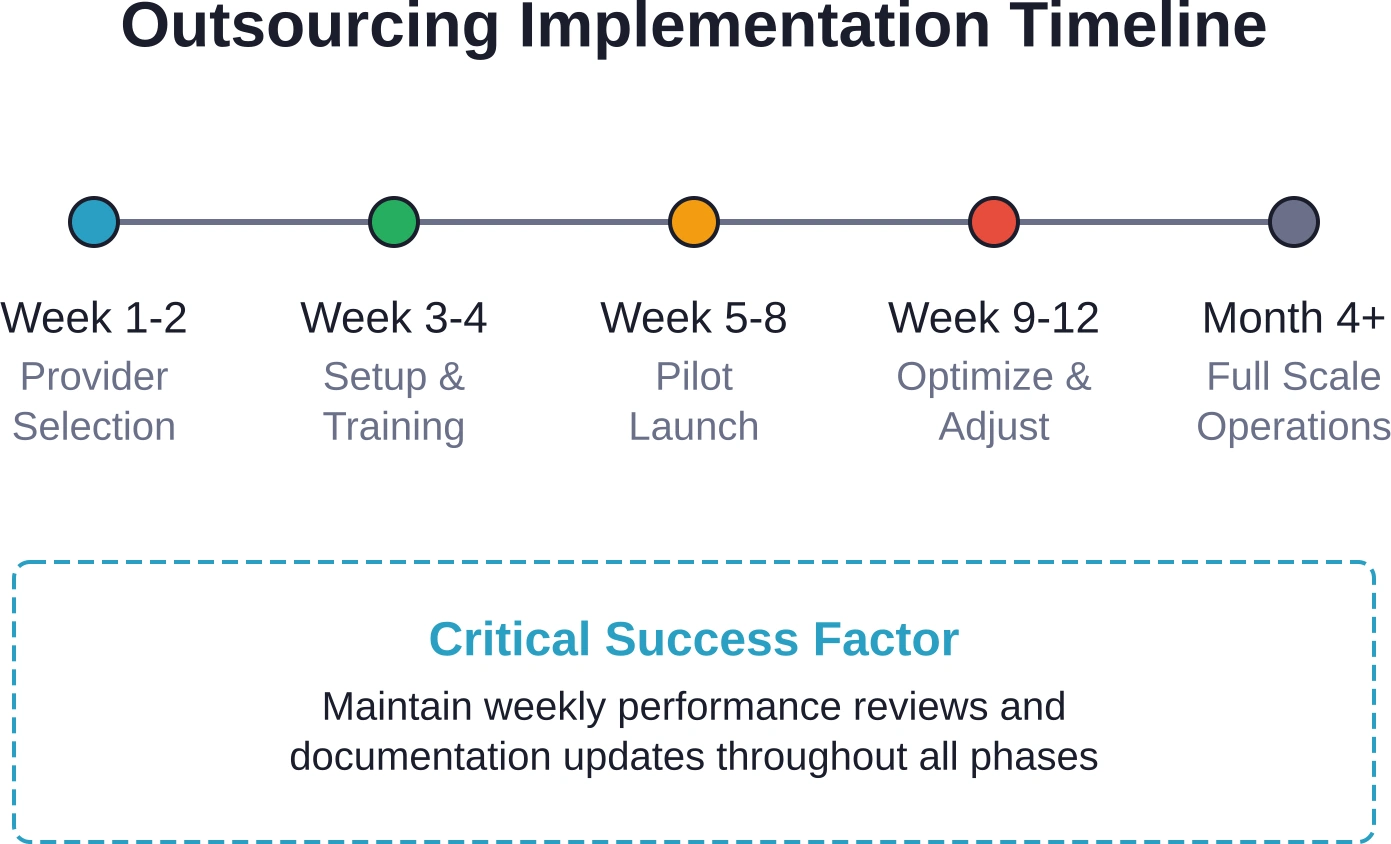
Even excellent providers fail without proper implementation. The transition phase determines long-term success.
Start Small and Specific
Don't outsource the entire customer service operation on day one. Pilot with a single function—after-hours call answering, or lead qualification for one marketing channel.
This contained scope allows testing provider capabilities, ironing out communication protocols, and building confidence before expanding. Failures hurt less. Successes build momentum.
Document Everything
Outsourced teams can't read minds. Create detailed process documentation: call scripts, response templates, escalation criteria, FAQs, CRM workflows, and approval authorities.
The more comprehensive the documentation, the better the execution. Invest time upfront building training materials and reference guides. Update them as processes evolve.
Establish Clear Performance Metrics
Define success quantitatively. Service level agreements should specify measurable targets: response time (under 2 minutes for calls, under 30 minutes for emails), resolution rates, customer satisfaction scores, lead conversion rates, data accuracy percentages.
Track metrics weekly initially, then monthly once operations stabilize. Hold regular performance reviews and adjust tactics based on data trends.
Maintain Regular Communication
Schedule daily or weekly check-ins with outsourced team leads. Review challenging interactions, clarify policy questions, provide market updates, and gather feedback on process improvements.
Communication gaps breed errors. Overcommunicate during the first 90 days, then settle into sustainable rhythms.
Invest in Training
Onboarding shouldn't stop after week one. Provide ongoing training on new listings, market shifts, technology updates, and service quality expectations.
Some firms fly outsourced team leads to headquarters quarterly for immersion training. Others conduct monthly webinar sessions. Knowledge transfer requires continuous investment, not one-time setup.
Build Redundancy Into Workflows
Never create single points of failure. Cross-train multiple team members on critical functions. Maintain updated documentation so coverage exists when individuals leave.
Deloitte's Build-Operate-Transform-Transfer model emphasizes building sustainable operations that don't collapse when specific people depart. Structure teams, not individual dependencies.
Common Pitfalls and How to Avoid Them
Real talk: plenty of outsourcing initiatives crash and burn. Here's what goes wrong and how to prevent it.
Inadequate Quality Control
Without monitoring, quality drifts. Mystery shop the outsourced team regularly—submit test inquiries, request callbacks, evaluate chat interactions. Listen to recorded calls randomly.
One Deloitte client was auditing over 90% of processed invoices because quality had eroded so badly under a previous BPO arrangement. Prevention requires ongoing vigilance, not blind trust.
Cultural and Communication Mismatches
Offshore teams sometimes miss cultural nuances—U.S. communication styles, regional idioms, local market references. This creates awkward client interactions that damage brand perception.
Mitigation requires cultural training for outsourced staff and realistic client expectation-setting. If cultural fit proves impossible, consider nearshore or domestic alternatives despite higher costs.
Scope Creep and Mission Drift
Clear boundaries matter. When agents start asking outsourced teams to handle tasks outside the agreed scope, quality suffers and costs balloon.
Enforce scope discipline. Route out-of-scope requests through formal change processes. Adjust contracts when expanded services make sense, but don't let informal mission creep undermine structured operations.
Data Security Breaches
The FTC doesn't take data security lightly in real estate contexts. Establish strict access controls—outsourced staff should only access data necessary for their specific functions.
Implement audit trails tracking who accessed what information when. Require regular security training. Schedule annual third-party security audits. Build breach response plans before incidents occur.
Over-Dependence Without Strategic Value
Outsourcing should support strategic goals, not just cut costs. If the activity doesn't free agents for higher-value work or improve client experience, reconsider the decision.
MIT research on strategic outsourcing emphasizes leveraging knowledge capabilities—focusing internal resources on core competencies while outsourcing non-differentiating functions. Outsource admin work and routine communication, not client relationship strategy and negotiation expertise.
Alternatives to Traditional Outsourcing
Full-service outsourcing isn't the only model. Alternatives suit different scenarios.
Hybrid Models
Some firms outsource after-hours and overflow volume only, maintaining in-house teams for normal business hours. This balances cost control with quality assurance.
Others use outsourced teams for initial lead qualification and appointment setting, then transition qualified prospects to internal agents for relationship building. The hybrid approach leverages outsourcing efficiency while preserving high-touch client experiences.
Technology-First Automation
AI chatbots, automated email responders, and self-service portals handle routine inquiries without human intervention. When automation can't resolve issues, escalation goes to either internal or outsourced teams.
The NAR virtual tour playbook notes that technology investments reduce manual workload—virtual tour scanning and processing can take one to two hours depending on the size of the property, but eliminates ongoing showing coordination time.
Automation complements rather than replaces outsourcing. The best setups use technology for simple tasks and humans for complex interactions.
Build-Operate-Transfer Models
Deloitte's BOTT approach builds an outsourced operation initially, then transfers it to internal ownership once processes stabilize and staff are trained.
This model suits firms planning long-term in-house expansion but needing immediate operational capacity. The provider establishes the function, proves the model, then hands off a turnkey operation.
Industry-Specific Considerations
Residential Real Estate
High lead volumes, short sales cycles, and emotional client relationships characterize residential markets. Outsourced teams must balance efficiency with empathy—buyers and sellers need reassurance, not just information.
Focus outsourcing on lead qualification, showing coordination, and transaction paperwork. Keep relationship management and negotiation in-house where personal connection drives value.
Commercial Real Estate
Commercial transactions involve longer sales cycles, higher dollar values, and more complex due diligence. Outsourced support works well for research tasks, document management, and initial prospect outreach.
However, commercial clients expect sophisticated expertise. Limit outsourcing to clearly defined support roles rather than client-facing advisory functions.
Property Management
Property management generates repetitive tenant inquiries, maintenance requests, and lease administration—ideal outsourcing candidates.
Industry partners in real estate management specialize in multifamily operations, HOA management, and commercial property oversight. Specialized providers deliver better results than generic call centers.
Measuring ROI and Success
Track these metrics to quantify outsourcing value:
The ultimate test: does outsourcing enable revenue growth that exceeds its cost? If agents close more deals because they're freed from admin work, the ROI justifies the investment.
Moving Forward With Strategic Outsourcing
Real estate customer service outsourcing works when approached strategically, not as a desperate cost-cutting measure.
The firms seeing the best results start with clear objectives—what specific outcomes justify the investment? They pilot small, measure rigorously, and scale gradually. They invest in provider relationships, maintain quality oversight, and adjust based on performance data.
Most importantly, they view outsourcing as a strategic tool to refocus agent time on revenue-generating activities, not just an operational expense to minimize.
BPO providers are moving up the value chain according to Wharton research, handling increasingly complex knowledge work beyond basic call answering. The organizations leveraging this shift strategically—matching the right tasks to the right providers with proper implementation—gain competitive advantages their rivals miss.
The housing market's pace won't slow down. Client expectations won't lower. Administrative burdens won't shrink. Outsourcing offers a proven path to scale operations, improve service consistency, and free professionals to focus on what actually drives business growth.
Start evaluating providers, document current processes, and pilot one specific function. Measure results honestly. Adjust approach based on data. The firms executing this playbook consistently report reclaimed time, improved client satisfaction, and stronger bottom lines.
Frequently Asked Questions
Topics
Real Estate Customer Service Outsourcing Guide 2026

Quick Summary: Real estate customer service outsourcing enables brokerages, property managers, and agencies to delegate client communication, lead management, and administrative tasks to specialized external providers. This guide covers benefits like cost savings of 50-60%, improved response times that boost referrals by 20-30%, and key considerations including provider selection, service scope, data security, and implementation best practices.
The housing market doesn't sleep. Leads arrive at midnight, clients expect instant responses, and administrative work piles up while agents chase closings. For real estate professionals juggling property showings, contract negotiations, and client relationships, operational tasks consume significant time weekly according to industry analyses.
That's where outsourcing steps in.
Real estate customer service outsourcing hands off routine client interactions, lead qualification, appointment scheduling, and back-office tasks to specialized external teams. The result? Agents reclaim time for high-value activities while clients get faster, more consistent communication.
But here's the thing—not all outsourcing arrangements deliver. Poor provider selection leads to quality erosion, security gaps, and disappointed clients. This guide walks through what works, what to avoid, and how to build an outsourcing strategy that actually scales operations without sacrificing service quality.
What Real Estate Customer Service Outsourcing Actually Covers
Real estate outsourcing isn't a single service. It's a spectrum of functions that external providers can handle, from simple call answering to complex transaction coordination.
Inbound Customer Support
External teams field incoming calls, emails, and chat messages from prospects and existing clients. This includes property inquiries, showing requests, contract questions, and general assistance.
Call centers handle initial screening—capturing lead details, qualifying interest level, and routing urgent matters to agents. According to National Association of Realtors resources, personalized communication strategies can drive engagement and participation.
Outbound Lead Management
Outsourced teams conduct proactive outreach: follow-up calls on submitted inquiries, appointment confirmations, feedback collection after showings, and nurture campaigns for cold leads.
Responding to inquiries within minutes instead of hours can improve client engagement and referral potential based on industry practice. Outbound campaigns keep the pipeline warm without pulling agents from active deals.
Administrative Support
Virtual assistants manage data entry, CRM updates, document preparation, listing coordination, and transaction paperwork. This category accounts for the bulk of that 80-85% operational time drain.
Tasks include uploading photos to MLS platforms, scheduling photographer appointments, preparing marketing materials, and maintaining client databases. These don't require an agent's license but consume hours daily.
Property Management Operations
For property managers, outsourcing extends to tenant screening, maintenance request triage, rent collection reminders, lease renewals, and owner communications.
External teams handle routine tenant questions, coordinate repair scheduling, and escalate urgent issues—freeing property managers to focus on portfolio growth and complex tenant situations.
Improve Real Estate Customer Service With NeoWork
Real estate businesses often handle inquiries from buyers, sellers, tenants, and property owners throughout the day. NeoWork provides staffing and operational support that can help teams manage customer communication and day-to-day service tasks.
Need Additional Real Estate Customer Support?
NeoWork can help with:
- customer communication
- tenant and client support
- appointment coordination
- administrative assistance
👉 Contact NeoWork to discuss your real estate support needs.
The Business Case: Why Real Estate Firms Outsource
Cost reduction drives initial interest, but the strategic benefits run deeper.
Direct Cost Savings
Hiring full-time staff for customer service roles in the U.S. typically requires significant annual salary investments, plus benefits, equipment, and office space. Outsourcing to the Philippines or India typically provides cost advantages compared to U.S.-based hiring.
This translates to substantially lower annual costs for a full-time equivalent—savings of 50-60% compared to U.S.-based employees. Eastern European providers offer regional pricing alternatives with cost advantages.
Virtual assistants typically offer cost advantages compared to local administrative hires. The math favors outsourcing particularly for routine, repeatable tasks that don't require physical presence.
Operational Flexibility
Markets fluctuate. Interest rate changes swing buyer demand, seasonal patterns affect inventory, and economic conditions create boom-bust cycles.
Outsourced teams scale quickly—adding capacity during busy seasons, reducing during slowdowns. No severance costs, no unemployment claims, no fixed overhead during lean periods. Strategic outsourcing substantially lowers risks and fixed investments, as MIT Sloan research on knowledge capabilities demonstrates.
Extended Coverage Hours
Offshore teams provide round-the-clock coverage without overtime costs. A Philippine team handles U.S. business hours during their daytime, while also capturing after-hours inquiries that local staff would miss.
Real estate doesn't respect 9-to-5 boundaries. Leads submit inquiries at 10 PM on Sunday. Outsourced teams respond immediately, capturing interest before it cools.
Quality and Consistency Improvements
Here's where it gets interesting. Properly managed outsourcing can actually improve service quality.
Deloitte case studies document quality improvements with structured outsourcing. One global delivery company reduced invoice audits from over 90% to much lower levels after implementing operational improvements, with productivity increases projected over 18 months.
Dedicated outsourced teams develop expertise, follow standardized scripts, and maintain consistent communication protocols. Internal staff juggling multiple priorities deliver uneven quality. Specialized external teams stick to their swim lane.
Cost Breakdown: What to Budget
Pricing varies widely based on geography, service complexity, and provider model.
Most providers require minimum commitments—typically 20-40 hours weekly or monthly retainers. Project-based pricing for virtual tours typically ranges from $200 to $500 when bundled with photography and floor plans according to NAR data.
Strategic outsourcing can enable significant productivity gains and revenue improvements as documented in MIT Sloan research on outsourcing best practices.
Selecting the Right Outsourcing Provider
Provider selection makes or breaks the initiative. Poor choices create more problems than they solve.
Real Estate Industry Experience
Generic call centers struggle with real estate terminology, transaction workflows, and regulatory nuances. Look for providers with real estate portfolios—teams that understand MLS systems, escrow processes, fair housing regulations, and local market dynamics.
Ask prospective providers about their real estate client roster, average agent tenure, and training programs specific to property transactions.
Technology Integration Capabilities
The provider must plug into existing systems: CRM platforms like Salesforce or Follow Up Boss, MLS databases, property management software, communication tools like Slack or Microsoft Teams.
Seamless integration means agents see real-time updates in their systems without manual transfers. Data flows automatically. Check integration lists and API capabilities before committing.
Communication Quality Standards
Language proficiency matters enormously. Request sample calls or chat transcripts. Assess accent clarity, grammar accuracy, and cultural fluency.
Some clients tolerate offshore accents for cost savings; others demand native-level communication. Match provider communication quality to customer base expectations. Premium U.S. clients often require nearshore or domestic outsourcing despite higher costs.
Security and Compliance Frameworks
Real estate transactions involve Social Security numbers, financial statements, property addresses, and personal client data. The Federal Trade Commission has prosecuted real estate services companies for inadequate data safeguards.
Verify providers maintain physical, electronic, and procedural safeguards. Look for SOC 2 certification, GDPR compliance for international clients, and clear data handling policies. Contracts must specify data ownership, breach notification procedures, and liability terms.
Scalability and Redundancy
What happens when call volume spikes? When a team member leaves? When local disasters disrupt provider operations?
Solid providers maintain excess capacity, cross-train team members, and operate multiple facilities for business continuity. Ask about surge capacity, backup communication channels, and disaster recovery protocols.
Implementation Best Practices
Even excellent providers fail without proper implementation. The transition phase determines long-term success.
Start Small and Specific
Don't outsource the entire customer service operation on day one. Pilot with a single function—after-hours call answering, or lead qualification for one marketing channel.
This contained scope allows testing provider capabilities, ironing out communication protocols, and building confidence before expanding. Failures hurt less. Successes build momentum.
Document Everything
Outsourced teams can't read minds. Create detailed process documentation: call scripts, response templates, escalation criteria, FAQs, CRM workflows, and approval authorities.
The more comprehensive the documentation, the better the execution. Invest time upfront building training materials and reference guides. Update them as processes evolve.
Establish Clear Performance Metrics
Define success quantitatively. Service level agreements should specify measurable targets: response time (under 2 minutes for calls, under 30 minutes for emails), resolution rates, customer satisfaction scores, lead conversion rates, data accuracy percentages.
Track metrics weekly initially, then monthly once operations stabilize. Hold regular performance reviews and adjust tactics based on data trends.
Maintain Regular Communication
Schedule daily or weekly check-ins with outsourced team leads. Review challenging interactions, clarify policy questions, provide market updates, and gather feedback on process improvements.
Communication gaps breed errors. Overcommunicate during the first 90 days, then settle into sustainable rhythms.
Invest in Training
Onboarding shouldn't stop after week one. Provide ongoing training on new listings, market shifts, technology updates, and service quality expectations.
Some firms fly outsourced team leads to headquarters quarterly for immersion training. Others conduct monthly webinar sessions. Knowledge transfer requires continuous investment, not one-time setup.
Build Redundancy Into Workflows
Never create single points of failure. Cross-train multiple team members on critical functions. Maintain updated documentation so coverage exists when individuals leave.
Deloitte's Build-Operate-Transform-Transfer model emphasizes building sustainable operations that don't collapse when specific people depart. Structure teams, not individual dependencies.
Common Pitfalls and How to Avoid Them
Real talk: plenty of outsourcing initiatives crash and burn. Here's what goes wrong and how to prevent it.
Inadequate Quality Control
Without monitoring, quality drifts. Mystery shop the outsourced team regularly—submit test inquiries, request callbacks, evaluate chat interactions. Listen to recorded calls randomly.
One Deloitte client was auditing over 90% of processed invoices because quality had eroded so badly under a previous BPO arrangement. Prevention requires ongoing vigilance, not blind trust.
Cultural and Communication Mismatches
Offshore teams sometimes miss cultural nuances—U.S. communication styles, regional idioms, local market references. This creates awkward client interactions that damage brand perception.
Mitigation requires cultural training for outsourced staff and realistic client expectation-setting. If cultural fit proves impossible, consider nearshore or domestic alternatives despite higher costs.
Scope Creep and Mission Drift
Clear boundaries matter. When agents start asking outsourced teams to handle tasks outside the agreed scope, quality suffers and costs balloon.
Enforce scope discipline. Route out-of-scope requests through formal change processes. Adjust contracts when expanded services make sense, but don't let informal mission creep undermine structured operations.
Data Security Breaches
The FTC doesn't take data security lightly in real estate contexts. Establish strict access controls—outsourced staff should only access data necessary for their specific functions.
Implement audit trails tracking who accessed what information when. Require regular security training. Schedule annual third-party security audits. Build breach response plans before incidents occur.
Over-Dependence Without Strategic Value
Outsourcing should support strategic goals, not just cut costs. If the activity doesn't free agents for higher-value work or improve client experience, reconsider the decision.
MIT research on strategic outsourcing emphasizes leveraging knowledge capabilities—focusing internal resources on core competencies while outsourcing non-differentiating functions. Outsource admin work and routine communication, not client relationship strategy and negotiation expertise.
Alternatives to Traditional Outsourcing
Full-service outsourcing isn't the only model. Alternatives suit different scenarios.
Hybrid Models
Some firms outsource after-hours and overflow volume only, maintaining in-house teams for normal business hours. This balances cost control with quality assurance.
Others use outsourced teams for initial lead qualification and appointment setting, then transition qualified prospects to internal agents for relationship building. The hybrid approach leverages outsourcing efficiency while preserving high-touch client experiences.
Technology-First Automation
AI chatbots, automated email responders, and self-service portals handle routine inquiries without human intervention. When automation can't resolve issues, escalation goes to either internal or outsourced teams.
The NAR virtual tour playbook notes that technology investments reduce manual workload—virtual tour scanning and processing can take one to two hours depending on the size of the property, but eliminates ongoing showing coordination time.
Automation complements rather than replaces outsourcing. The best setups use technology for simple tasks and humans for complex interactions.
Build-Operate-Transfer Models
Deloitte's BOTT approach builds an outsourced operation initially, then transfers it to internal ownership once processes stabilize and staff are trained.
This model suits firms planning long-term in-house expansion but needing immediate operational capacity. The provider establishes the function, proves the model, then hands off a turnkey operation.
Industry-Specific Considerations
Residential Real Estate
High lead volumes, short sales cycles, and emotional client relationships characterize residential markets. Outsourced teams must balance efficiency with empathy—buyers and sellers need reassurance, not just information.
Focus outsourcing on lead qualification, showing coordination, and transaction paperwork. Keep relationship management and negotiation in-house where personal connection drives value.
Commercial Real Estate
Commercial transactions involve longer sales cycles, higher dollar values, and more complex due diligence. Outsourced support works well for research tasks, document management, and initial prospect outreach.
However, commercial clients expect sophisticated expertise. Limit outsourcing to clearly defined support roles rather than client-facing advisory functions.
Property Management
Property management generates repetitive tenant inquiries, maintenance requests, and lease administration—ideal outsourcing candidates.
Industry partners in real estate management specialize in multifamily operations, HOA management, and commercial property oversight. Specialized providers deliver better results than generic call centers.
Measuring ROI and Success
Track these metrics to quantify outsourcing value:
The ultimate test: does outsourcing enable revenue growth that exceeds its cost? If agents close more deals because they're freed from admin work, the ROI justifies the investment.
Moving Forward With Strategic Outsourcing
Real estate customer service outsourcing works when approached strategically, not as a desperate cost-cutting measure.
The firms seeing the best results start with clear objectives—what specific outcomes justify the investment? They pilot small, measure rigorously, and scale gradually. They invest in provider relationships, maintain quality oversight, and adjust based on performance data.
Most importantly, they view outsourcing as a strategic tool to refocus agent time on revenue-generating activities, not just an operational expense to minimize.
BPO providers are moving up the value chain according to Wharton research, handling increasingly complex knowledge work beyond basic call answering. The organizations leveraging this shift strategically—matching the right tasks to the right providers with proper implementation—gain competitive advantages their rivals miss.
The housing market's pace won't slow down. Client expectations won't lower. Administrative burdens won't shrink. Outsourcing offers a proven path to scale operations, improve service consistency, and free professionals to focus on what actually drives business growth.
Start evaluating providers, document current processes, and pilot one specific function. Measure results honestly. Adjust approach based on data. The firms executing this playbook consistently report reclaimed time, improved client satisfaction, and stronger bottom lines.
Frequently Asked Questions
Topics
Related Blogs
Related Podcasts


.webp)
.webp)



