

.avif)
.avif)

Real Estate Data Entry Outsourcing Guide 2026


.svg)

Quick Summary: Real estate data entry outsourcing involves partnering with specialized providers to handle property listings, tenant records, MLS updates, and transaction documentation. This guide covers how to select the right outsourcing partner, the cost savings and efficiency gains available, quality control measures, and emerging technologies transforming real estate data management in 2026.
The real estate industry moves fast. Properties list and sell within hours, leads pile up faster than teams can respond, and administrative tasks multiply daily. Data entry sits at the center of this chaos—property details, tenant records, MLS updates, transaction documents, and compliance paperwork all demand accurate, timely handling.
But here's the thing: most real estate professionals didn't get into the business to spend hours typing listing details into databases.
That's exactly why thousands of real estate businesses now partner with specialized data entry providers. Instead of hiring full-time clerks or burdening agents with administrative work, they hand off these specialized tasks to teams built specifically for accuracy and speed.
This guide walks through everything needed to make outsourcing work—from understanding what tasks to delegate, to selecting providers, managing quality, and measuring results.
What Is Real Estate Data Entry Outsourcing?
Real estate data entry outsourcing means contracting with external specialists to handle the input, maintenance, and management of property-related information. These providers take on repetitive data tasks so internal teams can focus on client relationships, closings, and revenue generation.
The scope typically includes:
- Property listing entry and updates across MLS platforms
- Tenant and lease record management
- Transaction documentation and digital filing
- Contact database maintenance for CRM systems
- Market research data compilation
- Property valuation data processing
- Compliance document digitization
Real talk: data entry isn't glamorous work. But it's absolutely essential. Inaccurate property details lose sales. Missing tenant records create legal headaches. Outdated MLS information frustrates buyers and damages reputations.
Why Real Estate Businesses Outsource Data Entry
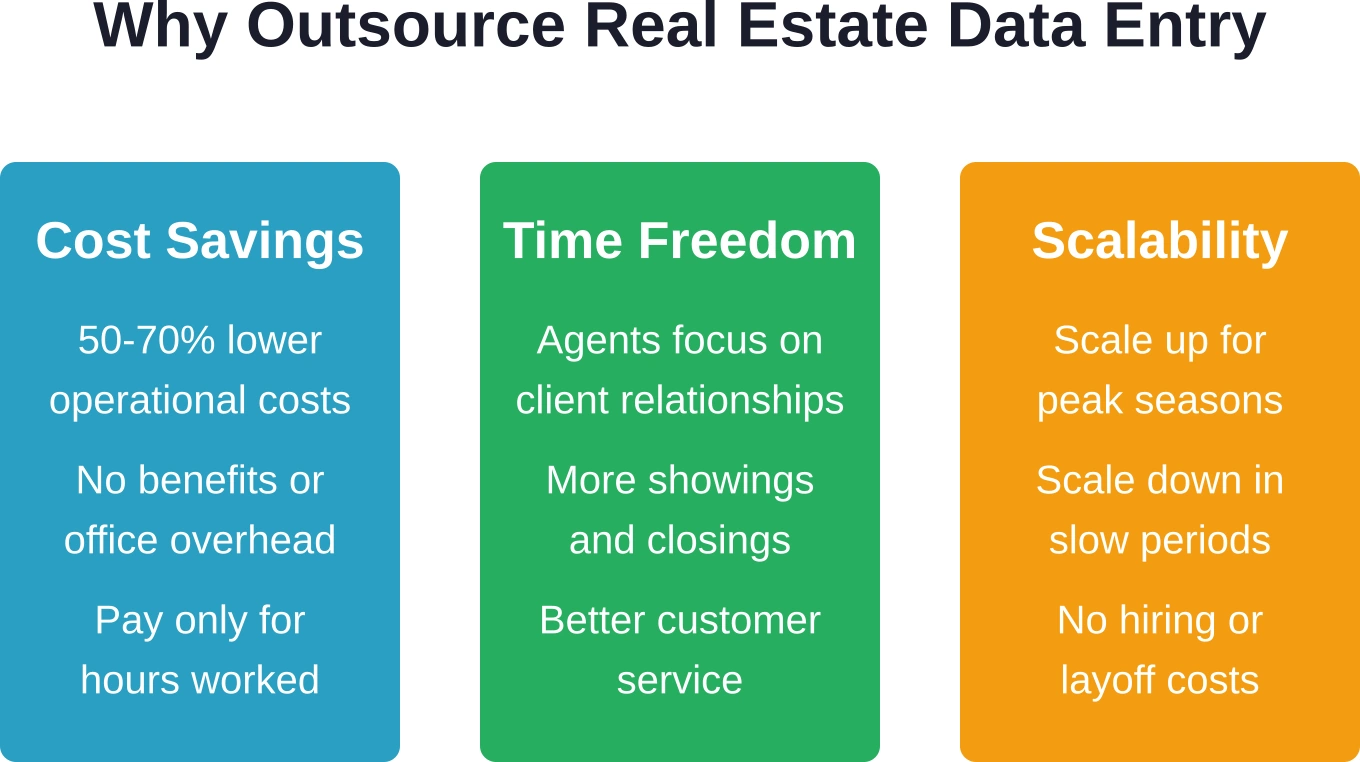
The decision to outsource typically comes down to three core drivers: cost reduction, operational efficiency, and scalability.
Cost Reduction That Actually Matters
Hiring full-time data entry staff means salaries, benefits, office space, equipment, and training costs. Offshore specialists are available at a fraction of that investment due to lower costs of living in popular outsourcing destinations.
Consider this: according to IAOP documentation, Bank of America utilized outsourced real estate partnerships to forecast needs and optimize workforce performance. While that's enterprise-scale, the principle holds—outsourcing converts fixed labor costs into variable expenses that scale with business needs.
Small to mid-size firms see similar percentage gains. Instead of paying $35,000-$45,000 annually per full-time clerk, outsourcing partners often charge $11 per hour and up, and clients only pay for hours actually worked.
Focus on Revenue-Generating Activities
Real estate agents and brokers generate revenue through client interactions, property showings, negotiations, and closings. Every hour spent on data entry is an hour not spent on those high-value activities.
Outsourcing shifts that workload to specialists who handle nothing but data tasks. Agents reclaim time. Productivity increases. Client satisfaction improves when professionals are actually available to answer calls and attend showings.
Scalability Without Hiring Headaches
Market conditions change. Inventory surges in spring selling season, then slows in winter. Hiring permanent staff for peak periods leaves businesses overstaffed during slow months.
Outsourcing providers scale teams up or down based on current needs. Need 150 trained resources for a large-scale geo-tagging project? Providers can deploy that capacity. Project complete? Scale back down without layoffs or severance costs.
Manage Real Estate Data More Efficiently With NeoWork

Keeping property records, listings, documents, and databases up to date requires ongoing attention. NeoWork provides staffing and operational support that can help real estate teams handle these tasks more efficiently.
Need Help With Real Estate Data Entry?
NeoWork can help with:
- property data updates
- records management
- document organization
- administrative support
👉 Contact NeoWork to discuss your real estate operations needs.
Common Real Estate Data Entry Tasks to Outsource
Not all data work makes sense to outsource. Tasks that require deep local market knowledge or sensitive client negotiations typically stay in-house. But high-volume, repetitive data processing? Perfect candidates.
MLS and Property Listing Management
Multiple Listing Service entries require detailed property information—addresses, square footage, bed and bath counts, amenity lists, pricing, photos, and descriptions. Updating these across multiple platforms consumes significant time.
Outsourced teams handle bulk listing uploads, regular updates as properties sell or prices change, and ensuring consistency across all platforms where listings appear.
Tenant and Lease Records
Property management generates mountains of paperwork: lease agreements, tenant applications, payment histories, maintenance requests, move-in and move-out inspections. Keeping this organized and accessible matters for operations and legal compliance.
Data entry specialists digitize paper records, maintain tenant databases, track lease renewals and expirations, and ensure quick retrieval when information is needed.
Transaction Documentation
Every real estate transaction produces contracts, disclosures, inspection reports, appraisals, title documents, and closing paperwork. These need accurate filing for regulatory compliance and future reference.
Outsourced teams organize digital filing systems, index documents for searchability, and maintain transaction histories that support audits and client questions down the line.
CRM Database Maintenance
Contact management systems only work when data stays current. Lead information, client preferences, communication histories, and follow-up schedules all require ongoing updates.
Providers handle contact record creation and updates, duplicate detection and merging, data enrichment from public sources, and list segmentation for marketing campaigns.
How to Choose the Right Data Entry Outsourcing Provider
The market's crowded with providers promising accuracy and low costs. Some deliver. Others don't. Here's what separates the reliable partners from the headache-generators.
Industry Experience and Specialization
Real estate data comes with unique requirements—MLS platform familiarity, understanding property terminology, recognizing red flags in listing details, knowing compliance requirements for different jurisdictions.
Look for providers with demonstrated real estate experience. Ask for case studies. Request client references from similar businesses. Generic data entry shops often miss nuances that specialized providers catch automatically.
Quality Control Processes
Accuracy isn't optional in real estate. A wrong square footage number loses a sale. An incorrect lease date creates legal problems. A transposed phone number means a lost lead.
Strong providers implement multi-level verification: initial data entry by a first operator, independent review by a second operator, automated validation against expected formats and ranges, and sample audits by quality supervisors.
Ask specific questions: What's the error rate in recent projects? How are errors tracked and addressed? What happens when mistakes are discovered?
Data Security and Compliance
Real estate data includes personal information, financial details, and legally privileged documents. Providers must protect this information rigorously.
Look for certifications like ISO 27001 for information security management. Ask about data encryption in transit and at rest, access controls limiting who sees what data, employee background screening, non-disclosure agreements, and secure data destruction protocols.
For businesses subject to specific regulations, verify the provider understands and complies with those requirements.
Technology and Integration Capabilities
Modern data entry isn't just typing. Providers should work with the platforms businesses actually use—direct MLS integration, CRM API connections, cloud storage systems, and property management software.
Ask about the technology stack. Can they work directly in client systems, or do they require file exports and imports? Do they use automation tools for validation and formatting? How do they handle version control when multiple people update the same records?
Communication and Support Structure
Time zones matter. When the property market's most active might be nighttime for offshore teams. Understand how the provider handles real-time questions and urgent updates.
Strong providers assign dedicated account managers, offer multiple communication channels (email, phone, chat, project management platforms), provide regular status updates without prompting, and maintain clear escalation paths for issues.
Pricing Models and Hidden Costs
Providers structure pricing different ways: per-hour rates, per-record fees, monthly retainers, or hybrid models. Each has pros and cons.
Hourly rates offer flexibility but can balloon if work takes longer than expected. Per-record pricing provides predictability but may not account for complex records requiring extra time. Retainers guarantee capacity but might go underutilized in slow periods.
Watch for hidden costs: setup fees, training charges, technology access fees, minimum monthly commitments, rush fees for tight deadlines, and termination penalties.
Setting Up a Successful Outsourcing Partnership
Picking a provider is just step one. Making the partnership actually work requires intentional setup and ongoing management.
Document Standard Operating Procedures
The provider can't read minds. Document exactly how work should be done—data formats, naming conventions, categorization rules, required fields, validation steps, and approval workflows.
These standard operating procedures become the training manual and the quality benchmark. The clearer the documentation, the faster new team members get up to speed and the more consistent the output.
Start With a Pilot Project
Don't hand over the entire operation on day one. Run a small pilot—perhaps one week of MLS updates or a single month of tenant records—to test accuracy, turnaround time, communication, and problem-solving.
Evaluate results honestly. If issues arise, do they get fixed quickly? Does the team learn from mistakes? Are they proactive about suggesting improvements?
A successful pilot builds confidence before scaling up. A problematic pilot reveals whether issues are temporary growing pains or fundamental incompatibilities.
Establish Clear Performance Metrics
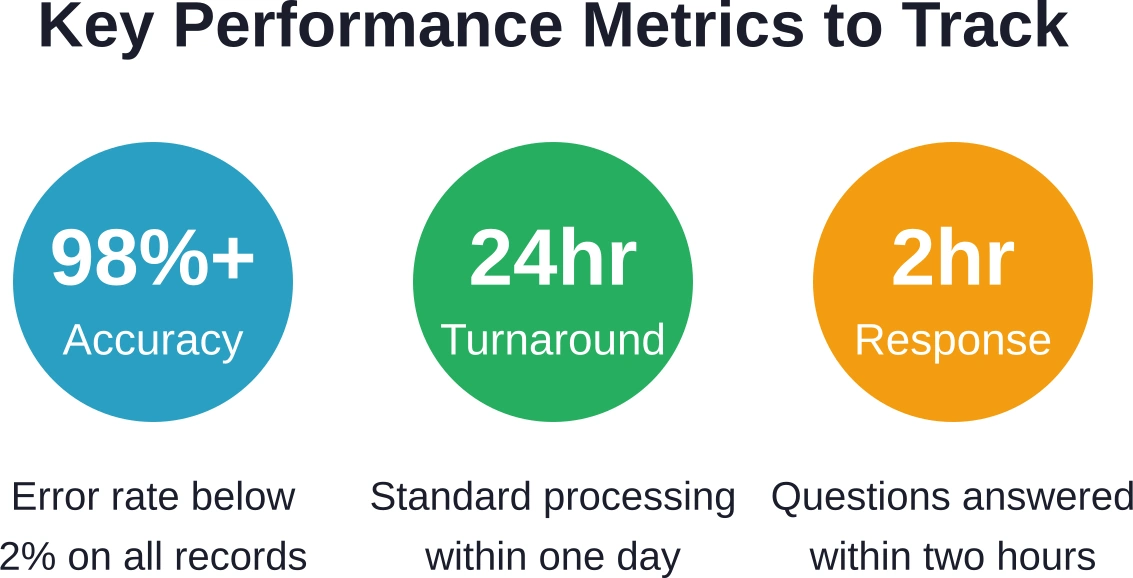
Define success quantitatively. Accuracy targets (typically 98-99.5% depending on task complexity), turnaround time commitments (same-day, 24-hour, 48-hour), volume capacity, and responsiveness standards.
Track these metrics consistently. Monthly scorecards keep everyone accountable and provide early warning when performance drifts.
Build Feedback Loops
Regular check-ins prevent small issues from becoming big problems. Weekly status calls during the initial months, then biweekly or monthly once operations stabilize.
Create channels for the outsourced team to ask questions and flag uncertainties. A team afraid to ask clarifying questions will guess instead—and guesses lead to errors.
Managing Quality and Accuracy
Quality doesn't maintain itself. Even experienced providers need ongoing oversight and feedback.
Random Sample Audits
Don't wait for errors to surface through customer complaints. Conduct regular random audits—pull 50-100 records monthly, verify accuracy, and calculate error rates.
Share results with the provider. When error rates climb, investigate root causes. Are instructions unclear? Has a new team member joined who needs additional training? Did system changes introduce confusion?
Address Issues Immediately
When mistakes happen, document them specifically and share examples with the provider. Vague feedback like "there were some errors" doesn't help. Specific feedback like "15 records had incorrect property types because ranch-style homes were coded as townhouses" enables targeted correction.
Strong providers welcome this feedback and demonstrate improvement. Defensive providers who resist acknowledging problems typically don't last as partners.
Continuous Process Improvement
As the partnership matures, look for optimization opportunities. Can automation handle certain validation steps? Would additional training reduce specific error types? Could workflow changes improve turnaround time?
The best provider relationships become collaborative partnerships where both sides actively work to improve processes.
Technology Trends Shaping Real Estate Data Entry
The data entry landscape is evolving. Providers incorporating these technologies deliver better results.
Artificial Intelligence and Machine Learning
AI tools now extract data from unstructured documents—pulling property details from PDFs, recognizing text in images, auto-populating fields from scanned contracts. This reduces manual typing and speeds processing.
Machine learning algorithms catch anomalies—flagging when a property price seems out of range for the neighborhood, or when square footage doesn't align with bedroom count. These smart validations improve accuracy.
Robotic Process Automation
RPA handles repetitive tasks: copying data between systems, formatting records to match platform requirements, generating standardized reports. Bots don't get tired or make transcription errors on their hundredth record of the day.
The most effective approach combines RPA for routine tasks with human operators for complex judgment calls and exception handling.
Cloud-Based Collaboration Platforms
Modern providers work directly in cloud systems—Google Workspace, Microsoft 365, various real estate platforms—with appropriate access controls. This eliminates file exports and imports, reduces version control problems, and provides real-time visibility into work progress.
Common Challenges and How to Overcome Them
Outsourcing isn't always smooth sailing. These challenges come up frequently, but they're all manageable with the right approach.
Communication Barriers
Time zone differences and potential language variations can slow communication. Overcome this by establishing overlap hours when both teams are available, using asynchronous communication tools effectively (detailed emails, shared documentation, project management platforms), and ensuring the provider assigns team members with strong communication skills to the account.
Knowledge Transfer
Getting a new team up to speed on business-specific processes takes time. Invest in thorough documentation, record video tutorials showing how to handle common tasks, and expect a ramp-up period where accuracy might not hit target levels immediately.
Process optimization in outsourcing can deliver significant cost reductions when implemented effectively. Similar process optimization applies to data entry—documenting and streamlining workflows before outsourcing makes knowledge transfer faster and more effective.
Data Security Concerns
Handing sensitive information to external parties feels risky. Mitigate this through strong contracts with clear data handling requirements, technical controls like encryption and access logging, regular security audits, and working only with providers who maintain relevant security certifications.
Quality Inconsistency
Performance sometimes varies—great accuracy one month, more errors the next. This often signals team turnover at the provider. Address it by requesting stable team assignments, cross-training multiple operators on the account so coverage continues if someone leaves, and implementing more frequent quality checks when inconsistency appears.
Measuring Return on Investment
How do businesses know if outsourcing actually delivers value? Track these metrics.
Direct Cost Savings
Calculate total cost of in-house data entry—salaries, benefits, payroll taxes, equipment, software, office space—versus total outsourcing fees. Most businesses see 40-60% reduction in direct costs.
Time Reclaimed
Measure how many hours per week agents and staff previously spent on data entry, then multiply by average hourly billing rates or opportunity cost. A single agent reclaiming 10 hours weekly for client-facing activities can generate substantial additional revenue.
Error Reduction Value
Errors cost money—lost deals from incorrect listings, legal issues from wrong lease dates, duplicate marketing to the same contact. Quantify historical error rates and their costs, then measure improvement under the outsourced model.
Scalability Benefits
The ability to handle volume spikes without hiring delays or turning away business has real value. Track times when the business scaled data entry capacity quickly to capture opportunities that would otherwise have been missed.
Who Benefits Most From Outsourcing Real Estate Data Entry
Outsourcing isn't right for every situation. These businesses typically see the strongest returns.
High-Volume Brokerages
Firms managing hundreds or thousands of listings monthly accumulate data entry work faster than most internal teams can process. Outsourcing prevents backlogs and keeps information current across all platforms.
Property Management Companies
Managing multiple properties means tracking countless tenant records, maintenance requests, financial transactions, and lease documents. Specialized data teams keep these systems organized and accessible.
Growing Real Estate Teams
When businesses expand into new markets or add agents, data volume grows but margins might not support proportional administrative staff increases. Outsourcing scales more economically than hiring.
Firms With Seasonal Fluctuations
Markets with strong seasonal patterns—think beach communities or college towns—see data entry needs spike and drop dramatically. Outsourcing eliminates the need to maintain year-round staff for peak-season work.
Making the Transition to Outsourced Data Entry
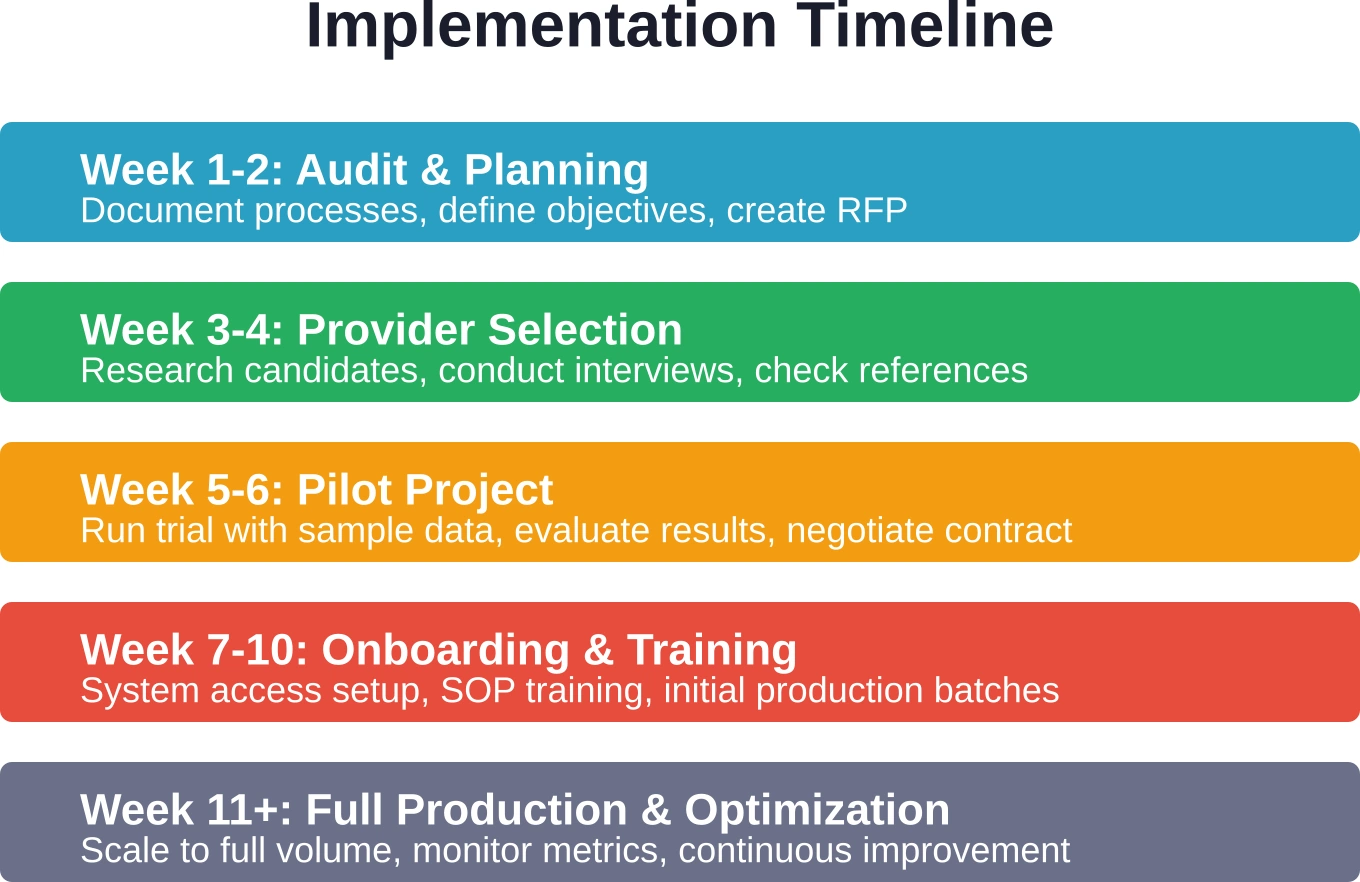
Ready to move forward? Here's a practical implementation roadmap.
Audit Current Data Processes
Document everything currently being done—task types, volumes, time requirements, accuracy rates, and costs. This baseline enables measuring improvement and helps providers understand exact requirements.
Define Clear Objectives
What needs to improve? Cost reduction? Faster turnaround? Better accuracy? Freed-up time for revenue-generating activities? Clear goals guide provider selection and establish success criteria.
Research and Shortlist Providers
Look beyond price. Evaluate industry experience, quality processes, security measures, technology capabilities, communication structure, and client references. Shortlist three to five candidates for detailed discussions.
Run Comprehensive Trials
Before committing, run paid pilot projects with top candidates. Provide identical sample work to each and evaluate results objectively on accuracy, turnaround, communication, and problem-solving.
Start Small and Scale Gradually
Begin with lower-risk, higher-volume tasks. As confidence builds and processes stabilize, gradually expand the scope. This staged approach minimizes disruption and allows both teams to learn together.
Maintain Ongoing Partnership Management
Outsourcing isn't set-it-and-forget-it. Schedule regular reviews, provide consistent feedback, share business updates that might affect data volume or requirements, and treat the provider as a strategic partner rather than just a vendor.
Conclusion: Taking the Next Step
Real estate success depends on relationships, market knowledge, and closing deals—not data entry. Yet accurate, current information underpins every transaction. Properties need listing. Tenants need tracking. Documents need filing. Contacts need managing.
Outsourcing shifts these specialized tasks to teams built specifically for accuracy and efficiency. The result? Lower operational costs, freed-up time for revenue-generating activities, and scalability that grows with the business without hiring headaches.
The key lies in selecting the right partner—one with real estate experience, proven quality processes, strong security measures, and collaborative communication. Start small, measure results, and scale gradually as confidence builds.
Strategic outsourcing can deliver significant operational improvements, as demonstrated by major corporations utilizing outsourced real estate partnerships.
For real estate professionals drowning in administrative work, outsourcing offers a practical path back to what they do best: serving clients and closing deals. The question isn't whether data entry needs handling—it's whether to keep handling it internally at high cost and low efficiency, or partner with specialists who deliver better results for less.
Ready to explore outsourcing for your real estate business? Start by auditing current data processes, defining clear objectives, and researching providers with demonstrated real estate expertise. A small pilot project tests the waters before full commitment, proving value and building confidence.
The administrative burden doesn't have to hold your business back. Strategic outsourcing turns data entry from a time-consuming cost center into a streamlined competitive advantage.
Frequently Asked Questions
Topics
Real Estate Data Entry Outsourcing Guide 2026

Quick Summary: Real estate data entry outsourcing involves partnering with specialized providers to handle property listings, tenant records, MLS updates, and transaction documentation. This guide covers how to select the right outsourcing partner, the cost savings and efficiency gains available, quality control measures, and emerging technologies transforming real estate data management in 2026.
The real estate industry moves fast. Properties list and sell within hours, leads pile up faster than teams can respond, and administrative tasks multiply daily. Data entry sits at the center of this chaos—property details, tenant records, MLS updates, transaction documents, and compliance paperwork all demand accurate, timely handling.
But here's the thing: most real estate professionals didn't get into the business to spend hours typing listing details into databases.
That's exactly why thousands of real estate businesses now partner with specialized data entry providers. Instead of hiring full-time clerks or burdening agents with administrative work, they hand off these specialized tasks to teams built specifically for accuracy and speed.
This guide walks through everything needed to make outsourcing work—from understanding what tasks to delegate, to selecting providers, managing quality, and measuring results.
What Is Real Estate Data Entry Outsourcing?
Real estate data entry outsourcing means contracting with external specialists to handle the input, maintenance, and management of property-related information. These providers take on repetitive data tasks so internal teams can focus on client relationships, closings, and revenue generation.
The scope typically includes:
- Property listing entry and updates across MLS platforms
- Tenant and lease record management
- Transaction documentation and digital filing
- Contact database maintenance for CRM systems
- Market research data compilation
- Property valuation data processing
- Compliance document digitization
Real talk: data entry isn't glamorous work. But it's absolutely essential. Inaccurate property details lose sales. Missing tenant records create legal headaches. Outdated MLS information frustrates buyers and damages reputations.
Why Real Estate Businesses Outsource Data Entry
The decision to outsource typically comes down to three core drivers: cost reduction, operational efficiency, and scalability.
Cost Reduction That Actually Matters
Hiring full-time data entry staff means salaries, benefits, office space, equipment, and training costs. Offshore specialists are available at a fraction of that investment due to lower costs of living in popular outsourcing destinations.
Consider this: according to IAOP documentation, Bank of America utilized outsourced real estate partnerships to forecast needs and optimize workforce performance. While that's enterprise-scale, the principle holds—outsourcing converts fixed labor costs into variable expenses that scale with business needs.
Small to mid-size firms see similar percentage gains. Instead of paying $35,000-$45,000 annually per full-time clerk, outsourcing partners often charge $11 per hour and up, and clients only pay for hours actually worked.
Focus on Revenue-Generating Activities
Real estate agents and brokers generate revenue through client interactions, property showings, negotiations, and closings. Every hour spent on data entry is an hour not spent on those high-value activities.
Outsourcing shifts that workload to specialists who handle nothing but data tasks. Agents reclaim time. Productivity increases. Client satisfaction improves when professionals are actually available to answer calls and attend showings.
Scalability Without Hiring Headaches
Market conditions change. Inventory surges in spring selling season, then slows in winter. Hiring permanent staff for peak periods leaves businesses overstaffed during slow months.
Outsourcing providers scale teams up or down based on current needs. Need 150 trained resources for a large-scale geo-tagging project? Providers can deploy that capacity. Project complete? Scale back down without layoffs or severance costs.
Manage Real Estate Data More Efficiently With NeoWork
Keeping property records, listings, documents, and databases up to date requires ongoing attention. NeoWork provides staffing and operational support that can help real estate teams handle these tasks more efficiently.
Need Help With Real Estate Data Entry?
NeoWork can help with:
- property data updates
- records management
- document organization
- administrative support
👉 Contact NeoWork to discuss your real estate operations needs.
Common Real Estate Data Entry Tasks to Outsource
Not all data work makes sense to outsource. Tasks that require deep local market knowledge or sensitive client negotiations typically stay in-house. But high-volume, repetitive data processing? Perfect candidates.
MLS and Property Listing Management
Multiple Listing Service entries require detailed property information—addresses, square footage, bed and bath counts, amenity lists, pricing, photos, and descriptions. Updating these across multiple platforms consumes significant time.
Outsourced teams handle bulk listing uploads, regular updates as properties sell or prices change, and ensuring consistency across all platforms where listings appear.
Tenant and Lease Records
Property management generates mountains of paperwork: lease agreements, tenant applications, payment histories, maintenance requests, move-in and move-out inspections. Keeping this organized and accessible matters for operations and legal compliance.
Data entry specialists digitize paper records, maintain tenant databases, track lease renewals and expirations, and ensure quick retrieval when information is needed.
Transaction Documentation
Every real estate transaction produces contracts, disclosures, inspection reports, appraisals, title documents, and closing paperwork. These need accurate filing for regulatory compliance and future reference.
Outsourced teams organize digital filing systems, index documents for searchability, and maintain transaction histories that support audits and client questions down the line.
CRM Database Maintenance
Contact management systems only work when data stays current. Lead information, client preferences, communication histories, and follow-up schedules all require ongoing updates.
Providers handle contact record creation and updates, duplicate detection and merging, data enrichment from public sources, and list segmentation for marketing campaigns.
How to Choose the Right Data Entry Outsourcing Provider
The market's crowded with providers promising accuracy and low costs. Some deliver. Others don't. Here's what separates the reliable partners from the headache-generators.
Industry Experience and Specialization
Real estate data comes with unique requirements—MLS platform familiarity, understanding property terminology, recognizing red flags in listing details, knowing compliance requirements for different jurisdictions.
Look for providers with demonstrated real estate experience. Ask for case studies. Request client references from similar businesses. Generic data entry shops often miss nuances that specialized providers catch automatically.
Quality Control Processes
Accuracy isn't optional in real estate. A wrong square footage number loses a sale. An incorrect lease date creates legal problems. A transposed phone number means a lost lead.
Strong providers implement multi-level verification: initial data entry by a first operator, independent review by a second operator, automated validation against expected formats and ranges, and sample audits by quality supervisors.
Ask specific questions: What's the error rate in recent projects? How are errors tracked and addressed? What happens when mistakes are discovered?
Data Security and Compliance
Real estate data includes personal information, financial details, and legally privileged documents. Providers must protect this information rigorously.
Look for certifications like ISO 27001 for information security management. Ask about data encryption in transit and at rest, access controls limiting who sees what data, employee background screening, non-disclosure agreements, and secure data destruction protocols.
For businesses subject to specific regulations, verify the provider understands and complies with those requirements.
Technology and Integration Capabilities
Modern data entry isn't just typing. Providers should work with the platforms businesses actually use—direct MLS integration, CRM API connections, cloud storage systems, and property management software.
Ask about the technology stack. Can they work directly in client systems, or do they require file exports and imports? Do they use automation tools for validation and formatting? How do they handle version control when multiple people update the same records?
Communication and Support Structure
Time zones matter. When the property market's most active might be nighttime for offshore teams. Understand how the provider handles real-time questions and urgent updates.
Strong providers assign dedicated account managers, offer multiple communication channels (email, phone, chat, project management platforms), provide regular status updates without prompting, and maintain clear escalation paths for issues.
Pricing Models and Hidden Costs
Providers structure pricing different ways: per-hour rates, per-record fees, monthly retainers, or hybrid models. Each has pros and cons.
Hourly rates offer flexibility but can balloon if work takes longer than expected. Per-record pricing provides predictability but may not account for complex records requiring extra time. Retainers guarantee capacity but might go underutilized in slow periods.
Watch for hidden costs: setup fees, training charges, technology access fees, minimum monthly commitments, rush fees for tight deadlines, and termination penalties.
Setting Up a Successful Outsourcing Partnership
Picking a provider is just step one. Making the partnership actually work requires intentional setup and ongoing management.
Document Standard Operating Procedures
The provider can't read minds. Document exactly how work should be done—data formats, naming conventions, categorization rules, required fields, validation steps, and approval workflows.
These standard operating procedures become the training manual and the quality benchmark. The clearer the documentation, the faster new team members get up to speed and the more consistent the output.
Start With a Pilot Project
Don't hand over the entire operation on day one. Run a small pilot—perhaps one week of MLS updates or a single month of tenant records—to test accuracy, turnaround time, communication, and problem-solving.
Evaluate results honestly. If issues arise, do they get fixed quickly? Does the team learn from mistakes? Are they proactive about suggesting improvements?
A successful pilot builds confidence before scaling up. A problematic pilot reveals whether issues are temporary growing pains or fundamental incompatibilities.
Establish Clear Performance Metrics
Define success quantitatively. Accuracy targets (typically 98-99.5% depending on task complexity), turnaround time commitments (same-day, 24-hour, 48-hour), volume capacity, and responsiveness standards.
Track these metrics consistently. Monthly scorecards keep everyone accountable and provide early warning when performance drifts.
Build Feedback Loops
Regular check-ins prevent small issues from becoming big problems. Weekly status calls during the initial months, then biweekly or monthly once operations stabilize.
Create channels for the outsourced team to ask questions and flag uncertainties. A team afraid to ask clarifying questions will guess instead—and guesses lead to errors.
Managing Quality and Accuracy
Quality doesn't maintain itself. Even experienced providers need ongoing oversight and feedback.
Random Sample Audits
Don't wait for errors to surface through customer complaints. Conduct regular random audits—pull 50-100 records monthly, verify accuracy, and calculate error rates.
Share results with the provider. When error rates climb, investigate root causes. Are instructions unclear? Has a new team member joined who needs additional training? Did system changes introduce confusion?
Address Issues Immediately
When mistakes happen, document them specifically and share examples with the provider. Vague feedback like "there were some errors" doesn't help. Specific feedback like "15 records had incorrect property types because ranch-style homes were coded as townhouses" enables targeted correction.
Strong providers welcome this feedback and demonstrate improvement. Defensive providers who resist acknowledging problems typically don't last as partners.
Continuous Process Improvement
As the partnership matures, look for optimization opportunities. Can automation handle certain validation steps? Would additional training reduce specific error types? Could workflow changes improve turnaround time?
The best provider relationships become collaborative partnerships where both sides actively work to improve processes.
Technology Trends Shaping Real Estate Data Entry
The data entry landscape is evolving. Providers incorporating these technologies deliver better results.
Artificial Intelligence and Machine Learning
AI tools now extract data from unstructured documents—pulling property details from PDFs, recognizing text in images, auto-populating fields from scanned contracts. This reduces manual typing and speeds processing.
Machine learning algorithms catch anomalies—flagging when a property price seems out of range for the neighborhood, or when square footage doesn't align with bedroom count. These smart validations improve accuracy.
Robotic Process Automation
RPA handles repetitive tasks: copying data between systems, formatting records to match platform requirements, generating standardized reports. Bots don't get tired or make transcription errors on their hundredth record of the day.
The most effective approach combines RPA for routine tasks with human operators for complex judgment calls and exception handling.
Cloud-Based Collaboration Platforms
Modern providers work directly in cloud systems—Google Workspace, Microsoft 365, various real estate platforms—with appropriate access controls. This eliminates file exports and imports, reduces version control problems, and provides real-time visibility into work progress.
Common Challenges and How to Overcome Them
Outsourcing isn't always smooth sailing. These challenges come up frequently, but they're all manageable with the right approach.
Communication Barriers
Time zone differences and potential language variations can slow communication. Overcome this by establishing overlap hours when both teams are available, using asynchronous communication tools effectively (detailed emails, shared documentation, project management platforms), and ensuring the provider assigns team members with strong communication skills to the account.
Knowledge Transfer
Getting a new team up to speed on business-specific processes takes time. Invest in thorough documentation, record video tutorials showing how to handle common tasks, and expect a ramp-up period where accuracy might not hit target levels immediately.
Process optimization in outsourcing can deliver significant cost reductions when implemented effectively. Similar process optimization applies to data entry—documenting and streamlining workflows before outsourcing makes knowledge transfer faster and more effective.
Data Security Concerns
Handing sensitive information to external parties feels risky. Mitigate this through strong contracts with clear data handling requirements, technical controls like encryption and access logging, regular security audits, and working only with providers who maintain relevant security certifications.
Quality Inconsistency
Performance sometimes varies—great accuracy one month, more errors the next. This often signals team turnover at the provider. Address it by requesting stable team assignments, cross-training multiple operators on the account so coverage continues if someone leaves, and implementing more frequent quality checks when inconsistency appears.
Measuring Return on Investment
How do businesses know if outsourcing actually delivers value? Track these metrics.
Direct Cost Savings
Calculate total cost of in-house data entry—salaries, benefits, payroll taxes, equipment, software, office space—versus total outsourcing fees. Most businesses see 40-60% reduction in direct costs.
Time Reclaimed
Measure how many hours per week agents and staff previously spent on data entry, then multiply by average hourly billing rates or opportunity cost. A single agent reclaiming 10 hours weekly for client-facing activities can generate substantial additional revenue.
Error Reduction Value
Errors cost money—lost deals from incorrect listings, legal issues from wrong lease dates, duplicate marketing to the same contact. Quantify historical error rates and their costs, then measure improvement under the outsourced model.
Scalability Benefits
The ability to handle volume spikes without hiring delays or turning away business has real value. Track times when the business scaled data entry capacity quickly to capture opportunities that would otherwise have been missed.
Who Benefits Most From Outsourcing Real Estate Data Entry
Outsourcing isn't right for every situation. These businesses typically see the strongest returns.
High-Volume Brokerages
Firms managing hundreds or thousands of listings monthly accumulate data entry work faster than most internal teams can process. Outsourcing prevents backlogs and keeps information current across all platforms.
Property Management Companies
Managing multiple properties means tracking countless tenant records, maintenance requests, financial transactions, and lease documents. Specialized data teams keep these systems organized and accessible.
Growing Real Estate Teams
When businesses expand into new markets or add agents, data volume grows but margins might not support proportional administrative staff increases. Outsourcing scales more economically than hiring.
Firms With Seasonal Fluctuations
Markets with strong seasonal patterns—think beach communities or college towns—see data entry needs spike and drop dramatically. Outsourcing eliminates the need to maintain year-round staff for peak-season work.
Making the Transition to Outsourced Data Entry
Ready to move forward? Here's a practical implementation roadmap.
Audit Current Data Processes
Document everything currently being done—task types, volumes, time requirements, accuracy rates, and costs. This baseline enables measuring improvement and helps providers understand exact requirements.
Define Clear Objectives
What needs to improve? Cost reduction? Faster turnaround? Better accuracy? Freed-up time for revenue-generating activities? Clear goals guide provider selection and establish success criteria.
Research and Shortlist Providers
Look beyond price. Evaluate industry experience, quality processes, security measures, technology capabilities, communication structure, and client references. Shortlist three to five candidates for detailed discussions.
Run Comprehensive Trials
Before committing, run paid pilot projects with top candidates. Provide identical sample work to each and evaluate results objectively on accuracy, turnaround, communication, and problem-solving.
Start Small and Scale Gradually
Begin with lower-risk, higher-volume tasks. As confidence builds and processes stabilize, gradually expand the scope. This staged approach minimizes disruption and allows both teams to learn together.
Maintain Ongoing Partnership Management
Outsourcing isn't set-it-and-forget-it. Schedule regular reviews, provide consistent feedback, share business updates that might affect data volume or requirements, and treat the provider as a strategic partner rather than just a vendor.
Conclusion: Taking the Next Step
Real estate success depends on relationships, market knowledge, and closing deals—not data entry. Yet accurate, current information underpins every transaction. Properties need listing. Tenants need tracking. Documents need filing. Contacts need managing.
Outsourcing shifts these specialized tasks to teams built specifically for accuracy and efficiency. The result? Lower operational costs, freed-up time for revenue-generating activities, and scalability that grows with the business without hiring headaches.
The key lies in selecting the right partner—one with real estate experience, proven quality processes, strong security measures, and collaborative communication. Start small, measure results, and scale gradually as confidence builds.
Strategic outsourcing can deliver significant operational improvements, as demonstrated by major corporations utilizing outsourced real estate partnerships.
For real estate professionals drowning in administrative work, outsourcing offers a practical path back to what they do best: serving clients and closing deals. The question isn't whether data entry needs handling—it's whether to keep handling it internally at high cost and low efficiency, or partner with specialists who deliver better results for less.
Ready to explore outsourcing for your real estate business? Start by auditing current data processes, defining clear objectives, and researching providers with demonstrated real estate expertise. A small pilot project tests the waters before full commitment, proving value and building confidence.
The administrative burden doesn't have to hold your business back. Strategic outsourcing turns data entry from a time-consuming cost center into a streamlined competitive advantage.
Frequently Asked Questions
Topics
Related Blogs
Related Podcasts


.webp)
.webp)



