

.avif)
.avif)

Legal Research Outsourcing Guide: Cost Savings & Best Practices


.svg)

Quick Summary: Real estate outsourcing services help companies delegate non-core tasks like accounting, property management, and administrative work to specialized providers. This guide covers the main types of outsourcing, key benefits such as cost savings and improved efficiency, and practical steps for selecting the right partner for your business.
What Is Real Estate Outsourcing?
Real estate outsourcing involves delegating operational tasks to external service providers instead of handling them in-house. Properties are listed, sold, and taken off the market rapidly, while leads and administrative tasks pile up faster than most teams can manage alone. That's why more businesses are turning to real estate outsourcing to stay competitive and agile.
The concept extends across residential and commercial sectors. Whether managing tenant relations, processing financial documents, or coordinating virtual property tours, outsourcing allows professionals to focus on high-value activities like closing deals and building client relationships.
Types of Real Estate Outsourcing Services
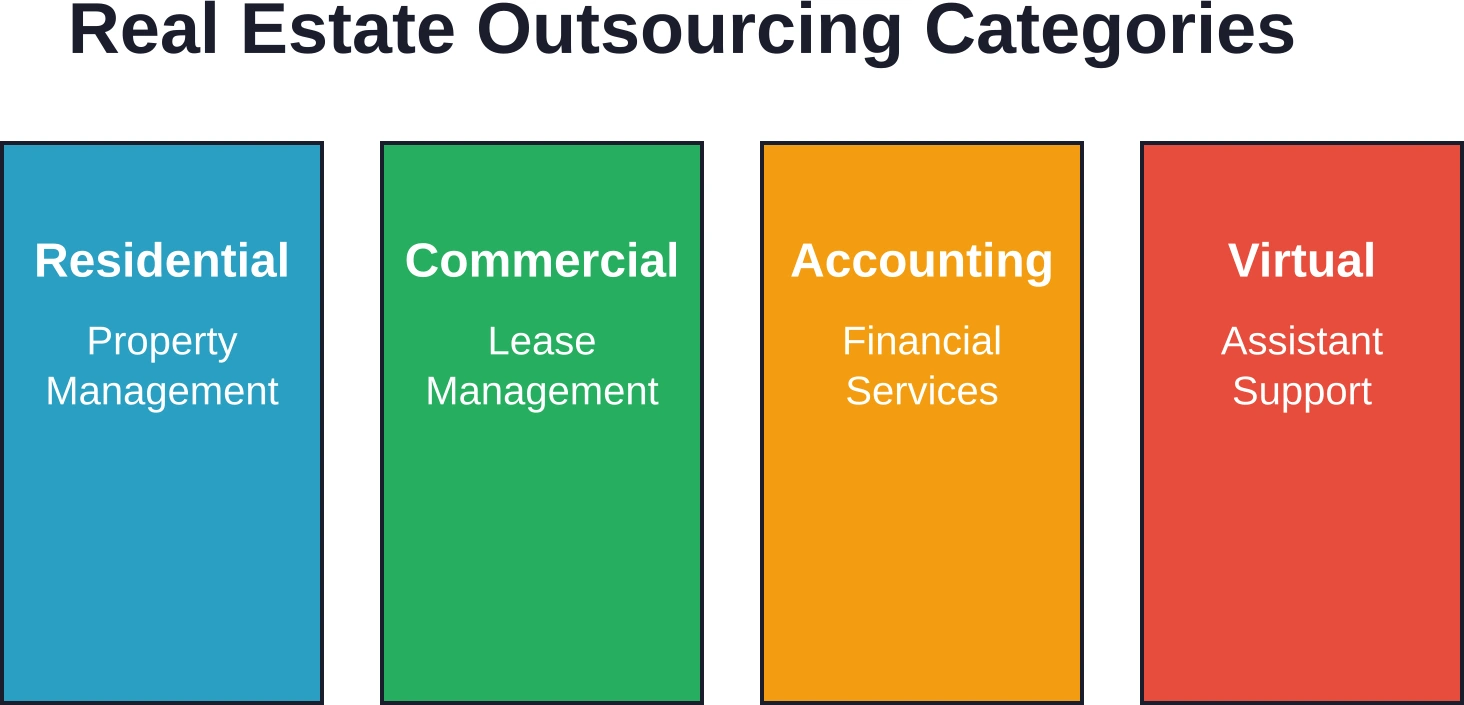
The outsourcing landscape spans diverse specializations. Understanding each type helps identify which services align with business priorities.
Residential Real Estate Outsourcing
Residential outsourcing covers property management, home staging, and virtual tour production. Administrative support handles client follow-ups, appointment scheduling, and transaction documentation. These services reduce the burden on agents and brokers managing multiple listings simultaneously.
Commercial Real Estate Outsourcing
Commercial operations demand sophisticated management. Outsourcing partners handle lease administration, tenant communication, and financial management. One example involved managing nearly 100 leases with an annual rent roll of $126 million, improving governance and accuracy around billing validation and payments.
Accounting and Financial Services
Outsourced accounting remains among the most popular outsourcing categories. The global finance and accounting outsourcing industry is valued at $54.8 billion and is on track to surpass $57.5 billion this year. For real estate investors balancing full-time work with portfolio management, delegating accounting frees valuable time.
Virtual Assistance and Administrative Support
Virtual assistants handle email management, scheduling, document preparation, and data entry. These foundational tasks consume hours that could be redirected toward revenue-generating activities. Virtual assistants improve responsiveness while reducing operational overhead.
Support Real Estate Operations With NeoWork

Real estate businesses often manage a combination of client communication, transaction coordination, documentation, scheduling, and administrative work. NeoWork provides staffing and operational support that can help teams handle these responsibilities more efficiently as workloads increase.
Need Additional Real Estate Support?
NeoWork can help with:
- client and tenant communication
- administrative and back-office tasks
- document and records management
- operational workflow coordination
👉 Contact NeoWork to discuss your real estate operations needs.
Key Benefits of Real Estate Outsourcing
Outsourcing delivers measurable advantages. Companies can save an average of $87,012 annually by outsourcing, representing an 85% reduction compared to hiring onshore talent. This allocation of resources more efficiently enables reinvestment in growth initiatives.
Cost Reduction and Efficiency Gains
Labor represents one of the largest expenses in real estate operations. By delegating tasks to specialized providers, particularly offshore teams, companies reduce payroll, benefits, and infrastructure costs. The financial relief extends to tax obligations and employee management overhead.
Focus on Core Business Activities
Time spent on paperwork, data entry, and scheduling distracts from deal closure and client relationship building. Outsourcing non-core tasks refocuses teams on revenue generation. Sales agents regain hours previously lost to administrative burdens.
Access to Specialized Expertise
Outsourcing partners develop deep expertise in specific domains. Accounting specialists understand real estate tax nuances. Virtual assistants master transaction documentation workflows. This specialization often delivers higher-quality output than generalist in-house teams.
Scalability and Flexibility
Seasonal fluctuations and unexpected growth require workforce flexibility. Outsourcing providers scale capacity up or down without hiring and termination cycles. During peak seasons, teams expand; during slower periods, costs contract.
Real Estate Outsourcing: Residential vs. Commercial
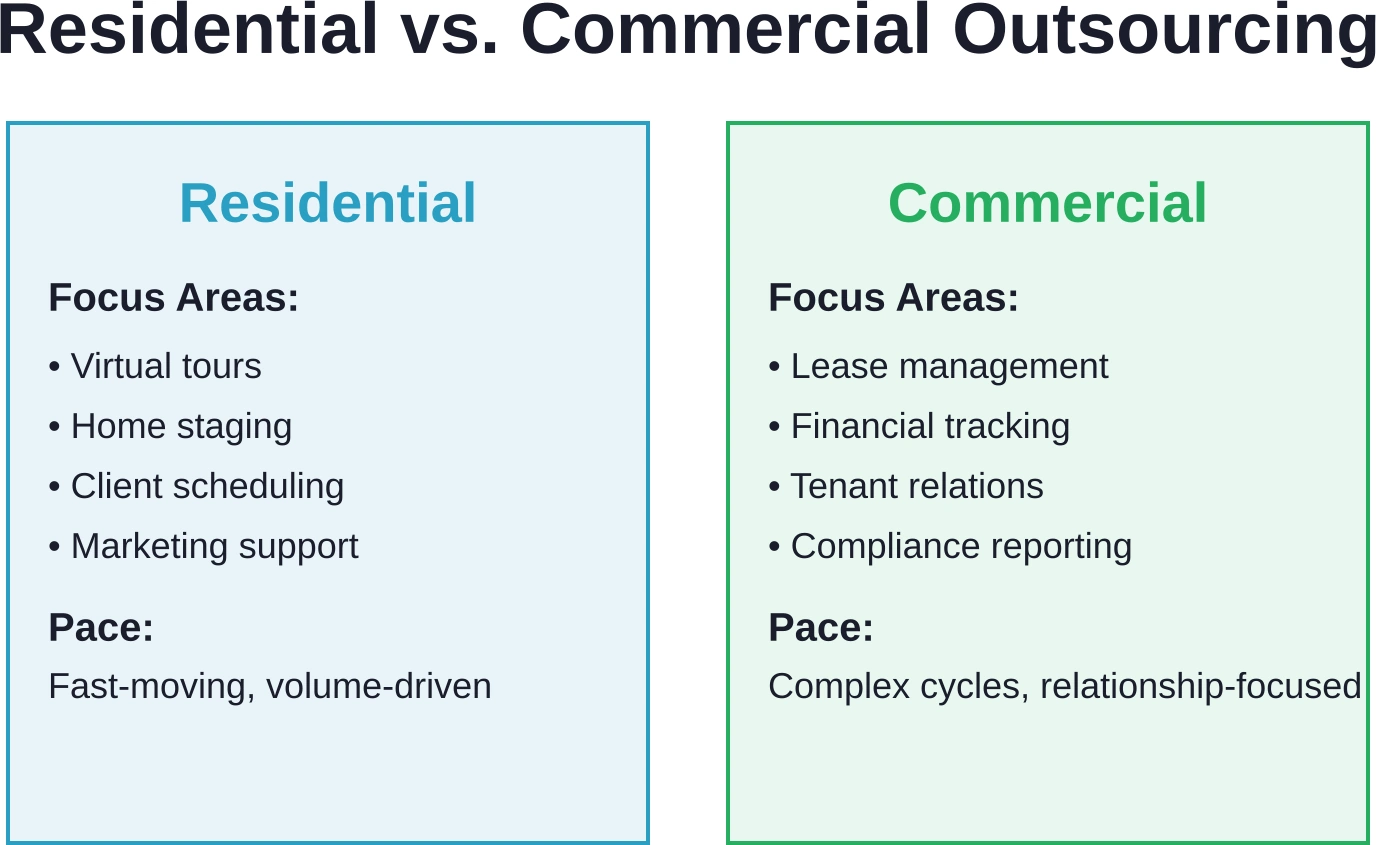
Residential and commercial outsourcing diverge in complexity and scope. Understanding the distinction helps match services to business type.
Residential Focus
Residential operations prioritize volume and speed. Home staging, virtual tours, and client communication drive sales velocity. Single-family properties and small multi-unit buildings dominate the market. Outsourcing here emphasizes marketing support, scheduling, and transaction coordination.
Commercial Emphasis
Commercial operations involve longer sales cycles, complex lease negotiations, and tenant management. Operations require sophisticated financial tracking and regulatory compliance. Outsourcing partners in this space handle lease administration, tenant communication, and comprehensive financial reporting.
How to Choose the Right Real Estate Outsourcing Partner
Selecting the right provider determines success. Look beyond price alone.
Assess Your Specific Needs
Document which tasks drain the most time and resources. Prioritize pain points. Do you need accounting expertise, administrative support, or property management assistance? Clear requirements prevent misalignment with provider capabilities.
Evaluate Provider Experience
Verify the outsourcing firm's track record in real estate. Request references from companies of similar size and business model. Ask about specific challenges they've solved for past clients.
Verify Quality and Compliance Standards
Quality directly impacts reputation and operations. Confirm the provider maintains relevant certifications and follows industry compliance requirements. For accounting outsourcing, verify they understand real estate-specific tax codes and reporting obligations.
Consider Communication and Integration
Distance and time zones complicate outsourcing. Evaluate the provider's communication protocols, reporting frequency, and software integration capabilities. Can they connect with your existing systems? Will communication happen in real-time or with delays?
Analyze Cost Structure Transparency
Hidden fees undermine savings projections. Request detailed cost breakdowns. Understand whether pricing scales with workload or remains fixed. Clarify what happens if workload decreases.
Real Estate Outsourcing Trends in 2026
The outsourcing landscape continues evolving. Technology integration drives modern partnerships. More organizations are recognizing that dynamic partnerships add value beyond simple task delegation. Evolving workplace strategies are transforming real estate services outsourcing, with companies increasingly seeking providers who contribute strategic insights alongside operational support.
Tech-enabled solutions improve visibility and control. Integration with property management systems, accounting software, and client relationship management platforms reduces friction. Providers offering seamless technology integration become more attractive.
Common Mistakes When Outsourcing Real Estate Operations
Understanding pitfalls prevents costly errors. Many businesses make predictable mistakes.
- Choosing Price Over Expertise: The cheapest provider isn't always the best. Cutting corners on quality creates downstream problems. Poor accounting work leads to tax issues. Careless property management damages tenant relationships.
- Unclear Communication Expectations: Ambiguous expectations breed frustration. Define reporting frequency, escalation procedures, and response times upfront.
- Insufficient Onboarding: Rushing the transition creates knowledge gaps. Invest time in training the outsourcing team. Document existing processes thoroughly.
- Ignoring Data Security: Real estate operations handle sensitive financial and personal information. Verify the provider implements robust security protocols, data encryption, and compliance measures.
Conclusion
Real estate outsourcing addresses a fundamental challenge: too much work, too little time. By delegating non-core tasks to specialized partners, businesses recover hours for revenue-generating activities. Cost savings average $87,012 annually, with 85% reductions compared to onshore hiring.
The right outsourcing partner contributes expertise, scalability, and efficiency. But partner selection demands diligence. Assess your specific needs, verify provider experience, and confirm quality standards before committing.
The real estate industry moves fast. Outsourcing doesn't slow you down—it accelerates growth by removing operational friction. Start today by identifying which tasks drain the most time. Then find the right partner to reclaim those hours for what matters most: building relationships and closing deals.
FAQ: Real Estate Outsourcing
Topics
Legal Research Outsourcing Guide: Cost Savings & Best Practices

Quick Summary: Real estate outsourcing services help companies delegate non-core tasks like accounting, property management, and administrative work to specialized providers. This guide covers the main types of outsourcing, key benefits such as cost savings and improved efficiency, and practical steps for selecting the right partner for your business.
What Is Real Estate Outsourcing?
Real estate outsourcing involves delegating operational tasks to external service providers instead of handling them in-house. Properties are listed, sold, and taken off the market rapidly, while leads and administrative tasks pile up faster than most teams can manage alone. That's why more businesses are turning to real estate outsourcing to stay competitive and agile.
The concept extends across residential and commercial sectors. Whether managing tenant relations, processing financial documents, or coordinating virtual property tours, outsourcing allows professionals to focus on high-value activities like closing deals and building client relationships.
Types of Real Estate Outsourcing Services
The outsourcing landscape spans diverse specializations. Understanding each type helps identify which services align with business priorities.
Residential Real Estate Outsourcing
Residential outsourcing covers property management, home staging, and virtual tour production. Administrative support handles client follow-ups, appointment scheduling, and transaction documentation. These services reduce the burden on agents and brokers managing multiple listings simultaneously.
Commercial Real Estate Outsourcing
Commercial operations demand sophisticated management. Outsourcing partners handle lease administration, tenant communication, and financial management. One example involved managing nearly 100 leases with an annual rent roll of $126 million, improving governance and accuracy around billing validation and payments.
Accounting and Financial Services
Outsourced accounting remains among the most popular outsourcing categories. The global finance and accounting outsourcing industry is valued at $54.8 billion and is on track to surpass $57.5 billion this year. For real estate investors balancing full-time work with portfolio management, delegating accounting frees valuable time.
Virtual Assistance and Administrative Support
Virtual assistants handle email management, scheduling, document preparation, and data entry. These foundational tasks consume hours that could be redirected toward revenue-generating activities. Virtual assistants improve responsiveness while reducing operational overhead.
Support Real Estate Operations With NeoWork
Real estate businesses often manage a combination of client communication, transaction coordination, documentation, scheduling, and administrative work. NeoWork provides staffing and operational support that can help teams handle these responsibilities more efficiently as workloads increase.
Need Additional Real Estate Support?
NeoWork can help with:
- client and tenant communication
- administrative and back-office tasks
- document and records management
- operational workflow coordination
👉 Contact NeoWork to discuss your real estate operations needs.
Key Benefits of Real Estate Outsourcing
Outsourcing delivers measurable advantages. Companies can save an average of $87,012 annually by outsourcing, representing an 85% reduction compared to hiring onshore talent. This allocation of resources more efficiently enables reinvestment in growth initiatives.
Cost Reduction and Efficiency Gains
Labor represents one of the largest expenses in real estate operations. By delegating tasks to specialized providers, particularly offshore teams, companies reduce payroll, benefits, and infrastructure costs. The financial relief extends to tax obligations and employee management overhead.
Focus on Core Business Activities
Time spent on paperwork, data entry, and scheduling distracts from deal closure and client relationship building. Outsourcing non-core tasks refocuses teams on revenue generation. Sales agents regain hours previously lost to administrative burdens.
Access to Specialized Expertise
Outsourcing partners develop deep expertise in specific domains. Accounting specialists understand real estate tax nuances. Virtual assistants master transaction documentation workflows. This specialization often delivers higher-quality output than generalist in-house teams.
Scalability and Flexibility
Seasonal fluctuations and unexpected growth require workforce flexibility. Outsourcing providers scale capacity up or down without hiring and termination cycles. During peak seasons, teams expand; during slower periods, costs contract.
Real Estate Outsourcing: Residential vs. Commercial
Residential and commercial outsourcing diverge in complexity and scope. Understanding the distinction helps match services to business type.
Residential Focus
Residential operations prioritize volume and speed. Home staging, virtual tours, and client communication drive sales velocity. Single-family properties and small multi-unit buildings dominate the market. Outsourcing here emphasizes marketing support, scheduling, and transaction coordination.
Commercial Emphasis
Commercial operations involve longer sales cycles, complex lease negotiations, and tenant management. Operations require sophisticated financial tracking and regulatory compliance. Outsourcing partners in this space handle lease administration, tenant communication, and comprehensive financial reporting.
How to Choose the Right Real Estate Outsourcing Partner
Selecting the right provider determines success. Look beyond price alone.
Assess Your Specific Needs
Document which tasks drain the most time and resources. Prioritize pain points. Do you need accounting expertise, administrative support, or property management assistance? Clear requirements prevent misalignment with provider capabilities.
Evaluate Provider Experience
Verify the outsourcing firm's track record in real estate. Request references from companies of similar size and business model. Ask about specific challenges they've solved for past clients.
Verify Quality and Compliance Standards
Quality directly impacts reputation and operations. Confirm the provider maintains relevant certifications and follows industry compliance requirements. For accounting outsourcing, verify they understand real estate-specific tax codes and reporting obligations.
Consider Communication and Integration
Distance and time zones complicate outsourcing. Evaluate the provider's communication protocols, reporting frequency, and software integration capabilities. Can they connect with your existing systems? Will communication happen in real-time or with delays?
Analyze Cost Structure Transparency
Hidden fees undermine savings projections. Request detailed cost breakdowns. Understand whether pricing scales with workload or remains fixed. Clarify what happens if workload decreases.
Real Estate Outsourcing Trends in 2026
The outsourcing landscape continues evolving. Technology integration drives modern partnerships. More organizations are recognizing that dynamic partnerships add value beyond simple task delegation. Evolving workplace strategies are transforming real estate services outsourcing, with companies increasingly seeking providers who contribute strategic insights alongside operational support.
Tech-enabled solutions improve visibility and control. Integration with property management systems, accounting software, and client relationship management platforms reduces friction. Providers offering seamless technology integration become more attractive.
Common Mistakes When Outsourcing Real Estate Operations
Understanding pitfalls prevents costly errors. Many businesses make predictable mistakes.
- Choosing Price Over Expertise: The cheapest provider isn't always the best. Cutting corners on quality creates downstream problems. Poor accounting work leads to tax issues. Careless property management damages tenant relationships.
- Unclear Communication Expectations: Ambiguous expectations breed frustration. Define reporting frequency, escalation procedures, and response times upfront.
- Insufficient Onboarding: Rushing the transition creates knowledge gaps. Invest time in training the outsourcing team. Document existing processes thoroughly.
- Ignoring Data Security: Real estate operations handle sensitive financial and personal information. Verify the provider implements robust security protocols, data encryption, and compliance measures.
Conclusion
Real estate outsourcing addresses a fundamental challenge: too much work, too little time. By delegating non-core tasks to specialized partners, businesses recover hours for revenue-generating activities. Cost savings average $87,012 annually, with 85% reductions compared to onshore hiring.
The right outsourcing partner contributes expertise, scalability, and efficiency. But partner selection demands diligence. Assess your specific needs, verify provider experience, and confirm quality standards before committing.
The real estate industry moves fast. Outsourcing doesn't slow you down—it accelerates growth by removing operational friction. Start today by identifying which tasks drain the most time. Then find the right partner to reclaim those hours for what matters most: building relationships and closing deals.
FAQ: Real Estate Outsourcing
Topics
Related Blogs
Related Podcasts


.webp)
.webp)



