

.avif)
.avif)

Real Estate Virtual Assistant Company Guide 2026


.svg)

Quick Summary: A real estate virtual assistant company provides remote administrative support to agents and brokers, handling non-client-facing tasks like lead follow-ups, CRM updates, listing coordination, and transaction paperwork. Hiring a VA can cost 70% less than full-time employees and free up agents to focus on revenue-generating activities. Understanding the roles, costs, and hiring process is essential for real estate professionals looking to scale their business efficiently.
What Is a Real Estate Virtual Assistant?
A real estate virtual assistant is a remote team member who handles administrative tasks that don't directly generate commissions. Unlike a general virtual assistant, real estate VAs specialize in the unique workflows, software, and terminology of the real estate industry.
These professionals work with MLS portals, real estate CRMs, and transaction management tools like Dotloop and SkySlope. They function as the backbone of an agent's back office, managing everything from scheduling to paperwork processing.
The key distinction: a VA is not a licensed agent. They don't negotiate deals, give legal advice, or handle client-facing communications on behalf of agents. Instead, they create the conditions for agents to spend time where it matters most—closing deals.
Why Real Estate Professionals Hire Virtual Assistants
Real talk: most agents don't struggle with sales ability. They struggle with time. According to industry data, agents spend a significant portion of their week buried in administrative work that doesn't directly generate revenue.
Here's the math. Hiring a full-time in-house employee typically costs more than $60,000 per year when you factor in benefits, payroll taxes, and desk space. A virtual assistant from a reputable company costs up to 70% less than that comparison, delivering immediate cost savings.
Beyond dollars, VAs deliver leverage. When an agent offloads 10-15 hours of administrative work per week, they gain time to prospect, show properties, and nurture relationships—activities that directly move the revenue needle.
Core Tasks a Real Estate Virtual Assistant Handles
Different agencies offer varying service levels, but the foundational tasks are consistent across the industry. Here are the seven core functions a real estate VA typically manages:
- Lead Follow-Up: Sending emails, text messages, and call reminders to warm and cold leads according to automated sequences.
- CRM Management: Entering prospect details, updating pipeline status, and maintaining data integrity in systems like Follow Up Boss or Salesforce.
- Listing Coordination: Uploading property information to MLS, coordinating with photographers, and managing listing timelines.
- Showing Scheduling: Booking property showings, sending confirmations, and managing the showing calendar across multiple platforms.
- Transaction Coordination: Organizing inspection reports, maintaining document libraries, and keeping closing timelines on track.
- Social Media & Content: Posting to Facebook, Instagram, and other platforms; creating simple graphics and captions from agent-provided content.
- Administrative Support: Email management, calendar scheduling, expense tracking, and general back-office work.
Real Estate VA vs. General Virtual Assistant
Not all virtual assistants are the same. The difference between a general VA and a specialized real estate VA matters significantly.
A specialized real estate VA arrives ready to work. They understand transaction timelines, know which data fields matter in MLS, and recognize compliance issues. This expertise eliminates the training overhead and reduces mistakes that could derail a deal.
Real Estate VA Costs in 2026
Pricing models vary, but understanding the landscape helps you budget effectively.
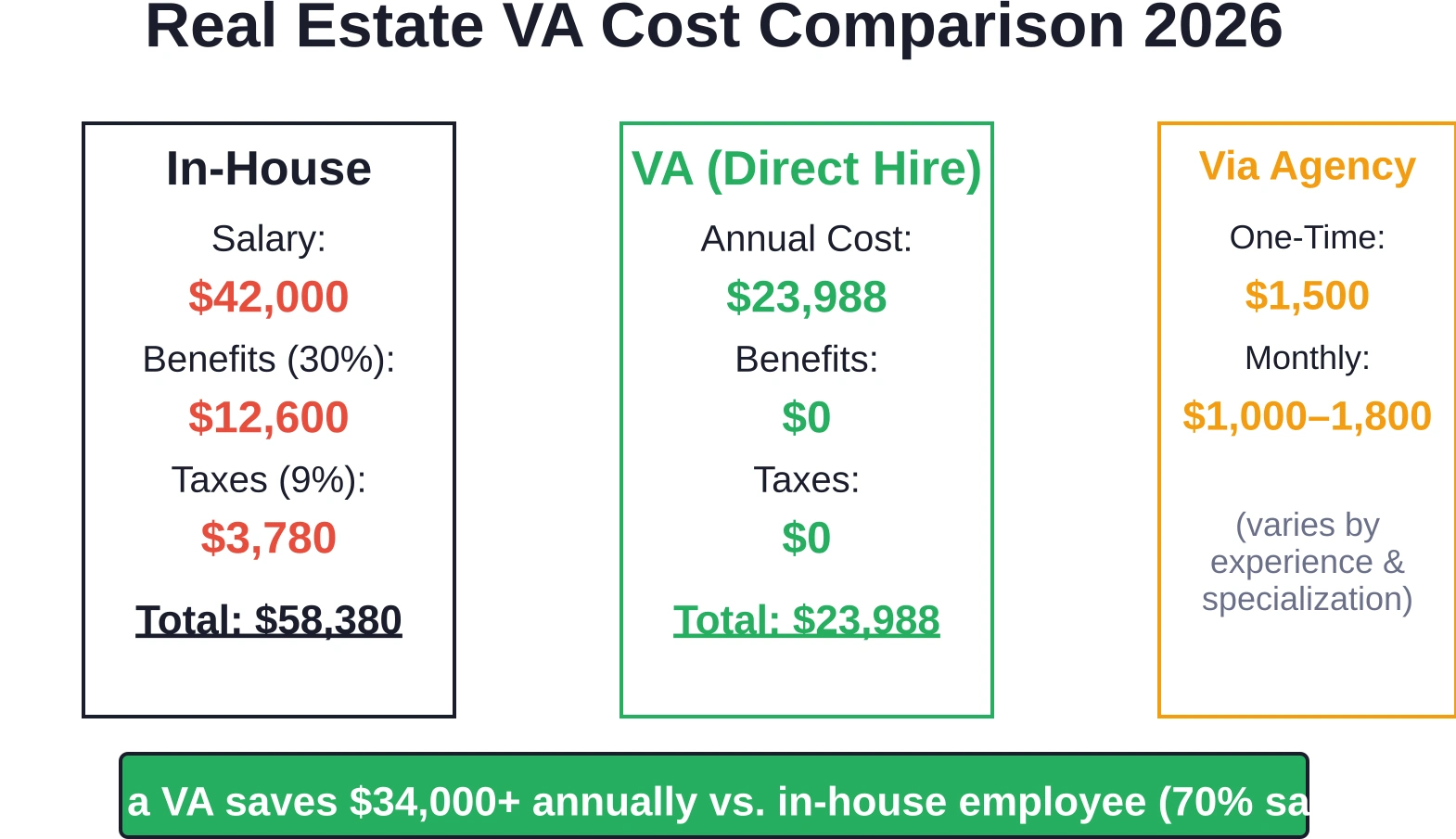
Three pricing models dominate the market:
- Direct Hire: You employ the VA directly. Annual cost is around $24,000-$36,000 depending on experience and location. Fast hiring (3-5 days), full control, but you handle onboarding and management.
- Agency Placement (One-Time Fee): Pay $1,500-$2,000 upfront; the VA is yours. You manage day-to-day but get agency support if issues arise. Cost-effective long-term.
- Agency Subscription: Monthly fee of $1,000-$1,800 per VA. The agency handles recruitment, training, and replacement. Higher monthly cost but less administrative burden.
The math is straightforward: even at the high end ($1,800/month = $21,600/year), a VA costs less than the average in-house salary of $42,000 plus benefits and taxes.
How to Choose the Right Real Estate Virtual Assistant
Not every VA is the right fit. Here's what matters when evaluating candidates or agencies.
1. Real Estate Experience
Does the VA understand transaction coordination, MLS workflows, and compliance? Experience in the industry beats generic admin skills every time.
2. Software Proficiency
Confirm they're trained in the tools you use: your CRM, MLS system, transaction software, and communication platforms. Retraining takes time and money.
3. Communication Style
A good VA proactively reports issues and asks clarifying questions. They don't wait for instructions; they anticipate needs. Test this during the trial period.
4. Reliability and Time Zone
For most U.S. agents, same-timezone VAs or near-timezone overlap is preferable. Confirm response times and availability expectations upfront.
5. Track Record
Ask for references or case studies. How long do clients stay? Do they renew contracts? Retention is a strong signal of competence.

Build Real Estate Virtual Assistant Support with NeoWork
A real estate virtual assistant can help with recurring admin work that takes time away from client communication, property operations, and deal-related priorities. NeoWork supports virtual assistant staffing, including administrative support, bookkeeping, social media support, customer support, and operational tasks that can be handled remotely. Their 91% annualized teammate retention rate and a 3.2% candidate selectivity rate especially matters when a virtual assistant needs to learn company workflows and stay reliable over time.
Real estate VA tasks NeoWork can help you with:
- document organization and back-office tasks
- bookkeeping and recurring operations support
- customer communication and social media support
Contact NeoWork to build real estate virtual assistant support that keeps admin work organized, reduces routine workload, and gives your internal team more time for clients and property-related priorities.
What a Real Estate VA Does Not Do
Clear boundaries prevent misunderstandings. A virtual assistant is not:
- A licensed agent: They cannot negotiate on behalf of clients or represent properties legally.
- A lawyer: They cannot provide legal advice or handle contract interpretation.
- A loan officer: They cannot offer financial advice or conduct mortgage discussions.
- A client-facing representative: They generally do not speak directly to buyers or sellers (except in routine scheduling contexts).
- A replacement for you: They amplify your capacity; they don't replace your expertise or relationships.
Real Estate VA Hiring Timeline
Onboarding takes time. Most agencies guarantee placement within 3-5 days, but the real work begins after the hire.
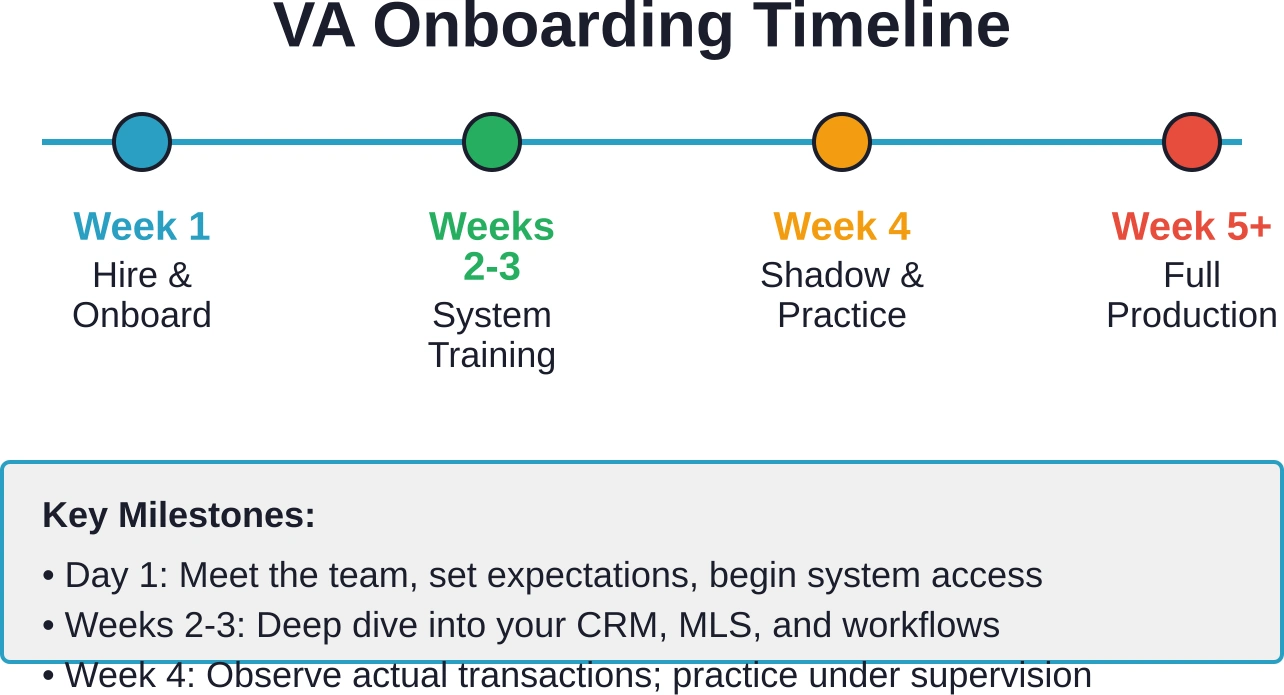
Expect the first month to be slower. The VA learns your business, asks many questions, and makes mistakes (minor ones, hopefully). By week 5, they should handle routine tasks independently. By week 8-12, they're genuinely productive.
Top Real Estate VA Company Models
The market offers several established approaches. Some agencies specialize in placement; others provide ongoing management and support.
Conclusion: Is a Real Estate VA Right for You?
Real estate virtual assistants aren't a luxury—they're a practical tool for scaling. The cost savings alone (60-70% less than in-house employees) justify the investment. But the real win is time: freed-up hours to prospect, nurture relationships, and close deals.
The hiring process is straightforward. Expect to invest 3-5 days in placement and 4-8 weeks in onboarding. By month three, a good VA compounds your productivity significantly.
Start by assessing your biggest time wasters. If you're drowning in lead follow-ups, CRM updates, or scheduling, a VA is your answer. If you're looking to grow without hiring full-time staff, a VA makes financial sense at any stage.
Ready to reclaim your time? Research agencies that specialize in real estate, request references, and schedule a consultation. The agents gaining the most leverage in 2026 aren't the smartest—they're the ones who outsourced the work that wasn't moving the needle.
FAQ: Real Estate Virtual Assistant Companies
Topics
Real Estate Virtual Assistant Company Guide 2026

Quick Summary: A real estate virtual assistant company provides remote administrative support to agents and brokers, handling non-client-facing tasks like lead follow-ups, CRM updates, listing coordination, and transaction paperwork. Hiring a VA can cost 70% less than full-time employees and free up agents to focus on revenue-generating activities. Understanding the roles, costs, and hiring process is essential for real estate professionals looking to scale their business efficiently.
What Is a Real Estate Virtual Assistant?
A real estate virtual assistant is a remote team member who handles administrative tasks that don't directly generate commissions. Unlike a general virtual assistant, real estate VAs specialize in the unique workflows, software, and terminology of the real estate industry.
These professionals work with MLS portals, real estate CRMs, and transaction management tools like Dotloop and SkySlope. They function as the backbone of an agent's back office, managing everything from scheduling to paperwork processing.
The key distinction: a VA is not a licensed agent. They don't negotiate deals, give legal advice, or handle client-facing communications on behalf of agents. Instead, they create the conditions for agents to spend time where it matters most—closing deals.
Why Real Estate Professionals Hire Virtual Assistants
Real talk: most agents don't struggle with sales ability. They struggle with time. According to industry data, agents spend a significant portion of their week buried in administrative work that doesn't directly generate revenue.
Here's the math. Hiring a full-time in-house employee typically costs more than $60,000 per year when you factor in benefits, payroll taxes, and desk space. A virtual assistant from a reputable company costs up to 70% less than that comparison, delivering immediate cost savings.
Beyond dollars, VAs deliver leverage. When an agent offloads 10-15 hours of administrative work per week, they gain time to prospect, show properties, and nurture relationships—activities that directly move the revenue needle.
Core Tasks a Real Estate Virtual Assistant Handles
Different agencies offer varying service levels, but the foundational tasks are consistent across the industry. Here are the seven core functions a real estate VA typically manages:
- Lead Follow-Up: Sending emails, text messages, and call reminders to warm and cold leads according to automated sequences.
- CRM Management: Entering prospect details, updating pipeline status, and maintaining data integrity in systems like Follow Up Boss or Salesforce.
- Listing Coordination: Uploading property information to MLS, coordinating with photographers, and managing listing timelines.
- Showing Scheduling: Booking property showings, sending confirmations, and managing the showing calendar across multiple platforms.
- Transaction Coordination: Organizing inspection reports, maintaining document libraries, and keeping closing timelines on track.
- Social Media & Content: Posting to Facebook, Instagram, and other platforms; creating simple graphics and captions from agent-provided content.
- Administrative Support: Email management, calendar scheduling, expense tracking, and general back-office work.
Real Estate VA vs. General Virtual Assistant
Not all virtual assistants are the same. The difference between a general VA and a specialized real estate VA matters significantly.
A specialized real estate VA arrives ready to work. They understand transaction timelines, know which data fields matter in MLS, and recognize compliance issues. This expertise eliminates the training overhead and reduces mistakes that could derail a deal.
Real Estate VA Costs in 2026
Pricing models vary, but understanding the landscape helps you budget effectively.
Three pricing models dominate the market:
- Direct Hire: You employ the VA directly. Annual cost is around $24,000-$36,000 depending on experience and location. Fast hiring (3-5 days), full control, but you handle onboarding and management.
- Agency Placement (One-Time Fee): Pay $1,500-$2,000 upfront; the VA is yours. You manage day-to-day but get agency support if issues arise. Cost-effective long-term.
- Agency Subscription: Monthly fee of $1,000-$1,800 per VA. The agency handles recruitment, training, and replacement. Higher monthly cost but less administrative burden.
The math is straightforward: even at the high end ($1,800/month = $21,600/year), a VA costs less than the average in-house salary of $42,000 plus benefits and taxes.
How to Choose the Right Real Estate Virtual Assistant
Not every VA is the right fit. Here's what matters when evaluating candidates or agencies.
1. Real Estate Experience
Does the VA understand transaction coordination, MLS workflows, and compliance? Experience in the industry beats generic admin skills every time.
2. Software Proficiency
Confirm they're trained in the tools you use: your CRM, MLS system, transaction software, and communication platforms. Retraining takes time and money.
3. Communication Style
A good VA proactively reports issues and asks clarifying questions. They don't wait for instructions; they anticipate needs. Test this during the trial period.
4. Reliability and Time Zone
For most U.S. agents, same-timezone VAs or near-timezone overlap is preferable. Confirm response times and availability expectations upfront.
5. Track Record
Ask for references or case studies. How long do clients stay? Do they renew contracts? Retention is a strong signal of competence.
Build Real Estate Virtual Assistant Support with NeoWork
A real estate virtual assistant can help with recurring admin work that takes time away from client communication, property operations, and deal-related priorities. NeoWork supports virtual assistant staffing, including administrative support, bookkeeping, social media support, customer support, and operational tasks that can be handled remotely. Their 91% annualized teammate retention rate and a 3.2% candidate selectivity rate especially matters when a virtual assistant needs to learn company workflows and stay reliable over time.
Real estate VA tasks NeoWork can help you with:
- document organization and back-office tasks
- bookkeeping and recurring operations support
- customer communication and social media support
Contact NeoWork to build real estate virtual assistant support that keeps admin work organized, reduces routine workload, and gives your internal team more time for clients and property-related priorities.
What a Real Estate VA Does Not Do
Clear boundaries prevent misunderstandings. A virtual assistant is not:
- A licensed agent: They cannot negotiate on behalf of clients or represent properties legally.
- A lawyer: They cannot provide legal advice or handle contract interpretation.
- A loan officer: They cannot offer financial advice or conduct mortgage discussions.
- A client-facing representative: They generally do not speak directly to buyers or sellers (except in routine scheduling contexts).
- A replacement for you: They amplify your capacity; they don't replace your expertise or relationships.
Real Estate VA Hiring Timeline
Onboarding takes time. Most agencies guarantee placement within 3-5 days, but the real work begins after the hire.
Expect the first month to be slower. The VA learns your business, asks many questions, and makes mistakes (minor ones, hopefully). By week 5, they should handle routine tasks independently. By week 8-12, they're genuinely productive.
Top Real Estate VA Company Models
The market offers several established approaches. Some agencies specialize in placement; others provide ongoing management and support.
Conclusion: Is a Real Estate VA Right for You?
Real estate virtual assistants aren't a luxury—they're a practical tool for scaling. The cost savings alone (60-70% less than in-house employees) justify the investment. But the real win is time: freed-up hours to prospect, nurture relationships, and close deals.
The hiring process is straightforward. Expect to invest 3-5 days in placement and 4-8 weeks in onboarding. By month three, a good VA compounds your productivity significantly.
Start by assessing your biggest time wasters. If you're drowning in lead follow-ups, CRM updates, or scheduling, a VA is your answer. If you're looking to grow without hiring full-time staff, a VA makes financial sense at any stage.
Ready to reclaim your time? Research agencies that specialize in real estate, request references, and schedule a consultation. The agents gaining the most leverage in 2026 aren't the smartest—they're the ones who outsourced the work that wasn't moving the needle.
FAQ: Real Estate Virtual Assistant Companies
Topics
Related Blogs
Related Podcasts


.webp)
.webp)



