

.avif)
.avif)

Tax Outsourcing Services Guide 2026


.svg)

Quick Summary: Tax outsourcing services enable businesses and accounting firms to delegate tax preparation, compliance, and related duties to specialized third-party providers. This strategic approach reduces operational costs, improves accuracy, and allows firms to focus on client relationships while ensuring compliance with IRS requirements and deadlines.
What Are Tax Outsourcing Services?
Tax outsourcing services represent a strategic partnership where accounting firms or businesses delegate tax preparation, compliance, and related responsibilities to external service providers. These specialized firms handle everything from individual tax returns to complex corporate filings, payroll tax administration, and bookkeeping support.
The IRS recognizes outsourcing as a legitimate business practice. According to IRS guidance, many employers outsource payroll and related tax duties to third-party payroll service providers. These providers can help ensure filing deadlines and deposit requirements are met while streamlining business operations. However, remember that employers remain ultimately responsible for the payment of income tax withheld and both employer and employee portions of Social Security and Medicare taxes.
This distinction matters. Outsourcing doesn't eliminate accountability—it transfers execution while maintaining compliance responsibility with the outsourcing firm.
Why Firms Are Outsourcing Tax Preparation Services
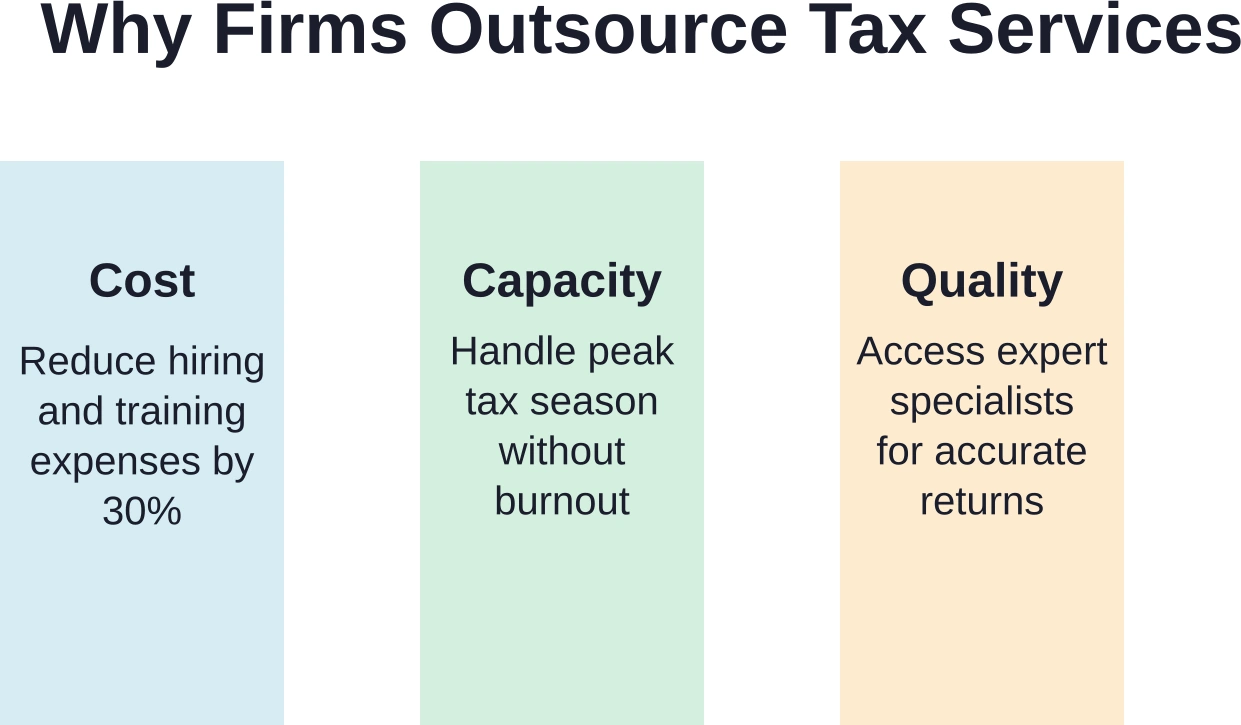
The decision to outsource tax preparation stems from real operational challenges. Tax season creates bottlenecks. Peak filing periods overwhelm internal staff, leading to missed deadlines, reduced quality, and burnout. Industry data shows over 44% of U.S. organizations have already adopted outsourced accounting services to address these pressures.
Cost efficiency ranks high. Hiring, training, and retaining specialized tax professionals demands significant investment. Outsourcing eliminates these overhead burdens while maintaining service quality. Firms report achieving as much as 30% improvement in efficiency metrics when partnering with reputable tax outsourcing service providers.
Staffing shortages compound the issue. Finding qualified tax professionals has become harder. Outsourced teams provide immediate access to experienced professionals without the long recruitment cycle.
Improve Tax Operations With NeoWork

NeoWork provides staffing and operational support for businesses that need help managing administrative workloads around tax preparation, document handling, data processing, and client communication. Their teams can support recurring processes while internal tax professionals focus on review, compliance, and advisory work.
Need Additional Support for Tax Workflows?
NeoWork can help with:
- document collection and organization
- data entry and administrative processing
- client communication and scheduling
- back-office support for tax teams
👉 Contact NeoWork to discuss your tax operations needs.
Core Benefits of Tax Outsourcing Services
Cost Savings and Profit Margin Growth
Outsourcing eliminates the fixed costs of maintaining a large in-house tax team. No salaries, benefits, training programs, or office space overhead. This translates directly to improved profit margins. Firms report significant cost reductions without sacrificing service quality.
Variable pricing models mean firms pay only for what they use. During slow seasons, costs drop. During peak periods, capacity scales up. This flexibility beats hiring full-time staff that sit idle half the year.
Access to Specialized Expertise
Tax outsourcing companies employ professionals specializing in specific areas—corporate taxation, international compliance, nonprofit rules, real estate transactions. Firms gain access to deeper expertise than they could afford to hire in-house.
These specialists stay current on tax law changes. They understand IRS requirements around wage bases, deposit thresholds, and compliance deadlines. For example, they track the $184,500 Social Security wage base limit for 2026, the 6.2% Social Security tax rate for employers, and the 1.45% Medicare tax rate to ensure accurate withholding.
Focus on Client Relationships
When tax preparation moves to outsourced partners, internal teams shift from execution to strategy. Accountants become advisors rather than data-entry specialists. This relationship-focused approach attracts higher-value clients willing to pay for guidance rather than just return preparation.
Scalability Without Hiring
Business growth no longer requires proportional staff expansion. Outsourced providers absorb volume increases. Firms scale revenue while keeping headcount stable.
Tax Outsourcing Services Workflow
Understanding the outsourcing process removes mystery. Here's what typically happens.
Step 1: Assess Internal Needs and Select a Provider
Firms evaluate which services to outsource. Do they need full tax preparation? Bookkeeping support? Compliance only? Then they research providers matching those requirements and evaluate security practices, certifications, and client references.
Step 2: Define Scope and Service Level Agreements
Clear agreements specify what gets outsourced, quality standards, turnaround times, and communication protocols. This prevents misunderstandings and ensures accountability.
Step 3: Transition and Integration
The firm transfers relevant client data, tax documents, and workflows. Staff training ensures everyone understands the new process. Many providers offer project management tools that integrate with existing firm systems.
Step 4: Execution and Quality Assurance
The outsourced team prepares returns, files documents, and manages compliance deadlines. The firm maintains oversight and performs quality checks on key deliverables.
Step 5: Ongoing Support and Adjustments
Regular communication identifies bottlenecks or issues. Providers adjust processes based on feedback, ensuring continuous improvement.
Choosing the Right Tax Outsourcing Services Provider
Provider selection determines success. Bad choices create compliance risks and client dissatisfaction. Good ones become trusted partners.
Essential Provider Qualities
Questions to Ask Before Signing
Don't skip due diligence. Ask prospective providers about security certifications. Inquire about their quality assurance process. Request references from similar-sized firms. Understand their contingency plan if staff leaves during peak season. Confirm they understand your state and specialty tax rules.
Ask about pricing structure. Is it per-return? Per-hour? Monthly subscription? What happens if volume exceeds estimates? Get details in writing.
Understanding Tax Outsourcing Services Costs
Pricing varies widely depending on scope, volume, complexity, and provider. There's no single "cost" for tax outsourcing services.
Common Pricing Models
- Per-Return Model: Firms pay a fixed fee per tax return prepared. Simple returns cost less; complex ones cost more. This model works well for firms with predictable volume and consistent return types.
- Per-Hour Model: Providers bill for actual time spent. Useful for advisory services or irregular work. Less predictable for budgeting.
- Subscription Model: Monthly or annual fees grant access to services up to a specified return volume. Overages cost extra. Good for firms wanting predictable monthly expenses.
- Tiered Model: Volume discounts apply. First 100 returns cost X; 101–500 cost Y; 501+ cost Z. Encourages firms to consolidate more work with one provider.
What Impacts the Price
Return complexity drives cost. Individual 1040s with standard deductions cost less than international business returns or partnership audits. Turnaround time affects price—rush fees apply for quick turnarounds. Geographic location matters; some regions pay more for local expertise. Technology requirements and integrations add cost.
Volume discounts reward larger commitments. Firms preparing 500+ returns annually typically negotiate better rates than those doing 50.
Compliance and Responsibility Considerations
Here's the critical point that many firms miss: outsourcing doesn't transfer compliance responsibility. The firm remains liable for accurate returns and timely filing.
The IRS makes this explicit. Employers who outsource payroll duties remain responsible for ensuring income tax withholding and both employer and employee portions of payroll taxes are paid correctly and on time. The outsourced provider executes; the firm remains accountable.
This means firms must implement oversight. Review returns before filing. Verify deadlines are met. Monitor for errors. Include audit rights in service agreements so firms can verify the provider's work.
Professional standards also apply. Tax professionals covered by IRS Circular 230 must maintain strict standards of competence and integrity. Choose providers whose staff includes enrolled agents, CPAs, or other credentialed professionals subject to these standards.
Common Myths About Tax Outsourcing Services
Myth: Outsourcing Reduces Quality
Reality: Quality often improves. Specialized providers focus exclusively on tax work. They employ experts with deeper knowledge than generalist accountants. They maintain quality assurance processes and have reputational incentive to perform well.
Myth: Data Security Becomes Riskier
Reality: Professional providers invest heavily in security. Many maintain SOC 2 certifications, use encryption, restrict access, and conduct regular security audits. A solo accountant with a shared password for their email is arguably less secure.
Myth: Outsourcing Costs More Than Hiring Staff
Reality: Over time, outsourcing typically costs less. Salary, benefits, payroll taxes, training, and office space for a full-time tax preparer easily exceed outsourcing costs, especially when accounting for idle time during slow seasons.
Myth: Client Relationships Suffer
Reality: Clients care about accurate returns, not who prepares them. When firms shift from preparation to advisory, relationships often strengthen. Clients get more personalized guidance from CPAs who have time to think strategically.
Pros and Cons of Tax Outsourcing Services
Is Tax Outsourcing Right for Your Firm?
Outsourcing makes sense when internal capacity can't meet demand, especially during peak tax season. If staff regularly works 60-hour weeks in March and April, outsourcing eases that pressure.
It's smart when specialization gaps exist. If a firm handles mostly individuals but wants to grow corporate clients, outsourcing corporate prep to specialists while learning is prudent.
Outsourcing fits when cash flow is tight. Variable expenses (outsourcing) beat fixed costs (full-time hires) for tight budgets.
But outsourcing may not fit if client relationships depend on personal service, if the firm operates in a highly specialized niche requiring in-house expertise, or if data security concerns outweigh cost benefits.
Conclusion
Tax outsourcing services have evolved from a cost-cutting tactic to a strategic business decision that drives growth, improves quality, and enhances firm competitiveness. The evidence is clear: firms that outsource effectively reduce costs, access specialized expertise, and scale without proportional hiring.
The key is choosing the right provider and maintaining appropriate oversight. Firms remain liable for accuracy and compliance, so service agreements, quality checks, and clear communication are non-negotiable.
Whether handling peaks in tax season or building new service lines, outsourced tax services offer flexibility that in-house teams simply can't match. For firms ready to focus on client relationships and strategic guidance rather than return preparation, outsourcing is no longer a luxury—it's a competitive necessity.
Ready to explore outsourcing for your firm? Start by clearly defining which services to outsource, then research providers with relevant expertise, strong security practices, and solid references. The firms that outsource strategically and thoughtfully are the ones thriving in 2026's competitive accounting landscape.
Frequently Asked Questions
Topics
Tax Outsourcing Services Guide 2026

Quick Summary: Tax outsourcing services enable businesses and accounting firms to delegate tax preparation, compliance, and related duties to specialized third-party providers. This strategic approach reduces operational costs, improves accuracy, and allows firms to focus on client relationships while ensuring compliance with IRS requirements and deadlines.
What Are Tax Outsourcing Services?
Tax outsourcing services represent a strategic partnership where accounting firms or businesses delegate tax preparation, compliance, and related responsibilities to external service providers. These specialized firms handle everything from individual tax returns to complex corporate filings, payroll tax administration, and bookkeeping support.
The IRS recognizes outsourcing as a legitimate business practice. According to IRS guidance, many employers outsource payroll and related tax duties to third-party payroll service providers. These providers can help ensure filing deadlines and deposit requirements are met while streamlining business operations. However, remember that employers remain ultimately responsible for the payment of income tax withheld and both employer and employee portions of Social Security and Medicare taxes.
This distinction matters. Outsourcing doesn't eliminate accountability—it transfers execution while maintaining compliance responsibility with the outsourcing firm.
Why Firms Are Outsourcing Tax Preparation Services
The decision to outsource tax preparation stems from real operational challenges. Tax season creates bottlenecks. Peak filing periods overwhelm internal staff, leading to missed deadlines, reduced quality, and burnout. Industry data shows over 44% of U.S. organizations have already adopted outsourced accounting services to address these pressures.
Cost efficiency ranks high. Hiring, training, and retaining specialized tax professionals demands significant investment. Outsourcing eliminates these overhead burdens while maintaining service quality. Firms report achieving as much as 30% improvement in efficiency metrics when partnering with reputable tax outsourcing service providers.
Staffing shortages compound the issue. Finding qualified tax professionals has become harder. Outsourced teams provide immediate access to experienced professionals without the long recruitment cycle.
Improve Tax Operations With NeoWork
NeoWork provides staffing and operational support for businesses that need help managing administrative workloads around tax preparation, document handling, data processing, and client communication. Their teams can support recurring processes while internal tax professionals focus on review, compliance, and advisory work.
Need Additional Support for Tax Workflows?
NeoWork can help with:
- document collection and organization
- data entry and administrative processing
- client communication and scheduling
- back-office support for tax teams
👉 Contact NeoWork to discuss your tax operations needs.
Core Benefits of Tax Outsourcing Services
Cost Savings and Profit Margin Growth
Outsourcing eliminates the fixed costs of maintaining a large in-house tax team. No salaries, benefits, training programs, or office space overhead. This translates directly to improved profit margins. Firms report significant cost reductions without sacrificing service quality.
Variable pricing models mean firms pay only for what they use. During slow seasons, costs drop. During peak periods, capacity scales up. This flexibility beats hiring full-time staff that sit idle half the year.
Access to Specialized Expertise
Tax outsourcing companies employ professionals specializing in specific areas—corporate taxation, international compliance, nonprofit rules, real estate transactions. Firms gain access to deeper expertise than they could afford to hire in-house.
These specialists stay current on tax law changes. They understand IRS requirements around wage bases, deposit thresholds, and compliance deadlines. For example, they track the $184,500 Social Security wage base limit for 2026, the 6.2% Social Security tax rate for employers, and the 1.45% Medicare tax rate to ensure accurate withholding.
Focus on Client Relationships
When tax preparation moves to outsourced partners, internal teams shift from execution to strategy. Accountants become advisors rather than data-entry specialists. This relationship-focused approach attracts higher-value clients willing to pay for guidance rather than just return preparation.
Scalability Without Hiring
Business growth no longer requires proportional staff expansion. Outsourced providers absorb volume increases. Firms scale revenue while keeping headcount stable.
Tax Outsourcing Services Workflow
Understanding the outsourcing process removes mystery. Here's what typically happens.
Step 1: Assess Internal Needs and Select a Provider
Firms evaluate which services to outsource. Do they need full tax preparation? Bookkeeping support? Compliance only? Then they research providers matching those requirements and evaluate security practices, certifications, and client references.
Step 2: Define Scope and Service Level Agreements
Clear agreements specify what gets outsourced, quality standards, turnaround times, and communication protocols. This prevents misunderstandings and ensures accountability.
Step 3: Transition and Integration
The firm transfers relevant client data, tax documents, and workflows. Staff training ensures everyone understands the new process. Many providers offer project management tools that integrate with existing firm systems.
Step 4: Execution and Quality Assurance
The outsourced team prepares returns, files documents, and manages compliance deadlines. The firm maintains oversight and performs quality checks on key deliverables.
Step 5: Ongoing Support and Adjustments
Regular communication identifies bottlenecks or issues. Providers adjust processes based on feedback, ensuring continuous improvement.
Choosing the Right Tax Outsourcing Services Provider
Provider selection determines success. Bad choices create compliance risks and client dissatisfaction. Good ones become trusted partners.
Essential Provider Qualities
Questions to Ask Before Signing
Don't skip due diligence. Ask prospective providers about security certifications. Inquire about their quality assurance process. Request references from similar-sized firms. Understand their contingency plan if staff leaves during peak season. Confirm they understand your state and specialty tax rules.
Ask about pricing structure. Is it per-return? Per-hour? Monthly subscription? What happens if volume exceeds estimates? Get details in writing.
Understanding Tax Outsourcing Services Costs
Pricing varies widely depending on scope, volume, complexity, and provider. There's no single "cost" for tax outsourcing services.
Common Pricing Models
- Per-Return Model: Firms pay a fixed fee per tax return prepared. Simple returns cost less; complex ones cost more. This model works well for firms with predictable volume and consistent return types.
- Per-Hour Model: Providers bill for actual time spent. Useful for advisory services or irregular work. Less predictable for budgeting.
- Subscription Model: Monthly or annual fees grant access to services up to a specified return volume. Overages cost extra. Good for firms wanting predictable monthly expenses.
- Tiered Model: Volume discounts apply. First 100 returns cost X; 101–500 cost Y; 501+ cost Z. Encourages firms to consolidate more work with one provider.
What Impacts the Price
Return complexity drives cost. Individual 1040s with standard deductions cost less than international business returns or partnership audits. Turnaround time affects price—rush fees apply for quick turnarounds. Geographic location matters; some regions pay more for local expertise. Technology requirements and integrations add cost.
Volume discounts reward larger commitments. Firms preparing 500+ returns annually typically negotiate better rates than those doing 50.
Compliance and Responsibility Considerations
Here's the critical point that many firms miss: outsourcing doesn't transfer compliance responsibility. The firm remains liable for accurate returns and timely filing.
The IRS makes this explicit. Employers who outsource payroll duties remain responsible for ensuring income tax withholding and both employer and employee portions of payroll taxes are paid correctly and on time. The outsourced provider executes; the firm remains accountable.
This means firms must implement oversight. Review returns before filing. Verify deadlines are met. Monitor for errors. Include audit rights in service agreements so firms can verify the provider's work.
Professional standards also apply. Tax professionals covered by IRS Circular 230 must maintain strict standards of competence and integrity. Choose providers whose staff includes enrolled agents, CPAs, or other credentialed professionals subject to these standards.
Common Myths About Tax Outsourcing Services
Myth: Outsourcing Reduces Quality
Reality: Quality often improves. Specialized providers focus exclusively on tax work. They employ experts with deeper knowledge than generalist accountants. They maintain quality assurance processes and have reputational incentive to perform well.
Myth: Data Security Becomes Riskier
Reality: Professional providers invest heavily in security. Many maintain SOC 2 certifications, use encryption, restrict access, and conduct regular security audits. A solo accountant with a shared password for their email is arguably less secure.
Myth: Outsourcing Costs More Than Hiring Staff
Reality: Over time, outsourcing typically costs less. Salary, benefits, payroll taxes, training, and office space for a full-time tax preparer easily exceed outsourcing costs, especially when accounting for idle time during slow seasons.
Myth: Client Relationships Suffer
Reality: Clients care about accurate returns, not who prepares them. When firms shift from preparation to advisory, relationships often strengthen. Clients get more personalized guidance from CPAs who have time to think strategically.
Pros and Cons of Tax Outsourcing Services
Is Tax Outsourcing Right for Your Firm?
Outsourcing makes sense when internal capacity can't meet demand, especially during peak tax season. If staff regularly works 60-hour weeks in March and April, outsourcing eases that pressure.
It's smart when specialization gaps exist. If a firm handles mostly individuals but wants to grow corporate clients, outsourcing corporate prep to specialists while learning is prudent.
Outsourcing fits when cash flow is tight. Variable expenses (outsourcing) beat fixed costs (full-time hires) for tight budgets.
But outsourcing may not fit if client relationships depend on personal service, if the firm operates in a highly specialized niche requiring in-house expertise, or if data security concerns outweigh cost benefits.
Conclusion
Tax outsourcing services have evolved from a cost-cutting tactic to a strategic business decision that drives growth, improves quality, and enhances firm competitiveness. The evidence is clear: firms that outsource effectively reduce costs, access specialized expertise, and scale without proportional hiring.
The key is choosing the right provider and maintaining appropriate oversight. Firms remain liable for accuracy and compliance, so service agreements, quality checks, and clear communication are non-negotiable.
Whether handling peaks in tax season or building new service lines, outsourced tax services offer flexibility that in-house teams simply can't match. For firms ready to focus on client relationships and strategic guidance rather than return preparation, outsourcing is no longer a luxury—it's a competitive necessity.
Ready to explore outsourcing for your firm? Start by clearly defining which services to outsource, then research providers with relevant expertise, strong security practices, and solid references. The firms that outsource strategically and thoughtfully are the ones thriving in 2026's competitive accounting landscape.
Frequently Asked Questions
Topics
Related Blogs
Related Podcasts


.webp)
.webp)



