

.avif)
.avif)

Tax Preparation Outsourcing Guide 2026: What CPAs Need


.svg)

Quick Summary: Tax preparation outsourcing enables accounting firms and businesses to delegate tax compliance work to specialized third-party providers, reducing costs by up to 60% while maintaining accuracy. The IRS confirms employers remain ultimately responsible for tax obligations even when outsourcing payroll and tax duties. Successful outsourcing requires vetting providers for SOC 2 compliance, data security measures, and qualified staff to ensure quality and regulatory adherence.
Tax season 2026 brings the same familiar pressures: tight deadlines, mounting workloads, and staff stretched thin. For many accounting firms and businesses, the question isn't whether they can handle the volume—it's whether they should keep trying to do everything in-house.
Outsourcing tax return preparation has shifted from a cost-cutting measure to a strategic decision. Firms that embrace it report cost savings up to 60 percent while maintaining service quality. But the decision comes with real responsibilities and risks that demand careful consideration.
This guide walks through everything needed to make tax preparation outsourcing work: the regulatory framework, provider selection criteria, cost structures, and implementation strategies that separate successful partnerships from costly mistakes.
Understanding Tax Preparation Outsourcing
Tax preparation outsourcing means delegating tax compliance work to specialized third-party service providers. These providers handle everything from data entry and return preparation to review and filing coordination.
The scope varies widely. Some firms outsource only overflow work during peak season. Others hand off entire tax functions year-round, including quarterly estimates, extension preparation, and amended returns.
According to the IRS, many employers now outsource payroll and related tax duties to third-party service providers. These providers help assure filing deadlines and deposit requirements are met while streamlining business operations.
Types of Tax Outsourcing Arrangements
The market offers several outsourcing models. Staff augmentation adds temporary professionals to your team during busy periods. These workers follow your processes and use your software.
Full-service outsourcing transfers entire tax functions to the provider. The vendor manages workflow, quality control, and delivery using their systems and methodologies.
Hybrid models combine elements of both. A firm might keep client-facing work in-house while outsourcing back-office preparation and data processing tasks.
The Regulatory Framework
The IRS makes one thing clear: employers remain ultimately responsible for tax obligations even when outsourcing. That includes payment of income tax withheld and both employer and employee portions of Social Security and Medicare taxes.
Typical Social Security tax rates apply at standard rates for both employer and employee on taxable wages. Medicare tax stands at 1.45% for each party with no wage limit.
Professional Employer Organizations (PEOs) represent a specific outsourcing category with distinct IRS regulations under IRC Section 3511 and Section 7705. Certified PEOs can assume certain employment tax responsibilities that standard outsourcing providers cannot.
Section 7216 requires explicit taxpayer consent prior to disclosing tax return information to any third party specifically in cases of offshore outsourcing (outside the United States) or when utilizing data for non-preparation purposes. Onshore tax preparation outsourcing within the United States to another domestic tax preparer for the purpose of auxiliary preparation or processing does not require Section 7216 consent, provided the data remains within the U.S. and is strictly used for return preparation.
_converted.webp)
Why Firms Choose to Outsource Tax Preparation
The financial case for outsourcing starts with hard numbers. Industry reports suggest cost reductions up to 60 percent compared to maintaining equivalent in-house capacity.
These savings come from multiple sources. Labor costs drop when work moves to providers with lower overhead and wage structures. Capital expenditures for software licenses, workstations, and infrastructure shift to operational expenses.
But cost isn't the only driver. Many firms report operational improvements that matter as much as the savings.
Capacity Management During Peak Season
Tax season creates predictable capacity crunches. In-house staff work excessive hours trying to meet filing deadlines while quality suffers and burnout increases.
Outsourcing provides flexible capacity that scales with demand. When work volume spikes in March and April, the provider absorbs overflow without requiring the firm to hire and train seasonal employees.
One provider notes that outsourcing quality often exceeds that of exhausted first or second-year preparers working 60 to 70-hour weeks. Fresh eyes catch errors that tired staff miss.
Access to Specialized Expertise
Tax code complexity continues growing. Specialized areas like international taxation, multi-state compliance, and industry-specific regulations require expertise that smaller firms struggle to maintain in-house.
Quality outsourcing providers employ professionals with niche specializations. A firm handling one or two international returns annually can access dedicated international tax experts without keeping that expertise on permanent payroll.
Technology and Automation Advantages
Leading providers invest heavily in tax technology that individual firms can't justify. Advanced solutions can enable automation for significant portions of certain tax processes.
These platforms integrate optical character recognition, data extraction algorithms, and automated review tools that catch common errors before human review begins. The technology investment pays off across hundreds of client engagements rather than being amortized over a single firm's workflow.
Key Considerations Before Outsourcing
Tax preparation outsourcing introduces risks that require careful management. The decision demands more than a simple cost-benefit calculation.
Data Security and Confidentiality
Tax returns contain sensitive financial and personal information. A data breach doesn't just harm clients—it destroys firm reputation and triggers regulatory consequences.
SOC 2 certification represents the baseline standard for service providers. This AICPA framework evaluates controls related to security, availability, processing integrity, confidentiality, and privacy.
Look beyond the certification itself. Ask about encryption standards for data in transit and at rest. Verify access controls, employee background screening processes, and incident response procedures.
Multi-factor authentication, virtual private networks, and encrypted file transfer protocols should be mandatory, not optional. The provider should demonstrate regular security audits and penetration testing.
Quality Control and Review Processes
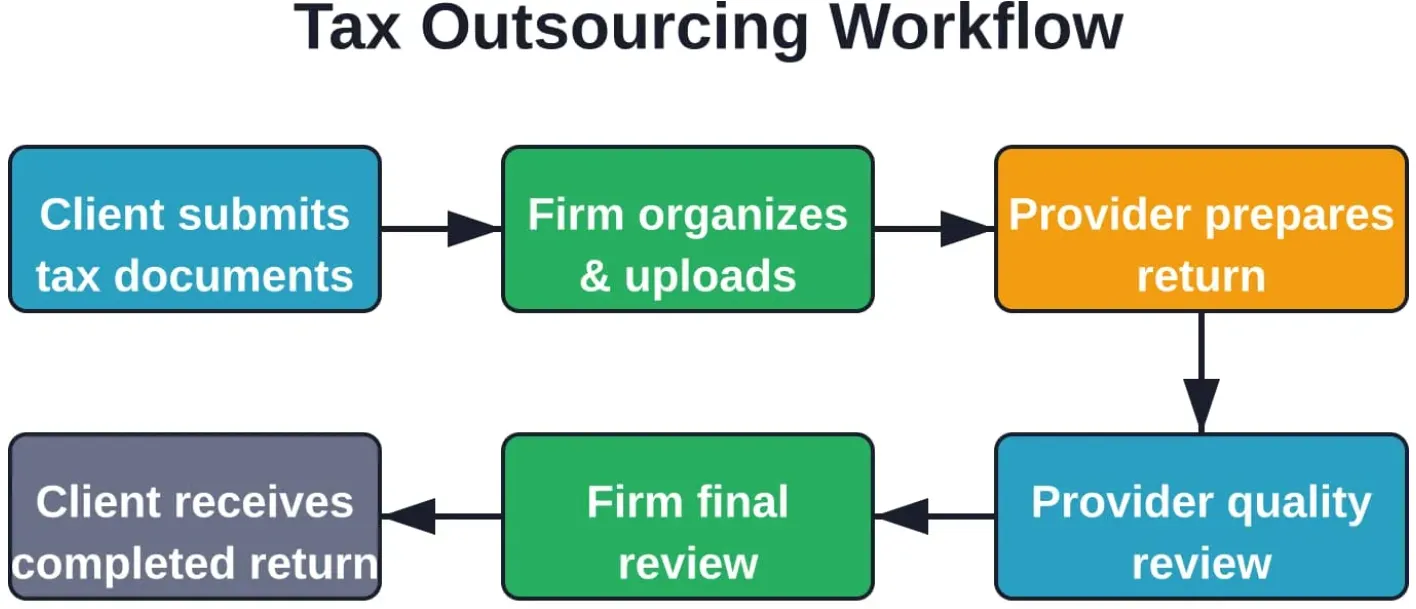
The firm's name goes on every return regardless of who prepared it. Quality control can't be outsourced along with the preparation work.
Strong providers implement multi-level review processes before returns reach the firm. But firms must maintain their own final review procedures to catch errors and ensure work meets their standards.
Define clear quality metrics in the service agreement. Accuracy rates, revision frequencies, and error categories should be tracked and reported regularly. The data reveals whether quality meets expectations or problems are emerging.
Communication and Turnaround Times
Time zone differences create both advantages and challenges. Offshore providers can work while firm staff sleep, potentially enabling 24-hour production cycles.
But the same time difference complicates real-time communication. Questions that need immediate answers wait hours for response. Complex issues requiring discussion are harder to resolve through email than conversation.
Evaluate the provider's communication infrastructure. Dedicated account managers, secure messaging platforms, and scheduled call times help bridge the gap. Some firms find nearshore or onshore providers worth the extra cost to simplify communication.
Selecting the Right Tax Outsourcing Provider
Not all outsourcing providers deliver equivalent results. The selection process separates successful partnerships from regretted decisions.
Essential Provider Qualifications
Start with credentials. Staff should hold relevant professional certifications—CPAs, Enrolled Agents, or equivalent credentials in their jurisdiction. Ask about continuing education requirements and how the provider ensures staff stay current on tax law changes.
Experience with your specific client types matters more than general tax knowledge. A provider skilled in individual returns might struggle with complex partnership allocations or consolidated corporate returns.
Request client references from firms with similar practice areas and similar-sized client bases. Ask those references about accuracy, responsiveness, and how the provider handled difficult situations or deadline pressure.
Industry tenure indicates stability. Newer providers might offer attractive pricing but lack the systems and experience to deliver consistently during high-volume periods.
Technology Infrastructure
The provider's technology stack directly impacts efficiency and security. Ask detailed questions about their platforms.
What tax software do they use? Does it integrate with your practice management system? Can they work in your software environment if that's required?
How do they handle data transfer? Secure portals with client-specific access controls represent best practice. Email attachments, even encrypted ones, create unnecessary risk.
Automation capabilities determine how efficiently they process routine work. Optical character recognition and automated data extraction from source documents reduce manual entry errors and speed turnaround.
Service Level Agreements
Everything promised during sales conversations should appear in the service level agreement. Verbal assurances mean nothing when problems arise.
The SLA must specify turnaround times for different return types. Simple individual returns shouldn't take as long as complex multi-state corporate returns. Define what constitutes a complete submission and when the turnaround clock starts.
Quality guarantees need teeth. What happens when returns contain errors? Does the provider fix problems at no charge? What accuracy rates do they guarantee?
Capacity commitments matter during tax season. Can the provider guarantee they'll accept your work volume during peak periods, or might they limit submissions when overloaded?

Add Tax Season Support Staff With NeoWork
Tax season often creates extra pressure around document handling, client follow-ups, bookkeeping support, data entry, and return preparation workflows. NeoWork can help firms hire remote tax preparers, accounting staff, bookkeepers, and admin support teammates for the operational workload that builds up during busy periods.
This makes NeoWork relevant for firms that need extra staffing capacity without treating every task as senior tax advisory work. Their 91% annualized teammate retention rate and 3.2% candidate selectivity rate can also help reduce the disruption that comes from constantly replacing short-term support.
NeoWork can bring in support for:
- Tax preparation support
- Client follow-ups
- Document collection and organization
- Bookkeeping and accounting support
- Routine data tasks
- Admin coordination during peak season
👉Reach out to NeoWork to add extra operational help around tax season workflows, client follow-ups, and routine support tasks.
Implementation Strategy
A successful outsourcing relationship requires thoughtful implementation. Rushing into production work without proper foundation causes problems that take months to correct.
Start Small and Scale Gradually
Begin with a pilot project involving limited scope and straightforward returns. This test run reveals how the provider works, their actual turnaround times, and quality levels before committing major client work.
Choose pilot returns that represent common client types but aren't high-stakes engagements. The goal is learning, not risking important client relationships.
Evaluate pilot results honestly. Did quality meet expectations? Were turnaround times acceptable? How well did communication work? Use the data to adjust processes before expanding volume.
Document Processes and Standards
The provider can't read minds. Clear documentation of firm standards prevents misunderstandings and ensures consistent output.
Create detailed preparation guides covering formatting preferences, documentation requirements, and quality standards. Include examples of properly completed work products.
Document the workflow from end to end. Who submits work to the provider? How do they communicate special circumstances? What review happens before returns go to clients?
Version control matters. When processes change, update documentation immediately and confirm the provider received and understood the changes.
Training and Knowledge Transfer
Effective outsourcing requires training in both directions. Provider staff need to understand firm processes and preferences. Firm staff must learn how to work effectively with the outsourcing team.
Invest time in detailed onboarding. Walk provider staff through sample returns, explaining the reasoning behind preparation decisions. This context helps them make better judgments on future work.
Train internal staff on proper work submission procedures, communication protocols, and quality review processes. They're now managing a vendor relationship, not just preparing returns.
Cost Structures and Pricing Models
Tax preparation outsourcing pricing varies significantly based on provider location, service scope, and engagement structure. Understanding common models helps evaluate proposals accurately.
Per-Return Pricing
Many providers charge fixed fees per return based on form complexity. A basic Form 1040 costs less than a multi-state S-corporation return with multiple K-1s.
This model offers predictability—each completed return carries a known cost. But it can incentivize speed over thoroughness if the provider maximizes volume to increase revenue.
Per-return pricing works well when return types are relatively standardized and volume is predictable. It's less suitable when returns vary widely in complexity or unusual situations require extra attention.
Hourly Rates
Some providers bill by preparer time spent on each return. Rates vary based on preparer experience level and provider location.
Hourly billing better handles variable-complexity work. Straightforward returns consume less cost while complicated situations get appropriate attention without provider losses.
The downside is less cost predictability. Monthly invoices fluctuate based on the specific mix of returns processed. Firms need strong cost tracking to monitor profitability per client.
Dedicated Staff Models
Larger firms sometimes contract for dedicated preparers who work exclusively on their returns. This creates consistent monthly costs regardless of volume fluctuation.
Dedicated staff become familiar with firm processes and client situations, potentially improving quality and efficiency over time. But the firm pays for capacity whether fully utilized or not.
This model makes sense when work volume justifies full-time equivalent capacity and consistency matters more than cost optimization.
Managing the Outsourcing Relationship
Signing the contract is just the beginning. Long-term success requires active relationship management and continuous improvement.
Regular Performance Reviews
Schedule quarterly business reviews to evaluate performance against service level agreements. Track metrics that matter: accuracy rates, turnaround times, revision frequencies, and communication responsiveness.
Document both successes and problems. When issues arise, address them directly rather than letting frustration build. Conversely, recognize when the provider exceeds expectations.
Performance reviews provide opportunities to adjust processes as needs change. Tax season workflow might differ from extension season or year-round compliance work.
Continuous Process Improvement
The initial process won't be optimal. Build in regular reviews to identify bottlenecks, communication gaps, and quality issues.
Solicit feedback from both provider staff and internal team members. The people doing the daily work often see improvement opportunities that management misses.
Some improvements require provider changes; others need internal adjustments. A collaborative approach works better than pointing fingers when problems emerge.
Maintaining Client Relationships
Clients hire firms, not outsourcing providers. The firm remains the client-facing relationship regardless of who prepares returns behind the scenes.
Decide whether to disclose outsourcing to clients. Some firms mention it explicitly; others consider it an internal operational detail. Either approach can work if service quality remains high.
What matters is responsiveness. Clients don't care about internal workflow complications. They expect their accountant to answer questions promptly and deliver accurate returns on time.
Common Pitfalls and How to Avoid Them
Several mistakes appear repeatedly when firms outsource tax preparation. Learning from others' errors beats making them personally.
Inadequate Due Diligence
The sales pitch sounds great, but some firms skip rigorous vetting. Then problems emerge during tax season when switching providers isn't practical.
Check references thoroughly. Don't just accept the list provided—ask for references similar to your firm size and client mix, then actually call them.
Visit the provider's facilities if possible, especially for large engagements. See the working conditions, meet the staff, and evaluate the operation firsthand.
Unclear Scope Definition
Misunderstandings about what's included in outsourcing services create conflicts and unexpected costs. One party assumes the provider handles organizer creation while the other expects only return preparation.
Define scope explicitly in writing. List each task the provider will perform and each task the firm retains. When gray areas exist, clarify them before they become problems.
Document handoff points clearly. Who's responsible for gathering missing information from clients? Who handles amended return requests? Explicit answers prevent finger-pointing later.
Insufficient Internal Resources
Some firms assume outsourcing eliminates all internal tax preparation work. Then they're surprised by the management overhead required.
Outsourcing changes work, it doesn't eliminate it. Someone must organize source documents, submit work to the provider, review completed returns, and handle client questions.
Plan for the internal capacity needed to manage the relationship effectively. Underestimating this requirement causes bottlenecks that negate outsourcing's efficiency benefits.
The Role of Technology in Tax Outsourcing
Technology capabilities separate leading providers from mediocre ones. The right platforms multiply efficiency while reducing error rates.
Secure Data Exchange Platforms
Modern outsourcing requires secure, efficient data transfer. Leading providers offer portal-based systems where firms upload source documents and download completed returns.
These portals maintain detailed audit trails showing who accessed files and when. Granular permissions ensure staff see only their assigned work, not the entire client base.
Integration with practice management systems streamlines workflow further. Data flows automatically rather than requiring manual export and import procedures.
Automation and Artificial Intelligence
Tax technology continues advancing rapidly. Advanced platforms can enable automation for significant portions of certain tax processes, dramatically reducing manual effort.
Optical character recognition extracts data from W-2s, 1099s, and other source documents automatically. Machine learning algorithms detect anomalies that might indicate errors or missing information.
These tools don't replace professional judgment, but they handle routine tasks efficiently while flagging situations that need human attention.
Practice Management Integration
Disconnected systems create inefficiency. The best outsourcing relationships feature technology that integrates with firm systems.
Status updates flow automatically into practice management software so staff know where each return stands without manual checking. Completed returns appear in document management systems without manual filing.
API-based integrations work better than file exports and imports. Real-time data exchange keeps everyone working with current information.
IRS Compliance and Regulatory Requirements
Tax preparation outsourcing doesn't change fundamental compliance obligations. Understanding what remains of the firm's responsibility matters critically.
Employer Tax Responsibility
The IRS states explicitly that employers remain ultimately responsible for tax obligations when outsourcing payroll duties. This includes both income tax withholding and employment taxes.
Federal tax deposit rules apply to outsourcing arrangements. When accumulated tax liabilities reach specified thresholds, deposits must occur according to applicable requirements regardless of whether payroll processing is outsourced.
For supplemental wages exceeding $1,000,000 annually, special withholding rules apply. Outsourcing providers should handle this automatically, but the employer remains responsible for compliance.
Section 7216 Compliance
IRC Section 7216 requires explicit taxpayer consent prior to disclosing tax return information to any third party specifically in cases of offshore outsourcing (outside the United States) or when utilizing data for non-preparation purposes. Onshore tax preparation outsourcing within the United States to another domestic tax preparer for the purpose of auxiliary preparation or processing does not require Section 7216 consent, provided the data remains within the U.S. and is strictly used for return preparation.
Penalties for Section 7216 violations are significant. Both criminal and civil penalties can apply when preparers disclose or use return information without proper consent.
Professional Liability Considerations
Malpractice insurance coverage deserves review before outsourcing. Some policies include specific provisions or exclusions related to outsourced work.
The firm's professional liability doesn't transfer to the outsourcing provider. When errors occur, clients sue the firm regardless of who actually prepared the return.
Verify that the provider carries appropriate errors and omissions insurance. But understand this protects the provider, not necessarily the firm. The firm's own coverage remains the primary protection.
Future Trends in Tax Preparation Outsourcing
The outsourcing market continues evolving. Several trends are reshaping how firms approach these relationships in 2026 and beyond.
Increased Automation
Artificial intelligence and machine learning continue advancing. Automation capabilities for certain processes will likely continue to advance as technology improves.
This doesn't eliminate human preparers—it shifts their role toward complex analysis and judgment calls that technology can't handle. Routine data entry and basic compliance checking increasingly happen automatically.
Firms benefit through lower costs and faster turnaround. But they must ensure quality control processes adapt to catch errors that automated systems miss.
Hybrid Delivery Models
The distinction between offshore, nearshore, and onshore outsourcing is blurring. Many providers now offer hybrid models combining talent from multiple locations.
Routine preparation might happen offshore while complex review and client communication remain onshore. This balances cost efficiency with service quality and communication effectiveness.
Specialized Service Offerings
Generic tax outsourcing is giving way to specialized providers focusing on specific industries or return types. A provider might specialize exclusively in dental practices, real estate investors, or manufacturing companies.
Specialization creates efficiency through deep expertise. Preparers familiar with industry-specific issues work faster and produce higher quality results than generalists learning each client's unique circumstances.
Building an Internal Outsourcing Strategy
Strategic outsourcing requires planning that extends beyond selecting a provider. Firms need internal frameworks defining how outsourcing fits their broader practice management.
Defining What to Outsource
Not all work should be outsourced. Strategic decisions determine which functions remain in-house and which move to providers.
Client-facing activities typically stay internal. Relationship management, complex consultation, and tax planning require direct firm involvement. Clients expect to work with firm professionals they know and trust.
Behind-the-scenes preparation represents prime outsourcing candidates, especially for routine compliance work. Data entry, basic return preparation, and document organization can move offshore without impacting client experience.
Staff Impact and Change Management
Outsourcing announcements trigger anxiety among staff who fear job elimination. Addressing concerns directly and honestly prevents morale problems.
The reality is outsourcing changes roles more than eliminating them. Staff shift from preparing routine returns to managing outsourcing relationships, handling complex situations, and focusing on advisory services.
Training helps staff succeed in evolved roles. They need project management skills, quality review capabilities, and often client service training as they spend more time in client-facing activities.
Measuring Success
Define success metrics before implementation so results can be evaluated objectively. What outcomes matter most—cost reduction, capacity expansion, quality improvement, or staff satisfaction?
Track financial metrics including cost per return, effective hourly rates, and profitability by client type. Compare actual results to projections to understand return on investment.
Measure operational metrics like turnaround times, revision rates, and client satisfaction scores. These indicate whether outsourcing improves or harms service delivery.
Frequently Asked Questions
Conclusion
Tax preparation outsourcing has matured from a cost-cutting measure into a strategic practice management tool. When implemented thoughtfully, it delivers substantial cost savings while expanding capacity and maintaining quality.
But success isn't automatic. The firms achieving the best results invest significant effort in provider selection, process development, and relationship management. They recognize that outsourcing changes work rather than eliminating it.
The regulatory framework is clear: firms retain ultimate responsibility for accuracy and compliance regardless of outsourcing arrangements. Quality control can't be delegated along with preparation work. Client relationships remain the firm's most valuable asset, and those relationships depend on consistent service delivery.
Technology continues advancing rapidly. Today's automation capabilities enable efficiency levels that seemed impossible five years ago. Firms that embrace these tools through strategic outsourcing partnerships position themselves to handle growing client demands without proportional staff expansion.
Start with careful planning. Define objectives clearly, select providers rigorously, implement gradually, and manage actively. The investment pays dividends through reduced costs, expanded capacity, and often improved work-life balance for internal staff no longer working 70-hour weeks during tax season.
Tax season 2026 is approaching. Firms that start their outsourcing evaluation now have time to implement properly before deadline pressure hits. Those waiting until February will find themselves scrambling rather than executing a strategic plan.
The question isn't whether tax preparation outsourcing works—proven results demonstrate it does when done right. The question is whether your firm will capture these benefits through strategic implementation or continue struggling with capacity constraints that limit growth and exhaust staff.
Topics
Tax Preparation Outsourcing Guide 2026: What CPAs Need

Quick Summary: Tax preparation outsourcing enables accounting firms and businesses to delegate tax compliance work to specialized third-party providers, reducing costs by up to 60% while maintaining accuracy. The IRS confirms employers remain ultimately responsible for tax obligations even when outsourcing payroll and tax duties. Successful outsourcing requires vetting providers for SOC 2 compliance, data security measures, and qualified staff to ensure quality and regulatory adherence.
Tax season 2026 brings the same familiar pressures: tight deadlines, mounting workloads, and staff stretched thin. For many accounting firms and businesses, the question isn't whether they can handle the volume—it's whether they should keep trying to do everything in-house.
Outsourcing tax return preparation has shifted from a cost-cutting measure to a strategic decision. Firms that embrace it report cost savings up to 60 percent while maintaining service quality. But the decision comes with real responsibilities and risks that demand careful consideration.
This guide walks through everything needed to make tax preparation outsourcing work: the regulatory framework, provider selection criteria, cost structures, and implementation strategies that separate successful partnerships from costly mistakes.
Understanding Tax Preparation Outsourcing
Tax preparation outsourcing means delegating tax compliance work to specialized third-party service providers. These providers handle everything from data entry and return preparation to review and filing coordination.
The scope varies widely. Some firms outsource only overflow work during peak season. Others hand off entire tax functions year-round, including quarterly estimates, extension preparation, and amended returns.
According to the IRS, many employers now outsource payroll and related tax duties to third-party service providers. These providers help assure filing deadlines and deposit requirements are met while streamlining business operations.
Types of Tax Outsourcing Arrangements
The market offers several outsourcing models. Staff augmentation adds temporary professionals to your team during busy periods. These workers follow your processes and use your software.
Full-service outsourcing transfers entire tax functions to the provider. The vendor manages workflow, quality control, and delivery using their systems and methodologies.
Hybrid models combine elements of both. A firm might keep client-facing work in-house while outsourcing back-office preparation and data processing tasks.
The Regulatory Framework
The IRS makes one thing clear: employers remain ultimately responsible for tax obligations even when outsourcing. That includes payment of income tax withheld and both employer and employee portions of Social Security and Medicare taxes.
Typical Social Security tax rates apply at standard rates for both employer and employee on taxable wages. Medicare tax stands at 1.45% for each party with no wage limit.
Professional Employer Organizations (PEOs) represent a specific outsourcing category with distinct IRS regulations under IRC Section 3511 and Section 7705. Certified PEOs can assume certain employment tax responsibilities that standard outsourcing providers cannot.
Section 7216 requires explicit taxpayer consent prior to disclosing tax return information to any third party specifically in cases of offshore outsourcing (outside the United States) or when utilizing data for non-preparation purposes. Onshore tax preparation outsourcing within the United States to another domestic tax preparer for the purpose of auxiliary preparation or processing does not require Section 7216 consent, provided the data remains within the U.S. and is strictly used for return preparation.
Why Firms Choose to Outsource Tax Preparation
The financial case for outsourcing starts with hard numbers. Industry reports suggest cost reductions up to 60 percent compared to maintaining equivalent in-house capacity.
These savings come from multiple sources. Labor costs drop when work moves to providers with lower overhead and wage structures. Capital expenditures for software licenses, workstations, and infrastructure shift to operational expenses.
But cost isn't the only driver. Many firms report operational improvements that matter as much as the savings.
Capacity Management During Peak Season
Tax season creates predictable capacity crunches. In-house staff work excessive hours trying to meet filing deadlines while quality suffers and burnout increases.
Outsourcing provides flexible capacity that scales with demand. When work volume spikes in March and April, the provider absorbs overflow without requiring the firm to hire and train seasonal employees.
One provider notes that outsourcing quality often exceeds that of exhausted first or second-year preparers working 60 to 70-hour weeks. Fresh eyes catch errors that tired staff miss.
Access to Specialized Expertise
Tax code complexity continues growing. Specialized areas like international taxation, multi-state compliance, and industry-specific regulations require expertise that smaller firms struggle to maintain in-house.
Quality outsourcing providers employ professionals with niche specializations. A firm handling one or two international returns annually can access dedicated international tax experts without keeping that expertise on permanent payroll.
Technology and Automation Advantages
Leading providers invest heavily in tax technology that individual firms can't justify. Advanced solutions can enable automation for significant portions of certain tax processes.
These platforms integrate optical character recognition, data extraction algorithms, and automated review tools that catch common errors before human review begins. The technology investment pays off across hundreds of client engagements rather than being amortized over a single firm's workflow.
Key Considerations Before Outsourcing
Tax preparation outsourcing introduces risks that require careful management. The decision demands more than a simple cost-benefit calculation.
Data Security and Confidentiality
Tax returns contain sensitive financial and personal information. A data breach doesn't just harm clients—it destroys firm reputation and triggers regulatory consequences.
SOC 2 certification represents the baseline standard for service providers. This AICPA framework evaluates controls related to security, availability, processing integrity, confidentiality, and privacy.
Look beyond the certification itself. Ask about encryption standards for data in transit and at rest. Verify access controls, employee background screening processes, and incident response procedures.
Multi-factor authentication, virtual private networks, and encrypted file transfer protocols should be mandatory, not optional. The provider should demonstrate regular security audits and penetration testing.
Quality Control and Review Processes
The firm's name goes on every return regardless of who prepared it. Quality control can't be outsourced along with the preparation work.
Strong providers implement multi-level review processes before returns reach the firm. But firms must maintain their own final review procedures to catch errors and ensure work meets their standards.
Define clear quality metrics in the service agreement. Accuracy rates, revision frequencies, and error categories should be tracked and reported regularly. The data reveals whether quality meets expectations or problems are emerging.
Communication and Turnaround Times
Time zone differences create both advantages and challenges. Offshore providers can work while firm staff sleep, potentially enabling 24-hour production cycles.
But the same time difference complicates real-time communication. Questions that need immediate answers wait hours for response. Complex issues requiring discussion are harder to resolve through email than conversation.
Evaluate the provider's communication infrastructure. Dedicated account managers, secure messaging platforms, and scheduled call times help bridge the gap. Some firms find nearshore or onshore providers worth the extra cost to simplify communication.
Selecting the Right Tax Outsourcing Provider
Not all outsourcing providers deliver equivalent results. The selection process separates successful partnerships from regretted decisions.
Essential Provider Qualifications
Start with credentials. Staff should hold relevant professional certifications—CPAs, Enrolled Agents, or equivalent credentials in their jurisdiction. Ask about continuing education requirements and how the provider ensures staff stay current on tax law changes.
Experience with your specific client types matters more than general tax knowledge. A provider skilled in individual returns might struggle with complex partnership allocations or consolidated corporate returns.
Request client references from firms with similar practice areas and similar-sized client bases. Ask those references about accuracy, responsiveness, and how the provider handled difficult situations or deadline pressure.
Industry tenure indicates stability. Newer providers might offer attractive pricing but lack the systems and experience to deliver consistently during high-volume periods.
Technology Infrastructure
The provider's technology stack directly impacts efficiency and security. Ask detailed questions about their platforms.
What tax software do they use? Does it integrate with your practice management system? Can they work in your software environment if that's required?
How do they handle data transfer? Secure portals with client-specific access controls represent best practice. Email attachments, even encrypted ones, create unnecessary risk.
Automation capabilities determine how efficiently they process routine work. Optical character recognition and automated data extraction from source documents reduce manual entry errors and speed turnaround.
Service Level Agreements
Everything promised during sales conversations should appear in the service level agreement. Verbal assurances mean nothing when problems arise.
The SLA must specify turnaround times for different return types. Simple individual returns shouldn't take as long as complex multi-state corporate returns. Define what constitutes a complete submission and when the turnaround clock starts.
Quality guarantees need teeth. What happens when returns contain errors? Does the provider fix problems at no charge? What accuracy rates do they guarantee?
Capacity commitments matter during tax season. Can the provider guarantee they'll accept your work volume during peak periods, or might they limit submissions when overloaded?
Add Tax Season Support Staff With NeoWork
Tax season often creates extra pressure around document handling, client follow-ups, bookkeeping support, data entry, and return preparation workflows. NeoWork can help firms hire remote tax preparers, accounting staff, bookkeepers, and admin support teammates for the operational workload that builds up during busy periods.
This makes NeoWork relevant for firms that need extra staffing capacity without treating every task as senior tax advisory work. Their 91% annualized teammate retention rate and 3.2% candidate selectivity rate can also help reduce the disruption that comes from constantly replacing short-term support.
NeoWork can bring in support for:
- Tax preparation support
- Client follow-ups
- Document collection and organization
- Bookkeeping and accounting support
- Routine data tasks
- Admin coordination during peak season
👉Reach out to NeoWork to add extra operational help around tax season workflows, client follow-ups, and routine support tasks.
Implementation Strategy
A successful outsourcing relationship requires thoughtful implementation. Rushing into production work without proper foundation causes problems that take months to correct.
Start Small and Scale Gradually
Begin with a pilot project involving limited scope and straightforward returns. This test run reveals how the provider works, their actual turnaround times, and quality levels before committing major client work.
Choose pilot returns that represent common client types but aren't high-stakes engagements. The goal is learning, not risking important client relationships.
Evaluate pilot results honestly. Did quality meet expectations? Were turnaround times acceptable? How well did communication work? Use the data to adjust processes before expanding volume.
Document Processes and Standards
The provider can't read minds. Clear documentation of firm standards prevents misunderstandings and ensures consistent output.
Create detailed preparation guides covering formatting preferences, documentation requirements, and quality standards. Include examples of properly completed work products.
Document the workflow from end to end. Who submits work to the provider? How do they communicate special circumstances? What review happens before returns go to clients?
Version control matters. When processes change, update documentation immediately and confirm the provider received and understood the changes.
Training and Knowledge Transfer
Effective outsourcing requires training in both directions. Provider staff need to understand firm processes and preferences. Firm staff must learn how to work effectively with the outsourcing team.
Invest time in detailed onboarding. Walk provider staff through sample returns, explaining the reasoning behind preparation decisions. This context helps them make better judgments on future work.
Train internal staff on proper work submission procedures, communication protocols, and quality review processes. They're now managing a vendor relationship, not just preparing returns.
Cost Structures and Pricing Models
Tax preparation outsourcing pricing varies significantly based on provider location, service scope, and engagement structure. Understanding common models helps evaluate proposals accurately.
Per-Return Pricing
Many providers charge fixed fees per return based on form complexity. A basic Form 1040 costs less than a multi-state S-corporation return with multiple K-1s.
This model offers predictability—each completed return carries a known cost. But it can incentivize speed over thoroughness if the provider maximizes volume to increase revenue.
Per-return pricing works well when return types are relatively standardized and volume is predictable. It's less suitable when returns vary widely in complexity or unusual situations require extra attention.
Hourly Rates
Some providers bill by preparer time spent on each return. Rates vary based on preparer experience level and provider location.
Hourly billing better handles variable-complexity work. Straightforward returns consume less cost while complicated situations get appropriate attention without provider losses.
The downside is less cost predictability. Monthly invoices fluctuate based on the specific mix of returns processed. Firms need strong cost tracking to monitor profitability per client.
Dedicated Staff Models
Larger firms sometimes contract for dedicated preparers who work exclusively on their returns. This creates consistent monthly costs regardless of volume fluctuation.
Dedicated staff become familiar with firm processes and client situations, potentially improving quality and efficiency over time. But the firm pays for capacity whether fully utilized or not.
This model makes sense when work volume justifies full-time equivalent capacity and consistency matters more than cost optimization.
Managing the Outsourcing Relationship
Signing the contract is just the beginning. Long-term success requires active relationship management and continuous improvement.
Regular Performance Reviews
Schedule quarterly business reviews to evaluate performance against service level agreements. Track metrics that matter: accuracy rates, turnaround times, revision frequencies, and communication responsiveness.
Document both successes and problems. When issues arise, address them directly rather than letting frustration build. Conversely, recognize when the provider exceeds expectations.
Performance reviews provide opportunities to adjust processes as needs change. Tax season workflow might differ from extension season or year-round compliance work.
Continuous Process Improvement
The initial process won't be optimal. Build in regular reviews to identify bottlenecks, communication gaps, and quality issues.
Solicit feedback from both provider staff and internal team members. The people doing the daily work often see improvement opportunities that management misses.
Some improvements require provider changes; others need internal adjustments. A collaborative approach works better than pointing fingers when problems emerge.
Maintaining Client Relationships
Clients hire firms, not outsourcing providers. The firm remains the client-facing relationship regardless of who prepares returns behind the scenes.
Decide whether to disclose outsourcing to clients. Some firms mention it explicitly; others consider it an internal operational detail. Either approach can work if service quality remains high.
What matters is responsiveness. Clients don't care about internal workflow complications. They expect their accountant to answer questions promptly and deliver accurate returns on time.
Common Pitfalls and How to Avoid Them
Several mistakes appear repeatedly when firms outsource tax preparation. Learning from others' errors beats making them personally.
Inadequate Due Diligence
The sales pitch sounds great, but some firms skip rigorous vetting. Then problems emerge during tax season when switching providers isn't practical.
Check references thoroughly. Don't just accept the list provided—ask for references similar to your firm size and client mix, then actually call them.
Visit the provider's facilities if possible, especially for large engagements. See the working conditions, meet the staff, and evaluate the operation firsthand.
Unclear Scope Definition
Misunderstandings about what's included in outsourcing services create conflicts and unexpected costs. One party assumes the provider handles organizer creation while the other expects only return preparation.
Define scope explicitly in writing. List each task the provider will perform and each task the firm retains. When gray areas exist, clarify them before they become problems.
Document handoff points clearly. Who's responsible for gathering missing information from clients? Who handles amended return requests? Explicit answers prevent finger-pointing later.
Insufficient Internal Resources
Some firms assume outsourcing eliminates all internal tax preparation work. Then they're surprised by the management overhead required.
Outsourcing changes work, it doesn't eliminate it. Someone must organize source documents, submit work to the provider, review completed returns, and handle client questions.
Plan for the internal capacity needed to manage the relationship effectively. Underestimating this requirement causes bottlenecks that negate outsourcing's efficiency benefits.
The Role of Technology in Tax Outsourcing
Technology capabilities separate leading providers from mediocre ones. The right platforms multiply efficiency while reducing error rates.
Secure Data Exchange Platforms
Modern outsourcing requires secure, efficient data transfer. Leading providers offer portal-based systems where firms upload source documents and download completed returns.
These portals maintain detailed audit trails showing who accessed files and when. Granular permissions ensure staff see only their assigned work, not the entire client base.
Integration with practice management systems streamlines workflow further. Data flows automatically rather than requiring manual export and import procedures.
Automation and Artificial Intelligence
Tax technology continues advancing rapidly. Advanced platforms can enable automation for significant portions of certain tax processes, dramatically reducing manual effort.
Optical character recognition extracts data from W-2s, 1099s, and other source documents automatically. Machine learning algorithms detect anomalies that might indicate errors or missing information.
These tools don't replace professional judgment, but they handle routine tasks efficiently while flagging situations that need human attention.
Practice Management Integration
Disconnected systems create inefficiency. The best outsourcing relationships feature technology that integrates with firm systems.
Status updates flow automatically into practice management software so staff know where each return stands without manual checking. Completed returns appear in document management systems without manual filing.
API-based integrations work better than file exports and imports. Real-time data exchange keeps everyone working with current information.
IRS Compliance and Regulatory Requirements
Tax preparation outsourcing doesn't change fundamental compliance obligations. Understanding what remains of the firm's responsibility matters critically.
Employer Tax Responsibility
The IRS states explicitly that employers remain ultimately responsible for tax obligations when outsourcing payroll duties. This includes both income tax withholding and employment taxes.
Federal tax deposit rules apply to outsourcing arrangements. When accumulated tax liabilities reach specified thresholds, deposits must occur according to applicable requirements regardless of whether payroll processing is outsourced.
For supplemental wages exceeding $1,000,000 annually, special withholding rules apply. Outsourcing providers should handle this automatically, but the employer remains responsible for compliance.
Section 7216 Compliance
IRC Section 7216 requires explicit taxpayer consent prior to disclosing tax return information to any third party specifically in cases of offshore outsourcing (outside the United States) or when utilizing data for non-preparation purposes. Onshore tax preparation outsourcing within the United States to another domestic tax preparer for the purpose of auxiliary preparation or processing does not require Section 7216 consent, provided the data remains within the U.S. and is strictly used for return preparation.
Penalties for Section 7216 violations are significant. Both criminal and civil penalties can apply when preparers disclose or use return information without proper consent.
Professional Liability Considerations
Malpractice insurance coverage deserves review before outsourcing. Some policies include specific provisions or exclusions related to outsourced work.
The firm's professional liability doesn't transfer to the outsourcing provider. When errors occur, clients sue the firm regardless of who actually prepared the return.
Verify that the provider carries appropriate errors and omissions insurance. But understand this protects the provider, not necessarily the firm. The firm's own coverage remains the primary protection.
Future Trends in Tax Preparation Outsourcing
The outsourcing market continues evolving. Several trends are reshaping how firms approach these relationships in 2026 and beyond.
Increased Automation
Artificial intelligence and machine learning continue advancing. Automation capabilities for certain processes will likely continue to advance as technology improves.
This doesn't eliminate human preparers—it shifts their role toward complex analysis and judgment calls that technology can't handle. Routine data entry and basic compliance checking increasingly happen automatically.
Firms benefit through lower costs and faster turnaround. But they must ensure quality control processes adapt to catch errors that automated systems miss.
Hybrid Delivery Models
The distinction between offshore, nearshore, and onshore outsourcing is blurring. Many providers now offer hybrid models combining talent from multiple locations.
Routine preparation might happen offshore while complex review and client communication remain onshore. This balances cost efficiency with service quality and communication effectiveness.
Specialized Service Offerings
Generic tax outsourcing is giving way to specialized providers focusing on specific industries or return types. A provider might specialize exclusively in dental practices, real estate investors, or manufacturing companies.
Specialization creates efficiency through deep expertise. Preparers familiar with industry-specific issues work faster and produce higher quality results than generalists learning each client's unique circumstances.
Building an Internal Outsourcing Strategy
Strategic outsourcing requires planning that extends beyond selecting a provider. Firms need internal frameworks defining how outsourcing fits their broader practice management.
Defining What to Outsource
Not all work should be outsourced. Strategic decisions determine which functions remain in-house and which move to providers.
Client-facing activities typically stay internal. Relationship management, complex consultation, and tax planning require direct firm involvement. Clients expect to work with firm professionals they know and trust.
Behind-the-scenes preparation represents prime outsourcing candidates, especially for routine compliance work. Data entry, basic return preparation, and document organization can move offshore without impacting client experience.
Staff Impact and Change Management
Outsourcing announcements trigger anxiety among staff who fear job elimination. Addressing concerns directly and honestly prevents morale problems.
The reality is outsourcing changes roles more than eliminating them. Staff shift from preparing routine returns to managing outsourcing relationships, handling complex situations, and focusing on advisory services.
Training helps staff succeed in evolved roles. They need project management skills, quality review capabilities, and often client service training as they spend more time in client-facing activities.
Measuring Success
Define success metrics before implementation so results can be evaluated objectively. What outcomes matter most—cost reduction, capacity expansion, quality improvement, or staff satisfaction?
Track financial metrics including cost per return, effective hourly rates, and profitability by client type. Compare actual results to projections to understand return on investment.
Measure operational metrics like turnaround times, revision rates, and client satisfaction scores. These indicate whether outsourcing improves or harms service delivery.
Frequently Asked Questions
Conclusion
Tax preparation outsourcing has matured from a cost-cutting measure into a strategic practice management tool. When implemented thoughtfully, it delivers substantial cost savings while expanding capacity and maintaining quality.
But success isn't automatic. The firms achieving the best results invest significant effort in provider selection, process development, and relationship management. They recognize that outsourcing changes work rather than eliminating it.
The regulatory framework is clear: firms retain ultimate responsibility for accuracy and compliance regardless of outsourcing arrangements. Quality control can't be delegated along with preparation work. Client relationships remain the firm's most valuable asset, and those relationships depend on consistent service delivery.
Technology continues advancing rapidly. Today's automation capabilities enable efficiency levels that seemed impossible five years ago. Firms that embrace these tools through strategic outsourcing partnerships position themselves to handle growing client demands without proportional staff expansion.
Start with careful planning. Define objectives clearly, select providers rigorously, implement gradually, and manage actively. The investment pays dividends through reduced costs, expanded capacity, and often improved work-life balance for internal staff no longer working 70-hour weeks during tax season.
Tax season 2026 is approaching. Firms that start their outsourcing evaluation now have time to implement properly before deadline pressure hits. Those waiting until February will find themselves scrambling rather than executing a strategic plan.
The question isn't whether tax preparation outsourcing works—proven results demonstrate it does when done right. The question is whether your firm will capture these benefits through strategic implementation or continue struggling with capacity constraints that limit growth and exhaust staff.
Topics
Related Blogs
Related Podcasts


.webp)

.webp)
.webp)



