

.avif)
.avif)

Technology Staff Augmentation Guide: How to Scale Your Team in 2026


.svg)

Quick Summary: Technology staff augmentation lets companies plug skilled developers, engineers, or specialists directly into an existing team on a temporary or ongoing basis, without the overhead of full-time hiring. It works best for short-to-mid-term skill gaps, sudden project spikes, or hard-to-find specialties, while managed services or full outsourcing fit better when a company wants to hand off an entire function. Success depends on picking the right engagement model, vetting a partner's talent pipeline, and setting up onboarding and communication processes before the first augmented hire ever logs in.
Every engineering leader eventually hits the same wall: the roadmap is full, the backlog is growing, and the internal team just doesn't have enough hands—or the right specialized skills—to hit the deadline. Hiring full-time takes months. Freelancers are hit or miss. That's the exact gap technology staff augmentation was built to fill.
This guide breaks down what staff augmentation actually means in a technology context, how it differs from outsourcing and managed services, when it makes sense (and when it doesn't), what it costs, and how to run the model well once talent is on board. The goal here isn't just definitions—it's a practical playbook for evaluating and executing an augmentation strategy in 2026.
What Is Technology Staff Augmentation?
Staff augmentation is a staffing model where an external provider supplies individual professionals—developers, QA engineers, DevOps specialists, data scientists—who work as an extension of an internal team, usually under that company's own processes, tools, and management structure. The augmented staff aren't handed a finished project to deliver independently; they show up to daily standups, take direction from internal leads, and function much like employees, minus the payroll paperwork.
That last part is the key distinction. With staff augmentation, the hiring company retains control over how the work gets done. The augmentation partner handles recruitment, contracts, and often HR logistics, but day-to-day direction stays internal.

Staff Augmentation vs. Outsourcing vs. Managed Services
These three terms get mixed up constantly, and picking the wrong one can derail a project before it starts.
- Staff augmentation: Individuals join an existing team; the client manages the work.
- Outsourcing (project-based): An entire project or deliverable is handed to a third party, which manages its own team and processes.
- Managed services: A vendor takes ongoing ownership of a function—say, infrastructure monitoring or a support desk—including the people, process, and outcomes, usually under an SLA.

Scale Technology Teams with NeoWork
Technology staff augmentation helps companies expand technical functions with remote professionals while keeping day-to-day work inside existing teams. NeoWork provides teammates across software engineering, data science, cloud architecture, IT, and other technical areas. NeoWork handles recruitment, benefits, training, and ongoing engagement, while teammates follow the client’s systems, workflows, and priorities. Its 91% annualized teammate retention rate and 3.2% candidate selectivity rate reflect a focus on selective hiring and longer-term team stability.
NeoWork's technology staff augmentation model offers:
- technical professionals across multiple functions
- integration with the client’s tools and processes
- recruitment and ongoing teammate support
Contact NeoWork to expand your technology team around current delivery and operational needs.
When Staff Augmentation Actually Makes Sense
Staff augmentation isn't a universal fix. It shines in specific situations and creates friction in others.
Good fits
- Sudden capacity crunches: A launch date moved up, and the backend team needs two more pairs of hands for three months.
- Niche or scarce skills: A short-term need for a Kubernetes expert or a machine learning specialist that doesn't justify a permanent hire.
- Testing new markets or products: Building a proof of concept without committing to headcount before validating demand.
- Bridging a hiring gap: Keeping momentum while recruiting drags on for a hard-to-fill full-time role.
Weaker fits
If the internal team lacks the bandwidth to manage and mentor augmented staff, the model tends to underperform—augmented developers still need direction, code review, and integration into team culture. And if the real need is a fully owned outcome with minimal internal oversight, outsourcing or managed services usually fit better. Companies chasing rock-bottom cost above all else also tend to be disappointed; augmentation saves on hiring overhead, not necessarily on hourly rates for senior talent.
Types of Staff Augmentation Models
Not all augmentation engagements look the same. The right shape depends on skill level needed, how long the gap will last, and where the talent is located.
- Commodity augmentation: Filling general, well-defined roles (junior QA, basic support) where many candidates could do the job.
- Skill-based augmentation: Bringing in specialists for a defined technical need—security audits, cloud migration, a specific framework.
- Highly skilled / niche augmentation: Senior architects, AI/ML researchers, or domain experts who are scarce and expensive to hire outright.
Location also matters. Onshore augmentation keeps teams in the same country, which simplifies communication and compliance but usually costs more. Nearshore balances cost savings with overlapping working hours. Offshore delivers the biggest cost reduction but demands stronger async communication habits and more deliberate onboarding.
Choosing Based on Demand Pattern
Some gaps are one-time spikes—a holiday season traffic surge, a compliance deadline. Others are recurring, like ongoing feature development that ebbs and flows with the roadmap. Short-term spikes usually favor a flexible, month-to-month contract with an augmentation vendor, while recurring demand often justifies a longer engagement with dedicated augmented team members who build deep product knowledge over time.
How Much Does Technology Staff Augmentation Cost?
Pricing varies widely by role, seniority, and region, and rates shift often enough that it's worth checking a provider's current rate card directly rather than relying on last year's numbers. As a general pattern, onshore senior engineering talent tends to command the highest hourly rates, nearshore sits in a middle band, and offshore talent typically offers the largest discount—though the gap has been narrowing as demand for skilled offshore developers grows.
Beyond the hourly or monthly rate, factor in:
- Recruitment and vetting fees baked into the vendor's markup
- Ramp-up time before an augmented hire is fully productive
- Tooling, licenses, and infrastructure access costs
- Management overhead—someone internally still needs to lead the augmented staff
For current, region-specific pricing, it's best to request quotes directly from a shortlist of augmentation providers rather than anchoring on published averages, which go stale quickly.
Best Practices for Managing Augmented Teams
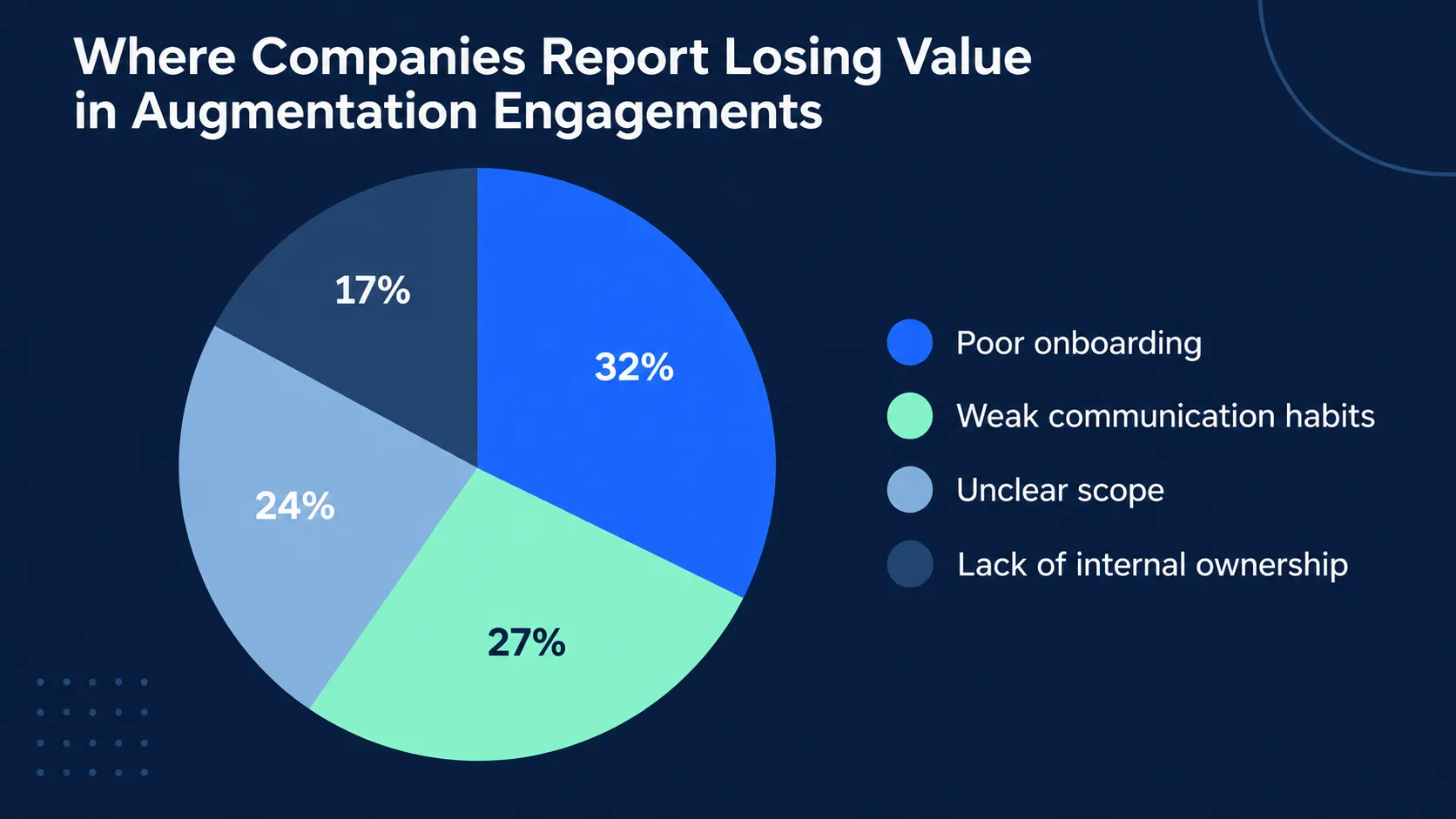
Bringing in augmented staff is the easy part. Getting real value out of them is where most companies stumble.
1. Define scope and success metrics upfront
Vague requests like "we need a developer" lead to mismatched hires. Specify the tech stack, the deliverables expected in the first 30/60/90 days, and how performance will be measured.
2. Treat onboarding as non-negotiable
Augmented staff who get dropped into a codebase with no documentation, no access setup, and no introduction to the team waste weeks getting oriented. A structured onboarding checklist—access provisioning, architecture overview, coding standards, key contacts—pays for itself fast.
3. Integrate them into real communication channels
Standups, sprint planning, retros—augmented team members should be in the same meetings as everyone else, not siloed off. Treating them as outsiders undermines both morale and output quality.
4. Assign clear internal ownership
Someone on the internal team needs to own the relationship: reviewing work, giving feedback, and flagging issues early. Without this, quality drifts and small misunderstandings compound.
5. Plan for knowledge transfer from day one
If the engagement is temporary, document decisions and code as they happen rather than scrambling to transfer knowledge at the end of the contract.
How to Choose a Staff Augmentation Partner
Not every vendor operates the same way, and the difference between a good and bad partner shows up fast once contracts start rolling.
Ask candidate vendors what happens if an augmented hire isn't working out. A serious partner has a replacement process built into the contract, not an awkward negotiation after the fact.
Common Pitfalls to Avoid
A few mistakes show up repeatedly across companies new to the model:
- Treating augmented staff as disposable rather than as team members worth investing in
- Skipping a trial period or paid pilot before committing to a longer contract
- Underestimating the internal management time required
- Choosing the cheapest rate without checking vetting quality
- Failing to plan an exit or knowledge-transfer strategy before the engagement starts
Final Thoughts
Technology staff augmentation works best as a targeted tool, not a default answer to every staffing problem. It's ideal for closing skill gaps quickly, testing new capabilities without long-term commitment, and keeping projects moving when internal hiring can't keep pace. The model falls apart, though, when companies skip onboarding, pick vendors on price alone, or expect augmented staff to operate with zero oversight.
Before signing a contract, get clear on the actual gap being filled, vet a shortlist of providers against real criteria—not just rate cards—and build the onboarding and management structure that makes augmented talent productive fast. Get those pieces right, and staff augmentation becomes one of the more reliable levers for scaling a tech team without the long runway of traditional hiring.
FAQ: Technology Staff Augmentation
Topics
Technology Staff Augmentation Guide: How to Scale Your Team in 2026

Quick Summary: Technology staff augmentation lets companies plug skilled developers, engineers, or specialists directly into an existing team on a temporary or ongoing basis, without the overhead of full-time hiring. It works best for short-to-mid-term skill gaps, sudden project spikes, or hard-to-find specialties, while managed services or full outsourcing fit better when a company wants to hand off an entire function. Success depends on picking the right engagement model, vetting a partner's talent pipeline, and setting up onboarding and communication processes before the first augmented hire ever logs in.
Every engineering leader eventually hits the same wall: the roadmap is full, the backlog is growing, and the internal team just doesn't have enough hands—or the right specialized skills—to hit the deadline. Hiring full-time takes months. Freelancers are hit or miss. That's the exact gap technology staff augmentation was built to fill.
This guide breaks down what staff augmentation actually means in a technology context, how it differs from outsourcing and managed services, when it makes sense (and when it doesn't), what it costs, and how to run the model well once talent is on board. The goal here isn't just definitions—it's a practical playbook for evaluating and executing an augmentation strategy in 2026.
What Is Technology Staff Augmentation?
Staff augmentation is a staffing model where an external provider supplies individual professionals—developers, QA engineers, DevOps specialists, data scientists—who work as an extension of an internal team, usually under that company's own processes, tools, and management structure. The augmented staff aren't handed a finished project to deliver independently; they show up to daily standups, take direction from internal leads, and function much like employees, minus the payroll paperwork.
That last part is the key distinction. With staff augmentation, the hiring company retains control over how the work gets done. The augmentation partner handles recruitment, contracts, and often HR logistics, but day-to-day direction stays internal.
Staff Augmentation vs. Outsourcing vs. Managed Services
These three terms get mixed up constantly, and picking the wrong one can derail a project before it starts.
- Staff augmentation: Individuals join an existing team; the client manages the work.
- Outsourcing (project-based): An entire project or deliverable is handed to a third party, which manages its own team and processes.
- Managed services: A vendor takes ongoing ownership of a function—say, infrastructure monitoring or a support desk—including the people, process, and outcomes, usually under an SLA.
Scale Technology Teams with NeoWork
Technology staff augmentation helps companies expand technical functions with remote professionals while keeping day-to-day work inside existing teams. NeoWork provides teammates across software engineering, data science, cloud architecture, IT, and other technical areas. NeoWork handles recruitment, benefits, training, and ongoing engagement, while teammates follow the client’s systems, workflows, and priorities. Its 91% annualized teammate retention rate and 3.2% candidate selectivity rate reflect a focus on selective hiring and longer-term team stability.
NeoWork's technology staff augmentation model offers:
- technical professionals across multiple functions
- integration with the client’s tools and processes
- recruitment and ongoing teammate support
Contact NeoWork to expand your technology team around current delivery and operational needs.
When Staff Augmentation Actually Makes Sense
Staff augmentation isn't a universal fix. It shines in specific situations and creates friction in others.
Good fits
- Sudden capacity crunches: A launch date moved up, and the backend team needs two more pairs of hands for three months.
- Niche or scarce skills: A short-term need for a Kubernetes expert or a machine learning specialist that doesn't justify a permanent hire.
- Testing new markets or products: Building a proof of concept without committing to headcount before validating demand.
- Bridging a hiring gap: Keeping momentum while recruiting drags on for a hard-to-fill full-time role.
Weaker fits
If the internal team lacks the bandwidth to manage and mentor augmented staff, the model tends to underperform—augmented developers still need direction, code review, and integration into team culture. And if the real need is a fully owned outcome with minimal internal oversight, outsourcing or managed services usually fit better. Companies chasing rock-bottom cost above all else also tend to be disappointed; augmentation saves on hiring overhead, not necessarily on hourly rates for senior talent.
Types of Staff Augmentation Models
Not all augmentation engagements look the same. The right shape depends on skill level needed, how long the gap will last, and where the talent is located.
- Commodity augmentation: Filling general, well-defined roles (junior QA, basic support) where many candidates could do the job.
- Skill-based augmentation: Bringing in specialists for a defined technical need—security audits, cloud migration, a specific framework.
- Highly skilled / niche augmentation: Senior architects, AI/ML researchers, or domain experts who are scarce and expensive to hire outright.
Location also matters. Onshore augmentation keeps teams in the same country, which simplifies communication and compliance but usually costs more. Nearshore balances cost savings with overlapping working hours. Offshore delivers the biggest cost reduction but demands stronger async communication habits and more deliberate onboarding.
Choosing Based on Demand Pattern
Some gaps are one-time spikes—a holiday season traffic surge, a compliance deadline. Others are recurring, like ongoing feature development that ebbs and flows with the roadmap. Short-term spikes usually favor a flexible, month-to-month contract with an augmentation vendor, while recurring demand often justifies a longer engagement with dedicated augmented team members who build deep product knowledge over time.
How Much Does Technology Staff Augmentation Cost?
Pricing varies widely by role, seniority, and region, and rates shift often enough that it's worth checking a provider's current rate card directly rather than relying on last year's numbers. As a general pattern, onshore senior engineering talent tends to command the highest hourly rates, nearshore sits in a middle band, and offshore talent typically offers the largest discount—though the gap has been narrowing as demand for skilled offshore developers grows.
Beyond the hourly or monthly rate, factor in:
- Recruitment and vetting fees baked into the vendor's markup
- Ramp-up time before an augmented hire is fully productive
- Tooling, licenses, and infrastructure access costs
- Management overhead—someone internally still needs to lead the augmented staff
For current, region-specific pricing, it's best to request quotes directly from a shortlist of augmentation providers rather than anchoring on published averages, which go stale quickly.
Best Practices for Managing Augmented Teams
Bringing in augmented staff is the easy part. Getting real value out of them is where most companies stumble.
1. Define scope and success metrics upfront
Vague requests like "we need a developer" lead to mismatched hires. Specify the tech stack, the deliverables expected in the first 30/60/90 days, and how performance will be measured.
2. Treat onboarding as non-negotiable
Augmented staff who get dropped into a codebase with no documentation, no access setup, and no introduction to the team waste weeks getting oriented. A structured onboarding checklist—access provisioning, architecture overview, coding standards, key contacts—pays for itself fast.
3. Integrate them into real communication channels
Standups, sprint planning, retros—augmented team members should be in the same meetings as everyone else, not siloed off. Treating them as outsiders undermines both morale and output quality.
4. Assign clear internal ownership
Someone on the internal team needs to own the relationship: reviewing work, giving feedback, and flagging issues early. Without this, quality drifts and small misunderstandings compound.
5. Plan for knowledge transfer from day one
If the engagement is temporary, document decisions and code as they happen rather than scrambling to transfer knowledge at the end of the contract.
How to Choose a Staff Augmentation Partner
Not every vendor operates the same way, and the difference between a good and bad partner shows up fast once contracts start rolling.
Ask candidate vendors what happens if an augmented hire isn't working out. A serious partner has a replacement process built into the contract, not an awkward negotiation after the fact.
Common Pitfalls to Avoid
A few mistakes show up repeatedly across companies new to the model:
- Treating augmented staff as disposable rather than as team members worth investing in
- Skipping a trial period or paid pilot before committing to a longer contract
- Underestimating the internal management time required
- Choosing the cheapest rate without checking vetting quality
- Failing to plan an exit or knowledge-transfer strategy before the engagement starts
Final Thoughts
Technology staff augmentation works best as a targeted tool, not a default answer to every staffing problem. It's ideal for closing skill gaps quickly, testing new capabilities without long-term commitment, and keeping projects moving when internal hiring can't keep pace. The model falls apart, though, when companies skip onboarding, pick vendors on price alone, or expect augmented staff to operate with zero oversight.
Before signing a contract, get clear on the actual gap being filled, vet a shortlist of providers against real criteria—not just rate cards—and build the onboarding and management structure that makes augmented talent productive fast. Get those pieces right, and staff augmentation becomes one of the more reliable levers for scaling a tech team without the long runway of traditional hiring.
FAQ: Technology Staff Augmentation
Topics
Related Blogs
Related Podcasts


.webp)

.webp)
.webp)



