


Updated:
Oct 31
2026





Quick Summary: Compliance outsourcing means using external specialists or dedicated external staff to handle compliance work such as KYC and AML reviews, regulatory change monitoring, policy administration, audit evidence collection, vendor risk assessments, and data privacy requests. It frees in-house compliance professionals for judgment and advisory work, but one principle never changes: you can outsource tasks, not accountability. Regulators hold the organization and its leadership responsible for outcomes. This guide explains which compliance functions to outsource first, the benefits and risks, how pricing works, how to choose a partner, and how to roll outsourcing out without losing control.
Compliance teams rarely get smaller workloads. New privacy laws, financial crime expectations, AI rules, and security certifications keep adding obligations, while much of the team's week disappears into repetitive work: collecting evidence, checking documents, chasing policy attestations, and filling in vendor questionnaires.
Outsourcing the right parts of that workload can change how a compliance function operates. Outsourcing the wrong parts, or doing it without oversight, creates exactly the kind of gaps regulators look for.
Compliance outsourcing is the use of third-party providers or dedicated external staff to perform compliance activities on an organization's behalf. The provider may supply expertise, such as a fractional compliance officer, operational capacity, such as KYC analysts, or managed services that combine people and technology.
The best starting points are tasks that are repetitive, rule-based, and easy to document. They create the most relief for the internal team and carry the least risk if procedures are clear:
Judgment calls, such as approving high-risk customers, deciding on suspicious activity, and interpreting new regulation, should stay with experienced internal staff.
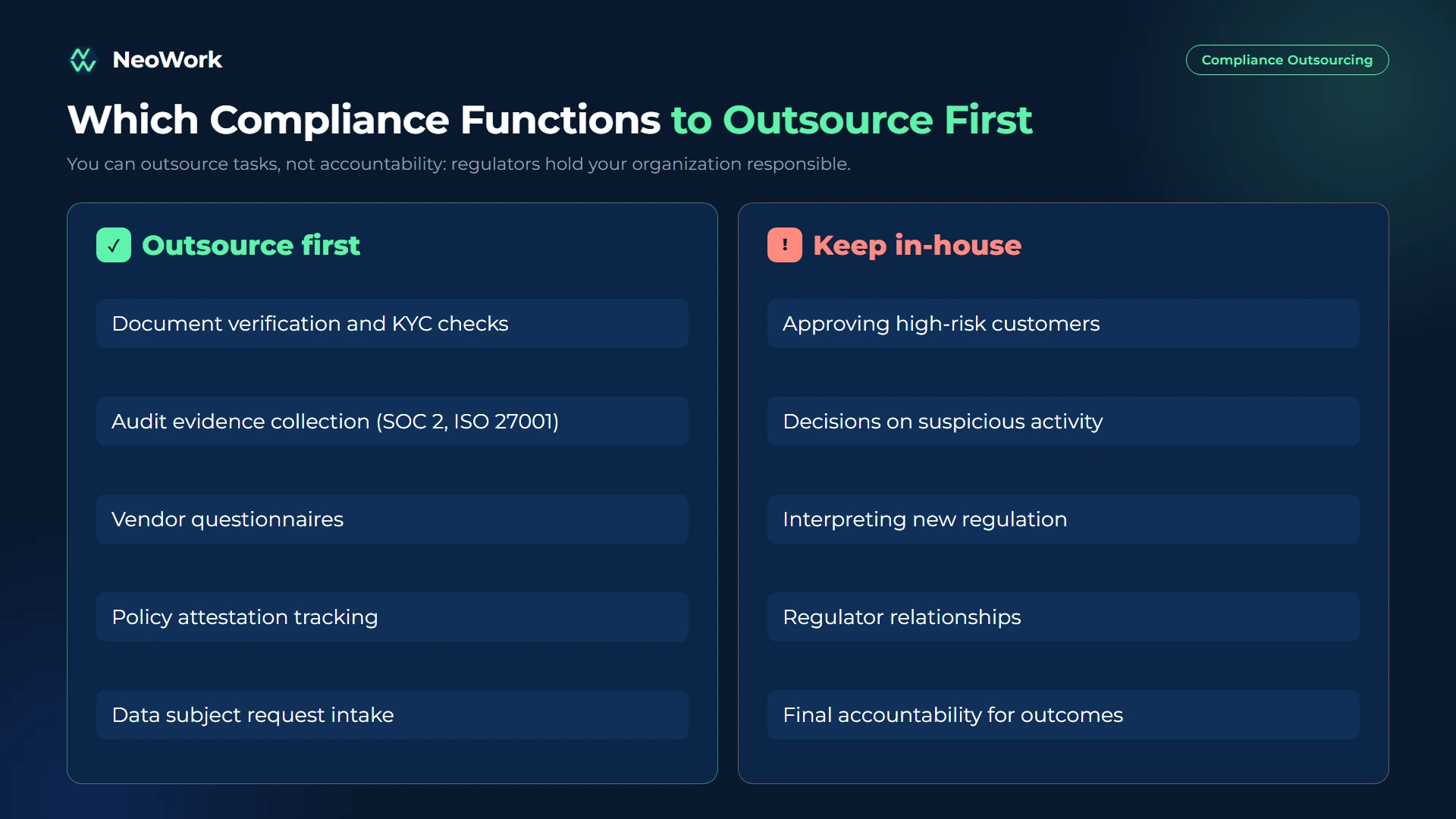

Compliance outsourcing helps organizations add capacity for process-driven compliance work without expanding every role in-house. At NeoWork, we provide dedicated operations teammates who handle document verification, evidence collection, vendor questionnaires, and attestation tracking under your procedures and your compliance team's oversight. We handle recruitment, benefits, training, and ongoing engagement. Our industry-leading 91% annualized teammate retention rate and 3.2% candidate selectivity rate reflect our focus on selective hiring and long-term team stability.
Our compliance support model offers:
Contact NeoWork to add compliance support that fits your oversight model.
The biggest risk is assuming that outsourcing moves responsibility. It doesn't. Regulators expect organizations to oversee outsourced activities as if they were done in-house, which means due diligence on the provider, written procedures, quality checks, and records that show how the work is controlled.
Data protection is the second major consideration. Compliance work often involves sensitive personal and financial data, and some regulations restrict where that data can be processed. Confirm where the work happens, who has access, and how data is protected before any process moves.
Finally, watch for unclear escalation rules. Operational teams can apply procedures consistently, but they need written criteria for what to escalate and to whom. Without them, outsourced staff either escalate everything or make decisions they shouldn't.
Compare these with the cost of hiring internally and with the business cost of backlogs, such as delayed customer onboarding. Our pricing page shows how dedicated roles are structured.
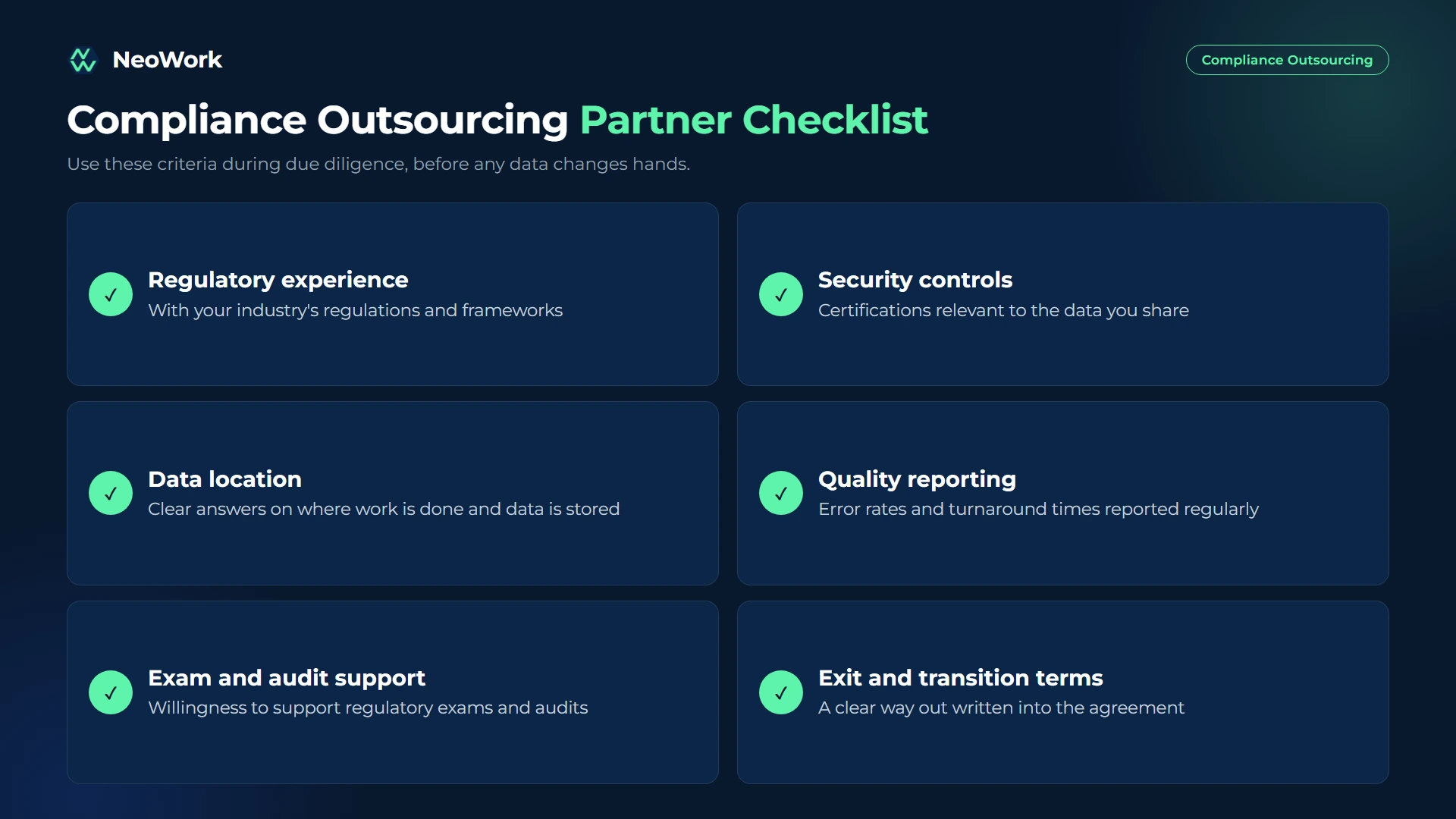
Most organizations start with the outsource column, prove quality over a few months, and then consider co-sourcing more specialized work.
Outsourcing doesn't remove scrutiny; it changes what you need to show. When auditors or examiners look at outsourced compliance work, they usually ask for:
Imagine a growing fintech where new customer applications wait days for KYC review. Sales complains, customers abandon onboarding, and the two-person compliance team spends every hour on document checks instead of improving controls.
The company documents its review procedure, defines clear escalation criteria for higher-risk applications, and adds dedicated operations teammates to handle standard document checks. Internal analysts keep final approval on escalated cases and review a sample of completed work every week. Within a couple of months, standard reviews move much faster, escalations reach the right people, and the internal team finally has time to strengthen monitoring and policies.
Risk-assess the activity, confirm it may be outsourced under the rules that apply to you, run due diligence on the provider, document procedures and escalation criteria, and sign agreements covering confidentiality, data processing, audit rights, and exit.
Assign a named internal owner for each outsourced process, sample-check completed work, starting high and reducing as quality stabilizes, track errors, escalations, and turnaround in a monthly report, and review access rights regularly.
Re-assess risk whenever scope, volumes, or regulations change, make sure records and evidence return to your systems, and confirm data deletion by the provider where required.
Outsourced compliance teams are only as effective as the systems they work in. Before the first teammate starts, make sure the basics are in place:
When outsourced teammates work inside your tools rather than their own, every action leaves a trail you control, which is exactly what auditors want to see.
Compliance outsourcing usually needs approval from leadership, and sometimes from the board or a regulator. The strongest business cases start with the problem, not the vendor. Show where the current team is losing time, how backlogs affect customers or revenue, and which risks grow when reviews are delayed or rushed.
Then present the plan: which tasks move to the outsourced team, which decisions stay in-house, how quality will be checked, and what it costs compared with hiring locally. Include a pilot period with clear success measures, such as turnaround time, error rates, and backlog size. A small, measurable pilot is far easier to approve than a large transformation, and it gives you real data before you expand the scope.
Compliance outsourcing works best when it's treated as a control, not a handoff. Outsource well-documented, high-volume work, keep judgment and accountability in-house, and maintain real oversight through procedures, quality checks, and clear escalation.
Start with one process, measure the results honestly, and expand from there. That approach relieves the team without creating new risk.

Quick Summary: Compliance outsourcing means using external specialists or dedicated external staff to handle compliance work such as KYC and AML reviews, regulatory change monitoring, policy administration, audit evidence collection, vendor risk assessments, and data privacy requests. It frees in-house compliance professionals for judgment and advisory work, but one principle never changes: you can outsource tasks, not accountability. Regulators hold the organization and its leadership responsible for outcomes. This guide explains which compliance functions to outsource first, the benefits and risks, how pricing works, how to choose a partner, and how to roll outsourcing out without losing control.
Compliance teams rarely get smaller workloads. New privacy laws, financial crime expectations, AI rules, and security certifications keep adding obligations, while much of the team's week disappears into repetitive work: collecting evidence, checking documents, chasing policy attestations, and filling in vendor questionnaires.
Outsourcing the right parts of that workload can change how a compliance function operates. Outsourcing the wrong parts, or doing it without oversight, creates exactly the kind of gaps regulators look for.
Compliance outsourcing is the use of third-party providers or dedicated external staff to perform compliance activities on an organization's behalf. The provider may supply expertise, such as a fractional compliance officer, operational capacity, such as KYC analysts, or managed services that combine people and technology.
The best starting points are tasks that are repetitive, rule-based, and easy to document. They create the most relief for the internal team and carry the least risk if procedures are clear:
Judgment calls, such as approving high-risk customers, deciding on suspicious activity, and interpreting new regulation, should stay with experienced internal staff.
Compliance outsourcing helps organizations add capacity for process-driven compliance work without expanding every role in-house. At NeoWork, we provide dedicated operations teammates who handle document verification, evidence collection, vendor questionnaires, and attestation tracking under your procedures and your compliance team's oversight. We handle recruitment, benefits, training, and ongoing engagement. Our industry-leading 91% annualized teammate retention rate and 3.2% candidate selectivity rate reflect our focus on selective hiring and long-term team stability.
Our compliance support model offers:
Contact NeoWork to add compliance support that fits your oversight model.
The biggest risk is assuming that outsourcing moves responsibility. It doesn't. Regulators expect organizations to oversee outsourced activities as if they were done in-house, which means due diligence on the provider, written procedures, quality checks, and records that show how the work is controlled.
Data protection is the second major consideration. Compliance work often involves sensitive personal and financial data, and some regulations restrict where that data can be processed. Confirm where the work happens, who has access, and how data is protected before any process moves.
Finally, watch for unclear escalation rules. Operational teams can apply procedures consistently, but they need written criteria for what to escalate and to whom. Without them, outsourced staff either escalate everything or make decisions they shouldn't.
Compare these with the cost of hiring internally and with the business cost of backlogs, such as delayed customer onboarding. Our pricing page shows how dedicated roles are structured.
Most organizations start with the outsource column, prove quality over a few months, and then consider co-sourcing more specialized work.
Outsourcing doesn't remove scrutiny; it changes what you need to show. When auditors or examiners look at outsourced compliance work, they usually ask for:
Imagine a growing fintech where new customer applications wait days for KYC review. Sales complains, customers abandon onboarding, and the two-person compliance team spends every hour on document checks instead of improving controls.
The company documents its review procedure, defines clear escalation criteria for higher-risk applications, and adds dedicated operations teammates to handle standard document checks. Internal analysts keep final approval on escalated cases and review a sample of completed work every week. Within a couple of months, standard reviews move much faster, escalations reach the right people, and the internal team finally has time to strengthen monitoring and policies.
Risk-assess the activity, confirm it may be outsourced under the rules that apply to you, run due diligence on the provider, document procedures and escalation criteria, and sign agreements covering confidentiality, data processing, audit rights, and exit.
Assign a named internal owner for each outsourced process, sample-check completed work, starting high and reducing as quality stabilizes, track errors, escalations, and turnaround in a monthly report, and review access rights regularly.
Re-assess risk whenever scope, volumes, or regulations change, make sure records and evidence return to your systems, and confirm data deletion by the provider where required.
Outsourced compliance teams are only as effective as the systems they work in. Before the first teammate starts, make sure the basics are in place:
When outsourced teammates work inside your tools rather than their own, every action leaves a trail you control, which is exactly what auditors want to see.
Compliance outsourcing usually needs approval from leadership, and sometimes from the board or a regulator. The strongest business cases start with the problem, not the vendor. Show where the current team is losing time, how backlogs affect customers or revenue, and which risks grow when reviews are delayed or rushed.
Then present the plan: which tasks move to the outsourced team, which decisions stay in-house, how quality will be checked, and what it costs compared with hiring locally. Include a pilot period with clear success measures, such as turnaround time, error rates, and backlog size. A small, measurable pilot is far easier to approve than a large transformation, and it gives you real data before you expand the scope.
Compliance outsourcing works best when it's treated as a control, not a handoff. Outsource well-documented, high-volume work, keep judgment and accountability in-house, and maintain real oversight through procedures, quality checks, and clear escalation.
Start with one process, measure the results honestly, and expand from there. That approach relieves the team without creating new risk.





