


Updated:
Oct 31
2026





Quick Summary: Facebook ads outsourcing means handing some or all of your Meta advertising (Facebook, Instagram, Messenger, and the Audience Network) to an agency, a freelance media buyer, a creative partner, or dedicated specialists who work as part of your team. Meta reported advertising revenue of roughly 196 billion US dollars in 2025, which shows how competitive the ad auction has become and why skilled management matters. This guide covers what's usually included, why businesses outsource Meta ads, how agencies, freelancers, and in-house teams compare, what outsourcing costs, how to choose a partner, and the risks to watch for.
Running Meta ads looks simple from the outside: pick an audience, upload an image, set a budget. Then performance drops, costs rise, and the numbers in Ads Manager stop matching what's in the bank account.
That's usually when businesses start looking for outside help. The right kind of help depends on what's actually broken, and this guide is designed to help you figure that out before you sign anything.
Facebook ads outsourcing is the delegation of Meta advertising work to people outside your company. Depending on the arrangement, the partner may handle strategy, tracking setup, creative production, daily campaign management, reporting, or all of the above.
One rule applies to every model: your business should own the ad accounts, the Business Portfolio, the Pixel, and the creative assets. The partner works inside your accounts with assigned access, so your history and data stay with you if the relationship ends.
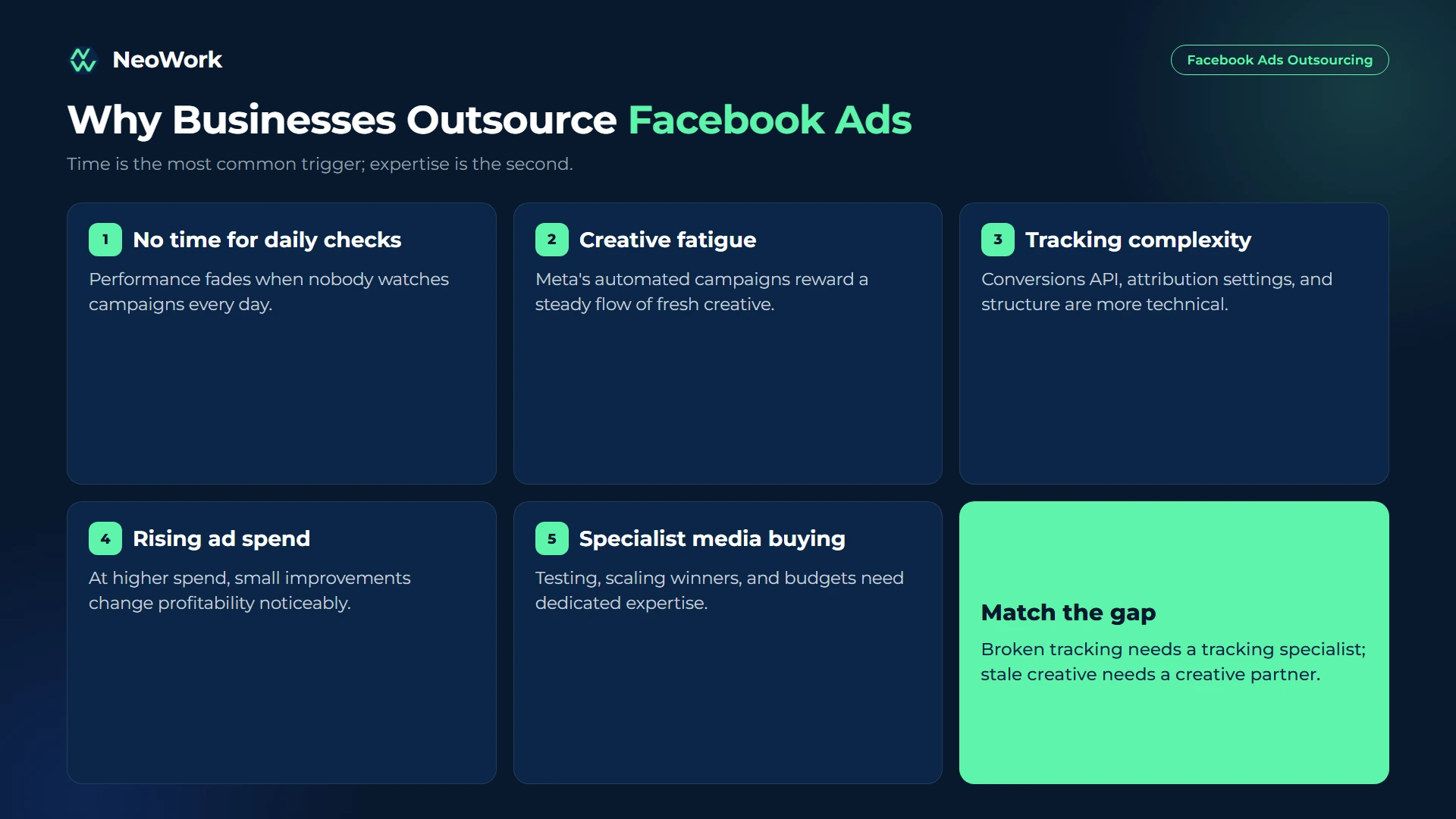
The most common trigger is time. Founders and marketing generalists launch campaigns, see early results, and then watch performance fade because nobody checks campaigns daily or produces new creative every week. Meta's automated campaign types reward a steady flow of fresh creative, and most small teams simply can't keep up.
Expertise is the second trigger. Tracking with the Conversions API, attribution settings, and campaign structure have all become more technical. Once monthly spend grows, small improvements in these areas can change profitability noticeably, and the cost of a specialist pays for itself.

Facebook ads outsourcing helps businesses add capacity for creative production, campaign support, and community management without building a full in-house team. At NeoWork, we provide dedicated marketing and creative teammates who work inside your ad accounts and tools, following your brand guidelines. We handle recruitment, benefits, training, and ongoing engagement. Our industry-leading 91% annualized teammate retention rate and 3.2% candidate selectivity rate reflect our focus on selective hiring and long-term team stability.
Our Meta ads support model offers:
Contact NeoWork to add Meta ads support that fits your marketing team.
Percentage-of-spend pricing gets expensive as budgets grow, while flat and teammate-based pricing stays predictable. Compare options at both your current and planned spend. Our pricing page shows how dedicated roles are structured.
For most businesses spending meaningful amounts every month, yes, as long as the help matches the gap. If tracking is broken, a tracking specialist fixes more than an agency retainer would. If creative is stale, a creative partner or dedicated designer usually does more for results than a new media buyer. If nobody has time for daily management, that's where an agency or dedicated specialist adds the most value.
Where outsourcing tends to disappoint is when businesses expect a partner to fix everything without investing in creative or giving honest feedback on lead quality and revenue.
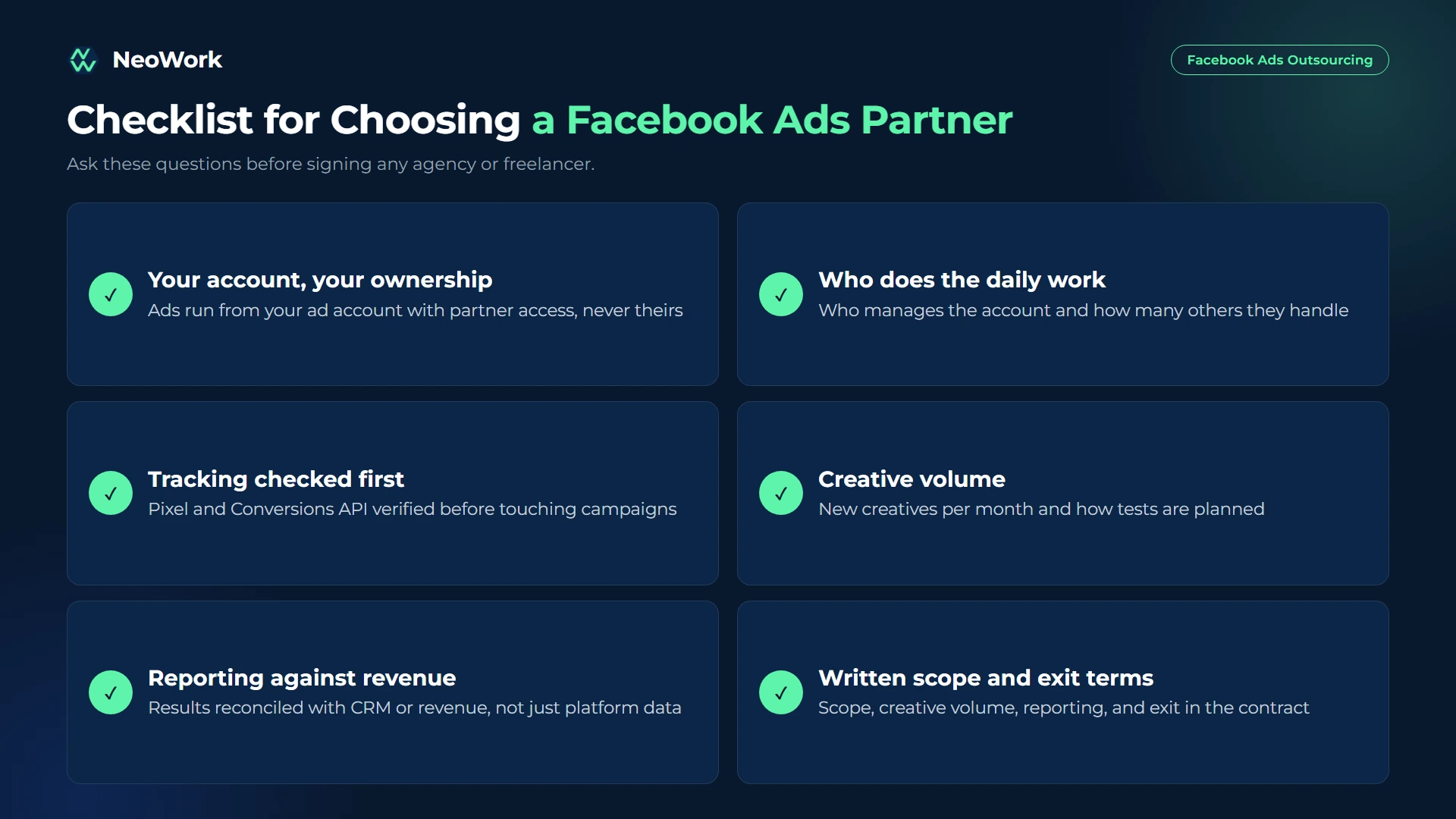
Ask who will manage your account every day and how many other accounts they handle. Senior people often sell; junior people often execute.
A good partner wants to verify your Pixel and Conversions API setup before touching campaigns.
Ask how many new creatives you'll get each month and how tests are planned and recorded.
Make sure results will be reconciled with your actual revenue or CRM data, not just platform metrics.
Before any outsourced partner touches campaigns, tracking should be checked. The Meta Pixel records actions in the browser, while the Conversions API sends events from your server, which makes data more reliable when browsers block tracking. Most accounts benefit from using both, with events deduplicated so purchases aren't counted twice.
A good partner verifies which events fire, whether values and currencies are passed correctly, and whether the events used for optimization match what actually matters to the business. Fixing tracking often improves results more than any change to targeting or bidding.
With Meta's automated campaign types handling more of the targeting, creative has become the main lever for performance. The brands that win usually test new concepts every week and keep a record of what they learn. A simple weekly rhythm looks like this:
The creative log matters as much as the ads themselves. It turns individual tests into knowledge about which hooks, formats, and offers work for your audience.
If a report shows only platform numbers and no explanation of what changed or what's next, ask for more. Reporting should help you make decisions, not just prove activity.
Outsourcing isn't always permanent. Many brands outsource Meta ads while they're small, then build in-house capability once spend and strategic importance grow. Signs it might be time include a marketing leader who wants direct control over testing, spend large enough that agency percentage fees outweigh a full-time salary, or a need for faster coordination between ads, email, and product launches.
A middle path works well for many teams: keep strategy and media buying in-house and add dedicated creative or execution support from a partner. That keeps learning inside the company while still solving the capacity problem that pushed you to outsource in the first place.
Facebook ads outsourcing works when the help you hire matches the problem you have. Fix tracking if the data is wrong, add creative capacity if ads are stale, and bring in management or strategy when campaigns lack attention or direction.
Whatever you choose, keep ownership of your accounts and judge results by real revenue. That keeps every partnership honest.

Quick Summary: Facebook ads outsourcing means handing some or all of your Meta advertising (Facebook, Instagram, Messenger, and the Audience Network) to an agency, a freelance media buyer, a creative partner, or dedicated specialists who work as part of your team. Meta reported advertising revenue of roughly 196 billion US dollars in 2025, which shows how competitive the ad auction has become and why skilled management matters. This guide covers what's usually included, why businesses outsource Meta ads, how agencies, freelancers, and in-house teams compare, what outsourcing costs, how to choose a partner, and the risks to watch for.
Running Meta ads looks simple from the outside: pick an audience, upload an image, set a budget. Then performance drops, costs rise, and the numbers in Ads Manager stop matching what's in the bank account.
That's usually when businesses start looking for outside help. The right kind of help depends on what's actually broken, and this guide is designed to help you figure that out before you sign anything.
Facebook ads outsourcing is the delegation of Meta advertising work to people outside your company. Depending on the arrangement, the partner may handle strategy, tracking setup, creative production, daily campaign management, reporting, or all of the above.
One rule applies to every model: your business should own the ad accounts, the Business Portfolio, the Pixel, and the creative assets. The partner works inside your accounts with assigned access, so your history and data stay with you if the relationship ends.
The most common trigger is time. Founders and marketing generalists launch campaigns, see early results, and then watch performance fade because nobody checks campaigns daily or produces new creative every week. Meta's automated campaign types reward a steady flow of fresh creative, and most small teams simply can't keep up.
Expertise is the second trigger. Tracking with the Conversions API, attribution settings, and campaign structure have all become more technical. Once monthly spend grows, small improvements in these areas can change profitability noticeably, and the cost of a specialist pays for itself.
Facebook ads outsourcing helps businesses add capacity for creative production, campaign support, and community management without building a full in-house team. At NeoWork, we provide dedicated marketing and creative teammates who work inside your ad accounts and tools, following your brand guidelines. We handle recruitment, benefits, training, and ongoing engagement. Our industry-leading 91% annualized teammate retention rate and 3.2% candidate selectivity rate reflect our focus on selective hiring and long-term team stability.
Our Meta ads support model offers:
Contact NeoWork to add Meta ads support that fits your marketing team.
Percentage-of-spend pricing gets expensive as budgets grow, while flat and teammate-based pricing stays predictable. Compare options at both your current and planned spend. Our pricing page shows how dedicated roles are structured.
For most businesses spending meaningful amounts every month, yes, as long as the help matches the gap. If tracking is broken, a tracking specialist fixes more than an agency retainer would. If creative is stale, a creative partner or dedicated designer usually does more for results than a new media buyer. If nobody has time for daily management, that's where an agency or dedicated specialist adds the most value.
Where outsourcing tends to disappoint is when businesses expect a partner to fix everything without investing in creative or giving honest feedback on lead quality and revenue.
Ask who will manage your account every day and how many other accounts they handle. Senior people often sell; junior people often execute.
A good partner wants to verify your Pixel and Conversions API setup before touching campaigns.
Ask how many new creatives you'll get each month and how tests are planned and recorded.
Make sure results will be reconciled with your actual revenue or CRM data, not just platform metrics.
Before any outsourced partner touches campaigns, tracking should be checked. The Meta Pixel records actions in the browser, while the Conversions API sends events from your server, which makes data more reliable when browsers block tracking. Most accounts benefit from using both, with events deduplicated so purchases aren't counted twice.
A good partner verifies which events fire, whether values and currencies are passed correctly, and whether the events used for optimization match what actually matters to the business. Fixing tracking often improves results more than any change to targeting or bidding.
With Meta's automated campaign types handling more of the targeting, creative has become the main lever for performance. The brands that win usually test new concepts every week and keep a record of what they learn. A simple weekly rhythm looks like this:
The creative log matters as much as the ads themselves. It turns individual tests into knowledge about which hooks, formats, and offers work for your audience.
If a report shows only platform numbers and no explanation of what changed or what's next, ask for more. Reporting should help you make decisions, not just prove activity.
Outsourcing isn't always permanent. Many brands outsource Meta ads while they're small, then build in-house capability once spend and strategic importance grow. Signs it might be time include a marketing leader who wants direct control over testing, spend large enough that agency percentage fees outweigh a full-time salary, or a need for faster coordination between ads, email, and product launches.
A middle path works well for many teams: keep strategy and media buying in-house and add dedicated creative or execution support from a partner. That keeps learning inside the company while still solving the capacity problem that pushed you to outsource in the first place.
Facebook ads outsourcing works when the help you hire matches the problem you have. Fix tracking if the data is wrong, add creative capacity if ads are stale, and bring in management or strategy when campaigns lack attention or direction.
Whatever you choose, keep ownership of your accounts and judge results by real revenue. That keeps every partnership honest.





