
Green glowing circular pattern with concentric rings and faint hexagonal grid on the left side.
Blue abstract hexagonal pattern with glowing circular gradient edges on a black background.Glowing greenish-blue hexagonal pattern with concentric circular gradients on a black background.

Global Outsourcing Guide: Strategy, Costs, and Talent Hubs for 2026

Calendar Icon
Published:
Oct 6
2026
,
Updated:
Oct 6
2026
Ann
Facebook IconInstagram Icon

Build your team with NeoWork

Talk to us about how we staff and manage high-performing remote teams for companies like yours.

Get a Global Outsourcing Quote

Quick Summary: Global outsourcing means hiring companies or talent abroad to handle business functions like IT, customer service, or back-office work, typically to cut costs and access skills that are scarce or expensive locally. Done well, it can trim operating expenses by 20-50% and speed up delivery; done poorly, it creates communication gaps, quality issues, and hidden fees. This guide walks through the main models, top talent hubs, realistic cost ranges, and a step-by-step framework for picking the right partner in 2026.

Outsourcing used to mean one thing: ship the call center overseas and cut the budget. That's no longer the whole story. Companies now outsource software development, finance operations, legal research, marketing, and even parts of product design — often to teams that are more specialized than anything they could hire in-house.

Estimates of the global outsourcing market's size vary a lot depending on which services get counted, with 2026 projections ranging anywhere from several hundred billion dollars up into the trillion-dollar range. The exact number matters less than the trend underneath it: more functions are becoming outsourceable, and more countries are competing to provide that talent.

This guide breaks down what outsourcing actually looks like in practice, where the strongest talent pools sit right now, what it realistically costs, and how to avoid the mistakes that turn a smart cost-saving move into a management headache.
What Global Outsourcing Actually Means

Global outsourcing is the practice of contracting a third-party company — usually located in a different country — to perform a business function on an ongoing or project basis. It's distinct from simple remote hiring because the outsourcing provider, not the client company, typically manages the workers, infrastructure, and in many cases the process itself.

There's a related term that gets used almost interchangeably: offshoring. The two overlap but aren't identical. Offshoring is about relocating a function to another country, regardless of who runs it. Outsourcing is about handing that function to an outside vendor, regardless of location. A company can offshore work to its own foreign subsidiary without outsourcing anything, or it can outsource to a vendor right down the street. Global outsourcing, the subject here, sits at the intersection of both.

Common Models

  • Business Process Outsourcing (BPO): customer support, data entry, HR administration, accounting.
  • IT Outsourcing (ITO): software development, QA testing, cloud infrastructure management, cybersecurity.
  • Knowledge Process Outsourcing (KPO): legal research, financial analysis, market research — higher-skill, judgment-heavy work.
  • Staff augmentation: bringing on individual contractors or small teams to fill specific skill gaps temporarily.

Why Companies Outsource

Cost is still the headline reason, but it's rarely the only one anymore. Talent scarcity pushes plenty of decisions now — there simply aren't enough senior engineers or specialized accountants in some local markets, no matter the budget. Speed matters too: a vendor with an existing team can often start faster than a six-month internal hiring process.

Other common drivers include:

  • Access to round-the-clock operations across time zones.
  • Flexibility to scale a team up or down without the overhead of layoffs or long hiring cycles.
  • Focus — freeing internal staff to concentrate on the work that actually differentiates the business.
  • Regulatory or compliance expertise that's hard to build internally for a single market.

Build Global Outsourcing Capacity with NeoWork

Global outsourcing helps companies add remote professionals across support, operations, technical, AI, and back-office functions without expanding every role in-house. At NeoWork, we provide global teammates through individual contributor and dedicated team structures, depending on your operating needs. We handle recruitment, benefits, training, and ongoing engagement, while our teammates integrate into your systems, tools, and daily workflows. Our 91% annualized teammate retention rate and 3.2% candidate selectivity rate reflect our focus on selective hiring and longer-term team stability.

Our global outsourcing model offers:

  • remote teams across multiple business functions
  • integration with your tools and processes
  • recruitment and ongoing teammate support

Contact NeoWork to build global support around your recurring operational needs.

Where Companies Are Sourcing Talent in 2026

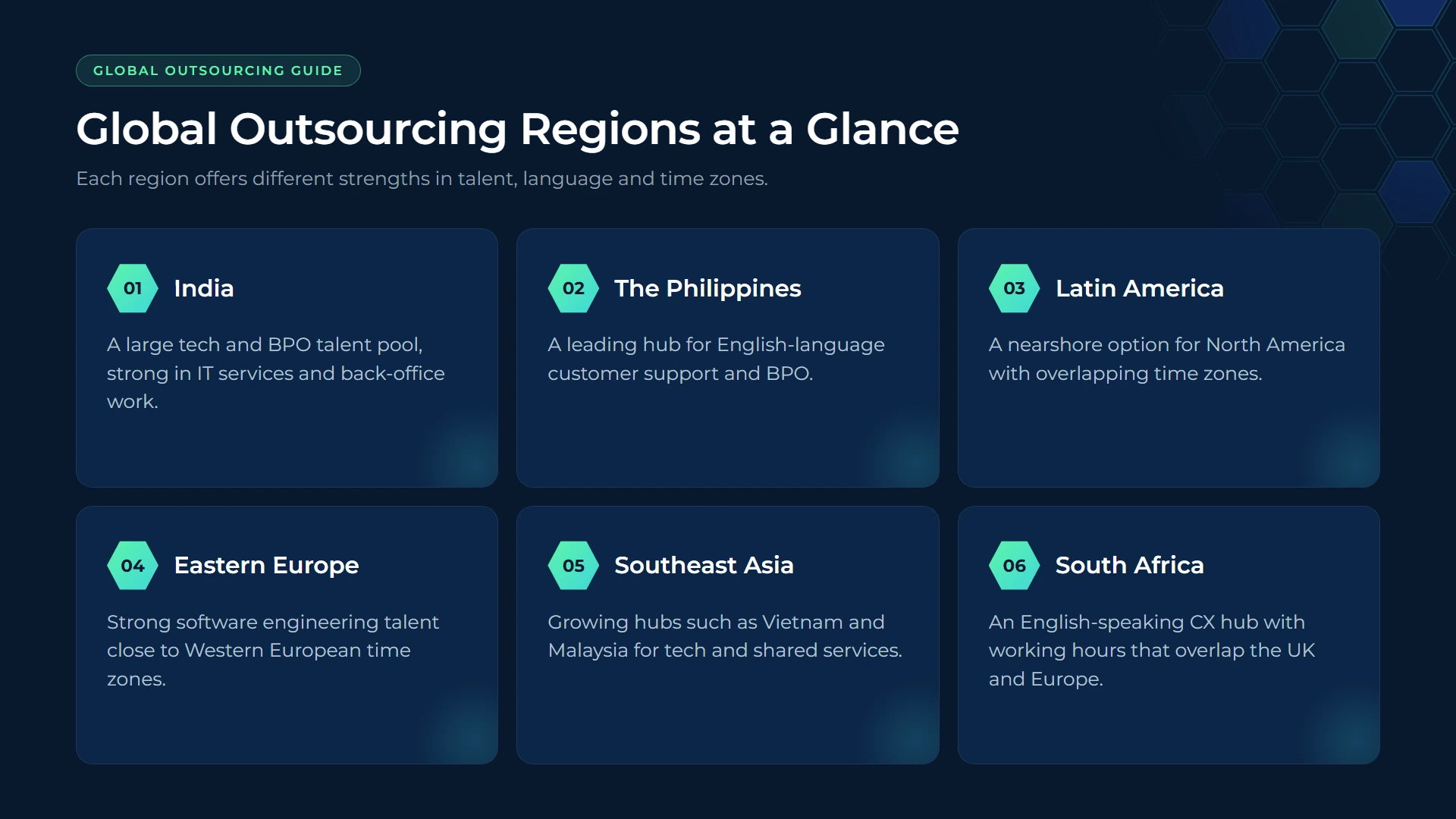
Talent hubs shift as wage levels rise in once-cheap markets and new regions build up infrastructure and English proficiency. A few regions still dominate the conversation, each with a different value proposition.

Region

Known For

Typical Strengths

Common Trade-offs

India

IT, software development, BPO

Huge talent pool, mature outsourcing industry, English proficiency

Time zone gap for US clients, variable quality across vendors

Philippines

Customer support, BPO

Strong English fluency, cultural alignment with US clients

Rising wages in major cities, limited niche tech specialization

Eastern Europe (Poland, Ukraine, Romania)

Software engineering, product design

Strong technical education, closer time zone to Western Europe

Higher rates than Asia, geopolitical considerations in some countries

Latin America (Mexico, Colombia, Argentina)

Nearshore development, support for US clients

Time zone overlap with North America, growing tech talent base

Infrastructure and talent depth vary a lot by country

Vietnam & Southeast Asia

Software development, manufacturing support

Lower costs, growing technical education investment

Smaller senior talent pool, language barriers in some areas

Nearshoring — outsourcing to a nearby country rather than the cheapest one available — has picked up momentum, particularly among US companies looking at Latin America. The cost savings are usually smaller than offshoring to Asia, but overlapping work hours and easier travel often make up for it.

What Global Outsourcing Actually Costs

Pricing swings wildly depending on the function, the region, and the vendor's seniority tier. A junior customer support agent in the Philippines costs a fraction of a senior software architect in Eastern Europe, and both are "outsourcing." That said, a few patterns hold up across most markets.

  • Hourly rates for general BPO/support work commonly fall in the low single digits to roughly $15-$25 per hour depending on the region and skill level.
  • Software development rates commonly range from around $20-$50 per hour in South and Southeast Asia up to $40-$90 per hour in Eastern Europe and Latin America, with senior specialists charging more.
  • KPO work — legal, financial, or analytical — tends to sit above standard BPO pricing because it requires domain expertise and lower error tolerance.

Rates like these change often as wages rise and currencies fluctuate, so it's worth checking a vendor's current pricing directly or consulting a recent market report before budgeting a contract. What rarely shows up in the headline rate: onboarding costs, project management overhead, tooling, and the cost of quality control on the client side. Factor those in before comparing an outsourced quote against an in-house hire.

In-House vs. Outsourced: A Side-by-Side Look

Factor

In-House

Outsourced

Upfront cost

High — recruiting, salary, benefits, equipment

Lower — vendor absorbs most fixed costs

Speed to start

Slow — weeks to months of hiring

Fast — established vendors can start in days

Control over process

Full control

Shared or vendor-managed, depending on model

Scalability

Limited by local hiring capacity

Flexible — scale with contract terms

Institutional knowledge

Builds up over time, stays in-house

Risk of turnover affecting continuity

Quality consistency

Easier to monitor directly

Depends heavily on vendor management

Common Pitfalls — and How to Avoid Them

Most outsourcing failures trace back to a handful of recurring mistakes rather than bad luck. Here's what tends to go wrong, and what usually fixes it.

Vague Scope and Weak SLAs

A contract without measurable service-level agreements is an invitation for disappointment. Define response times, quality benchmarks, and escalation paths before signing — not after the first missed deadline.

Underestimating Management Overhead

Outsourcing doesn't eliminate management work; it changes its shape. Someone internally still needs to own the relationship, review output, and keep the vendor aligned with shifting priorities. Skipping this step is one of the fastest ways to erode the expected savings.

Ignoring Cultural and Communication Gaps

Time zone differences, language nuances, and differing workplace norms can quietly derail a project long before anyone notices a quality problem. Regular check-ins and clear written documentation go a long way here.

Picking Price Over Fit

The cheapest bid is rarely the best long-term value. A vendor that's slightly more expensive but understands the industry, speaks the client's language fluently, and has verifiable references usually outperforms a bargain option over a full contract cycle.
A Practical Framework for Getting Started

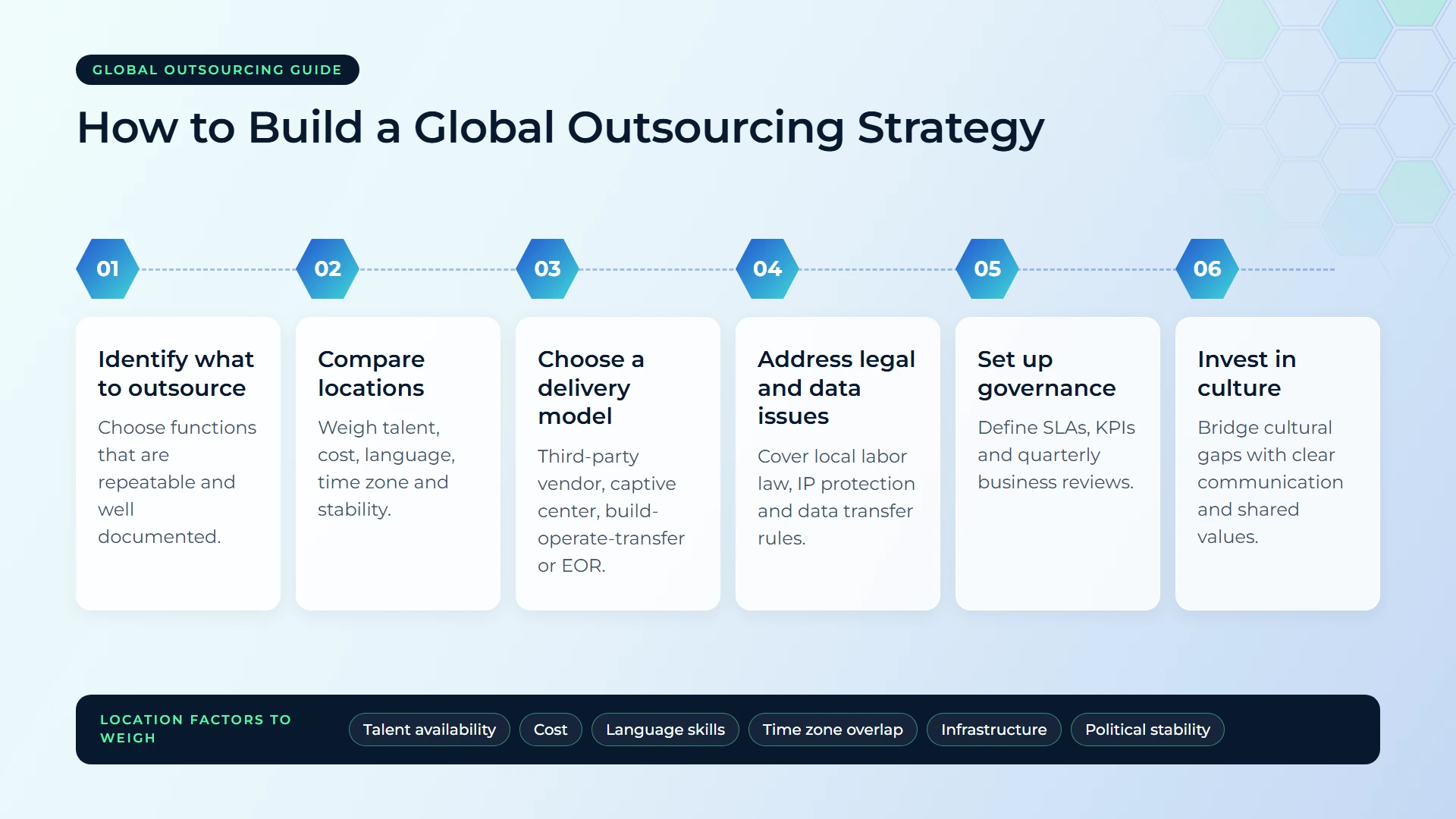
Here's a simplified path that works for most companies evaluating outsourcing for the first time:

  1. Audit internal functions. List tasks that are repetitive, well-documented, or require skills that are scarce locally.
  2. Rank by risk and value. Start with lower-risk, non-core functions before outsourcing anything tied to core intellectual property.
  3. Research 3-5 vendors across at least two regions to compare pricing, specialization, and client reviews.
  4. Run a paid pilot. A small, time-boxed project reveals communication quality and reliability far better than a sales call does.
  5. Set clear SLAs and review cadences before scaling the relationship further.
  6. Review quarterly. Costs, quality, and vendor capacity all shift — revisit the arrangement regularly rather than assuming it will stay static.

FAQ

What's the difference between outsourcing and offshoring?

Outsourcing means handing a function to a third-party vendor, regardless of location. Offshoring means moving a function to another country, regardless of who runs it. The two frequently overlap but describe different things.

Is global outsourcing only for large companies?

No. Small businesses often outsource specific functions — bookkeeping, customer support, website development — precisely because they can't justify a full-time hire for a part-time workload. Scale just affects which model makes sense.

How much can outsourcing actually save a company?

Savings vary widely by function and region, but companies commonly report reductions somewhere in the range of 20-50% on specific outsourced functions compared to hiring locally, once all overhead is accounted for. Exact figures depend heavily on the specific role, region, and vendor chosen.

What functions should never be outsourced?

Functions tied directly to core competitive advantage — proprietary algorithms, sensitive strategic planning, or anything requiring deep institutional context — are usually poor candidates. Non-core, well-documented, repeatable tasks tend to outsource far more successfully.

How long does it take to set up an outsourcing relationship?

A straightforward BPO arrangement can be running within a few weeks. More complex technical projects, especially those requiring custom onboarding or compliance review, often take one to three months before full productivity.

What's the biggest risk with international outsourcing?

Communication breakdown tends to cause more failures than cost overruns. Differences in time zone, language fluency, and working norms can compound quietly until a project is visibly off track.

Should a company outsource to one vendor or several?

It depends on complexity. A single vendor simplifies management but creates dependency risk. Splitting work across multiple vendors adds resilience but requires more internal coordination. Many companies start with one vendor and diversify as the relationship matures.

Final Thoughts

Global outsourcing isn't a shortcut, and it was never really about just cutting a check to someone overseas. The companies that get real value from it treat it as a genuine operating decision — one that requires the same scrutiny as any internal hire, plus a bit more attention to communication and process design.

Start small, pick a non-core function, run a real pilot, and measure the results honestly before scaling further. That approach beats chasing the lowest rate every time. For current pricing and vendor-specific details, check the official sites of shortlisted providers directly, since rates and availability shift throughout the year.

Topics
No items found.

Global Outsourcing Guide: Strategy, Costs, and Talent Hubs for 2026

Paper
Calendar Icon
Oct 6, 2026
Ann

Quick Summary: Global outsourcing means hiring companies or talent abroad to handle business functions like IT, customer service, or back-office work, typically to cut costs and access skills that are scarce or expensive locally. Done well, it can trim operating expenses by 20-50% and speed up delivery; done poorly, it creates communication gaps, quality issues, and hidden fees. This guide walks through the main models, top talent hubs, realistic cost ranges, and a step-by-step framework for picking the right partner in 2026.

Outsourcing used to mean one thing: ship the call center overseas and cut the budget. That's no longer the whole story. Companies now outsource software development, finance operations, legal research, marketing, and even parts of product design — often to teams that are more specialized than anything they could hire in-house.

Estimates of the global outsourcing market's size vary a lot depending on which services get counted, with 2026 projections ranging anywhere from several hundred billion dollars up into the trillion-dollar range. The exact number matters less than the trend underneath it: more functions are becoming outsourceable, and more countries are competing to provide that talent.

This guide breaks down what outsourcing actually looks like in practice, where the strongest talent pools sit right now, what it realistically costs, and how to avoid the mistakes that turn a smart cost-saving move into a management headache.

What Global Outsourcing Actually Means

Global outsourcing is the practice of contracting a third-party company — usually located in a different country — to perform a business function on an ongoing or project basis. It's distinct from simple remote hiring because the outsourcing provider, not the client company, typically manages the workers, infrastructure, and in many cases the process itself.

There's a related term that gets used almost interchangeably: offshoring. The two overlap but aren't identical. Offshoring is about relocating a function to another country, regardless of who runs it. Outsourcing is about handing that function to an outside vendor, regardless of location. A company can offshore work to its own foreign subsidiary without outsourcing anything, or it can outsource to a vendor right down the street. Global outsourcing, the subject here, sits at the intersection of both.

Common Models

  • Business Process Outsourcing (BPO): customer support, data entry, HR administration, accounting.
  • IT Outsourcing (ITO): software development, QA testing, cloud infrastructure management, cybersecurity.
  • Knowledge Process Outsourcing (KPO): legal research, financial analysis, market research — higher-skill, judgment-heavy work.
  • Staff augmentation: bringing on individual contractors or small teams to fill specific skill gaps temporarily.

Why Companies Outsource

Cost is still the headline reason, but it's rarely the only one anymore. Talent scarcity pushes plenty of decisions now — there simply aren't enough senior engineers or specialized accountants in some local markets, no matter the budget. Speed matters too: a vendor with an existing team can often start faster than a six-month internal hiring process.

Other common drivers include:

  • Access to round-the-clock operations across time zones.
  • Flexibility to scale a team up or down without the overhead of layoffs or long hiring cycles.
  • Focus — freeing internal staff to concentrate on the work that actually differentiates the business.
  • Regulatory or compliance expertise that's hard to build internally for a single market.

Build Global Outsourcing Capacity with NeoWork

Global outsourcing helps companies add remote professionals across support, operations, technical, AI, and back-office functions without expanding every role in-house. At NeoWork, we provide global teammates through individual contributor and dedicated team structures, depending on your operating needs. We handle recruitment, benefits, training, and ongoing engagement, while our teammates integrate into your systems, tools, and daily workflows. Our 91% annualized teammate retention rate and 3.2% candidate selectivity rate reflect our focus on selective hiring and longer-term team stability.

Our global outsourcing model offers:

  • remote teams across multiple business functions
  • integration with your tools and processes
  • recruitment and ongoing teammate support

Contact NeoWork to build global support around your recurring operational needs.

Where Companies Are Sourcing Talent in 2026

Talent hubs shift as wage levels rise in once-cheap markets and new regions build up infrastructure and English proficiency. A few regions still dominate the conversation, each with a different value proposition.

Region

Known For

Typical Strengths

Common Trade-offs

India

IT, software development, BPO

Huge talent pool, mature outsourcing industry, English proficiency

Time zone gap for US clients, variable quality across vendors

Philippines

Customer support, BPO

Strong English fluency, cultural alignment with US clients

Rising wages in major cities, limited niche tech specialization

Eastern Europe (Poland, Ukraine, Romania)

Software engineering, product design

Strong technical education, closer time zone to Western Europe

Higher rates than Asia, geopolitical considerations in some countries

Latin America (Mexico, Colombia, Argentina)

Nearshore development, support for US clients

Time zone overlap with North America, growing tech talent base

Infrastructure and talent depth vary a lot by country

Vietnam & Southeast Asia

Software development, manufacturing support

Lower costs, growing technical education investment

Smaller senior talent pool, language barriers in some areas

Nearshoring — outsourcing to a nearby country rather than the cheapest one available — has picked up momentum, particularly among US companies looking at Latin America. The cost savings are usually smaller than offshoring to Asia, but overlapping work hours and easier travel often make up for it.

What Global Outsourcing Actually Costs

Pricing swings wildly depending on the function, the region, and the vendor's seniority tier. A junior customer support agent in the Philippines costs a fraction of a senior software architect in Eastern Europe, and both are "outsourcing." That said, a few patterns hold up across most markets.

  • Hourly rates for general BPO/support work commonly fall in the low single digits to roughly $15-$25 per hour depending on the region and skill level.
  • Software development rates commonly range from around $20-$50 per hour in South and Southeast Asia up to $40-$90 per hour in Eastern Europe and Latin America, with senior specialists charging more.
  • KPO work — legal, financial, or analytical — tends to sit above standard BPO pricing because it requires domain expertise and lower error tolerance.

Rates like these change often as wages rise and currencies fluctuate, so it's worth checking a vendor's current pricing directly or consulting a recent market report before budgeting a contract. What rarely shows up in the headline rate: onboarding costs, project management overhead, tooling, and the cost of quality control on the client side. Factor those in before comparing an outsourced quote against an in-house hire.

In-House vs. Outsourced: A Side-by-Side Look

Factor

In-House

Outsourced

Upfront cost

High — recruiting, salary, benefits, equipment

Lower — vendor absorbs most fixed costs

Speed to start

Slow — weeks to months of hiring

Fast — established vendors can start in days

Control over process

Full control

Shared or vendor-managed, depending on model

Scalability

Limited by local hiring capacity

Flexible — scale with contract terms

Institutional knowledge

Builds up over time, stays in-house

Risk of turnover affecting continuity

Quality consistency

Easier to monitor directly

Depends heavily on vendor management

Common Pitfalls — and How to Avoid Them

Most outsourcing failures trace back to a handful of recurring mistakes rather than bad luck. Here's what tends to go wrong, and what usually fixes it.

Vague Scope and Weak SLAs

A contract without measurable service-level agreements is an invitation for disappointment. Define response times, quality benchmarks, and escalation paths before signing — not after the first missed deadline.

Underestimating Management Overhead

Outsourcing doesn't eliminate management work; it changes its shape. Someone internally still needs to own the relationship, review output, and keep the vendor aligned with shifting priorities. Skipping this step is one of the fastest ways to erode the expected savings.

Ignoring Cultural and Communication Gaps

Time zone differences, language nuances, and differing workplace norms can quietly derail a project long before anyone notices a quality problem. Regular check-ins and clear written documentation go a long way here.

Picking Price Over Fit

The cheapest bid is rarely the best long-term value. A vendor that's slightly more expensive but understands the industry, speaks the client's language fluently, and has verifiable references usually outperforms a bargain option over a full contract cycle.

A Practical Framework for Getting Started

Here's a simplified path that works for most companies evaluating outsourcing for the first time:

  1. Audit internal functions. List tasks that are repetitive, well-documented, or require skills that are scarce locally.
  2. Rank by risk and value. Start with lower-risk, non-core functions before outsourcing anything tied to core intellectual property.
  3. Research 3-5 vendors across at least two regions to compare pricing, specialization, and client reviews.
  4. Run a paid pilot. A small, time-boxed project reveals communication quality and reliability far better than a sales call does.
  5. Set clear SLAs and review cadences before scaling the relationship further.
  6. Review quarterly. Costs, quality, and vendor capacity all shift — revisit the arrangement regularly rather than assuming it will stay static.

FAQ

What's the difference between outsourcing and offshoring?

Outsourcing means handing a function to a third-party vendor, regardless of location. Offshoring means moving a function to another country, regardless of who runs it. The two frequently overlap but describe different things.

Is global outsourcing only for large companies?

No. Small businesses often outsource specific functions — bookkeeping, customer support, website development — precisely because they can't justify a full-time hire for a part-time workload. Scale just affects which model makes sense.

How much can outsourcing actually save a company?

Savings vary widely by function and region, but companies commonly report reductions somewhere in the range of 20-50% on specific outsourced functions compared to hiring locally, once all overhead is accounted for. Exact figures depend heavily on the specific role, region, and vendor chosen.

What functions should never be outsourced?

Functions tied directly to core competitive advantage — proprietary algorithms, sensitive strategic planning, or anything requiring deep institutional context — are usually poor candidates. Non-core, well-documented, repeatable tasks tend to outsource far more successfully.

How long does it take to set up an outsourcing relationship?

A straightforward BPO arrangement can be running within a few weeks. More complex technical projects, especially those requiring custom onboarding or compliance review, often take one to three months before full productivity.

What's the biggest risk with international outsourcing?

Communication breakdown tends to cause more failures than cost overruns. Differences in time zone, language fluency, and working norms can compound quietly until a project is visibly off track.

Should a company outsource to one vendor or several?

It depends on complexity. A single vendor simplifies management but creates dependency risk. Splitting work across multiple vendors adds resilience but requires more internal coordination. Many companies start with one vendor and diversify as the relationship matures.

Final Thoughts

Global outsourcing isn't a shortcut, and it was never really about just cutting a check to someone overseas. The companies that get real value from it treat it as a genuine operating decision — one that requires the same scrutiny as any internal hire, plus a bit more attention to communication and process design.

Start small, pick a non-core function, run a real pilot, and measure the results honestly before scaling further. That approach beats chasing the lowest rate every time. For current pricing and vendor-specific details, check the official sites of shortlisted providers directly, since rates and availability shift throughout the year.

Topics

No items found.
Blue gradient banner with rounded corners at the top.
CTA Hexagon LeftCTA Hexagon LeftCTA Hexagon RightCTA Hexagon Right Mobile

Navigate the shadows of tech leadership – all while enjoying the comfort food that binds us all.

CTA Hexagon LeftCTA Hexagon LeftCTA Hexagon RightCTA Hexagon Right Mobile

Book a consultation

Build your team with NeoWork

Talk to us about how we staff and manage high-performing remote teams for companies like yours.