

.avif)
.avif)

Law Firm Administrative Outsourcing Guide for 2026


.svg)

Quick Summary: Law firm administrative outsourcing means handing off non-legal tasks—billing, scheduling, data entry, document prep, and client intake—to external specialists or virtual assistants so attorneys can focus on billable, client-facing work. Done right, it cuts overhead, speeds up turnaround on routine tasks, and gives small and mid-size firms access to skills they couldn't otherwise afford in-house. The key is choosing the right mix of tasks, vetting vendors for legal-industry experience and confidentiality safeguards, and rolling out the change in stages rather than all at once.
Most attorneys didn't go to law school to spend their afternoons formatting invoices or chasing down a client's callback. Yet that's exactly where a huge chunk of billable hours disappears. Administrative drag is one of the quiet profitability killers in legal practice, and it's a big reason outsourcing has moved from a niche cost-cutting tactic to a mainstream operating strategy for firms of every size.
This guide walks through what law firm administrative outsourcing actually covers, which tasks make sense to hand off, the real benefits and risks, and how to pick a partner without putting client confidentiality at risk.
What Is Law Firm Administrative Outsourcing?
Administrative outsourcing is the practice of delegating non-billable, non-substantive legal work to a third party—an outsourcing company, a freelance virtual assistant, or a specialized legal process outsourcing (LPO) firm. It's distinct from outsourcing legal research or contract review, which touches the substance of a case. Administrative outsourcing stays on the operations side: scheduling, data entry, billing, file organization, and client communication logistics.
Some firms outsource a single function, like bookkeeping. Others build a near-complete virtual back office, with an outsourced team handling everything from intake calls to court filing reminders. The right scope depends on firm size, budget, and how much control partners want to retain over day-to-day operations.
Tasks Law Firms Commonly Outsource
Not every task is a good outsourcing candidate. The best ones are repetitive, rules-based, and don't require attorney judgment. Here's how common tasks break down.

Strengthen Law Firm Administration with NeoWork
Law firm administrative outsourcing helps legal teams handle scheduling, records, document management, data entry, and recurring back-office work. NeoWork provides remote teammates who can support administrative workflows while working inside the firm’s existing systems and processes. NeoWork handles recruitment, benefits, training, and ongoing engagement, while the firm retains control over daily priorities and task management. Its 91% annualized teammate retention rate and 3.2% candidate selectivity rate reflect a focus on selective hiring and longer-term team stability.
NeoWork's law firm administrative support model offers:
- legal admin and back-office support
- integration with the firm’s tools and processes
- recruitment and ongoing teammate support
Contact NeoWork to add administrative support that keeps your law firm’s daily work organized.
Why Firms Are Outsourcing More Administrative Work
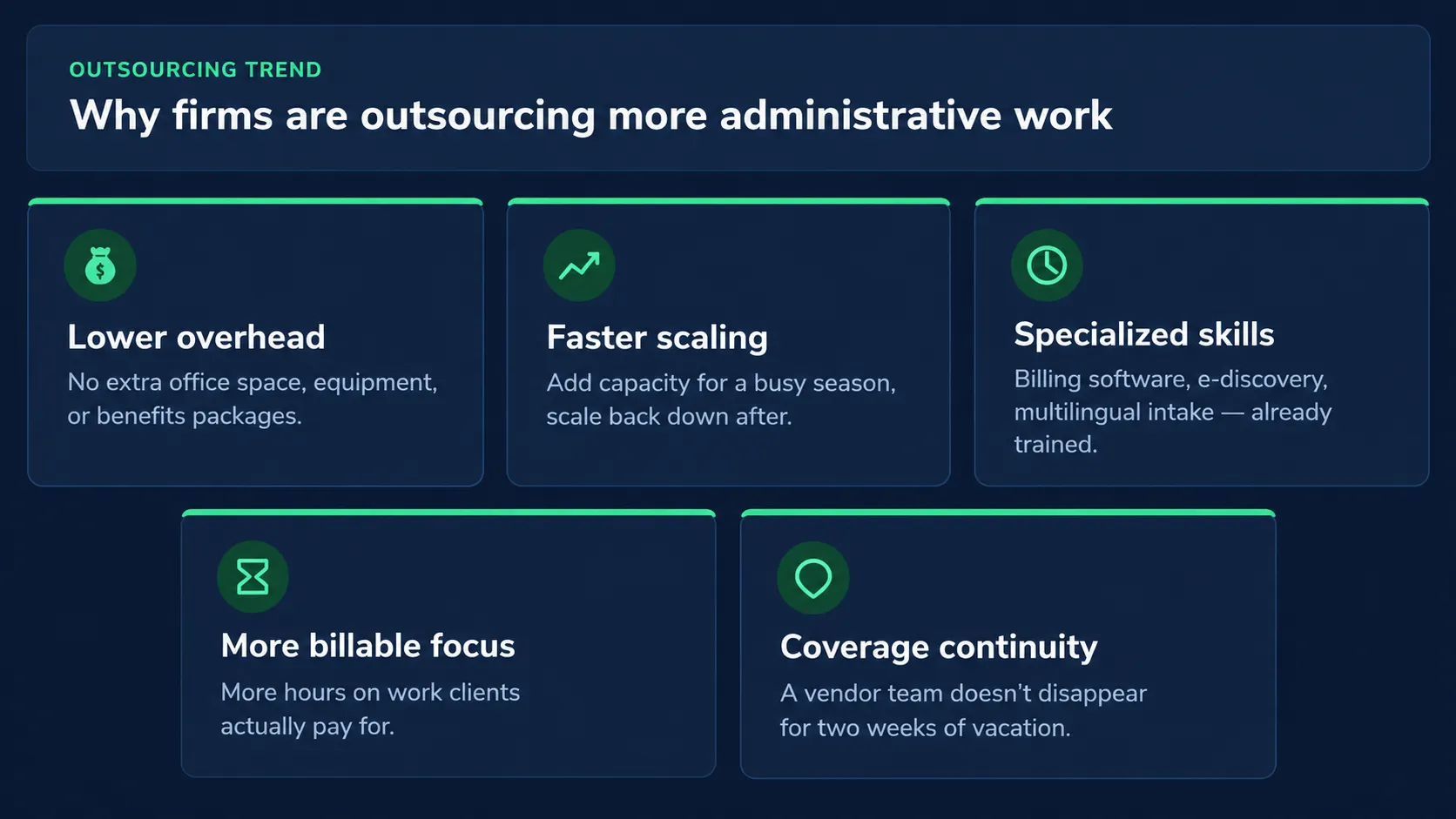
The math is simple, even if the decision isn't always easy. Hiring a full-time paralegal or office manager comes with salary, benefits, training time, and turnover risk. An outsourced provider or virtual assistant can often cover the same ground at a fraction of the fully-loaded cost, and without the multi-week ramp-up.
- Lower overhead: No need for extra office space, equipment, or benefits packages.
- Faster scaling: A firm can add capacity during a busy litigation season and scale back down after, something that's much harder with full-time staff.
- Access to specialized skills: Legal billing software, e-discovery tools, and multilingual intake support are easier to access through a vendor that already trains staff on them.
- More billable focus: Attorneys and paralegals spend more hours on work clients actually pay for.
- Coverage continuity: A vendor team doesn't disappear for two weeks of vacation the way a solo in-house assistant might.
Solo practitioners and small firms tend to feel these benefits most acutely—there's often no administrative staff to begin with, so outsourcing becomes the difference between drowning in paperwork and actually practicing law. Mid-size and larger firms use outsourcing differently, often to handle overflow during peak periods or to standardize back-office processes across multiple offices.
In-House vs. Outsourced Administrative Support
Risks and Ethical Considerations
Outsourcing administrative work isn't risk-free, and bar associations have opinions on this. Client confidentiality obligations don't disappear just because a third party is doing the typing. Before signing with any provider, firms need to confirm a few things.
- Confidentiality agreements: A signed NDA and clear data-handling policy should be non-negotiable.
- Data security: Encrypted file transfer, access controls, and secure case management integrations matter more than a low hourly rate.
- Bar rules on supervision: Many jurisdictions still require attorneys to supervise non-lawyer work adequately, even when it's outsourced. Check the applicable rules of professional conduct before delegating anything client-facing.
- Client disclosure: Some states expect firms to disclose outsourcing arrangements to clients, particularly when sensitive data crosses borders.
- Vendor stability: A provider that goes out of business mid-engagement can leave a firm scrambling. Ask about business continuity plans.
None of this means outsourcing is dangerous by default. It just means the vetting process deserves as much rigor as hiring an employee would—arguably more, since there's less day-to-day visibility into how the work gets done.
How to Choose an Outsourcing Partner
Not all providers are built the same. A generic virtual assistant agency might handle scheduling well but struggle with trust accounting rules. A specialized legal process outsourcing firm, meanwhile, might be unnecessary and overpriced for a two-attorney practice that only needs help answering phones.
Check Their Legal Industry Experience
Ask whether they have worked specifically with law firms or only with general business administration. Legal support often involves confidentiality requirements, legal terminology, filing procedures, and workflows that differ from those in other industries.
Confirm Their Software Knowledge
Find out which case management and billing platforms they already know, including Clio, MyCase, PracticePanther, or other systems used by the firm. A provider familiar with the existing software will usually need less training and can begin contributing sooner.
Ask About Team Consistency
Clarify how they handle staff turnover and whether the same people will work on the firm's files consistently. Frequent changes can create training gaps, communication problems, and uneven work quality.
Review the Pricing Model
Ask how the provider charges and whether costs increase predictably as the workload grows. Firms should understand what is included, what costs extra, and whether the pricing structure still makes sense at a higher volume.
Request Law Firm References
Ask for references from other law firm clients with similar needs or team sizes. Direct feedback can reveal how the provider handles deadlines, communication, confidentiality, and ongoing service quality.
Pricing Models to Expect
Rates vary widely by region, task complexity, and whether the provider is domestic or offshore. Firms should request a detailed quote and compare it against the fully-loaded cost of hiring in-house—salary plus benefits, payroll taxes, equipment, and management time—before assuming outsourcing is automatically cheaper. For most routine administrative tasks, it still comes out ahead, but it's worth running the numbers rather than taking that on faith.
A Realistic Look at Time Reallocation
One of the clearest ways firms notice the impact of outsourcing is in how attorney and staff time gets reallocated. A firm that shifts routine administrative work off attorneys' plates typically sees billable and client-facing hours rise as a share of the total workday.
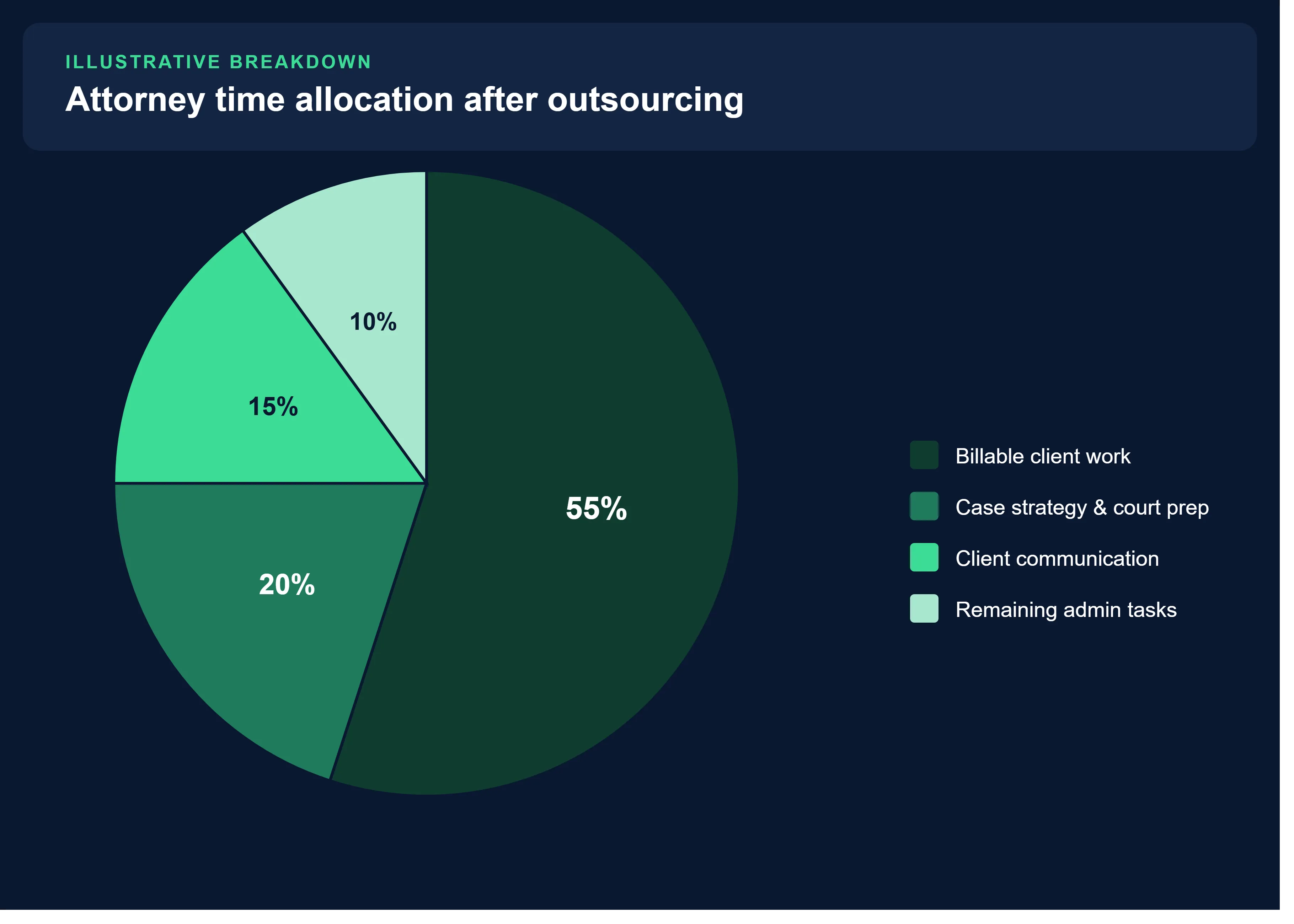
These numbers will look different at every firm, and the exact split depends heavily on practice area and firm size. The pattern that tends to hold, though, is that administrative time drops sharply once repetitive tasks move off an attorney's desk.
Getting Started: A Phased Rollout
Firms that outsource everything at once often regret it. A phased approach reduces disruption and gives partners a chance to evaluate a vendor before committing further.
- Start with one low-risk function. Billing or transcription is a common first step because it's easy to measure results.
- Set clear KPIs. Turnaround time, error rate, and cost per task give an objective read on whether it's working.
- Run a 30–60 day trial. Most reputable vendors will agree to a short trial before a longer commitment.
- Expand gradually. Add intake support, then scheduling, then document prep as trust builds.
- Reassess annually. Workload and firm size change; outsourcing arrangements should be revisited, not set on autopilot.
Final Thoughts
Administrative outsourcing isn't about replacing a firm's culture or handing over control of client relationships. It's about clearing the busywork off attorneys' desks so they can spend more hours on the work that actually moves cases forward and brings in revenue. Start small, measure results, and expand only where it clearly pays off.
Firms weighing this decision should treat vendor selection with the same care as any hiring decision—check references, confirm security practices, and run a trial before committing long term. Done thoughtfully, administrative outsourcing tends to pay for itself well before the first quarter is over.
FAQ: Law Firm Administrative Outsourcing
Topics
Law Firm Administrative Outsourcing Guide for 2026

Quick Summary: Law firm administrative outsourcing means handing off non-legal tasks—billing, scheduling, data entry, document prep, and client intake—to external specialists or virtual assistants so attorneys can focus on billable, client-facing work. Done right, it cuts overhead, speeds up turnaround on routine tasks, and gives small and mid-size firms access to skills they couldn't otherwise afford in-house. The key is choosing the right mix of tasks, vetting vendors for legal-industry experience and confidentiality safeguards, and rolling out the change in stages rather than all at once.
Most attorneys didn't go to law school to spend their afternoons formatting invoices or chasing down a client's callback. Yet that's exactly where a huge chunk of billable hours disappears. Administrative drag is one of the quiet profitability killers in legal practice, and it's a big reason outsourcing has moved from a niche cost-cutting tactic to a mainstream operating strategy for firms of every size.
This guide walks through what law firm administrative outsourcing actually covers, which tasks make sense to hand off, the real benefits and risks, and how to pick a partner without putting client confidentiality at risk.
What Is Law Firm Administrative Outsourcing?
Administrative outsourcing is the practice of delegating non-billable, non-substantive legal work to a third party—an outsourcing company, a freelance virtual assistant, or a specialized legal process outsourcing (LPO) firm. It's distinct from outsourcing legal research or contract review, which touches the substance of a case. Administrative outsourcing stays on the operations side: scheduling, data entry, billing, file organization, and client communication logistics.
Some firms outsource a single function, like bookkeeping. Others build a near-complete virtual back office, with an outsourced team handling everything from intake calls to court filing reminders. The right scope depends on firm size, budget, and how much control partners want to retain over day-to-day operations.
Tasks Law Firms Commonly Outsource
Not every task is a good outsourcing candidate. The best ones are repetitive, rules-based, and don't require attorney judgment. Here's how common tasks break down.
Strengthen Law Firm Administration with NeoWork
Law firm administrative outsourcing helps legal teams handle scheduling, records, document management, data entry, and recurring back-office work. NeoWork provides remote teammates who can support administrative workflows while working inside the firm’s existing systems and processes. NeoWork handles recruitment, benefits, training, and ongoing engagement, while the firm retains control over daily priorities and task management. Its 91% annualized teammate retention rate and 3.2% candidate selectivity rate reflect a focus on selective hiring and longer-term team stability.
NeoWork's law firm administrative support model offers:
- legal admin and back-office support
- integration with the firm’s tools and processes
- recruitment and ongoing teammate support
Contact NeoWork to add administrative support that keeps your law firm’s daily work organized.
Why Firms Are Outsourcing More Administrative Work
The math is simple, even if the decision isn't always easy. Hiring a full-time paralegal or office manager comes with salary, benefits, training time, and turnover risk. An outsourced provider or virtual assistant can often cover the same ground at a fraction of the fully-loaded cost, and without the multi-week ramp-up.
- Lower overhead: No need for extra office space, equipment, or benefits packages.
- Faster scaling: A firm can add capacity during a busy litigation season and scale back down after, something that's much harder with full-time staff.
- Access to specialized skills: Legal billing software, e-discovery tools, and multilingual intake support are easier to access through a vendor that already trains staff on them.
- More billable focus: Attorneys and paralegals spend more hours on work clients actually pay for.
- Coverage continuity: A vendor team doesn't disappear for two weeks of vacation the way a solo in-house assistant might.
Solo practitioners and small firms tend to feel these benefits most acutely—there's often no administrative staff to begin with, so outsourcing becomes the difference between drowning in paperwork and actually practicing law. Mid-size and larger firms use outsourcing differently, often to handle overflow during peak periods or to standardize back-office processes across multiple offices.
In-House vs. Outsourced Administrative Support
Risks and Ethical Considerations
Outsourcing administrative work isn't risk-free, and bar associations have opinions on this. Client confidentiality obligations don't disappear just because a third party is doing the typing. Before signing with any provider, firms need to confirm a few things.
- Confidentiality agreements: A signed NDA and clear data-handling policy should be non-negotiable.
- Data security: Encrypted file transfer, access controls, and secure case management integrations matter more than a low hourly rate.
- Bar rules on supervision: Many jurisdictions still require attorneys to supervise non-lawyer work adequately, even when it's outsourced. Check the applicable rules of professional conduct before delegating anything client-facing.
- Client disclosure: Some states expect firms to disclose outsourcing arrangements to clients, particularly when sensitive data crosses borders.
- Vendor stability: A provider that goes out of business mid-engagement can leave a firm scrambling. Ask about business continuity plans.
None of this means outsourcing is dangerous by default. It just means the vetting process deserves as much rigor as hiring an employee would—arguably more, since there's less day-to-day visibility into how the work gets done.
How to Choose an Outsourcing Partner
Not all providers are built the same. A generic virtual assistant agency might handle scheduling well but struggle with trust accounting rules. A specialized legal process outsourcing firm, meanwhile, might be unnecessary and overpriced for a two-attorney practice that only needs help answering phones.
Check Their Legal Industry Experience
Ask whether they have worked specifically with law firms or only with general business administration. Legal support often involves confidentiality requirements, legal terminology, filing procedures, and workflows that differ from those in other industries.
Confirm Their Software Knowledge
Find out which case management and billing platforms they already know, including Clio, MyCase, PracticePanther, or other systems used by the firm. A provider familiar with the existing software will usually need less training and can begin contributing sooner.
Ask About Team Consistency
Clarify how they handle staff turnover and whether the same people will work on the firm's files consistently. Frequent changes can create training gaps, communication problems, and uneven work quality.
Review the Pricing Model
Ask how the provider charges and whether costs increase predictably as the workload grows. Firms should understand what is included, what costs extra, and whether the pricing structure still makes sense at a higher volume.
Request Law Firm References
Ask for references from other law firm clients with similar needs or team sizes. Direct feedback can reveal how the provider handles deadlines, communication, confidentiality, and ongoing service quality.
Pricing Models to Expect
Rates vary widely by region, task complexity, and whether the provider is domestic or offshore. Firms should request a detailed quote and compare it against the fully-loaded cost of hiring in-house—salary plus benefits, payroll taxes, equipment, and management time—before assuming outsourcing is automatically cheaper. For most routine administrative tasks, it still comes out ahead, but it's worth running the numbers rather than taking that on faith.
A Realistic Look at Time Reallocation
One of the clearest ways firms notice the impact of outsourcing is in how attorney and staff time gets reallocated. A firm that shifts routine administrative work off attorneys' plates typically sees billable and client-facing hours rise as a share of the total workday.
These numbers will look different at every firm, and the exact split depends heavily on practice area and firm size. The pattern that tends to hold, though, is that administrative time drops sharply once repetitive tasks move off an attorney's desk.
Getting Started: A Phased Rollout
Firms that outsource everything at once often regret it. A phased approach reduces disruption and gives partners a chance to evaluate a vendor before committing further.
- Start with one low-risk function. Billing or transcription is a common first step because it's easy to measure results.
- Set clear KPIs. Turnaround time, error rate, and cost per task give an objective read on whether it's working.
- Run a 30–60 day trial. Most reputable vendors will agree to a short trial before a longer commitment.
- Expand gradually. Add intake support, then scheduling, then document prep as trust builds.
- Reassess annually. Workload and firm size change; outsourcing arrangements should be revisited, not set on autopilot.
Final Thoughts
Administrative outsourcing isn't about replacing a firm's culture or handing over control of client relationships. It's about clearing the busywork off attorneys' desks so they can spend more hours on the work that actually moves cases forward and brings in revenue. Start small, measure results, and expand only where it clearly pays off.
Firms weighing this decision should treat vendor selection with the same care as any hiring decision—check references, confirm security practices, and run a trial before committing long term. Done thoughtfully, administrative outsourcing tends to pay for itself well before the first quarter is over.
FAQ: Law Firm Administrative Outsourcing
Topics
Related Blogs
Related Podcasts


.webp)

.webp)
.webp)



