

.avif)
.avif)

QA Outsourcing Guide 2026: How to Outsource Testing Right


.svg)

Quick Summary: QA outsourcing means hiring an external team or vendor to handle some or all of a product's testing, rather than building that capacity in-house. Done well, it cuts hiring costs, speeds up release cycles, and brings in specialized skills like automation or security testing on demand. Done poorly, it creates communication gaps and quality blind spots. The difference usually comes down to picking the right engagement model and vetting the partner properly.
Most engineering teams reach the same wall eventually: features are shipping faster than testing can keep up. Hiring a full in-house QA department takes months and a budget line that's hard to justify for a startup. That's usually the moment QA outsourcing enters the conversation.
But outsourcing testing isn't just handing off a to-do list to someone cheaper. It's a decision that touches release velocity, product quality, and how much control a team keeps over its own roadmap. This guide walks through what QA outsourcing actually looks like in practice, the models available, what it costs, and how to avoid the mistakes that turn a cost-saving move into a quality disaster.
What Is QA Outsourcing, Exactly?
QA outsourcing is the practice of contracting an external company or independent specialists to perform quality assurance and software testing tasks that would otherwise sit with an internal team. That can mean anything from manual regression testing to building out a full automation framework, performance testing, or security audits.
It's not the same as simply hiring a freelance tester. Most QA outsourcing arrangements involve a structured team — test leads, automation engineers, and manual testers — working against a defined scope, often with their own tooling and reporting cadence. Some vendors specialize narrowly (mobile QA, accessibility testing); others offer full-service testing across the software development lifecycle.
Why Companies Outsource QA
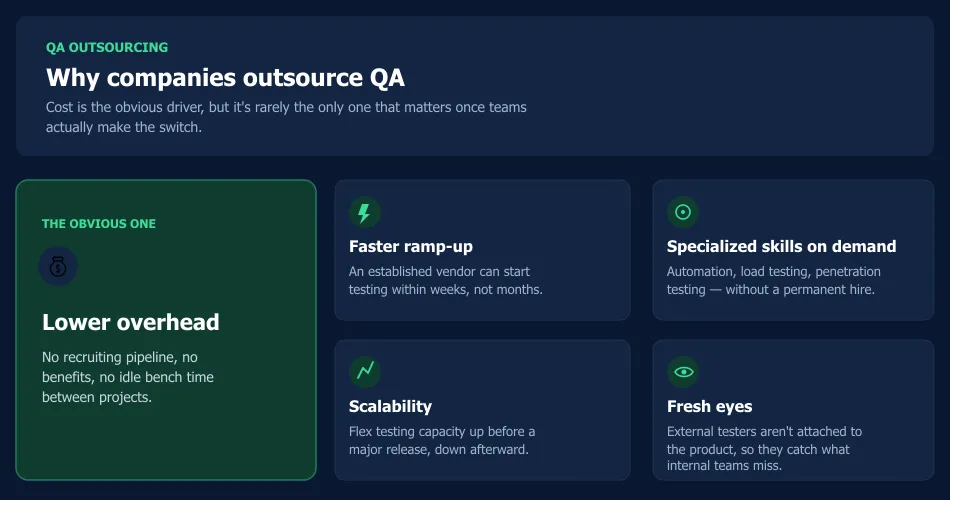
The reasons tend to cluster around a handful of drivers. Cost is the obvious one, but it's rarely the only one that matters once teams actually make the switch.
- Lower overhead: no recruiting pipeline, no benefits, no idle bench time between projects.
- Faster ramp-up: an established QA vendor can start testing within weeks, not months.
- Specialized skills on demand: automation frameworks, load testing, or penetration testing without a permanent hire.
- Scalability: teams can flex testing capacity up before a major release and down afterward.
- Fresh eyes: external testers aren't attached to the product the way developers are, which sometimes catches bugs internal teams miss.
None of that comes free, though. Outsourcing introduces coordination overhead, and quality depends heavily on how the relationship is structured — which is really the core of this guide.
QA Outsourcing Models
There isn't one way to outsource testing. Picking the wrong model is one of the most common reasons these engagements underperform, so it's worth understanding the options before talking to any vendor.
Staff Augmentation
A vendor supplies individual testers who slot into the existing internal team and follow the company's own processes and tools. Good for teams that already have QA leadership but need extra hands.
Dedicated QA Team
The vendor assembles a full team — often including a QA lead — that works exclusively on one client's product, usually long-term. This tends to produce deeper product knowledge over time and works well for ongoing, complex products.
Project-Based Outsourcing
A fixed-scope engagement for a specific need: a pre-launch testing sprint, a one-off security audit, or a compatibility test across dozens of devices. Clear start and end dates, clear deliverables.
Managed QA Services
The vendor owns the entire QA process end-to-end, including strategy, tooling, and reporting. This suits companies that want to treat testing as a fully outsourced function rather than an extension of their own team.

Expand QA Capacity with NeoWork
QA outsourcing helps companies add testing and quality support without building every QA role in-house. NeoWork provides remote teammates who can support quality assurance workflows, issue documentation, test coordination, and recurring technical tasks. NeoWork handles recruitment, benefits, training, and ongoing engagement, while teammates work inside the client’s systems and development processes. Its 91% annualized teammate retention rate and 3.2% candidate selectivity rate reflect a focus on selective hiring and longer-term team stability.
NeoWork's QA outsourcing model offers:
- quality assurance and testing support
- integration with the client’s tools and processes
- recruitment and ongoing teammate support
Contact NeoWork to add QA support that fits your product and development workflows.
When It Makes Sense — and When It Doesn't
Outsourcing QA works best when the product is stable enough to have a defined scope, when the team needs specialized testing skills it doesn't have internally, or when release cadence has outgrown internal testing capacity. Startups pre-product-market-fit often benefit too, since building a full QA department before the product settles is usually premature.
It makes less sense when the product is changing so fast that documentation can't keep up, or when the core value of the product depends on tacit domain knowledge that's hard to transfer. In those cases, at least a thin internal QA layer usually needs to stay in-house, with outsourcing handling the overflow.
How to Choose the Right QA Outsourcing Partner
This is where most of the risk in QA outsourcing actually lives. A vendor that looks great on a sales call can still be a poor fit once real work starts.
- Check domain experience. A vendor that's tested fintech apps for years will spot compliance-related edge cases a generalist won't.
- Ask for a trial engagement. A two- to four-week paid pilot reveals more than any case study.
- Evaluate communication style early. Time zone overlap, response speed, and reporting clarity matter more than most people expect going in.
- Review their automation maturity. Ask what percentage of their test suites are automated versus manual, and why.
- Clarify data security practices. Testing often requires access to staging environments or even production-like data — make sure NDAs and access controls are airtight.
- Understand pricing structure fully. Hourly, per sprint, or fixed-fee — each carries different incentives.
What QA Outsourcing Costs
Pricing varies enormously by region, seniority, and scope, and any specific number quoted today can shift by the time a contract gets signed. As a general orientation, hourly rates for outsourced testers tend to run highest in North America and Western Europe, mid-range across parts of Eastern Europe and Latin America, and lowest across South and Southeast Asia — though rate alone says little about quality. It's worth confirming current pricing directly with shortlisted vendors rather than relying on published averages, since they shift with demand and currency swings.
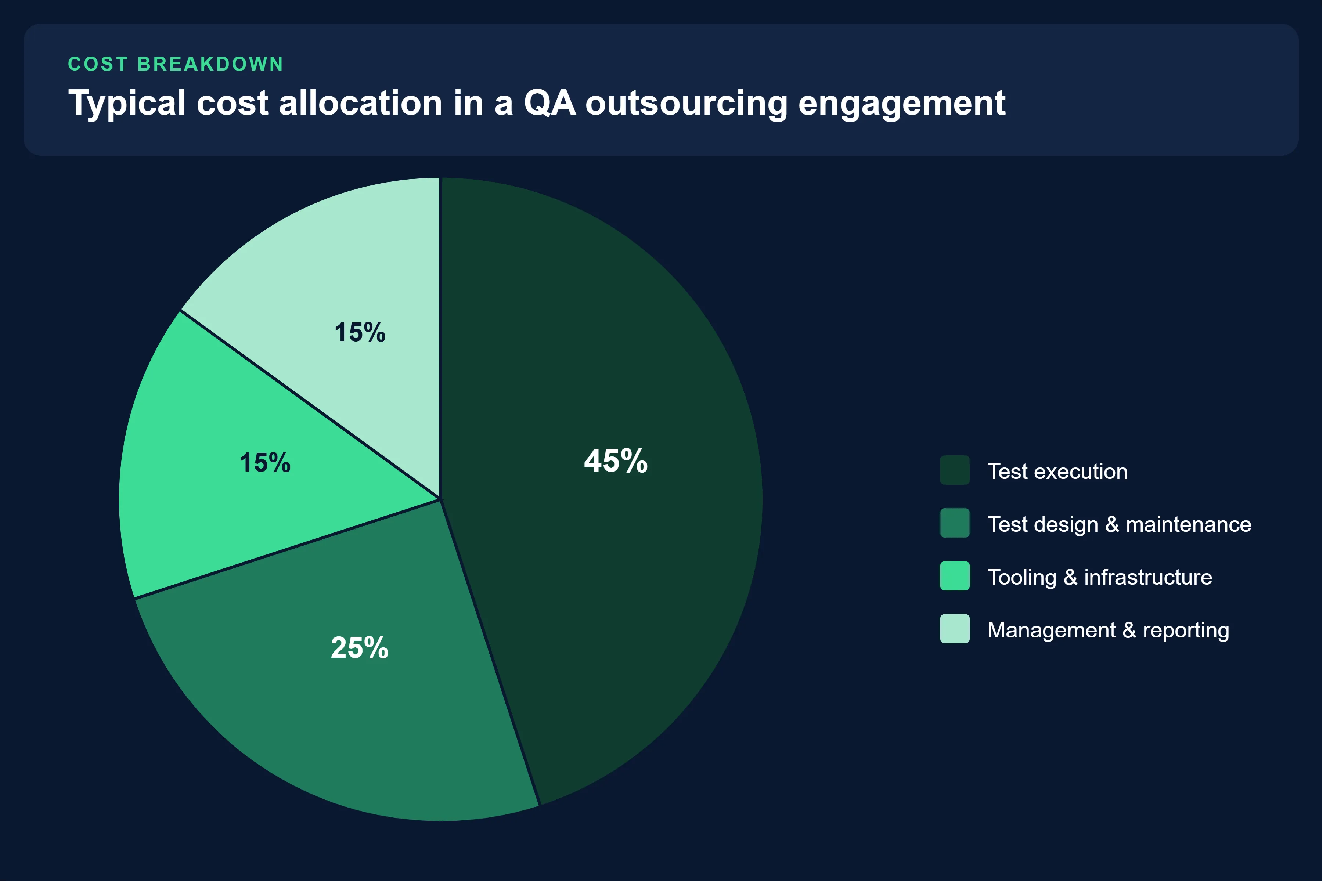
Beyond the headline rate, a realistic budget for a mid-size QA engagement typically splits across a few buckets: hands-on test execution, test case design and maintenance, tooling and infrastructure, and management or reporting overhead.
Common Challenges — and How to Manage Them
Outsourced QA relationships tend to run into a similar set of problems, most of which are preventable with the right setup from day one.
- Knowledge gaps: fix with thorough onboarding docs and a shared knowledge base, not just a kickoff call.
- Communication lag: overlap working hours where possible, and use asynchronous tools (shared dashboards, recorded walkthroughs) to fill the gaps.
- Scope creep: lock testing scope into the contract and revisit it formally each quarter rather than adding tasks ad hoc.
- Quality drift: set measurable quality metrics — defect escape rate, test coverage — and review them regularly, not just at contract renewal.
- Tooling mismatch: agree on shared test management and bug-tracking tools before work starts, not after the first sprint.
Best Practices for Managing an Outsourced QA Team
Treat the outsourced team like an extension of the product organization, not a separate vendor to manage at arm's length. That means including them in sprint planning, giving them access to product context (not just tickets), and inviting QA leads into retrospectives.
Set up a lightweight but consistent reporting rhythm — weekly test summaries, defect trend charts, and coverage reports work better than sporadic status calls. And build in a feedback loop early: the first month of any engagement should include a formal check-in specifically about what's working and what isn't, before small friction turns into a bigger problem.
Getting Started
QA outsourcing isn't a shortcut around building a quality culture — it's a way to extend one, if the right partner and structure are in place. Start small: run a paid pilot with a clearly scoped project before committing to a long-term contract, and measure results against concrete metrics rather than gut feel.
The teams that get the most out of outsourced QA are the ones that treat the vendor relationship as a partnership worth investing in, not a line item to set and forget. Take the checklist above, shortlist two or three vendors, and run a real pilot before signing anything long-term.
FAQ
Topics
QA Outsourcing Guide 2026: How to Outsource Testing Right

Quick Summary: QA outsourcing means hiring an external team or vendor to handle some or all of a product's testing, rather than building that capacity in-house. Done well, it cuts hiring costs, speeds up release cycles, and brings in specialized skills like automation or security testing on demand. Done poorly, it creates communication gaps and quality blind spots. The difference usually comes down to picking the right engagement model and vetting the partner properly.
Most engineering teams reach the same wall eventually: features are shipping faster than testing can keep up. Hiring a full in-house QA department takes months and a budget line that's hard to justify for a startup. That's usually the moment QA outsourcing enters the conversation.
But outsourcing testing isn't just handing off a to-do list to someone cheaper. It's a decision that touches release velocity, product quality, and how much control a team keeps over its own roadmap. This guide walks through what QA outsourcing actually looks like in practice, the models available, what it costs, and how to avoid the mistakes that turn a cost-saving move into a quality disaster.
What Is QA Outsourcing, Exactly?
QA outsourcing is the practice of contracting an external company or independent specialists to perform quality assurance and software testing tasks that would otherwise sit with an internal team. That can mean anything from manual regression testing to building out a full automation framework, performance testing, or security audits.
It's not the same as simply hiring a freelance tester. Most QA outsourcing arrangements involve a structured team — test leads, automation engineers, and manual testers — working against a defined scope, often with their own tooling and reporting cadence. Some vendors specialize narrowly (mobile QA, accessibility testing); others offer full-service testing across the software development lifecycle.
Why Companies Outsource QA
The reasons tend to cluster around a handful of drivers. Cost is the obvious one, but it's rarely the only one that matters once teams actually make the switch.
- Lower overhead: no recruiting pipeline, no benefits, no idle bench time between projects.
- Faster ramp-up: an established QA vendor can start testing within weeks, not months.
- Specialized skills on demand: automation frameworks, load testing, or penetration testing without a permanent hire.
- Scalability: teams can flex testing capacity up before a major release and down afterward.
- Fresh eyes: external testers aren't attached to the product the way developers are, which sometimes catches bugs internal teams miss.
None of that comes free, though. Outsourcing introduces coordination overhead, and quality depends heavily on how the relationship is structured — which is really the core of this guide.
QA Outsourcing Models
There isn't one way to outsource testing. Picking the wrong model is one of the most common reasons these engagements underperform, so it's worth understanding the options before talking to any vendor.
Staff Augmentation
A vendor supplies individual testers who slot into the existing internal team and follow the company's own processes and tools. Good for teams that already have QA leadership but need extra hands.
Dedicated QA Team
The vendor assembles a full team — often including a QA lead — that works exclusively on one client's product, usually long-term. This tends to produce deeper product knowledge over time and works well for ongoing, complex products.
Project-Based Outsourcing
A fixed-scope engagement for a specific need: a pre-launch testing sprint, a one-off security audit, or a compatibility test across dozens of devices. Clear start and end dates, clear deliverables.
Managed QA Services
The vendor owns the entire QA process end-to-end, including strategy, tooling, and reporting. This suits companies that want to treat testing as a fully outsourced function rather than an extension of their own team.
Expand QA Capacity with NeoWork
QA outsourcing helps companies add testing and quality support without building every QA role in-house. NeoWork provides remote teammates who can support quality assurance workflows, issue documentation, test coordination, and recurring technical tasks. NeoWork handles recruitment, benefits, training, and ongoing engagement, while teammates work inside the client’s systems and development processes. Its 91% annualized teammate retention rate and 3.2% candidate selectivity rate reflect a focus on selective hiring and longer-term team stability.
NeoWork's QA outsourcing model offers:
- quality assurance and testing support
- integration with the client’s tools and processes
- recruitment and ongoing teammate support
Contact NeoWork to add QA support that fits your product and development workflows.
When It Makes Sense — and When It Doesn't
Outsourcing QA works best when the product is stable enough to have a defined scope, when the team needs specialized testing skills it doesn't have internally, or when release cadence has outgrown internal testing capacity. Startups pre-product-market-fit often benefit too, since building a full QA department before the product settles is usually premature.
It makes less sense when the product is changing so fast that documentation can't keep up, or when the core value of the product depends on tacit domain knowledge that's hard to transfer. In those cases, at least a thin internal QA layer usually needs to stay in-house, with outsourcing handling the overflow.
How to Choose the Right QA Outsourcing Partner
This is where most of the risk in QA outsourcing actually lives. A vendor that looks great on a sales call can still be a poor fit once real work starts.
- Check domain experience. A vendor that's tested fintech apps for years will spot compliance-related edge cases a generalist won't.
- Ask for a trial engagement. A two- to four-week paid pilot reveals more than any case study.
- Evaluate communication style early. Time zone overlap, response speed, and reporting clarity matter more than most people expect going in.
- Review their automation maturity. Ask what percentage of their test suites are automated versus manual, and why.
- Clarify data security practices. Testing often requires access to staging environments or even production-like data — make sure NDAs and access controls are airtight.
- Understand pricing structure fully. Hourly, per sprint, or fixed-fee — each carries different incentives.
What QA Outsourcing Costs
Pricing varies enormously by region, seniority, and scope, and any specific number quoted today can shift by the time a contract gets signed. As a general orientation, hourly rates for outsourced testers tend to run highest in North America and Western Europe, mid-range across parts of Eastern Europe and Latin America, and lowest across South and Southeast Asia — though rate alone says little about quality. It's worth confirming current pricing directly with shortlisted vendors rather than relying on published averages, since they shift with demand and currency swings.
Beyond the headline rate, a realistic budget for a mid-size QA engagement typically splits across a few buckets: hands-on test execution, test case design and maintenance, tooling and infrastructure, and management or reporting overhead.
Common Challenges — and How to Manage Them
Outsourced QA relationships tend to run into a similar set of problems, most of which are preventable with the right setup from day one.
- Knowledge gaps: fix with thorough onboarding docs and a shared knowledge base, not just a kickoff call.
- Communication lag: overlap working hours where possible, and use asynchronous tools (shared dashboards, recorded walkthroughs) to fill the gaps.
- Scope creep: lock testing scope into the contract and revisit it formally each quarter rather than adding tasks ad hoc.
- Quality drift: set measurable quality metrics — defect escape rate, test coverage — and review them regularly, not just at contract renewal.
- Tooling mismatch: agree on shared test management and bug-tracking tools before work starts, not after the first sprint.
Best Practices for Managing an Outsourced QA Team
Treat the outsourced team like an extension of the product organization, not a separate vendor to manage at arm's length. That means including them in sprint planning, giving them access to product context (not just tickets), and inviting QA leads into retrospectives.
Set up a lightweight but consistent reporting rhythm — weekly test summaries, defect trend charts, and coverage reports work better than sporadic status calls. And build in a feedback loop early: the first month of any engagement should include a formal check-in specifically about what's working and what isn't, before small friction turns into a bigger problem.
Getting Started
QA outsourcing isn't a shortcut around building a quality culture — it's a way to extend one, if the right partner and structure are in place. Start small: run a paid pilot with a clearly scoped project before committing to a long-term contract, and measure results against concrete metrics rather than gut feel.
The teams that get the most out of outsourced QA are the ones that treat the vendor relationship as a partnership worth investing in, not a line item to set and forget. Take the checklist above, shortlist two or three vendors, and run a real pilot before signing anything long-term.
FAQ
Topics
Related Blogs
Related Podcasts


.webp)

.webp)
.webp)



