

.avif)
.avif)

Insurance BPO Outsourcing Guide: What Carriers Need to Know in 2026


.svg)

Quick Summary: Insurance BPO outsourcing means handing off back-office and customer-facing insurance processes—claims, underwriting support, policy servicing, data entry—to a specialized third-party or offshore team. Done right, it cuts operating costs by 30-50%, speeds up claims cycles, and frees internal staff to focus on underwriting judgment and customer relationships. The key is picking the right BPO model, vetting security and compliance capabilities, and starting with a narrow pilot before scaling.
Insurance carriers are drowning in paperwork. Between policy issuance, claims adjudication, renewals, and endless compliance documentation, back-office work can eat up more staff hours than the actual business of underwriting risk. That's exactly why insurance BPO (business process outsourcing) has quietly become one of the most common operational strategies in the industry.
This isn't a niche tactic anymore. Carriers, MGAs, wholesalers, and independent agencies of every size now lean on outsourced teams for everything from first-notice-of-loss intake to policy checking. The question for most insurance leaders in 2026 isn't whether to outsource—it's which processes to hand off, to whom, and how to do it without losing control of quality or data security.
What Is Insurance BPO, Exactly?
Insurance BPO refers to contracting specialized external vendors—onshore, nearshore, or offshore—to handle specific insurance operations that don't require in-house underwriting authority or direct regulatory sign-off. Think of it as renting expertise and labor capacity instead of building it internally.
Most insurance BPO arrangements fall into a few buckets: transactional processing (data entry, policy administration), customer-facing support (call centers, policy servicing), specialized claims work (FNOR intake, claims adjudication support), and knowledge-based tasks (underwriting assistance, actuarial data prep). Some providers specialize narrowly; others offer end-to-end back-office coverage across the policy lifecycle.
Insurance BPO vs. Traditional Staffing
It's worth separating BPO from simple staff augmentation. Staffing firms place individual workers under a client's direct management. BPO providers, by contrast, own the process itself—they bring their own workflows, quality controls, and technology stack, and they're accountable for outcomes, not just headcount.
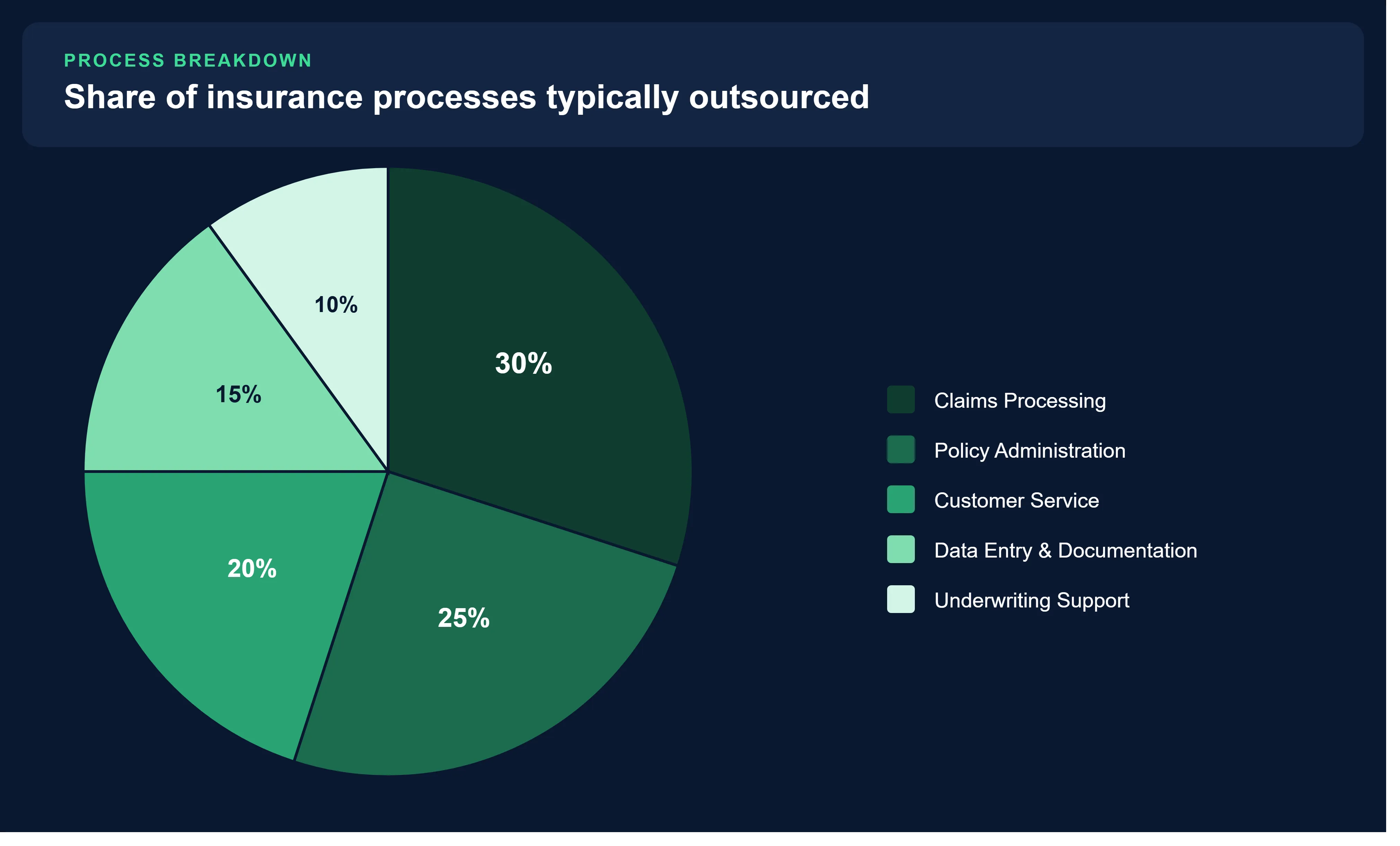
Which Insurance Processes Get Outsourced Most Often
Not every function is a good candidate for outsourcing. The processes that move to BPO teams tend to share a common trait: they're rules-based, high-volume, and don't require final regulatory or underwriting authority.
- Claims processing: intake, documentation review, adjudication support, and fraud-flag triage.
- Policy administration: issuance, endorsements, renewals, and cancellations.
- Underwriting support: data gathering, risk profile assembly, and pre-screening—leaving final decisions to in-house underwriters.
- Customer service: policyholder inquiries, billing questions, and first-line support via phone, chat, or email.
- Data entry and document management: digitizing paper applications, indexing records, and maintaining databases.
- Compliance and reporting: assembling regulatory filings and audit documentation (with internal sign-off retained)
How Insurance BPO Actually Works
The mechanics are fairly consistent across providers, even if the scope varies. A carrier defines the process it wants to hand off, sets service-level agreements (SLAs) for turnaround time and accuracy, and integrates the BPO team into its existing systems—usually through secure portals, API connections, or shared policy administration platforms.
From there, the outsourced team executes day-to-day work while the carrier retains oversight through regular reporting, quality audits, and escalation paths for anything outside standard parameters. The best partnerships treat the BPO provider less like a vendor and more like an extension of the internal team.
Onshore, Nearshore, or Offshore: Choosing a Model
Location matters more than most carriers expect going in. Offshore staffing (commonly in the Philippines, India, or Latin America) delivers the deepest cost savings but requires more attention to time-zone overlap and communication cadence. Nearshore options trade a bit of cost savings for closer time-zone alignment and often stronger cultural fit with U.S. or European clients. Onshore BPO costs the most but simplifies compliance conversations, especially for state-specific insurance regulations.

Build Insurance BPO Support with NeoWork
Insurance BPO outsourcing helps companies handle customer inquiries, records management, data processing, and back-office workflows without placing more pressure on internal teams. NeoWork provides remote teammates who can support recurring insurance operations as individual contributors or part of a dedicated team. NeoWork handles recruitment, benefits, training, and ongoing engagement, while teammates integrate into the client’s systems and workflows. Its 91% annualized teammate retention rate and 3.2% candidate selectivity rate reflect a focus on selective hiring and longer-term team stability.
NeoWork's insurance BPO model offers:
- customer and back-office support
- integration with the client’s tools and processes
- recruitment and ongoing teammate support
Contact NeoWork to build insurance BPO support around your existing operations.
Benefits Carriers Actually See
Cost reduction gets the headline, but it's rarely the only reason carriers commit to outsourcing. Faster claims cycle times, better scalability during catastrophe events or seasonal spikes, and access to specialized talent that would be expensive to hire directly all factor in.
There's also a bandwidth argument that gets underappreciated: when routine processing moves off internal desks, underwriters and claims adjusters get more time for the judgment-heavy work that actually requires their expertise. That shift alone can improve underwriting quality, not just throughput.
Where Outsourcing Falls Short
It's not a universal fix. Outsourcing complex, judgment-heavy underwriting decisions rarely works well—regulators expect accountable in-house sign-off, and customers notice when service feels impersonal. Poorly vetted vendors can also introduce data security gaps or inconsistent quality that costs more to fix than it saved.
Data Security and Compliance: The Non-Negotiables
Insurance data is sensitive by nature—health records, financial details, personal identifiers. Any BPO partner touching that data needs demonstrable security controls: encryption standards, access logging, background-checked staff, and compliance alignment with frameworks like SOC 2, HIPAA (for health-adjacent lines), and relevant state insurance data-privacy statutes.
Carriers should ask vendors directly about breach history, audit frequency, and how subcontractors (if any) are managed. A provider that can't answer these questions clearly is a red flag, regardless of how attractive its pricing looks.
How to Choose the Right Insurance BPO Provider
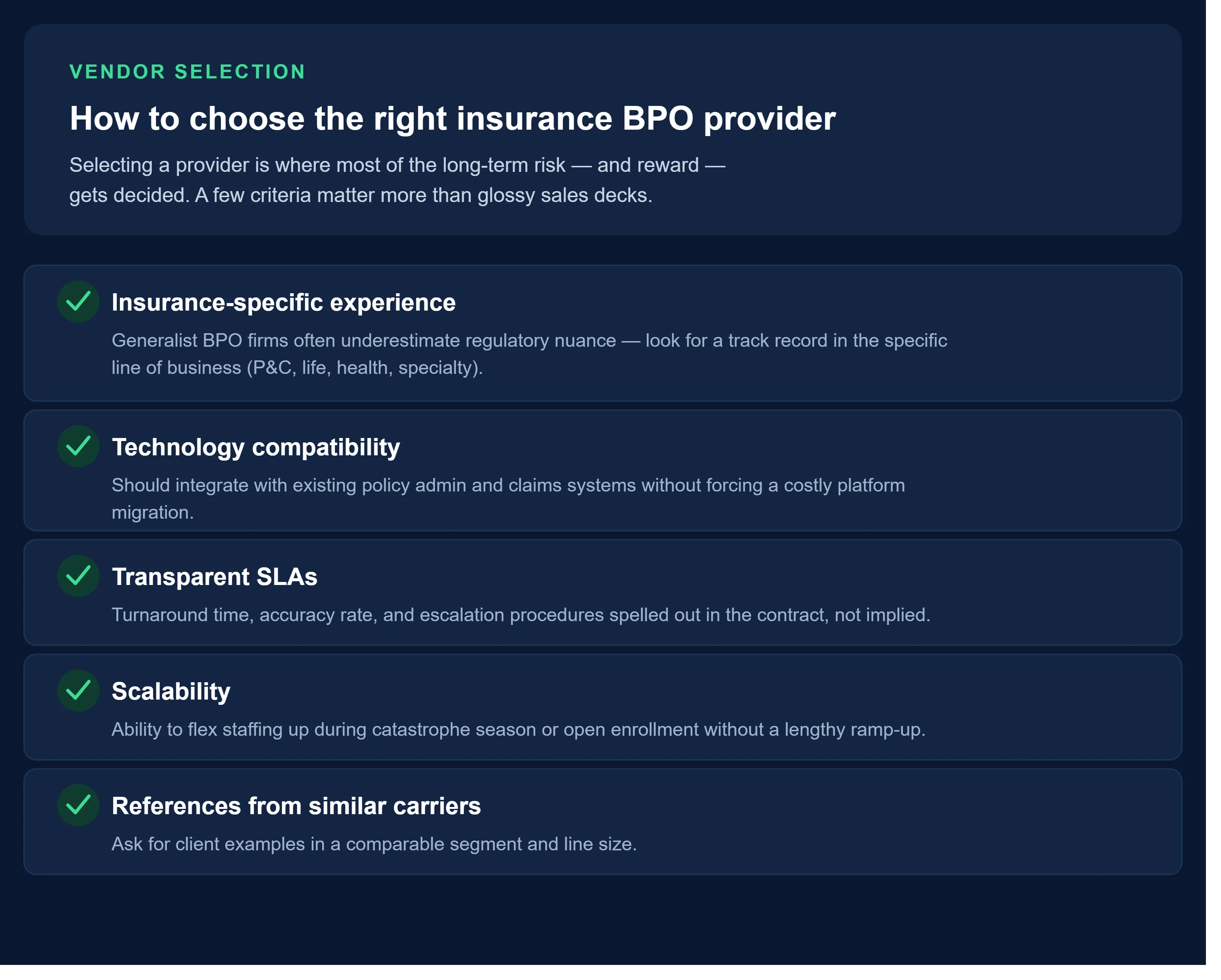
Selecting a provider is where most of the long-term risk—and reward—gets decided. A few criteria matter more than glossy sales decks:
- Insurance-specific experience: generalist BPO firms often underestimate regulatory nuance; look for providers with a track record in the specific line of business (P&C, life, health, specialty).
- Technology compatibility: the provider should integrate with existing policy admin and claims systems without forcing a costly platform migration.
- Transparent SLAs: turnaround time, accuracy rate, and escalation procedures should be spelled out in the contract, not implied.
- Scalability: the ability to flex staffing up during catastrophe season or open enrollment periods without a lengthy ramp-up.
- References from similar carriers: ask for client examples in a comparable segment and line size.
What Insurance BPO Costs in 2026
Pricing structures vary by provider and scope, but most insurance BPO contracts fall into one of three models: per-transaction pricing (common for claims intake or data entry), full-time-equivalent (FTE) pricing (common for dedicated customer service or underwriting support staff), and hybrid models that blend a base retainer with volume-based fees. Exact rates depend heavily on location, complexity, and required certifications, so it's worth requesting a detailed quote against a defined scope rather than comparing headline "per hour" figures across providers—those numbers rarely reflect true total cost. Check each vendor's official pricing page for current rates, since offshore labor costs shift year to year.
Getting Started: A Practical Rollout Approach
Carriers that succeed with BPO rarely go all-in on day one. The more reliable path starts with a single, well-defined process—say, claims document intake—and runs it as a pilot for 60 to 90 days with clear success metrics. From there, expand into adjacent processes once the vendor relationship has proven itself on quality, communication, and data handling.
Trying to outsource half the back office at once tends to backfire. It stretches internal oversight too thin and makes it hard to isolate what's actually working versus what's just noise in the transition.
Final Thoughts
Insurance BPO outsourcing isn't a shortcut—it's an operating decision that, handled carefully, lets carriers move faster and spend their internal expertise where it matters most. The providers worth partnering with are the ones that can prove insurance-specific experience, show real security credentials, and start small before asking for a bigger commitment.
Carriers weighing their next move should start with one process, define clear success metrics, and treat the first 90 days as a test rather than a full commitment. That approach protects quality control while still capturing the efficiency gains that make outsourcing worth considering in the first place.
FAQ: Insurance BPO Outsourcing
Topics
Insurance BPO Outsourcing Guide: What Carriers Need to Know in 2026

Quick Summary: Insurance BPO outsourcing means handing off back-office and customer-facing insurance processes—claims, underwriting support, policy servicing, data entry—to a specialized third-party or offshore team. Done right, it cuts operating costs by 30-50%, speeds up claims cycles, and frees internal staff to focus on underwriting judgment and customer relationships. The key is picking the right BPO model, vetting security and compliance capabilities, and starting with a narrow pilot before scaling.
Insurance carriers are drowning in paperwork. Between policy issuance, claims adjudication, renewals, and endless compliance documentation, back-office work can eat up more staff hours than the actual business of underwriting risk. That's exactly why insurance BPO (business process outsourcing) has quietly become one of the most common operational strategies in the industry.
This isn't a niche tactic anymore. Carriers, MGAs, wholesalers, and independent agencies of every size now lean on outsourced teams for everything from first-notice-of-loss intake to policy checking. The question for most insurance leaders in 2026 isn't whether to outsource—it's which processes to hand off, to whom, and how to do it without losing control of quality or data security.
What Is Insurance BPO, Exactly?
Insurance BPO refers to contracting specialized external vendors—onshore, nearshore, or offshore—to handle specific insurance operations that don't require in-house underwriting authority or direct regulatory sign-off. Think of it as renting expertise and labor capacity instead of building it internally.
Most insurance BPO arrangements fall into a few buckets: transactional processing (data entry, policy administration), customer-facing support (call centers, policy servicing), specialized claims work (FNOR intake, claims adjudication support), and knowledge-based tasks (underwriting assistance, actuarial data prep). Some providers specialize narrowly; others offer end-to-end back-office coverage across the policy lifecycle.
Insurance BPO vs. Traditional Staffing
It's worth separating BPO from simple staff augmentation. Staffing firms place individual workers under a client's direct management. BPO providers, by contrast, own the process itself—they bring their own workflows, quality controls, and technology stack, and they're accountable for outcomes, not just headcount.
Which Insurance Processes Get Outsourced Most Often
Not every function is a good candidate for outsourcing. The processes that move to BPO teams tend to share a common trait: they're rules-based, high-volume, and don't require final regulatory or underwriting authority.
- Claims processing: intake, documentation review, adjudication support, and fraud-flag triage.
- Policy administration: issuance, endorsements, renewals, and cancellations.
- Underwriting support: data gathering, risk profile assembly, and pre-screening—leaving final decisions to in-house underwriters.
- Customer service: policyholder inquiries, billing questions, and first-line support via phone, chat, or email.
- Data entry and document management: digitizing paper applications, indexing records, and maintaining databases.
- Compliance and reporting: assembling regulatory filings and audit documentation (with internal sign-off retained)
How Insurance BPO Actually Works
The mechanics are fairly consistent across providers, even if the scope varies. A carrier defines the process it wants to hand off, sets service-level agreements (SLAs) for turnaround time and accuracy, and integrates the BPO team into its existing systems—usually through secure portals, API connections, or shared policy administration platforms.
From there, the outsourced team executes day-to-day work while the carrier retains oversight through regular reporting, quality audits, and escalation paths for anything outside standard parameters. The best partnerships treat the BPO provider less like a vendor and more like an extension of the internal team.
Onshore, Nearshore, or Offshore: Choosing a Model
Location matters more than most carriers expect going in. Offshore staffing (commonly in the Philippines, India, or Latin America) delivers the deepest cost savings but requires more attention to time-zone overlap and communication cadence. Nearshore options trade a bit of cost savings for closer time-zone alignment and often stronger cultural fit with U.S. or European clients. Onshore BPO costs the most but simplifies compliance conversations, especially for state-specific insurance regulations.
Build Insurance BPO Support with NeoWork
Insurance BPO outsourcing helps companies handle customer inquiries, records management, data processing, and back-office workflows without placing more pressure on internal teams. NeoWork provides remote teammates who can support recurring insurance operations as individual contributors or part of a dedicated team. NeoWork handles recruitment, benefits, training, and ongoing engagement, while teammates integrate into the client’s systems and workflows. Its 91% annualized teammate retention rate and 3.2% candidate selectivity rate reflect a focus on selective hiring and longer-term team stability.
NeoWork's insurance BPO model offers:
- customer and back-office support
- integration with the client’s tools and processes
- recruitment and ongoing teammate support
Contact NeoWork to build insurance BPO support around your existing operations.
Benefits Carriers Actually See
Cost reduction gets the headline, but it's rarely the only reason carriers commit to outsourcing. Faster claims cycle times, better scalability during catastrophe events or seasonal spikes, and access to specialized talent that would be expensive to hire directly all factor in.
There's also a bandwidth argument that gets underappreciated: when routine processing moves off internal desks, underwriters and claims adjusters get more time for the judgment-heavy work that actually requires their expertise. That shift alone can improve underwriting quality, not just throughput.
Where Outsourcing Falls Short
It's not a universal fix. Outsourcing complex, judgment-heavy underwriting decisions rarely works well—regulators expect accountable in-house sign-off, and customers notice when service feels impersonal. Poorly vetted vendors can also introduce data security gaps or inconsistent quality that costs more to fix than it saved.
Data Security and Compliance: The Non-Negotiables
Insurance data is sensitive by nature—health records, financial details, personal identifiers. Any BPO partner touching that data needs demonstrable security controls: encryption standards, access logging, background-checked staff, and compliance alignment with frameworks like SOC 2, HIPAA (for health-adjacent lines), and relevant state insurance data-privacy statutes.
Carriers should ask vendors directly about breach history, audit frequency, and how subcontractors (if any) are managed. A provider that can't answer these questions clearly is a red flag, regardless of how attractive its pricing looks.
How to Choose the Right Insurance BPO Provider
Selecting a provider is where most of the long-term risk—and reward—gets decided. A few criteria matter more than glossy sales decks:
- Insurance-specific experience: generalist BPO firms often underestimate regulatory nuance; look for providers with a track record in the specific line of business (P&C, life, health, specialty).
- Technology compatibility: the provider should integrate with existing policy admin and claims systems without forcing a costly platform migration.
- Transparent SLAs: turnaround time, accuracy rate, and escalation procedures should be spelled out in the contract, not implied.
- Scalability: the ability to flex staffing up during catastrophe season or open enrollment periods without a lengthy ramp-up.
- References from similar carriers: ask for client examples in a comparable segment and line size.
What Insurance BPO Costs in 2026
Pricing structures vary by provider and scope, but most insurance BPO contracts fall into one of three models: per-transaction pricing (common for claims intake or data entry), full-time-equivalent (FTE) pricing (common for dedicated customer service or underwriting support staff), and hybrid models that blend a base retainer with volume-based fees. Exact rates depend heavily on location, complexity, and required certifications, so it's worth requesting a detailed quote against a defined scope rather than comparing headline "per hour" figures across providers—those numbers rarely reflect true total cost. Check each vendor's official pricing page for current rates, since offshore labor costs shift year to year.
Getting Started: A Practical Rollout Approach
Carriers that succeed with BPO rarely go all-in on day one. The more reliable path starts with a single, well-defined process—say, claims document intake—and runs it as a pilot for 60 to 90 days with clear success metrics. From there, expand into adjacent processes once the vendor relationship has proven itself on quality, communication, and data handling.
Trying to outsource half the back office at once tends to backfire. It stretches internal oversight too thin and makes it hard to isolate what's actually working versus what's just noise in the transition.
Final Thoughts
Insurance BPO outsourcing isn't a shortcut—it's an operating decision that, handled carefully, lets carriers move faster and spend their internal expertise where it matters most. The providers worth partnering with are the ones that can prove insurance-specific experience, show real security credentials, and start small before asking for a bigger commitment.
Carriers weighing their next move should start with one process, define clear success metrics, and treat the first 90 days as a test rather than a full commitment. That approach protects quality control while still capturing the efficiency gains that make outsourcing worth considering in the first place.
FAQ: Insurance BPO Outsourcing
Topics
Related Blogs
Related Podcasts


.webp)

.webp)
.webp)



