

.avif)
.avif)

HR Outsourcing Guide: Models, Costs, and How to Choose (2026)


.svg)

Quick Summary: HR outsourcing means handing off some or all human resources functions—like payroll, benefits, compliance, or recruiting—to an outside provider such as a PEO, ASO, or HR BPO firm. The right setup depends on company size, budget, and how much control leadership wants to keep in-house. Costs typically run from a flat per-employee fee to a percentage of payroll, and the biggest wins tend to come from reduced compliance risk and time saved on administrative work.
Running HR in-house sounds simple until the paperwork piles up. Payroll taxes, benefits enrollment, harassment training, state-by-state compliance rules that seem to change every quarter—it adds up fast, especially for companies without a dedicated HR department. That's the gap HR outsourcing is built to fill.
This guide walks through what HR outsourcing actually covers, the different models available, realistic cost ranges, and a practical framework for picking a provider that won't leave you stuck mid-contract. No fluff, no vendor pitch—just what matters when making the call.
What Is HR Outsourcing?
HR outsourcing is the practice of contracting an external company to handle part or all of an organization's human resources responsibilities. That can mean anything from a single function—say, payroll processing—to a near-total handoff of HR administration, compliance, and employee relations.
Small businesses often start with one outsourced function and expand from there. Larger companies sometimes outsource transactional HR work while keeping strategic decisions, like culture and leadership development, in-house. There's no single right way to do it. The structure should match the company's actual pain points, not a generic template.
The Main Models of HR Outsourcing
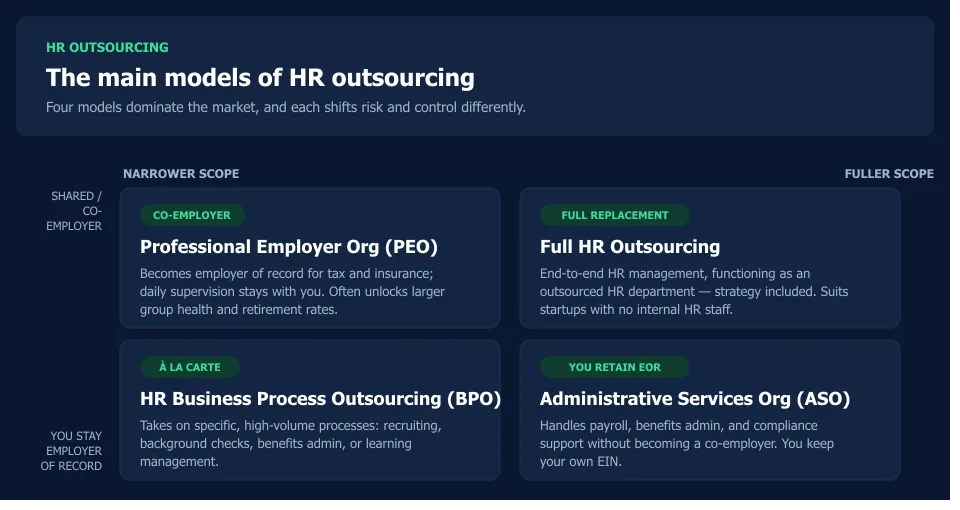
Not all HR outsourcing looks the same. Four models dominate the market, and each shifts risk and control differently.
Professional Employer Organization (PEO)
A PEO enters a co-employment arrangement with your company. The PEO becomes the employer of record for tax and insurance purposes, while daily supervision of employees stays with the business. This structure often unlocks access to larger group health insurance rates and retirement plans that smaller companies couldn't negotiate alone.
Administrative Services Organization (ASO)
An ASO handles HR administration—payroll, benefits administration, compliance support—without becoming a co-employer. The business retains its own EIN and stays the sole employer of record. ASOs suit companies that want outsourced support but don't want to share employment liability.
HR Business Process Outsourcing (BPO)
BPO providers take on specific, often high-volume HR processes: recruiting, background checks, benefits administration, or learning management. It's a more à la carte model than a PEO, useful for companies that only need help in one or two areas.
Full HR Outsourcing
Some providers offer end-to-end HR management, essentially functioning as an outsourced HR department. This tends to suit startups and small businesses that have no internal HR staff at all and need everything covered—strategy included.
What Can Be Outsourced
Almost every HR function can be handed off in some form. The most commonly outsourced tasks include:
- Payroll processing and tax filing
- Benefits administration and open enrollment
- Recruiting and applicant screening
- Onboarding and offboarding paperwork
- Compliance tracking (FMLA, ACA, state leave laws)
- Workers' compensation and risk management
- Employee handbook creation and policy updates
- Performance management systems
Strategic work—culture building, leadership coaching, workforce planning—is usually kept in-house even by companies that outsource heavily elsewhere. It's the transactional, compliance-heavy tasks that get outsourced most often, because they carry the highest risk of costly mistakes when handled by non-specialists.

Strengthen HR Operations with NeoWork
HR outsourcing helps companies manage recurring recruitment coordination, records, scheduling, onboarding support, and administrative workflows. NeoWork provides remote teammates who can support HR operations while working within the client’s existing systems and approval processes. NeoWork handles recruitment, benefits, training, and ongoing engagement for its teammates, while clients manage daily priorities and workflows. Its 91% annualized teammate retention rate and 3.2% candidate selectivity rate reflect a focus on selective hiring and longer-term team stability.
NeoWork's HR support model offers:
- recruitment and administrative support
- integration with the client’s tools and processes
- recruitment and ongoing teammate support
Contact NeoWork to add HR operations support that fits your existing team.
Benefits of HR Outsourcing
The appeal isn't just cost savings, though that's part of it. Time is the bigger factor for most small and mid-size businesses.
Consider a typical small business owner or office manager juggling HR alongside their actual job. A rough breakdown of where that time tends to go before outsourcing looks something like this:
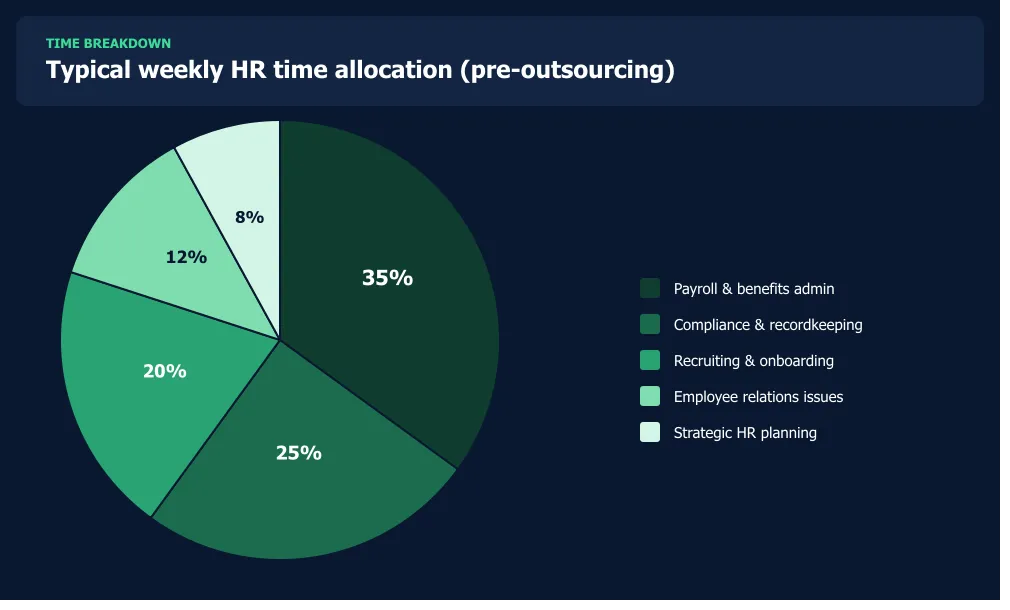
Once payroll and compliance move to a provider, that freed-up time usually shifts toward the strategic work at the bottom of the chart—the part that actually grows the business.
Other commonly cited benefits:
- Reduced compliance risk. Providers track changing labor laws across jurisdictions so internal teams don't have to.
- Better benefits access. PEOs especially can offer group rates smaller companies couldn't get alone.
- Scalability. Outsourced HR flexes up or down more easily than hiring internal staff for every growth phase.
- Access to expertise. Specialized providers often know nuances of employment law better than a generalist internal hire.
What HR Outsourcing Costs
Pricing varies a lot depending on the model, provider, and company size. Broadly, expect one of these structures:
Exact rates shift with market conditions and provider tier, so it's worth requesting a customized quote rather than relying on a published average. Ask any prospective provider for a full breakdown of fees, including setup costs and charges for add-on services—those extras can quietly inflate the bill.
How to Choose an HR Outsourcing Provider
Not every provider fits every business. A few things worth checking before signing anything:
- Confirm which services are included versus billed separately.
- Ask about technology—does the platform integrate with existing payroll or accounting software?
- Check certifications and accreditations relevant to the provider's model (PEO accreditation bodies, for example).
- Request references from current clients in a similar industry and size range.
- Clarify contract length, termination terms, and data ownership if the relationship ends.
Risks and Trade-Offs to Consider
Outsourcing isn't risk-free. Handing over employee data to a third party means vetting their security practices carefully. Co-employment models like PEOs also mean sharing some control over HR policy decisions—not every business is comfortable with that trade-off.
There's also the relationship risk. A provider that's slow to respond or unfamiliar with an industry's specific compliance quirks can create more headaches than it solves. That's why references and a trial period matter more than a slick sales deck.
Best Practices for Managing the Relationship
Once a provider is in place, the work isn't over. A few habits tend to separate the outsourcing relationships that work well from the ones that don't:
- Set clear service-level expectations in writing, not just verbally.
- Keep a designated internal point of contact for the vendor relationship.
- Review performance and pricing annually, not just at renewal panic time.
- Maintain some internal HR knowledge so the company isn't entirely dependent on one vendor.
Final Thoughts
HR outsourcing isn't an all-or-nothing decision. Start by identifying which tasks are eating the most time or creating the most compliance risk, then match that need to a model—PEO, ASO, BPO, or full outsourcing—that fits the company's size and appetite for shared control.
The businesses that get the most out of outsourcing tend to treat it as an ongoing partnership, not a one-time fix. Vet providers carefully, set clear expectations, and revisit the arrangement regularly as the company grows. Ready to take the next step? Start by listing the three HR tasks currently taking up the most time this month, and use that list to request quotes from a few providers.
FAQ: HR Outsourcing Guide
Topics
HR Outsourcing Guide: Models, Costs, and How to Choose (2026)

Quick Summary: HR outsourcing means handing off some or all human resources functions—like payroll, benefits, compliance, or recruiting—to an outside provider such as a PEO, ASO, or HR BPO firm. The right setup depends on company size, budget, and how much control leadership wants to keep in-house. Costs typically run from a flat per-employee fee to a percentage of payroll, and the biggest wins tend to come from reduced compliance risk and time saved on administrative work.
Running HR in-house sounds simple until the paperwork piles up. Payroll taxes, benefits enrollment, harassment training, state-by-state compliance rules that seem to change every quarter—it adds up fast, especially for companies without a dedicated HR department. That's the gap HR outsourcing is built to fill.
This guide walks through what HR outsourcing actually covers, the different models available, realistic cost ranges, and a practical framework for picking a provider that won't leave you stuck mid-contract. No fluff, no vendor pitch—just what matters when making the call.
What Is HR Outsourcing?
HR outsourcing is the practice of contracting an external company to handle part or all of an organization's human resources responsibilities. That can mean anything from a single function—say, payroll processing—to a near-total handoff of HR administration, compliance, and employee relations.
Small businesses often start with one outsourced function and expand from there. Larger companies sometimes outsource transactional HR work while keeping strategic decisions, like culture and leadership development, in-house. There's no single right way to do it. The structure should match the company's actual pain points, not a generic template.
The Main Models of HR Outsourcing
Not all HR outsourcing looks the same. Four models dominate the market, and each shifts risk and control differently.
Professional Employer Organization (PEO)
A PEO enters a co-employment arrangement with your company. The PEO becomes the employer of record for tax and insurance purposes, while daily supervision of employees stays with the business. This structure often unlocks access to larger group health insurance rates and retirement plans that smaller companies couldn't negotiate alone.
Administrative Services Organization (ASO)
An ASO handles HR administration—payroll, benefits administration, compliance support—without becoming a co-employer. The business retains its own EIN and stays the sole employer of record. ASOs suit companies that want outsourced support but don't want to share employment liability.
HR Business Process Outsourcing (BPO)
BPO providers take on specific, often high-volume HR processes: recruiting, background checks, benefits administration, or learning management. It's a more à la carte model than a PEO, useful for companies that only need help in one or two areas.
Full HR Outsourcing
Some providers offer end-to-end HR management, essentially functioning as an outsourced HR department. This tends to suit startups and small businesses that have no internal HR staff at all and need everything covered—strategy included.
What Can Be Outsourced
Almost every HR function can be handed off in some form. The most commonly outsourced tasks include:
- Payroll processing and tax filing
- Benefits administration and open enrollment
- Recruiting and applicant screening
- Onboarding and offboarding paperwork
- Compliance tracking (FMLA, ACA, state leave laws)
- Workers' compensation and risk management
- Employee handbook creation and policy updates
- Performance management systems
Strategic work—culture building, leadership coaching, workforce planning—is usually kept in-house even by companies that outsource heavily elsewhere. It's the transactional, compliance-heavy tasks that get outsourced most often, because they carry the highest risk of costly mistakes when handled by non-specialists.
Strengthen HR Operations with NeoWork
HR outsourcing helps companies manage recurring recruitment coordination, records, scheduling, onboarding support, and administrative workflows. NeoWork provides remote teammates who can support HR operations while working within the client’s existing systems and approval processes. NeoWork handles recruitment, benefits, training, and ongoing engagement for its teammates, while clients manage daily priorities and workflows. Its 91% annualized teammate retention rate and 3.2% candidate selectivity rate reflect a focus on selective hiring and longer-term team stability.
NeoWork's HR support model offers:
- recruitment and administrative support
- integration with the client’s tools and processes
- recruitment and ongoing teammate support
Contact NeoWork to add HR operations support that fits your existing team.
Benefits of HR Outsourcing
The appeal isn't just cost savings, though that's part of it. Time is the bigger factor for most small and mid-size businesses.
Consider a typical small business owner or office manager juggling HR alongside their actual job. A rough breakdown of where that time tends to go before outsourcing looks something like this:
Once payroll and compliance move to a provider, that freed-up time usually shifts toward the strategic work at the bottom of the chart—the part that actually grows the business.
Other commonly cited benefits:
- Reduced compliance risk. Providers track changing labor laws across jurisdictions so internal teams don't have to.
- Better benefits access. PEOs especially can offer group rates smaller companies couldn't get alone.
- Scalability. Outsourced HR flexes up or down more easily than hiring internal staff for every growth phase.
- Access to expertise. Specialized providers often know nuances of employment law better than a generalist internal hire.
What HR Outsourcing Costs
Pricing varies a lot depending on the model, provider, and company size. Broadly, expect one of these structures:
Exact rates shift with market conditions and provider tier, so it's worth requesting a customized quote rather than relying on a published average. Ask any prospective provider for a full breakdown of fees, including setup costs and charges for add-on services—those extras can quietly inflate the bill.
How to Choose an HR Outsourcing Provider
Not every provider fits every business. A few things worth checking before signing anything:
- Confirm which services are included versus billed separately.
- Ask about technology—does the platform integrate with existing payroll or accounting software?
- Check certifications and accreditations relevant to the provider's model (PEO accreditation bodies, for example).
- Request references from current clients in a similar industry and size range.
- Clarify contract length, termination terms, and data ownership if the relationship ends.
Risks and Trade-Offs to Consider
Outsourcing isn't risk-free. Handing over employee data to a third party means vetting their security practices carefully. Co-employment models like PEOs also mean sharing some control over HR policy decisions—not every business is comfortable with that trade-off.
There's also the relationship risk. A provider that's slow to respond or unfamiliar with an industry's specific compliance quirks can create more headaches than it solves. That's why references and a trial period matter more than a slick sales deck.
Best Practices for Managing the Relationship
Once a provider is in place, the work isn't over. A few habits tend to separate the outsourcing relationships that work well from the ones that don't:
- Set clear service-level expectations in writing, not just verbally.
- Keep a designated internal point of contact for the vendor relationship.
- Review performance and pricing annually, not just at renewal panic time.
- Maintain some internal HR knowledge so the company isn't entirely dependent on one vendor.
Final Thoughts
HR outsourcing isn't an all-or-nothing decision. Start by identifying which tasks are eating the most time or creating the most compliance risk, then match that need to a model—PEO, ASO, BPO, or full outsourcing—that fits the company's size and appetite for shared control.
The businesses that get the most out of outsourcing tend to treat it as an ongoing partnership, not a one-time fix. Vet providers carefully, set clear expectations, and revisit the arrangement regularly as the company grows. Ready to take the next step? Start by listing the three HR tasks currently taking up the most time this month, and use that list to request quotes from a few providers.
FAQ: HR Outsourcing Guide
Topics
Related Blogs
Related Podcasts


.webp)

.webp)
.webp)



