

.avif)
.avif)

QA Testing Outsourcing Guide: Models, Costs, Best Practices


.svg)

Quick Summary: QA testing outsourcing means hiring an external team to handle some or all of a product's quality assurance work, from manual test cases to full test automation. Done right, it cuts testing costs, speeds up release cycles, and gives teams access to specialized skills they'd struggle to hire in-house. The trade-off is real: communication gaps, knowledge transfer, and vendor selection can make or break the engagement, so picking the right model and partner matters more than the decision to outsource itself.
Every software team eventually hits the same wall: releases keep piling up, but the QA headcount doesn't grow fast enough to keep pace. Hiring more testers takes months. Training them takes longer. Meanwhile, bugs slip into production and customers notice.
That's usually the moment QA testing outsourcing enters the conversation. It's not a new idea — companies have been sending testing work to external teams for decades — but the way it's done in 2026 looks pretty different from a decade ago. Automation, AI-assisted test generation, and distributed teams have changed what "outsourced QA" actually means in practice.
This guide breaks down what QA outsourcing involves, the models available, realistic costs, and how to avoid the mistakes that sink most engagements.
What Is QA Testing Outsourcing?
QA testing outsourcing is the practice of contracting an external company or independent team to perform quality assurance activities on a software product. That can mean anything from a single round of manual regression testing before a launch to a fully embedded team running automated test suites as part of the daily development cycle.
It's different from staff augmentation in one key way: outsourcing typically transfers ownership of the testing process, not just the headcount. A good outsourcing partner brings its own methodology, tooling, and reporting structure rather than simply plugging bodies into an existing team.
Why Companies Outsource QA
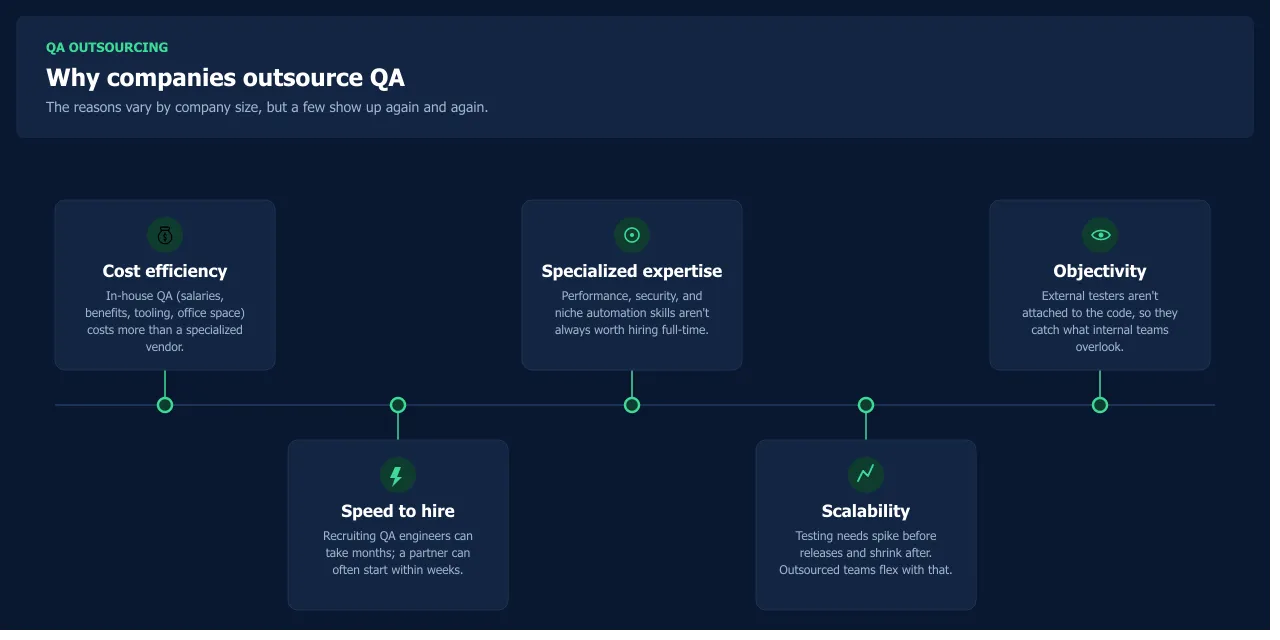
The reasons vary by company size, but a few show up again and again.
- Cost efficiency. Building an in-house QA department — salaries, benefits, tooling licenses, office space — costs significantly more than contracting a specialized vendor, especially for teams based in high-cost markets.
- Speed to hire. Recruiting skilled QA engineers can take months. An outsourcing partner can often start within weeks.
- Specialized expertise. Performance testing, security testing, and test automation for niche frameworks require skills that aren't always worth hiring full-time for.
- Scalability. Testing needs spike before major releases and shrink afterward. Outsourced teams flex with that demand; in-house teams don't.
- Objectivity. External testers aren't emotionally attached to the code. They tend to catch issues internal teams overlook simply because they didn't write the feature.
None of this means outsourcing is automatically the right call. Teams with tight IP constraints, highly regulated products, or deeply domain-specific logic sometimes find in-house QA easier to control. The decision comes down to trade-offs, not a universal best answer.
Outsourcing Models: Which One Fits?
There isn't one single way to outsource QA. Most vendors offer a variation of three core models, and picking the wrong one is one of the most common reasons engagements underperform.
Hybrid setups are common too — a dedicated team handles core regression testing while a specialized vendor is brought in for periodic penetration testing or performance benchmarking.

Strengthen QA Testing with NeoWork
QA testing outsourcing helps companies manage recurring software testing, issue tracking, test documentation, and quality workflows without overloading internal development teams. NeoWork provides remote teammates who can support QA testing as part of the client’s existing technical operations. NeoWork handles recruitment, benefits, training, and ongoing engagement, while teammates integrate into the client’s tools, processes, and release workflows. Its 91% annualized teammate retention rate and 3.2% candidate selectivity rate reflect a focus on selective hiring and longer-term team stability.
NeoWork's QA testing support model offers:
- software testing and issue tracking support
- integration with the client’s tools and processes
- recruitment and ongoing teammate support
Contact NeoWork to build QA testing support around your existing development process.
How Much Does QA Outsourcing Cost?
Costs vary widely depending on region, tester seniority, and scope. A manual tester in Eastern Europe or South Asia typically costs a fraction of an equivalent hire in North America or Western Europe, while automation engineers and security specialists command higher rates everywhere. Rather than quoting a fixed number here — rates shift year to year — it's worth requesting a detailed quote from at least three vendors and comparing not just hourly rates but what's included: tooling licenses, reporting overhead, and management time.
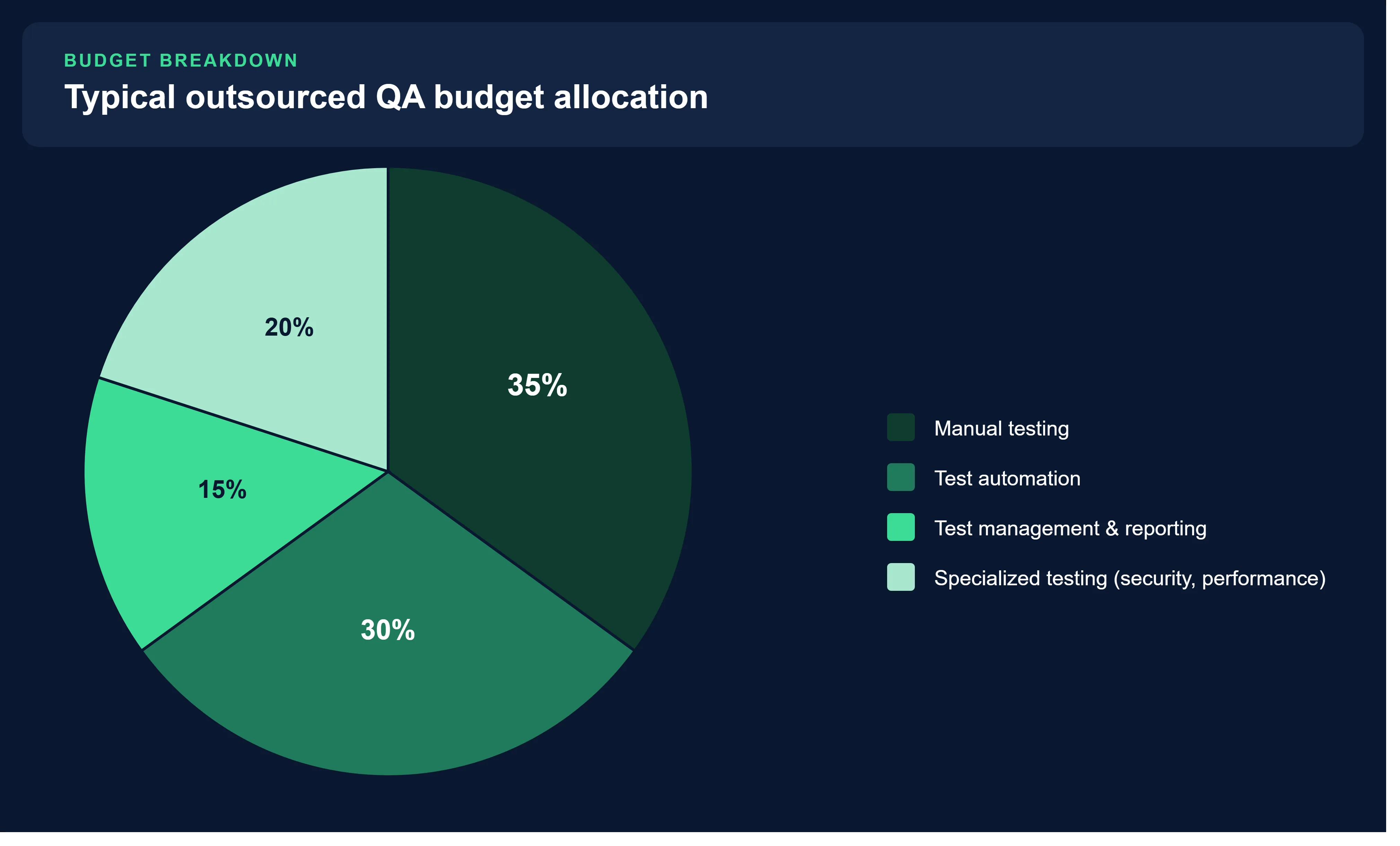
A rough breakdown of where outsourced QA budgets typically go looks like this:
Fixed-price contracts work well for narrow, well-defined scopes. Time-and-materials billing suits ongoing, evolving projects where requirements shift. Retainer models sit somewhere in between, offering a set number of hours per month at a locked-in rate.
How to Choose the Right QA Outsourcing Partner
This is where most of the risk in outsourcing actually lives. A vendor mismatch causes far more damage than the outsourcing decision itself.
Key Criteria to Evaluate
- Domain experience. A vendor that's tested fintech apps understands compliance nuances a generalist team won't.
- Automation maturity. Ask for examples of their test frameworks, not just a claim that they "do automation."
- Communication cadence. Daily standups, shared dashboards, and clear escalation paths matter more than time zone overlap alone.
- Security practices. NDAs, access controls, and data handling policies should be spelled out before any code changes hands.
- References and track record. Ask for case studies with measurable outcomes, not just logos.
A short paid pilot — two to four weeks of real work on a real feature — reveals more about a vendor's actual quality than any sales call. Skipping this step is one of the most avoidable mistakes teams make.
Common Challenges in Outsourced QA
Outsourcing isn't friction-free. Being upfront about the risks makes it easier to plan around them.
None of these are dealbreakers on their own. They're just the reason contracts, onboarding, and documentation deserve as much attention as the testing work itself.
Best Practices for Managing an Outsourced QA Team
Treat the outsourced team like an extension of the product organization, not a black box that returns bug reports. That mindset shift alone fixes a surprising number of engagement problems.
- Set clear, measurable KPIs upfront — defect detection rate, test coverage, turnaround time.
- Give the vendor real access to product context: roadmaps, user personas, past incidents.
- Run joint retrospectives every sprint or release cycle, not just when something breaks.
- Keep test documentation in shared, version-controlled repositories rather than the vendor's private system.
- Review automation code the same way internal code gets reviewed — outsourced doesn't mean unaudited.
Teams that treat the relationship as a long-term partnership rather than a transactional vendor arrangement tend to see compounding returns: the outsourced team gets faster and more accurate the longer it works on a specific product, simply because it accumulates domain knowledge.
Final Thoughts
QA testing outsourcing isn't a shortcut — it's a strategic choice that works well when paired with the right model, a properly vetted vendor, and clear internal ownership of quality standards. Skip the vetting process, and even the most experienced vendor won't save a rushed engagement.
The teams that get the most value treat outsourcing as an ongoing partnership rather than a one-time cost-cutting move. Start with a pilot, define measurable success criteria, and scale the relationship only once trust and quality are proven. That approach beats jumping straight into a long-term contract almost every time.
FAQ: QA Testing Outsourcing
Topics
QA Testing Outsourcing Guide: Models, Costs, Best Practices

Quick Summary: QA testing outsourcing means hiring an external team to handle some or all of a product's quality assurance work, from manual test cases to full test automation. Done right, it cuts testing costs, speeds up release cycles, and gives teams access to specialized skills they'd struggle to hire in-house. The trade-off is real: communication gaps, knowledge transfer, and vendor selection can make or break the engagement, so picking the right model and partner matters more than the decision to outsource itself.
Every software team eventually hits the same wall: releases keep piling up, but the QA headcount doesn't grow fast enough to keep pace. Hiring more testers takes months. Training them takes longer. Meanwhile, bugs slip into production and customers notice.
That's usually the moment QA testing outsourcing enters the conversation. It's not a new idea — companies have been sending testing work to external teams for decades — but the way it's done in 2026 looks pretty different from a decade ago. Automation, AI-assisted test generation, and distributed teams have changed what "outsourced QA" actually means in practice.
This guide breaks down what QA outsourcing involves, the models available, realistic costs, and how to avoid the mistakes that sink most engagements.
What Is QA Testing Outsourcing?
QA testing outsourcing is the practice of contracting an external company or independent team to perform quality assurance activities on a software product. That can mean anything from a single round of manual regression testing before a launch to a fully embedded team running automated test suites as part of the daily development cycle.
It's different from staff augmentation in one key way: outsourcing typically transfers ownership of the testing process, not just the headcount. A good outsourcing partner brings its own methodology, tooling, and reporting structure rather than simply plugging bodies into an existing team.
Why Companies Outsource QA
The reasons vary by company size, but a few show up again and again.
- Cost efficiency. Building an in-house QA department — salaries, benefits, tooling licenses, office space — costs significantly more than contracting a specialized vendor, especially for teams based in high-cost markets.
- Speed to hire. Recruiting skilled QA engineers can take months. An outsourcing partner can often start within weeks.
- Specialized expertise. Performance testing, security testing, and test automation for niche frameworks require skills that aren't always worth hiring full-time for.
- Scalability. Testing needs spike before major releases and shrink afterward. Outsourced teams flex with that demand; in-house teams don't.
- Objectivity. External testers aren't emotionally attached to the code. They tend to catch issues internal teams overlook simply because they didn't write the feature.
None of this means outsourcing is automatically the right call. Teams with tight IP constraints, highly regulated products, or deeply domain-specific logic sometimes find in-house QA easier to control. The decision comes down to trade-offs, not a universal best answer.
Outsourcing Models: Which One Fits?
There isn't one single way to outsource QA. Most vendors offer a variation of three core models, and picking the wrong one is one of the most common reasons engagements underperform.
Hybrid setups are common too — a dedicated team handles core regression testing while a specialized vendor is brought in for periodic penetration testing or performance benchmarking.
Strengthen QA Testing with NeoWork
QA testing outsourcing helps companies manage recurring software testing, issue tracking, test documentation, and quality workflows without overloading internal development teams. NeoWork provides remote teammates who can support QA testing as part of the client’s existing technical operations. NeoWork handles recruitment, benefits, training, and ongoing engagement, while teammates integrate into the client’s tools, processes, and release workflows. Its 91% annualized teammate retention rate and 3.2% candidate selectivity rate reflect a focus on selective hiring and longer-term team stability.
NeoWork's QA testing support model offers:
- software testing and issue tracking support
- integration with the client’s tools and processes
- recruitment and ongoing teammate support
Contact NeoWork to build QA testing support around your existing development process.
How Much Does QA Outsourcing Cost?
Costs vary widely depending on region, tester seniority, and scope. A manual tester in Eastern Europe or South Asia typically costs a fraction of an equivalent hire in North America or Western Europe, while automation engineers and security specialists command higher rates everywhere. Rather than quoting a fixed number here — rates shift year to year — it's worth requesting a detailed quote from at least three vendors and comparing not just hourly rates but what's included: tooling licenses, reporting overhead, and management time.
A rough breakdown of where outsourced QA budgets typically go looks like this:
Fixed-price contracts work well for narrow, well-defined scopes. Time-and-materials billing suits ongoing, evolving projects where requirements shift. Retainer models sit somewhere in between, offering a set number of hours per month at a locked-in rate.
How to Choose the Right QA Outsourcing Partner
This is where most of the risk in outsourcing actually lives. A vendor mismatch causes far more damage than the outsourcing decision itself.
Key Criteria to Evaluate
- Domain experience. A vendor that's tested fintech apps understands compliance nuances a generalist team won't.
- Automation maturity. Ask for examples of their test frameworks, not just a claim that they "do automation."
- Communication cadence. Daily standups, shared dashboards, and clear escalation paths matter more than time zone overlap alone.
- Security practices. NDAs, access controls, and data handling policies should be spelled out before any code changes hands.
- References and track record. Ask for case studies with measurable outcomes, not just logos.
A short paid pilot — two to four weeks of real work on a real feature — reveals more about a vendor's actual quality than any sales call. Skipping this step is one of the most avoidable mistakes teams make.
Common Challenges in Outsourced QA
Outsourcing isn't friction-free. Being upfront about the risks makes it easier to plan around them.
None of these are dealbreakers on their own. They're just the reason contracts, onboarding, and documentation deserve as much attention as the testing work itself.
Best Practices for Managing an Outsourced QA Team
Treat the outsourced team like an extension of the product organization, not a black box that returns bug reports. That mindset shift alone fixes a surprising number of engagement problems.
- Set clear, measurable KPIs upfront — defect detection rate, test coverage, turnaround time.
- Give the vendor real access to product context: roadmaps, user personas, past incidents.
- Run joint retrospectives every sprint or release cycle, not just when something breaks.
- Keep test documentation in shared, version-controlled repositories rather than the vendor's private system.
- Review automation code the same way internal code gets reviewed — outsourced doesn't mean unaudited.
Teams that treat the relationship as a long-term partnership rather than a transactional vendor arrangement tend to see compounding returns: the outsourced team gets faster and more accurate the longer it works on a specific product, simply because it accumulates domain knowledge.
Final Thoughts
QA testing outsourcing isn't a shortcut — it's a strategic choice that works well when paired with the right model, a properly vetted vendor, and clear internal ownership of quality standards. Skip the vetting process, and even the most experienced vendor won't save a rushed engagement.
The teams that get the most value treat outsourcing as an ongoing partnership rather than a one-time cost-cutting move. Start with a pilot, define measurable success criteria, and scale the relationship only once trust and quality are proven. That approach beats jumping straight into a long-term contract almost every time.
FAQ: QA Testing Outsourcing
Topics
Related Blogs
Related Podcasts


.webp)

.webp)
.webp)



