

.avif)
.avif)

Insurance Outsourcing Guide: What to Outsource, How, and Why (2026)


.svg)

Quick Summary: Insurance outsourcing means handing off functions like claims processing, underwriting support, policy administration, or customer service to a specialized third-party provider, either onshore, nearshore, or offshore. Done well, it typically cuts operating costs by 30-60% and speeds up turnaround times, but it only works when insurers pick the right functions, vet partners for compliance and data security, and manage the relationship actively rather than treating it as a one-time handoff.
Insurers are under pressure from every direction right now — rising claims volume, thinner margins, a workforce that's aging out faster than it's being replaced. Outsourcing has quietly become one of the few levers that actually moves the needle on all three at once. But not every function should leave the building, and not every vendor deserves your data.
This guide walks through what insurance outsourcing actually covers, the models available, realistic cost expectations, and a practical process for choosing a partner without getting burned. Whether the goal is trimming overhead or simply keeping up with claims volume during peak season, the fundamentals below apply the same way.
What Is Insurance Outsourcing?
Insurance outsourcing is the practice of contracting external providers — often called insurance BPO (business process outsourcing) firms — to handle operational tasks that would otherwise sit inside an insurer's own back office. Think claims intake, policy administration, underwriting support, data entry, customer service, and increasingly, IT and analytics work.
It's not new. Carriers have used third-party administrators for decades. What's changed is the scope: modern BPO providers now offer AI-assisted claims triage, 24/7 multilingual support, and specialized compliance teams that most mid-sized insurers simply can't staff in-house at a comparable cost.
Functions Insurers Commonly Outsource
Some functions outsource cleanly because they're rules-based and repetitive. Others require more judgment and stay in-house longer. Here's how the split typically looks across the industry.
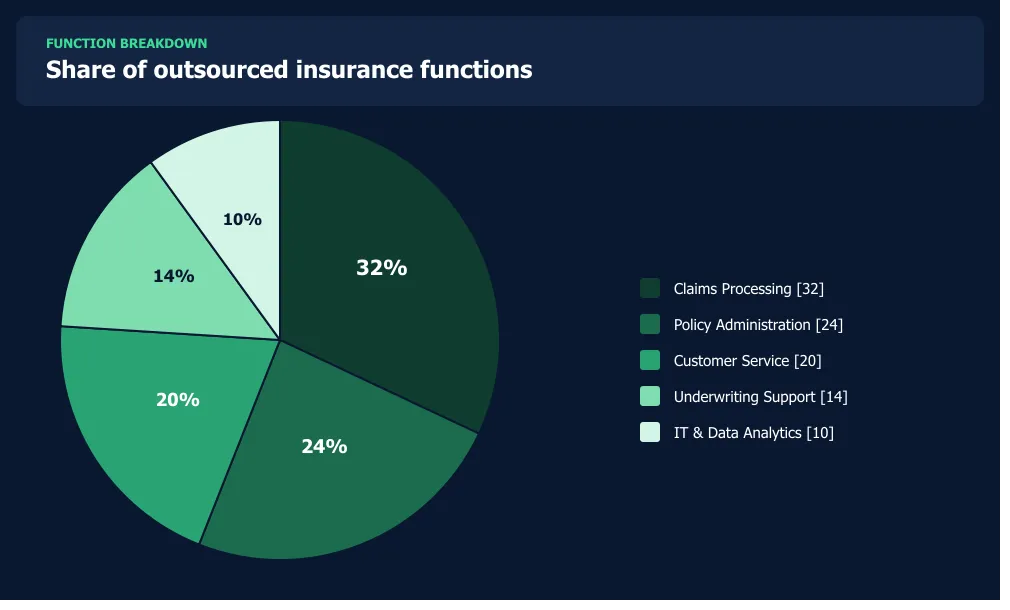
Notice the pattern: the more a task depends on regulatory judgment or final decision-making authority, the more insurers tend to keep it close, even when they outsource the supporting research or data work around it.
Outsourcing Models: Offshore, Nearshore, or Onshore?
Location matters more than most people expect. It affects cost, but also time zone overlap, language fit, and regulatory alignment.
There's also a structural choice beyond geography: straight BPO (you manage the relationship, they execute tasks) versus BPaaS (business process as a service), where the vendor bundles technology, staffing, and process ownership into one package. BPaaS tends to cost more upfront but reduces the management burden significantly.

Support Insurance Operations with NeoWork
Insurance outsourcing helps companies manage recurring customer service, data entry, documentation, and administrative workflows without expanding every internal role. NeoWork provides remote teammates who can support structured operational tasks within the client’s existing systems and processes. NeoWork handles recruitment, benefits, training, and ongoing engagement, while teammates follow the client’s tools, procedures, and daily priorities. Its 91% annualized teammate retention rate and 3.2% candidate selectivity rate reflect a focus on selective hiring and longer-term team stability.
NeoWork's insurance operations support model offers:
- customer service and administrative support
- integration with the client’s tools and processes
- recruitment and ongoing teammate support
Contact NeoWork to add remote support for recurring insurance operations.
Why Insurers Outsource: The Real Drivers
Cost savings get the headline, but they're rarely the only reason a carrier signs a contract. Speed and scalability usually matter just as much, especially during catastrophe season when claims volume can triple overnight.
- Cost efficiency — labor arbitrage plus reduced overhead on office space, benefits, and training
- Scalability — spin capacity up or down without hiring and firing cycles
- Faster turnaround — dedicated teams working structured workflows tend to process claims quicker than generalist internal staff
- Access to specialized skills — fraud analytics, multilingual support, niche compliance knowledge
- Focus — freeing internal teams to concentrate on underwriting judgment and customer relationships instead of paperwork
That said, none of this happens automatically. A poorly chosen partner can slow things down, introduce compliance gaps, and damage the customer experience it was supposed to improve.
The Outsourcing Process, Step by Step
Most successful outsourcing initiatives follow a similar sequence. Skipping steps — especially due diligence — is where most failures start.
1. Define Objectives
Cost reduction, faster claims turnaround, and better scalability call for different provider profiles. Get specific before shopping vendors.
2. Identify What to Outsource
Start with rules-based, high-volume, low-judgment tasks. Claims intake and policy data entry are common first moves for insurers new to outsourcing.
3. Shortlist and Vet Providers
Look past the sales deck. Ask for references from other insurance clients specifically — general BPO experience doesn't guarantee they understand claims regulations or policy language.
4. Due Diligence
This is where compliance, data security certifications, and financial stability of the vendor get checked. Skipping this step is the single most common cause of outsourcing regret.
5. Contract and SLAs
Service-level agreements should specify turnaround times, accuracy thresholds, data handling protocols, and escalation paths — not just price.
6. Pilot Before Scaling
Run a limited pilot on one line of business or region before handing over the full book. It's the cheapest insurance policy against a bad fit.
Compliance and Data Security: Non-Negotiables
Insurance is one of the most regulated industries around, and outsourcing doesn't transfer regulatory responsibility — it just adds a layer of oversight. Regulators in most jurisdictions still hold the insurer accountable for how outsourced data is handled, even when a third party caused the breach.
Before signing anything, insurers should confirm the provider holds relevant certifications (SOC 2, ISO 27001, or regional equivalents), understands data residency requirements, and has a documented incident-response process. Cross-border outsourcing adds another wrinkle: GDPR, HIPAA-adjacent rules for health-related lines, and local insurance regulators may all apply simultaneously depending on where the insurer and vendor operate.
Costs: What to Actually Expect
Savings figures used in marketing materials, such as 40% or 70%, can provide a rough reference point but vary widely by function, region, and contract structure. A simple offshore data-entry arrangement will usually produce greater percentage savings than a nearshore underwriting-support setup that requires closer collaboration and more experienced staff.
Rather than anchoring on a single percentage, insurers should model the total cost of ownership, including:
- Base service fees or hourly rates
- Setup, onboarding, and transition costs
- Technology integration and software expenses
- Training and process documentation
- Internal management and vendor oversight
- Compliance, auditing, and security reviews
- Pilot project costs
- Charges for overtime, peak periods, or additional capacity
- Currency fluctuations and cross-border payment fees
- Contract termination or transition costs
Insurers should request a detailed pricing breakdown from each prospective provider and confirm which services are included in the quoted rate. Current pricing should be checked directly with vendors, since labor markets, service scope, and currency movements can affect costs over time.
Choosing the Right Partner
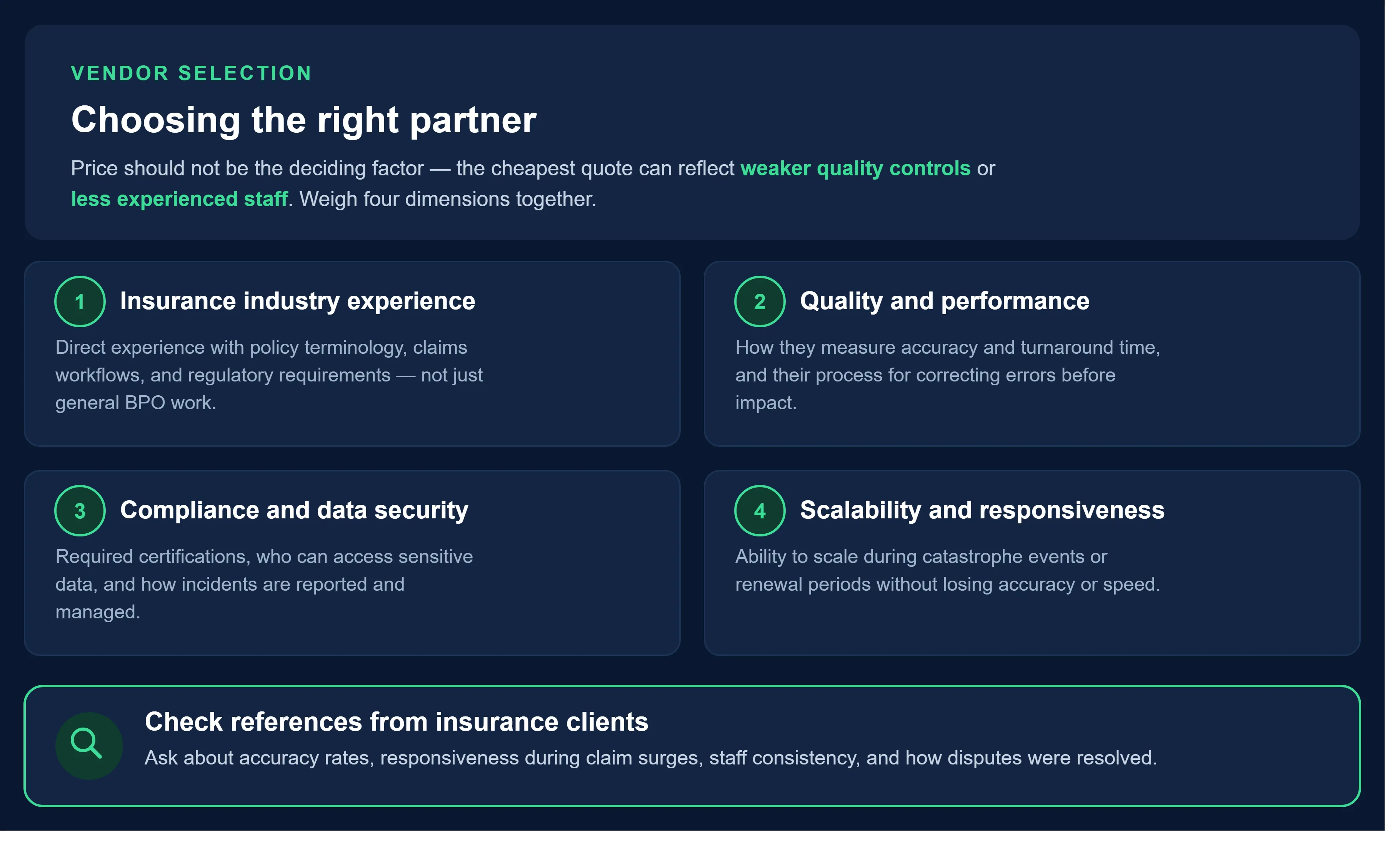
Price should not be the deciding factor. The cheapest quote can reflect weaker quality controls, limited insurance experience, or less experienced staff. A useful decision framework considers four dimensions together.
Insurance Industry Experience
Look for a provider with direct experience in insurance operations rather than general BPO work alone. They should understand policy terminology, claims workflows, regulatory requirements, and the operational differences between lines of business.
Quality and Performance
Ask how the provider measures accuracy, turnaround time, and service consistency. Review their quality-control process, reporting methods, and procedures for correcting errors before they affect policyholders or claims decisions.
Compliance and Data Security
Confirm that the provider holds the required security certifications and follows applicable data protection and insurance regulations. They should be able to explain who can access sensitive information, where data is stored, and how incidents are reported and managed.
Scalability and Responsiveness
Assess whether the provider can increase capacity during catastrophe events, renewal periods, or sudden claim surges. The team should be able to scale without causing a drop in accuracy, communication, or turnaround speed.
Check References from Insurance Clients
Reference checks matter more here than in most procurement decisions. Ask the prospective provider's existing insurance clients directly about accuracy rates, responsiveness during claim surges, consistency of assigned staff, and how disputes or service failures were resolved.
Final Thoughts
Insurance outsourcing isn't a shortcut, and it isn't magic. It's an operational strategy that works when the objectives are clear, the function fits the model, and the vendor gets vetted like a long-term partner rather than a line-item expense. Start small, measure honestly, and scale what actually performs.
Ready to explore outsourcing for a specific function like claims or policy administration? Map out objectives first, then shortlist providers with proven insurance-sector experience before requesting proposals.
FAQ
Topics
Insurance Outsourcing Guide: What to Outsource, How, and Why (2026)

Quick Summary: Insurance outsourcing means handing off functions like claims processing, underwriting support, policy administration, or customer service to a specialized third-party provider, either onshore, nearshore, or offshore. Done well, it typically cuts operating costs by 30-60% and speeds up turnaround times, but it only works when insurers pick the right functions, vet partners for compliance and data security, and manage the relationship actively rather than treating it as a one-time handoff.
Insurers are under pressure from every direction right now — rising claims volume, thinner margins, a workforce that's aging out faster than it's being replaced. Outsourcing has quietly become one of the few levers that actually moves the needle on all three at once. But not every function should leave the building, and not every vendor deserves your data.
This guide walks through what insurance outsourcing actually covers, the models available, realistic cost expectations, and a practical process for choosing a partner without getting burned. Whether the goal is trimming overhead or simply keeping up with claims volume during peak season, the fundamentals below apply the same way.
What Is Insurance Outsourcing?
Insurance outsourcing is the practice of contracting external providers — often called insurance BPO (business process outsourcing) firms — to handle operational tasks that would otherwise sit inside an insurer's own back office. Think claims intake, policy administration, underwriting support, data entry, customer service, and increasingly, IT and analytics work.
It's not new. Carriers have used third-party administrators for decades. What's changed is the scope: modern BPO providers now offer AI-assisted claims triage, 24/7 multilingual support, and specialized compliance teams that most mid-sized insurers simply can't staff in-house at a comparable cost.
Functions Insurers Commonly Outsource
Some functions outsource cleanly because they're rules-based and repetitive. Others require more judgment and stay in-house longer. Here's how the split typically looks across the industry.
Notice the pattern: the more a task depends on regulatory judgment or final decision-making authority, the more insurers tend to keep it close, even when they outsource the supporting research or data work around it.
Outsourcing Models: Offshore, Nearshore, or Onshore?
Location matters more than most people expect. It affects cost, but also time zone overlap, language fit, and regulatory alignment.
There's also a structural choice beyond geography: straight BPO (you manage the relationship, they execute tasks) versus BPaaS (business process as a service), where the vendor bundles technology, staffing, and process ownership into one package. BPaaS tends to cost more upfront but reduces the management burden significantly.
Support Insurance Operations with NeoWork
Insurance outsourcing helps companies manage recurring customer service, data entry, documentation, and administrative workflows without expanding every internal role. NeoWork provides remote teammates who can support structured operational tasks within the client’s existing systems and processes. NeoWork handles recruitment, benefits, training, and ongoing engagement, while teammates follow the client’s tools, procedures, and daily priorities. Its 91% annualized teammate retention rate and 3.2% candidate selectivity rate reflect a focus on selective hiring and longer-term team stability.
NeoWork's insurance operations support model offers:
- customer service and administrative support
- integration with the client’s tools and processes
- recruitment and ongoing teammate support
Contact NeoWork to add remote support for recurring insurance operations.
Why Insurers Outsource: The Real Drivers
Cost savings get the headline, but they're rarely the only reason a carrier signs a contract. Speed and scalability usually matter just as much, especially during catastrophe season when claims volume can triple overnight.
- Cost efficiency — labor arbitrage plus reduced overhead on office space, benefits, and training
- Scalability — spin capacity up or down without hiring and firing cycles
- Faster turnaround — dedicated teams working structured workflows tend to process claims quicker than generalist internal staff
- Access to specialized skills — fraud analytics, multilingual support, niche compliance knowledge
- Focus — freeing internal teams to concentrate on underwriting judgment and customer relationships instead of paperwork
That said, none of this happens automatically. A poorly chosen partner can slow things down, introduce compliance gaps, and damage the customer experience it was supposed to improve.
The Outsourcing Process, Step by Step
Most successful outsourcing initiatives follow a similar sequence. Skipping steps — especially due diligence — is where most failures start.
1. Define Objectives
Cost reduction, faster claims turnaround, and better scalability call for different provider profiles. Get specific before shopping vendors.
2. Identify What to Outsource
Start with rules-based, high-volume, low-judgment tasks. Claims intake and policy data entry are common first moves for insurers new to outsourcing.
3. Shortlist and Vet Providers
Look past the sales deck. Ask for references from other insurance clients specifically — general BPO experience doesn't guarantee they understand claims regulations or policy language.
4. Due Diligence
This is where compliance, data security certifications, and financial stability of the vendor get checked. Skipping this step is the single most common cause of outsourcing regret.
5. Contract and SLAs
Service-level agreements should specify turnaround times, accuracy thresholds, data handling protocols, and escalation paths — not just price.
6. Pilot Before Scaling
Run a limited pilot on one line of business or region before handing over the full book. It's the cheapest insurance policy against a bad fit.
Compliance and Data Security: Non-Negotiables
Insurance is one of the most regulated industries around, and outsourcing doesn't transfer regulatory responsibility — it just adds a layer of oversight. Regulators in most jurisdictions still hold the insurer accountable for how outsourced data is handled, even when a third party caused the breach.
Before signing anything, insurers should confirm the provider holds relevant certifications (SOC 2, ISO 27001, or regional equivalents), understands data residency requirements, and has a documented incident-response process. Cross-border outsourcing adds another wrinkle: GDPR, HIPAA-adjacent rules for health-related lines, and local insurance regulators may all apply simultaneously depending on where the insurer and vendor operate.
Costs: What to Actually Expect
Savings figures used in marketing materials, such as 40% or 70%, can provide a rough reference point but vary widely by function, region, and contract structure. A simple offshore data-entry arrangement will usually produce greater percentage savings than a nearshore underwriting-support setup that requires closer collaboration and more experienced staff.
Rather than anchoring on a single percentage, insurers should model the total cost of ownership, including:
- Base service fees or hourly rates
- Setup, onboarding, and transition costs
- Technology integration and software expenses
- Training and process documentation
- Internal management and vendor oversight
- Compliance, auditing, and security reviews
- Pilot project costs
- Charges for overtime, peak periods, or additional capacity
- Currency fluctuations and cross-border payment fees
- Contract termination or transition costs
Insurers should request a detailed pricing breakdown from each prospective provider and confirm which services are included in the quoted rate. Current pricing should be checked directly with vendors, since labor markets, service scope, and currency movements can affect costs over time.
Choosing the Right Partner
Price should not be the deciding factor. The cheapest quote can reflect weaker quality controls, limited insurance experience, or less experienced staff. A useful decision framework considers four dimensions together.
Insurance Industry Experience
Look for a provider with direct experience in insurance operations rather than general BPO work alone. They should understand policy terminology, claims workflows, regulatory requirements, and the operational differences between lines of business.
Quality and Performance
Ask how the provider measures accuracy, turnaround time, and service consistency. Review their quality-control process, reporting methods, and procedures for correcting errors before they affect policyholders or claims decisions.
Compliance and Data Security
Confirm that the provider holds the required security certifications and follows applicable data protection and insurance regulations. They should be able to explain who can access sensitive information, where data is stored, and how incidents are reported and managed.
Scalability and Responsiveness
Assess whether the provider can increase capacity during catastrophe events, renewal periods, or sudden claim surges. The team should be able to scale without causing a drop in accuracy, communication, or turnaround speed.
Check References from Insurance Clients
Reference checks matter more here than in most procurement decisions. Ask the prospective provider's existing insurance clients directly about accuracy rates, responsiveness during claim surges, consistency of assigned staff, and how disputes or service failures were resolved.
Final Thoughts
Insurance outsourcing isn't a shortcut, and it isn't magic. It's an operational strategy that works when the objectives are clear, the function fits the model, and the vendor gets vetted like a long-term partner rather than a line-item expense. Start small, measure honestly, and scale what actually performs.
Ready to explore outsourcing for a specific function like claims or policy administration? Map out objectives first, then shortlist providers with proven insurance-sector experience before requesting proposals.
FAQ
Topics
Related Blogs
Related Podcasts


.webp)

.webp)
.webp)



