

Updated:
Oct 6
2026
.avif)
.avif)


.svg)

Quick Summary: Account outsourcing means hiring an external provider to handle bookkeeping, payables, receivables, payroll, or full-cycle accounting instead of keeping every task in-house. Done well, it typically cuts accounting overhead by roughly 30-40% while giving smaller teams access to senior-level financial expertise they couldn't otherwise afford. The real work is in choosing the right scope, provider, and transition plan — not just signing a contract.
Most finance leaders don't wake up one day and decide to outsource accounting on a whim. It usually happens after a bad month — a missed tax deadline, a bookkeeper who quit without notice, or a board asking for numbers that took three weeks to produce. That's the moment account outsourcing stops being a theoretical cost-saving idea and becomes an actual project.
This guide walks through what account outsourcing actually covers, what it costs, how the process works month to month, and how to pick a provider without getting burned. No fluff about "unlocking growth" — just the practical stuff a controller or founder needs before signing anything.
Account outsourcing is the practice of handing specific accounting or finance functions to a third-party firm or offshore team rather than hiring full-time staff for them. It can mean one narrow task, like accounts payable processing, or it can mean an entire finance department run by an external partner while a company keeps only a controller or CFO on staff.
It's different from simply hiring a freelance bookkeeper. Outsourcing providers usually bring a team — a bookkeeper, a reviewer, and an account manager — plus established software, documented processes, and backup coverage if someone goes on leave. That redundancy is one of the biggest practical advantages over a single in-house hire.
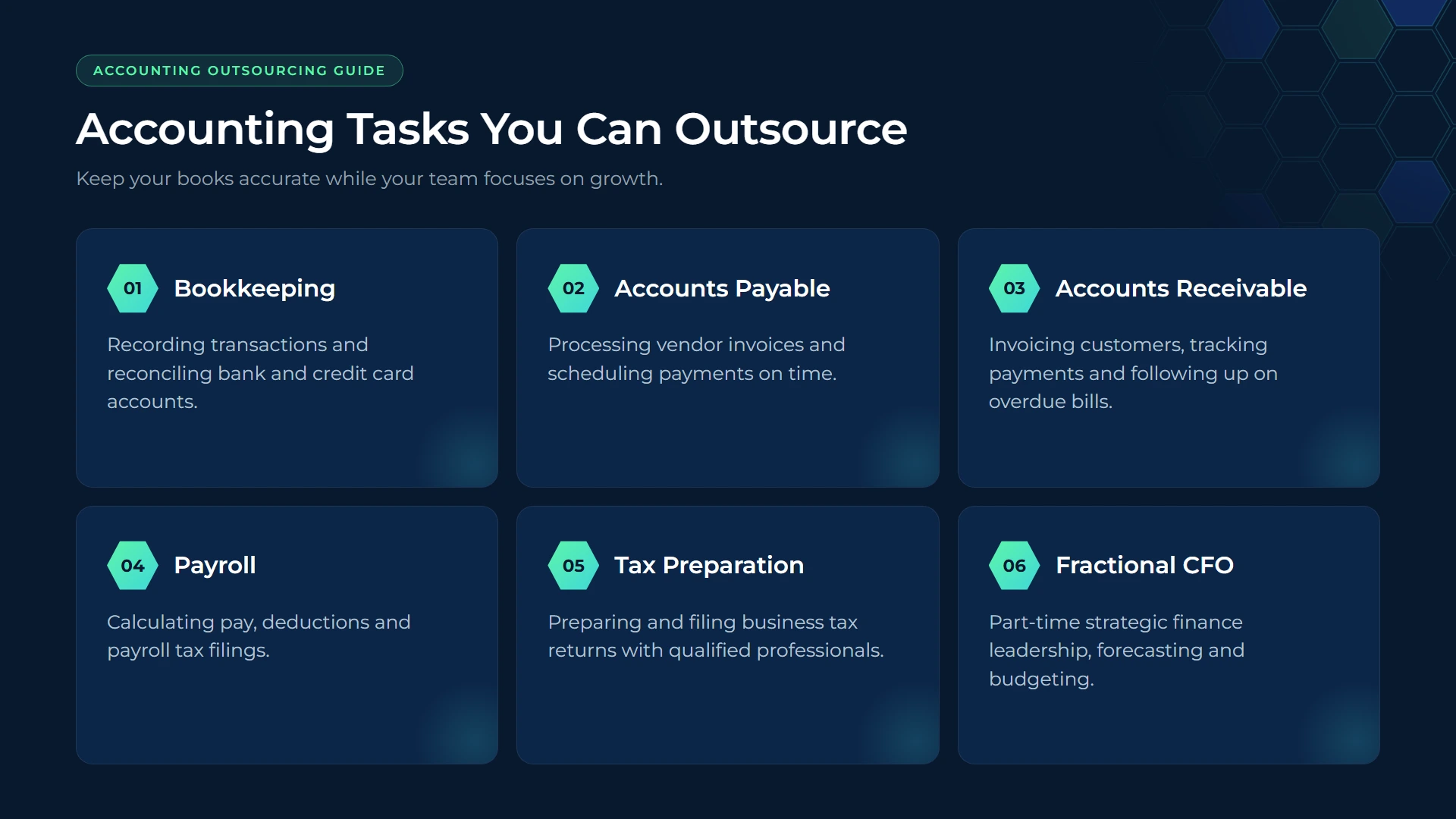
Some businesses outsource everything above except strategic finance leadership. Others only outsource the repetitive, low-judgment tasks and keep reporting in-house. There's no single correct split — it depends on team size, industry complexity, and how much control the business wants to retain.
Cost is the headline reason, but it's rarely the only one. A full-time, experienced accountant in a major metro area commands a salary that many small and mid-sized businesses simply can't absorb for a role that doesn't need to be full-time yet. Outsourcing lets a company pay for a fraction of that expertise instead of the whole position.
Accuracy and consistency matter just as much. An outsourced team that processes books for dozens of similar clients tends to catch errors faster than a solo in-house hire juggling five different responsibilities. And when that hire takes vacation, gets sick, or leaves the company, the books don't grind to a halt — the provider's team keeps running.
There's also a scalability angle. Transaction volume during a busy season, a product launch, or an acquisition can spike fast. An outsourced provider can usually flex capacity up or down within weeks; hiring and training an in-house employee for the same spike takes months and leaves a company overstaffed once things settle.

Accounting outsourcing helps companies manage recurring financial records, data entry, bookkeeping support, and back-office workflows without expanding every internal role. At NeoWork, we provide remote teammates who can support accounting operations within your existing systems and processes. We handle recruitment, benefits, training, and ongoing engagement, while our teammates follow your tools, procedures, and daily priorities. Our 91% annualized teammate retention rate and 3.2% candidate selectivity rate reflect our focus on selective hiring and longer-term team stability.
Our accounting outsourcing model offers:
Contact NeoWork to add accounting support that fits your existing finance operations.
Pricing varies widely based on transaction volume, complexity, and whether the provider is domestic, nearshore, or offshore. Most providers price using one of three models: flat monthly retainer, hourly billing, or a hybrid based on transaction count.
As a rough benchmark, many businesses report overall accounting cost reductions somewhere in the 30-40% range after switching from an in-house hire to an outsourced arrangement, though the actual figure depends heavily on the baseline salary being replaced and the scope of work transferred. Treat any specific percentage a provider quotes as a starting point for discussion, not a guarantee — ask for a breakdown based on your own transaction volume before committing.
Beyond the base fee, ask about setup charges, software licensing (QuickBooks, Xero, NetSuite), and whether year-end tax filing is included or billed separately. Vague pricing pages are a red flag — a provider that can't explain its own fee structure clearly probably won't communicate clearly about the numbers either.
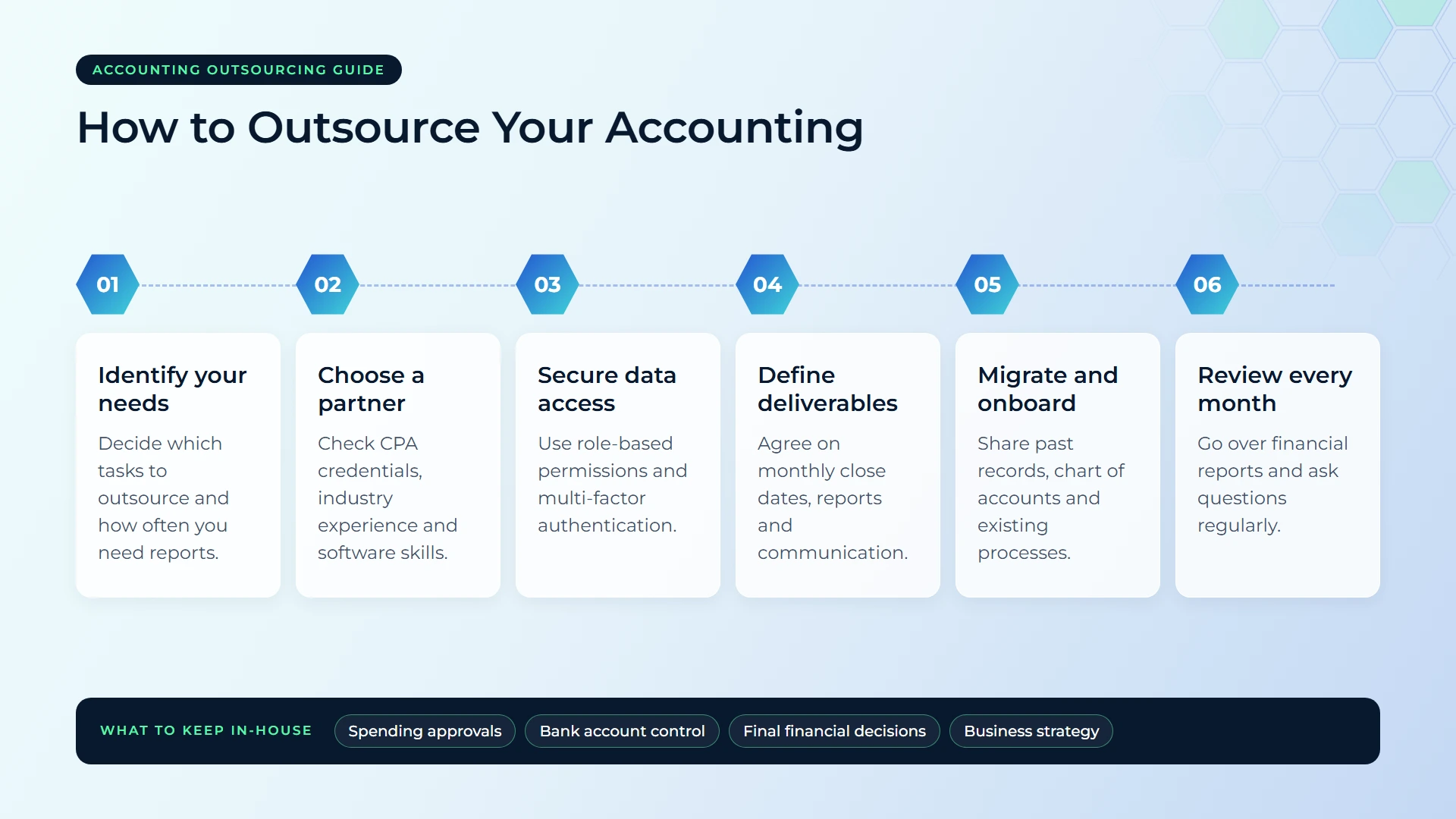
Once a contract is signed, there’s usually a transition period before everything runs smoothly. Onboarding often takes two to six weeks, depending on the condition of the existing books and how many systems need to be connected.
The provider starts by reviewing current records, accounting software, reporting requirements, and internal workflows. This is also when access permissions, integrations, and responsibilities are sorted out.
For a short period, the old and new processes usually run side by side. This helps expose missing entries, reconciliation issues, or differences in how transactions are categorized before the in-house team steps away completely. A provider that skips or rushes this stage can create unnecessary problems during the first few months.
Once the records and workflows are stable, responsibility shifts fully to the outsourcing provider. Roles, approval processes, and communication routines should already be clear by this point.
After handover, the work usually settles into a predictable rhythm. Transactions are categorized throughout the month, reconciliations happen around month-end, and reports such as the P&L, balance sheet, and cash flow statement are delivered after close.
The exact reporting deadline matters, so it’s worth agreeing in writing on how many business days after month-end the final reporting package should arrive.
Neither column is universally "better." A company with highly specialized accounting needs — regulated industries, complex multi-entity structures — might still want key functions kept in-house, outsourcing only the repetitive parts. A leaner startup, on the other hand, often benefits from outsourcing nearly everything except final sign-off.
Not all outsourcing firms are built the same, and the differences show up fast once real money starts moving. A few things worth checking before signing a contract:
Here's the thing though — pricing shouldn't be the deciding factor on its own. The cheapest provider is often cheap because corners get cut on review processes or because junior staff handle accounts with minimal senior oversight. A slightly higher fee that buys a dedicated reviewer and faster turnaround tends to pay for itself.
Vague answers about who specifically will handle the account, reluctance to share references, unclear data security policies, and pricing that seems too good relative to the market are all worth probing further. A provider should be able to explain exactly how a question gets escalated if something looks wrong in the books.
For a mid-size business outsourcing its full finance function, spend typically breaks down something like this — the exact split varies by company, but it reflects where most of the recurring work sits.
Outsourcing isn't risk-free, and pretending otherwise does nobody favors. The most common issue is a loss of institutional knowledge — when nobody internally understands the books well enough to catch an error the provider misses. The fix is simple but often skipped: keep at least one internal person reviewing summary reports monthly, even if they're not doing the data entry themselves.
Data security is the second big concern, especially with offshore providers. Ask specifically about SOC 2 compliance or equivalent certifications, and get data handling terms written into the contract rather than taking a verbal assurance at face value.
Finally, there's the communication gap that can creep in with time zone differences. It's manageable with clear SLAs on response times, but it's worth testing during the sales process — send a tricky question before signing and see how fast and how clearly it gets answered.
Account outsourcing works best when it's treated as a structured decision, not a quick fix for a bad quarter. Start by mapping out exactly which functions are draining the most internal time, get clear pricing from at least two or three providers, and build in a real review period before fully handing off the books.
Done thoughtfully, it frees up internal teams to focus on the parts of finance that actually need human judgment — forecasting, strategy, decisions — while the repetitive work runs quietly in the background. That's the real payoff, and it's worth more than the cost savings alone.

Quick Summary: Account outsourcing means hiring an external provider to handle bookkeeping, payables, receivables, payroll, or full-cycle accounting instead of keeping every task in-house. Done well, it typically cuts accounting overhead by roughly 30-40% while giving smaller teams access to senior-level financial expertise they couldn't otherwise afford. The real work is in choosing the right scope, provider, and transition plan — not just signing a contract.
Most finance leaders don't wake up one day and decide to outsource accounting on a whim. It usually happens after a bad month — a missed tax deadline, a bookkeeper who quit without notice, or a board asking for numbers that took three weeks to produce. That's the moment account outsourcing stops being a theoretical cost-saving idea and becomes an actual project.
This guide walks through what account outsourcing actually covers, what it costs, how the process works month to month, and how to pick a provider without getting burned. No fluff about "unlocking growth" — just the practical stuff a controller or founder needs before signing anything.
Account outsourcing is the practice of handing specific accounting or finance functions to a third-party firm or offshore team rather than hiring full-time staff for them. It can mean one narrow task, like accounts payable processing, or it can mean an entire finance department run by an external partner while a company keeps only a controller or CFO on staff.
It's different from simply hiring a freelance bookkeeper. Outsourcing providers usually bring a team — a bookkeeper, a reviewer, and an account manager — plus established software, documented processes, and backup coverage if someone goes on leave. That redundancy is one of the biggest practical advantages over a single in-house hire.
Some businesses outsource everything above except strategic finance leadership. Others only outsource the repetitive, low-judgment tasks and keep reporting in-house. There's no single correct split — it depends on team size, industry complexity, and how much control the business wants to retain.
Cost is the headline reason, but it's rarely the only one. A full-time, experienced accountant in a major metro area commands a salary that many small and mid-sized businesses simply can't absorb for a role that doesn't need to be full-time yet. Outsourcing lets a company pay for a fraction of that expertise instead of the whole position.
Accuracy and consistency matter just as much. An outsourced team that processes books for dozens of similar clients tends to catch errors faster than a solo in-house hire juggling five different responsibilities. And when that hire takes vacation, gets sick, or leaves the company, the books don't grind to a halt — the provider's team keeps running.
There's also a scalability angle. Transaction volume during a busy season, a product launch, or an acquisition can spike fast. An outsourced provider can usually flex capacity up or down within weeks; hiring and training an in-house employee for the same spike takes months and leaves a company overstaffed once things settle.
Accounting outsourcing helps companies manage recurring financial records, data entry, bookkeeping support, and back-office workflows without expanding every internal role. At NeoWork, we provide remote teammates who can support accounting operations within your existing systems and processes. We handle recruitment, benefits, training, and ongoing engagement, while our teammates follow your tools, procedures, and daily priorities. Our 91% annualized teammate retention rate and 3.2% candidate selectivity rate reflect our focus on selective hiring and longer-term team stability.
Our accounting outsourcing model offers:
Contact NeoWork to add accounting support that fits your existing finance operations.
Pricing varies widely based on transaction volume, complexity, and whether the provider is domestic, nearshore, or offshore. Most providers price using one of three models: flat monthly retainer, hourly billing, or a hybrid based on transaction count.
As a rough benchmark, many businesses report overall accounting cost reductions somewhere in the 30-40% range after switching from an in-house hire to an outsourced arrangement, though the actual figure depends heavily on the baseline salary being replaced and the scope of work transferred. Treat any specific percentage a provider quotes as a starting point for discussion, not a guarantee — ask for a breakdown based on your own transaction volume before committing.
Beyond the base fee, ask about setup charges, software licensing (QuickBooks, Xero, NetSuite), and whether year-end tax filing is included or billed separately. Vague pricing pages are a red flag — a provider that can't explain its own fee structure clearly probably won't communicate clearly about the numbers either.
Once a contract is signed, there’s usually a transition period before everything runs smoothly. Onboarding often takes two to six weeks, depending on the condition of the existing books and how many systems need to be connected.
The provider starts by reviewing current records, accounting software, reporting requirements, and internal workflows. This is also when access permissions, integrations, and responsibilities are sorted out.
For a short period, the old and new processes usually run side by side. This helps expose missing entries, reconciliation issues, or differences in how transactions are categorized before the in-house team steps away completely. A provider that skips or rushes this stage can create unnecessary problems during the first few months.
Once the records and workflows are stable, responsibility shifts fully to the outsourcing provider. Roles, approval processes, and communication routines should already be clear by this point.
After handover, the work usually settles into a predictable rhythm. Transactions are categorized throughout the month, reconciliations happen around month-end, and reports such as the P&L, balance sheet, and cash flow statement are delivered after close.
The exact reporting deadline matters, so it’s worth agreeing in writing on how many business days after month-end the final reporting package should arrive.
Neither column is universally "better." A company with highly specialized accounting needs — regulated industries, complex multi-entity structures — might still want key functions kept in-house, outsourcing only the repetitive parts. A leaner startup, on the other hand, often benefits from outsourcing nearly everything except final sign-off.
Not all outsourcing firms are built the same, and the differences show up fast once real money starts moving. A few things worth checking before signing a contract:
Here's the thing though — pricing shouldn't be the deciding factor on its own. The cheapest provider is often cheap because corners get cut on review processes or because junior staff handle accounts with minimal senior oversight. A slightly higher fee that buys a dedicated reviewer and faster turnaround tends to pay for itself.
Vague answers about who specifically will handle the account, reluctance to share references, unclear data security policies, and pricing that seems too good relative to the market are all worth probing further. A provider should be able to explain exactly how a question gets escalated if something looks wrong in the books.
For a mid-size business outsourcing its full finance function, spend typically breaks down something like this — the exact split varies by company, but it reflects where most of the recurring work sits.
Outsourcing isn't risk-free, and pretending otherwise does nobody favors. The most common issue is a loss of institutional knowledge — when nobody internally understands the books well enough to catch an error the provider misses. The fix is simple but often skipped: keep at least one internal person reviewing summary reports monthly, even if they're not doing the data entry themselves.
Data security is the second big concern, especially with offshore providers. Ask specifically about SOC 2 compliance or equivalent certifications, and get data handling terms written into the contract rather than taking a verbal assurance at face value.
Finally, there's the communication gap that can creep in with time zone differences. It's manageable with clear SLAs on response times, but it's worth testing during the sales process — send a tricky question before signing and see how fast and how clearly it gets answered.
Account outsourcing works best when it's treated as a structured decision, not a quick fix for a bad quarter. Start by mapping out exactly which functions are draining the most internal time, get clear pricing from at least two or three providers, and build in a real review period before fully handing off the books.
Done thoughtfully, it frees up internal teams to focus on the parts of finance that actually need human judgment — forecasting, strategy, decisions — while the repetitive work runs quietly in the background. That's the real payoff, and it's worth more than the cost savings alone.



.webp)

.webp)