
.avif)
.avif)

Nearshore Staff Augmentation Guide 2026: Complete Strategy


.svg)

Quick Summary: Nearshore staff augmentation is a strategic hiring model that brings skilled tech professionals from neighboring countries onto your team, delivering 30-50% cost savings with minimal friction. Unlike offshore outsourcing, nearshore teams work in overlapping time zones with similar cultural contexts, enabling real-time collaboration while filling critical skill gaps. This guide covers how to choose nearshore partners, integrate remote teams effectively, and avoid common pitfalls that derail projects.
Remember when building a tech team meant posting job ads, waiting months for the right candidates, and praying they'd accept the offer? That playbook barely works anymore.
Fast forward to 2026, and tech leaders are assembling engineering powerhouses without geographic boundaries. But there's a catch. While offshore outsourcing promises cheap labor, smart companies are homing in on a different approach: nearshore staff augmentation.
The difference? Picture this scenario. A critical production issue hits at 3 PM Eastern. An offshore team in Asia won't see the ticket for another 12 hours. A nearshore team in Latin America? They're already investigating the root cause and have a fix deployed before dinner.
That's not hypothetical. For many companies, this scenario plays out weekly.
What Is Nearshore Staff Augmentation?
Nearshore staff augmentation is IT staff augmentation that outsources professionals from neighboring countries. Instead of hiring full-time employees or relying on distant offshore teams, companies bring on skilled tech talent from geographically proximate regions.
The model combines three elements that offshore and in-house hiring struggle to balance:
- Cost efficiency comparable to offshore rates
- Time zone alignment that enables synchronous collaboration
- Cultural proximity that reduces communication friction
For U.S. companies, nearshore typically means Latin America—Mexico, Costa Rica, Colombia, Argentina. For European businesses, it's Eastern Europe and the Balkans. Australian companies look to Southeast Asia.
Here's the thing though—nearshore staff augmentation isn't just "outsourcing to a closer country." The strategic value emerges from how these professionals integrate with existing teams.
Unlike traditional outsourcing where work gets tossed over a wall, nearshore augmentation treats external professionals as extensions of the core team. They join daily standups, participate in sprint planning, and collaborate in real time. The only difference? Their employment contracts run through a staffing partner instead of internal HR.
Nearshore vs Offshore vs Onshore: Key Differences
The staffing landscape offers three main paths. Each comes with distinct tradeoffs.
Onshore hiring delivers zero friction but maximum cost. Offshore slashes budgets but introduces coordination headaches. Nearshore occupies the strategic middle ground.
The 30-50% cost savings figure isn't trivial. For a team of five senior developers, this cost differential can translate to significant annual savings—enough to fund additional headcount or accelerate product development.
But the real competitive edge comes from operational efficiency. When nearshore teams share working hours, decisions happen in minutes instead of days. Code reviews close within hours, not the next business day. Sprint planning sessions include everyone, not just whoever was awake.
_converted.webp)
Key Benefits Of Nearshoring In 2026
The global IT staff augmentation market keeps expanding, and nearshore models are capturing a disproportionate share. Here's why companies are betting on geographic proximity.
Financial and Operational Efficiency
The financial case for nearshore staff augmentation starts with labor costs but extends into areas many companies overlook.
Direct labor cost reduction delivers the headline number: 30-50% cost savings with minimal friction. Senior software engineers in San Francisco command significantly higher salaries than comparable professionals in Mexico City or Buenos Aires, with nearshore regions typically offering 30-50% cost savings.
But wait. The savings compound when accounting for:
- Reduced recruitment overhead: Staffing partners handle sourcing, vetting, and initial screening
- Lower infrastructure costs: No additional office space or equipment procurement
- Faster time-to-productivity: Experienced professionals ramp up in weeks instead of months
- Flexible scaling: Add capacity for a product launch, then scale back without layoffs
Real talk: these aren't marginal gains. For mid-sized engineering organizations, nearshore augmentation can generate substantial annual cost savings that get reallocated to product development or market expansion.
Time Zone Alignment Drives Velocity
Time zones sound like a minor detail until asynchronous handoffs start killing momentum.
Nearshore regions typically sit within 1-3 hours of U.S. time zones, enabling synchronous collaboration during overlapping working hours.
That overlap enables synchronous collaboration:
- Daily standups include the entire team
- Code reviews close within hours, not overnight
- Critical bugs get addressed during U.S. business hours
- Pair programming sessions happen in real time
- Sprint planning includes everyone's input simultaneously
The alternative? Offshore teams operating 10-12 hours ahead or behind create a relay race where each handoff costs a full day. A simple clarification question asked at 4 PM doesn't get answered until tomorrow morning. Multiply that friction across dozens of daily interactions, and development cycles can be significantly extended.
Cultural Proximity Reduces Communication Friction
Cultural alignment doesn't show up on cost-benefit spreadsheets, but it shapes every interaction.
Nearshore professionals often share similar business practices, communication styles, and work expectations. Latin American developers working with U.S. companies understand Agile methodologies, American corporate culture, and Western product development norms.
Language matters too. English proficiency in top nearshore markets—Mexico, Costa Rica, Argentina—exceeds most offshore alternatives. Technical conversations happen without constant clarification loops.
The result? Less time explaining context, fewer misunderstandings about project requirements, and smoother integration with existing teams.
Access To Specialized Skills Without Long Hiring Cycles
Tech talent shortages hit specialized skills hardest. Finding a local expert in machine learning, blockchain, or specific cloud platforms can take months.
Nearshore staffing partners maintain pre-vetted talent pools across niche specialties. Need a DevOps engineer with Kubernetes experience? A React Native specialist? A data scientist familiar with healthcare compliance? Deployment timelines are accelerated compared to traditional hiring cycles.
This flexibility matters most for:
- Project-based work requiring temporary specialized skills
- Rapid scaling to meet aggressive roadmap deadlines
- Pilot initiatives exploring new technologies
- Backfilling critical roles while permanent hiring continues
Companies aren't choosing between in-house teams and augmented staff. The winning strategy combines both—core competencies stay in-house while augmented professionals fill gaps and provide surge capacity.
How To Know Nearshoring Is Right For Your Organization
Not every company needs nearshore staff augmentation. The model delivers maximum value in specific scenarios.
Signal 1: Skill Gaps Blocking Critical Roadmap Items
When specialized expertise becomes the bottleneck, nearshore augmentation accelerates faster than traditional hiring. If core product features are delayed because the team lacks specific technical skills—cloud architecture, mobile development, security expertise—bringing on nearshore specialists unblocks progress immediately.
Signal 2: Aggressive Growth Targets With Budget Constraints
Scaling an engineering team by 50% through local hiring might blow the budget. Nearshore augmentation delivers similar capacity at significantly lower cost, preserving runway while maintaining development velocity.
Signal 3: Seasonal Or Project-Based Capacity Needs
Product launches, major feature releases, and system migrations create temporary spikes in workload. Hiring permanent staff for temporary needs creates downstream headcount issues. Augmented teams scale up for the push, then scale back when the project closes.
Signal 4: Recruitment Cycles Taking Too Long
When time-to-hire stretches beyond three months and competitors are shipping faster, nearshore partners provide pre-vetted professionals ready to start within weeks.
The strategic question isn't "nearshore or in-house." Most successful tech orgs blend both approaches—permanent staff for core functions, augmented teams for flexibility and specialized skills.
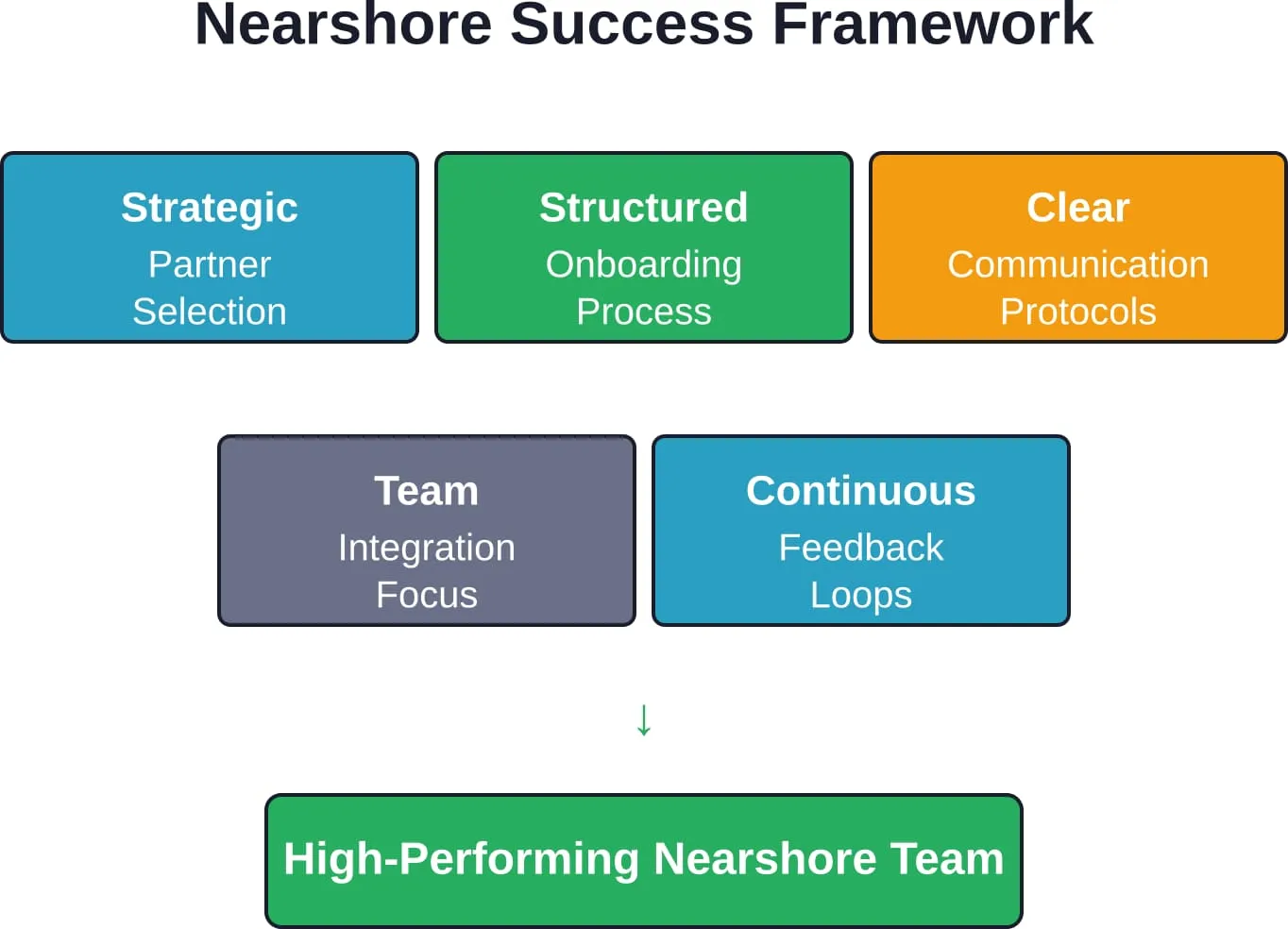
Choosing The Right Nearshore Partner
The staffing partner makes or breaks the nearshore experience. Poor partner selection leads to mismatched talent, cultural friction, and project delays.
Technical Vetting Standards
Top nearshore partners maintain rigorous technical screening processes. Before candidates reach clients, they complete:
- Technical assessments validating hands-on coding ability
- Architecture and system design evaluations
- Code review exercises demonstrating real-world skills
- Portfolio reviews showing previous work quality
Ask potential partners about their vetting process. Weak answers or vague assurances? Red flag. Strong partners provide detailed methodology and measurable screening metrics.
Industry-Specific Experience
Domain expertise matters. A staffing partner with fintech experience understands compliance requirements, security standards, and technical patterns specific to financial services. Healthcare-focused partners know HIPAA, HL7, and regulated data handling.
Generic staffing firms struggle to assess specialized knowledge. Industry-focused partners pre-screen for relevant domain experience, reducing ramp-up time significantly.
Communication Infrastructure
Effective nearshore partnerships require robust communication frameworks:
- Dedicated account managers who understand your business context
- Clear escalation paths for technical or administrative issues
- Regular check-ins monitoring team performance and satisfaction
- Transparent reporting on utilization, deliverables, and timelines
The partner becomes an extension of the HR and engineering management functions. Poor communication infrastructure creates administrative overhead that negates efficiency gains.
Flexibility In Engagement Models
Strong staffing partners offer multiple engagement structures:
- Dedicated individuals embedded in existing teams
- Small pods with complementary skill sets
- Full project teams with defined deliverables
- Hybrid models combining staff augmentation with managed services
Rigid partners force clients into one-size-fits-all arrangements that rarely align with actual needs.
Cultural Fit And Team Integration Support
The best partners actively facilitate team integration. Look for:
- Onboarding processes that introduce augmented staff to company culture
- Training on internal tools, workflows, and communication norms
- Regular feedback loops ensuring alignment between augmented staff and core teams
- Conflict resolution support when cultural or communication issues emerge
Staffing partners who simply assign bodies and disappear create integration headaches down the line.

Add Nearshore Capacity with NeoWork
Nearshore staff augmentation helps companies expand their teams with professionals based in a closer region and compatible working hours. NeoWork provides nearshore staffing, so that teammates can integrate into the client’s existing structure and work within established processes.
NeoWork reports a 91% annualized teammate retention rate and a 3.2% candidate selectivity rate, supporting a staffing approach built around careful hiring and longer-term team continuity.
Nearshore staff augmentation with NeoWork can provide:
- teammates integrated into existing departments
- support across operational and technical functions
- recruitment and ongoing teammate support
Contact NeoWork to add nearshore professionals who can work within your current processes and extend your team’s capacity.
Best Practices For Building High-Performing Nearshore Teams
Hiring nearshore professionals is step one. Integrating them effectively determines whether the investment pays off.
Treat Augmented Staff As Core Team Members
The biggest mistake companies make? Creating a two-tier system where nearshore professionals feel like outsiders.
High-performing nearshore teams result when augmented staff participate fully:
- Include them in all team meetings, standups, and planning sessions
- Give them access to the same tools, systems, and documentation
- Assign meaningful work that contributes to core product objectives
- Provide context about business goals, not just task lists
- Celebrate their wins and include them in team-building activities
When augmented professionals understand how their work connects to broader company objectives, engagement and output quality increase dramatically.
Establish Clear Communication Protocols
Distributed teams need explicit communication norms. Assumptions that work for co-located teams create confusion across geographic boundaries.
Define and document:
- Core collaboration hours when the full team is available
- Response time expectations for different communication channels
- Meeting cadence and attendance requirements
- Documentation standards for decisions and technical discussions
- Preferred tools for synchronous vs asynchronous communication
Early investment in communication infrastructure prevents the drift and misalignment that kills distributed team productivity.
Invest In Onboarding And Context-Setting
Nearshore professionals bring technical skills, but they need context about the product, customers, and technical architecture.
Strong onboarding programs include:
- Product walkthroughs explaining user workflows and business logic
- Architecture documentation covering system design and technical decisions
- Codebase tours highlighting key modules and integration points
- Introduction to team members and their areas of ownership
- Access provisioning and development environment setup
The goal? New team members should ship meaningful code within the first week, not spend two weeks deciphering undocumented systems.
Set Measurable Objectives And Track Progress
Distributed teams need clear success metrics. Ambiguous expectations create friction and underperformance.
Define specific objectives aligned with sprint goals or project milestones. For example:
Regular check-ins tracking progress against these metrics keep distributed teams aligned and accountable.
Build Trust Through Transparency
Distance amplifies uncertainty. When nearshore team members can't see what's happening in the main office, they fill information gaps with assumptions—often negative ones.
Combat this through radical transparency:
- Share company updates, product roadmaps, and strategic decisions openly
- Explain the reasoning behind prioritization changes or technical pivots
- Acknowledge challenges and setbacks honestly instead of sugarcoating
- Create channels for nearshore team members to ask questions and voice concerns
Trust compounds over time when teams see consistent, transparent communication patterns.
Create Feedback Loops For Continuous Improvement
Distributed collaboration requires ongoing refinement. What works initially often needs adjustment as teams grow and projects evolve.
Establish regular retrospectives focusing on:
- Communication effectiveness: What's working, what's creating friction?
- Tool and process pain points: Where do workflows break down?
- Collaboration quality: Are meetings productive or could they be asynchronous?
- Cultural alignment: Are there misunderstandings about expectations or norms?
The goal isn't perfection on day one. The goal is steady improvement driven by team feedback.
Common Pitfalls And How To Avoid Them
Even well-intentioned nearshore engagements hit predictable problems. Anticipating these challenges reduces their impact.
Pitfall 1: Treating Nearshore Teams As Commodity Resources
When companies view augmented professionals as interchangeable coding units, quality and engagement suffer.
The fix? Invest in relationships. Learn about team members' career goals, technical interests, and professional development needs. Provide growth opportunities and challenging work, not just ticket-grinding.
High-performing professionals—regardless of geography—want meaningful work and career progression. Companies that treat nearshore teams as disposable resources experience constant turnover and declining output quality.
Pitfall 2: Insufficient Onboarding And Context
Dropping nearshore professionals into complex projects without adequate context creates weeks of unproductive spinning.
The fix? Dedicate time upfront to thorough onboarding. The investment pays back within the first sprint through faster ramp-up and fewer mistakes from misunderstood requirements.
Pitfall 3: Poor Time Zone Coordination
Even with nearshore alignment, poor meeting scheduling creates unnecessary friction. Scheduling critical meetings at 8 AM Pacific excludes Latin American teams still offline.
The fix? Identify core collaboration hours where everyone is available and schedule important synchronous work then. Respect boundaries—don't expect team members to routinely work outside normal hours just because the time zones overlap slightly.
Pitfall 4: Over-Reliance On Asynchronous Communication
Some distributed teams swing too far toward async-everything, avoiding real-time conversations entirely.
While asynchronous communication has value, complex technical discussions, brainstorming sessions, and conflict resolution benefit from synchronous interaction. Balance matters.
The fix? Use the overlapping hours for high-bandwidth synchronous collaboration. Save asynchronous channels for updates, documentation, and non-urgent questions.
Pitfall 5: Weak Partner Relationship Management
When companies neglect the relationship with the staffing partner, small issues escalate into major problems.
The fix? Maintain regular communication with account managers. Provide feedback on team performance—both positive and constructive. Address concerns early before they metastasize into team dysfunction.
Future-Proofing Your Nearshore Strategy
The nearshore landscape keeps evolving. Companies that adapt to emerging trends maintain competitive advantage.
Regional Talent Pool Development
Latin American tech ecosystems are maturing rapidly. Cities like Mexico City, Buenos Aires, Medellín, and São Paulo are producing increasing numbers of senior-level engineers with specialized expertise.
This trend reduces the gap between nearshore and local talent pools. Companies that build relationships with emerging talent hubs gain early access to growing skill bases.
Hybrid Engagement Models
The line between staff augmentation and managed services is blurring. Forward-thinking companies combine individual augmented professionals with small dedicated teams that own specific product areas or technical functions.
This hybrid approach balances flexibility with ownership, allowing companies to scale both capacity and capability simultaneously.
Emphasis On Cultural Alignment And Soft Skills
As technical skills become more commoditized, cultural fit and communication ability drive differentiation. Nearshore professionals who navigate cross-cultural collaboration effectively become increasingly valuable.
Top staffing partners are investing heavily in soft skill development—communication training, cultural awareness programs, and collaboration frameworks that help nearshore teams integrate seamlessly.
Automation And AI Augmentation
AI tools are transforming how distributed teams collaborate. Code generation assistants, automated testing frameworks, and intelligent documentation systems reduce coordination overhead.
Nearshore teams that embrace these tools gain productivity advantages that compound over time. Companies should evaluate partners based on their adoption of modern development tooling and AI-assisted workflows.
Frequently Asked Questions
Topics
Nearshore Staff Augmentation Guide 2026: Complete Strategy

Quick Summary: Nearshore staff augmentation is a strategic hiring model that brings skilled tech professionals from neighboring countries onto your team, delivering 30-50% cost savings with minimal friction. Unlike offshore outsourcing, nearshore teams work in overlapping time zones with similar cultural contexts, enabling real-time collaboration while filling critical skill gaps. This guide covers how to choose nearshore partners, integrate remote teams effectively, and avoid common pitfalls that derail projects.
Remember when building a tech team meant posting job ads, waiting months for the right candidates, and praying they'd accept the offer? That playbook barely works anymore.
Fast forward to 2026, and tech leaders are assembling engineering powerhouses without geographic boundaries. But there's a catch. While offshore outsourcing promises cheap labor, smart companies are homing in on a different approach: nearshore staff augmentation.
The difference? Picture this scenario. A critical production issue hits at 3 PM Eastern. An offshore team in Asia won't see the ticket for another 12 hours. A nearshore team in Latin America? They're already investigating the root cause and have a fix deployed before dinner.
That's not hypothetical. For many companies, this scenario plays out weekly.
What Is Nearshore Staff Augmentation?
Nearshore staff augmentation is IT staff augmentation that outsources professionals from neighboring countries. Instead of hiring full-time employees or relying on distant offshore teams, companies bring on skilled tech talent from geographically proximate regions.
The model combines three elements that offshore and in-house hiring struggle to balance:
- Cost efficiency comparable to offshore rates
- Time zone alignment that enables synchronous collaboration
- Cultural proximity that reduces communication friction
For U.S. companies, nearshore typically means Latin America—Mexico, Costa Rica, Colombia, Argentina. For European businesses, it's Eastern Europe and the Balkans. Australian companies look to Southeast Asia.
Here's the thing though—nearshore staff augmentation isn't just "outsourcing to a closer country." The strategic value emerges from how these professionals integrate with existing teams.
Unlike traditional outsourcing where work gets tossed over a wall, nearshore augmentation treats external professionals as extensions of the core team. They join daily standups, participate in sprint planning, and collaborate in real time. The only difference? Their employment contracts run through a staffing partner instead of internal HR.
Nearshore vs Offshore vs Onshore: Key Differences
The staffing landscape offers three main paths. Each comes with distinct tradeoffs.
Onshore hiring delivers zero friction but maximum cost. Offshore slashes budgets but introduces coordination headaches. Nearshore occupies the strategic middle ground.
The 30-50% cost savings figure isn't trivial. For a team of five senior developers, this cost differential can translate to significant annual savings—enough to fund additional headcount or accelerate product development.
But the real competitive edge comes from operational efficiency. When nearshore teams share working hours, decisions happen in minutes instead of days. Code reviews close within hours, not the next business day. Sprint planning sessions include everyone, not just whoever was awake.
Key Benefits Of Nearshoring In 2026
The global IT staff augmentation market keeps expanding, and nearshore models are capturing a disproportionate share. Here's why companies are betting on geographic proximity.
Financial and Operational Efficiency
The financial case for nearshore staff augmentation starts with labor costs but extends into areas many companies overlook.
Direct labor cost reduction delivers the headline number: 30-50% cost savings with minimal friction. Senior software engineers in San Francisco command significantly higher salaries than comparable professionals in Mexico City or Buenos Aires, with nearshore regions typically offering 30-50% cost savings.
But wait. The savings compound when accounting for:
- Reduced recruitment overhead: Staffing partners handle sourcing, vetting, and initial screening
- Lower infrastructure costs: No additional office space or equipment procurement
- Faster time-to-productivity: Experienced professionals ramp up in weeks instead of months
- Flexible scaling: Add capacity for a product launch, then scale back without layoffs
Real talk: these aren't marginal gains. For mid-sized engineering organizations, nearshore augmentation can generate substantial annual cost savings that get reallocated to product development or market expansion.
Time Zone Alignment Drives Velocity
Time zones sound like a minor detail until asynchronous handoffs start killing momentum.
Nearshore regions typically sit within 1-3 hours of U.S. time zones, enabling synchronous collaboration during overlapping working hours.
That overlap enables synchronous collaboration:
- Daily standups include the entire team
- Code reviews close within hours, not overnight
- Critical bugs get addressed during U.S. business hours
- Pair programming sessions happen in real time
- Sprint planning includes everyone's input simultaneously
The alternative? Offshore teams operating 10-12 hours ahead or behind create a relay race where each handoff costs a full day. A simple clarification question asked at 4 PM doesn't get answered until tomorrow morning. Multiply that friction across dozens of daily interactions, and development cycles can be significantly extended.
Cultural Proximity Reduces Communication Friction
Cultural alignment doesn't show up on cost-benefit spreadsheets, but it shapes every interaction.
Nearshore professionals often share similar business practices, communication styles, and work expectations. Latin American developers working with U.S. companies understand Agile methodologies, American corporate culture, and Western product development norms.
Language matters too. English proficiency in top nearshore markets—Mexico, Costa Rica, Argentina—exceeds most offshore alternatives. Technical conversations happen without constant clarification loops.
The result? Less time explaining context, fewer misunderstandings about project requirements, and smoother integration with existing teams.
Access To Specialized Skills Without Long Hiring Cycles
Tech talent shortages hit specialized skills hardest. Finding a local expert in machine learning, blockchain, or specific cloud platforms can take months.
Nearshore staffing partners maintain pre-vetted talent pools across niche specialties. Need a DevOps engineer with Kubernetes experience? A React Native specialist? A data scientist familiar with healthcare compliance? Deployment timelines are accelerated compared to traditional hiring cycles.
This flexibility matters most for:
- Project-based work requiring temporary specialized skills
- Rapid scaling to meet aggressive roadmap deadlines
- Pilot initiatives exploring new technologies
- Backfilling critical roles while permanent hiring continues
Companies aren't choosing between in-house teams and augmented staff. The winning strategy combines both—core competencies stay in-house while augmented professionals fill gaps and provide surge capacity.
How To Know Nearshoring Is Right For Your Organization
Not every company needs nearshore staff augmentation. The model delivers maximum value in specific scenarios.
Signal 1: Skill Gaps Blocking Critical Roadmap Items
When specialized expertise becomes the bottleneck, nearshore augmentation accelerates faster than traditional hiring. If core product features are delayed because the team lacks specific technical skills—cloud architecture, mobile development, security expertise—bringing on nearshore specialists unblocks progress immediately.
Signal 2: Aggressive Growth Targets With Budget Constraints
Scaling an engineering team by 50% through local hiring might blow the budget. Nearshore augmentation delivers similar capacity at significantly lower cost, preserving runway while maintaining development velocity.
Signal 3: Seasonal Or Project-Based Capacity Needs
Product launches, major feature releases, and system migrations create temporary spikes in workload. Hiring permanent staff for temporary needs creates downstream headcount issues. Augmented teams scale up for the push, then scale back when the project closes.
Signal 4: Recruitment Cycles Taking Too Long
When time-to-hire stretches beyond three months and competitors are shipping faster, nearshore partners provide pre-vetted professionals ready to start within weeks.
The strategic question isn't "nearshore or in-house." Most successful tech orgs blend both approaches—permanent staff for core functions, augmented teams for flexibility and specialized skills.
Choosing The Right Nearshore Partner
The staffing partner makes or breaks the nearshore experience. Poor partner selection leads to mismatched talent, cultural friction, and project delays.
Technical Vetting Standards
Top nearshore partners maintain rigorous technical screening processes. Before candidates reach clients, they complete:
- Technical assessments validating hands-on coding ability
- Architecture and system design evaluations
- Code review exercises demonstrating real-world skills
- Portfolio reviews showing previous work quality
Ask potential partners about their vetting process. Weak answers or vague assurances? Red flag. Strong partners provide detailed methodology and measurable screening metrics.
Industry-Specific Experience
Domain expertise matters. A staffing partner with fintech experience understands compliance requirements, security standards, and technical patterns specific to financial services. Healthcare-focused partners know HIPAA, HL7, and regulated data handling.
Generic staffing firms struggle to assess specialized knowledge. Industry-focused partners pre-screen for relevant domain experience, reducing ramp-up time significantly.
Communication Infrastructure
Effective nearshore partnerships require robust communication frameworks:
- Dedicated account managers who understand your business context
- Clear escalation paths for technical or administrative issues
- Regular check-ins monitoring team performance and satisfaction
- Transparent reporting on utilization, deliverables, and timelines
The partner becomes an extension of the HR and engineering management functions. Poor communication infrastructure creates administrative overhead that negates efficiency gains.
Flexibility In Engagement Models
Strong staffing partners offer multiple engagement structures:
- Dedicated individuals embedded in existing teams
- Small pods with complementary skill sets
- Full project teams with defined deliverables
- Hybrid models combining staff augmentation with managed services
Rigid partners force clients into one-size-fits-all arrangements that rarely align with actual needs.
Cultural Fit And Team Integration Support
The best partners actively facilitate team integration. Look for:
- Onboarding processes that introduce augmented staff to company culture
- Training on internal tools, workflows, and communication norms
- Regular feedback loops ensuring alignment between augmented staff and core teams
- Conflict resolution support when cultural or communication issues emerge
Staffing partners who simply assign bodies and disappear create integration headaches down the line.
Add Nearshore Capacity with NeoWork
Nearshore staff augmentation helps companies expand their teams with professionals based in a closer region and compatible working hours. NeoWork provides nearshore staffing, so that teammates can integrate into the client’s existing structure and work within established processes.
NeoWork reports a 91% annualized teammate retention rate and a 3.2% candidate selectivity rate, supporting a staffing approach built around careful hiring and longer-term team continuity.
Nearshore staff augmentation with NeoWork can provide:
- teammates integrated into existing departments
- support across operational and technical functions
- recruitment and ongoing teammate support
Contact NeoWork to add nearshore professionals who can work within your current processes and extend your team’s capacity.
Best Practices For Building High-Performing Nearshore Teams
Hiring nearshore professionals is step one. Integrating them effectively determines whether the investment pays off.
Treat Augmented Staff As Core Team Members
The biggest mistake companies make? Creating a two-tier system where nearshore professionals feel like outsiders.
High-performing nearshore teams result when augmented staff participate fully:
- Include them in all team meetings, standups, and planning sessions
- Give them access to the same tools, systems, and documentation
- Assign meaningful work that contributes to core product objectives
- Provide context about business goals, not just task lists
- Celebrate their wins and include them in team-building activities
When augmented professionals understand how their work connects to broader company objectives, engagement and output quality increase dramatically.
Establish Clear Communication Protocols
Distributed teams need explicit communication norms. Assumptions that work for co-located teams create confusion across geographic boundaries.
Define and document:
- Core collaboration hours when the full team is available
- Response time expectations for different communication channels
- Meeting cadence and attendance requirements
- Documentation standards for decisions and technical discussions
- Preferred tools for synchronous vs asynchronous communication
Early investment in communication infrastructure prevents the drift and misalignment that kills distributed team productivity.
Invest In Onboarding And Context-Setting
Nearshore professionals bring technical skills, but they need context about the product, customers, and technical architecture.
Strong onboarding programs include:
- Product walkthroughs explaining user workflows and business logic
- Architecture documentation covering system design and technical decisions
- Codebase tours highlighting key modules and integration points
- Introduction to team members and their areas of ownership
- Access provisioning and development environment setup
The goal? New team members should ship meaningful code within the first week, not spend two weeks deciphering undocumented systems.
Set Measurable Objectives And Track Progress
Distributed teams need clear success metrics. Ambiguous expectations create friction and underperformance.
Define specific objectives aligned with sprint goals or project milestones. For example:
Regular check-ins tracking progress against these metrics keep distributed teams aligned and accountable.
Build Trust Through Transparency
Distance amplifies uncertainty. When nearshore team members can't see what's happening in the main office, they fill information gaps with assumptions—often negative ones.
Combat this through radical transparency:
- Share company updates, product roadmaps, and strategic decisions openly
- Explain the reasoning behind prioritization changes or technical pivots
- Acknowledge challenges and setbacks honestly instead of sugarcoating
- Create channels for nearshore team members to ask questions and voice concerns
Trust compounds over time when teams see consistent, transparent communication patterns.
Create Feedback Loops For Continuous Improvement
Distributed collaboration requires ongoing refinement. What works initially often needs adjustment as teams grow and projects evolve.
Establish regular retrospectives focusing on:
- Communication effectiveness: What's working, what's creating friction?
- Tool and process pain points: Where do workflows break down?
- Collaboration quality: Are meetings productive or could they be asynchronous?
- Cultural alignment: Are there misunderstandings about expectations or norms?
The goal isn't perfection on day one. The goal is steady improvement driven by team feedback.
Common Pitfalls And How To Avoid Them
Even well-intentioned nearshore engagements hit predictable problems. Anticipating these challenges reduces their impact.
Pitfall 1: Treating Nearshore Teams As Commodity Resources
When companies view augmented professionals as interchangeable coding units, quality and engagement suffer.
The fix? Invest in relationships. Learn about team members' career goals, technical interests, and professional development needs. Provide growth opportunities and challenging work, not just ticket-grinding.
High-performing professionals—regardless of geography—want meaningful work and career progression. Companies that treat nearshore teams as disposable resources experience constant turnover and declining output quality.
Pitfall 2: Insufficient Onboarding And Context
Dropping nearshore professionals into complex projects without adequate context creates weeks of unproductive spinning.
The fix? Dedicate time upfront to thorough onboarding. The investment pays back within the first sprint through faster ramp-up and fewer mistakes from misunderstood requirements.
Pitfall 3: Poor Time Zone Coordination
Even with nearshore alignment, poor meeting scheduling creates unnecessary friction. Scheduling critical meetings at 8 AM Pacific excludes Latin American teams still offline.
The fix? Identify core collaboration hours where everyone is available and schedule important synchronous work then. Respect boundaries—don't expect team members to routinely work outside normal hours just because the time zones overlap slightly.
Pitfall 4: Over-Reliance On Asynchronous Communication
Some distributed teams swing too far toward async-everything, avoiding real-time conversations entirely.
While asynchronous communication has value, complex technical discussions, brainstorming sessions, and conflict resolution benefit from synchronous interaction. Balance matters.
The fix? Use the overlapping hours for high-bandwidth synchronous collaboration. Save asynchronous channels for updates, documentation, and non-urgent questions.
Pitfall 5: Weak Partner Relationship Management
When companies neglect the relationship with the staffing partner, small issues escalate into major problems.
The fix? Maintain regular communication with account managers. Provide feedback on team performance—both positive and constructive. Address concerns early before they metastasize into team dysfunction.
Future-Proofing Your Nearshore Strategy
The nearshore landscape keeps evolving. Companies that adapt to emerging trends maintain competitive advantage.
Regional Talent Pool Development
Latin American tech ecosystems are maturing rapidly. Cities like Mexico City, Buenos Aires, Medellín, and São Paulo are producing increasing numbers of senior-level engineers with specialized expertise.
This trend reduces the gap between nearshore and local talent pools. Companies that build relationships with emerging talent hubs gain early access to growing skill bases.
Hybrid Engagement Models
The line between staff augmentation and managed services is blurring. Forward-thinking companies combine individual augmented professionals with small dedicated teams that own specific product areas or technical functions.
This hybrid approach balances flexibility with ownership, allowing companies to scale both capacity and capability simultaneously.
Emphasis On Cultural Alignment And Soft Skills
As technical skills become more commoditized, cultural fit and communication ability drive differentiation. Nearshore professionals who navigate cross-cultural collaboration effectively become increasingly valuable.
Top staffing partners are investing heavily in soft skill development—communication training, cultural awareness programs, and collaboration frameworks that help nearshore teams integrate seamlessly.
Automation And AI Augmentation
AI tools are transforming how distributed teams collaborate. Code generation assistants, automated testing frameworks, and intelligent documentation systems reduce coordination overhead.
Nearshore teams that embrace these tools gain productivity advantages that compound over time. Companies should evaluate partners based on their adoption of modern development tooling and AI-assisted workflows.
Frequently Asked Questions
Topics
Related Blogs
Related Podcasts