


Updated:
Oct 31
2026





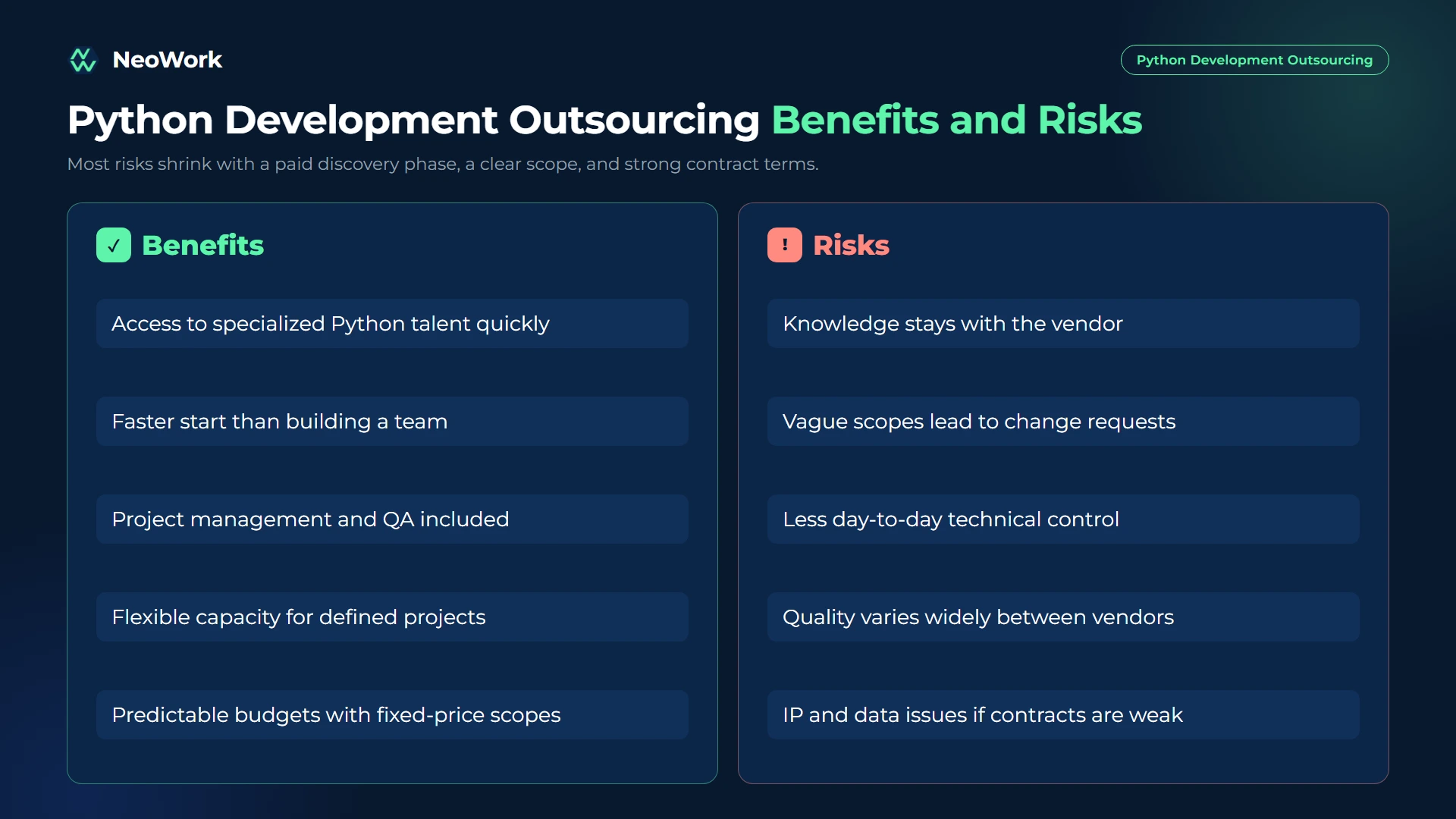
Quick Summary: Python development outsourcing means hiring an external company to build, test, or maintain Python software, such as web applications, APIs, data platforms, automation, or AI features, with the vendor managing its own team and delivering an agreed scope. Deloitte's 2024 Global Outsourcing Survey found that 80% of executives plan to maintain or increase investment in third-party outsourcing, with skilled talent now joining cost reduction as a key driver. This guide breaks down the main engagement models, how costs are structured, the benefits and risks side by side, how to choose a vendor, and how to manage an outsourced Python team well.
Python is often the first choice for new projects because it's fast to build with and covers so much ground: Django and FastAPI for web backends, Pandas and Airflow for data, PyTorch and scikit-learn for machine learning, and a fast-growing ecosystem for AI applications.
That popularity cuts both ways. There are thousands of vendors offering Python development, and their proposals often look alike. The projects that come out of them don't. This guide focuses on the decisions that separate the two.
Python development outsourcing is the practice of contracting an external company to deliver software written in Python. The vendor provides a team, typically a project manager, developers, QA, and sometimes designers or DevOps, and takes responsibility for delivering agreed outcomes.
It differs from Python team augmentation in who manages the work. With augmentation, engineers join your team and follow your direction. With outsourcing, the vendor runs its own team and process, while you provide requirements, feedback, and acceptance.

Python development outsourcing helps companies add capacity for backend, data, automation, and AI work without building every role in-house. At NeoWork, we provide dedicated Python engineers who work inside your repositories and processes, under your leadership, as an alternative to handing the whole project to a vendor. We handle recruitment, benefits, training, and ongoing engagement. Our industry-leading 91% annualized teammate retention rate and 3.2% candidate selectivity rate reflect our focus on selective hiring and long-term team stability.
Our Python development model offers:
Contact NeoWork to add Python capacity that fits your delivery process.
Pricing varies widely by region, seniority, and specialization, so any single number is misleading. Data, machine learning, and AI work usually costs more than standard web development because the skills are scarcer.
What stays fairly constant is the cost structure:
A tempting low quote that skips QA or maintenance almost always costs more later. Our pricing page shows how dedicated Python roles compare.
A vendor that builds great Django marketplaces isn't automatically good at data platforms or AI features. Ask for projects similar to yours in stack and domain.
Insist on meeting the architect and lead developers who will actually work on your project. Their answers tell you more than any pitch deck.
All code, models, and documentation should belong to your company, live in your repositories, and run in your cloud accounts where possible.
A short paid discovery phase validates requirements and architecture, and it shows how the vendor communicates before you commit to a large contract.
Before contacting vendors, it helps to check whether outsourcing suits the project at all. Outsourcing is usually a good fit when:
If the project is a core platform that will evolve indefinitely, or nobody can make product decisions, dedicated engineers who work under your leadership are often the better path.
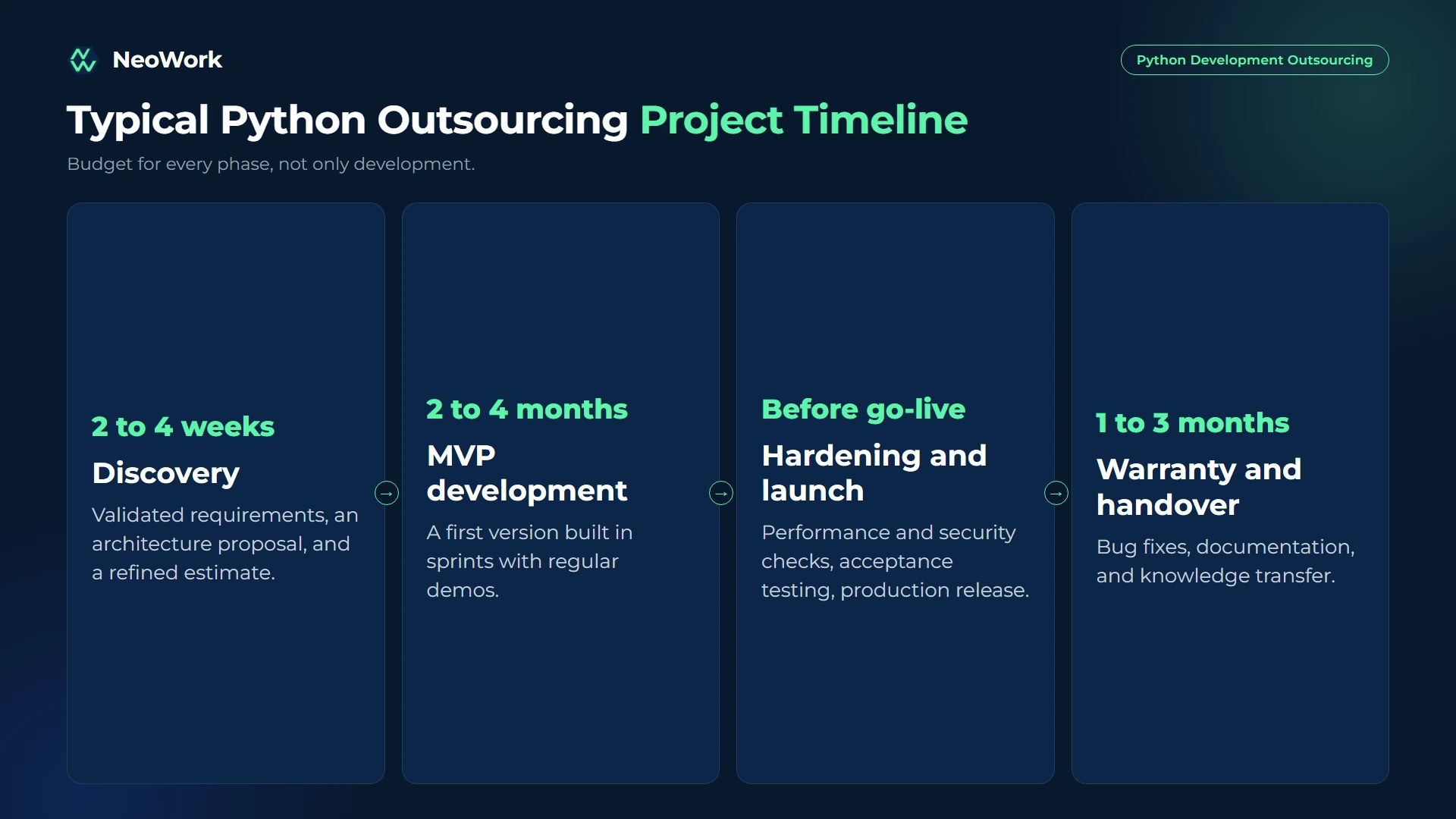
Most outsourced Python projects move through four phases. Discovery usually takes two to four weeks and produces validated requirements, an architecture proposal, and a refined estimate. Development of a first version or MVP often runs two to four months, with sprints and regular demos. Hardening and launch add performance and security checks, acceptance testing, and the production release. Finally, a warranty and handover period of one to three months covers bug fixes, documentation, and knowledge transfer.
Budgeting for every phase, not only development, is what keeps projects from ending with a working product that nobody on your side knows how to maintain.
When a vendor manages the team, you mainly see the work through demos and releases, which isn't enough to judge quality. Ask for read access to the repository and CI from day one, and have someone technical, internal or independent, review code, tests, and architecture every few weeks. Problems caught in month two are cheap; problems found after launch are not.
Quality problems in outsourced projects often trace back to missing engineering basics. Agree on these standards in the contract or statement of work, not after the first release:
Imagine a logistics company that wants to combine shipment data from several systems into one dashboard for operations managers. The internal team is small and busy with existing products, so the company outsources a first version to a Python vendor.
The project starts with a three-week discovery phase that maps data sources and agrees on the most important metrics. The vendor then builds ingestion pipelines, a cleaned data model, and an API that feeds the dashboard, with weekly demos for operations managers. Before launch, the internal team reviews the code, runs a handover workshop, and takes over monitoring. Later, the company adds two dedicated Python engineers to keep improving the platform, so the knowledge built during the project stays in-house.
Python development outsourcing can deliver products, data platforms, and AI features faster than building a team from scratch. It works best with a clear scope, the right engagement model, strong engineering practices, and full ownership of your code.
Ready to start? Shortlist two or three vendors, run a paid discovery phase, and decide based on the work you see, not the pitch you hear.

Quick Summary: Python development outsourcing means hiring an external company to build, test, or maintain Python software, such as web applications, APIs, data platforms, automation, or AI features, with the vendor managing its own team and delivering an agreed scope. Deloitte's 2024 Global Outsourcing Survey found that 80% of executives plan to maintain or increase investment in third-party outsourcing, with skilled talent now joining cost reduction as a key driver. This guide breaks down the main engagement models, how costs are structured, the benefits and risks side by side, how to choose a vendor, and how to manage an outsourced Python team well.
Python is often the first choice for new projects because it's fast to build with and covers so much ground: Django and FastAPI for web backends, Pandas and Airflow for data, PyTorch and scikit-learn for machine learning, and a fast-growing ecosystem for AI applications.
That popularity cuts both ways. There are thousands of vendors offering Python development, and their proposals often look alike. The projects that come out of them don't. This guide focuses on the decisions that separate the two.
Python development outsourcing is the practice of contracting an external company to deliver software written in Python. The vendor provides a team, typically a project manager, developers, QA, and sometimes designers or DevOps, and takes responsibility for delivering agreed outcomes.
It differs from Python team augmentation in who manages the work. With augmentation, engineers join your team and follow your direction. With outsourcing, the vendor runs its own team and process, while you provide requirements, feedback, and acceptance.
Python development outsourcing helps companies add capacity for backend, data, automation, and AI work without building every role in-house. At NeoWork, we provide dedicated Python engineers who work inside your repositories and processes, under your leadership, as an alternative to handing the whole project to a vendor. We handle recruitment, benefits, training, and ongoing engagement. Our industry-leading 91% annualized teammate retention rate and 3.2% candidate selectivity rate reflect our focus on selective hiring and long-term team stability.
Our Python development model offers:
Contact NeoWork to add Python capacity that fits your delivery process.
Pricing varies widely by region, seniority, and specialization, so any single number is misleading. Data, machine learning, and AI work usually costs more than standard web development because the skills are scarcer.
What stays fairly constant is the cost structure:
A tempting low quote that skips QA or maintenance almost always costs more later. Our pricing page shows how dedicated Python roles compare.
A vendor that builds great Django marketplaces isn't automatically good at data platforms or AI features. Ask for projects similar to yours in stack and domain.
Insist on meeting the architect and lead developers who will actually work on your project. Their answers tell you more than any pitch deck.
All code, models, and documentation should belong to your company, live in your repositories, and run in your cloud accounts where possible.
A short paid discovery phase validates requirements and architecture, and it shows how the vendor communicates before you commit to a large contract.
Before contacting vendors, it helps to check whether outsourcing suits the project at all. Outsourcing is usually a good fit when:
If the project is a core platform that will evolve indefinitely, or nobody can make product decisions, dedicated engineers who work under your leadership are often the better path.
Most outsourced Python projects move through four phases. Discovery usually takes two to four weeks and produces validated requirements, an architecture proposal, and a refined estimate. Development of a first version or MVP often runs two to four months, with sprints and regular demos. Hardening and launch add performance and security checks, acceptance testing, and the production release. Finally, a warranty and handover period of one to three months covers bug fixes, documentation, and knowledge transfer.
Budgeting for every phase, not only development, is what keeps projects from ending with a working product that nobody on your side knows how to maintain.
When a vendor manages the team, you mainly see the work through demos and releases, which isn't enough to judge quality. Ask for read access to the repository and CI from day one, and have someone technical, internal or independent, review code, tests, and architecture every few weeks. Problems caught in month two are cheap; problems found after launch are not.
Quality problems in outsourced projects often trace back to missing engineering basics. Agree on these standards in the contract or statement of work, not after the first release:
Imagine a logistics company that wants to combine shipment data from several systems into one dashboard for operations managers. The internal team is small and busy with existing products, so the company outsources a first version to a Python vendor.
The project starts with a three-week discovery phase that maps data sources and agrees on the most important metrics. The vendor then builds ingestion pipelines, a cleaned data model, and an API that feeds the dashboard, with weekly demos for operations managers. Before launch, the internal team reviews the code, runs a handover workshop, and takes over monitoring. Later, the company adds two dedicated Python engineers to keep improving the platform, so the knowledge built during the project stays in-house.
Python development outsourcing can deliver products, data platforms, and AI features faster than building a team from scratch. It works best with a clear scope, the right engagement model, strong engineering practices, and full ownership of your code.
Ready to start? Shortlist two or three vendors, run a paid discovery phase, and decide based on the work you see, not the pitch you hear.





