

.avif)
.avif)

Agile Team Augmentation Guide: Scale Sprints in 2026


.svg)

Quick Summary: Agile team augmentation means embedding external specialists directly into existing sprint teams to close skill gaps and add capacity, without handing over ownership of the product. Done right, it keeps backlog control, ceremonies, and delivery cadence in-house while borrowed talent plugs straight into the workflow. The model works best for short-to-medium term gaps, not for open-ended product ownership. This guide covers the process, the pitfalls, and how it compares to plain staff augmentation and outsourcing.
Sprint planning looks great on paper until someone points out there's no one available to build the payments integration, or the one engineer who understands the legacy API just gave notice. That's the moment most engineering leads start Googling staff augmentation guides at 11 p.m.
Agile team augmentation is the answer that shows up again and again, but it's often explained badly—either as generic outsourcing advice or as a sales pitch dressed up as a "strategic guide." This one skips the pitch. It walks through what the model actually is, when it makes sense, and how to fold augmented talent into a live sprint without wrecking velocity or morale.
What Is Agile Team Augmentation, Exactly?
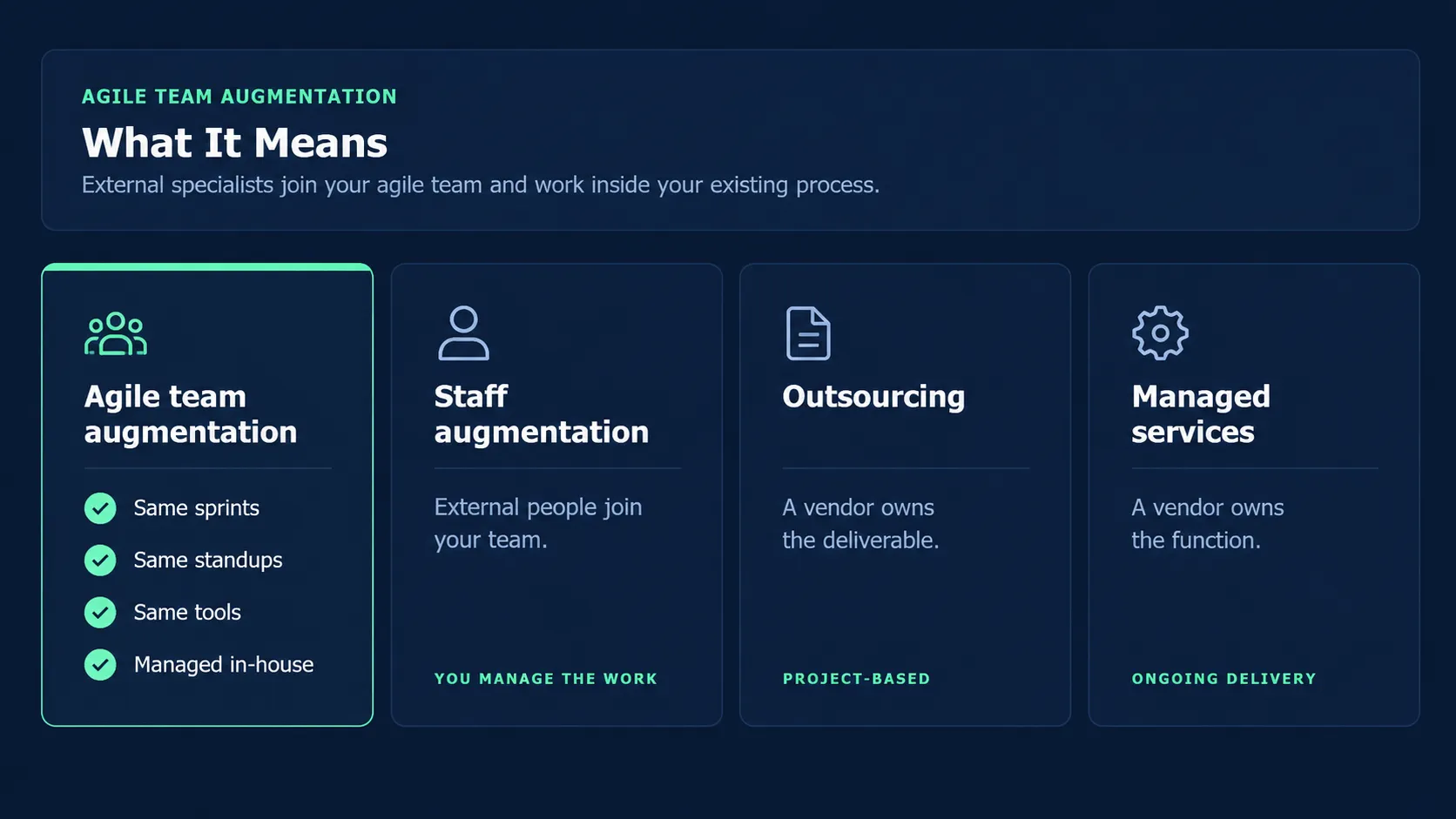
Agile team augmentation is a staffing model where external specialists join an existing agile team temporarily, working inside the same sprints, standups, and tools as the permanent crew. Unlike a separate outsourced squad, augmented staff report into the existing product owner and scrum master. They don't own a workstream in isolation—they sit inside one.
The distinction matters. Plain staff augmentation often just means "hire a contractor." Agile team augmentation specifically means that contractor gets absorbed into the agile rituals: sprint planning, backlog refinement, retros, the works. It's less about headcount and more about capacity that behaves like a native team member.
How It Differs from Outsourcing and Managed Services
Outsourcing typically hands an entire feature, module, or product to an external vendor who manages their own process. Managed services go further, taking on delivery accountability end to end. Team augmentation sits at the opposite end of that spectrum: control stays in-house, only the hands change.
When Does Team Augmentation Actually Make Sense?
Not every gap needs an augmented hire. Sometimes it's a training problem, sometimes it's a scope problem. Team augmentation earns its keep in a fairly specific set of situations.
- A niche skill (say, a particular ML framework or legacy mainframe language) is needed for a defined stretch of work.
- A launch date is fixed and the backlog is bigger than current velocity supports.
- Someone left mid-project and knowledge transfer needs a bridge, not a full rebuild.
- Leadership wants to test a new tech stack before committing to permanent headcount.
That last branch—work that isn't separable—is where augmentation shines. If the task depends on shared context, existing code, and daily back-and-forth with the product owner, splitting it off to a vendor usually backfires. Keeping it inside the sprint, staffed by a temporary specialist, tends to work better.
The Real Benefits (and the Ones That Get Oversold)
Vendors love to quote big percentage savings on cost or time. Those numbers vary wildly by region, role, and contract structure, so treat any specific figure with some skepticism unless it's tied to a named source. The more defensible benefits are structural.
- Faster ramp than hiring. Recruiting a permanent senior engineer can take months; an augmented specialist can often start within weeks.
- Lower commitment risk. No severance, no long-term benefits obligation, easier to scale down when the sprint backlog shrinks.
- Knowledge stays partly in-house. Because augmented staff work inside existing ceremonies, institutional knowledge transfers more naturally than with a black-box vendor team.
- Flexible capacity. Teams can flex up for a release push and flex back down after, which is much harder with permanent staff.
Where teams get burned is assuming augmentation fixes a broken process. It doesn't. Adding three contractors to a team with unclear backlog priorities just multiplies the confusion.

Expand Agile Delivery Capacity with NeoWork
Agile team augmentation helps companies add remote professionals to existing product, engineering, and operational teams without changing core workflows. NeoWork provides teammates across software development, data, cloud, support, and related functions. NeoWork handles recruitment, benefits, training, and ongoing engagement, while teammates integrate into the client’s systems, tools, and sprint processes. Its 91% annualized teammate retention rate and 3.2% candidate selectivity rate reflect a focus on selective hiring and longer-term team stability.
NeoWork's agile team augmentation model offers:
- remote professionals for agile teams
- integration with the client’s tools and processes
- recruitment and ongoing teammate support
Contact NeoWork to add capacity to your agile team without disrupting existing delivery workflows.
A Step-by-Step Process for Integrating Augmented Talent
Most failures in this model trace back to onboarding, not skill. Here's a sequence that holds up across most agile setups.
Step 1: Define the Gap Precisely
Vague requests like "we need a senior developer" produce vague results. Specify the tech stack, the sprint role (is this a full team member or a specialist consultant?), and the expected duration.
Step 2: Pre-Wire Access and Tooling
Before day one, make sure repo access, ticketing tools, and communication channels are ready. Nothing kills first-week velocity faster than a new team member waiting three days for VPN credentials.
Step 3: Run a Real Onboarding Sprint
Treat the first sprint as partial capacity, not full. Pair the new hire with an existing team member, walk through the codebase, and let them take on smaller tickets before the big ones.
Step 4: Fold Them Into Every Ceremony
Standups, retros, backlog grooming—all of it. Skipping ceremonies to "save time" is exactly how augmented staff end up isolated from context and shipping the wrong thing.
Step 5: Review and Adjust Scope Monthly
Team augmentation contracts shouldn't run on autopilot. A monthly check-in on scope, velocity contribution, and fit keeps the arrangement honest.
Best Practices That Separate Smooth Integrations from Messy Ones
A few habits consistently show up in teams that get this right.
- Keep the product owner in charge of priority. Augmented staff should never be setting backlog priority independently—that's a fast track to scope drift.
- Overlap time zones deliberately. Even a two-hour daily overlap window prevents the classic "answer arrives 12 hours later" bottleneck.
- Document decisions, not just code. Augmented team members leave eventually. Written context outlives them.
- Set a clear exit plan from day one. Know in advance whether the role converts to permanent, extends, or wraps up—ambiguity here breeds anxiety and turnover.
Common Challenges (and Honest Fixes)
Choosing a Partner or Contractor: What Actually Matters
Portfolio size and logo walls look impressive but predict little about day-to-day fit. More useful signals: how quickly a candidate can explain a past agile team's sprint structure, whether they've worked inside client tooling before (versus only their own internal stack), and how they handle a trial ticket assigned before signing anything longer-term.
A short paid trial—one or two sprints—reveals more about fit than any resume. It costs a little more upfront but saves months of mismatch later.

Wrapping Up
Agile team augmentation isn't a silver bullet, and it's not just a fancier name for hiring a contractor either. It's a specific way of closing gaps—skill gaps, capacity gaps, timeline gaps—while keeping ownership of the product exactly where it already lives. The model rewards teams that plan onboarding carefully, keep ceremonies intact, and review scope regularly instead of letting engagements drift.
Before reaching for augmentation, get clear on the actual gap, map it against the decision flow above, and set an exit plan before day one. That's the difference between a smooth six-week sprint boost and a messy six-month entanglement.
FAQ: Agile Team Augmentation
Topics
Agile Team Augmentation Guide: Scale Sprints in 2026

Quick Summary: Agile team augmentation means embedding external specialists directly into existing sprint teams to close skill gaps and add capacity, without handing over ownership of the product. Done right, it keeps backlog control, ceremonies, and delivery cadence in-house while borrowed talent plugs straight into the workflow. The model works best for short-to-medium term gaps, not for open-ended product ownership. This guide covers the process, the pitfalls, and how it compares to plain staff augmentation and outsourcing.
Sprint planning looks great on paper until someone points out there's no one available to build the payments integration, or the one engineer who understands the legacy API just gave notice. That's the moment most engineering leads start Googling staff augmentation guides at 11 p.m.
Agile team augmentation is the answer that shows up again and again, but it's often explained badly—either as generic outsourcing advice or as a sales pitch dressed up as a "strategic guide." This one skips the pitch. It walks through what the model actually is, when it makes sense, and how to fold augmented talent into a live sprint without wrecking velocity or morale.
What Is Agile Team Augmentation, Exactly?
Agile team augmentation is a staffing model where external specialists join an existing agile team temporarily, working inside the same sprints, standups, and tools as the permanent crew. Unlike a separate outsourced squad, augmented staff report into the existing product owner and scrum master. They don't own a workstream in isolation—they sit inside one.
The distinction matters. Plain staff augmentation often just means "hire a contractor." Agile team augmentation specifically means that contractor gets absorbed into the agile rituals: sprint planning, backlog refinement, retros, the works. It's less about headcount and more about capacity that behaves like a native team member.
How It Differs from Outsourcing and Managed Services
Outsourcing typically hands an entire feature, module, or product to an external vendor who manages their own process. Managed services go further, taking on delivery accountability end to end. Team augmentation sits at the opposite end of that spectrum: control stays in-house, only the hands change.
When Does Team Augmentation Actually Make Sense?
Not every gap needs an augmented hire. Sometimes it's a training problem, sometimes it's a scope problem. Team augmentation earns its keep in a fairly specific set of situations.
- A niche skill (say, a particular ML framework or legacy mainframe language) is needed for a defined stretch of work.
- A launch date is fixed and the backlog is bigger than current velocity supports.
- Someone left mid-project and knowledge transfer needs a bridge, not a full rebuild.
- Leadership wants to test a new tech stack before committing to permanent headcount.
That last branch—work that isn't separable—is where augmentation shines. If the task depends on shared context, existing code, and daily back-and-forth with the product owner, splitting it off to a vendor usually backfires. Keeping it inside the sprint, staffed by a temporary specialist, tends to work better.
The Real Benefits (and the Ones That Get Oversold)
Vendors love to quote big percentage savings on cost or time. Those numbers vary wildly by region, role, and contract structure, so treat any specific figure with some skepticism unless it's tied to a named source. The more defensible benefits are structural.
- Faster ramp than hiring. Recruiting a permanent senior engineer can take months; an augmented specialist can often start within weeks.
- Lower commitment risk. No severance, no long-term benefits obligation, easier to scale down when the sprint backlog shrinks.
- Knowledge stays partly in-house. Because augmented staff work inside existing ceremonies, institutional knowledge transfers more naturally than with a black-box vendor team.
- Flexible capacity. Teams can flex up for a release push and flex back down after, which is much harder with permanent staff.
Where teams get burned is assuming augmentation fixes a broken process. It doesn't. Adding three contractors to a team with unclear backlog priorities just multiplies the confusion.
Expand Agile Delivery Capacity with NeoWork
Agile team augmentation helps companies add remote professionals to existing product, engineering, and operational teams without changing core workflows. NeoWork provides teammates across software development, data, cloud, support, and related functions. NeoWork handles recruitment, benefits, training, and ongoing engagement, while teammates integrate into the client’s systems, tools, and sprint processes. Its 91% annualized teammate retention rate and 3.2% candidate selectivity rate reflect a focus on selective hiring and longer-term team stability.
NeoWork's agile team augmentation model offers:
- remote professionals for agile teams
- integration with the client’s tools and processes
- recruitment and ongoing teammate support
Contact NeoWork to add capacity to your agile team without disrupting existing delivery workflows.
A Step-by-Step Process for Integrating Augmented Talent
Most failures in this model trace back to onboarding, not skill. Here's a sequence that holds up across most agile setups.
Step 1: Define the Gap Precisely
Vague requests like "we need a senior developer" produce vague results. Specify the tech stack, the sprint role (is this a full team member or a specialist consultant?), and the expected duration.
Step 2: Pre-Wire Access and Tooling
Before day one, make sure repo access, ticketing tools, and communication channels are ready. Nothing kills first-week velocity faster than a new team member waiting three days for VPN credentials.
Step 3: Run a Real Onboarding Sprint
Treat the first sprint as partial capacity, not full. Pair the new hire with an existing team member, walk through the codebase, and let them take on smaller tickets before the big ones.
Step 4: Fold Them Into Every Ceremony
Standups, retros, backlog grooming—all of it. Skipping ceremonies to "save time" is exactly how augmented staff end up isolated from context and shipping the wrong thing.
Step 5: Review and Adjust Scope Monthly
Team augmentation contracts shouldn't run on autopilot. A monthly check-in on scope, velocity contribution, and fit keeps the arrangement honest.
Best Practices That Separate Smooth Integrations from Messy Ones
A few habits consistently show up in teams that get this right.
- Keep the product owner in charge of priority. Augmented staff should never be setting backlog priority independently—that's a fast track to scope drift.
- Overlap time zones deliberately. Even a two-hour daily overlap window prevents the classic "answer arrives 12 hours later" bottleneck.
- Document decisions, not just code. Augmented team members leave eventually. Written context outlives them.
- Set a clear exit plan from day one. Know in advance whether the role converts to permanent, extends, or wraps up—ambiguity here breeds anxiety and turnover.
Common Challenges (and Honest Fixes)
Choosing a Partner or Contractor: What Actually Matters
Portfolio size and logo walls look impressive but predict little about day-to-day fit. More useful signals: how quickly a candidate can explain a past agile team's sprint structure, whether they've worked inside client tooling before (versus only their own internal stack), and how they handle a trial ticket assigned before signing anything longer-term.
A short paid trial—one or two sprints—reveals more about fit than any resume. It costs a little more upfront but saves months of mismatch later.
Wrapping Up
Agile team augmentation isn't a silver bullet, and it's not just a fancier name for hiring a contractor either. It's a specific way of closing gaps—skill gaps, capacity gaps, timeline gaps—while keeping ownership of the product exactly where it already lives. The model rewards teams that plan onboarding carefully, keep ceremonies intact, and review scope regularly instead of letting engagements drift.
Before reaching for augmentation, get clear on the actual gap, map it against the decision flow above, and set an exit plan before day one. That's the difference between a smooth six-week sprint boost and a messy six-month entanglement.
FAQ: Agile Team Augmentation
Topics
Related Blogs
Related Podcasts


.webp)

.webp)
.webp)



