
.avif)
.avif)

AI Customer Support Outsourcing Guide 2026


.svg)

AI customer support outsourcing combines artificial intelligence technology with external service providers to deliver scalable, cost-effective customer service. Businesses can achieve 40-60% cost savings while maintaining 24/7 availability, though success requires balancing automation with human expertise and careful provider selection.
The customer service landscape has transformed dramatically. What used to require dozens of support agents now runs partially on algorithms and machine learning. And it's not just about replacing humans—it's about rethinking the entire support model.
According to the International Journal of Engineering Research & Technology, tech giants such as Google and Baidu spent an estimated $20 billion to $30 billion on AI in 2016. Investment in AI startups grew to $15.2 billion globally in 2017, with nearly half (48 percent) going to China and 38 percent to the United States. The question isn't whether to adopt AI in customer support anymore. It's how to do it without losing what makes service actually work.
Here's the thing though—outsourcing customer support while integrating AI creates complexities most companies don't anticipate. The right approach can slash costs by 40-60% compared to in-house operations, based on Gartner research. The wrong approach creates a disconnected experience that drives customers away faster than bad hold music.
Understanding AI Customer Support Outsourcing
AI customer support outsourcing merges two distinct strategies: leveraging artificial intelligence tools and partnering with external service providers. The combination creates a hybrid model where automation handles routine inquiries while skilled agents tackle complex issues.
The technology stack typically includes natural language processing (NLP), machine learning algorithms, and sentiment analysis tools. These work together to understand customer inquiries, process requests, and generate appropriate responses. But technology alone doesn't define the model.
Outsourcing introduces a third-party provider who manages the infrastructure, staffing, and often the AI implementation itself. The provider becomes responsible for maintaining service levels, training both AI systems and human agents, and scaling operations based on demand.
Real talk: this isn't a set-it-and-forget-it solution. Community discussions frequently highlight frustration when businesses treat AI outsourcing as a cost-cutting exercise without considering service quality. The most successful implementations treat it as a strategic partnership requiring active management and ongoing refinement.
Why Businesses Are Embracing This Hybrid Model
Cost reduction drives most initial interest. According to a Deloitte study, 59% of companies outsource primarily to cut costs. When AI enters the equation, the savings compound—AI reduces the need for large support teams while outsourcing lowers labor costs through geographic arbitrage and specialized efficiency.
But wait. Cost savings tell only part of the story.
The shift toward results-based pricing models shows how the industry has matured. In 2025, 68% of new call center agreements utilize results-based pricing, up from just 23% five years earlier. This shift transfers risk to providers and aligns incentives around actual performance rather than just hours logged.
Scalability matters more than most companies realize initially. Seasonal businesses or those experiencing rapid growth can't afford to hire and train support staff months in advance. Outsourced AI-enabled support flexes with demand, spinning up additional capacity within days rather than quarters.
The Federal Trade Commission has emphasized privacy and data security in AI applications. When evaluating outsourcing partners, businesses must ensure providers uphold privacy commitments and maintain confidentiality, particularly when handling sensitive customer information.
How AI Transforms Customer Interactions
Natural language processing enables AI to understand customer inquiries in conversational language rather than requiring specific keywords or phrases. Modern systems parse intent, identify sentiment, and route requests appropriately—all within milliseconds.
Machine learning algorithms improve continuously by analyzing past interactions. An AI system learns which responses resolve issues effectively and which create confusion requiring human escalation. Over time, containment rates increase as the system recognizes and handles more scenarios independently.
Sentiment analysis adds an emotional intelligence layer. When a customer uses language indicating frustration or anger, the system can automatically escalate to a human agent rather than attempting automated resolution. This prevents the common failure mode where customers get trapped in chatbot loops while angry.
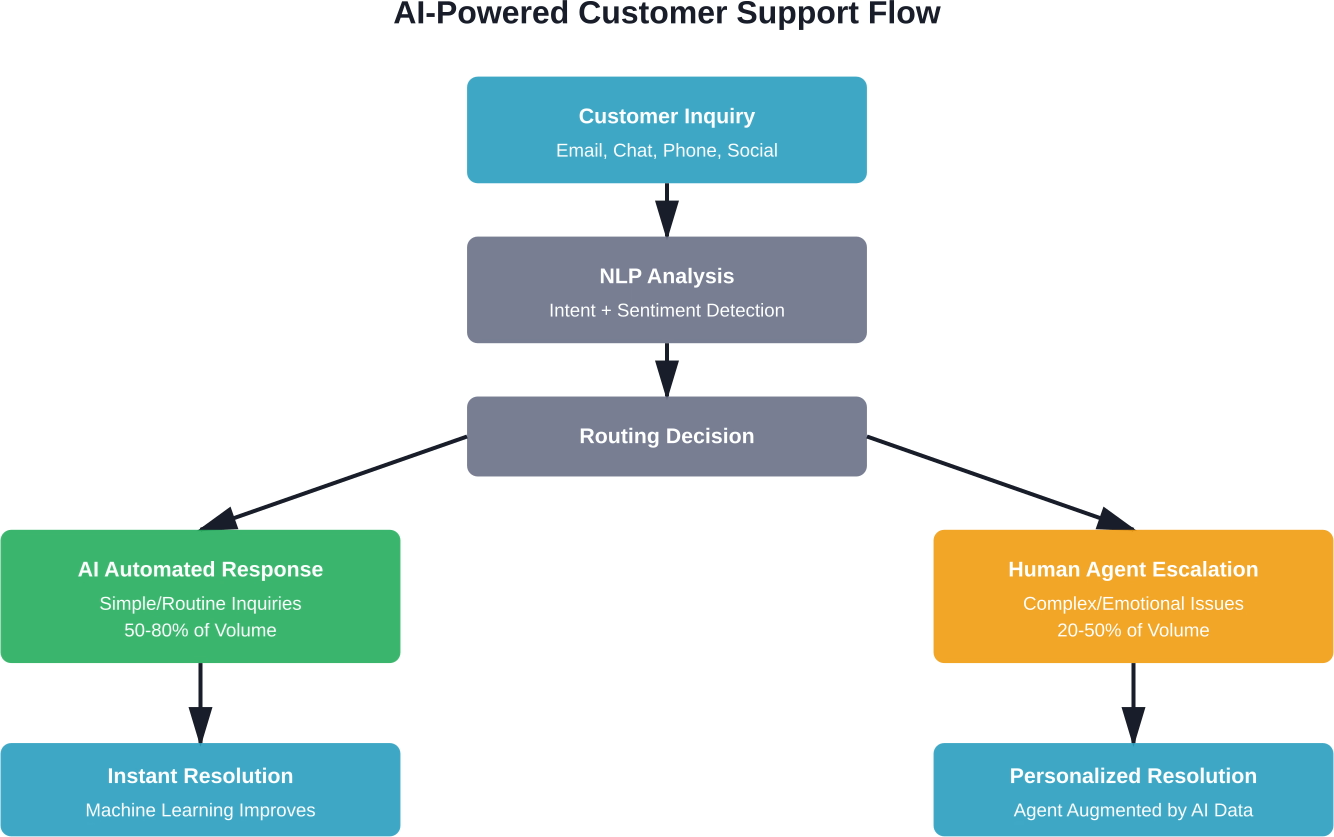
Setting realistic expectations matters enormously. According to industry experts, if AI handles 30–50% of predictable volume while meaningfully improving agent performance on complex issues, that's considered successful. According to Reddit discussions on customer support outsourcing, users note that "AI is great but humans still want to talk to humans when they are frustrated about something."
The Tiered Support Model That Actually Works
The most effective approach treats AI and humans as complementary tiers rather than competitors. AI handles Tier 1 support—password resets, order status checks, basic FAQs, account updates. This frees human agents to focus on Tier 2 and beyond.
Tier 2 involves troubleshooting, complaints, returns, and scenarios requiring judgment calls. These benefit from human empathy, creative problem-solving, and the ability to make exceptions based on customer history. AI supports these interactions by surfacing relevant data, suggesting solutions, and documenting outcomes.
This division maximizes the strengths of both. AI provides speed, consistency, and infinite patience for repetitive questions. Humans provide empathy, flexibility, and the ability to handle novel situations requiring real thinking.
Now, this is where it gets interesting. The best outsourcing providers train agents to work alongside AI rather than viewing it as a threat. Agents receive real-time suggestions during calls, automatic access to customer history, and predictive prompts about likely next questions. The AI becomes a performance multiplier rather than a replacement.
Measuring Success: Beyond Traditional ROI
Berkeley's Executive Education program recently challenged the obsession with ROI when measuring AI success. Their 2025 analysis suggests organizations focus too narrowly on revenue increases while missing equally important metrics.
Return on Efficiency (ROE) measures time savings and productivity gains. When a support team reduces average handling time from 8 minutes to 5 minutes per inquiry, that efficiency compounds across thousands of interactions. The saved time allows the same team to handle higher volume or focus on complex cases requiring more attention.
Key performance indicators for AI customer support outsourcing should include:
The Controllers Council's 2026 report on AI ROI evaluation warns CFOs against falling into hype cycles. Organizations should validate business cases with realistic projections, not aspirational vendor promises. Measure current performance thoroughly before implementation to establish accurate baselines.
MIT's report, titled "The GenAI Divide: State of AI in Business 2025," found that 95% of organizations studied are seeing zero return on their AI initiatives despite $30-40 billion in enterprise investment. That stat should give everyone pause. The failures typically stem from unrealistic expectations, poor implementation planning, and inadequate change management—not technology limitations.
Selecting the Right Outsourcing Provider
Provider selection determines whether AI customer support outsourcing succeeds or becomes an expensive distraction. Not all providers offer equivalent capabilities, and mismatches between business needs and provider strengths create predictable problems.
Technical capabilities matter first. Does the provider use modern NLP and machine learning, or are they relying on basic chatbot scripts? Can their systems integrate with existing CRM platforms, ticketing systems, and knowledge bases? How quickly can they deploy and train models on company-specific data?
Industry experience shouldn't be overlooked. Providers specializing in e-commerce support understand product questions, shipping inquiries, and return processes. Those focused on SaaS companies excel at technical troubleshooting and onboarding. Generic providers may cost less but require significantly more training and oversight.
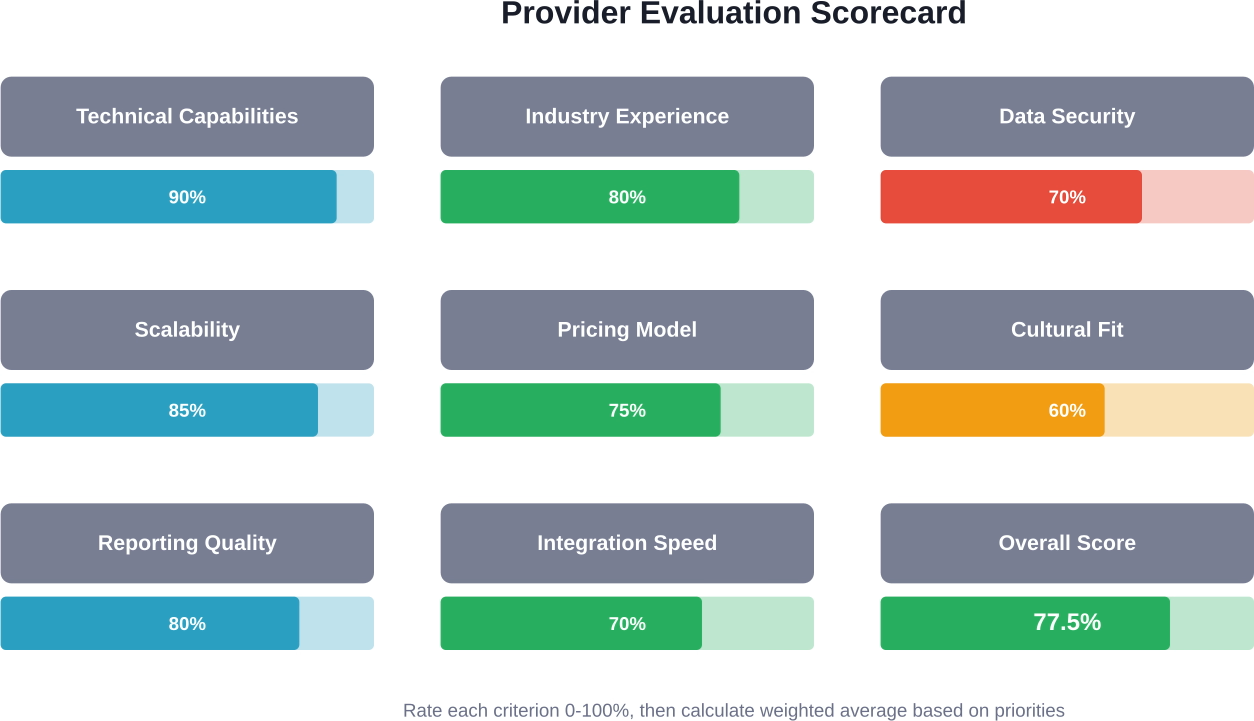
Data security and compliance can't be treated as checkboxes. The FTC actively enforces privacy violations, particularly regarding AI systems handling consumer data. Providers must demonstrate SOC 2 compliance at minimum, with GDPR readiness for international operations and HIPAA compliance where health information is involved.
Pricing models have shifted toward performance-based structures, but transparency remains critical. Understand what's included in base pricing versus add-ons. Some providers charge separately for AI implementation, custom integrations, or advanced analytics. Others bundle everything but limit volume or channels.
Cultural fit determines day-to-day collaboration quality. Providers with rigid processes may struggle to adapt to evolving business needs. Those with collaborative approaches treat the relationship as a partnership rather than a vendor transaction.
Implementation: Getting the Launch Right
Implementation follows a predictable path when done well. It starts with baseline measurement—documenting current performance across all key metrics before changing anything. This creates the comparison point for measuring improvement later.
Knowledge base development comes next. AI systems require comprehensive, structured information to provide accurate responses. Many companies discover their existing documentation is outdated, incomplete, or organized illogically. Fixing this benefits both AI and human agents.
The short answer? Start narrow and expand gradually. Launch AI support for one product line, one channel, or one type of inquiry. Monitor performance obsessively. Collect feedback from both customers and agents. Refine the system based on what actually happens, not what was expected to happen.
Parallel running reduces risk during the transition. Keep existing support channels fully operational while introducing AI-enabled outsourced support alongside them. This allows real-time comparison and provides a fallback if issues emerge.
Training agents on AI collaboration deserves significant attention. Agents need to understand when to trust AI suggestions versus when to override them. They should know how to provide feedback that improves the system. And they must feel empowered to escalate when AI clearly isn't working in a specific scenario.
Common Implementation Challenges and Solutions
Integration complexity catches many businesses off guard. AI systems need to connect with CRM platforms, inventory management systems, order processing software, and knowledge bases. Each integration introduces potential failure points and requires ongoing maintenance.
Solution: prioritize integrations based on impact. Start with the customer-facing systems that enable the most common inquiries. Add secondary integrations after core functionality proves stable.
Brand voice inconsistency emerges when AI responses don't match company communication style. A formal enterprise software company sounds jarring when its chatbot uses casual language with emoji. A youth-focused brand seems stuffy when AI responses are overly formal.
Solution: develop comprehensive tone guidelines and provide extensive training examples. Review AI responses regularly and refine prompts to align with brand standards. Some providers offer voice customization as part of their AI training process.
Agent resistance happens when human support staff view AI as a threat to their jobs rather than a tool enhancing their work. This creates passive resistance—agents who don't provide quality feedback for AI improvement or who actively undermine the technology.
Solution: communicate honestly about how roles will evolve. In practice, AI typically enables teams to handle higher volume with existing headcount rather than triggering layoffs. Position AI as eliminating tedious repetitive work, allowing agents to focus on interesting problem-solving.
Data quality issues surface quickly. AI systems trained on inaccurate information provide inaccurate responses. Garbage in, garbage out applies fully to customer support AI.
Solution: audit knowledge bases thoroughly before AI training. Implement quality control processes for ongoing content updates. Monitor AI responses for accuracy and correct errors promptly.
Regulatory Considerations and Compliance
The Federal Trade Commission (FTC) launched 'Operation AI Comply' in September 2024 and demonstrated active oversight of AI applications affecting consumers.
Organizations deploying AI customer support must ensure transparency about when customers interact with AI versus humans. Deceptive practices include representing AI responses as coming from human agents or failing to disclose AI usage when it materially affects the interaction.
Privacy regulations apply fully to AI systems. The FTC's Health Breach Notification Rule extends beyond HIPAA-covered entities, affecting any company collecting consumer health information through AI support channels. Financial services face additional requirements under sector-specific regulations.
IEEE standards provide guidance on responsible AI procurement and deployment. Their technical standards address autonomous and intelligent systems, emphasizing the importance of regulatory compliance in AI sourcing strategies. Organizations should consider these frameworks when establishing AI governance policies.
Data residency requirements affect outsourcing decisions. Some jurisdictions mandate that customer data remain within specific geographic boundaries. Providers with globally distributed operations may not meet these requirements without significant architectural changes.
The Future of AI Customer Support Outsourcing
Generative AI capabilities continue advancing rapidly. Systems that currently handle structured inquiries will increasingly manage complex, nuanced conversations requiring context awareness and creative problem-solving. But does that actually work reliably today? Not consistently.
The trend toward hybrid models will accelerate rather than reverse. Pure AI support creates customer frustration when complexity exceeds system capabilities. Pure human support becomes economically unsustainable as volume scales. The optimal balance point shifts as technology improves, but the hybrid approach persists.
Proactive support enabled by predictive AI represents the next frontier. Instead of waiting for customers to contact support, systems identify potential issues and reach out preemptively. An order delayed in shipping triggers automatic communication before the customer notices. A technical error affecting multiple users generates targeted outreach to those impacted.
Voice AI improving rapidly changes call center dynamics. Natural-sounding AI voices that understand context and handle interruptions are approaching human parity for structured conversations. This expands AI applicability beyond text-based channels into phone support.
Emotional intelligence in AI systems remains limited but developing. Current sentiment analysis detects obvious frustration or anger. Future systems may recognize subtle emotional cues and adjust responses accordingly, approximating the empathy human agents provide naturally.
Cost Analysis: Real Numbers
Understanding total costs requires looking beyond headline pricing. Gartner research indicates outsourcing saves 40-60% compared to in-house operations, but implementation costs, integration expenses, and ongoing management overhead reduce net savings.
Hidden costs deserve scrutiny. Integration complexity may require development resources not included in provider quotes. Customization requests often trigger professional services fees. Volume overages can dramatically increase per-contact costs if traffic exceeds projections.
The Controllers Council recommends building 15-20% contingency into AI project budgets to account for unexpected requirements. Organizations consistently underestimate integration effort and overestimate out-of-box functionality.
Maintaining Quality While Scaling
Quality degrades predictably during rapid scaling unless actively managed. New agents require time to develop expertise. AI systems exposed to higher volume encounter edge cases not present in training data. Processes optimized for small teams break under larger loads.
Quality assurance programs must scale alongside operations. This includes regular call monitoring, customer satisfaction surveys, agent performance reviews, and AI accuracy audits. Providers should demonstrate QA processes during selection, not just promise quality in contracts.
Continuous improvement processes separate good providers from mediocre ones. Look for structured approaches to collecting feedback, identifying improvement opportunities, implementing changes, and measuring results. Ad hoc improvement efforts rarely deliver sustained gains.
Customer feedback loops provide ground truth about service quality. CSAT scores, NPS ratings, and direct comments reveal what's actually happening at the front lines. Organizations should insist on transparent access to this data, not filtered summaries showing only positive results.

Build an AI-Ready Support Team with NeoWork
AI customer support works best when the human layer is stable and trained to operate inside your systems. NeoWork builds dedicated remote support teams that work alongside AI tools, from automated chat to ticket routing and escalation workflows. With a 91% annualized teammate retention rate and a 3.2% candidate selectivity rate, the model focuses on long term team stability and careful hiring, not constant turnover.
If you want AI support that scales without breaking under growth, build it on a team that stays. Connect with NeoWork and set up a support structure designed to last.
Making the Decision: Is AI Customer Support Outsourcing Right?
Not every business benefits equally from AI customer support outsourcing. Companies with highly complex, technical products requiring deep expertise may struggle with outsourced support even with AI augmentation. Those with primarily simple, repetitive inquiries gain maximum benefit.
Volume matters significantly. Businesses handling fewer than 500 support interactions monthly probably don't justify AI implementation complexity. Those managing thousands of inquiries daily see ROI quickly.
Growth trajectory influences timing. Rapidly growing companies benefit from outsourcing's scalability but need providers who can maintain quality during expansion. Stable businesses may prioritize cost optimization over flexibility.
Brand differentiation through service quality argues against aggressive automation. If exceptional support represents a competitive advantage and brand pillar, maintaining direct control through in-house teams makes strategic sense. If support is purely cost center table stakes, outsourcing becomes more attractive.
Technical capabilities within the organization affect implementation success. Companies with strong IT teams can handle integration challenges and customize systems extensively. Those lacking technical depth need providers offering comprehensive implementation support and simpler, more standardized solutions.
Conclusion
AI customer support outsourcing represents a fundamental shift in how businesses deliver service, not just an incremental improvement. The combination of intelligent automation and specialized external expertise creates capabilities no single organization can easily replicate internally.
Success requires treating this as a strategic partnership rather than a tactical cost reduction. The providers who understand the business context, adapt to evolving needs, and transparently share performance data become genuine extensions of the team. Those viewing the relationship purely transactionally create friction and suboptimal results.
The technology continues improving rapidly, but current capabilities already deliver substantial value when implemented thoughtfully. Organizations waiting for perfect AI miss opportunities to improve service quality and operational efficiency today.
Start with clear objectives tied to business outcomes, not technology for its own sake. Measure rigorously from the beginning. Expect a learning curve during implementation. And maintain realistic expectations about what AI can and cannot handle.
The future of customer support isn't purely automated or purely human—it's intelligently hybrid. Organizations that embrace this reality and execute well will deliver superior experiences at sustainable costs. Those clinging to old models or chasing unrealistic automation promises will struggle to compete.
Ready to explore AI customer support outsourcing for your business? Begin by documenting current performance metrics, identifying pain points in existing operations, and defining specific outcomes the initiative should achieve. Then start conversations with providers who demonstrate relevant industry experience and technical capabilities aligned with your requirements.
Frequently Asked Questions
Topics
AI Customer Support Outsourcing Guide 2026

AI customer support outsourcing combines artificial intelligence technology with external service providers to deliver scalable, cost-effective customer service. Businesses can achieve 40-60% cost savings while maintaining 24/7 availability, though success requires balancing automation with human expertise and careful provider selection.
The customer service landscape has transformed dramatically. What used to require dozens of support agents now runs partially on algorithms and machine learning. And it's not just about replacing humans—it's about rethinking the entire support model.
According to the International Journal of Engineering Research & Technology, tech giants such as Google and Baidu spent an estimated $20 billion to $30 billion on AI in 2016. Investment in AI startups grew to $15.2 billion globally in 2017, with nearly half (48 percent) going to China and 38 percent to the United States. The question isn't whether to adopt AI in customer support anymore. It's how to do it without losing what makes service actually work.
Here's the thing though—outsourcing customer support while integrating AI creates complexities most companies don't anticipate. The right approach can slash costs by 40-60% compared to in-house operations, based on Gartner research. The wrong approach creates a disconnected experience that drives customers away faster than bad hold music.
Understanding AI Customer Support Outsourcing
AI customer support outsourcing merges two distinct strategies: leveraging artificial intelligence tools and partnering with external service providers. The combination creates a hybrid model where automation handles routine inquiries while skilled agents tackle complex issues.
The technology stack typically includes natural language processing (NLP), machine learning algorithms, and sentiment analysis tools. These work together to understand customer inquiries, process requests, and generate appropriate responses. But technology alone doesn't define the model.
Outsourcing introduces a third-party provider who manages the infrastructure, staffing, and often the AI implementation itself. The provider becomes responsible for maintaining service levels, training both AI systems and human agents, and scaling operations based on demand.
Real talk: this isn't a set-it-and-forget-it solution. Community discussions frequently highlight frustration when businesses treat AI outsourcing as a cost-cutting exercise without considering service quality. The most successful implementations treat it as a strategic partnership requiring active management and ongoing refinement.
Why Businesses Are Embracing This Hybrid Model
Cost reduction drives most initial interest. According to a Deloitte study, 59% of companies outsource primarily to cut costs. When AI enters the equation, the savings compound—AI reduces the need for large support teams while outsourcing lowers labor costs through geographic arbitrage and specialized efficiency.
But wait. Cost savings tell only part of the story.
The shift toward results-based pricing models shows how the industry has matured. In 2025, 68% of new call center agreements utilize results-based pricing, up from just 23% five years earlier. This shift transfers risk to providers and aligns incentives around actual performance rather than just hours logged.
Scalability matters more than most companies realize initially. Seasonal businesses or those experiencing rapid growth can't afford to hire and train support staff months in advance. Outsourced AI-enabled support flexes with demand, spinning up additional capacity within days rather than quarters.
The Federal Trade Commission has emphasized privacy and data security in AI applications. When evaluating outsourcing partners, businesses must ensure providers uphold privacy commitments and maintain confidentiality, particularly when handling sensitive customer information.
How AI Transforms Customer Interactions
Natural language processing enables AI to understand customer inquiries in conversational language rather than requiring specific keywords or phrases. Modern systems parse intent, identify sentiment, and route requests appropriately—all within milliseconds.
Machine learning algorithms improve continuously by analyzing past interactions. An AI system learns which responses resolve issues effectively and which create confusion requiring human escalation. Over time, containment rates increase as the system recognizes and handles more scenarios independently.
Sentiment analysis adds an emotional intelligence layer. When a customer uses language indicating frustration or anger, the system can automatically escalate to a human agent rather than attempting automated resolution. This prevents the common failure mode where customers get trapped in chatbot loops while angry.
Setting realistic expectations matters enormously. According to industry experts, if AI handles 30–50% of predictable volume while meaningfully improving agent performance on complex issues, that's considered successful. According to Reddit discussions on customer support outsourcing, users note that "AI is great but humans still want to talk to humans when they are frustrated about something."
The Tiered Support Model That Actually Works
The most effective approach treats AI and humans as complementary tiers rather than competitors. AI handles Tier 1 support—password resets, order status checks, basic FAQs, account updates. This frees human agents to focus on Tier 2 and beyond.
Tier 2 involves troubleshooting, complaints, returns, and scenarios requiring judgment calls. These benefit from human empathy, creative problem-solving, and the ability to make exceptions based on customer history. AI supports these interactions by surfacing relevant data, suggesting solutions, and documenting outcomes.
This division maximizes the strengths of both. AI provides speed, consistency, and infinite patience for repetitive questions. Humans provide empathy, flexibility, and the ability to handle novel situations requiring real thinking.
Now, this is where it gets interesting. The best outsourcing providers train agents to work alongside AI rather than viewing it as a threat. Agents receive real-time suggestions during calls, automatic access to customer history, and predictive prompts about likely next questions. The AI becomes a performance multiplier rather than a replacement.
Measuring Success: Beyond Traditional ROI
Berkeley's Executive Education program recently challenged the obsession with ROI when measuring AI success. Their 2025 analysis suggests organizations focus too narrowly on revenue increases while missing equally important metrics.
Return on Efficiency (ROE) measures time savings and productivity gains. When a support team reduces average handling time from 8 minutes to 5 minutes per inquiry, that efficiency compounds across thousands of interactions. The saved time allows the same team to handle higher volume or focus on complex cases requiring more attention.
Key performance indicators for AI customer support outsourcing should include:
The Controllers Council's 2026 report on AI ROI evaluation warns CFOs against falling into hype cycles. Organizations should validate business cases with realistic projections, not aspirational vendor promises. Measure current performance thoroughly before implementation to establish accurate baselines.
MIT's report, titled "The GenAI Divide: State of AI in Business 2025," found that 95% of organizations studied are seeing zero return on their AI initiatives despite $30-40 billion in enterprise investment. That stat should give everyone pause. The failures typically stem from unrealistic expectations, poor implementation planning, and inadequate change management—not technology limitations.
Selecting the Right Outsourcing Provider
Provider selection determines whether AI customer support outsourcing succeeds or becomes an expensive distraction. Not all providers offer equivalent capabilities, and mismatches between business needs and provider strengths create predictable problems.
Technical capabilities matter first. Does the provider use modern NLP and machine learning, or are they relying on basic chatbot scripts? Can their systems integrate with existing CRM platforms, ticketing systems, and knowledge bases? How quickly can they deploy and train models on company-specific data?
Industry experience shouldn't be overlooked. Providers specializing in e-commerce support understand product questions, shipping inquiries, and return processes. Those focused on SaaS companies excel at technical troubleshooting and onboarding. Generic providers may cost less but require significantly more training and oversight.
Data security and compliance can't be treated as checkboxes. The FTC actively enforces privacy violations, particularly regarding AI systems handling consumer data. Providers must demonstrate SOC 2 compliance at minimum, with GDPR readiness for international operations and HIPAA compliance where health information is involved.
Pricing models have shifted toward performance-based structures, but transparency remains critical. Understand what's included in base pricing versus add-ons. Some providers charge separately for AI implementation, custom integrations, or advanced analytics. Others bundle everything but limit volume or channels.
Cultural fit determines day-to-day collaboration quality. Providers with rigid processes may struggle to adapt to evolving business needs. Those with collaborative approaches treat the relationship as a partnership rather than a vendor transaction.
Implementation: Getting the Launch Right
Implementation follows a predictable path when done well. It starts with baseline measurement—documenting current performance across all key metrics before changing anything. This creates the comparison point for measuring improvement later.
Knowledge base development comes next. AI systems require comprehensive, structured information to provide accurate responses. Many companies discover their existing documentation is outdated, incomplete, or organized illogically. Fixing this benefits both AI and human agents.
The short answer? Start narrow and expand gradually. Launch AI support for one product line, one channel, or one type of inquiry. Monitor performance obsessively. Collect feedback from both customers and agents. Refine the system based on what actually happens, not what was expected to happen.
Parallel running reduces risk during the transition. Keep existing support channels fully operational while introducing AI-enabled outsourced support alongside them. This allows real-time comparison and provides a fallback if issues emerge.
Training agents on AI collaboration deserves significant attention. Agents need to understand when to trust AI suggestions versus when to override them. They should know how to provide feedback that improves the system. And they must feel empowered to escalate when AI clearly isn't working in a specific scenario.
Common Implementation Challenges and Solutions
Integration complexity catches many businesses off guard. AI systems need to connect with CRM platforms, inventory management systems, order processing software, and knowledge bases. Each integration introduces potential failure points and requires ongoing maintenance.
Solution: prioritize integrations based on impact. Start with the customer-facing systems that enable the most common inquiries. Add secondary integrations after core functionality proves stable.
Brand voice inconsistency emerges when AI responses don't match company communication style. A formal enterprise software company sounds jarring when its chatbot uses casual language with emoji. A youth-focused brand seems stuffy when AI responses are overly formal.
Solution: develop comprehensive tone guidelines and provide extensive training examples. Review AI responses regularly and refine prompts to align with brand standards. Some providers offer voice customization as part of their AI training process.
Agent resistance happens when human support staff view AI as a threat to their jobs rather than a tool enhancing their work. This creates passive resistance—agents who don't provide quality feedback for AI improvement or who actively undermine the technology.
Solution: communicate honestly about how roles will evolve. In practice, AI typically enables teams to handle higher volume with existing headcount rather than triggering layoffs. Position AI as eliminating tedious repetitive work, allowing agents to focus on interesting problem-solving.
Data quality issues surface quickly. AI systems trained on inaccurate information provide inaccurate responses. Garbage in, garbage out applies fully to customer support AI.
Solution: audit knowledge bases thoroughly before AI training. Implement quality control processes for ongoing content updates. Monitor AI responses for accuracy and correct errors promptly.
Regulatory Considerations and Compliance
The Federal Trade Commission (FTC) launched 'Operation AI Comply' in September 2024 and demonstrated active oversight of AI applications affecting consumers.
Organizations deploying AI customer support must ensure transparency about when customers interact with AI versus humans. Deceptive practices include representing AI responses as coming from human agents or failing to disclose AI usage when it materially affects the interaction.
Privacy regulations apply fully to AI systems. The FTC's Health Breach Notification Rule extends beyond HIPAA-covered entities, affecting any company collecting consumer health information through AI support channels. Financial services face additional requirements under sector-specific regulations.
IEEE standards provide guidance on responsible AI procurement and deployment. Their technical standards address autonomous and intelligent systems, emphasizing the importance of regulatory compliance in AI sourcing strategies. Organizations should consider these frameworks when establishing AI governance policies.
Data residency requirements affect outsourcing decisions. Some jurisdictions mandate that customer data remain within specific geographic boundaries. Providers with globally distributed operations may not meet these requirements without significant architectural changes.
The Future of AI Customer Support Outsourcing
Generative AI capabilities continue advancing rapidly. Systems that currently handle structured inquiries will increasingly manage complex, nuanced conversations requiring context awareness and creative problem-solving. But does that actually work reliably today? Not consistently.
The trend toward hybrid models will accelerate rather than reverse. Pure AI support creates customer frustration when complexity exceeds system capabilities. Pure human support becomes economically unsustainable as volume scales. The optimal balance point shifts as technology improves, but the hybrid approach persists.
Proactive support enabled by predictive AI represents the next frontier. Instead of waiting for customers to contact support, systems identify potential issues and reach out preemptively. An order delayed in shipping triggers automatic communication before the customer notices. A technical error affecting multiple users generates targeted outreach to those impacted.
Voice AI improving rapidly changes call center dynamics. Natural-sounding AI voices that understand context and handle interruptions are approaching human parity for structured conversations. This expands AI applicability beyond text-based channels into phone support.
Emotional intelligence in AI systems remains limited but developing. Current sentiment analysis detects obvious frustration or anger. Future systems may recognize subtle emotional cues and adjust responses accordingly, approximating the empathy human agents provide naturally.
Cost Analysis: Real Numbers
Understanding total costs requires looking beyond headline pricing. Gartner research indicates outsourcing saves 40-60% compared to in-house operations, but implementation costs, integration expenses, and ongoing management overhead reduce net savings.
Hidden costs deserve scrutiny. Integration complexity may require development resources not included in provider quotes. Customization requests often trigger professional services fees. Volume overages can dramatically increase per-contact costs if traffic exceeds projections.
The Controllers Council recommends building 15-20% contingency into AI project budgets to account for unexpected requirements. Organizations consistently underestimate integration effort and overestimate out-of-box functionality.
Maintaining Quality While Scaling
Quality degrades predictably during rapid scaling unless actively managed. New agents require time to develop expertise. AI systems exposed to higher volume encounter edge cases not present in training data. Processes optimized for small teams break under larger loads.
Quality assurance programs must scale alongside operations. This includes regular call monitoring, customer satisfaction surveys, agent performance reviews, and AI accuracy audits. Providers should demonstrate QA processes during selection, not just promise quality in contracts.
Continuous improvement processes separate good providers from mediocre ones. Look for structured approaches to collecting feedback, identifying improvement opportunities, implementing changes, and measuring results. Ad hoc improvement efforts rarely deliver sustained gains.
Customer feedback loops provide ground truth about service quality. CSAT scores, NPS ratings, and direct comments reveal what's actually happening at the front lines. Organizations should insist on transparent access to this data, not filtered summaries showing only positive results.
Build an AI-Ready Support Team with NeoWork
AI customer support works best when the human layer is stable and trained to operate inside your systems. NeoWork builds dedicated remote support teams that work alongside AI tools, from automated chat to ticket routing and escalation workflows. With a 91% annualized teammate retention rate and a 3.2% candidate selectivity rate, the model focuses on long term team stability and careful hiring, not constant turnover.
If you want AI support that scales without breaking under growth, build it on a team that stays. Connect with NeoWork and set up a support structure designed to last.
Making the Decision: Is AI Customer Support Outsourcing Right?
Not every business benefits equally from AI customer support outsourcing. Companies with highly complex, technical products requiring deep expertise may struggle with outsourced support even with AI augmentation. Those with primarily simple, repetitive inquiries gain maximum benefit.
Volume matters significantly. Businesses handling fewer than 500 support interactions monthly probably don't justify AI implementation complexity. Those managing thousands of inquiries daily see ROI quickly.
Growth trajectory influences timing. Rapidly growing companies benefit from outsourcing's scalability but need providers who can maintain quality during expansion. Stable businesses may prioritize cost optimization over flexibility.
Brand differentiation through service quality argues against aggressive automation. If exceptional support represents a competitive advantage and brand pillar, maintaining direct control through in-house teams makes strategic sense. If support is purely cost center table stakes, outsourcing becomes more attractive.
Technical capabilities within the organization affect implementation success. Companies with strong IT teams can handle integration challenges and customize systems extensively. Those lacking technical depth need providers offering comprehensive implementation support and simpler, more standardized solutions.
Conclusion
AI customer support outsourcing represents a fundamental shift in how businesses deliver service, not just an incremental improvement. The combination of intelligent automation and specialized external expertise creates capabilities no single organization can easily replicate internally.
Success requires treating this as a strategic partnership rather than a tactical cost reduction. The providers who understand the business context, adapt to evolving needs, and transparently share performance data become genuine extensions of the team. Those viewing the relationship purely transactionally create friction and suboptimal results.
The technology continues improving rapidly, but current capabilities already deliver substantial value when implemented thoughtfully. Organizations waiting for perfect AI miss opportunities to improve service quality and operational efficiency today.
Start with clear objectives tied to business outcomes, not technology for its own sake. Measure rigorously from the beginning. Expect a learning curve during implementation. And maintain realistic expectations about what AI can and cannot handle.
The future of customer support isn't purely automated or purely human—it's intelligently hybrid. Organizations that embrace this reality and execute well will deliver superior experiences at sustainable costs. Those clinging to old models or chasing unrealistic automation promises will struggle to compete.
Ready to explore AI customer support outsourcing for your business? Begin by documenting current performance metrics, identifying pain points in existing operations, and defining specific outcomes the initiative should achieve. Then start conversations with providers who demonstrate relevant industry experience and technical capabilities aligned with your requirements.
Frequently Asked Questions
Topics
Related Blogs
Related Podcasts