
.avif)
.avif)

AI Development Outsourcing Guide 2026: Complete Strategy


.svg)

AI development outsourcing enables businesses to access specialized talent, reduce costs by 30-50%, and accelerate deployment without maintaining in-house teams. Success requires careful vendor selection, clear project scope definition, strong IP protection measures, and choosing the right engagement model based on project complexity and timeline.
The race to integrate artificial intelligence isn't slowing down. But here's the reality: most companies don't have machine learning engineers sitting on the bench, and frankly, they don't need to.
AI development outsourcing has shifted from a cost-cutting tactic to a strategic necessity. The North America market is expected to maintain a significant share, but the current verified figure is nearly 35%.
The challenge isn't whether to outsource. It's how to do it right.
What Is AI Development Outsourcing?
AI development outsourcing means contracting external teams or vendors to design, build, train, and deploy artificial intelligence systems instead of handling everything in-house. This covers the full spectrum: data labeling and preparation, model development and training, integration with existing systems, and ongoing maintenance.
Unlike traditional software outsourcing, AI projects carry unique complexity. The development process is iterative and experimental, requiring multiple rounds of model training and validation. Recent Gartner data (2025) indicates that around 41–42% of AI prototypes (generative and non-generative) reach production, a significant improvement from earlier estimates of 10–20% in the late 2010s, though many projects still face abandonment risks.
That statistic matters. It means vendor selection isn't just about finding developers who can code. Teams need domain expertise, infrastructure experience with cloud platforms and GPU resources, and the ability to navigate the unpredictable nature of model performance.
Why Companies Are Outsourcing AI Development in 2026
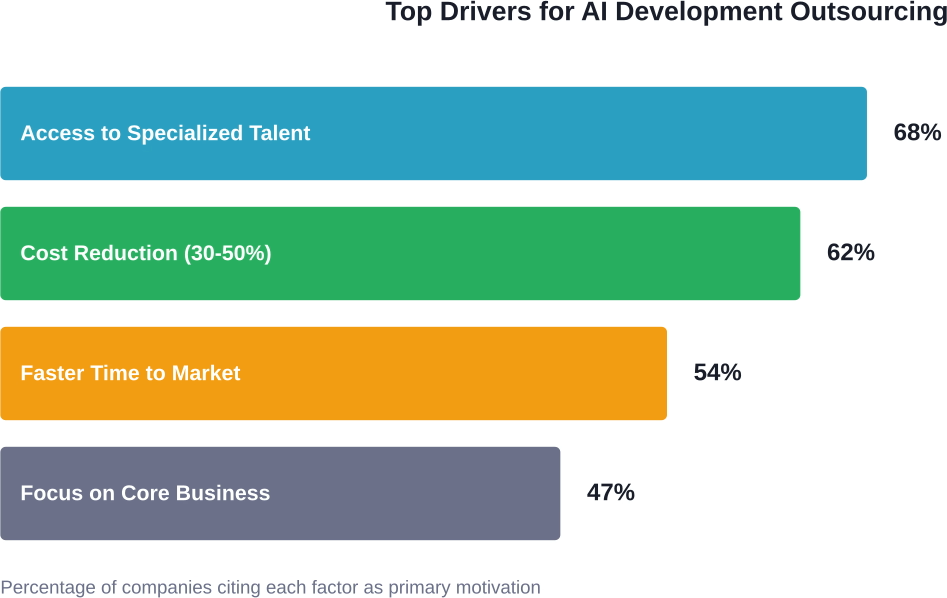
The push toward AI outsourcing stems from converging pressures that make in-house development increasingly impractical for many organizations.
Access to Specialized Talent
Machine learning engineers, data scientists, and AI specialists remain scarce. Building an internal team means competing with tech giants who can offer compensation packages most businesses can't match. Outsourcing provides immediate access to established teams with proven track records across multiple AI implementations.
Cost Efficiency That Actually Matters
Outsourcing typically reduces total costs by 30-50% compared to in-house development. Simple proof-of-concept projects can start from tens of thousands of dollars, while enterprise-grade AI platforms can reach several hundred thousand.
But the real savings go beyond hourly rates. Salaries and benefits become line items scaled based on project needs rather than headcount locked in year-round. Infrastructure costs shift to the vendor, who already maintains the GPU clusters, cloud environments, and development tools required for AI work.
Speed to Market
Established outsourcing partners arrive with frameworks, pipelines, and processes already battle-tested. They've solved the common problems. They know which architectures work for specific use cases. This accumulated knowledge compresses timelines significantly compared to teams learning through trial and error.
Focus on Core Business
Not every company needs to become an AI company. Most need AI capabilities integrated into their existing operations. Outsourcing lets internal teams focus on business logic, customer needs, and strategic direction while external specialists handle the technical complexity of model development.
AI Outsourcing Models: Choosing the Right Fit
Not all outsourcing arrangements work the same way. The engagement model shapes everything from budget predictability to communication overhead.
Project-Based Outsourcing
The vendor takes responsibility for delivering a defined AI solution with specific requirements, timeline, and budget. This works well for self-contained projects with clear objectives: building a recommendation engine, developing a chatbot, or creating a document classification system.
The advantage? Fixed scope means predictable costs. The risk? AI development rarely follows a straight line. Changing requirements mid-project can trigger scope creep and budget overruns.
Dedicated Team Model
Organizations hire an external team that functions as an extension of internal staff. The team works exclusively on the company's projects, providing continuity and deep product knowledge over time.
This model suits ongoing AI initiatives where requirements evolve based on user feedback and model performance. Teams integrate into existing workflows, participate in planning, and build institutional knowledge. The tradeoff is higher cost compared to project-based work, though still typically 30-40% less than equivalent in-house headcount.
Staff Augmentation
Individual specialists join the internal team temporarily to fill specific skill gaps. Need a computer vision expert for three months? Staff augmentation provides targeted expertise without long-term commitment.
This works when internal teams have AI capability but lack depth in particular areas. The augmented staff work under internal management, following existing processes and reporting structures.
Managed AI Services
The vendor handles end-to-end AI operations: infrastructure management, model monitoring, retraining, and optimization. This appeals to organizations that want AI capabilities without building internal AI expertise.
Managed services shift responsibility for technical operations to the vendor while the business focuses on defining use cases and measuring outcomes.
Key Benefits of AI Development Outsourcing
Beyond the obvious cost and talent advantages, outsourcing AI development delivers strategic benefits that reshape how organizations approach innovation.
Reduced Time to Value
Experienced vendors accelerate every phase. They've built similar systems before. They know which data preprocessing steps actually matter and which are wasted effort. They've debugged the infrastructure issues that would stall internal teams for weeks.
This accumulated experience compresses project timelines. What might take an internal team six months to figure out through experimentation, an experienced vendor completes in six weeks.
Risk Mitigation
AI projects carry technical risk. Models might not achieve required accuracy. Data quality issues might emerge late in development. Infrastructure costs might exceed projections.
Reputable outsourcing partners have seen these problems before and built processes to identify and address them early. They conduct feasibility assessments before committing to full development. They prototype solutions to validate approaches before scaling up.
Scalability Without Overhead
Business needs fluctuate. A major AI initiative might require a team of twelve for six months, then drop to two people for maintenance. Building that capacity internally means either maintaining expensive bench time or conducting painful hiring and layoff cycles.
Outsourcing provides elastic capacity. Scale up during intensive development phases, scale down for maintenance, scale up again for the next initiative.
Access to Infrastructure
Training large AI models requires serious computational resources. GPU clusters, distributed training frameworks, and high-bandwidth data pipelines represent significant capital investment.
Outsourcing vendors amortize these infrastructure costs across multiple clients. Organizations get access to enterprise-grade AI development environments without the capital expenditure or ongoing management burden.
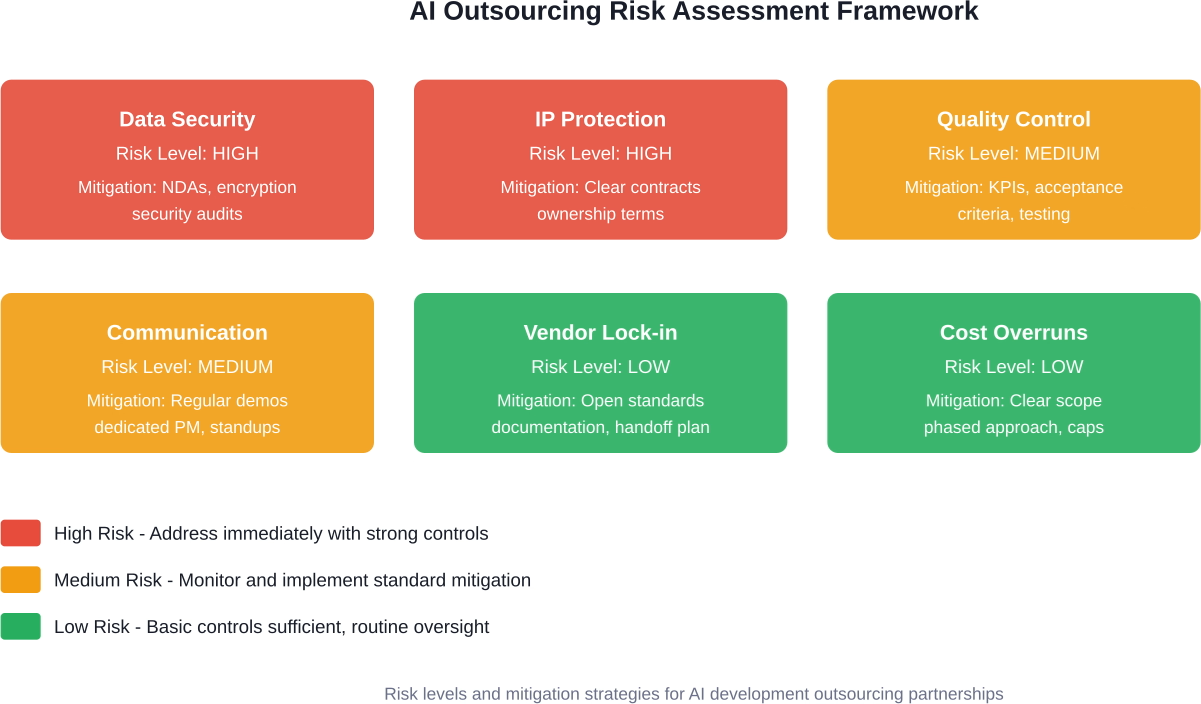
Challenges and How to Navigate Them
AI development outsourcing isn't without friction. Understanding the common pitfalls helps organizations structure partnerships that avoid them.
Communication and Alignment
AI projects require continuous feedback loops. Models need evaluation by people who understand business context. Requirements shift based on performance testing. Misaligned expectations between business stakeholders and technical teams derail projects.
Mitigation strategies include establishing clear communication protocols from day one, scheduling regular demos and checkpoints, and assigning a dedicated internal product owner who bridges business and technical domains.
Data Security and Privacy
AI models train on data, often sensitive business information or customer data. Sharing this with external vendors introduces security and compliance risks.
Address this through comprehensive data handling agreements, vendor security audits, data anonymization where possible, and strict access controls. For highly sensitive data, consider hybrid approaches where training happens on-premises or within controlled cloud environments.
Intellectual Property Protection
Who owns the trained models? The training code? The data pipelines? Unclear IP terms create conflicts down the road.
Contracts must explicitly define IP ownership. Typically, clients should own all custom code, trained models, and project artifacts. Standard frameworks and tools the vendor brings remain vendor property.
Quality Control
Evaluating AI system quality requires domain expertise. How do organizations without internal AI specialists assess whether a delivered model meets quality standards?
Build acceptance criteria into contracts: minimum accuracy thresholds, latency requirements, specific test cases the model must handle correctly. Consider engaging third-party AI auditors for independent validation of complex systems.
Vendor Lock-in
Proprietary frameworks, undocumented code, or opaque model architectures can trap organizations with a single vendor.
Require comprehensive documentation, use open-source frameworks where possible, insist on knowledge transfer sessions, and structure contracts with clear handoff procedures if the relationship ends.
Selecting the Right AI Outsourcing Partner
Vendor selection makes or breaks AI outsourcing success. The wrong partner wastes months and budget. The right one accelerates capabilities and delivers competitive advantage.
Technical Expertise and Track Record
Demand specific examples of similar projects. Generic claims about AI capability mean nothing. Look for demonstrated experience with the exact AI techniques relevant to the project: computer vision, natural language processing, reinforcement learning, recommendation systems.
Ask about model performance metrics from past projects. What accuracy did they achieve? How long did training take? What were the infrastructure requirements?
Domain Knowledge
AI systems require understanding both the technology and the business domain. A vendor with healthcare experience understands HIPAA compliance, clinical workflows, and medical terminology. A vendor with fintech experience knows fraud patterns, regulatory requirements, and transaction processing.
Domain expertise accelerates development because vendors ask better questions, propose more relevant solutions, and anticipate domain-specific challenges.
Communication and Cultural Fit
Time zone overlap matters for real-time collaboration. Latin America (Mexico, Brazil, Colombia) aligns directly with US time zones, with rates running $35 to $70 per hour. Eastern Europe offers strong technical talent with partial time zone overlap.
Beyond geography, evaluate communication clarity. Can the team explain technical concepts to non-technical stakeholders? Do they ask clarifying questions or make assumptions? How do they handle disagreements or setbacks?
Security and Compliance Posture
Request security certifications: SOC 2, ISO 27001, industry-specific compliance like GDPR or CCPA. Review their data handling policies, access control procedures, and incident response plans.
For regulated industries, compliance expertise is non-negotiable. The vendor must understand regulatory requirements and build them into development processes.
Scalability and Resource Depth
Can the vendor scale the team up if the project expands? Do they have backup resources if key team members leave? What's their staff turnover rate?
Small boutique vendors offer personalized attention but limited capacity. Large firms provide deep benches but potential bureaucracy. Match vendor size and structure to project scope and organizational needs.
Pricing Transparency
Beware of vendors who can't provide clear pricing structures. Fixed-price projects should include detailed scope definitions with pricing for change requests. Time-and-materials contracts need hourly rates for different role levels.
Request detailed project estimates breaking down hours by phase and role. This reveals whether the vendor understands the work involved or is guessing.

Get AI Development Teams That Actually Stick
Outsourcing AI development often breaks down when turnover is high and hiring is unfocused. NeoWork builds dedicated remote teams that plug into your workflows and stay engaged long term. With a 91% annualized teammate retention rate and a 3.2% candidate selectivity rate, the process emphasizes careful hiring and team stability so your engineers and data scientists learn your product and deliver consistently.
If you need outsourced AI developers who stay, contribute, and grow with your roadmap, contact NeoWork to discuss building a team that supports your development goals.
Best Practices for Successful AI Outsourcing
Even with the right vendor, project success requires deliberate management and clear processes.
Start With a Proof of Concept
Don't commit to full development before validating feasibility. Begin with a small proof-of-concept project that tests the core technical approach, evaluates vendor capability, and validates business value.
POCs typically run four to eight weeks and cost a fraction of full projects. They reveal technical risks early and provide concrete basis for decision-making.
Define Success Metrics Upfront
Vague goals like "improve customer experience" don't provide actionable direction. Specific metrics do: "achieve 85% accuracy on customer intent classification" or "reduce support ticket response time by 30%."
Quantifiable success criteria enable objective evaluation and keep teams aligned on priorities.
Establish Clear Data Ownership and Access
Document exactly what data the vendor can access, how it can be used, where it can be stored, and what happens to it after project completion. This prevents disputes and ensures compliance with data protection regulations.
Implement Iterative Development Cycles
AI development doesn't follow waterfall methodologies well. Models require experimentation. Requirements evolve as stakeholders see what's possible.
Structure projects in two-week to four-week sprints with regular demos and feedback sessions. This keeps development aligned with business needs and surfaces issues early.
Maintain Internal Product Ownership
Outsource execution, not strategy. Internal stakeholders must own the product vision, prioritize features, and make business decisions. The vendor executes on technical implementation.
Assign a dedicated internal product owner who serves as primary contact, makes decisions quickly, and keeps the project moving forward.
Document Everything
Require comprehensive documentation: architecture diagrams, data flow documentation, model training procedures, deployment instructions, and troubleshooting guides.
Good documentation enables internal teams to maintain and extend the system after the vendor relationship ends. It also forces clarity around design decisions during development.
Plan for Knowledge Transfer
Build knowledge transfer into the contract and project timeline. This includes training sessions for internal teams, documentation review, and transition support.
Don't wait until the end. Ongoing knowledge sharing throughout the project prepares internal teams to take over operations smoothly.
Regional Considerations for AI Outsourcing
Geography influences more than just cost. Time zones, cultural alignment, and talent pools vary significantly across regions.
Latin America
Countries like Mexico, Brazil, and Colombia offer direct time zone alignment with North American businesses. Teams work during overlapping hours, enabling real-time collaboration and faster feedback cycles.
Rates for specialized AI/ML engineers in Latin America typically range from $50 to $100+ per hour. Cultural similarities ease collaboration compared to more distant regions.
Eastern Europe
Strong technical education systems produce skilled AI developers. Countries like Poland, Ukraine, and Romania offer quality talent at competitive rates, typically $40 to $80 per hour.
Time zone overlap with North America is limited but manageable. European clients benefit from full overlap.
Asia
India dominates Asian outsourcing with deep talent pools and low costs ($25 to $50 per hour). However, communication challenges and minimal time zone overlap require more asynchronous workflows.
The Philippines provides English proficiency and some time zone overlap with US West Coast hours, making it attractive for tasks requiring frequent communication.
Nearshore vs. Offshore
Nearshore outsourcing (geographically close regions) prioritizes communication and collaboration over maximum cost savings. Offshore outsourcing (distant regions) maximizes cost reduction but increases coordination overhead.
Match the approach to project needs. Complex, ambiguous projects benefit from nearshore partnerships. Well-defined projects with clear specifications work offshore.
Cost Structure and Budgeting for AI Outsourcing
Understanding cost components helps organizations budget accurately and evaluate vendor proposals.
Development Costs
Simple proof-of-concept projects start from tens of thousands of dollars. Production-ready AI systems with custom models, integration, and testing typically range from $50,000 to $200,000. Enterprise-grade AI platforms with multiple models, complex workflows, and extensive integration can reach several hundred thousand dollars.
Hourly rates vary by region and expertise level. Junior developers cost $25-$40 per hour, mid-level developers $40-$70, senior developers and AI specialists $70-$120.
Infrastructure Costs
Model training requires computational resources. These might be included in vendor rates or billed separately. GPU instance costs range from $1 to $10+ per hour depending on specifications.
Clarify whether infrastructure costs are included in project quotes or additional charges.
Data Preparation Costs
Data labeling and preparation often consume more effort than model development. Expect 30-50% of total project cost to go toward data work for supervised learning projects.
Some vendors offer data labeling services; others expect clients to provide labeled datasets. Factor this into project planning and budgeting.
Maintenance and Operations
AI systems require ongoing monitoring, retraining, and updates. Budget 15-25% of initial development costs annually for maintenance.
Managed service agreements bundle maintenance into predictable monthly fees, simplifying budgeting.
Common Use Cases for AI Development Outsourcing
Different AI applications suit outsourcing to varying degrees based on complexity, data sensitivity, and strategic importance.
Natural Language Processing
Chatbots, sentiment analysis, document classification, and text summarization represent common NLP outsourcing projects. These applications have established architectures and proven approaches, making them lower-risk for external development.
Computer Vision
Object detection, image classification, facial recognition, and visual inspection systems benefit from specialized expertise that many organizations lack internally. Outsourcing accelerates development while accessing teams experienced with specific vision architectures.
Recommendation Systems
Product recommendations, content personalization, and collaborative filtering systems enhance customer experience and drive revenue. External teams bring experience across multiple recommendation approaches and can implement systems faster than internal teams learning from scratch.
Predictive Analytics
Demand forecasting, customer churn prediction, maintenance scheduling, and risk assessment leverage historical data to predict future outcomes. These projects typically have clear success metrics and well-defined data requirements.
Process Automation
Robotic process automation enhanced with AI capabilities automates repetitive tasks like data entry, document processing, and workflow routing. The combination of rule-based logic and AI decision-making increases automation scope.
Future Trends in AI Development Outsourcing
The outsourcing landscape continues evolving as AI technology matures and business adoption accelerates.
Increased Specialization
Generic AI development firms are giving way to specialized providers focused on specific industries or technologies. Healthcare AI vendors understand clinical workflows and regulatory requirements. Computer vision specialists focus exclusively on visual AI applications.
This specialization delivers better outcomes but requires more careful vendor selection matching specific needs.
Hybrid Engagement Models
Organizations increasingly blend in-house and outsourced AI capabilities. Core strategic AI systems remain internal while specialized or capacity-constrained projects go external.
This hybrid approach balances control with access to specialized expertise.
Managed AI Services Growth
More vendors offer end-to-end managed AI services handling development, deployment, monitoring, and optimization. This appeals to businesses wanting AI capabilities without building internal AI operations expertise.
Emphasis on Responsible AI
Bias detection, fairness testing, explainability, and ethical AI practices become standard vendor offerings rather than optional add-ons. Regulatory pressure and brand risk drive this shift.
Look for vendors with demonstrated responsible AI practices and tooling.
Platform-Based Delivery
Some vendors shift from custom development to configurable AI platforms that solve common use cases. These platforms reduce development time and cost but offer less customization than fully custom solutions.
Making the Decision: When to Outsource AI Development
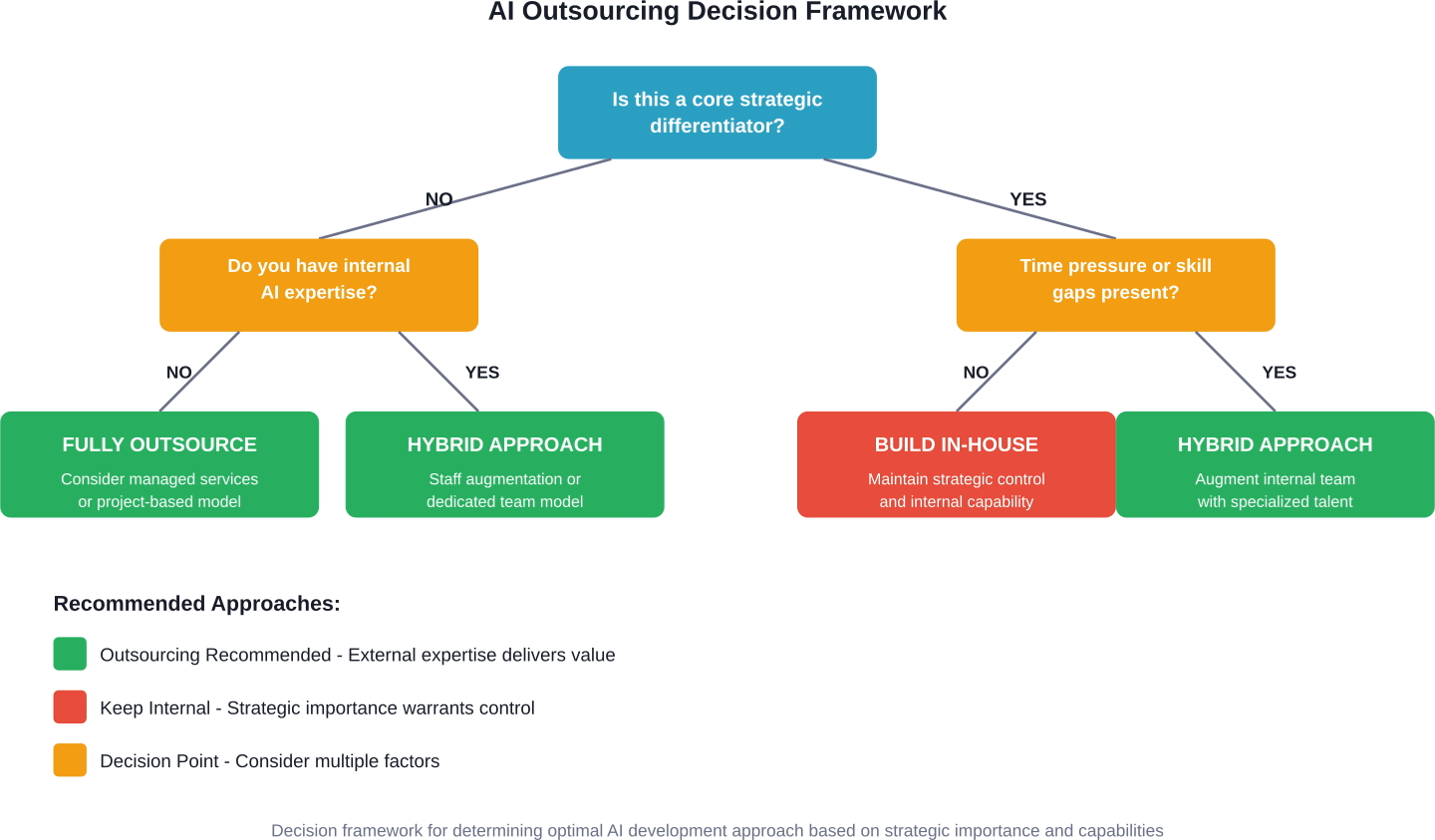
Not every AI project suits outsourcing. Strategic importance, data sensitivity, and internal capability influence the decision.
Strong Candidates for Outsourcing
Projects with well-defined requirements and clear success metrics work well externally. Applications using established AI techniques rather than cutting-edge research minimize risk. Non-core systems that enhance operations but don't represent competitive differentiation suit external development.
Time-sensitive projects where speed matters more than developing internal expertise benefit from outsourcing experienced teams.
Keep Internal
Core strategic systems that differentiate the business from competitors should remain internal. Projects involving highly sensitive data with strict regulatory requirements introduce unnecessary risk when outsourced.
When building internal AI capability represents a strategic objective, keep development in-house even if it takes longer.
Hybrid Approaches
Many successful AI initiatives blend internal and external resources. Internal teams own strategy, architecture, and integration while external specialists handle model development, data preparation, or specific technical components.
This approach balances control with access to specialized expertise.
Conclusion
AI development outsourcing has evolved far beyond basic cost reduction. It's become a strategic tool for accessing specialized expertise, accelerating time to market, and scaling AI capabilities without the overhead of maintaining large internal teams.
Success hinges on thoughtful vendor selection, clear communication protocols, comprehensive contracts addressing IP and security, and maintaining internal strategic ownership while outsourcing execution. The 30-50% cost reduction compared to in-house development provides immediate financial value, but the real advantage lies in compressed timelines and access to teams who've solved similar problems before.
Start small. Validate vendor capability and technical feasibility through proof-of-concept projects before committing to full development. Define success metrics upfront. Structure projects in iterative cycles with regular feedback. Document everything. Plan for knowledge transfer from day one.
The organizations that excel at AI outsourcing treat vendors as true partners rather than temporary contractors. They invest in the relationship, communicate openly about challenges, and create environments where both internal and external teams work toward shared goals.
Ready to explore AI development outsourcing for your organization? Start by clearly defining the business problem you're trying to solve, not the AI technology you think you need. Evaluate your internal AI capability honestly. Consider whether this project represents core strategic differentiation or operational enhancement. Then match that assessment to the right outsourcing model and begin the vendor selection process with clear criteria.
The AI revolution isn't waiting. But you don't need to build everything internally to participate. Strategic outsourcing puts powerful AI capabilities within reach of organizations at every scale.
Frequently Asked Questions
Topics
AI Development Outsourcing Guide 2026: Complete Strategy

AI development outsourcing enables businesses to access specialized talent, reduce costs by 30-50%, and accelerate deployment without maintaining in-house teams. Success requires careful vendor selection, clear project scope definition, strong IP protection measures, and choosing the right engagement model based on project complexity and timeline.
The race to integrate artificial intelligence isn't slowing down. But here's the reality: most companies don't have machine learning engineers sitting on the bench, and frankly, they don't need to.
AI development outsourcing has shifted from a cost-cutting tactic to a strategic necessity. The North America market is expected to maintain a significant share, but the current verified figure is nearly 35%.
The challenge isn't whether to outsource. It's how to do it right.
What Is AI Development Outsourcing?
AI development outsourcing means contracting external teams or vendors to design, build, train, and deploy artificial intelligence systems instead of handling everything in-house. This covers the full spectrum: data labeling and preparation, model development and training, integration with existing systems, and ongoing maintenance.
Unlike traditional software outsourcing, AI projects carry unique complexity. The development process is iterative and experimental, requiring multiple rounds of model training and validation. Recent Gartner data (2025) indicates that around 41–42% of AI prototypes (generative and non-generative) reach production, a significant improvement from earlier estimates of 10–20% in the late 2010s, though many projects still face abandonment risks.
That statistic matters. It means vendor selection isn't just about finding developers who can code. Teams need domain expertise, infrastructure experience with cloud platforms and GPU resources, and the ability to navigate the unpredictable nature of model performance.
Why Companies Are Outsourcing AI Development in 2026
The push toward AI outsourcing stems from converging pressures that make in-house development increasingly impractical for many organizations.
Access to Specialized Talent
Machine learning engineers, data scientists, and AI specialists remain scarce. Building an internal team means competing with tech giants who can offer compensation packages most businesses can't match. Outsourcing provides immediate access to established teams with proven track records across multiple AI implementations.
Cost Efficiency That Actually Matters
Outsourcing typically reduces total costs by 30-50% compared to in-house development. Simple proof-of-concept projects can start from tens of thousands of dollars, while enterprise-grade AI platforms can reach several hundred thousand.
But the real savings go beyond hourly rates. Salaries and benefits become line items scaled based on project needs rather than headcount locked in year-round. Infrastructure costs shift to the vendor, who already maintains the GPU clusters, cloud environments, and development tools required for AI work.
Speed to Market
Established outsourcing partners arrive with frameworks, pipelines, and processes already battle-tested. They've solved the common problems. They know which architectures work for specific use cases. This accumulated knowledge compresses timelines significantly compared to teams learning through trial and error.
Focus on Core Business
Not every company needs to become an AI company. Most need AI capabilities integrated into their existing operations. Outsourcing lets internal teams focus on business logic, customer needs, and strategic direction while external specialists handle the technical complexity of model development.
AI Outsourcing Models: Choosing the Right Fit
Not all outsourcing arrangements work the same way. The engagement model shapes everything from budget predictability to communication overhead.
Project-Based Outsourcing
The vendor takes responsibility for delivering a defined AI solution with specific requirements, timeline, and budget. This works well for self-contained projects with clear objectives: building a recommendation engine, developing a chatbot, or creating a document classification system.
The advantage? Fixed scope means predictable costs. The risk? AI development rarely follows a straight line. Changing requirements mid-project can trigger scope creep and budget overruns.
Dedicated Team Model
Organizations hire an external team that functions as an extension of internal staff. The team works exclusively on the company's projects, providing continuity and deep product knowledge over time.
This model suits ongoing AI initiatives where requirements evolve based on user feedback and model performance. Teams integrate into existing workflows, participate in planning, and build institutional knowledge. The tradeoff is higher cost compared to project-based work, though still typically 30-40% less than equivalent in-house headcount.
Staff Augmentation
Individual specialists join the internal team temporarily to fill specific skill gaps. Need a computer vision expert for three months? Staff augmentation provides targeted expertise without long-term commitment.
This works when internal teams have AI capability but lack depth in particular areas. The augmented staff work under internal management, following existing processes and reporting structures.
Managed AI Services
The vendor handles end-to-end AI operations: infrastructure management, model monitoring, retraining, and optimization. This appeals to organizations that want AI capabilities without building internal AI expertise.
Managed services shift responsibility for technical operations to the vendor while the business focuses on defining use cases and measuring outcomes.
Key Benefits of AI Development Outsourcing
Beyond the obvious cost and talent advantages, outsourcing AI development delivers strategic benefits that reshape how organizations approach innovation.
Reduced Time to Value
Experienced vendors accelerate every phase. They've built similar systems before. They know which data preprocessing steps actually matter and which are wasted effort. They've debugged the infrastructure issues that would stall internal teams for weeks.
This accumulated experience compresses project timelines. What might take an internal team six months to figure out through experimentation, an experienced vendor completes in six weeks.
Risk Mitigation
AI projects carry technical risk. Models might not achieve required accuracy. Data quality issues might emerge late in development. Infrastructure costs might exceed projections.
Reputable outsourcing partners have seen these problems before and built processes to identify and address them early. They conduct feasibility assessments before committing to full development. They prototype solutions to validate approaches before scaling up.
Scalability Without Overhead
Business needs fluctuate. A major AI initiative might require a team of twelve for six months, then drop to two people for maintenance. Building that capacity internally means either maintaining expensive bench time or conducting painful hiring and layoff cycles.
Outsourcing provides elastic capacity. Scale up during intensive development phases, scale down for maintenance, scale up again for the next initiative.
Access to Infrastructure
Training large AI models requires serious computational resources. GPU clusters, distributed training frameworks, and high-bandwidth data pipelines represent significant capital investment.
Outsourcing vendors amortize these infrastructure costs across multiple clients. Organizations get access to enterprise-grade AI development environments without the capital expenditure or ongoing management burden.
Challenges and How to Navigate Them
AI development outsourcing isn't without friction. Understanding the common pitfalls helps organizations structure partnerships that avoid them.
Communication and Alignment
AI projects require continuous feedback loops. Models need evaluation by people who understand business context. Requirements shift based on performance testing. Misaligned expectations between business stakeholders and technical teams derail projects.
Mitigation strategies include establishing clear communication protocols from day one, scheduling regular demos and checkpoints, and assigning a dedicated internal product owner who bridges business and technical domains.
Data Security and Privacy
AI models train on data, often sensitive business information or customer data. Sharing this with external vendors introduces security and compliance risks.
Address this through comprehensive data handling agreements, vendor security audits, data anonymization where possible, and strict access controls. For highly sensitive data, consider hybrid approaches where training happens on-premises or within controlled cloud environments.
Intellectual Property Protection
Who owns the trained models? The training code? The data pipelines? Unclear IP terms create conflicts down the road.
Contracts must explicitly define IP ownership. Typically, clients should own all custom code, trained models, and project artifacts. Standard frameworks and tools the vendor brings remain vendor property.
Quality Control
Evaluating AI system quality requires domain expertise. How do organizations without internal AI specialists assess whether a delivered model meets quality standards?
Build acceptance criteria into contracts: minimum accuracy thresholds, latency requirements, specific test cases the model must handle correctly. Consider engaging third-party AI auditors for independent validation of complex systems.
Vendor Lock-in
Proprietary frameworks, undocumented code, or opaque model architectures can trap organizations with a single vendor.
Require comprehensive documentation, use open-source frameworks where possible, insist on knowledge transfer sessions, and structure contracts with clear handoff procedures if the relationship ends.
Selecting the Right AI Outsourcing Partner
Vendor selection makes or breaks AI outsourcing success. The wrong partner wastes months and budget. The right one accelerates capabilities and delivers competitive advantage.
Technical Expertise and Track Record
Demand specific examples of similar projects. Generic claims about AI capability mean nothing. Look for demonstrated experience with the exact AI techniques relevant to the project: computer vision, natural language processing, reinforcement learning, recommendation systems.
Ask about model performance metrics from past projects. What accuracy did they achieve? How long did training take? What were the infrastructure requirements?
Domain Knowledge
AI systems require understanding both the technology and the business domain. A vendor with healthcare experience understands HIPAA compliance, clinical workflows, and medical terminology. A vendor with fintech experience knows fraud patterns, regulatory requirements, and transaction processing.
Domain expertise accelerates development because vendors ask better questions, propose more relevant solutions, and anticipate domain-specific challenges.
Communication and Cultural Fit
Time zone overlap matters for real-time collaboration. Latin America (Mexico, Brazil, Colombia) aligns directly with US time zones, with rates running $35 to $70 per hour. Eastern Europe offers strong technical talent with partial time zone overlap.
Beyond geography, evaluate communication clarity. Can the team explain technical concepts to non-technical stakeholders? Do they ask clarifying questions or make assumptions? How do they handle disagreements or setbacks?
Security and Compliance Posture
Request security certifications: SOC 2, ISO 27001, industry-specific compliance like GDPR or CCPA. Review their data handling policies, access control procedures, and incident response plans.
For regulated industries, compliance expertise is non-negotiable. The vendor must understand regulatory requirements and build them into development processes.
Scalability and Resource Depth
Can the vendor scale the team up if the project expands? Do they have backup resources if key team members leave? What's their staff turnover rate?
Small boutique vendors offer personalized attention but limited capacity. Large firms provide deep benches but potential bureaucracy. Match vendor size and structure to project scope and organizational needs.
Pricing Transparency
Beware of vendors who can't provide clear pricing structures. Fixed-price projects should include detailed scope definitions with pricing for change requests. Time-and-materials contracts need hourly rates for different role levels.
Request detailed project estimates breaking down hours by phase and role. This reveals whether the vendor understands the work involved or is guessing.
Get AI Development Teams That Actually Stick
Outsourcing AI development often breaks down when turnover is high and hiring is unfocused. NeoWork builds dedicated remote teams that plug into your workflows and stay engaged long term. With a 91% annualized teammate retention rate and a 3.2% candidate selectivity rate, the process emphasizes careful hiring and team stability so your engineers and data scientists learn your product and deliver consistently.
If you need outsourced AI developers who stay, contribute, and grow with your roadmap, contact NeoWork to discuss building a team that supports your development goals.
Best Practices for Successful AI Outsourcing
Even with the right vendor, project success requires deliberate management and clear processes.
Start With a Proof of Concept
Don't commit to full development before validating feasibility. Begin with a small proof-of-concept project that tests the core technical approach, evaluates vendor capability, and validates business value.
POCs typically run four to eight weeks and cost a fraction of full projects. They reveal technical risks early and provide concrete basis for decision-making.
Define Success Metrics Upfront
Vague goals like "improve customer experience" don't provide actionable direction. Specific metrics do: "achieve 85% accuracy on customer intent classification" or "reduce support ticket response time by 30%."
Quantifiable success criteria enable objective evaluation and keep teams aligned on priorities.
Establish Clear Data Ownership and Access
Document exactly what data the vendor can access, how it can be used, where it can be stored, and what happens to it after project completion. This prevents disputes and ensures compliance with data protection regulations.
Implement Iterative Development Cycles
AI development doesn't follow waterfall methodologies well. Models require experimentation. Requirements evolve as stakeholders see what's possible.
Structure projects in two-week to four-week sprints with regular demos and feedback sessions. This keeps development aligned with business needs and surfaces issues early.
Maintain Internal Product Ownership
Outsource execution, not strategy. Internal stakeholders must own the product vision, prioritize features, and make business decisions. The vendor executes on technical implementation.
Assign a dedicated internal product owner who serves as primary contact, makes decisions quickly, and keeps the project moving forward.
Document Everything
Require comprehensive documentation: architecture diagrams, data flow documentation, model training procedures, deployment instructions, and troubleshooting guides.
Good documentation enables internal teams to maintain and extend the system after the vendor relationship ends. It also forces clarity around design decisions during development.
Plan for Knowledge Transfer
Build knowledge transfer into the contract and project timeline. This includes training sessions for internal teams, documentation review, and transition support.
Don't wait until the end. Ongoing knowledge sharing throughout the project prepares internal teams to take over operations smoothly.
Regional Considerations for AI Outsourcing
Geography influences more than just cost. Time zones, cultural alignment, and talent pools vary significantly across regions.
Latin America
Countries like Mexico, Brazil, and Colombia offer direct time zone alignment with North American businesses. Teams work during overlapping hours, enabling real-time collaboration and faster feedback cycles.
Rates for specialized AI/ML engineers in Latin America typically range from $50 to $100+ per hour. Cultural similarities ease collaboration compared to more distant regions.
Eastern Europe
Strong technical education systems produce skilled AI developers. Countries like Poland, Ukraine, and Romania offer quality talent at competitive rates, typically $40 to $80 per hour.
Time zone overlap with North America is limited but manageable. European clients benefit from full overlap.
Asia
India dominates Asian outsourcing with deep talent pools and low costs ($25 to $50 per hour). However, communication challenges and minimal time zone overlap require more asynchronous workflows.
The Philippines provides English proficiency and some time zone overlap with US West Coast hours, making it attractive for tasks requiring frequent communication.
Nearshore vs. Offshore
Nearshore outsourcing (geographically close regions) prioritizes communication and collaboration over maximum cost savings. Offshore outsourcing (distant regions) maximizes cost reduction but increases coordination overhead.
Match the approach to project needs. Complex, ambiguous projects benefit from nearshore partnerships. Well-defined projects with clear specifications work offshore.
Cost Structure and Budgeting for AI Outsourcing
Understanding cost components helps organizations budget accurately and evaluate vendor proposals.
Development Costs
Simple proof-of-concept projects start from tens of thousands of dollars. Production-ready AI systems with custom models, integration, and testing typically range from $50,000 to $200,000. Enterprise-grade AI platforms with multiple models, complex workflows, and extensive integration can reach several hundred thousand dollars.
Hourly rates vary by region and expertise level. Junior developers cost $25-$40 per hour, mid-level developers $40-$70, senior developers and AI specialists $70-$120.
Infrastructure Costs
Model training requires computational resources. These might be included in vendor rates or billed separately. GPU instance costs range from $1 to $10+ per hour depending on specifications.
Clarify whether infrastructure costs are included in project quotes or additional charges.
Data Preparation Costs
Data labeling and preparation often consume more effort than model development. Expect 30-50% of total project cost to go toward data work for supervised learning projects.
Some vendors offer data labeling services; others expect clients to provide labeled datasets. Factor this into project planning and budgeting.
Maintenance and Operations
AI systems require ongoing monitoring, retraining, and updates. Budget 15-25% of initial development costs annually for maintenance.
Managed service agreements bundle maintenance into predictable monthly fees, simplifying budgeting.
Common Use Cases for AI Development Outsourcing
Different AI applications suit outsourcing to varying degrees based on complexity, data sensitivity, and strategic importance.
Natural Language Processing
Chatbots, sentiment analysis, document classification, and text summarization represent common NLP outsourcing projects. These applications have established architectures and proven approaches, making them lower-risk for external development.
Computer Vision
Object detection, image classification, facial recognition, and visual inspection systems benefit from specialized expertise that many organizations lack internally. Outsourcing accelerates development while accessing teams experienced with specific vision architectures.
Recommendation Systems
Product recommendations, content personalization, and collaborative filtering systems enhance customer experience and drive revenue. External teams bring experience across multiple recommendation approaches and can implement systems faster than internal teams learning from scratch.
Predictive Analytics
Demand forecasting, customer churn prediction, maintenance scheduling, and risk assessment leverage historical data to predict future outcomes. These projects typically have clear success metrics and well-defined data requirements.
Process Automation
Robotic process automation enhanced with AI capabilities automates repetitive tasks like data entry, document processing, and workflow routing. The combination of rule-based logic and AI decision-making increases automation scope.
Future Trends in AI Development Outsourcing
The outsourcing landscape continues evolving as AI technology matures and business adoption accelerates.
Increased Specialization
Generic AI development firms are giving way to specialized providers focused on specific industries or technologies. Healthcare AI vendors understand clinical workflows and regulatory requirements. Computer vision specialists focus exclusively on visual AI applications.
This specialization delivers better outcomes but requires more careful vendor selection matching specific needs.
Hybrid Engagement Models
Organizations increasingly blend in-house and outsourced AI capabilities. Core strategic AI systems remain internal while specialized or capacity-constrained projects go external.
This hybrid approach balances control with access to specialized expertise.
Managed AI Services Growth
More vendors offer end-to-end managed AI services handling development, deployment, monitoring, and optimization. This appeals to businesses wanting AI capabilities without building internal AI operations expertise.
Emphasis on Responsible AI
Bias detection, fairness testing, explainability, and ethical AI practices become standard vendor offerings rather than optional add-ons. Regulatory pressure and brand risk drive this shift.
Look for vendors with demonstrated responsible AI practices and tooling.
Platform-Based Delivery
Some vendors shift from custom development to configurable AI platforms that solve common use cases. These platforms reduce development time and cost but offer less customization than fully custom solutions.
Making the Decision: When to Outsource AI Development
Not every AI project suits outsourcing. Strategic importance, data sensitivity, and internal capability influence the decision.
Strong Candidates for Outsourcing
Projects with well-defined requirements and clear success metrics work well externally. Applications using established AI techniques rather than cutting-edge research minimize risk. Non-core systems that enhance operations but don't represent competitive differentiation suit external development.
Time-sensitive projects where speed matters more than developing internal expertise benefit from outsourcing experienced teams.
Keep Internal
Core strategic systems that differentiate the business from competitors should remain internal. Projects involving highly sensitive data with strict regulatory requirements introduce unnecessary risk when outsourced.
When building internal AI capability represents a strategic objective, keep development in-house even if it takes longer.
Hybrid Approaches
Many successful AI initiatives blend internal and external resources. Internal teams own strategy, architecture, and integration while external specialists handle model development, data preparation, or specific technical components.
This approach balances control with access to specialized expertise.
Conclusion
AI development outsourcing has evolved far beyond basic cost reduction. It's become a strategic tool for accessing specialized expertise, accelerating time to market, and scaling AI capabilities without the overhead of maintaining large internal teams.
Success hinges on thoughtful vendor selection, clear communication protocols, comprehensive contracts addressing IP and security, and maintaining internal strategic ownership while outsourcing execution. The 30-50% cost reduction compared to in-house development provides immediate financial value, but the real advantage lies in compressed timelines and access to teams who've solved similar problems before.
Start small. Validate vendor capability and technical feasibility through proof-of-concept projects before committing to full development. Define success metrics upfront. Structure projects in iterative cycles with regular feedback. Document everything. Plan for knowledge transfer from day one.
The organizations that excel at AI outsourcing treat vendors as true partners rather than temporary contractors. They invest in the relationship, communicate openly about challenges, and create environments where both internal and external teams work toward shared goals.
Ready to explore AI development outsourcing for your organization? Start by clearly defining the business problem you're trying to solve, not the AI technology you think you need. Evaluate your internal AI capability honestly. Consider whether this project represents core strategic differentiation or operational enhancement. Then match that assessment to the right outsourcing model and begin the vendor selection process with clear criteria.
The AI revolution isn't waiting. But you don't need to build everything internally to participate. Strategic outsourcing puts powerful AI capabilities within reach of organizations at every scale.
Frequently Asked Questions
Topics
Related Blogs
Related Podcasts