

.avif)
.avif)

The Real-World Guide to AI & ML Outsourcing Services


.svg)

AI is showing up in more places than we expected. From chatbots that actually answer questions to tools that spot fraud before it happens, machine learning is quietly reshaping how businesses operate. But here’s the thing – building those systems isn’t always straightforward. Not every company has in-house data scientists on standby. And even if you do, scaling fast can get messy.
That’s where outsourcing comes in. Done right, it can save time, bring in real expertise, and cut through a lot of the trial-and-error. Done wrong? You end up micromanaging contractors or cleaning up after poorly labeled training data.
This guide is for teams thinking about handing off AI or ML work to external partners. We’ll cover what to look for, what to avoid, and how to set yourself up for success without needing to become an AI expert first.
What Is AI & ML Outsourcing?
AI and ML outsourcing means hiring an external team to design, build, or manage parts of your artificial intelligence or machine learning workflows. Instead of doing everything in-house, you bring in specialists to handle tasks like data labeling, model training, algorithm tuning, infrastructure setup, or post-deployment monitoring.
This could look like a short-term engagement to build a prototype, or an ongoing partnership to manage production systems. Some companies outsource specific roles (like MLOps or annotation), while others hand off entire projects. The goal is usually the same: get results faster, avoid hiring overhead, and tap into skills you don’t currently have.
Why Companies Outsource AI and ML Projects
Let’s get the obvious reason out of the way: it’s hard to hire machine learning talent. Finding the right people takes time, and even when you do, building an in-house team that can move fast and scale responsibly is expensive. Outsourcing helps companies skip that entire grind.
But it’s not just about cost or speed. A good outsourcing partner brings things you might not have internally:
- Specialized technical expertise across AI disciplines (NLP, computer vision, MLOps).
- Exposure to deployment patterns that actually work in production.
- A refined process for handling training data, validation, and fine-tuning.
- Frameworks for explainability and compliance.
In short, outsourcing helps teams make fewer mistakes, especially on their first or second major AI initiative.

How We Approach AI & ML Outsourcing at NeoWork
At NeoWork, we help companies build and scale AI capabilities without the bottlenecks of traditional hiring. Our AI outsourcing services connect businesses with highly skilled engineers from the Philippines and Colombia, giving them access to deep technical expertise at a fraction of the cost of local hiring. Whether you're building training pipelines, fine-tuning models, or validating outputs, our engineers step in as seamless extensions of your team.
What makes us different is the way we approach talent. We only hire 3.2% of the candidates we evaluate, and our 91% annualized retention rate means clients work with stable, high-performing teams over time. We’ve supported use cases ranging from model training and RLHF to manual QA for early-stage AI products. Some clients start with a single engineer; others build full managed teams through our operations partnership model.
We don’t see AI outsourcing as a commodity service. It’s a strategic capability that requires alignment, context, and real communication. That’s why we focus on integration, transparency, and outcomes, not just tasks. If you’re looking to scale AI without slowing down, we’re built for that.
When Outsourcing Actually Makes Sense
Not every project needs outside help. But some situations clearly benefit from it:
- You’re building a model for a new use case and don’t have in-house experience.
- Your existing engineers are swamped or not familiar with ML tooling.
- You need a prototype quickly to prove value to stakeholders.
- There’s a high risk of failure if the first version underdelivers.
- You want to avoid infrastructure lock-in or heavy upfront investment.
The right partner can step in for part of the stack or own a full end-to-end solution. Some act as team extensions, while others run managed services under your direction.

Common Pitfalls to Avoid
AI outsourcing comes with its own set of traps. Most have less to do with the tech and more to do with misalignment. Here’s where things often go sideways:
Poorly Defined Problem
If you’re not clear about what you’re solving, the partner will guess. And when they guess wrong, you'll waste time fixing outputs that don’t match your needs.
Tip: Think in terms of outcomes, not features. Say “we need to automate insurance claim coding with less than 5% error,” not “we want to use AI to improve operations.”
Overestimating What Can Be Done with Raw Data
Just because you have data doesn’t mean it’s usable. Unstructured, inconsistent, or biased data can derail a project before it starts.
Make sure your vendor sees sample data early. If you can’t share live data due to privacy or regulation, consider synthetic datasets or data masking approaches.
Lack of Internal Buy-In
Some companies outsource AI while leadership still sees it as a “nice to have.” That usually leads to short funding windows and rushed evaluations.
Reality check: if AI is important, treat the outsourced team like a core part of the product org, not a side project.
What a Good Partner Actually Brings to the Table
A solid AI/ML outsourcing vendor isn’t just selling hours. They should be bringing structure, accountability, and a process for delivering something that works. These are the signals that someone knows what they’re doing:
- Discovery process: They ask questions before quoting anything. Not just about tech, but your business case.
- MLOps readiness: They use reproducible pipelines, version models, and don’t treat model deployment like an afterthought.
- Model explainability: They can explain outputs and help you stay compliant (especially in regulated fields).
- Performance baselines: They define success before building, not after.
When possible, ask for references or case studies with measurable outcomes. And don’t just look at what models they’ve built. Ask how many made it into production and stayed there.
Structuring the Relationship for Success
Having a qualified partner is only half the battle. The rest comes down to how you work together.
Start with a Narrow Scope
Don’t hand off your entire roadmap. Start with one use case that’s easy to measure and low-risk if it fails. Examples:
- Classifying customer support tickets.
- Auto-tagging product descriptions.
- Predicting equipment failure in a defined context.
This gives you a chance to test the working relationship, evaluate code quality, and understand their communication rhythm.
Share More Context Than You Think You Need To
Outsourcing fails when partners don’t understand how your business works. If they don’t get the full picture, they can’t make tradeoffs that align with your goals.
Give them examples of real users, edge cases, internal tools, and constraints. The more they know, the less likely you’ll need to rework things later.
Make Feedback Loops a Priority
AI models need feedback to improve, and so do humans. Set up regular check-ins that focus on both progress and blockers:
- Weekly syncs for sprint progress.
- Monthly reviews for outcomes vs metrics.
- Slack channels or shared dashboards for async updates.
Don’t wait until delivery day to spot issues.
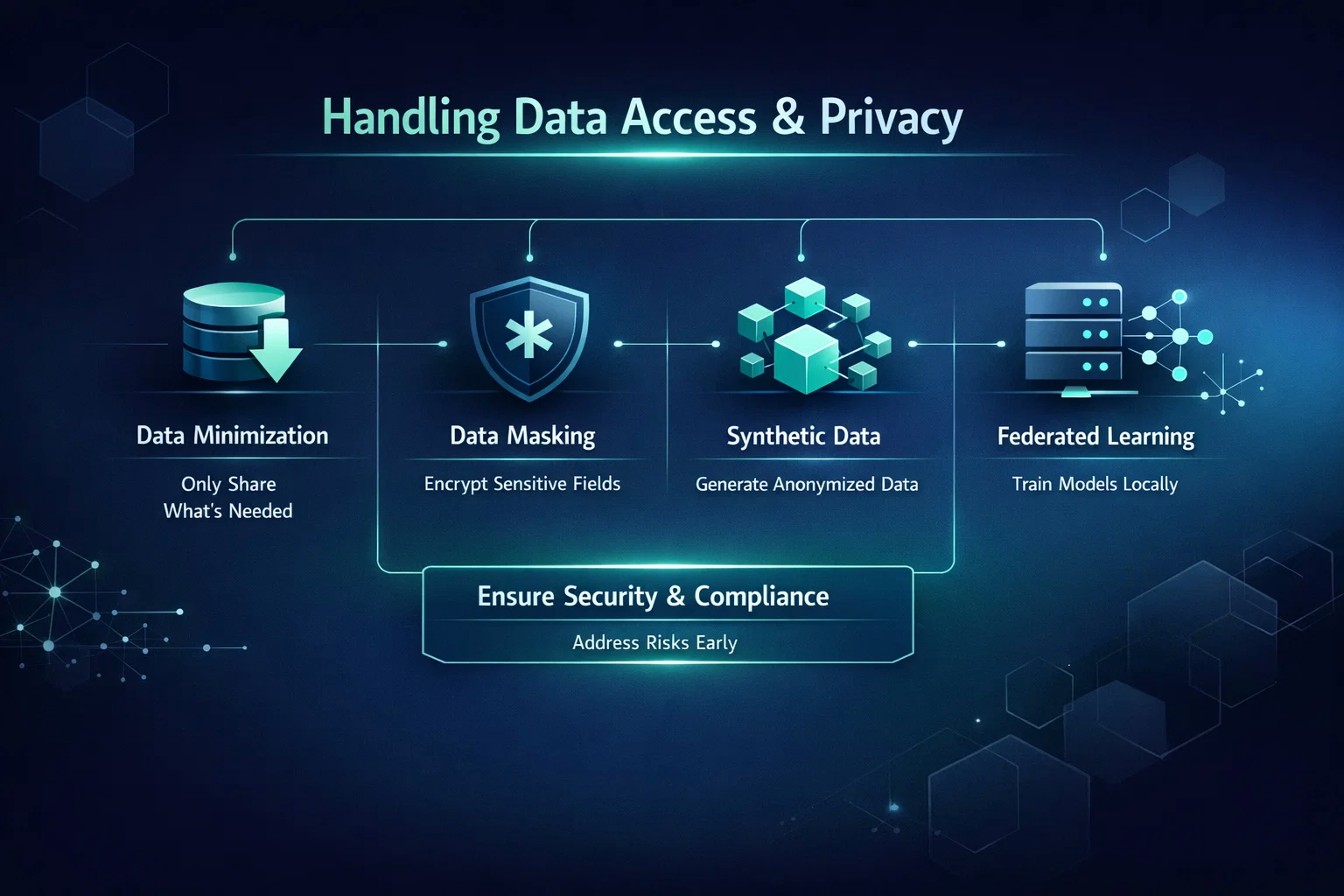
How to Handle Data Access and Privacy
This is where a lot of hesitation happens. If you’re in healthcare, finance, or anything regulated, you’re likely worried about what data can be shared and how it’s handled.
Here’s how companies manage it:
- Data minimization: Share only what’s needed, not entire databases.
- Data masking: Remove or encrypt sensitive fields before handing over samples.
- Synthetic data: Use generated datasets that mimic the structure of real data.
- Federated learning: Keep data on your servers and let models train locally, then aggregate results.
Your vendor should help guide this conversation. If they don’t raise security or compliance concerns early, that’s a red flag.
Integration Matters More Than You Think
Even if the model is great, it’s worthless if it doesn’t work with your stack. That’s where many teams get caught off guard.
Make sure to include integration planning early following the basic questions.
What systems will this model connect to? Is it a real-time service or a batch job? Who owns the API layer? Do you need a UI for non-technical users?
Also consider if the model will need monitoring or alerting once live. A good vendor should offer advice on model drift and version management.
What to Track Beyond Accuracy
A lot of AI teams obsess over precision, recall, and F1 scores. These are important, but they’re not the full picture. Depending on your use case, also look at:
- Adoption rate: Are people actually using the output?
- Time saved per task: Are workflows faster?
- Reduction in manual effort: Has the need for human review decreased?
- Failure impact: What happens when the model gets it wrong?
Your outsourced team should help you measure both technical and business metrics.
Key Questions to Ask Before Signing Anything
To avoid surprises later, here are a few questions worth asking upfront:
- Have you deployed a model like this to production before?
- How do you handle training data issues or inconsistencies?
- What’s your typical ramp-up time for new projects?
- How do you document models, experiments, and outcomes?
- Will we have access to the code and artifacts after delivery?
- Do you provide post-deployment support?
And don’t forget to define IP ownership early. Make sure the contract spells out who owns what.
Final Thoughts
Outsourcing AI and ML work doesn’t mean giving up control. If anything, it means taking more responsibility for the process, not less.
You still need to define success. You still need to validate results. And you definitely need to be involved in making sure what gets built actually works in your environment.
But with the right partner, you don’t have to figure it all out alone.
Done well, AI outsourcing lets you move faster, stay flexible, and build smarter systems without hiring an entire ML team from scratch. Just don’t treat it like a transaction. Treat it like a collaboration.
Because when the models are live and the results start coming in, you’ll want a team that’s as invested in the outcome as you are.
FAQ
Topics
The Real-World Guide to AI & ML Outsourcing Services

AI is showing up in more places than we expected. From chatbots that actually answer questions to tools that spot fraud before it happens, machine learning is quietly reshaping how businesses operate. But here’s the thing – building those systems isn’t always straightforward. Not every company has in-house data scientists on standby. And even if you do, scaling fast can get messy.
That’s where outsourcing comes in. Done right, it can save time, bring in real expertise, and cut through a lot of the trial-and-error. Done wrong? You end up micromanaging contractors or cleaning up after poorly labeled training data.
This guide is for teams thinking about handing off AI or ML work to external partners. We’ll cover what to look for, what to avoid, and how to set yourself up for success without needing to become an AI expert first.
What Is AI & ML Outsourcing?
AI and ML outsourcing means hiring an external team to design, build, or manage parts of your artificial intelligence or machine learning workflows. Instead of doing everything in-house, you bring in specialists to handle tasks like data labeling, model training, algorithm tuning, infrastructure setup, or post-deployment monitoring.
This could look like a short-term engagement to build a prototype, or an ongoing partnership to manage production systems. Some companies outsource specific roles (like MLOps or annotation), while others hand off entire projects. The goal is usually the same: get results faster, avoid hiring overhead, and tap into skills you don’t currently have.
Why Companies Outsource AI and ML Projects
Let’s get the obvious reason out of the way: it’s hard to hire machine learning talent. Finding the right people takes time, and even when you do, building an in-house team that can move fast and scale responsibly is expensive. Outsourcing helps companies skip that entire grind.
But it’s not just about cost or speed. A good outsourcing partner brings things you might not have internally:
- Specialized technical expertise across AI disciplines (NLP, computer vision, MLOps).
- Exposure to deployment patterns that actually work in production.
- A refined process for handling training data, validation, and fine-tuning.
- Frameworks for explainability and compliance.
In short, outsourcing helps teams make fewer mistakes, especially on their first or second major AI initiative.
How We Approach AI & ML Outsourcing at NeoWork
At NeoWork, we help companies build and scale AI capabilities without the bottlenecks of traditional hiring. Our AI outsourcing services connect businesses with highly skilled engineers from the Philippines and Colombia, giving them access to deep technical expertise at a fraction of the cost of local hiring. Whether you're building training pipelines, fine-tuning models, or validating outputs, our engineers step in as seamless extensions of your team.
What makes us different is the way we approach talent. We only hire 3.2% of the candidates we evaluate, and our 91% annualized retention rate means clients work with stable, high-performing teams over time. We’ve supported use cases ranging from model training and RLHF to manual QA for early-stage AI products. Some clients start with a single engineer; others build full managed teams through our operations partnership model.
We don’t see AI outsourcing as a commodity service. It’s a strategic capability that requires alignment, context, and real communication. That’s why we focus on integration, transparency, and outcomes, not just tasks. If you’re looking to scale AI without slowing down, we’re built for that.
When Outsourcing Actually Makes Sense
Not every project needs outside help. But some situations clearly benefit from it:
- You’re building a model for a new use case and don’t have in-house experience.
- Your existing engineers are swamped or not familiar with ML tooling.
- You need a prototype quickly to prove value to stakeholders.
- There’s a high risk of failure if the first version underdelivers.
- You want to avoid infrastructure lock-in or heavy upfront investment.
The right partner can step in for part of the stack or own a full end-to-end solution. Some act as team extensions, while others run managed services under your direction.
Common Pitfalls to Avoid
AI outsourcing comes with its own set of traps. Most have less to do with the tech and more to do with misalignment. Here’s where things often go sideways:
Poorly Defined Problem
If you’re not clear about what you’re solving, the partner will guess. And when they guess wrong, you'll waste time fixing outputs that don’t match your needs.
Tip: Think in terms of outcomes, not features. Say “we need to automate insurance claim coding with less than 5% error,” not “we want to use AI to improve operations.”
Overestimating What Can Be Done with Raw Data
Just because you have data doesn’t mean it’s usable. Unstructured, inconsistent, or biased data can derail a project before it starts.
Make sure your vendor sees sample data early. If you can’t share live data due to privacy or regulation, consider synthetic datasets or data masking approaches.
Lack of Internal Buy-In
Some companies outsource AI while leadership still sees it as a “nice to have.” That usually leads to short funding windows and rushed evaluations.
Reality check: if AI is important, treat the outsourced team like a core part of the product org, not a side project.
What a Good Partner Actually Brings to the Table
A solid AI/ML outsourcing vendor isn’t just selling hours. They should be bringing structure, accountability, and a process for delivering something that works. These are the signals that someone knows what they’re doing:
- Discovery process: They ask questions before quoting anything. Not just about tech, but your business case.
- MLOps readiness: They use reproducible pipelines, version models, and don’t treat model deployment like an afterthought.
- Model explainability: They can explain outputs and help you stay compliant (especially in regulated fields).
- Performance baselines: They define success before building, not after.
When possible, ask for references or case studies with measurable outcomes. And don’t just look at what models they’ve built. Ask how many made it into production and stayed there.
Structuring the Relationship for Success
Having a qualified partner is only half the battle. The rest comes down to how you work together.
Start with a Narrow Scope
Don’t hand off your entire roadmap. Start with one use case that’s easy to measure and low-risk if it fails. Examples:
- Classifying customer support tickets.
- Auto-tagging product descriptions.
- Predicting equipment failure in a defined context.
This gives you a chance to test the working relationship, evaluate code quality, and understand their communication rhythm.
Share More Context Than You Think You Need To
Outsourcing fails when partners don’t understand how your business works. If they don’t get the full picture, they can’t make tradeoffs that align with your goals.
Give them examples of real users, edge cases, internal tools, and constraints. The more they know, the less likely you’ll need to rework things later.
Make Feedback Loops a Priority
AI models need feedback to improve, and so do humans. Set up regular check-ins that focus on both progress and blockers:
- Weekly syncs for sprint progress.
- Monthly reviews for outcomes vs metrics.
- Slack channels or shared dashboards for async updates.
Don’t wait until delivery day to spot issues.
How to Handle Data Access and Privacy
This is where a lot of hesitation happens. If you’re in healthcare, finance, or anything regulated, you’re likely worried about what data can be shared and how it’s handled.
Here’s how companies manage it:
- Data minimization: Share only what’s needed, not entire databases.
- Data masking: Remove or encrypt sensitive fields before handing over samples.
- Synthetic data: Use generated datasets that mimic the structure of real data.
- Federated learning: Keep data on your servers and let models train locally, then aggregate results.
Your vendor should help guide this conversation. If they don’t raise security or compliance concerns early, that’s a red flag.
Integration Matters More Than You Think
Even if the model is great, it’s worthless if it doesn’t work with your stack. That’s where many teams get caught off guard.
Make sure to include integration planning early following the basic questions.
What systems will this model connect to? Is it a real-time service or a batch job? Who owns the API layer? Do you need a UI for non-technical users?
Also consider if the model will need monitoring or alerting once live. A good vendor should offer advice on model drift and version management.
What to Track Beyond Accuracy
A lot of AI teams obsess over precision, recall, and F1 scores. These are important, but they’re not the full picture. Depending on your use case, also look at:
- Adoption rate: Are people actually using the output?
- Time saved per task: Are workflows faster?
- Reduction in manual effort: Has the need for human review decreased?
- Failure impact: What happens when the model gets it wrong?
Your outsourced team should help you measure both technical and business metrics.
Key Questions to Ask Before Signing Anything
To avoid surprises later, here are a few questions worth asking upfront:
- Have you deployed a model like this to production before?
- How do you handle training data issues or inconsistencies?
- What’s your typical ramp-up time for new projects?
- How do you document models, experiments, and outcomes?
- Will we have access to the code and artifacts after delivery?
- Do you provide post-deployment support?
And don’t forget to define IP ownership early. Make sure the contract spells out who owns what.
Final Thoughts
Outsourcing AI and ML work doesn’t mean giving up control. If anything, it means taking more responsibility for the process, not less.
You still need to define success. You still need to validate results. And you definitely need to be involved in making sure what gets built actually works in your environment.
But with the right partner, you don’t have to figure it all out alone.
Done well, AI outsourcing lets you move faster, stay flexible, and build smarter systems without hiring an entire ML team from scratch. Just don’t treat it like a transaction. Treat it like a collaboration.
Because when the models are live and the results start coming in, you’ll want a team that’s as invested in the outcome as you are.
FAQ
Topics
Related Blogs
Related Podcasts


.webp)

.webp)
.webp)



