

.avif)
.avif)

AI Outsourcing Companies Guide 2026: Models & Costs


.svg)

AI outsourcing companies provide specialized talent and technology to help businesses implement artificial intelligence without building in-house teams. Organizations typically choose from project-based, staff augmentation, or fully managed service models depending on their needs, with costs ranging from $25-60 per hour for development talent to $10,000-$300,000+ for complete projects. Success depends on clear scope definition, strong governance frameworks, and selecting partners with proven AI expertise and cultural alignment.
Most companies don't have machine learning engineers sitting around ready to build custom AI systems. And frankly, most don't need full-time AI teams.
But they do need AI capabilities—whether that's automating customer support, optimizing supply chains, or building recommendation engines. That's where AI outsourcing companies come in.
The market has matured significantly. According to MIT Sloan Management Review, organizations are increasing their investments in artificial intelligence and learning that achieving ROI requires more than a simple "set it and forget it" mentality. Building a data-driven culture, evaluating AI tools properly, and managing both internal and external data effectively have become critical success factors.
According to a McKinsey report cited in HBS research, AI adoption could deliver up to $4.4 trillion in global economic value annually. That growth is driven by optimization in operations, automation of tasks, and predictive analytics that actually move business metrics.
This guide breaks down what AI outsourcing actually looks like in 2026, which models make sense for different situations, what to expect cost-wise, and how to avoid the common pitfalls that derail AI projects.
What AI Outsourcing Actually Covers
AI outsourcing isn't just about hiring developers. It spans a range of activities across the AI development lifecycle.
Data preparation and annotation form the foundation. External teams label images, transcribe audio, tag entities in text, and clean datasets so models can actually learn. This work is tedious, time-intensive, and requires quality control processes that most companies don't want to manage internally.
Model development and training is where specialized engineering talent becomes essential. Outsourcing partners build custom machine learning models, fine-tune large language models, or adapt existing frameworks to specific business requirements.
Infrastructure setup and deployment gets outsourced when companies lack cloud architecture expertise or need to scale quickly. This includes configuring GPU clusters, setting up MLOps pipelines, and establishing monitoring systems.
AI-powered application development represents end-to-end outsourcing. A partner builds complete solutions—chatbots, recommendation engines, document processing systems—from concept through production deployment.
Maintenance and optimization keeps AI systems performing after launch. Models drift over time as data patterns change, requiring regular retraining and tuning that outsourced teams can handle.
Why Organizations Turn to AI Outsourcing in 2026
The talent shortage remains the primary driver. There simply aren't enough experienced AI engineers to go around, and the ones who are available command salaries that make building large in-house teams prohibitively expensive for most organizations.
Speed to market matters more than ever. Wharton's 2025 report on enterprise AI adoption shows that AI is now deeply embedded into core business functions at large American companies, with three out of four leaders reporting positive returns on AI investments. But they're also facing pressure to deliver results quickly. Outsourcing accelerates delivery by tapping into established teams with proven processes.
Cost control provides another compelling reason. Outsourcing typically reduces total costs by 30–50% compared to in-house development, according to industry analysis. That's not just about lower hourly rates—it includes avoided recruitment costs, training expenses, and the overhead of managing specialized infrastructure.
Access to specialized expertise rounds out the value proposition. AI is broad. Natural language processing, computer vision, reinforcement learning, and time-series forecasting all require different skill sets. Outsourcing partners maintain diverse teams that can tackle varied requirements without companies needing to hire for every specialty.
The same Wharton research notes that 43% of senior leaders worry about a decline in skills proficiency as the use of AI climbs. Partnering with outsourcing companies that maintain cutting-edge expertise helps bridge that gap.

Partner With a Stable AI Outsourcing Company
AI outsourcing only works when teams are consistent and process-driven. NeoWork supports AI initiatives with data labeling, RLHF, evaluation, and technical staffing. With a 91% annualized teammate retention rate and a 3.2% candidate selectivity rate, NeoWork focuses on long-term team stability rather than short-term contracts. This improves quality control and delivery predictability.
Ready to Scale Your AI Operations?
Talk with NeoWork to:
- build dedicated AI support teams
- maintain strict quality standards
- scale projects without internal hiring delays
👉 Contact NeoWork to discuss your AI outsourcing strategy.
The Three Main Outsourcing Models
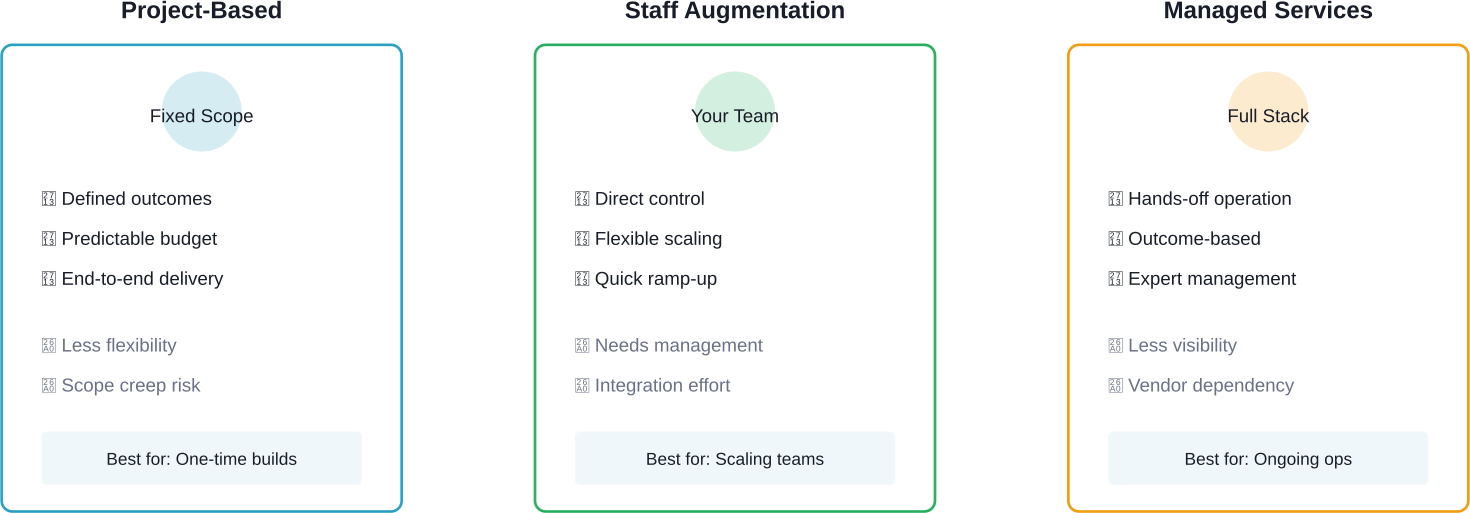
Not all AI outsourcing arrangements look the same. Three distinct models dominate the market, each suited to different situations.
Project-Based Outsourcing
This model works like traditional software consulting. Companies define a specific outcome—build a fraud detection system, create a customer churn predictor, automate document classification—and the outsourcing partner delivers a complete solution for a fixed price or time-and-materials arrangement.
Project-based engagements suit organizations with well-defined requirements and finite timelines. The partner handles everything: requirements analysis, data engineering, model development, testing, and deployment.
The upside is predictability. Scope and budget get established upfront. The downside is less flexibility—changing requirements mid-project can trigger scope creep and budget overruns.
Staff Augmentation
Here, outsourcing companies provide individual AI specialists who integrate directly into internal teams. A company might bring on two machine learning engineers and a data scientist for six months to accelerate an internal project.
This model gives more control. Augmented staff work under internal management, using existing processes and infrastructure. It's essentially renting expertise without long-term employment commitments.
Staff augmentation makes sense when companies have solid project management capabilities but lack specific technical skills. It's also useful for scaling teams up and down based on project phases.
Fully Managed AI Services
The most hands-off approach involves outsourcing entire AI functions. A partner doesn't just build solutions—they run them. Think outsourced customer support powered by AI, managed data labeling operations, or AI-driven content moderation as a service.
Managed services work best for ongoing operations rather than one-time builds. The outsourcing company owns outcomes and often structures pricing around performance metrics rather than hours worked.
This model demands less internal AI expertise but requires strong vendor management and clear service level agreements.
What AI Outsourcing Actually Costs
Pricing varies dramatically based on geography, expertise level, and engagement model. Here's what the market looks like in 2026.
Hourly rates for AI developers from major outsourcing markets typically range from $25 to $60 per hour, based on India market averages. Eastern European developers command $40-80 per hour, while Latin American talent falls in the $35-70 range.
These rates reflect mid-level to senior developers. Junior talent costs less but requires more oversight. True AI specialists—experts in specific domains like reinforcement learning or large language model fine-tuning—can exceed $100 per hour even from offshore markets.
Project-based pricing depends heavily on complexity. Simple proof-of-concept projects start around $10,000-$30,000. A basic chatbot implementation or simple predictive model might fall in this range.
Mid-sized projects—think custom recommendation engines, document classification systems, or conversational AI applications—typically run $50,000-$150,000. These involve more extensive data engineering, custom model development, and integration with existing systems.
Enterprise-grade AI platforms can easily reach several hundred thousand dollars. Complex computer vision systems, multi-model AI architectures, or platforms that require extensive customization and security considerations often exceed $300,000.
The same industry analysis indicates that outsourcing reduces total costs by 30–50% compared to building equivalent capabilities in-house. That calculation factors in not just developer salaries but recruitment costs, benefits, training, infrastructure, and management overhead.
But here's the thing—cheap doesn't mean good value. A $20/hour developer who produces buggy code that requires extensive rework costs more than a $60/hour expert who delivers clean, production-ready solutions.
Where AI Outsourcing Delivers Real Value
Certain use cases lend themselves particularly well to outsourced development. Customer service automation tops the list. Chatbots, email classification, sentiment analysis, and ticket routing all follow established patterns that experienced outsourcing teams can implement efficiently.
Data annotation and labeling is almost always outsourced. Companies that need thousands of images labeled, audio transcribed, or text entities tagged don't build internal teams for this—they use specialized providers who've optimized the workflows and quality control processes.
Predictive analytics projects work well with outsourcing when requirements are clearly defined. Churn prediction, demand forecasting, fraud detection, and similar applications have mature methodologies that skilled teams can execute reliably.
Computer vision applications—object detection, facial recognition, defect identification in manufacturing—often get outsourced because they require specialized expertise that most companies don't maintain internally.
Document processing and intelligent automation represent a sweet spot. Extracting data from invoices, contracts, or forms using AI-powered OCR and natural language processing follows repeatable patterns that outsourcing companies execute efficiently.
Critical Governance and Risk Management
Academic research on AI outsourcing governance highlights that both formal and relational governance mechanisms matter for successful outcomes. Organizations can't treat AI outsourcing like traditional IT services.
Data security and privacy require particular attention. The EU AI Act, which went into force in August 2024 and will phase in over coming years, aims to ensure AI systems are used safely, transparently, traceably, and in a non-discriminatory manner. Companies outsourcing AI development need partners who understand these evolving regulatory requirements.
IEEE standards on algorithmic bias provide frameworks for evaluating whether AI systems exhibit fairness issues. When outsourcing, contracts should specify bias testing requirements and establish accountability for model behavior.
Intellectual property ownership needs explicit definition upfront. Who owns the trained models? The underlying code? The data processing pipelines? Ambiguity here creates problems later.
Model explainability and transparency become crucial when AI systems make consequential decisions. Outsourcing agreements should address documentation requirements, model interpretability standards, and audit rights.
Vendor lock-in poses real risks. Relying entirely on a single outsourcing partner for critical AI capabilities can leave companies vulnerable if the relationship sours or the vendor's business changes. Maintaining some internal AI literacy and ensuring you can transition systems if needed matters.
What to Evaluate When Selecting AI Outsourcing Partners
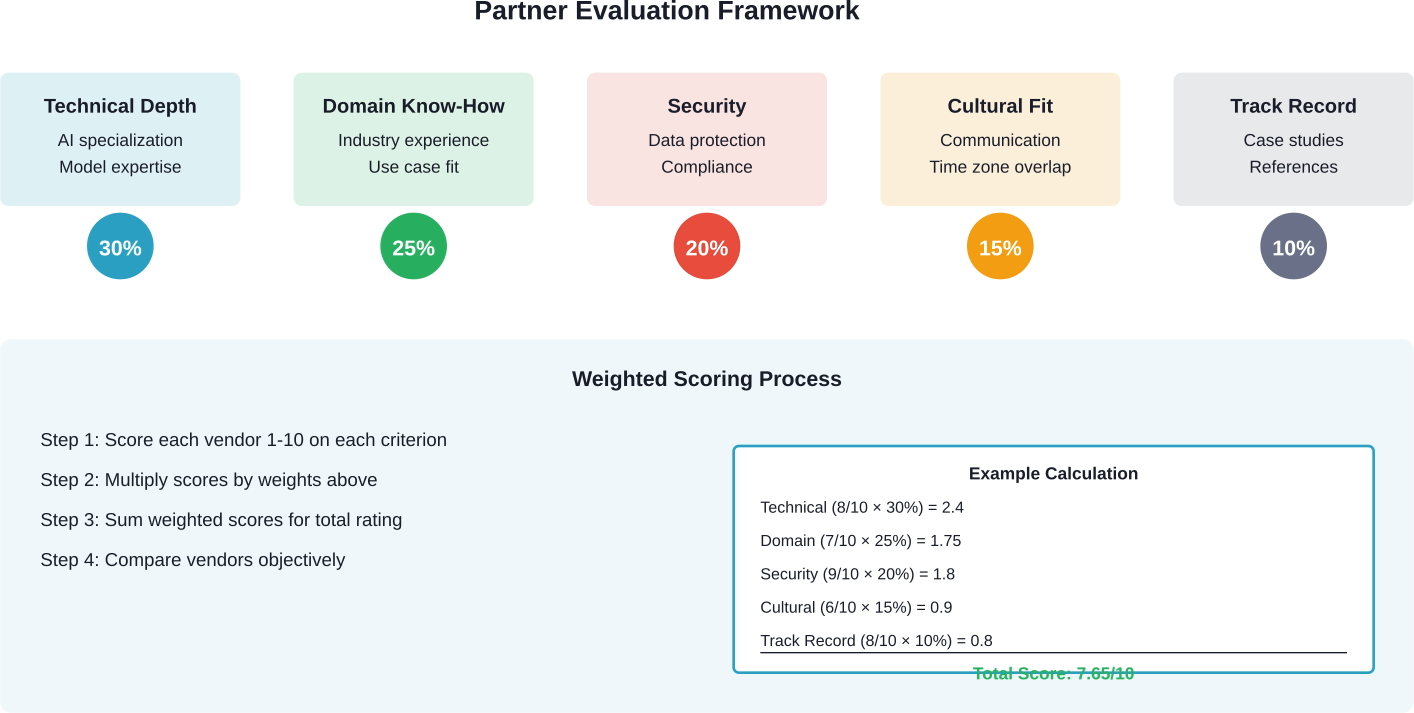
Not all AI outsourcing companies deliver equivalent value. Several factors separate strong partners from mediocre ones.
Technical Depth and Specialization
Look beyond generic "AI services" claims. Does the company demonstrate expertise in the specific AI domains relevant to your needs? Natural language processing differs fundamentally from computer vision, which differs from time-series forecasting.
Ask about their technical stack, model architectures they've worked with, and how they stay current as AI technology evolves. Partners who can discuss trade-offs between different approaches credibly understand the technology.
Domain Experience
AI applications vary significantly across industries. Healthcare AI requires understanding of medical terminology, regulatory constraints, and clinical workflows. Financial services AI demands fraud detection expertise and regulatory compliance knowledge.
Partners with relevant domain experience ramp up faster and make fewer costly mistakes about what actually matters in your specific context.
Data Handling and Security Practices
How does the partner manage sensitive data? What security certifications do they maintain? Where do they store and process data? These aren't theoretical concerns—data breaches or compliance violations can be catastrophic.
Singapore's Monetary Authority recently strengthened regulatory frameworks for outsourcing arrangements, particularly those involving technology and cloud services. Similar regulations are emerging globally, making partner vetting on security and compliance increasingly important.
Cultural and Communication Fit
Time zone overlap, language proficiency, and cultural alignment affect day-to-day collaboration more than many companies anticipate. A technically brilliant team that's difficult to communicate with creates friction that slows projects.
Some outsourcing markets—the Philippines and Colombia are frequently cited—offer strong cultural alignment with Western business practices alongside technical skills and cost efficiency.
Delivery Track Record
Case studies and references matter. Have they delivered similar projects successfully? Can they provide references from clients with comparable requirements?
Watch for partners who can articulate not just what they built but the business impact it generated. Did the fraud detection system actually reduce losses? Did the chatbot improve customer satisfaction while reducing support costs?
Common Pitfalls and How to Avoid Them
Even well-intentioned AI outsourcing relationships run into predictable problems. Being aware of them increases the odds of success.
Vague Requirements
"Build us an AI chatbot" isn't a requirement—it's a vague aspiration. Without specifics about use cases, integration points, expected volumes, performance metrics, and success criteria, projects drift.
Strong partners will push back and help clarify requirements, but that's not guaranteed. Taking time upfront to document what success actually looks like prevents expensive misalignment later.
Unrealistic Expectations About AI Capabilities
AI is powerful but not magic. Models require quality training data, they make mistakes, and they often can't handle edge cases reliably without extensive tuning.
Vendors sometimes oversell capabilities to win contracts. Being informed enough to ask hard questions about accuracy rates, data requirements, and limitations helps set realistic expectations.
Inadequate Data Quality or Availability
Many AI projects stall because companies don't have the data they assumed they had—or the data they do have is incomplete, inconsistent, or biased.
Before engaging outsourcing partners, audit what data actually exists and what condition it's in. If data needs significant cleaning or enrichment, factor that into project timelines and budgets.
Poor Communication and Project Management
AI development involves iteration and experimentation. Models get trained, evaluated, tuned, and retrained. Without regular communication, teams can spend weeks optimizing for the wrong metric or building features nobody needs.
Establish clear communication cadences—weekly check-ins at minimum for active projects—and use collaborative tools that provide visibility into progress.
Insufficient Knowledge Transfer
Outsourcing partners build the system, deploy it, and then... what? If they haven't documented how it works, how to maintain it, or how to troubleshoot issues, companies end up perpetually dependent on the vendor for basic operations.
Contracts should specify documentation requirements, training for internal teams, and knowledge transfer processes before projects conclude.
Preparing Your Organization for AI Outsourcing
Success with AI outsourcing doesn't happen purely through vendor selection. Internal preparation matters just as much.
MIT Sloan research emphasizes building a data-driven culture as foundational. Organizations that treat AI projects as purely technical initiatives struggle. Those that invest in developing AI literacy across business functions, establish clear data governance, and align AI investments with strategic priorities see better outcomes.
Define clear success metrics before starting. What business outcome needs to improve? By how much? Over what timeframe? "Implement AI" isn't a success metric—"reduce customer support costs by 20% while maintaining satisfaction scores" is.
Assign an internal project owner with decision-making authority. AI projects that report to committees or lack clear ownership drift. Someone needs to own outcomes, make timely decisions, and remove blockers.
Allocate time for internal stakeholders to engage with the project. Subject matter experts need to review model outputs, provide feedback on accuracy, and validate that solutions address real needs. If internal teams are too busy to engage, projects produce technically sound systems that miss the mark on business value.
Plan for change management. AI systems often change how people work. Customer support agents interact differently with AI-augmented tools. Operations teams need training on AI-powered forecasting systems. Ignoring the human side of AI implementation kills adoption.
Emerging Trends Shaping AI Outsourcing in 2026
Several shifts are changing how AI outsourcing works and what's possible.
Generative AI has moved from experimentation to everyday use, according to Wharton research on enterprise AI adoption. Outsourcing partners now offer specialized services around large language model fine-tuning, prompt engineering, and building applications on top of foundation models like GPT-4, Claude, or Gemini.
This changes the economics of AI development. Teams can build sophisticated natural language applications without training models from scratch, reducing development time and costs significantly.
Regulatory compliance is becoming a bigger part of outsourcing arrangements. With the EU AI Act phasing in and other jurisdictions developing similar frameworks, outsourcing partners need to demonstrate compliance capabilities—not just technical skills.
Organizations are increasingly asking about environmental impact. AI model training consumes significant energy. Some outsourcing companies now track and report on the carbon footprint of AI development as sustainability becomes a procurement criterion.
Outcome-based pricing models are gaining traction. Rather than paying for developer hours or fixed projects, some arrangements tie compensation to business results—cost savings achieved, accuracy improvements, or revenue generated. This aligns incentives better but requires sophisticated measurement frameworks.
Multi-vendor strategies are replacing single-partner approaches for larger organizations. Rather than relying entirely on one outsourcing company, enterprises engage specialists for different AI domains—one for computer vision, another for NLP, a third for data labeling—reducing dependency risks.
Making the Build vs. Buy vs. Outsource Decision
Not every AI capability should be outsourced. Strategic decisions about where to build internal expertise versus where to leverage external partners shape long-term competitive positioning.
Core differentiators usually warrant internal investment. If an AI capability creates genuine competitive advantage—say, a proprietary recommendation algorithm that drives customer loyalty—building and maintaining it in-house protects that advantage.
Commodity AI applications make perfect outsourcing candidates. Standard chatbots, basic document processing, or off-the-shelf computer vision don't differentiate most businesses. Using outsourcing partners to implement these quickly and cost-effectively makes sense.
Skills availability influences the decision. If specialized expertise is needed temporarily—training an initial model that internal teams can then maintain, for instance—staff augmentation bridges the gap without permanent hires.
Speed requirements matter. Building internal AI teams takes months of recruiting, onboarding, and ramping up. Outsourcing delivers faster when speed to market drives competitive outcomes.
Questions to Ask Potential AI Outsourcing Partners
Due diligence conversations reveal whether a partner truly understands AI development or just talks a good game.
- About their approach: How do they handle situations where initial models don't meet performance targets? Good answers involve iterative experimentation, trying different architectures, tuning parameters, adjusting training approaches, or potentially recommending alternative approaches. Vague promises that "it'll work" are red flags.
- About data: What data quality and volume do they need to deliver the proposed solution? How will they handle data privacy? Where will data be stored and processed? Partners who haven't thought carefully about data handling lack AI development maturity.
- About deployment: How will the solution integrate with existing systems? What infrastructure does it require? How will they handle model updates and retraining? AI systems need ongoing care—partners should articulate clear plans for post-deployment support.
- About risk mitigation: How do they test for bias in models? What happens if the system makes mistakes? How do they ensure model decisions are explainable when needed? These questions reveal whether partners think about responsible AI or just chase technical performance metrics.
- About team composition: Who specifically will work on the project? What's their background and expertise? Can you interview key team members? Knowing the actual people doing the work matters more than generic company capabilities.
- About similar projects: Ask for specific examples of comparable projects they've delivered. What challenges did they encounter? How did they overcome them? What business results did the solution generate? Detailed answers demonstrate real experience; vague generalities suggest limited relevant work.
Structuring Effective AI Outsourcing Contracts
Legal agreements need to address AI-specific considerations beyond typical software development contracts.
Intellectual property clauses should explicitly cover not just source code but trained models, datasets created or curated during development, and any proprietary algorithms or architectures developed for the project.
Performance guarantees require careful definition. Model accuracy, latency, throughput, and other metrics should be specified—but with realistic acknowledgment that AI systems rarely achieve perfect performance. Service level agreements should reflect what's technically achievable.
Data handling provisions need to specify exactly what data the vendor can access, how they can use it, where it can be stored, and what happens to it after the project concludes. For regulated industries or sensitive data, this section becomes particularly critical.
Liability and indemnification clauses should address what happens if AI systems make errors that cause harm. Who's responsible if a recommendation engine suggests inappropriate products or a classification system makes discriminatory decisions?
Exit provisions define how transitions work if the relationship ends. Can internal teams take over the system? Is the vendor obligated to support handoff? Are there knowledge transfer requirements? Without clear exit terms, switching away from a vendor becomes prohibitively difficult.
Building Long-Term Outsourcing Partnerships
The most successful AI outsourcing relationships evolve from transactional vendor engagements to strategic partnerships over time.
Start with smaller proof-of-concept projects to validate capabilities and cultural fit before committing to major initiatives. A $25,000 pilot reveals whether the partner understands requirements, communicates effectively, and delivers quality work—before risking $250,000 on a larger project.
Provide feedback continuously. Partners who receive clear, timely feedback about what's working and what isn't can course-correct. Those kept in the dark until formal project reviews can't adapt.
Invest in relationship building beyond project delivery. Understanding the partner's capabilities, roadmap, and other clients helps identify opportunities for collaboration beyond the immediate project.
Consider retained relationships for ongoing AI needs rather than one-off projects. Partners who understand business context deeply deliver better solutions faster than those starting fresh each time.
Balance fair pricing with quality expectations. Constantly pushing for the lowest rates incentivizes partners to cut corners. Paying fair market rates for good work builds partnerships where both sides benefit.
Conclusion: Getting AI Outsourcing Right
AI outsourcing isn't a shortcut to innovation—it's a strategic choice about how to access specialized capabilities efficiently. Organizations that succeed treat it as a partnership requiring clear goals, realistic expectations, and ongoing management rather than a transaction where requirements go in and finished systems come out.
The market has matured considerably. Quality outsourcing partners exist across geographies and specializations. But so do vendors who overpromise and underdeliver. Due diligence matters.
Start with well-defined problems that have clear success criteria. Work with partners who demonstrate deep expertise in relevant AI domains and who ask hard questions about data, requirements, and constraints rather than promising everything is possible.
Structure engagements that accommodate the iterative nature of AI development while maintaining accountability for outcomes. Build internal AI literacy so teams can evaluate vendor work intelligently and make informed decisions about build-versus-outsource trade-offs.
Most importantly, focus on business value over technical sophistication. The goal isn't implementing AI—it's solving business problems more effectively. Partners who understand that distinction and align their work accordingly deliver results. Those focused purely on technical achievement often miss the mark.
Ready to explore AI outsourcing for your organization? Start by documenting one specific business problem that AI might help solve, establishing clear metrics for success, and researching partners with demonstrated expertise in that domain. The time invested in preparation upfront prevents expensive mistakes later.
Frequently Asked Questions
Topics
AI Outsourcing Companies Guide 2026: Models & Costs

AI outsourcing companies provide specialized talent and technology to help businesses implement artificial intelligence without building in-house teams. Organizations typically choose from project-based, staff augmentation, or fully managed service models depending on their needs, with costs ranging from $25-60 per hour for development talent to $10,000-$300,000+ for complete projects. Success depends on clear scope definition, strong governance frameworks, and selecting partners with proven AI expertise and cultural alignment.
Most companies don't have machine learning engineers sitting around ready to build custom AI systems. And frankly, most don't need full-time AI teams.
But they do need AI capabilities—whether that's automating customer support, optimizing supply chains, or building recommendation engines. That's where AI outsourcing companies come in.
The market has matured significantly. According to MIT Sloan Management Review, organizations are increasing their investments in artificial intelligence and learning that achieving ROI requires more than a simple "set it and forget it" mentality. Building a data-driven culture, evaluating AI tools properly, and managing both internal and external data effectively have become critical success factors.
According to a McKinsey report cited in HBS research, AI adoption could deliver up to $4.4 trillion in global economic value annually. That growth is driven by optimization in operations, automation of tasks, and predictive analytics that actually move business metrics.
This guide breaks down what AI outsourcing actually looks like in 2026, which models make sense for different situations, what to expect cost-wise, and how to avoid the common pitfalls that derail AI projects.
What AI Outsourcing Actually Covers
AI outsourcing isn't just about hiring developers. It spans a range of activities across the AI development lifecycle.
Data preparation and annotation form the foundation. External teams label images, transcribe audio, tag entities in text, and clean datasets so models can actually learn. This work is tedious, time-intensive, and requires quality control processes that most companies don't want to manage internally.
Model development and training is where specialized engineering talent becomes essential. Outsourcing partners build custom machine learning models, fine-tune large language models, or adapt existing frameworks to specific business requirements.
Infrastructure setup and deployment gets outsourced when companies lack cloud architecture expertise or need to scale quickly. This includes configuring GPU clusters, setting up MLOps pipelines, and establishing monitoring systems.
AI-powered application development represents end-to-end outsourcing. A partner builds complete solutions—chatbots, recommendation engines, document processing systems—from concept through production deployment.
Maintenance and optimization keeps AI systems performing after launch. Models drift over time as data patterns change, requiring regular retraining and tuning that outsourced teams can handle.
Why Organizations Turn to AI Outsourcing in 2026
The talent shortage remains the primary driver. There simply aren't enough experienced AI engineers to go around, and the ones who are available command salaries that make building large in-house teams prohibitively expensive for most organizations.
Speed to market matters more than ever. Wharton's 2025 report on enterprise AI adoption shows that AI is now deeply embedded into core business functions at large American companies, with three out of four leaders reporting positive returns on AI investments. But they're also facing pressure to deliver results quickly. Outsourcing accelerates delivery by tapping into established teams with proven processes.
Cost control provides another compelling reason. Outsourcing typically reduces total costs by 30–50% compared to in-house development, according to industry analysis. That's not just about lower hourly rates—it includes avoided recruitment costs, training expenses, and the overhead of managing specialized infrastructure.
Access to specialized expertise rounds out the value proposition. AI is broad. Natural language processing, computer vision, reinforcement learning, and time-series forecasting all require different skill sets. Outsourcing partners maintain diverse teams that can tackle varied requirements without companies needing to hire for every specialty.
The same Wharton research notes that 43% of senior leaders worry about a decline in skills proficiency as the use of AI climbs. Partnering with outsourcing companies that maintain cutting-edge expertise helps bridge that gap.
Partner With a Stable AI Outsourcing Company
AI outsourcing only works when teams are consistent and process-driven. NeoWork supports AI initiatives with data labeling, RLHF, evaluation, and technical staffing. With a 91% annualized teammate retention rate and a 3.2% candidate selectivity rate, NeoWork focuses on long-term team stability rather than short-term contracts. This improves quality control and delivery predictability.
Ready to Scale Your AI Operations?
Talk with NeoWork to:
- build dedicated AI support teams
- maintain strict quality standards
- scale projects without internal hiring delays
👉 Contact NeoWork to discuss your AI outsourcing strategy.
The Three Main Outsourcing Models
Not all AI outsourcing arrangements look the same. Three distinct models dominate the market, each suited to different situations.
Project-Based Outsourcing
This model works like traditional software consulting. Companies define a specific outcome—build a fraud detection system, create a customer churn predictor, automate document classification—and the outsourcing partner delivers a complete solution for a fixed price or time-and-materials arrangement.
Project-based engagements suit organizations with well-defined requirements and finite timelines. The partner handles everything: requirements analysis, data engineering, model development, testing, and deployment.
The upside is predictability. Scope and budget get established upfront. The downside is less flexibility—changing requirements mid-project can trigger scope creep and budget overruns.
Staff Augmentation
Here, outsourcing companies provide individual AI specialists who integrate directly into internal teams. A company might bring on two machine learning engineers and a data scientist for six months to accelerate an internal project.
This model gives more control. Augmented staff work under internal management, using existing processes and infrastructure. It's essentially renting expertise without long-term employment commitments.
Staff augmentation makes sense when companies have solid project management capabilities but lack specific technical skills. It's also useful for scaling teams up and down based on project phases.
Fully Managed AI Services
The most hands-off approach involves outsourcing entire AI functions. A partner doesn't just build solutions—they run them. Think outsourced customer support powered by AI, managed data labeling operations, or AI-driven content moderation as a service.
Managed services work best for ongoing operations rather than one-time builds. The outsourcing company owns outcomes and often structures pricing around performance metrics rather than hours worked.
This model demands less internal AI expertise but requires strong vendor management and clear service level agreements.
What AI Outsourcing Actually Costs
Pricing varies dramatically based on geography, expertise level, and engagement model. Here's what the market looks like in 2026.
Hourly rates for AI developers from major outsourcing markets typically range from $25 to $60 per hour, based on India market averages. Eastern European developers command $40-80 per hour, while Latin American talent falls in the $35-70 range.
These rates reflect mid-level to senior developers. Junior talent costs less but requires more oversight. True AI specialists—experts in specific domains like reinforcement learning or large language model fine-tuning—can exceed $100 per hour even from offshore markets.
Project-based pricing depends heavily on complexity. Simple proof-of-concept projects start around $10,000-$30,000. A basic chatbot implementation or simple predictive model might fall in this range.
Mid-sized projects—think custom recommendation engines, document classification systems, or conversational AI applications—typically run $50,000-$150,000. These involve more extensive data engineering, custom model development, and integration with existing systems.
Enterprise-grade AI platforms can easily reach several hundred thousand dollars. Complex computer vision systems, multi-model AI architectures, or platforms that require extensive customization and security considerations often exceed $300,000.
The same industry analysis indicates that outsourcing reduces total costs by 30–50% compared to building equivalent capabilities in-house. That calculation factors in not just developer salaries but recruitment costs, benefits, training, infrastructure, and management overhead.
But here's the thing—cheap doesn't mean good value. A $20/hour developer who produces buggy code that requires extensive rework costs more than a $60/hour expert who delivers clean, production-ready solutions.
Where AI Outsourcing Delivers Real Value
Certain use cases lend themselves particularly well to outsourced development. Customer service automation tops the list. Chatbots, email classification, sentiment analysis, and ticket routing all follow established patterns that experienced outsourcing teams can implement efficiently.
Data annotation and labeling is almost always outsourced. Companies that need thousands of images labeled, audio transcribed, or text entities tagged don't build internal teams for this—they use specialized providers who've optimized the workflows and quality control processes.
Predictive analytics projects work well with outsourcing when requirements are clearly defined. Churn prediction, demand forecasting, fraud detection, and similar applications have mature methodologies that skilled teams can execute reliably.
Computer vision applications—object detection, facial recognition, defect identification in manufacturing—often get outsourced because they require specialized expertise that most companies don't maintain internally.
Document processing and intelligent automation represent a sweet spot. Extracting data from invoices, contracts, or forms using AI-powered OCR and natural language processing follows repeatable patterns that outsourcing companies execute efficiently.
Critical Governance and Risk Management
Academic research on AI outsourcing governance highlights that both formal and relational governance mechanisms matter for successful outcomes. Organizations can't treat AI outsourcing like traditional IT services.
Data security and privacy require particular attention. The EU AI Act, which went into force in August 2024 and will phase in over coming years, aims to ensure AI systems are used safely, transparently, traceably, and in a non-discriminatory manner. Companies outsourcing AI development need partners who understand these evolving regulatory requirements.
IEEE standards on algorithmic bias provide frameworks for evaluating whether AI systems exhibit fairness issues. When outsourcing, contracts should specify bias testing requirements and establish accountability for model behavior.
Intellectual property ownership needs explicit definition upfront. Who owns the trained models? The underlying code? The data processing pipelines? Ambiguity here creates problems later.
Model explainability and transparency become crucial when AI systems make consequential decisions. Outsourcing agreements should address documentation requirements, model interpretability standards, and audit rights.
Vendor lock-in poses real risks. Relying entirely on a single outsourcing partner for critical AI capabilities can leave companies vulnerable if the relationship sours or the vendor's business changes. Maintaining some internal AI literacy and ensuring you can transition systems if needed matters.
What to Evaluate When Selecting AI Outsourcing Partners
Not all AI outsourcing companies deliver equivalent value. Several factors separate strong partners from mediocre ones.
Technical Depth and Specialization
Look beyond generic "AI services" claims. Does the company demonstrate expertise in the specific AI domains relevant to your needs? Natural language processing differs fundamentally from computer vision, which differs from time-series forecasting.
Ask about their technical stack, model architectures they've worked with, and how they stay current as AI technology evolves. Partners who can discuss trade-offs between different approaches credibly understand the technology.
Domain Experience
AI applications vary significantly across industries. Healthcare AI requires understanding of medical terminology, regulatory constraints, and clinical workflows. Financial services AI demands fraud detection expertise and regulatory compliance knowledge.
Partners with relevant domain experience ramp up faster and make fewer costly mistakes about what actually matters in your specific context.
Data Handling and Security Practices
How does the partner manage sensitive data? What security certifications do they maintain? Where do they store and process data? These aren't theoretical concerns—data breaches or compliance violations can be catastrophic.
Singapore's Monetary Authority recently strengthened regulatory frameworks for outsourcing arrangements, particularly those involving technology and cloud services. Similar regulations are emerging globally, making partner vetting on security and compliance increasingly important.
Cultural and Communication Fit
Time zone overlap, language proficiency, and cultural alignment affect day-to-day collaboration more than many companies anticipate. A technically brilliant team that's difficult to communicate with creates friction that slows projects.
Some outsourcing markets—the Philippines and Colombia are frequently cited—offer strong cultural alignment with Western business practices alongside technical skills and cost efficiency.
Delivery Track Record
Case studies and references matter. Have they delivered similar projects successfully? Can they provide references from clients with comparable requirements?
Watch for partners who can articulate not just what they built but the business impact it generated. Did the fraud detection system actually reduce losses? Did the chatbot improve customer satisfaction while reducing support costs?
Common Pitfalls and How to Avoid Them
Even well-intentioned AI outsourcing relationships run into predictable problems. Being aware of them increases the odds of success.
Vague Requirements
"Build us an AI chatbot" isn't a requirement—it's a vague aspiration. Without specifics about use cases, integration points, expected volumes, performance metrics, and success criteria, projects drift.
Strong partners will push back and help clarify requirements, but that's not guaranteed. Taking time upfront to document what success actually looks like prevents expensive misalignment later.
Unrealistic Expectations About AI Capabilities
AI is powerful but not magic. Models require quality training data, they make mistakes, and they often can't handle edge cases reliably without extensive tuning.
Vendors sometimes oversell capabilities to win contracts. Being informed enough to ask hard questions about accuracy rates, data requirements, and limitations helps set realistic expectations.
Inadequate Data Quality or Availability
Many AI projects stall because companies don't have the data they assumed they had—or the data they do have is incomplete, inconsistent, or biased.
Before engaging outsourcing partners, audit what data actually exists and what condition it's in. If data needs significant cleaning or enrichment, factor that into project timelines and budgets.
Poor Communication and Project Management
AI development involves iteration and experimentation. Models get trained, evaluated, tuned, and retrained. Without regular communication, teams can spend weeks optimizing for the wrong metric or building features nobody needs.
Establish clear communication cadences—weekly check-ins at minimum for active projects—and use collaborative tools that provide visibility into progress.
Insufficient Knowledge Transfer
Outsourcing partners build the system, deploy it, and then... what? If they haven't documented how it works, how to maintain it, or how to troubleshoot issues, companies end up perpetually dependent on the vendor for basic operations.
Contracts should specify documentation requirements, training for internal teams, and knowledge transfer processes before projects conclude.
Preparing Your Organization for AI Outsourcing
Success with AI outsourcing doesn't happen purely through vendor selection. Internal preparation matters just as much.
MIT Sloan research emphasizes building a data-driven culture as foundational. Organizations that treat AI projects as purely technical initiatives struggle. Those that invest in developing AI literacy across business functions, establish clear data governance, and align AI investments with strategic priorities see better outcomes.
Define clear success metrics before starting. What business outcome needs to improve? By how much? Over what timeframe? "Implement AI" isn't a success metric—"reduce customer support costs by 20% while maintaining satisfaction scores" is.
Assign an internal project owner with decision-making authority. AI projects that report to committees or lack clear ownership drift. Someone needs to own outcomes, make timely decisions, and remove blockers.
Allocate time for internal stakeholders to engage with the project. Subject matter experts need to review model outputs, provide feedback on accuracy, and validate that solutions address real needs. If internal teams are too busy to engage, projects produce technically sound systems that miss the mark on business value.
Plan for change management. AI systems often change how people work. Customer support agents interact differently with AI-augmented tools. Operations teams need training on AI-powered forecasting systems. Ignoring the human side of AI implementation kills adoption.
Emerging Trends Shaping AI Outsourcing in 2026
Several shifts are changing how AI outsourcing works and what's possible.
Generative AI has moved from experimentation to everyday use, according to Wharton research on enterprise AI adoption. Outsourcing partners now offer specialized services around large language model fine-tuning, prompt engineering, and building applications on top of foundation models like GPT-4, Claude, or Gemini.
This changes the economics of AI development. Teams can build sophisticated natural language applications without training models from scratch, reducing development time and costs significantly.
Regulatory compliance is becoming a bigger part of outsourcing arrangements. With the EU AI Act phasing in and other jurisdictions developing similar frameworks, outsourcing partners need to demonstrate compliance capabilities—not just technical skills.
Organizations are increasingly asking about environmental impact. AI model training consumes significant energy. Some outsourcing companies now track and report on the carbon footprint of AI development as sustainability becomes a procurement criterion.
Outcome-based pricing models are gaining traction. Rather than paying for developer hours or fixed projects, some arrangements tie compensation to business results—cost savings achieved, accuracy improvements, or revenue generated. This aligns incentives better but requires sophisticated measurement frameworks.
Multi-vendor strategies are replacing single-partner approaches for larger organizations. Rather than relying entirely on one outsourcing company, enterprises engage specialists for different AI domains—one for computer vision, another for NLP, a third for data labeling—reducing dependency risks.
Making the Build vs. Buy vs. Outsource Decision
Not every AI capability should be outsourced. Strategic decisions about where to build internal expertise versus where to leverage external partners shape long-term competitive positioning.
Core differentiators usually warrant internal investment. If an AI capability creates genuine competitive advantage—say, a proprietary recommendation algorithm that drives customer loyalty—building and maintaining it in-house protects that advantage.
Commodity AI applications make perfect outsourcing candidates. Standard chatbots, basic document processing, or off-the-shelf computer vision don't differentiate most businesses. Using outsourcing partners to implement these quickly and cost-effectively makes sense.
Skills availability influences the decision. If specialized expertise is needed temporarily—training an initial model that internal teams can then maintain, for instance—staff augmentation bridges the gap without permanent hires.
Speed requirements matter. Building internal AI teams takes months of recruiting, onboarding, and ramping up. Outsourcing delivers faster when speed to market drives competitive outcomes.
Questions to Ask Potential AI Outsourcing Partners
Due diligence conversations reveal whether a partner truly understands AI development or just talks a good game.
- About their approach: How do they handle situations where initial models don't meet performance targets? Good answers involve iterative experimentation, trying different architectures, tuning parameters, adjusting training approaches, or potentially recommending alternative approaches. Vague promises that "it'll work" are red flags.
- About data: What data quality and volume do they need to deliver the proposed solution? How will they handle data privacy? Where will data be stored and processed? Partners who haven't thought carefully about data handling lack AI development maturity.
- About deployment: How will the solution integrate with existing systems? What infrastructure does it require? How will they handle model updates and retraining? AI systems need ongoing care—partners should articulate clear plans for post-deployment support.
- About risk mitigation: How do they test for bias in models? What happens if the system makes mistakes? How do they ensure model decisions are explainable when needed? These questions reveal whether partners think about responsible AI or just chase technical performance metrics.
- About team composition: Who specifically will work on the project? What's their background and expertise? Can you interview key team members? Knowing the actual people doing the work matters more than generic company capabilities.
- About similar projects: Ask for specific examples of comparable projects they've delivered. What challenges did they encounter? How did they overcome them? What business results did the solution generate? Detailed answers demonstrate real experience; vague generalities suggest limited relevant work.
Structuring Effective AI Outsourcing Contracts
Legal agreements need to address AI-specific considerations beyond typical software development contracts.
Intellectual property clauses should explicitly cover not just source code but trained models, datasets created or curated during development, and any proprietary algorithms or architectures developed for the project.
Performance guarantees require careful definition. Model accuracy, latency, throughput, and other metrics should be specified—but with realistic acknowledgment that AI systems rarely achieve perfect performance. Service level agreements should reflect what's technically achievable.
Data handling provisions need to specify exactly what data the vendor can access, how they can use it, where it can be stored, and what happens to it after the project concludes. For regulated industries or sensitive data, this section becomes particularly critical.
Liability and indemnification clauses should address what happens if AI systems make errors that cause harm. Who's responsible if a recommendation engine suggests inappropriate products or a classification system makes discriminatory decisions?
Exit provisions define how transitions work if the relationship ends. Can internal teams take over the system? Is the vendor obligated to support handoff? Are there knowledge transfer requirements? Without clear exit terms, switching away from a vendor becomes prohibitively difficult.
Building Long-Term Outsourcing Partnerships
The most successful AI outsourcing relationships evolve from transactional vendor engagements to strategic partnerships over time.
Start with smaller proof-of-concept projects to validate capabilities and cultural fit before committing to major initiatives. A $25,000 pilot reveals whether the partner understands requirements, communicates effectively, and delivers quality work—before risking $250,000 on a larger project.
Provide feedback continuously. Partners who receive clear, timely feedback about what's working and what isn't can course-correct. Those kept in the dark until formal project reviews can't adapt.
Invest in relationship building beyond project delivery. Understanding the partner's capabilities, roadmap, and other clients helps identify opportunities for collaboration beyond the immediate project.
Consider retained relationships for ongoing AI needs rather than one-off projects. Partners who understand business context deeply deliver better solutions faster than those starting fresh each time.
Balance fair pricing with quality expectations. Constantly pushing for the lowest rates incentivizes partners to cut corners. Paying fair market rates for good work builds partnerships where both sides benefit.
Conclusion: Getting AI Outsourcing Right
AI outsourcing isn't a shortcut to innovation—it's a strategic choice about how to access specialized capabilities efficiently. Organizations that succeed treat it as a partnership requiring clear goals, realistic expectations, and ongoing management rather than a transaction where requirements go in and finished systems come out.
The market has matured considerably. Quality outsourcing partners exist across geographies and specializations. But so do vendors who overpromise and underdeliver. Due diligence matters.
Start with well-defined problems that have clear success criteria. Work with partners who demonstrate deep expertise in relevant AI domains and who ask hard questions about data, requirements, and constraints rather than promising everything is possible.
Structure engagements that accommodate the iterative nature of AI development while maintaining accountability for outcomes. Build internal AI literacy so teams can evaluate vendor work intelligently and make informed decisions about build-versus-outsource trade-offs.
Most importantly, focus on business value over technical sophistication. The goal isn't implementing AI—it's solving business problems more effectively. Partners who understand that distinction and align their work accordingly deliver results. Those focused purely on technical achievement often miss the mark.
Ready to explore AI outsourcing for your organization? Start by documenting one specific business problem that AI might help solve, establishing clear metrics for success, and researching partners with demonstrated expertise in that domain. The time invested in preparation upfront prevents expensive mistakes later.
Frequently Asked Questions
Topics
Related Blogs
Related Podcasts


.webp)
.webp)



