
.avif)
.avif)

Benefits Administration Outsourcing Guide for 2026


.svg)

Quick Summary: Benefits administration outsourcing means handing off tasks like open enrollment, COBRA, ACA reporting, and carrier connectivity to a specialized provider — typically a PEO, ASO, TPA, or benefits software platform. Costs generally run from a few dollars to $50 or more per employee per month depending on scope. The right choice depends on company size, in-house HR capacity, and how much compliance risk a business is willing to manage internally.
Open enrollment season has a way of exposing every crack in an HR team's workflow. Spreadsheets get out of sync with carrier systems, COBRA notices go out late, and someone inevitably spends a Friday afternoon chasing down a missing I-9. Benefits administration outsourcing exists precisely because this stuff is tedious, high-stakes, and genuinely hard to do well with a lean team.
This guide walks through what outsourcing actually covers, what it tends to cost, how the main provider models differ, and how to decide whether handing it off makes sense for a given organization. No fluff — just the practical details that matter when evaluating a benefits partner.
What Is Benefits Administration Outsourcing?
At its core, benefits administration outsourcing is the practice of delegating the day-to-day management of employee benefits programs to an external provider. That typically includes enrollment processing, carrier billing reconciliation, compliance filings, and employee support — the operational grind that sits behind every health plan, retirement account, and voluntary benefit a company offers.
Instead of an HR generalist manually updating spreadsheets and emailing carriers every time someone gets married or has a baby, a dedicated system (and often a team of specialists) handles it. Some providers offer pure software; others pair software with a service team that fields employee questions directly.
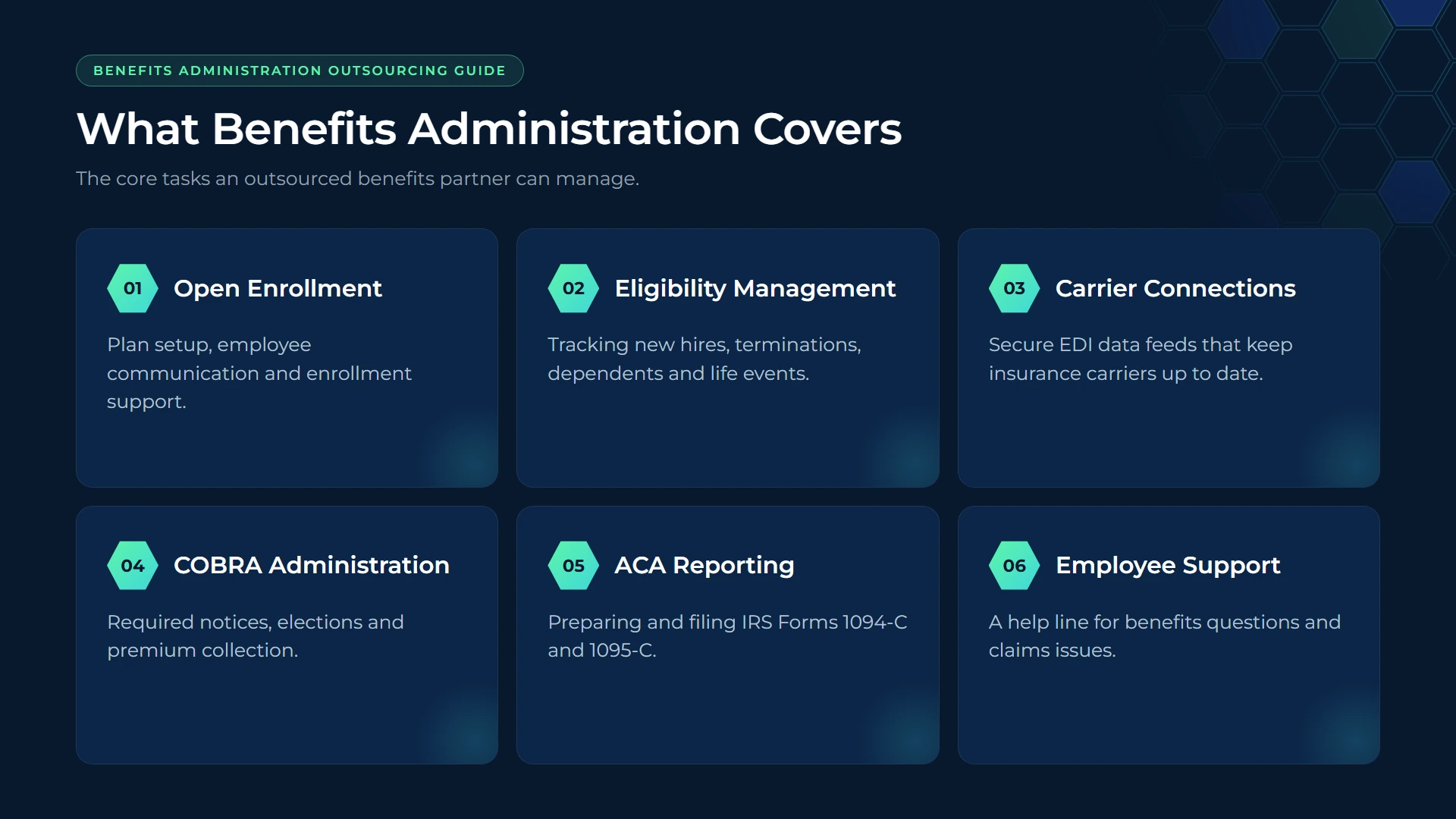
What's Typically Included
- Open enrollment setup, communication, and election processing
- Carrier connectivity and electronic data interchange (EDI) feeds
- COBRA administration and qualifying event notices
- ACA reporting (Forms 1094-C and 1095-C) and affordability tracking
- FSA administration, including debit card issuance and claim substantiation, and HSA administration, which may include debit card issuance but does not include FSA-style claim substantiation
- Life event processing (marriage, birth, divorce, termination)
- Employee self-service portals and call center support
Why Companies Outsource Benefits Administration
Most organizations don't outsource because they love the idea of a vendor relationship. They outsource because the alternative — building and maintaining in-house expertise across benefits law, carrier integrations, and employee communications — gets expensive and risky fast.
A small HR team managing benefits manually is one bad hire away from missing an ACA deadline or mishandling a COBRA notice, and penalties for those mistakes aren't small. Outsourcing shifts that compliance burden onto a provider whose entire business depends on getting it right.
There's also a scale argument. A 40-person company doesn't need a full-time benefits specialist, but it does need the work done correctly. Outsourcing bridges that gap without adding headcount.

Simplify Benefits Administration for Your Team
At NeoWork, we support the employment side of building a dedicated offshore team, including benefits and ongoing teammate support. That gives your internal team fewer administrative tasks to manage after a new hire joins.
Working with us helps you:
- Keep benefits support connected to the rest of the employment process
- Reduce routine people-management administration
- Give teammates ongoing support after onboarding
- Maintain continuity as your outsourced team grows
Contact us to discuss the team you want to build and the employee support you want us to handle.
PEO vs ASO vs TPA vs Software: What's the Difference?
This is where a lot of the confusion lives. The terms get thrown around interchangeably, but they describe genuinely different relationships.
None of these is universally "better." A PEO can be a great fit for a 15-person startup trying to offer competitive benefits without enterprise-level premiums. An ASO might suit a 300-person company that already negotiated solid carrier contracts but wants help with the administrative load. Software alone works when HR already has the expertise and just needs fewer manual steps.
What Does Benefits Administration Outsourcing Cost?
Pricing varies widely based on scope, company size, and whether the service is bundled with payroll or broader HR support. As a general range, per-employee-per-month fees can run anywhere from roughly $4 for a basic software platform up to $50 or more for full-service PEO arrangements that include broker support, compliance consulting, and dedicated account management. Exact pricing changes by provider and year, so always confirm current rates directly with any vendor under consideration.
Beyond the headline per-employee fee, watch for setup charges, carrier integration fees, COBRA administration add-ons, and minimum monthly contracts. A quote that looks cheap on paper can balloon once those extras get added in.
In-House vs Outsourced: Pros and Cons
Neither approach is automatically right. Here's how the tradeoffs usually shake out.
Smaller teams tend to lean toward outsourcing simply because the compliance stakes outweigh the cost of a vendor relationship. Larger organizations with mature HR departments sometimes keep administration in-house but layer in software to reduce manual work — a middle path that's become increasingly common.
Compliance: Why This Is the Real Risk
Compliance is the quiet reason most companies eventually outsource. Benefits administration touches ERISA, COBRA, HIPAA, and ACA requirements simultaneously, and each carries its own penalty structure for mistakes. A missed COBRA notice alone can trigger statutory penalties per day, per affected individual — the kind of exposure that makes a modest monthly outsourcing fee look like cheap insurance.
ACA reporting deadlines are a particular pain point. Forms 1094-C and 1095-C still have to be filed with the IRS on a fixed schedule every year for applicable large employers. Automatic delivery of Form 1095-C to every employee is no longer required federally: under the Paperwork Burden Reduction Act and IRS Notice 2025-15, an employer can meet the furnishing rule with a clear website notice and by providing the form on request. Some states still require ordinary distribution. Errors or late IRS filings draw per-form penalties. A provider that specializes in this work has systems built specifically to avoid missing those windows — something a generalist HR team juggling a dozen other priorities can struggle to replicate consistently.
How to Choose a Benefits Administration Partner
Picking a provider isn't just about price. A few things matter more than the quote on page one of the proposal:
- Carrier connectivity: Does the provider already integrate with the specific carriers the company uses, or will new EDI feeds need to be built?
- Support model: Is there a dedicated account manager, or does every question go into a generic support queue?
- Compliance guarantees: Does the contract include any liability protection or indemnification for filing errors?
- Implementation timeline: How long does onboarding typically take, and what does the company need to prepare?
- Exit terms: What happens to historical data and ongoing COBRA obligations if the relationship ends?
Asking for references from companies of similar size and industry tends to reveal more than any sales deck. So does a direct question about what happens when something goes wrong — a provider that has a clear answer for that is usually the safer bet.
Making the Transition Smooth
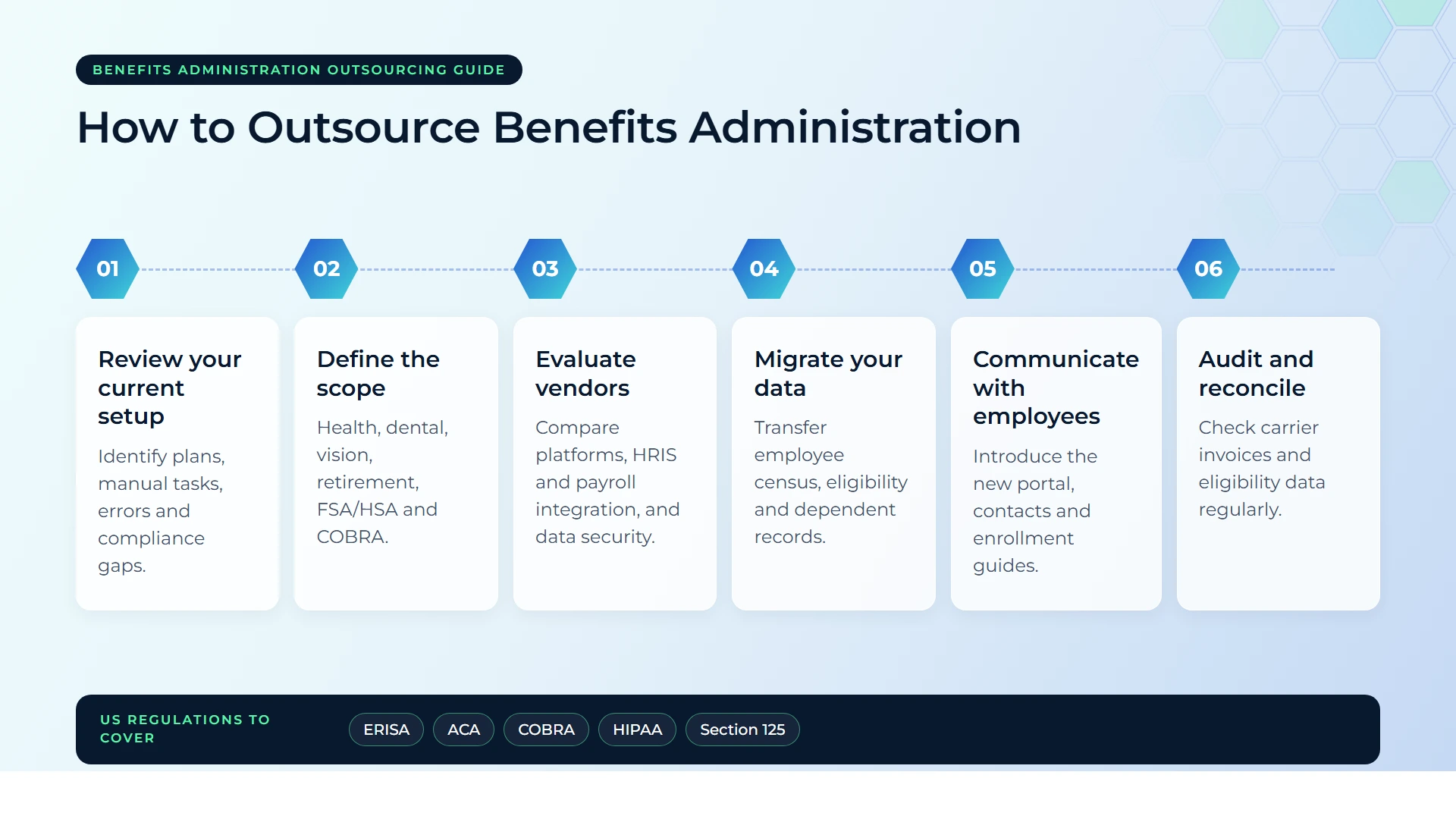
Switching benefits administration mid-year is possible but adds complexity — most companies time the transition to align with their plan renewal date or the start of open enrollment. That gives the new provider a clean slate instead of migrating mid-stream elections and partial COBRA cases.
Clear communication to employees matters too. A new portal, a new support number, and a new enrollment process can feel disruptive if nobody explains why it's happening. A short internal announcement, paired with a walkthrough session before open enrollment opens, tends to smooth most of that friction out.
Final Thoughts
Benefits administration outsourcing isn't a one-size-fits-all decision, but for most growing companies it ends up being less about convenience and more about risk management. The deadlines are real, the penalties are real, and employee trust takes a hit every time a benefits question goes unanswered or an enrollment gets botched.
Start by mapping out which tasks are consuming the most internal time and causing the most errors, then compare that against what a PEO, ASO, TPA, or software platform would actually take off the plate. Request a few proposals, ask hard questions about compliance support, and talk to existing clients before signing anything. Getting this right once tends to save a lot of headaches later.
Topics
Benefits Administration Outsourcing Guide for 2026

Quick Summary: Benefits administration outsourcing means handing off tasks like open enrollment, COBRA, ACA reporting, and carrier connectivity to a specialized provider — typically a PEO, ASO, TPA, or benefits software platform. Costs generally run from a few dollars to $50 or more per employee per month depending on scope. The right choice depends on company size, in-house HR capacity, and how much compliance risk a business is willing to manage internally.
Open enrollment season has a way of exposing every crack in an HR team's workflow. Spreadsheets get out of sync with carrier systems, COBRA notices go out late, and someone inevitably spends a Friday afternoon chasing down a missing I-9. Benefits administration outsourcing exists precisely because this stuff is tedious, high-stakes, and genuinely hard to do well with a lean team.
This guide walks through what outsourcing actually covers, what it tends to cost, how the main provider models differ, and how to decide whether handing it off makes sense for a given organization. No fluff — just the practical details that matter when evaluating a benefits partner.
What Is Benefits Administration Outsourcing?
At its core, benefits administration outsourcing is the practice of delegating the day-to-day management of employee benefits programs to an external provider. That typically includes enrollment processing, carrier billing reconciliation, compliance filings, and employee support — the operational grind that sits behind every health plan, retirement account, and voluntary benefit a company offers.
Instead of an HR generalist manually updating spreadsheets and emailing carriers every time someone gets married or has a baby, a dedicated system (and often a team of specialists) handles it. Some providers offer pure software; others pair software with a service team that fields employee questions directly.
What's Typically Included
- Open enrollment setup, communication, and election processing
- Carrier connectivity and electronic data interchange (EDI) feeds
- COBRA administration and qualifying event notices
- ACA reporting (Forms 1094-C and 1095-C) and affordability tracking
- FSA administration, including debit card issuance and claim substantiation, and HSA administration, which may include debit card issuance but does not include FSA-style claim substantiation
- Life event processing (marriage, birth, divorce, termination)
- Employee self-service portals and call center support
Why Companies Outsource Benefits Administration
Most organizations don't outsource because they love the idea of a vendor relationship. They outsource because the alternative — building and maintaining in-house expertise across benefits law, carrier integrations, and employee communications — gets expensive and risky fast.
A small HR team managing benefits manually is one bad hire away from missing an ACA deadline or mishandling a COBRA notice, and penalties for those mistakes aren't small. Outsourcing shifts that compliance burden onto a provider whose entire business depends on getting it right.
There's also a scale argument. A 40-person company doesn't need a full-time benefits specialist, but it does need the work done correctly. Outsourcing bridges that gap without adding headcount.
Simplify Benefits Administration for Your Team
At NeoWork, we support the employment side of building a dedicated offshore team, including benefits and ongoing teammate support. That gives your internal team fewer administrative tasks to manage after a new hire joins.
Working with us helps you:
- Keep benefits support connected to the rest of the employment process
- Reduce routine people-management administration
- Give teammates ongoing support after onboarding
- Maintain continuity as your outsourced team grows
Contact us to discuss the team you want to build and the employee support you want us to handle.
PEO vs ASO vs TPA vs Software: What's the Difference?
This is where a lot of the confusion lives. The terms get thrown around interchangeably, but they describe genuinely different relationships.
None of these is universally "better." A PEO can be a great fit for a 15-person startup trying to offer competitive benefits without enterprise-level premiums. An ASO might suit a 300-person company that already negotiated solid carrier contracts but wants help with the administrative load. Software alone works when HR already has the expertise and just needs fewer manual steps.
What Does Benefits Administration Outsourcing Cost?
Pricing varies widely based on scope, company size, and whether the service is bundled with payroll or broader HR support. As a general range, per-employee-per-month fees can run anywhere from roughly $4 for a basic software platform up to $50 or more for full-service PEO arrangements that include broker support, compliance consulting, and dedicated account management. Exact pricing changes by provider and year, so always confirm current rates directly with any vendor under consideration.
Beyond the headline per-employee fee, watch for setup charges, carrier integration fees, COBRA administration add-ons, and minimum monthly contracts. A quote that looks cheap on paper can balloon once those extras get added in.
In-House vs Outsourced: Pros and Cons
Neither approach is automatically right. Here's how the tradeoffs usually shake out.
Smaller teams tend to lean toward outsourcing simply because the compliance stakes outweigh the cost of a vendor relationship. Larger organizations with mature HR departments sometimes keep administration in-house but layer in software to reduce manual work — a middle path that's become increasingly common.
Compliance: Why This Is the Real Risk
Compliance is the quiet reason most companies eventually outsource. Benefits administration touches ERISA, COBRA, HIPAA, and ACA requirements simultaneously, and each carries its own penalty structure for mistakes. A missed COBRA notice alone can trigger statutory penalties per day, per affected individual — the kind of exposure that makes a modest monthly outsourcing fee look like cheap insurance.
ACA reporting deadlines are a particular pain point. Forms 1094-C and 1095-C still have to be filed with the IRS on a fixed schedule every year for applicable large employers. Automatic delivery of Form 1095-C to every employee is no longer required federally: under the Paperwork Burden Reduction Act and IRS Notice 2025-15, an employer can meet the furnishing rule with a clear website notice and by providing the form on request. Some states still require ordinary distribution. Errors or late IRS filings draw per-form penalties. A provider that specializes in this work has systems built specifically to avoid missing those windows — something a generalist HR team juggling a dozen other priorities can struggle to replicate consistently.
How to Choose a Benefits Administration Partner
Picking a provider isn't just about price. A few things matter more than the quote on page one of the proposal:
- Carrier connectivity: Does the provider already integrate with the specific carriers the company uses, or will new EDI feeds need to be built?
- Support model: Is there a dedicated account manager, or does every question go into a generic support queue?
- Compliance guarantees: Does the contract include any liability protection or indemnification for filing errors?
- Implementation timeline: How long does onboarding typically take, and what does the company need to prepare?
- Exit terms: What happens to historical data and ongoing COBRA obligations if the relationship ends?
Asking for references from companies of similar size and industry tends to reveal more than any sales deck. So does a direct question about what happens when something goes wrong — a provider that has a clear answer for that is usually the safer bet.
Making the Transition Smooth
Switching benefits administration mid-year is possible but adds complexity — most companies time the transition to align with their plan renewal date or the start of open enrollment. That gives the new provider a clean slate instead of migrating mid-stream elections and partial COBRA cases.
Clear communication to employees matters too. A new portal, a new support number, and a new enrollment process can feel disruptive if nobody explains why it's happening. A short internal announcement, paired with a walkthrough session before open enrollment opens, tends to smooth most of that friction out.
Final Thoughts
Benefits administration outsourcing isn't a one-size-fits-all decision, but for most growing companies it ends up being less about convenience and more about risk management. The deadlines are real, the penalties are real, and employee trust takes a hit every time a benefits question goes unanswered or an enrollment gets botched.
Start by mapping out which tasks are consuming the most internal time and causing the most errors, then compare that against what a PEO, ASO, TPA, or software platform would actually take off the plate. Request a few proposals, ask hard questions about compliance support, and talk to existing clients before signing anything. Getting this right once tends to save a lot of headaches later.
Topics
Related Blogs
Related Podcasts