

Updated:
Oct 4
2026
.avif)
.avif)


.svg)

Quick Summary: Software outsourcing means hiring an external team or company to build, maintain, or scale your product instead of relying solely on in-house staff. The right model depends on project scope, budget, and how much control you want to retain. This guide walks through outsourcing models, realistic 2026 cost ranges, vetting steps, and the mistakes that sink most engagements.
Every founder eventually hits the same wall: there's more product to build than there are hands to build it. Hiring full-time engineers takes months and real money. So teams turn to outsourcing instead — bringing in external developers to fill the gap quickly.
Done right, outsourcing software development stretches a budget further and gets products to market faster. Done poorly, it turns into missed deadlines, rewritten codebases, and awkward calls explaining why the launch slipped again. The difference usually comes down to picking the right model and the right partner, not luck.
This guide breaks down how outsourcing actually works in practice, what it costs in 2026, and how to avoid the traps that catch first-timers.
Software outsourcing is the practice of contracting an external company or individual to handle development work — anything from a single feature to an entire product build. It's different from freelancing in scale and different from staff augmentation in structure, though the lines blur depending on the vendor.
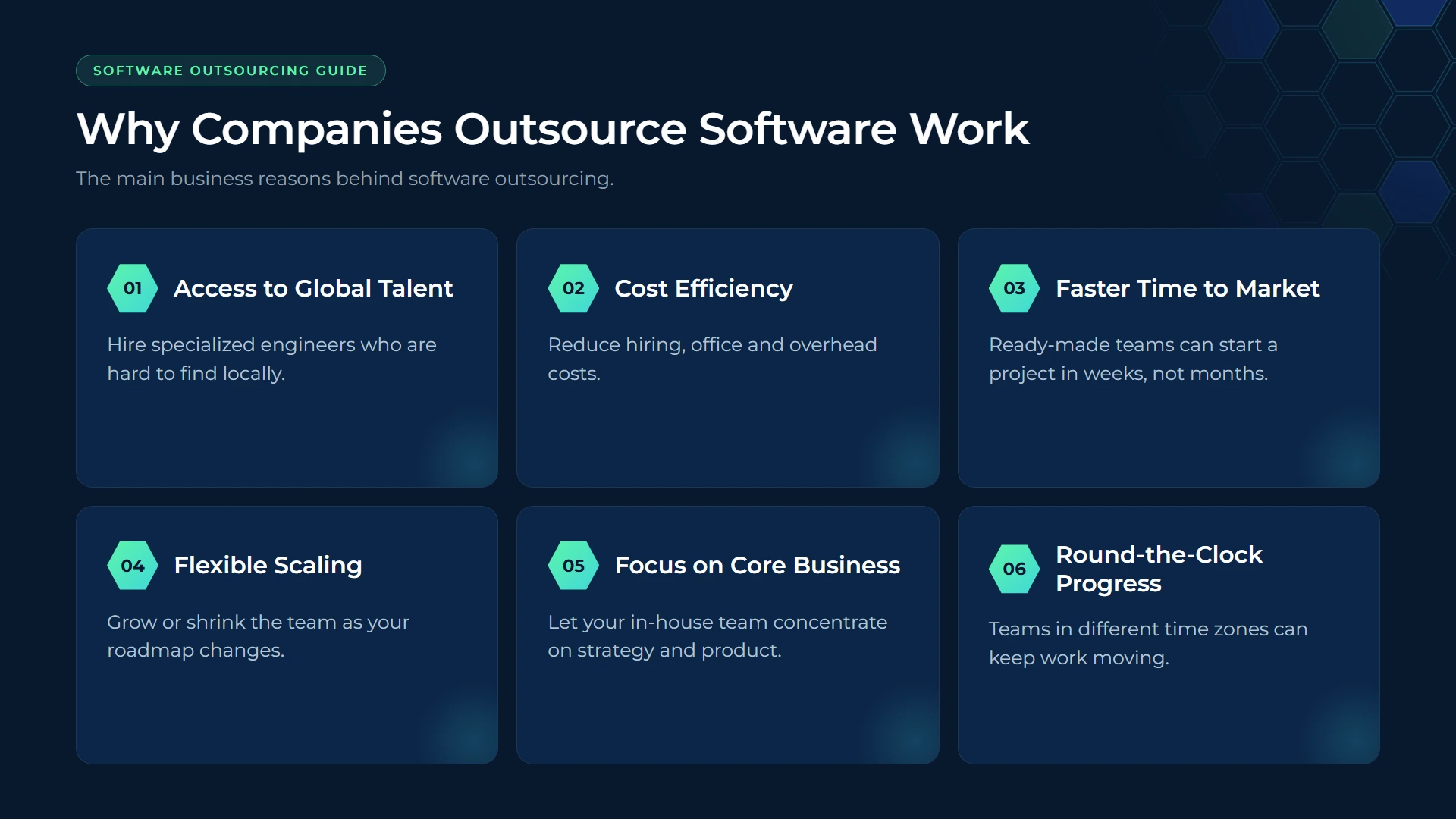
Companies outsource for a few core reasons: cost savings, access to specialized skills not available locally, faster hiring, and the ability to scale a team up or down without the overhead of permanent employees. None of that is new. What's changed in recent years is how distributed teams have become normal rather than exceptional — remote-first work made outsourcing feel far less risky than it used to.
Most vendors pitch their services under one of three umbrellas. Picking between them shapes everything downstream, from contracts to how much day-to-day management a project needs.
There's also the question of location. Onshore means the vendor is in the same country; nearshore means a neighboring region with overlapping time zones; offshore means a distant country, often with a significant time difference but lower rates. Each has trade-offs worth weighing against the project's communication needs.

Software outsourcing helps companies add technical capacity for development, testing, maintenance, and related engineering workflows without building every role internally. At NeoWork, we provide remote teammates who can support software functions within your existing product and engineering environment. We handle recruitment, benefits, training, and ongoing engagement, while our teammates work inside your tools, processes, and delivery workflows. Our 91% annualized teammate retention rate and 3.2% candidate selectivity rate reflect our focus on selective hiring and longer-term team stability.
Our software outsourcing model offers:
Contact NeoWork to add software support that fits your existing delivery process.
Pricing varies wildly by region, seniority, and specialization — there's no single number that applies everywhere. As a general guide, hourly rates tend to run roughly $15-$35 in South Asia and parts of Southeast Asia, $25-$55 in Latin America and Eastern Europe, and $70-$150+ for onshore teams in North America or Western Europe. Specialized skills, like AI engineering or security, push rates above these ranges regardless of location.
Those figures move with market conditions and currency fluctuations, so treat them as a planning baseline rather than a quote. Always confirm current rates directly with shortlisted vendors before budgeting a project.
Cost isn't just the hourly rate, either. Factor in onboarding time, communication overhead, project management, and the inevitable rework when requirements weren't crystal clear from day one. A cheap rate that triples the timeline isn't actually cheap.
Outsourcing isn't a universal win. It solves specific problems and introduces specific new ones — worth looking at both sides honestly before committing.
None of these risks are dealbreakers on their own. They're just things a contract, a clear process, and a decent vetting process can mitigate. The teams that get burned usually skipped one of those three.
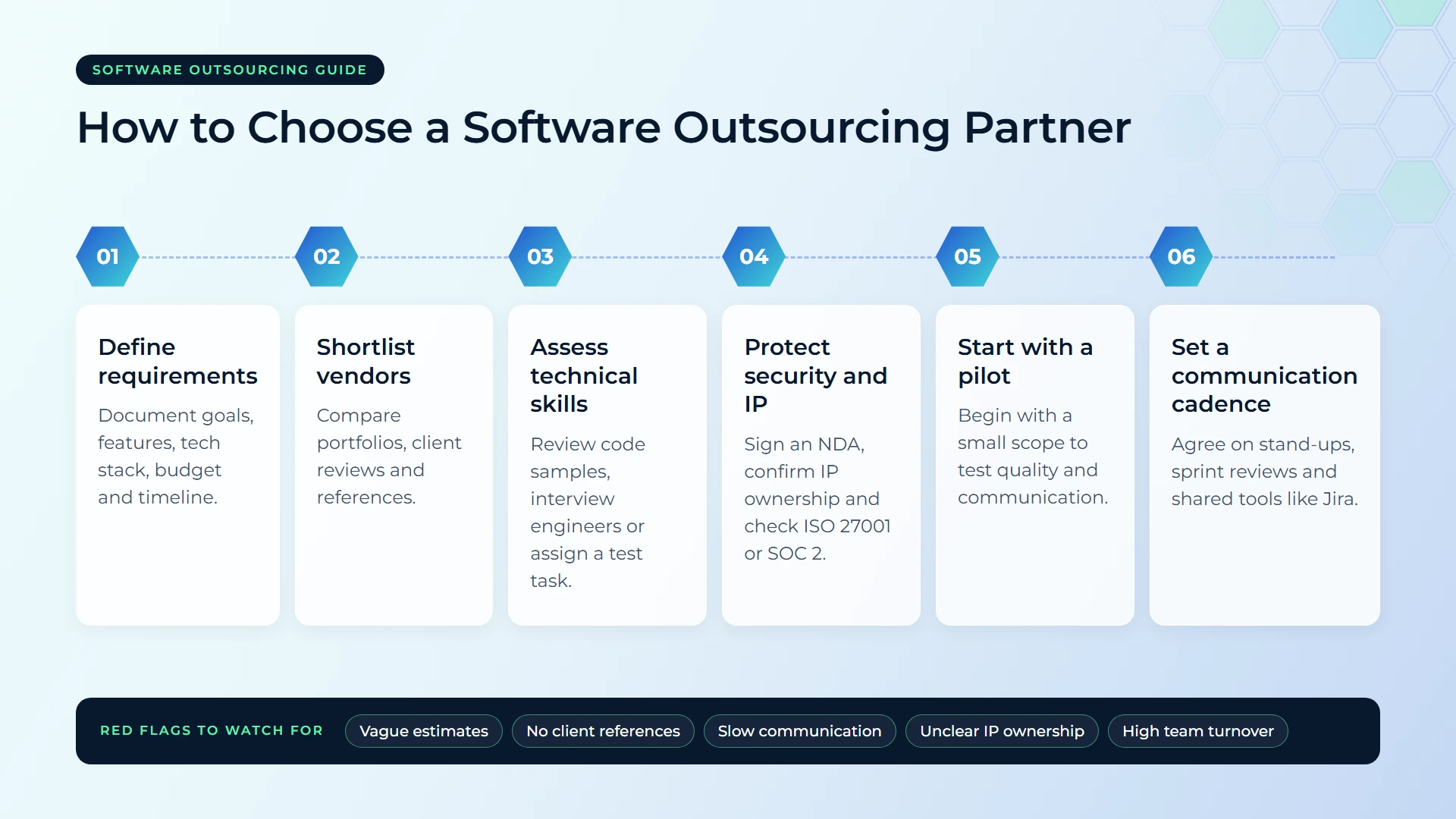
This is where most guides get vague. Concretely, here's what actually separates a solid partner from a problematic one.
A vendor's past work matters less for its polish and more for its relevance. A team that's built e-commerce platforms for five years isn't automatically equipped to handle a real-time trading system. Ask for case studies that map closely to the project at hand, not just a highlight reel.
Sales calls are run by salespeople. Insist on speaking with the developers, tech lead, or architect who would actually work on the project before signing anything. Technical depth shows up fast in conversation — or it doesn't show up at all.
Response times, clarity of written updates, willingness to push back on a bad requirement — these surface within the first few email threads. A vendor that's slow or vague before the contract is signed won't magically improve after.
Intellectual property ownership, data handling, non-disclosure terms — these need to be explicit, not assumed. Vague contracts are where disputes start months later.
A paid trial project, or a limited first sprint, reveals more about a vendor's real capability than any pitch deck. It's a small cost against the risk of a six-month commitment gone wrong.
Picking the right partner is half the job. Managing the relationship well is the other half, and it's where a lot of companies underinvest.
Here's the thing though — outsourcing works best when it's treated like an extension of the team, not a vendor transaction handled at arm's length. The companies that get the most value tend to involve outsourced developers in planning discussions, not just execution.
Outsourcing isn't a replacement for in-house teams in every case — it's a tool for specific situations. It tends to make the most sense for short-term scaling, specialized one-off projects, or when speed matters more than deep institutional knowledge. In-house hiring wins when the work touches core IP long-term, or when day-to-day collaboration needs to be tight and immediate.
Plenty of companies land somewhere in between: a lean in-house core team handling architecture and product direction, with an outsourced team executing features under their guidance. That hybrid setup often captures the benefits of both without fully committing to either extreme.
Software outsourcing isn't a shortcut, and it isn't a gamble either — it's a tool that works when matched to the right project and paired with the right partner. Start with a clear scope, vet thoroughly, start small, and manage the relationship like it's part of the team. Do that, and outsourcing becomes one of the more reliable ways to ship software without blowing up the budget or the timeline.
Ready to start? Shortlist two or three vendors, run a small paid trial project with each, and compare not just the code they ship but how they communicate along the way. That trial tells you more than any sales pitch will.

Quick Summary: Software outsourcing means hiring an external team or company to build, maintain, or scale your product instead of relying solely on in-house staff. The right model depends on project scope, budget, and how much control you want to retain. This guide walks through outsourcing models, realistic 2026 cost ranges, vetting steps, and the mistakes that sink most engagements.
Every founder eventually hits the same wall: there's more product to build than there are hands to build it. Hiring full-time engineers takes months and real money. So teams turn to outsourcing instead — bringing in external developers to fill the gap quickly.
Done right, outsourcing software development stretches a budget further and gets products to market faster. Done poorly, it turns into missed deadlines, rewritten codebases, and awkward calls explaining why the launch slipped again. The difference usually comes down to picking the right model and the right partner, not luck.
This guide breaks down how outsourcing actually works in practice, what it costs in 2026, and how to avoid the traps that catch first-timers.
Software outsourcing is the practice of contracting an external company or individual to handle development work — anything from a single feature to an entire product build. It's different from freelancing in scale and different from staff augmentation in structure, though the lines blur depending on the vendor.
Companies outsource for a few core reasons: cost savings, access to specialized skills not available locally, faster hiring, and the ability to scale a team up or down without the overhead of permanent employees. None of that is new. What's changed in recent years is how distributed teams have become normal rather than exceptional — remote-first work made outsourcing feel far less risky than it used to.
Most vendors pitch their services under one of three umbrellas. Picking between them shapes everything downstream, from contracts to how much day-to-day management a project needs.
There's also the question of location. Onshore means the vendor is in the same country; nearshore means a neighboring region with overlapping time zones; offshore means a distant country, often with a significant time difference but lower rates. Each has trade-offs worth weighing against the project's communication needs.
Software outsourcing helps companies add technical capacity for development, testing, maintenance, and related engineering workflows without building every role internally. At NeoWork, we provide remote teammates who can support software functions within your existing product and engineering environment. We handle recruitment, benefits, training, and ongoing engagement, while our teammates work inside your tools, processes, and delivery workflows. Our 91% annualized teammate retention rate and 3.2% candidate selectivity rate reflect our focus on selective hiring and longer-term team stability.
Our software outsourcing model offers:
Contact NeoWork to add software support that fits your existing delivery process.
Pricing varies wildly by region, seniority, and specialization — there's no single number that applies everywhere. As a general guide, hourly rates tend to run roughly $15-$35 in South Asia and parts of Southeast Asia, $25-$55 in Latin America and Eastern Europe, and $70-$150+ for onshore teams in North America or Western Europe. Specialized skills, like AI engineering or security, push rates above these ranges regardless of location.
Those figures move with market conditions and currency fluctuations, so treat them as a planning baseline rather than a quote. Always confirm current rates directly with shortlisted vendors before budgeting a project.
Cost isn't just the hourly rate, either. Factor in onboarding time, communication overhead, project management, and the inevitable rework when requirements weren't crystal clear from day one. A cheap rate that triples the timeline isn't actually cheap.
Outsourcing isn't a universal win. It solves specific problems and introduces specific new ones — worth looking at both sides honestly before committing.
None of these risks are dealbreakers on their own. They're just things a contract, a clear process, and a decent vetting process can mitigate. The teams that get burned usually skipped one of those three.
This is where most guides get vague. Concretely, here's what actually separates a solid partner from a problematic one.
A vendor's past work matters less for its polish and more for its relevance. A team that's built e-commerce platforms for five years isn't automatically equipped to handle a real-time trading system. Ask for case studies that map closely to the project at hand, not just a highlight reel.
Sales calls are run by salespeople. Insist on speaking with the developers, tech lead, or architect who would actually work on the project before signing anything. Technical depth shows up fast in conversation — or it doesn't show up at all.
Response times, clarity of written updates, willingness to push back on a bad requirement — these surface within the first few email threads. A vendor that's slow or vague before the contract is signed won't magically improve after.
Intellectual property ownership, data handling, non-disclosure terms — these need to be explicit, not assumed. Vague contracts are where disputes start months later.
A paid trial project, or a limited first sprint, reveals more about a vendor's real capability than any pitch deck. It's a small cost against the risk of a six-month commitment gone wrong.
Picking the right partner is half the job. Managing the relationship well is the other half, and it's where a lot of companies underinvest.
Here's the thing though — outsourcing works best when it's treated like an extension of the team, not a vendor transaction handled at arm's length. The companies that get the most value tend to involve outsourced developers in planning discussions, not just execution.
Outsourcing isn't a replacement for in-house teams in every case — it's a tool for specific situations. It tends to make the most sense for short-term scaling, specialized one-off projects, or when speed matters more than deep institutional knowledge. In-house hiring wins when the work touches core IP long-term, or when day-to-day collaboration needs to be tight and immediate.
Plenty of companies land somewhere in between: a lean in-house core team handling architecture and product direction, with an outsourced team executing features under their guidance. That hybrid setup often captures the benefits of both without fully committing to either extreme.
Software outsourcing isn't a shortcut, and it isn't a gamble either — it's a tool that works when matched to the right project and paired with the right partner. Start with a clear scope, vet thoroughly, start small, and manage the relationship like it's part of the team. Do that, and outsourcing becomes one of the more reliable ways to ship software without blowing up the budget or the timeline.
Ready to start? Shortlist two or three vendors, run a small paid trial project with each, and compare not just the code they ship but how they communicate along the way. That trial tells you more than any sales pitch will.