

Updated:
Oct 4
2026
.avif)
.avif)


.svg)

Quick Summary: Software development outsourcing means hiring an external team or company to design, build, test, or maintain software instead of relying solely on in-house staff. Done right, it cuts costs, speeds up delivery, and opens access to specialized talent that's hard to find locally. Done poorly, it leads to communication breakdowns, quality issues, and budget overruns. This guide breaks down the engagement models, real costs, risks, and a practical process for choosing a partner in 2026.
Outsourcing software development used to be a dirty word in some boardrooms. It conjured images of cheap offshore teams, missed deadlines, and code nobody wanted to touch again. That reputation is mostly outdated now.
Today, outsourcing is how startups ship MVPs in months instead of a year, how enterprises plug skill gaps during AI and cloud migrations, and how lean teams scale up for a single project without the overhead of permanent hires. The practice hasn't changed so much as the tooling, talent pool, and expectations around it have matured.
This guide walks through how outsourcing actually works, which engagement model fits which situation, what it realistically costs, and how to avoid the pitfalls that still trip up companies every year.
Software development outsourcing is the practice of delegating part or all of a software project — design, coding, testing, or ongoing maintenance — to a third-party team rather than building everything with internal staff. That external team might sit in the same city, the same country, or on the other side of the world. The location matters enough that the industry generally splits outsourcing into three main models.
Onshore outsourcing means hiring a development team in the same country. It usually makes time-zone coordination, communication, contracting, and legal compliance simpler, although costs tend to be higher than nearshore or offshore alternatives.
Nearshore outsourcing involves hiring a team in a neighboring or nearby region with overlapping working hours. It is especially common for North American companies working with teams in Latin America and Western European businesses partnering with developers in Eastern Europe.
Offshore outsourcing means working with teams in more distant countries, commonly India, Vietnam, or the Philippines. This model is often chosen for lower hourly rates and access to larger talent pools, though it may require more planning around time-zone differences and communication.
None of these models is universally "best." The right choice depends on budget, how much real-time collaboration the project needs, and how much internal bandwidth exists to manage an external team.
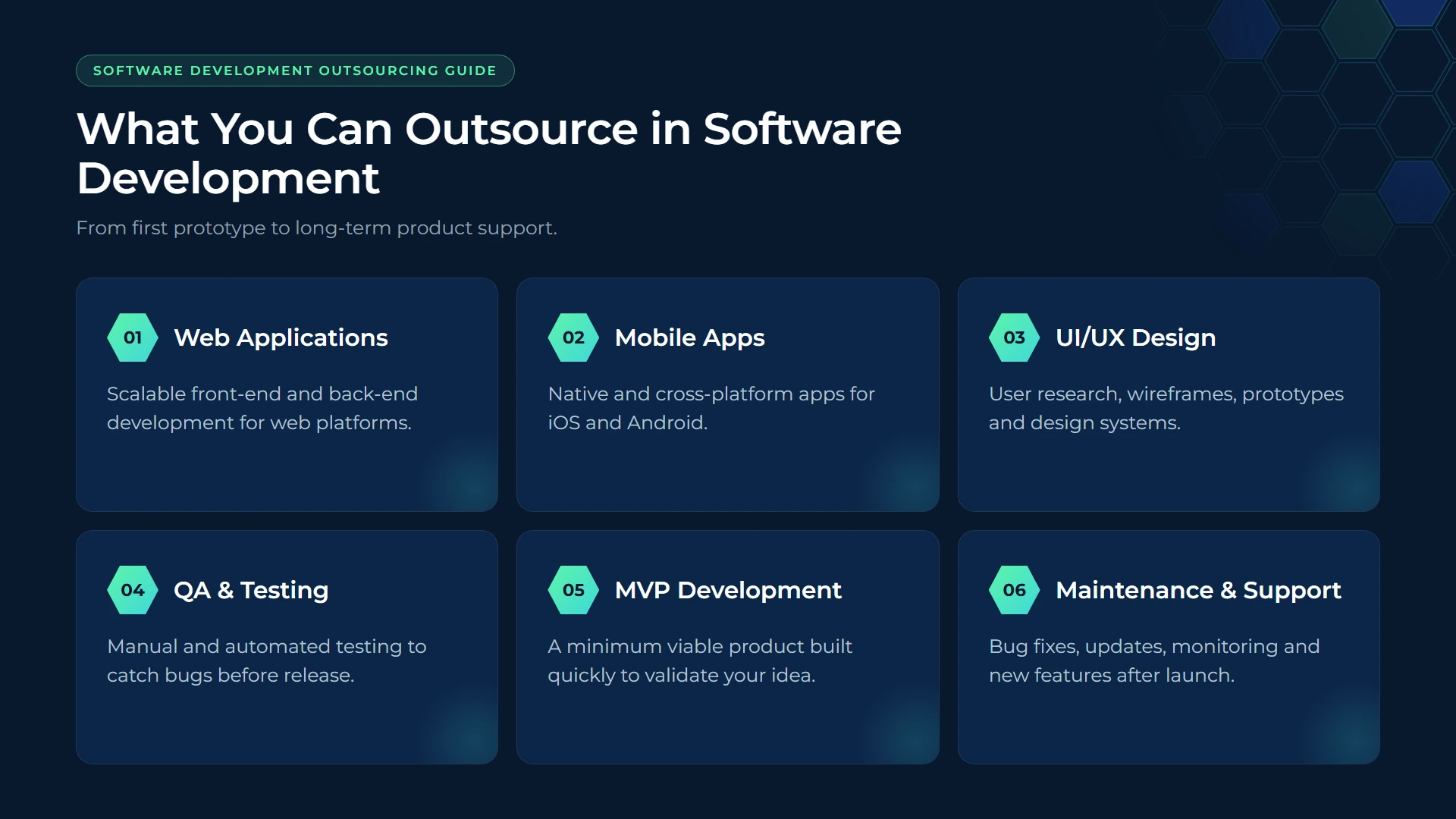
Cost is the headline reason, but it's rarely the only one. Teams outsource because hiring senior engineers locally can take months, because a project needs a skill set — say, a specific AI framework or legacy mainframe language — that nobody on staff has, or because leadership wants to test a product idea without committing to permanent headcount.
There's also a flexibility argument. An outsourced team can ramp up for a six-month push and wind down afterward. Try doing that with full-time employees and HR will have opinions.
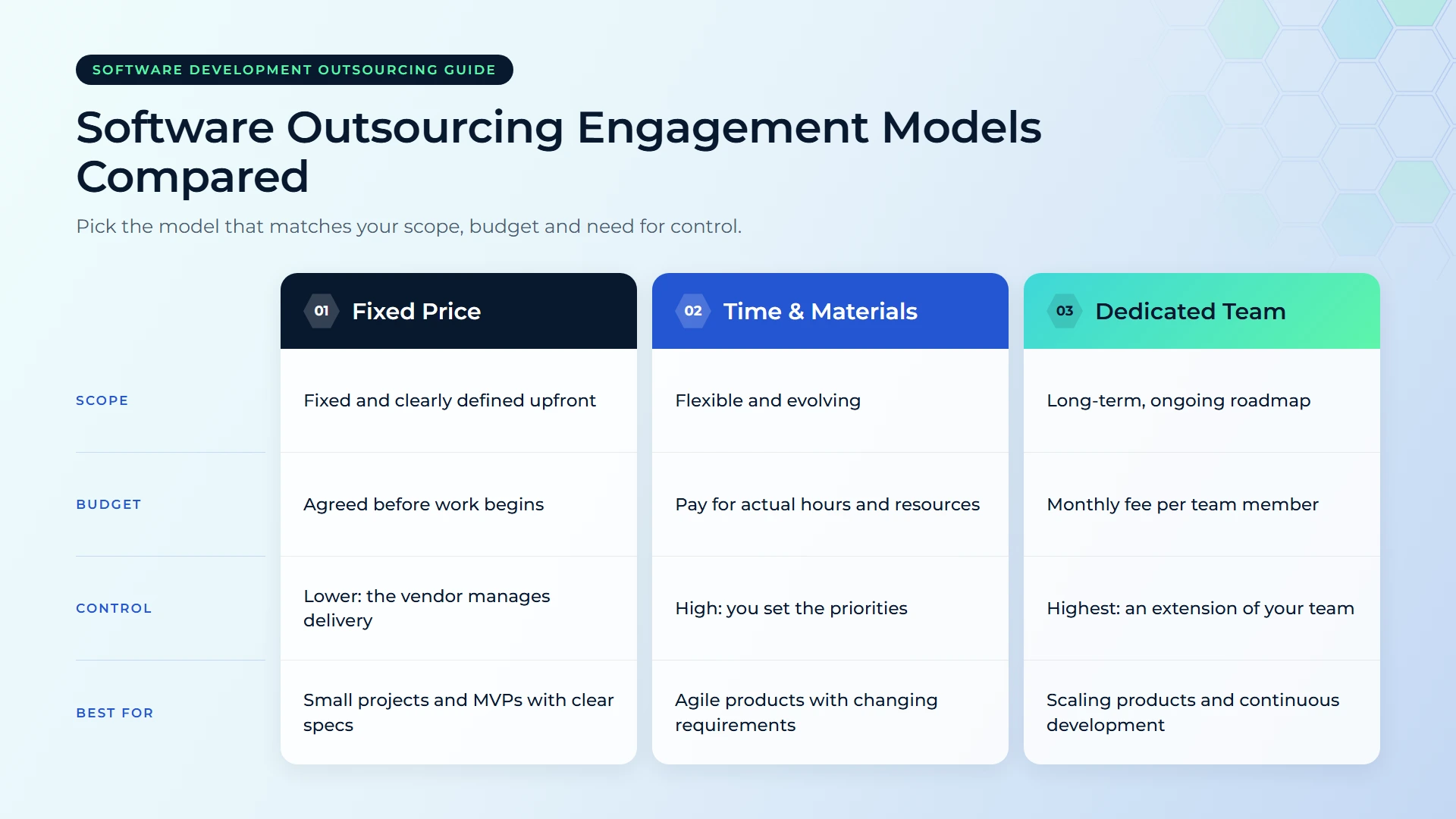
Most outsourcing arrangements fall into one of three structures. Picking the wrong one is probably the single most common reason projects go sideways.
Project-based outsourcing works well for a clearly scoped tool — a marketing site, a one-off internal app. It falls apart fast when requirements shift mid-project, which, let's be honest, they almost always do.
Dedicated teams suit products that will evolve for years: a SaaS platform, a fintech app, anything with a long roadmap. Staff augmentation is the pragmatic middle ground — bring in a senior DevOps engineer or two without restructuring the whole project.

Software development outsourcing helps companies add technical capacity for development, testing, maintenance, and related engineering workflows. At NeoWork, we provide remote teammates who can support software development functions as part of your existing product or engineering team. We handle recruitment, benefits, training, and ongoing engagement, while our teammates work inside your tools, processes, and delivery workflows. Our 91% annualized teammate retention rate and 3.2% candidate selectivity rate reflect our focus on selective hiring and longer-term team stability.
Our software development outsourcing model offers:
Contact NeoWork to add software development capacity that fits your existing delivery process.
Rates vary enormously by region and skill level, and anyone quoting a single number for "outsourcing cost" is oversimplifying. Eastern European developers typically charge less than Western European or North American ones but more than teams in South or Southeast Asia. Seniority matters more than location in most quotes — a senior architect in a lower-cost country can still cost more per hour than a junior developer somewhere pricier.
Rather than quote specific hourly figures here — rates shift with currency swings and market demand — it's worth checking a few outsourcing marketplaces or vendor directories for current pricing in the target region before budgeting a project.
What stays fairly constant is the cost structure itself:
A tempting low quote that skips QA or maintenance almost always costs more down the line in bug fixes and rework.
The advantages go beyond "it's cheaper," though cost reduction is real and often substantial when comparing fully-loaded in-house salaries, benefits, and office overhead against an external rate.
None of this is risk-free, and pretending otherwise does a disservice to anyone evaluating the decision.
Communication gaps are the most common complaint — time zone differences, language nuances, or simply a partner that doesn't ask enough clarifying questions. Quality control is another: without clear acceptance criteria and testing standards, "done" can mean very different things to a client and a vendor.
Intellectual property protection deserves real attention too. Contracts should spell out who owns the code, the data, and any custom tooling built during the engagement — and that should be settled before work starts, not after a dispute.
Vetting a vendor properly takes more than reading testimonials on their homepage. Look at their portfolio for projects genuinely similar in scale and domain — a company great at marketing websites isn't automatically great at healthcare compliance software.
Ask about their communication cadence before signing anything. How often will there be demos? Who's the single point of contact? What happens if a key developer leaves mid-project? These questions reveal more about day-to-day reality than any case study.
Technical due diligence matters too. A short paid pilot project — even a two-week sprint — tells a company far more about a vendor's actual working style than any sales call ever will.
Plenty of companies land on a hybrid: a small in-house core team that owns product vision, supplemented by an outsourced team for execution capacity. That blend often captures the upside of both approaches without fully committing to either one's weaknesses.
Outsourcing software development isn't a shortcut, and it isn't a gamble either — it's a tool. Used with a clear scope, the right engagement model, and realistic expectations about communication overhead, it can genuinely accelerate a product roadmap without blowing the budget.
The companies that get burned are usually the ones that skip due diligence, pick the cheapest quote without checking fit, or hand off a project with no documentation and hope for the best. Avoid those traps, run a small pilot before committing long-term, and outsourcing becomes a lot less risky than its reputation suggests.
Ready to evaluate outsourcing for an upcoming project? Start with a short paid pilot sprint with one or two shortlisted vendors before signing a long-term contract — it's the fastest way to separate real capability from a polished sales pitch.

Quick Summary: Software development outsourcing means hiring an external team or company to design, build, test, or maintain software instead of relying solely on in-house staff. Done right, it cuts costs, speeds up delivery, and opens access to specialized talent that's hard to find locally. Done poorly, it leads to communication breakdowns, quality issues, and budget overruns. This guide breaks down the engagement models, real costs, risks, and a practical process for choosing a partner in 2026.
Outsourcing software development used to be a dirty word in some boardrooms. It conjured images of cheap offshore teams, missed deadlines, and code nobody wanted to touch again. That reputation is mostly outdated now.
Today, outsourcing is how startups ship MVPs in months instead of a year, how enterprises plug skill gaps during AI and cloud migrations, and how lean teams scale up for a single project without the overhead of permanent hires. The practice hasn't changed so much as the tooling, talent pool, and expectations around it have matured.
This guide walks through how outsourcing actually works, which engagement model fits which situation, what it realistically costs, and how to avoid the pitfalls that still trip up companies every year.
Software development outsourcing is the practice of delegating part or all of a software project — design, coding, testing, or ongoing maintenance — to a third-party team rather than building everything with internal staff. That external team might sit in the same city, the same country, or on the other side of the world. The location matters enough that the industry generally splits outsourcing into three main models.
Onshore outsourcing means hiring a development team in the same country. It usually makes time-zone coordination, communication, contracting, and legal compliance simpler, although costs tend to be higher than nearshore or offshore alternatives.
Nearshore outsourcing involves hiring a team in a neighboring or nearby region with overlapping working hours. It is especially common for North American companies working with teams in Latin America and Western European businesses partnering with developers in Eastern Europe.
Offshore outsourcing means working with teams in more distant countries, commonly India, Vietnam, or the Philippines. This model is often chosen for lower hourly rates and access to larger talent pools, though it may require more planning around time-zone differences and communication.
None of these models is universally "best." The right choice depends on budget, how much real-time collaboration the project needs, and how much internal bandwidth exists to manage an external team.
Cost is the headline reason, but it's rarely the only one. Teams outsource because hiring senior engineers locally can take months, because a project needs a skill set — say, a specific AI framework or legacy mainframe language — that nobody on staff has, or because leadership wants to test a product idea without committing to permanent headcount.
There's also a flexibility argument. An outsourced team can ramp up for a six-month push and wind down afterward. Try doing that with full-time employees and HR will have opinions.
Most outsourcing arrangements fall into one of three structures. Picking the wrong one is probably the single most common reason projects go sideways.
Project-based outsourcing works well for a clearly scoped tool — a marketing site, a one-off internal app. It falls apart fast when requirements shift mid-project, which, let's be honest, they almost always do.
Dedicated teams suit products that will evolve for years: a SaaS platform, a fintech app, anything with a long roadmap. Staff augmentation is the pragmatic middle ground — bring in a senior DevOps engineer or two without restructuring the whole project.
Software development outsourcing helps companies add technical capacity for development, testing, maintenance, and related engineering workflows. At NeoWork, we provide remote teammates who can support software development functions as part of your existing product or engineering team. We handle recruitment, benefits, training, and ongoing engagement, while our teammates work inside your tools, processes, and delivery workflows. Our 91% annualized teammate retention rate and 3.2% candidate selectivity rate reflect our focus on selective hiring and longer-term team stability.
Our software development outsourcing model offers:
Contact NeoWork to add software development capacity that fits your existing delivery process.
Rates vary enormously by region and skill level, and anyone quoting a single number for "outsourcing cost" is oversimplifying. Eastern European developers typically charge less than Western European or North American ones but more than teams in South or Southeast Asia. Seniority matters more than location in most quotes — a senior architect in a lower-cost country can still cost more per hour than a junior developer somewhere pricier.
Rather than quote specific hourly figures here — rates shift with currency swings and market demand — it's worth checking a few outsourcing marketplaces or vendor directories for current pricing in the target region before budgeting a project.
What stays fairly constant is the cost structure itself:
A tempting low quote that skips QA or maintenance almost always costs more down the line in bug fixes and rework.
The advantages go beyond "it's cheaper," though cost reduction is real and often substantial when comparing fully-loaded in-house salaries, benefits, and office overhead against an external rate.
None of this is risk-free, and pretending otherwise does a disservice to anyone evaluating the decision.
Communication gaps are the most common complaint — time zone differences, language nuances, or simply a partner that doesn't ask enough clarifying questions. Quality control is another: without clear acceptance criteria and testing standards, "done" can mean very different things to a client and a vendor.
Intellectual property protection deserves real attention too. Contracts should spell out who owns the code, the data, and any custom tooling built during the engagement — and that should be settled before work starts, not after a dispute.
Vetting a vendor properly takes more than reading testimonials on their homepage. Look at their portfolio for projects genuinely similar in scale and domain — a company great at marketing websites isn't automatically great at healthcare compliance software.
Ask about their communication cadence before signing anything. How often will there be demos? Who's the single point of contact? What happens if a key developer leaves mid-project? These questions reveal more about day-to-day reality than any case study.
Technical due diligence matters too. A short paid pilot project — even a two-week sprint — tells a company far more about a vendor's actual working style than any sales call ever will.
Plenty of companies land on a hybrid: a small in-house core team that owns product vision, supplemented by an outsourced team for execution capacity. That blend often captures the upside of both approaches without fully committing to either one's weaknesses.
Outsourcing software development isn't a shortcut, and it isn't a gamble either — it's a tool. Used with a clear scope, the right engagement model, and realistic expectations about communication overhead, it can genuinely accelerate a product roadmap without blowing the budget.
The companies that get burned are usually the ones that skip due diligence, pick the cheapest quote without checking fit, or hand off a project with no documentation and hope for the best. Avoid those traps, run a small pilot before committing long-term, and outsourcing becomes a lot less risky than its reputation suggests.
Ready to evaluate outsourcing for an upcoming project? Start with a short paid pilot sprint with one or two shortlisted vendors before signing a long-term contract — it's the fastest way to separate real capability from a polished sales pitch.