

Updated:
Oct 4
2026
.avif)
.avif)


.svg)

Quick Summary: IT outsourcing means hiring an external provider to handle technology work like help desk support, cloud management, cybersecurity, or software development instead of building that capacity in-house. The right approach depends on matching a cooperation model—staff augmentation, managed services, or project-based—to your budget, control needs, and the complexity of the work. This guide walks through the models, realistic costs, common risks, and a practical process for picking a provider in 2026.
Every IT leader eventually hits the same wall: there's more work than headcount, and hiring takes too long. That's usually the moment outsourcing enters the conversation.
But handing technology functions to an outside team isn't a single decision—it's a spectrum of choices, from bringing in one contractor for a six-week project to turning over an entire department to a managed services partner. Get the model wrong and costs balloon or quality slips. Get it right and outsourcing becomes one of the more reliable levers for scaling a tech operation without scaling the org chart at the same pace.
This guide covers what IT outsourcing actually looks like in practice, the models worth knowing, what it tends to cost, the risks nobody mentions in the sales pitch, and a straightforward process for choosing a provider that won't become a liability six months in.
IT outsourcing is the practice of contracting an external company or individual to perform technology functions that a business would otherwise handle with internal staff. That can mean a single engineer filling a skills gap, or it can mean an entire vendor relationship running network operations, security monitoring, and application support around the clock.
It's distinct from simply buying software. With outsourcing, you're paying for people and process—expertise, labor, and often infrastructure—rather than a license. The provider takes on operational responsibility for a defined scope of work, and the client retains strategic ownership of the outcomes.
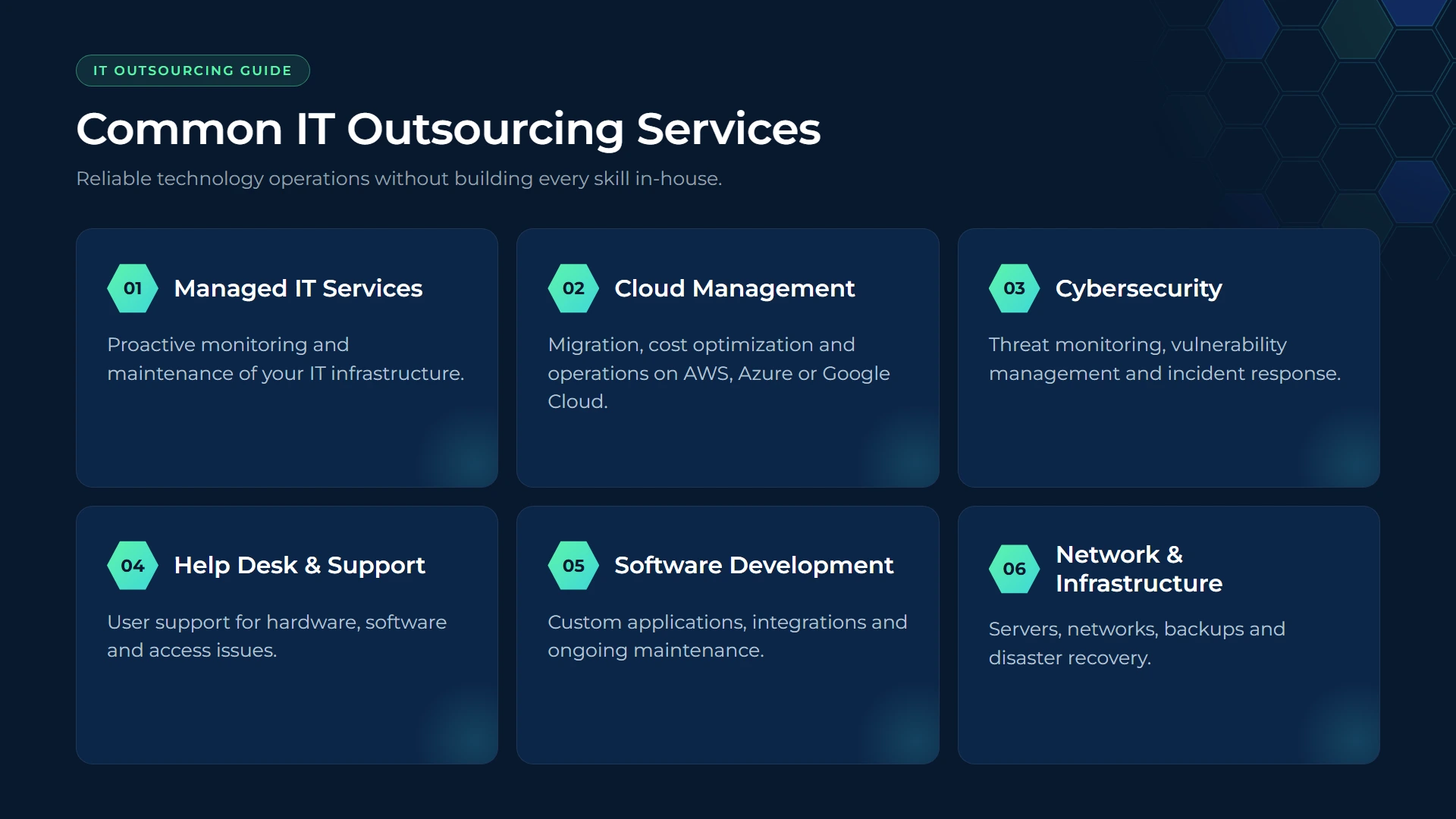
Common examples include help desk and service desk support, infrastructure and cloud operations, cybersecurity monitoring, custom software development, QA and testing, and data management. Some companies outsource a narrow slice of IT; others outsource nearly the whole function and keep only a small internal team for vendor oversight and strategy.
The reasons tend to repeat across industries, even if the emphasis shifts depending on company size.
None of this means outsourcing is automatically cheaper or better. It's a trade: businesses give up some direct control in exchange for flexibility and specialized skill. Whether that trade is worth it depends heavily on the model chosen.
Most IT outsourcing arrangements fall into a few recognizable patterns. Picking the wrong one is probably the single most common reason outsourcing relationships fail.
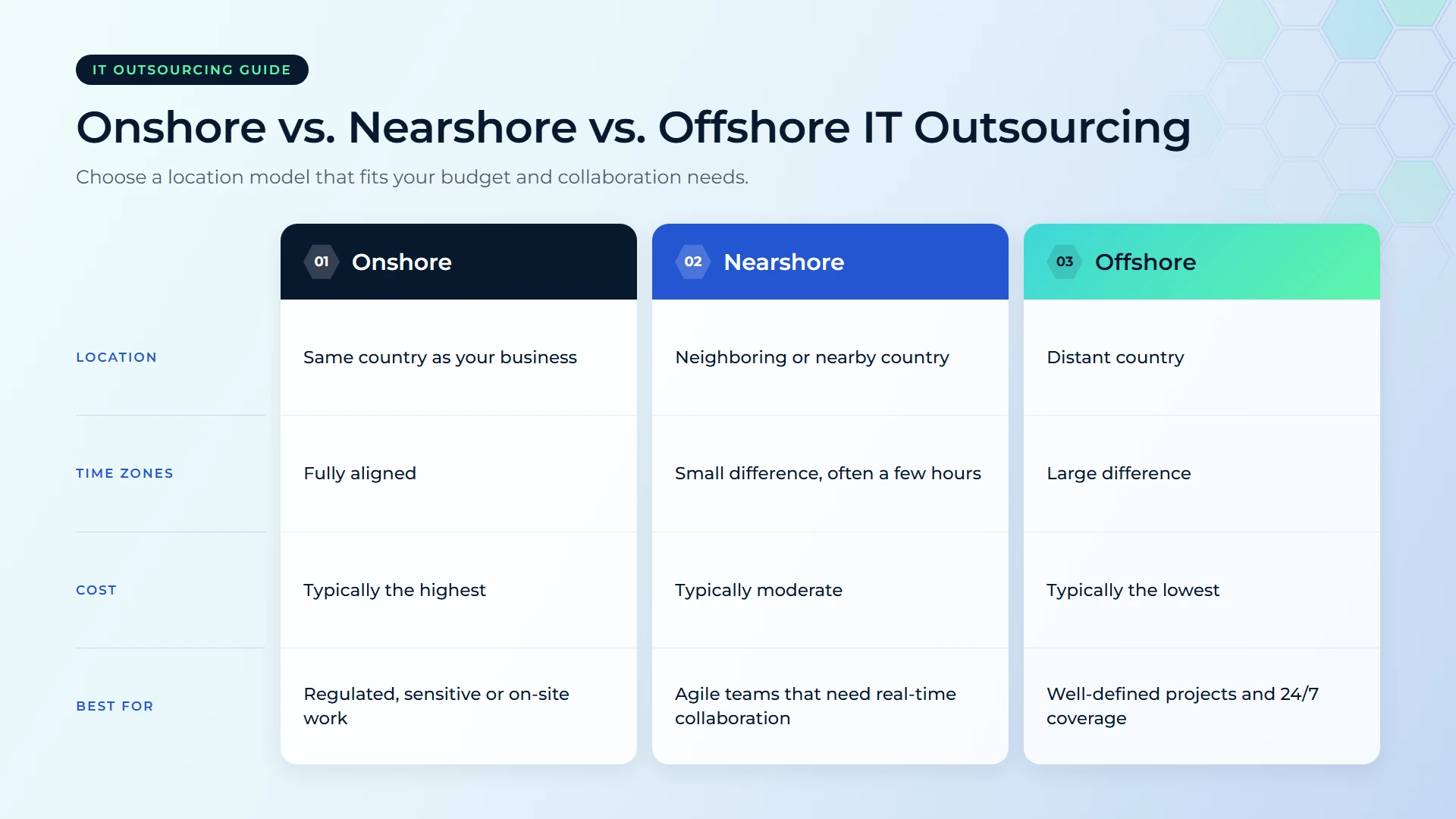
Onshore outsourcing keeps the provider in the same country, which simplifies time zones, language, and legal compliance but usually costs more. Nearshore moves the work to a neighboring region—similar time zone, often lower cost, easier collaboration than fully offshore. Offshore outsourcing sends work to a distant country, typically for the lowest rates, at the cost of time zone gaps and sometimes communication friction.
Staff augmentation adds outsourced individuals to an existing internal team, under internal management. Managed services hand over an entire function—network operations, say—to a provider who owns the outcome, not just the hours. Project-based outsourcing contracts a team to deliver one defined deliverable, like a new application, and then the relationship ends or moves to support mode.
Not every part of IT is equally suited to outsourcing. Functions that are well-documented, process-driven, or require niche technical depth tend to transition more smoothly than ones tightly coupled to company culture or sensitive institutional knowledge.
Strategic planning, architecture decisions tied to competitive advantage, and anything involving highly sensitive internal data usually stay in-house, or at least under close internal oversight even when execution is outsourced.

IT outsourcing helps companies manage technical support, development, system-related tasks, and recurring IT workflows without building every role in-house. At NeoWork, we provide remote teammates who can support IT and development functions within your existing technical environment. We handle recruitment, benefits, training, and ongoing engagement, while our teammates integrate into your tools, systems, and day-to-day processes. Our 91% annualized teammate retention rate and 3.2% candidate selectivity rate reflect our focus on selective hiring and longer-term team stability.
Our IT outsourcing model offers:
Contact NeoWork to add IT capacity that works alongside your existing team.
Pricing varies enormously based on location, skill level, and the model chosen—there's no single number that applies across the board. What's more useful is understanding the common pricing structures and what drives them.
Beyond the headline rate, a few costs are easy to underestimate: onboarding and knowledge transfer time, management overhead for coordinating with the provider, tooling and integration work, and the occasional cost of switching providers if the fit isn't right. A provider's own website is the right place to check current rate cards, since these shift with market conditions and currency fluctuations.
Outsourcing has a real downside, and most of the horror stories trace back to a handful of predictable causes rather than bad luck.
None of these risks are reasons to avoid outsourcing altogether. They're reasons to negotiate contracts carefully and to keep enough internal capability to manage the relationship rather than being entirely dependent on it.
Here's the thing though—most provider evaluations focus too heavily on price and not enough on fit. A cheaper rate that comes with poor communication or inconsistent delivery usually ends up costing more once rework and delays are factored in.
A practical selection process tends to cover these steps:
A few shifts are reshaping how companies approach outsourcing this year. AI-assisted development and support tools are changing what "a developer" or "a help desk agent" can accomplish, which is pushing some providers toward smaller, more senior teams augmented by automation rather than large junior-heavy staffing. Hybrid models—combining a core in-house team with a flexible outsourced layer—are becoming more common than fully outsourced or fully in-house extremes. And cybersecurity outsourcing keeps growing as threats get more sophisticated and specialized security talent stays scarce.
None of this changes the fundamentals. It just means the models and pricing conversations happening today look a bit different than they did even a couple of years back, and it's worth asking any shortlisted provider directly how they're incorporating these shifts into their delivery.
IT outsourcing isn't a single decision so much as a set of smaller ones: which functions to hand off, which model fits the work, and which provider can actually deliver on the promises in the proposal. Done carefully, it gives technology teams room to grow without the lag time of traditional hiring. Done carelessly, it creates exactly the dependency and oversight problems critics warn about.
The practical move is to start small—pilot a single function or project, measure the results against clear metrics, and expand the relationship only once trust and process are established. That approach limits downside while still capturing most of the upside outsourcing offers.

Quick Summary: IT outsourcing means hiring an external provider to handle technology work like help desk support, cloud management, cybersecurity, or software development instead of building that capacity in-house. The right approach depends on matching a cooperation model—staff augmentation, managed services, or project-based—to your budget, control needs, and the complexity of the work. This guide walks through the models, realistic costs, common risks, and a practical process for picking a provider in 2026.
Every IT leader eventually hits the same wall: there's more work than headcount, and hiring takes too long. That's usually the moment outsourcing enters the conversation.
But handing technology functions to an outside team isn't a single decision—it's a spectrum of choices, from bringing in one contractor for a six-week project to turning over an entire department to a managed services partner. Get the model wrong and costs balloon or quality slips. Get it right and outsourcing becomes one of the more reliable levers for scaling a tech operation without scaling the org chart at the same pace.
This guide covers what IT outsourcing actually looks like in practice, the models worth knowing, what it tends to cost, the risks nobody mentions in the sales pitch, and a straightforward process for choosing a provider that won't become a liability six months in.
IT outsourcing is the practice of contracting an external company or individual to perform technology functions that a business would otherwise handle with internal staff. That can mean a single engineer filling a skills gap, or it can mean an entire vendor relationship running network operations, security monitoring, and application support around the clock.
It's distinct from simply buying software. With outsourcing, you're paying for people and process—expertise, labor, and often infrastructure—rather than a license. The provider takes on operational responsibility for a defined scope of work, and the client retains strategic ownership of the outcomes.
Common examples include help desk and service desk support, infrastructure and cloud operations, cybersecurity monitoring, custom software development, QA and testing, and data management. Some companies outsource a narrow slice of IT; others outsource nearly the whole function and keep only a small internal team for vendor oversight and strategy.
The reasons tend to repeat across industries, even if the emphasis shifts depending on company size.
None of this means outsourcing is automatically cheaper or better. It's a trade: businesses give up some direct control in exchange for flexibility and specialized skill. Whether that trade is worth it depends heavily on the model chosen.
Most IT outsourcing arrangements fall into a few recognizable patterns. Picking the wrong one is probably the single most common reason outsourcing relationships fail.
Onshore outsourcing keeps the provider in the same country, which simplifies time zones, language, and legal compliance but usually costs more. Nearshore moves the work to a neighboring region—similar time zone, often lower cost, easier collaboration than fully offshore. Offshore outsourcing sends work to a distant country, typically for the lowest rates, at the cost of time zone gaps and sometimes communication friction.
Staff augmentation adds outsourced individuals to an existing internal team, under internal management. Managed services hand over an entire function—network operations, say—to a provider who owns the outcome, not just the hours. Project-based outsourcing contracts a team to deliver one defined deliverable, like a new application, and then the relationship ends or moves to support mode.
Not every part of IT is equally suited to outsourcing. Functions that are well-documented, process-driven, or require niche technical depth tend to transition more smoothly than ones tightly coupled to company culture or sensitive institutional knowledge.
Strategic planning, architecture decisions tied to competitive advantage, and anything involving highly sensitive internal data usually stay in-house, or at least under close internal oversight even when execution is outsourced.
IT outsourcing helps companies manage technical support, development, system-related tasks, and recurring IT workflows without building every role in-house. At NeoWork, we provide remote teammates who can support IT and development functions within your existing technical environment. We handle recruitment, benefits, training, and ongoing engagement, while our teammates integrate into your tools, systems, and day-to-day processes. Our 91% annualized teammate retention rate and 3.2% candidate selectivity rate reflect our focus on selective hiring and longer-term team stability.
Our IT outsourcing model offers:
Contact NeoWork to add IT capacity that works alongside your existing team.
Pricing varies enormously based on location, skill level, and the model chosen—there's no single number that applies across the board. What's more useful is understanding the common pricing structures and what drives them.
Beyond the headline rate, a few costs are easy to underestimate: onboarding and knowledge transfer time, management overhead for coordinating with the provider, tooling and integration work, and the occasional cost of switching providers if the fit isn't right. A provider's own website is the right place to check current rate cards, since these shift with market conditions and currency fluctuations.
Outsourcing has a real downside, and most of the horror stories trace back to a handful of predictable causes rather than bad luck.
None of these risks are reasons to avoid outsourcing altogether. They're reasons to negotiate contracts carefully and to keep enough internal capability to manage the relationship rather than being entirely dependent on it.
Here's the thing though—most provider evaluations focus too heavily on price and not enough on fit. A cheaper rate that comes with poor communication or inconsistent delivery usually ends up costing more once rework and delays are factored in.
A practical selection process tends to cover these steps:
A few shifts are reshaping how companies approach outsourcing this year. AI-assisted development and support tools are changing what "a developer" or "a help desk agent" can accomplish, which is pushing some providers toward smaller, more senior teams augmented by automation rather than large junior-heavy staffing. Hybrid models—combining a core in-house team with a flexible outsourced layer—are becoming more common than fully outsourced or fully in-house extremes. And cybersecurity outsourcing keeps growing as threats get more sophisticated and specialized security talent stays scarce.
None of this changes the fundamentals. It just means the models and pricing conversations happening today look a bit different than they did even a couple of years back, and it's worth asking any shortlisted provider directly how they're incorporating these shifts into their delivery.
IT outsourcing isn't a single decision so much as a set of smaller ones: which functions to hand off, which model fits the work, and which provider can actually deliver on the promises in the proposal. Done carefully, it gives technology teams room to grow without the lag time of traditional hiring. Done carelessly, it creates exactly the dependency and oversight problems critics warn about.
The practical move is to start small—pilot a single function or project, measure the results against clear metrics, and expand the relationship only once trust and process are established. That approach limits downside while still capturing most of the upside outsourcing offers.