

.avif)
.avif)

Business Process Outsourcing Guide: What Works in 2026


.svg)

Quick Summary: Business process outsourcing (BPO) means hiring a third-party provider to run specific business functions — customer service, finance, HR, IT support — so internal teams can focus on core work. The global BPO market is valued at roughly $358.6 billion in 2026 and is projected to grow at a 9.9% CAGR through 2033, according to Grand View Research. Choosing the right model, whether offshore, nearshore, or onshore, and vetting providers on security and service-level guarantees are the two decisions that determine whether an outsourcing deal actually pays off.
Every growing company eventually hits the same wall: there's more work than there is internal capacity to do it well. Payroll needs processing, customer tickets keep piling up, and the finance team is drowning in reconciliations instead of strategy. That's usually the moment business process outsourcing enters the conversation.
BPO isn't new — companies have been shipping call centers and data entry offshore for decades. What's changed is the sophistication of it. Modern BPO providers layer AI-driven automation, analytics, and outcome-based pricing on top of traditional labor arbitrage, turning what used to be a cost-cutting tactic into a genuine operating strategy. This guide covers what BPO actually involves, the types of arrangements available, real costs and risks, and how to pick a partner without getting burned.
What Is Business Process Outsourcing?
Business process outsourcing is the practice of contracting an external service provider to handle a defined business function — one that isn't part of the company's core competitive advantage but still needs to run smoothly. Instead of hiring, training, and managing an in-house team for that function, a company pays a specialist firm to do it under an agreed contract, usually with measurable service-level agreements (SLAs) attached.
The functions handed off are typically repeatable, process-driven, and easier to standardize than they are to differentiate. Think payroll processing, tier-1 customer support, accounts payable, IT helpdesk tickets, or data entry. The logic is straightforward: let a specialist that does this work at scale for dozens of clients do it more efficiently than a generalist internal team ever could.
Back-Office vs. Front-Office BPO
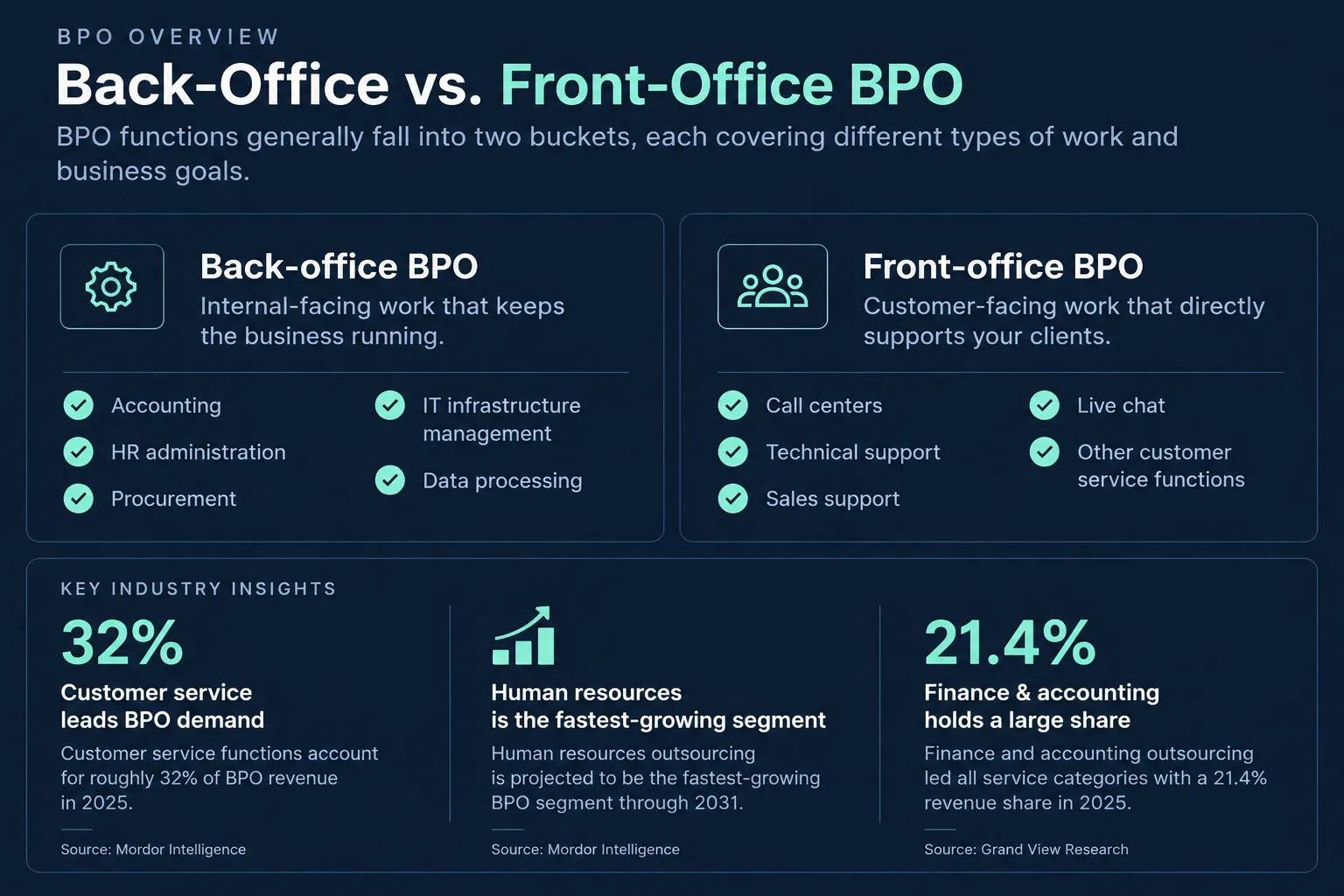
BPO functions generally split into two buckets:
- Back-office BPO — internal-facing work like accounting, HR administration, procurement, IT infrastructure management, and data processing.
- Front-office BPO — customer-facing work like call centers, technical support, sales support, and live chat.
Industry data from Mordor Intelligence puts customer service functions at the top of BPO demand, accounting for roughly 32% of 2025 revenue, while human resources outsourcing is projected to be the fastest-growing segment through 2031. Finance and accounting outsourcing also holds a large share — Grand View Research reports it led all service categories with a 21.4% revenue share in 2025.
Types of Outsourcing Models
Not all BPO arrangements look the same. The main variable is location, and it shapes cost, time zone overlap, and communication style.
According to Grand View Research, the onshore segment held the largest share of the global BPO market in 2025, reflecting growing demand for data residency and tighter oversight even as offshore and nearshore models remain popular for cost-sensitive functions.
What Functions Get Outsourced Most
Some functions are outsourced far more often than others, largely because they're standardized across industries and don't require deep proprietary knowledge to execute well.
- Customer service and technical support
- Finance and accounting (accounts payable/receivable, payroll, bookkeeping)
- Human resources administration and recruitment
- IT support and infrastructure management
- Data entry, data processing, and back-office administration
- Procurement and supply chain coordination
- Knowledge process outsourcing (KPO) — research, analytics, legal support

Scale Business Processes with NeoWork
Business process outsourcing helps companies move recurring operational, administrative, customer support, and back-office workflows to a remote team. NeoWork provides teammates through individual contributor and dedicated team structures across customer experience, virtual assistance, technical services, AI training, and creative operations. NeoWork handles recruitment, benefits, training, and ongoing engagement, while teammates integrate into the client’s systems and workflows. Its 91% annualized teammate retention rate and 3.2% candidate selectivity rate reflect a focus on selective hiring and longer-term team stability.
NeoWork's business process outsourcing model offers:
- support for recurring business workflows
- integration with the client’s tools and processes
- recruitment and ongoing teammate support
Contact NeoWork to build an outsourced team around your ongoing operational needs.
Benefits of Business Process Outsourcing
Cost reduction gets top billing in most pitches, and it's real — labor arbitrage between regions still drives a meaningful chunk of BPO adoption. But the benefits go further than the invoice.
- Cost efficiency — lower labor and infrastructure costs, especially with offshore or nearshore models.
- Access to specialized talent — providers often have deeper expertise in a niche function than a generalist internal team.
- Scalability — headcount can flex up or down with demand without the overhead of hiring and layoffs.
- Focus on core business — leadership time and internal resources shift toward the work that actually differentiates the company.
- 24/7 coverage — offshore and nearshore partners can extend support hours without night shifts for internal staff.
- Faster technology adoption — many BPO providers now bundle AI-driven automation and analytics tools into their service, something a smaller internal team might not build on its own.
Risks and Challenges
None of this is risk-free, and providers rarely lead with the downsides in a sales conversation. Worth going in with eyes open on a few fronts.
How to Choose a BPO Provider
Picking a provider isn't just a procurement exercise — it's closer to hiring a long-term operational partner. A few things matter more than the sales deck.
- Industry experience. A provider that's handled similar workflows for comparable companies will ramp up faster and make fewer costly mistakes.
- Security and compliance credentials. Ask directly about SOC 2, ISO 27001, GDPR handling, or HIPAA compliance if relevant to the function.
- Technology stack. Providers investing in automation and AI tools tend to deliver more consistent quality at lower long-term cost.
- Transparent pricing. Watch for vague line items or "implementation fees" that aren't spelled out upfront.
- References and track record. Talk to existing clients, not just the ones the provider hand-picks.
- Cultural and communication fit. This matters more for front-office functions where tone and language directly affect the customer experience.
Questions to Ask Before Signing
- What are the specific SLAs, and what happens if they're missed?
- How is data secured, stored, and deleted after the contract ends?
- What's the exit process if the relationship doesn't work out?
- How is pricing structured — per FTE, per transaction, or outcome-based?
BPO Costs: What to Expect
Pricing varies enormously depending on function, location, and complexity, so treat any flat number with suspicion. Offshore customer support and data entry tend to sit at the lower end of the cost spectrum, while specialized finance, legal, or IT services command higher rates even offshore. Most providers price using one of a few models:
- Per full-time employee (FTE) — a fixed monthly or annual rate per dedicated staff member.
- Per transaction or ticket — common in customer support and data processing.
- Outcome-based pricing — tied to results like resolution rates or accuracy, increasingly common as the market shifts away from pure labor arbitrage.
Get quotes from multiple providers for the exact same scope of work before committing — pricing structures differ enough between vendors that side-by-side comparison is the only reliable way to judge value.
The State of the BPO Market in 2026
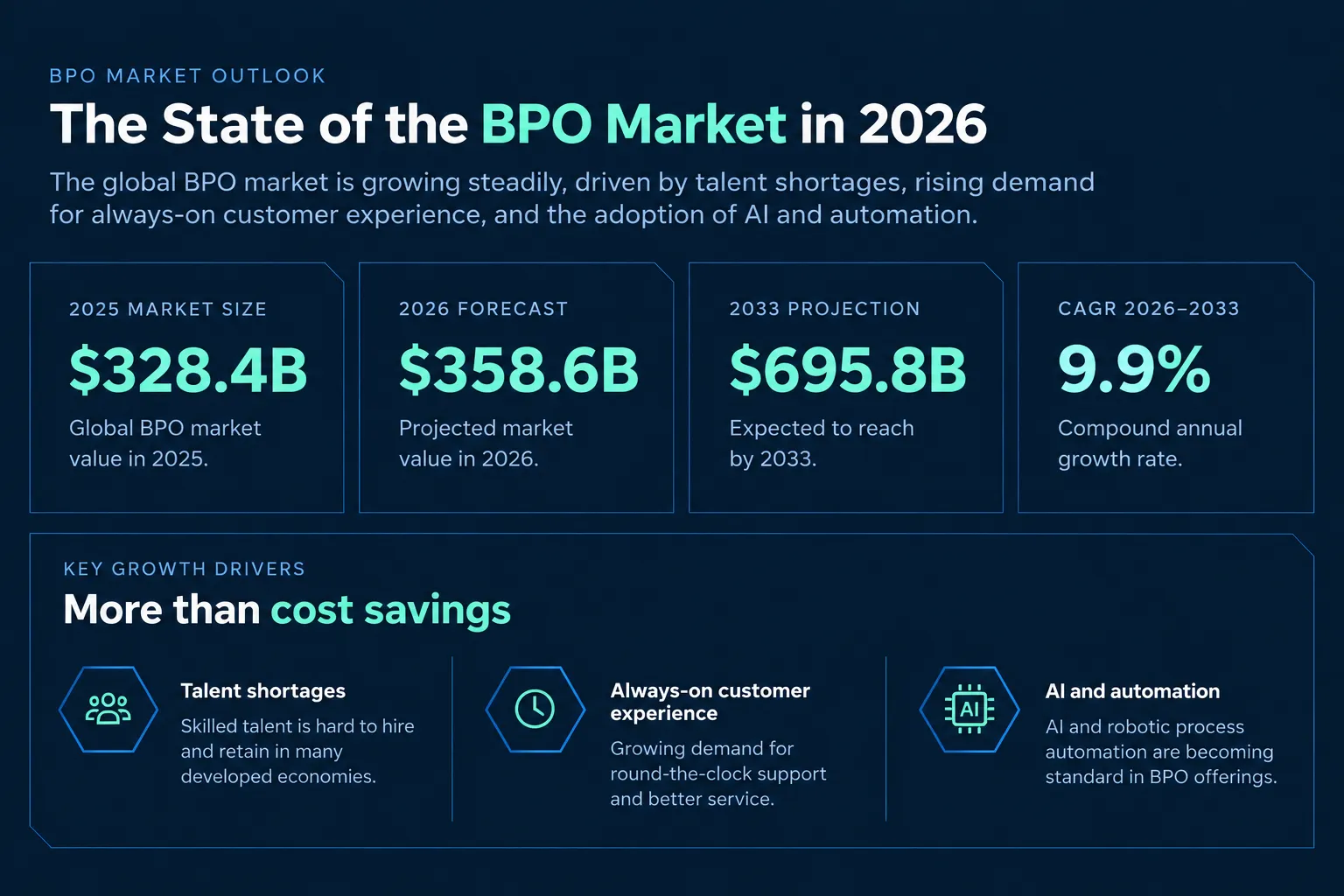
The global BPO market was valued at roughly $328.4 billion in 2025 and is projected to reach $358.6 billion in 2026, growing to $695.8 billion by 2033 at a 9.9% compound annual growth rate, according to Grand View Research. North America held the largest regional share, at roughly 37.4% of global revenue in 2025.
What's driving that growth isn't just cost pressure. Persistent talent shortages in developed economies, rising demand for round-the-clock customer experience, and the integration of AI and robotic process automation into standard BPO offerings are all pushing companies of every size to reconsider what should stay in-house versus what should be handed off.
Is BPO Right for a Small Business?
Larger enterprises aren't the only ones benefiting. Small and mid-sized businesses often gain more relatively speaking, since they typically lack the budget to build a full in-house finance, HR, or IT department. Outsourcing lets a five-person startup access the same quality of payroll processing or customer support infrastructure as a company ten times its size — without the hiring overhead.
That said, small businesses should start narrow. Pick one function that's clearly non-core and repeatable — bookkeeping or basic customer support are common starting points — run it for a defined trial period, and expand only once the provider has proven reliable.
Final Thoughts
Business process outsourcing isn't a one-size-fits-all decision, and it's not purely a cost play anymore either. The companies getting real value from it in 2026 are the ones treating provider selection with the same rigor as a key hire — checking security credentials, negotiating clear SLAs, and starting with a pilot before handing over anything mission-critical.
Start small: pick one non-core, repeatable function, define what success looks like in measurable terms, and give the provider a defined trial window. If the numbers and quality hold up, scale from there. That's a far safer path than outsourcing five functions at once and hoping it all works out.
FAQ: Business Process Outsourcing
Topics
Business Process Outsourcing Guide: What Works in 2026

Quick Summary: Business process outsourcing (BPO) means hiring a third-party provider to run specific business functions — customer service, finance, HR, IT support — so internal teams can focus on core work. The global BPO market is valued at roughly $358.6 billion in 2026 and is projected to grow at a 9.9% CAGR through 2033, according to Grand View Research. Choosing the right model, whether offshore, nearshore, or onshore, and vetting providers on security and service-level guarantees are the two decisions that determine whether an outsourcing deal actually pays off.
Every growing company eventually hits the same wall: there's more work than there is internal capacity to do it well. Payroll needs processing, customer tickets keep piling up, and the finance team is drowning in reconciliations instead of strategy. That's usually the moment business process outsourcing enters the conversation.
BPO isn't new — companies have been shipping call centers and data entry offshore for decades. What's changed is the sophistication of it. Modern BPO providers layer AI-driven automation, analytics, and outcome-based pricing on top of traditional labor arbitrage, turning what used to be a cost-cutting tactic into a genuine operating strategy. This guide covers what BPO actually involves, the types of arrangements available, real costs and risks, and how to pick a partner without getting burned.
What Is Business Process Outsourcing?
Business process outsourcing is the practice of contracting an external service provider to handle a defined business function — one that isn't part of the company's core competitive advantage but still needs to run smoothly. Instead of hiring, training, and managing an in-house team for that function, a company pays a specialist firm to do it under an agreed contract, usually with measurable service-level agreements (SLAs) attached.
The functions handed off are typically repeatable, process-driven, and easier to standardize than they are to differentiate. Think payroll processing, tier-1 customer support, accounts payable, IT helpdesk tickets, or data entry. The logic is straightforward: let a specialist that does this work at scale for dozens of clients do it more efficiently than a generalist internal team ever could.
Back-Office vs. Front-Office BPO
BPO functions generally split into two buckets:
- Back-office BPO — internal-facing work like accounting, HR administration, procurement, IT infrastructure management, and data processing.
- Front-office BPO — customer-facing work like call centers, technical support, sales support, and live chat.
Industry data from Mordor Intelligence puts customer service functions at the top of BPO demand, accounting for roughly 32% of 2025 revenue, while human resources outsourcing is projected to be the fastest-growing segment through 2031. Finance and accounting outsourcing also holds a large share — Grand View Research reports it led all service categories with a 21.4% revenue share in 2025.
Types of Outsourcing Models
Not all BPO arrangements look the same. The main variable is location, and it shapes cost, time zone overlap, and communication style.
According to Grand View Research, the onshore segment held the largest share of the global BPO market in 2025, reflecting growing demand for data residency and tighter oversight even as offshore and nearshore models remain popular for cost-sensitive functions.
What Functions Get Outsourced Most
Some functions are outsourced far more often than others, largely because they're standardized across industries and don't require deep proprietary knowledge to execute well.
- Customer service and technical support
- Finance and accounting (accounts payable/receivable, payroll, bookkeeping)
- Human resources administration and recruitment
- IT support and infrastructure management
- Data entry, data processing, and back-office administration
- Procurement and supply chain coordination
- Knowledge process outsourcing (KPO) — research, analytics, legal support
Scale Business Processes with NeoWork
Business process outsourcing helps companies move recurring operational, administrative, customer support, and back-office workflows to a remote team. NeoWork provides teammates through individual contributor and dedicated team structures across customer experience, virtual assistance, technical services, AI training, and creative operations. NeoWork handles recruitment, benefits, training, and ongoing engagement, while teammates integrate into the client’s systems and workflows. Its 91% annualized teammate retention rate and 3.2% candidate selectivity rate reflect a focus on selective hiring and longer-term team stability.
NeoWork's business process outsourcing model offers:
- support for recurring business workflows
- integration with the client’s tools and processes
- recruitment and ongoing teammate support
Contact NeoWork to build an outsourced team around your ongoing operational needs.
Benefits of Business Process Outsourcing
Cost reduction gets top billing in most pitches, and it's real — labor arbitrage between regions still drives a meaningful chunk of BPO adoption. But the benefits go further than the invoice.
- Cost efficiency — lower labor and infrastructure costs, especially with offshore or nearshore models.
- Access to specialized talent — providers often have deeper expertise in a niche function than a generalist internal team.
- Scalability — headcount can flex up or down with demand without the overhead of hiring and layoffs.
- Focus on core business — leadership time and internal resources shift toward the work that actually differentiates the company.
- 24/7 coverage — offshore and nearshore partners can extend support hours without night shifts for internal staff.
- Faster technology adoption — many BPO providers now bundle AI-driven automation and analytics tools into their service, something a smaller internal team might not build on its own.
Risks and Challenges
None of this is risk-free, and providers rarely lead with the downsides in a sales conversation. Worth going in with eyes open on a few fronts.
How to Choose a BPO Provider
Picking a provider isn't just a procurement exercise — it's closer to hiring a long-term operational partner. A few things matter more than the sales deck.
- Industry experience. A provider that's handled similar workflows for comparable companies will ramp up faster and make fewer costly mistakes.
- Security and compliance credentials. Ask directly about SOC 2, ISO 27001, GDPR handling, or HIPAA compliance if relevant to the function.
- Technology stack. Providers investing in automation and AI tools tend to deliver more consistent quality at lower long-term cost.
- Transparent pricing. Watch for vague line items or "implementation fees" that aren't spelled out upfront.
- References and track record. Talk to existing clients, not just the ones the provider hand-picks.
- Cultural and communication fit. This matters more for front-office functions where tone and language directly affect the customer experience.
Questions to Ask Before Signing
- What are the specific SLAs, and what happens if they're missed?
- How is data secured, stored, and deleted after the contract ends?
- What's the exit process if the relationship doesn't work out?
- How is pricing structured — per FTE, per transaction, or outcome-based?
BPO Costs: What to Expect
Pricing varies enormously depending on function, location, and complexity, so treat any flat number with suspicion. Offshore customer support and data entry tend to sit at the lower end of the cost spectrum, while specialized finance, legal, or IT services command higher rates even offshore. Most providers price using one of a few models:
- Per full-time employee (FTE) — a fixed monthly or annual rate per dedicated staff member.
- Per transaction or ticket — common in customer support and data processing.
- Outcome-based pricing — tied to results like resolution rates or accuracy, increasingly common as the market shifts away from pure labor arbitrage.
Get quotes from multiple providers for the exact same scope of work before committing — pricing structures differ enough between vendors that side-by-side comparison is the only reliable way to judge value.
The State of the BPO Market in 2026
The global BPO market was valued at roughly $328.4 billion in 2025 and is projected to reach $358.6 billion in 2026, growing to $695.8 billion by 2033 at a 9.9% compound annual growth rate, according to Grand View Research. North America held the largest regional share, at roughly 37.4% of global revenue in 2025.
What's driving that growth isn't just cost pressure. Persistent talent shortages in developed economies, rising demand for round-the-clock customer experience, and the integration of AI and robotic process automation into standard BPO offerings are all pushing companies of every size to reconsider what should stay in-house versus what should be handed off.
Is BPO Right for a Small Business?
Larger enterprises aren't the only ones benefiting. Small and mid-sized businesses often gain more relatively speaking, since they typically lack the budget to build a full in-house finance, HR, or IT department. Outsourcing lets a five-person startup access the same quality of payroll processing or customer support infrastructure as a company ten times its size — without the hiring overhead.
That said, small businesses should start narrow. Pick one function that's clearly non-core and repeatable — bookkeeping or basic customer support are common starting points — run it for a defined trial period, and expand only once the provider has proven reliable.
Final Thoughts
Business process outsourcing isn't a one-size-fits-all decision, and it's not purely a cost play anymore either. The companies getting real value from it in 2026 are the ones treating provider selection with the same rigor as a key hire — checking security credentials, negotiating clear SLAs, and starting with a pilot before handing over anything mission-critical.
Start small: pick one non-core, repeatable function, define what success looks like in measurable terms, and give the provider a defined trial window. If the numbers and quality hold up, scale from there. That's a far safer path than outsourcing five functions at once and hoping it all works out.
FAQ: Business Process Outsourcing
Topics
Related Blogs
Related Podcasts


.webp)

.webp)
.webp)



