

.avif)
.avif)

Healthcare Virtual Assistant Outsourcing Guide (2026)


.svg)

Quick Summary: Healthcare virtual assistant outsourcing means hiring a remote, non-clinical professional to handle scheduling, insurance verification, billing, and patient communication so in-house staff can focus on care. Done right, it cuts overhead, reduces no-shows, and speeds up admin turnaround, but it only works when practices vet HIPAA compliance, define tasks clearly, and use secure, purpose-built tools. This guide covers what these assistants actually do, how to hire one safely, realistic costs, and the mistakes that sink most outsourcing attempts.
Front-desk staff drowning in phone calls. Claims sitting untouched for weeks. Patients frustrated because nobody called back about their referral. This is the daily reality at a lot of small and mid-sized practices, and it's exactly why healthcare virtual assistant outsourcing has moved from a niche experiment to a mainstream staffing strategy.
A healthcare virtual assistant (sometimes called a virtual medical assistant or VMA) is a remote worker who takes on administrative and non-clinical tasks for clinics, hospitals, telehealth companies, and solo practitioners. They don't diagnose, prescribe, or touch clinical decision-making. What they do is free up the people who can.
This guide walks through what these assistants actually handle, how outsourcing works in practice, what it costs, and how to avoid the compliance headaches that trip up practices new to the model.
What Is a Healthcare Virtual Assistant, Exactly?
Strip away the marketing language and a healthcare virtual assistant is simply a remote employee or contractor trained to support medical office operations. Some work through staffing agencies that specialize in healthcare outsourcing; others are independent contractors sourced through freelance platforms. Either way, they log in remotely — often using the practice's own systems — and perform tasks that don't require a license to practice medicine.
The distinction that matters most: virtual medical assistants handle non-clinical work, while a "virtual nurse" or remote clinical assistant (a licensed role) might touch patient triage or clinical documentation under supervision. Mixing these up is one of the fastest ways to run into scope-of-practice trouble.
Tasks Practices Commonly Outsource
Almost every competitor guide on this topic lists a version of the same top tasks — and for good reason, since these are the ones with the clearest ROI.
- Appointment scheduling and calendar management — booking, rescheduling, and sending reminders to cut no-show rates.
- Patient communication and follow-up — answering routine questions, confirming appointments, closing the loop after visits.
- Insurance verification and prior authorizations — checking eligibility before the patient even walks in.
- Medical billing and claims processing — submitting claims, tracking denials, following up with payers.
- Patient intake and data entry — updating EHR records, transcribing notes, organizing charts.
- Referral coordination — managing paperwork between specialists and primary care.
- Bookkeeping and light financial admin — invoicing, expense tracking, reconciling payments.
Why Practices Are Turning to Outsourcing Now
Staffing shortages didn't go away — they just changed shape. Front-office roles are hard to fill and even harder to retain, and turnover in that seat is expensive: retraining, onboarding, and the productivity dip while a new hire gets up to speed all add up fast.
Outsourcing sidesteps a chunk of that. There's no local commute requirement, so the hiring pool widens dramatically. Many virtual assistants work across time zones, which means coverage can extend beyond a standard 9-to-5 without paying overtime. And because most engagements are contract-based, practices can scale hours up during flu season or a growth spurt, then scale back down without a layoff conversation.
None of that means outsourcing is a magic fix. It works best as a targeted solution for specific bottlenecks — not a wholesale replacement for every front-desk role.

Add Healthcare Virtual Assistant Support with NeoWork
Healthcare virtual assistant outsourcing helps organizations manage scheduling, records, patient communication, data entry, and recurring administrative workflows. NeoWork provides remote teammates who can support healthcare operations while working within the client’s existing systems and processes. NeoWork handles recruitment, benefits, training, and ongoing engagement, while teammates follow the client’s tools, procedures, and daily priorities. Its 91% annualized teammate retention rate and 3.2% candidate selectivity rate reflect a focus on selective hiring and longer-term team stability.
NeoWork's healthcare virtual assistant model offers:
- healthcare administrative support
- integration with the client’s tools and processes
- recruitment and ongoing teammate support
Contact NeoWork to add virtual assistant support for recurring healthcare operations.
In-House vs. Outsourced: A Side-by-Side Look
How to Vet and Hire a Healthcare Virtual Assistant
This is where most guides get vague, so here's the practical version. Start by defining the exact tasks that need to move off your team's plate — not a wish list, an actual short list. Vague job descriptions produce vague candidates.
Compliance Comes First
Any virtual assistant touching patient data in the U.S. needs to operate under a signed Business Associate Agreement (BAA) if the practice is a HIPAA-covered entity. That's non-negotiable. Ask specifically how the agency or contractor trains staff on HIPAA, what device and network security policies are in place, and whether they'll sign a BAA before onboarding — not after.
Ask About the Actual Workflow
Find out which EHR and practice management systems the candidate has used. Confirm how they'll access systems — dedicated VPN, secure remote desktop, role-based logins — rather than shared passwords. And clarify who owns quality control: is there a supervisor reviewing their work, or is it entirely self-managed?
Run a Paid Trial Period
A two-to-four week trial on a narrow task set (say, appointment reminders only) reveals far more than any interview. Track response time, accuracy, and how they handle an edge case — like a patient who's upset about a billing error.
What Does It Cost?
Pricing varies a lot depending on region, experience level, and whether the assistant is sourced through an agency (which typically bundles in vetting, training, and backup coverage) or hired independently (usually cheaper, but the compliance burden shifts entirely to the practice).
As a rough guide, agency-managed virtual medical assistants tend to run somewhere in the range of $8 to $25 per hour depending on the assistant's location and specialization, while independent contractors can fall outside that range in either direction. Rates change often enough that it's worth checking a few current agency quotes directly rather than relying on a single published number — costs from 2024 or 2025 guides are already stale.
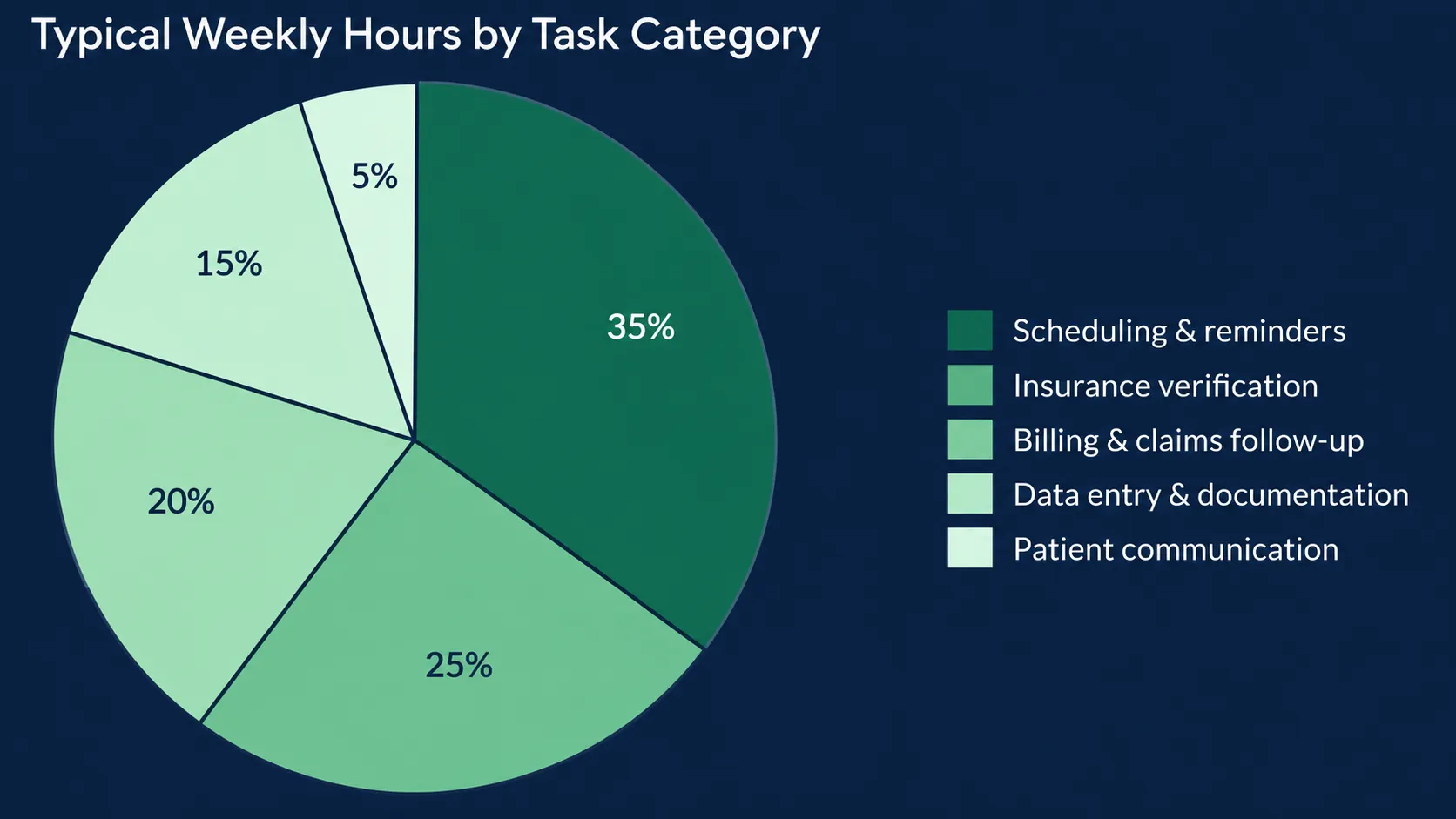
Where the Time Actually Goes
Practices that track hours after onboarding a virtual assistant often find the workload skews heavily toward a handful of tasks rather than spreading evenly.
Common Mistakes That Undermine Outsourcing
Skipping the BAA is the big one — and it's shockingly common among smaller practices in a hurry to fill a gap. Beyond that, a few patterns show up repeatedly:
- Handing over vague instructions and assuming the assistant will "figure it out."
- Giving full system access instead of role-based, limited permissions.
- Treating the relationship as fire-and-forget with no check-ins for the first month.
- Outsourcing a task that actually requires clinical judgment, then blaming the assistant when it goes wrong.
- Ignoring time zone mismatches that delay same-day patient callbacks.
Here's the thing though — most of these are fixable with a bit of upfront structure, not a reason to avoid outsourcing altogether.
Security and HIPAA: The Non-Negotiables
Look, this deserves its own section because it's where practices get burned. A virtual assistant handling patient names, dates of birth, insurance IDs, or clinical notes is handling protected health information, full stop. That means encrypted communication channels, secure file storage, no personal devices unless they meet the practice's security standards, and a documented incident response plan in case something goes wrong.
Reputable healthcare-specific staffing agencies build this into their onboarding by default. Generic virtual assistant marketplaces, built for tasks like inbox management or social media, usually don't — and that gap is exactly where compliance risk lives.
Signs Outsourcing Isn't the Right Fit Yet
Outsourcing may not be the right move when:
- Workflows are undocumented. A remote assistant cannot follow a process that has not been clearly defined.
- Systems change constantly. Frequent EHR changes make training and consistency difficult.
- Tasks are not repeatable. Outsourcing works best when there is a stable process to hand off.
- Internal operations are already chaotic. Adding a remote worker without fixing the underlying workflow can create more confusion.
- There is no one to manage the relationship. Even a capable assistant needs clear instructions, feedback, and a point of contact.
Bottom Line
Healthcare virtual assistant outsourcing isn't a trend that's fading — it's becoming a standard part of how lean practices stay operational without burning out their front-desk teams. The practices that get the most out of it treat it like any other vendor relationship: clear scope, signed compliance agreements, a real trial period, and regular check-ins. Skip those steps and outsourcing turns into just another headache.
Start small. Pick one bottleneck — scheduling, billing follow-up, insurance verification — hand it to a vetted virtual assistant, and measure the results before expanding. That's a far safer path than outsourcing the entire front office on day one.
FAQ
Topics
Healthcare Virtual Assistant Outsourcing Guide (2026)

Quick Summary: Healthcare virtual assistant outsourcing means hiring a remote, non-clinical professional to handle scheduling, insurance verification, billing, and patient communication so in-house staff can focus on care. Done right, it cuts overhead, reduces no-shows, and speeds up admin turnaround, but it only works when practices vet HIPAA compliance, define tasks clearly, and use secure, purpose-built tools. This guide covers what these assistants actually do, how to hire one safely, realistic costs, and the mistakes that sink most outsourcing attempts.
Front-desk staff drowning in phone calls. Claims sitting untouched for weeks. Patients frustrated because nobody called back about their referral. This is the daily reality at a lot of small and mid-sized practices, and it's exactly why healthcare virtual assistant outsourcing has moved from a niche experiment to a mainstream staffing strategy.
A healthcare virtual assistant (sometimes called a virtual medical assistant or VMA) is a remote worker who takes on administrative and non-clinical tasks for clinics, hospitals, telehealth companies, and solo practitioners. They don't diagnose, prescribe, or touch clinical decision-making. What they do is free up the people who can.
This guide walks through what these assistants actually handle, how outsourcing works in practice, what it costs, and how to avoid the compliance headaches that trip up practices new to the model.
What Is a Healthcare Virtual Assistant, Exactly?
Strip away the marketing language and a healthcare virtual assistant is simply a remote employee or contractor trained to support medical office operations. Some work through staffing agencies that specialize in healthcare outsourcing; others are independent contractors sourced through freelance platforms. Either way, they log in remotely — often using the practice's own systems — and perform tasks that don't require a license to practice medicine.
The distinction that matters most: virtual medical assistants handle non-clinical work, while a "virtual nurse" or remote clinical assistant (a licensed role) might touch patient triage or clinical documentation under supervision. Mixing these up is one of the fastest ways to run into scope-of-practice trouble.
Tasks Practices Commonly Outsource
Almost every competitor guide on this topic lists a version of the same top tasks — and for good reason, since these are the ones with the clearest ROI.
- Appointment scheduling and calendar management — booking, rescheduling, and sending reminders to cut no-show rates.
- Patient communication and follow-up — answering routine questions, confirming appointments, closing the loop after visits.
- Insurance verification and prior authorizations — checking eligibility before the patient even walks in.
- Medical billing and claims processing — submitting claims, tracking denials, following up with payers.
- Patient intake and data entry — updating EHR records, transcribing notes, organizing charts.
- Referral coordination — managing paperwork between specialists and primary care.
- Bookkeeping and light financial admin — invoicing, expense tracking, reconciling payments.
Why Practices Are Turning to Outsourcing Now
Staffing shortages didn't go away — they just changed shape. Front-office roles are hard to fill and even harder to retain, and turnover in that seat is expensive: retraining, onboarding, and the productivity dip while a new hire gets up to speed all add up fast.
Outsourcing sidesteps a chunk of that. There's no local commute requirement, so the hiring pool widens dramatically. Many virtual assistants work across time zones, which means coverage can extend beyond a standard 9-to-5 without paying overtime. And because most engagements are contract-based, practices can scale hours up during flu season or a growth spurt, then scale back down without a layoff conversation.
None of that means outsourcing is a magic fix. It works best as a targeted solution for specific bottlenecks — not a wholesale replacement for every front-desk role.
Add Healthcare Virtual Assistant Support with NeoWork
Healthcare virtual assistant outsourcing helps organizations manage scheduling, records, patient communication, data entry, and recurring administrative workflows. NeoWork provides remote teammates who can support healthcare operations while working within the client’s existing systems and processes. NeoWork handles recruitment, benefits, training, and ongoing engagement, while teammates follow the client’s tools, procedures, and daily priorities. Its 91% annualized teammate retention rate and 3.2% candidate selectivity rate reflect a focus on selective hiring and longer-term team stability.
NeoWork's healthcare virtual assistant model offers:
- healthcare administrative support
- integration with the client’s tools and processes
- recruitment and ongoing teammate support
Contact NeoWork to add virtual assistant support for recurring healthcare operations.
In-House vs. Outsourced: A Side-by-Side Look
How to Vet and Hire a Healthcare Virtual Assistant
This is where most guides get vague, so here's the practical version. Start by defining the exact tasks that need to move off your team's plate — not a wish list, an actual short list. Vague job descriptions produce vague candidates.
Compliance Comes First
Any virtual assistant touching patient data in the U.S. needs to operate under a signed Business Associate Agreement (BAA) if the practice is a HIPAA-covered entity. That's non-negotiable. Ask specifically how the agency or contractor trains staff on HIPAA, what device and network security policies are in place, and whether they'll sign a BAA before onboarding — not after.
Ask About the Actual Workflow
Find out which EHR and practice management systems the candidate has used. Confirm how they'll access systems — dedicated VPN, secure remote desktop, role-based logins — rather than shared passwords. And clarify who owns quality control: is there a supervisor reviewing their work, or is it entirely self-managed?
Run a Paid Trial Period
A two-to-four week trial on a narrow task set (say, appointment reminders only) reveals far more than any interview. Track response time, accuracy, and how they handle an edge case — like a patient who's upset about a billing error.
What Does It Cost?
Pricing varies a lot depending on region, experience level, and whether the assistant is sourced through an agency (which typically bundles in vetting, training, and backup coverage) or hired independently (usually cheaper, but the compliance burden shifts entirely to the practice).
As a rough guide, agency-managed virtual medical assistants tend to run somewhere in the range of $8 to $25 per hour depending on the assistant's location and specialization, while independent contractors can fall outside that range in either direction. Rates change often enough that it's worth checking a few current agency quotes directly rather than relying on a single published number — costs from 2024 or 2025 guides are already stale.
Where the Time Actually Goes
Practices that track hours after onboarding a virtual assistant often find the workload skews heavily toward a handful of tasks rather than spreading evenly.
Common Mistakes That Undermine Outsourcing
Skipping the BAA is the big one — and it's shockingly common among smaller practices in a hurry to fill a gap. Beyond that, a few patterns show up repeatedly:
- Handing over vague instructions and assuming the assistant will "figure it out."
- Giving full system access instead of role-based, limited permissions.
- Treating the relationship as fire-and-forget with no check-ins for the first month.
- Outsourcing a task that actually requires clinical judgment, then blaming the assistant when it goes wrong.
- Ignoring time zone mismatches that delay same-day patient callbacks.
Here's the thing though — most of these are fixable with a bit of upfront structure, not a reason to avoid outsourcing altogether.
Security and HIPAA: The Non-Negotiables
Look, this deserves its own section because it's where practices get burned. A virtual assistant handling patient names, dates of birth, insurance IDs, or clinical notes is handling protected health information, full stop. That means encrypted communication channels, secure file storage, no personal devices unless they meet the practice's security standards, and a documented incident response plan in case something goes wrong.
Reputable healthcare-specific staffing agencies build this into their onboarding by default. Generic virtual assistant marketplaces, built for tasks like inbox management or social media, usually don't — and that gap is exactly where compliance risk lives.
Signs Outsourcing Isn't the Right Fit Yet
Outsourcing may not be the right move when:
- Workflows are undocumented. A remote assistant cannot follow a process that has not been clearly defined.
- Systems change constantly. Frequent EHR changes make training and consistency difficult.
- Tasks are not repeatable. Outsourcing works best when there is a stable process to hand off.
- Internal operations are already chaotic. Adding a remote worker without fixing the underlying workflow can create more confusion.
- There is no one to manage the relationship. Even a capable assistant needs clear instructions, feedback, and a point of contact.
Bottom Line
Healthcare virtual assistant outsourcing isn't a trend that's fading — it's becoming a standard part of how lean practices stay operational without burning out their front-desk teams. The practices that get the most out of it treat it like any other vendor relationship: clear scope, signed compliance agreements, a real trial period, and regular check-ins. Skip those steps and outsourcing turns into just another headache.
Start small. Pick one bottleneck — scheduling, billing follow-up, insurance verification — hand it to a vetted virtual assistant, and measure the results before expanding. That's a far safer path than outsourcing the entire front office on day one.
FAQ
Topics
Related Blogs
Related Podcasts


.webp)

.webp)
.webp)



