

.avif)
.avif)

Healthcare IT Outsourcing Guide: What Works in 2026


.svg)

Quick Summary: Healthcare IT outsourcing means handing off software development, infrastructure management, cybersecurity, or help desk functions to an external partner instead of building everything in-house. Done right, it cuts costs by roughly 20-30%, according to industry estimates, while giving providers faster access to specialized talent and modern compliance frameworks. The tradeoff is real, though — vendor selection, data governance, and HIPAA-grade security controls determine whether the arrangement actually pays off.
Hospitals and clinics are drowning in software problems nobody budgeted for. Electronic health record systems need constant patching. Telehealth platforms need round-the-clock uptime. And cybersecurity threats aimed at healthcare data keep climbing, year after year. Building an internal team that can handle all of that is expensive, slow, and honestly, most provider organizations aren't equipped for it.
That's the gap healthcare IT outsourcing fills. It's not a new idea, but the way it's being used has shifted. Instead of just farming out a help desk, health systems now outsource entire product teams, security operations centers, and compliance monitoring functions. This guide walks through what outsourcing actually covers, how much it costs, the risks worth knowing about, and how to pick a partner that won't put patient data at risk.
What Healthcare IT Outsourcing Actually Covers
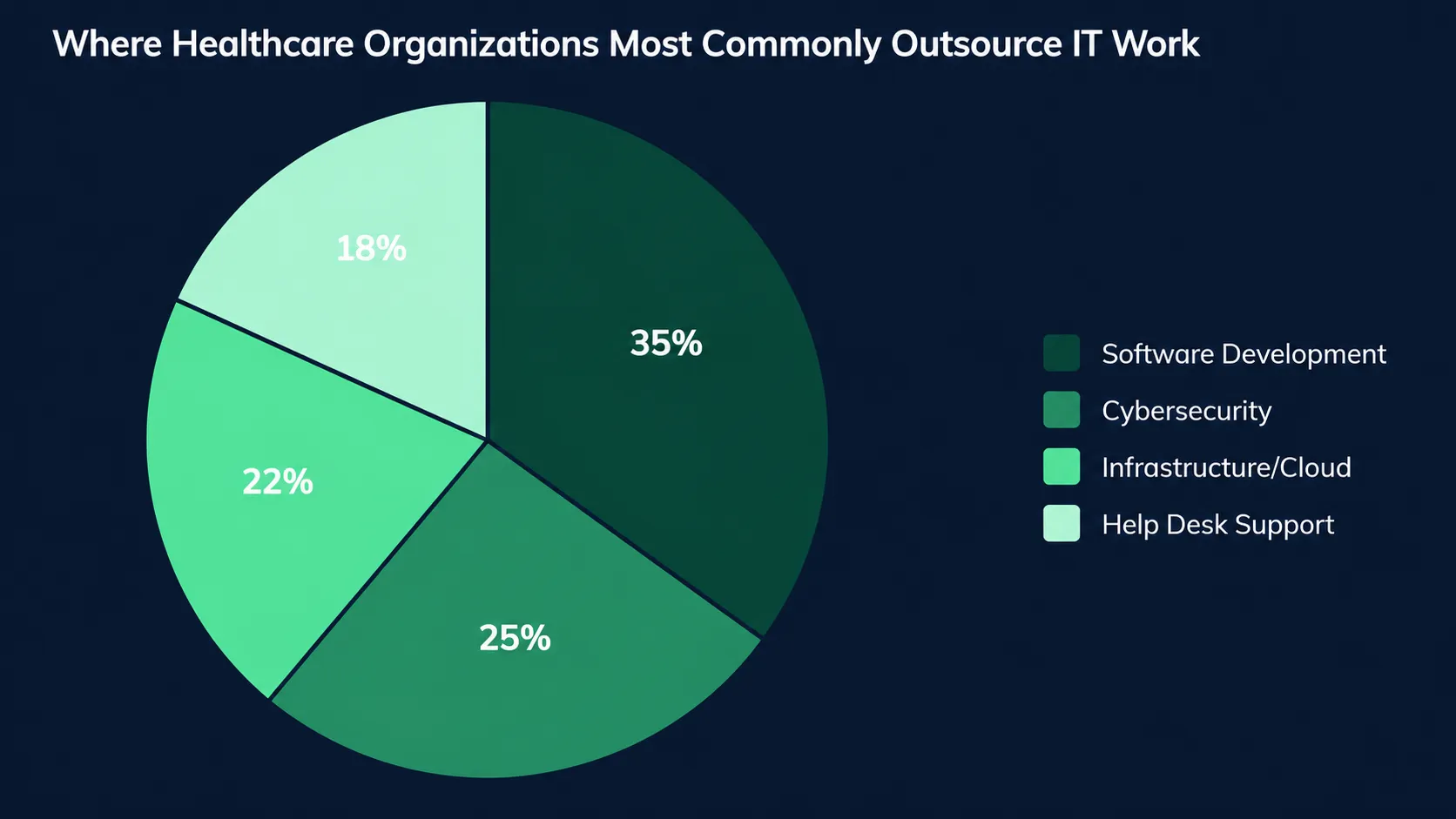
The term gets used loosely, so it helps to break it into categories. Most engagements fall into one of four buckets:
- Software development and EHR customization — building or maintaining patient portals, clinical decision tools, and integrations with electronic health record systems.
- Infrastructure and cloud management — hosting, servers, backups, and disaster recovery for clinical and administrative systems.
- Cybersecurity operations — threat monitoring, penetration testing, incident response, and HIPAA security risk assessments.
- Help desk and technical support — front-line troubleshooting for clinicians and staff, often the first function organizations outsource.
Some providers outsource a single function. Others hand off nearly the whole IT department, keeping only a small internal team to manage vendor relationships and strategy. Neither approach is inherently better — it depends on internal capacity and how much control leadership wants to retain.
Why Healthcare Organizations Outsource IT
Cost is usually the headline reason, but it's rarely the only one. Talent shortages are a bigger driver than most executives admit publicly. Skilled healthcare IT professionals — people who understand both clinical workflows and modern software architecture — are hard to hire and even harder to retain in a competitive market.
According to a Deloitte-cited estimate reported by market analysts, healthcare organizations that outsource IT functions can see cost savings of up to 30% compared to running everything internally. That figure varies a lot by region, function, and vendor, so treat it as a ballpark rather than a guarantee.
Beyond cost, here's what tends to drive the decision:
- Faster access to specialists in cloud security, interoperability standards like FHIR, and AI-assisted clinical tools.
- Reduced administrative burden on internal staff, freeing them to focus on patient-facing priorities.
- Scalability — ramping capacity up or down without the overhead of hiring and layoffs.
- Access to compliance frameworks already built for HIPAA, HITECH, and increasingly, state-level privacy laws.
Healthcare IT Outsourcing Models Compared
Not every outsourcing arrangement looks the same. Picking the wrong model is one of the most common mistakes providers make — a fixed-price contract for a project that needs constant iteration, for instance, tends to create friction fast.
Larger health systems often mix models — staff augmentation for a big EHR rollout, paired with a managed services contract for day-to-day security monitoring. Smaller clinics tend to go with full outsourcing simply because they don't have the internal bandwidth to manage multiple vendors.

Expand Healthcare IT Support with NeoWork
Healthcare IT outsourcing helps organizations manage technical support, system administration, data workflows, and recurring IT tasks without building every role internally. NeoWork provides remote teammates who can support healthcare IT and development functions as part of the client’s existing technical operations. NeoWork handles recruitment, benefits, training, and ongoing engagement, while teammates integrate into the client’s systems, tools, and support processes. Its 91% annualized teammate retention rate and 3.2% candidate selectivity rate reflect a focus on selective hiring and longer-term team stability.
NeoWork's healthcare IT support model offers:
- IT and technical support professionals
- integration with the client’s tools and processes
- recruitment and ongoing teammate support
Contact NeoWork to build healthcare IT support around your existing systems and workflows.
Compliance and Security: The Non-Negotiables
This is where healthcare outsourcing diverges sharply from outsourcing in almost any other industry. A vendor that mishandles patient data doesn't just create a technical headache — it creates legal exposure under HIPAA, and potentially under state privacy statutes too.
Before signing anything, confirm the vendor can produce:
- A signed Business Associate Agreement (BAA) — non-negotiable under HIPAA if the vendor touches protected health information.
- Evidence of a recent SOC 2 Type II audit or equivalent security certification.
- A documented incident response plan, including breach notification timelines.
- Data encryption standards for data at rest and in transit.
- Clear data residency terms — where servers are physically located matters for some state and international regulations.
Skipping this step to save time is one of the costliest shortcuts a healthcare organization can take. Breach costs in healthcare consistently run higher than in almost any other industry, largely because of regulatory penalties layered on top of remediation expenses.
How Much Does Healthcare IT Outsourcing Cost?
Pricing varies widely depending on the scope of work, provider location, and level of expertise required. A small clinic outsourcing basic help desk support will face very different costs than a hospital system outsourcing a full cybersecurity operations center.
Offshore Providers
Offshore development and support teams usually offer lower hourly rates than onshore vendors. However, they may require more oversight around compliance, communication, and workflow coordination.
Nearshore Providers
Nearshore partners often sit in the middle on cost. They typically offer better time zone overlap and easier collaboration while remaining more affordable than domestic providers.
Onshore Providers
Onshore or domestic vendors usually cost more, but they can simplify communication and compliance because they operate under the same regulatory framework.
Compare the Full Scope
Instead of relying on a fixed price estimate, request itemized quotes from at least three vendors. Compare included services, support levels, compliance responsibilities, setup fees, and ongoing costs line by line rather than focusing only on the final total.
Choosing the Right Outsourcing Partner
Vendor selection is where most outsourcing initiatives succeed or fail. A technically strong vendor with no healthcare experience will underestimate the complexity of clinical workflows. A healthcare-focused vendor with weak security practices puts patient data at risk. The best partners sit at the intersection of both.
Questions worth asking during vendor evaluation:
- Can they name specific healthcare clients (with permission) and describe the systems they've worked on?
- How do they handle EHR interoperability standards like HL7 and FHIR?
- What does their onboarding and knowledge transfer process actually look like?
- How is pricing structured if project scope changes mid-engagement?
- What happens to data and access credentials if the contract ends?
Risks and How to Manage Them
Outsourcing isn't risk-free, and pretending otherwise sets up unrealistic expectations. The most common problems fall into a handful of categories.
None of these risks are dealbreakers on their own. But ignoring more than one at a time tends to compound quickly — a vendor with weak communication and unclear billing, for example, is a much bigger problem than either issue alone.
Implementation: A Practical Rollout Path
Jumping straight to a full outsourcing contract rarely works well. A phased approach tends to produce better results and gives both sides a chance to build trust before the stakes get higher.
- Start with an internal audit. Map out which IT functions are underperforming, understaffed, or draining budget disproportionately.
- Pilot with a single, contained function. Help desk support or a discrete development project works well as a low-risk starting point.
- Set measurable success criteria. Response times, uptime percentages, ticket resolution rates — whatever matters most for that function.
- Review after 90 days. Decide whether to expand scope, renegotiate terms, or switch vendors.
- Formalize governance. Once scaled, put a dedicated internal owner in place to manage the vendor relationship long-term.
Final Thoughts
Healthcare IT outsourcing isn't a shortcut, and it isn't a silver bullet either. It's a strategic tool — one that works well when the scope is clear, the vendor is vetted properly, and compliance sits at the center of every decision rather than as an afterthought. Organizations that treat it that way tend to see real gains: lower costs, faster access to specialized skills, and IT infrastructure that can actually keep pace with modern clinical demands.
The organizations that struggle are usually the ones that skipped the vetting process or picked a vendor based on price alone. Before signing anything, run the pilot, check the compliance paperwork twice, and put a real owner in charge of the relationship. That's the difference between outsourcing that pays off and outsourcing that turns into a liability.
Frequently Asked Questions
Topics
Healthcare IT Outsourcing Guide: What Works in 2026

Quick Summary: Healthcare IT outsourcing means handing off software development, infrastructure management, cybersecurity, or help desk functions to an external partner instead of building everything in-house. Done right, it cuts costs by roughly 20-30%, according to industry estimates, while giving providers faster access to specialized talent and modern compliance frameworks. The tradeoff is real, though — vendor selection, data governance, and HIPAA-grade security controls determine whether the arrangement actually pays off.
Hospitals and clinics are drowning in software problems nobody budgeted for. Electronic health record systems need constant patching. Telehealth platforms need round-the-clock uptime. And cybersecurity threats aimed at healthcare data keep climbing, year after year. Building an internal team that can handle all of that is expensive, slow, and honestly, most provider organizations aren't equipped for it.
That's the gap healthcare IT outsourcing fills. It's not a new idea, but the way it's being used has shifted. Instead of just farming out a help desk, health systems now outsource entire product teams, security operations centers, and compliance monitoring functions. This guide walks through what outsourcing actually covers, how much it costs, the risks worth knowing about, and how to pick a partner that won't put patient data at risk.
What Healthcare IT Outsourcing Actually Covers
The term gets used loosely, so it helps to break it into categories. Most engagements fall into one of four buckets:
- Software development and EHR customization — building or maintaining patient portals, clinical decision tools, and integrations with electronic health record systems.
- Infrastructure and cloud management — hosting, servers, backups, and disaster recovery for clinical and administrative systems.
- Cybersecurity operations — threat monitoring, penetration testing, incident response, and HIPAA security risk assessments.
- Help desk and technical support — front-line troubleshooting for clinicians and staff, often the first function organizations outsource.
Some providers outsource a single function. Others hand off nearly the whole IT department, keeping only a small internal team to manage vendor relationships and strategy. Neither approach is inherently better — it depends on internal capacity and how much control leadership wants to retain.
Why Healthcare Organizations Outsource IT
Cost is usually the headline reason, but it's rarely the only one. Talent shortages are a bigger driver than most executives admit publicly. Skilled healthcare IT professionals — people who understand both clinical workflows and modern software architecture — are hard to hire and even harder to retain in a competitive market.
According to a Deloitte-cited estimate reported by market analysts, healthcare organizations that outsource IT functions can see cost savings of up to 30% compared to running everything internally. That figure varies a lot by region, function, and vendor, so treat it as a ballpark rather than a guarantee.
Beyond cost, here's what tends to drive the decision:
- Faster access to specialists in cloud security, interoperability standards like FHIR, and AI-assisted clinical tools.
- Reduced administrative burden on internal staff, freeing them to focus on patient-facing priorities.
- Scalability — ramping capacity up or down without the overhead of hiring and layoffs.
- Access to compliance frameworks already built for HIPAA, HITECH, and increasingly, state-level privacy laws.
Healthcare IT Outsourcing Models Compared
Not every outsourcing arrangement looks the same. Picking the wrong model is one of the most common mistakes providers make — a fixed-price contract for a project that needs constant iteration, for instance, tends to create friction fast.
Larger health systems often mix models — staff augmentation for a big EHR rollout, paired with a managed services contract for day-to-day security monitoring. Smaller clinics tend to go with full outsourcing simply because they don't have the internal bandwidth to manage multiple vendors.
Expand Healthcare IT Support with NeoWork
Healthcare IT outsourcing helps organizations manage technical support, system administration, data workflows, and recurring IT tasks without building every role internally. NeoWork provides remote teammates who can support healthcare IT and development functions as part of the client’s existing technical operations. NeoWork handles recruitment, benefits, training, and ongoing engagement, while teammates integrate into the client’s systems, tools, and support processes. Its 91% annualized teammate retention rate and 3.2% candidate selectivity rate reflect a focus on selective hiring and longer-term team stability.
NeoWork's healthcare IT support model offers:
- IT and technical support professionals
- integration with the client’s tools and processes
- recruitment and ongoing teammate support
Contact NeoWork to build healthcare IT support around your existing systems and workflows.
Compliance and Security: The Non-Negotiables
This is where healthcare outsourcing diverges sharply from outsourcing in almost any other industry. A vendor that mishandles patient data doesn't just create a technical headache — it creates legal exposure under HIPAA, and potentially under state privacy statutes too.
Before signing anything, confirm the vendor can produce:
- A signed Business Associate Agreement (BAA) — non-negotiable under HIPAA if the vendor touches protected health information.
- Evidence of a recent SOC 2 Type II audit or equivalent security certification.
- A documented incident response plan, including breach notification timelines.
- Data encryption standards for data at rest and in transit.
- Clear data residency terms — where servers are physically located matters for some state and international regulations.
Skipping this step to save time is one of the costliest shortcuts a healthcare organization can take. Breach costs in healthcare consistently run higher than in almost any other industry, largely because of regulatory penalties layered on top of remediation expenses.
How Much Does Healthcare IT Outsourcing Cost?
Pricing varies widely depending on the scope of work, provider location, and level of expertise required. A small clinic outsourcing basic help desk support will face very different costs than a hospital system outsourcing a full cybersecurity operations center.
Offshore Providers
Offshore development and support teams usually offer lower hourly rates than onshore vendors. However, they may require more oversight around compliance, communication, and workflow coordination.
Nearshore Providers
Nearshore partners often sit in the middle on cost. They typically offer better time zone overlap and easier collaboration while remaining more affordable than domestic providers.
Onshore Providers
Onshore or domestic vendors usually cost more, but they can simplify communication and compliance because they operate under the same regulatory framework.
Compare the Full Scope
Instead of relying on a fixed price estimate, request itemized quotes from at least three vendors. Compare included services, support levels, compliance responsibilities, setup fees, and ongoing costs line by line rather than focusing only on the final total.
Choosing the Right Outsourcing Partner
Vendor selection is where most outsourcing initiatives succeed or fail. A technically strong vendor with no healthcare experience will underestimate the complexity of clinical workflows. A healthcare-focused vendor with weak security practices puts patient data at risk. The best partners sit at the intersection of both.
Questions worth asking during vendor evaluation:
- Can they name specific healthcare clients (with permission) and describe the systems they've worked on?
- How do they handle EHR interoperability standards like HL7 and FHIR?
- What does their onboarding and knowledge transfer process actually look like?
- How is pricing structured if project scope changes mid-engagement?
- What happens to data and access credentials if the contract ends?
Risks and How to Manage Them
Outsourcing isn't risk-free, and pretending otherwise sets up unrealistic expectations. The most common problems fall into a handful of categories.
None of these risks are dealbreakers on their own. But ignoring more than one at a time tends to compound quickly — a vendor with weak communication and unclear billing, for example, is a much bigger problem than either issue alone.
Implementation: A Practical Rollout Path
Jumping straight to a full outsourcing contract rarely works well. A phased approach tends to produce better results and gives both sides a chance to build trust before the stakes get higher.
- Start with an internal audit. Map out which IT functions are underperforming, understaffed, or draining budget disproportionately.
- Pilot with a single, contained function. Help desk support or a discrete development project works well as a low-risk starting point.
- Set measurable success criteria. Response times, uptime percentages, ticket resolution rates — whatever matters most for that function.
- Review after 90 days. Decide whether to expand scope, renegotiate terms, or switch vendors.
- Formalize governance. Once scaled, put a dedicated internal owner in place to manage the vendor relationship long-term.
Final Thoughts
Healthcare IT outsourcing isn't a shortcut, and it isn't a silver bullet either. It's a strategic tool — one that works well when the scope is clear, the vendor is vetted properly, and compliance sits at the center of every decision rather than as an afterthought. Organizations that treat it that way tend to see real gains: lower costs, faster access to specialized skills, and IT infrastructure that can actually keep pace with modern clinical demands.
The organizations that struggle are usually the ones that skipped the vetting process or picked a vendor based on price alone. Before signing anything, run the pilot, check the compliance paperwork twice, and put a real owner in charge of the relationship. That's the difference between outsourcing that pays off and outsourcing that turns into a liability.
Frequently Asked Questions
Topics
Related Blogs
Related Podcasts


.webp)

.webp)
.webp)



