

.avif)
.avif)

Payroll Specialist Outsourcing Guide (2026): What to Know


.svg)

Quick Summary: Payroll outsourcing means handing payroll calculations, tax filings, and compliance work to a third-party specialist instead of managing it internally. It typically saves time, reduces compliance risk, and cuts the cost of maintaining in-house payroll software and staff, though it does require giving up some direct control. The right choice depends on company size, budget, and how complex the payroll needs actually are.
Running payroll sounds simple until it isn't. One misclassified employee, one missed tax deadline, one botched overtime calculation — and suddenly a routine task turns into a compliance headache. That's exactly why so many businesses, from five-person startups to companies with hundreds of employees, hand payroll off to a specialist rather than managing it themselves.
This guide walks through what payroll outsourcing actually involves, how the process works day to day, what it costs, and how to decide whether it's the right move. No sales pitch, no jargon — just the practical information needed to make the call.
What Is Payroll Outsourcing?
Payroll outsourcing is the practice of contracting an external provider — a payroll specialist, bureau, or full-service HR outsourcing firm — to handle some or all payroll functions. That can mean anything from calculating gross-to-net pay and filing tax withholdings to managing benefits deductions, issuing pay stubs, and staying current with changing labor law.
Some businesses outsource everything. Others keep a payroll manager on staff and outsource only the technical, compliance-heavy pieces like tax filing. Both approaches count as outsourcing, just at different depths.
Full-Service vs. Partial Outsourcing
Full-service outsourcing puts nearly the entire payroll cycle in the provider's hands — data collection, calculations, filings, direct deposits, year-end reporting. Partial outsourcing keeps day-to-day processing in-house but sends specific tasks, usually tax compliance or year-end filings, to a specialist. Smaller companies tend to lean toward full-service; mid-sized and larger organizations often prefer a hybrid.
How Payroll Outsourcing Works
The mechanics are fairly consistent across providers, even if the tools differ. Here is the typical flow once a contract is signed.
Submit Payroll Information
Employers enter employee hours, bonuses, deductions, new hires, and other payroll changes through a cloud-based portal or connected HR system.
Calculate Pay and File Taxes
The provider calculates wages, applies deductions, processes payments, and files the required payroll taxes automatically. Employers usually review and approve the payroll before it is finalized.
Provide Employee Self-Service
Employees typically receive access to a self-service portal where they can view pay stubs, update direct deposit details, download tax documents, and manage basic personal information without contacting HR.
Types of Payroll Outsourcing Providers
Not all providers offer the same thing, and picking the wrong category is a common mistake. Broadly, options fall into a few buckets.

Add Payroll Specialist Support with NeoWork
Payroll specialist outsourcing helps companies add remote professionals for payroll processing support, records management, employee data updates, and recurring administrative tasks. NeoWork provides teammates who can work within the client’s existing payroll systems, approval processes, and reporting workflows. NeoWork handles recruitment, benefits, training, and ongoing engagement, while clients retain control over daily priorities and procedures. Its 91% annualized teammate retention rate and 3.2% candidate selectivity rate reflect a focus on selective hiring and longer-term team stability.
NeoWork's payroll specialist model offers:
- dedicated payroll support professionals
- integration with the client’s tools and processes
- recruitment and ongoing teammate support
Contact NeoWork to add payroll specialist support for recurring payroll operations.
Benefits of Outsourcing Payroll
The appeal isn't just convenience. There are measurable reasons companies make the switch, and they tend to cluster around a few themes: time, accuracy, and risk reduction.
- Time savings. Payroll processing, tax filing, and record-keeping can eat several hours per pay cycle — hours that go back to running the actual business.
- Compliance confidence. Tax codes and labor rules shift often. Specialists track those changes as their core job, not a side task.
- Reduced error risk. Automated calculations and built-in checks cut down on the manual mistakes that cause underpayments, overpayments, or penalty notices.
- Lower overhead. No need to license payroll software, train staff on it, or keep someone dedicated solely to payroll administration.
- Scalability. Adding employees, new states, or even new countries is usually easier through a provider already set up for it.
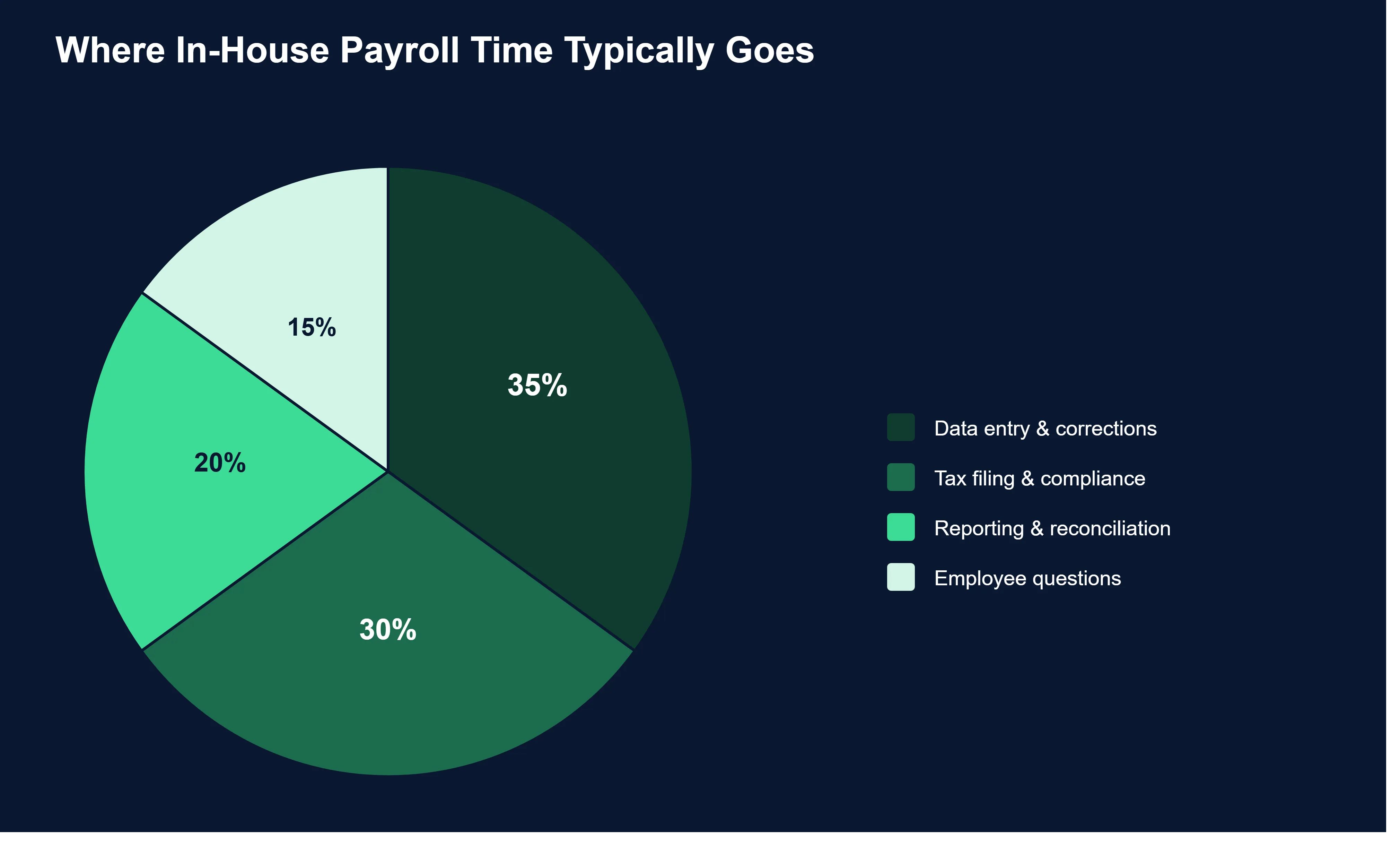
Downsides and Risks to Weigh
Outsourcing isn't automatically the right answer for everyone. It's worth being honest about the trade-offs before signing anything.
Data security deserves particular attention. Payroll data includes bank details, national ID numbers, and salary information — exactly what a provider needs strong safeguards around. Ask any prospective vendor directly about encryption, access controls, and how they handle a data breach before signing.
When Does It Make Sense to Outsource?
There is no universal rule, but a few signs can indicate that outsourcing is worth considering.
Clear Signs Outsourcing May Help
Businesses expanding into new regions, dealing with frequent staff turnover, or lacking in-house payroll expertise are often strong candidates. Outsourcing can also make sense when payroll is taking too much time from HR, finance, or business owners.
When In-House Payroll May Still Work
Companies with a stable, small headcount and an experienced in-house bookkeeper may not see enough benefit to justify switching. In those cases, keeping payroll internal may remain the simpler and more cost-effective option.
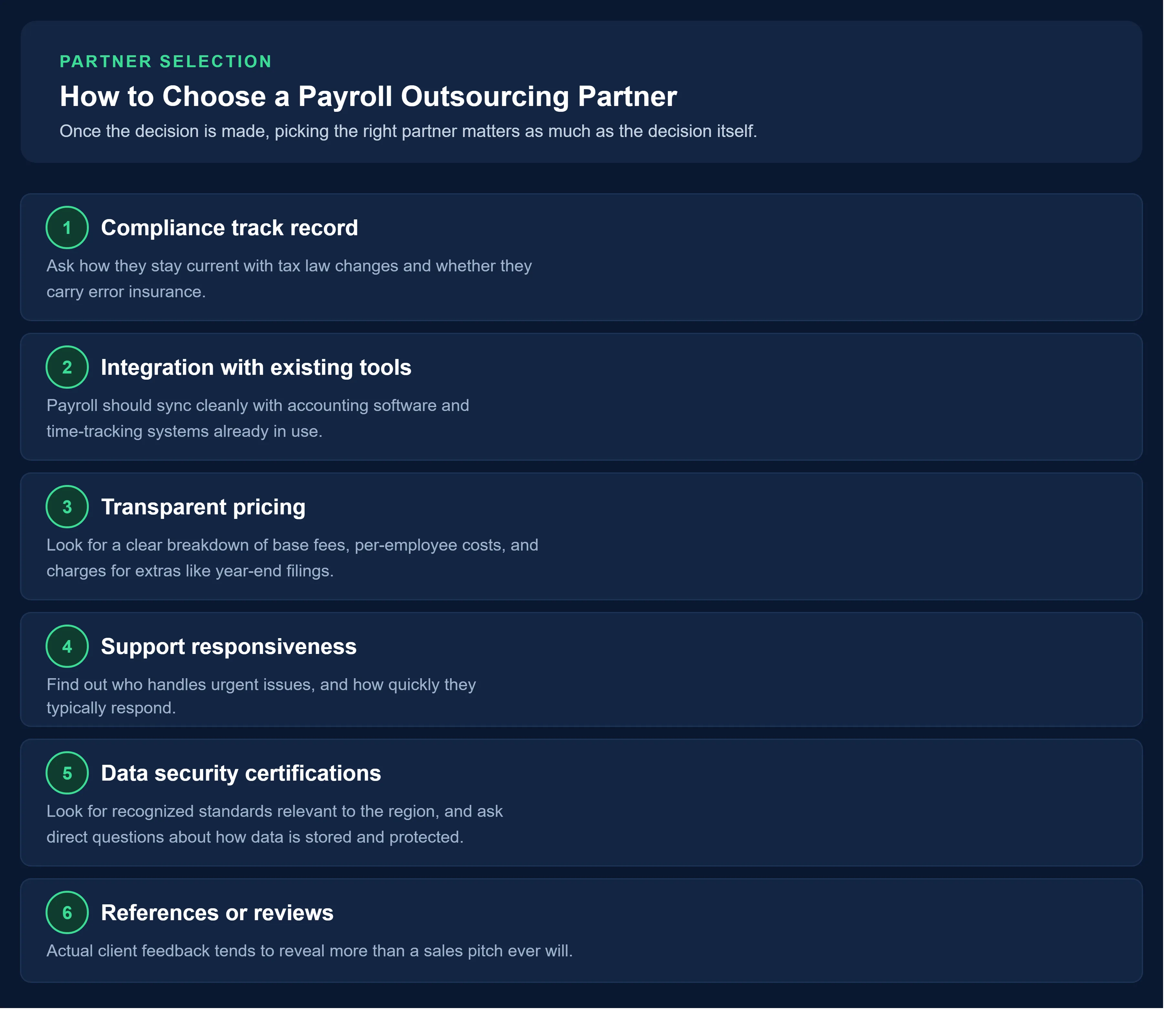
How to Choose a Payroll Outsourcing Partner
Once the decision is made, picking the right partner matters as much as the decision itself. A few things worth checking before signing a contract:
- Compliance track record. Ask how they stay current with tax law changes and whether they carry error insurance.
- Integration with existing tools. Payroll should sync cleanly with accounting software and time-tracking systems already in use.
- Transparent pricing. Look for a clear breakdown of base fees, per-employee costs, and charges for extras like year-end filings.
- Support responsiveness. Find out who handles urgent issues, and how quickly they typically respond.
- Data security certifications. Look for recognized standards relevant to the region, and ask direct questions about how data is stored and protected.
- References or reviews. Actual client feedback tends to reveal more than a sales pitch ever will.
What Does Payroll Outsourcing Cost?
Pricing varies widely depending on headcount, complexity, and provider type — and it changes often enough that quoting a fixed number here wouldn't hold up for long. Most providers charge either a flat monthly base fee plus a per-employee rate, or a percentage of total payroll. PEOs often bundle payroll into a broader HR fee. Because pricing structures shift and promotions come and go, it's best to request current quotes directly from a shortlist of providers rather than relying on a number found online.
Final Thoughts
Payroll outsourcing isn't a one-size-fits-all decision, but for most growing businesses it ends up saving more time and reducing more risk than it costs. The key is matching the provider type to actual needs — a payroll bureau for straightforward processing, a PEO for bundled HR support, or a hybrid approach that keeps some control in-house.
Before committing, get quotes from at least two or three providers, ask pointed questions about compliance and security, and read the contract's fine print on error liability. That homework upfront tends to save a lot of frustration down the line.
FAQ: Payroll Specialist Outsourcing
Topics
Payroll Specialist Outsourcing Guide (2026): What to Know

Quick Summary: Payroll outsourcing means handing payroll calculations, tax filings, and compliance work to a third-party specialist instead of managing it internally. It typically saves time, reduces compliance risk, and cuts the cost of maintaining in-house payroll software and staff, though it does require giving up some direct control. The right choice depends on company size, budget, and how complex the payroll needs actually are.
Running payroll sounds simple until it isn't. One misclassified employee, one missed tax deadline, one botched overtime calculation — and suddenly a routine task turns into a compliance headache. That's exactly why so many businesses, from five-person startups to companies with hundreds of employees, hand payroll off to a specialist rather than managing it themselves.
This guide walks through what payroll outsourcing actually involves, how the process works day to day, what it costs, and how to decide whether it's the right move. No sales pitch, no jargon — just the practical information needed to make the call.
What Is Payroll Outsourcing?
Payroll outsourcing is the practice of contracting an external provider — a payroll specialist, bureau, or full-service HR outsourcing firm — to handle some or all payroll functions. That can mean anything from calculating gross-to-net pay and filing tax withholdings to managing benefits deductions, issuing pay stubs, and staying current with changing labor law.
Some businesses outsource everything. Others keep a payroll manager on staff and outsource only the technical, compliance-heavy pieces like tax filing. Both approaches count as outsourcing, just at different depths.
Full-Service vs. Partial Outsourcing
Full-service outsourcing puts nearly the entire payroll cycle in the provider's hands — data collection, calculations, filings, direct deposits, year-end reporting. Partial outsourcing keeps day-to-day processing in-house but sends specific tasks, usually tax compliance or year-end filings, to a specialist. Smaller companies tend to lean toward full-service; mid-sized and larger organizations often prefer a hybrid.
How Payroll Outsourcing Works
The mechanics are fairly consistent across providers, even if the tools differ. Here is the typical flow once a contract is signed.
Submit Payroll Information
Employers enter employee hours, bonuses, deductions, new hires, and other payroll changes through a cloud-based portal or connected HR system.
Calculate Pay and File Taxes
The provider calculates wages, applies deductions, processes payments, and files the required payroll taxes automatically. Employers usually review and approve the payroll before it is finalized.
Provide Employee Self-Service
Employees typically receive access to a self-service portal where they can view pay stubs, update direct deposit details, download tax documents, and manage basic personal information without contacting HR.
Types of Payroll Outsourcing Providers
Not all providers offer the same thing, and picking the wrong category is a common mistake. Broadly, options fall into a few buckets.
Add Payroll Specialist Support with NeoWork
Payroll specialist outsourcing helps companies add remote professionals for payroll processing support, records management, employee data updates, and recurring administrative tasks. NeoWork provides teammates who can work within the client’s existing payroll systems, approval processes, and reporting workflows. NeoWork handles recruitment, benefits, training, and ongoing engagement, while clients retain control over daily priorities and procedures. Its 91% annualized teammate retention rate and 3.2% candidate selectivity rate reflect a focus on selective hiring and longer-term team stability.
NeoWork's payroll specialist model offers:
- dedicated payroll support professionals
- integration with the client’s tools and processes
- recruitment and ongoing teammate support
Contact NeoWork to add payroll specialist support for recurring payroll operations.
Benefits of Outsourcing Payroll
The appeal isn't just convenience. There are measurable reasons companies make the switch, and they tend to cluster around a few themes: time, accuracy, and risk reduction.
- Time savings. Payroll processing, tax filing, and record-keeping can eat several hours per pay cycle — hours that go back to running the actual business.
- Compliance confidence. Tax codes and labor rules shift often. Specialists track those changes as their core job, not a side task.
- Reduced error risk. Automated calculations and built-in checks cut down on the manual mistakes that cause underpayments, overpayments, or penalty notices.
- Lower overhead. No need to license payroll software, train staff on it, or keep someone dedicated solely to payroll administration.
- Scalability. Adding employees, new states, or even new countries is usually easier through a provider already set up for it.
Downsides and Risks to Weigh
Outsourcing isn't automatically the right answer for everyone. It's worth being honest about the trade-offs before signing anything.
Data security deserves particular attention. Payroll data includes bank details, national ID numbers, and salary information — exactly what a provider needs strong safeguards around. Ask any prospective vendor directly about encryption, access controls, and how they handle a data breach before signing.
When Does It Make Sense to Outsource?
There is no universal rule, but a few signs can indicate that outsourcing is worth considering.
Clear Signs Outsourcing May Help
Businesses expanding into new regions, dealing with frequent staff turnover, or lacking in-house payroll expertise are often strong candidates. Outsourcing can also make sense when payroll is taking too much time from HR, finance, or business owners.
When In-House Payroll May Still Work
Companies with a stable, small headcount and an experienced in-house bookkeeper may not see enough benefit to justify switching. In those cases, keeping payroll internal may remain the simpler and more cost-effective option.
How to Choose a Payroll Outsourcing Partner
Once the decision is made, picking the right partner matters as much as the decision itself. A few things worth checking before signing a contract:
- Compliance track record. Ask how they stay current with tax law changes and whether they carry error insurance.
- Integration with existing tools. Payroll should sync cleanly with accounting software and time-tracking systems already in use.
- Transparent pricing. Look for a clear breakdown of base fees, per-employee costs, and charges for extras like year-end filings.
- Support responsiveness. Find out who handles urgent issues, and how quickly they typically respond.
- Data security certifications. Look for recognized standards relevant to the region, and ask direct questions about how data is stored and protected.
- References or reviews. Actual client feedback tends to reveal more than a sales pitch ever will.
What Does Payroll Outsourcing Cost?
Pricing varies widely depending on headcount, complexity, and provider type — and it changes often enough that quoting a fixed number here wouldn't hold up for long. Most providers charge either a flat monthly base fee plus a per-employee rate, or a percentage of total payroll. PEOs often bundle payroll into a broader HR fee. Because pricing structures shift and promotions come and go, it's best to request current quotes directly from a shortlist of providers rather than relying on a number found online.
Final Thoughts
Payroll outsourcing isn't a one-size-fits-all decision, but for most growing businesses it ends up saving more time and reducing more risk than it costs. The key is matching the provider type to actual needs — a payroll bureau for straightforward processing, a PEO for bundled HR support, or a hybrid approach that keeps some control in-house.
Before committing, get quotes from at least two or three providers, ask pointed questions about compliance and security, and read the contract's fine print on error liability. That homework upfront tends to save a lot of frustration down the line.
FAQ: Payroll Specialist Outsourcing
Topics
Related Blogs
Related Podcasts


.webp)

.webp)
.webp)



