
Green glowing circular pattern with concentric rings and faint hexagonal grid on the left side.
Blue abstract hexagonal pattern with glowing circular gradient edges on a black background.Glowing greenish-blue hexagonal pattern with concentric circular gradients on a black background.

Contact Center Outsourcing Guide: How It Works in 2026

Calendar Icon
Published:
Oct 29
2026
,
Updated:
Oct 30
2026
Ann
Facebook IconInstagram Icon

Build your team with NeoWork

Talk to us about how we staff and manage high-performing remote teams for companies like yours.

Get a Contact Center Outsourcing Quote

Quick Summary: Contact center outsourcing is when a company hands some or all of its customer interactions (phone, email, live chat, SMS, and social messaging) to an external provider that supplies trained agents, workforce management, quality assurance, and reporting. Grand View Research values the global call and contact center outsourcing market at about 110 billion US dollars in 2026, with forecasts of double-digit growth through the early 2030s. Most programs combine a location model (onshore, nearshore, or offshore) with a staffing model (dedicated or shared agents), are priced per hour, per seat, or per contact, and are measured on service level, first contact resolution, and CSAT.

Customer contact volume rarely stays flat. A product launch, a billing change, a holiday season, or a single outage can double inbound volume overnight, and building an in-house contact center sized for those peaks means paying for idle seats the rest of the year. At the same time, customers now expect answers on whichever channel they pick, often outside business hours.

That combination is why many growing companies now use contact center outsourcing as a standard operating model rather than a one-off cost cut. But the term covers a wide range of arrangements, from a handful of overflow chat agents to a multi-site operation running every channel in several languages. The right setup depends on your volume, channels, and customer experience standards.

What Is Contact Center Outsourcing?

Contact center outsourcing is a type of business process outsourcing (BPO) in which a company contracts a third-party provider to manage inbound and outbound customer interactions across multiple channels. The provider is responsible for staffing, training, scheduling, quality monitoring, and performance reporting, while the client usually keeps ownership of policies, brand voice, escalation rules, and customer data.

The difference between a call center and a contact center is the channel mix. A call center handles voice only. A contact center handles voice plus digital channels such as email, chat, SMS, social media, and messaging apps, ideally with a shared view of the customer so conversations can move between channels without starting over.

What Services Does an Outsourced Contact Center Handle?

Most providers group their work into inbound, outbound, and back-office support. The table below shows what typically falls into each category.
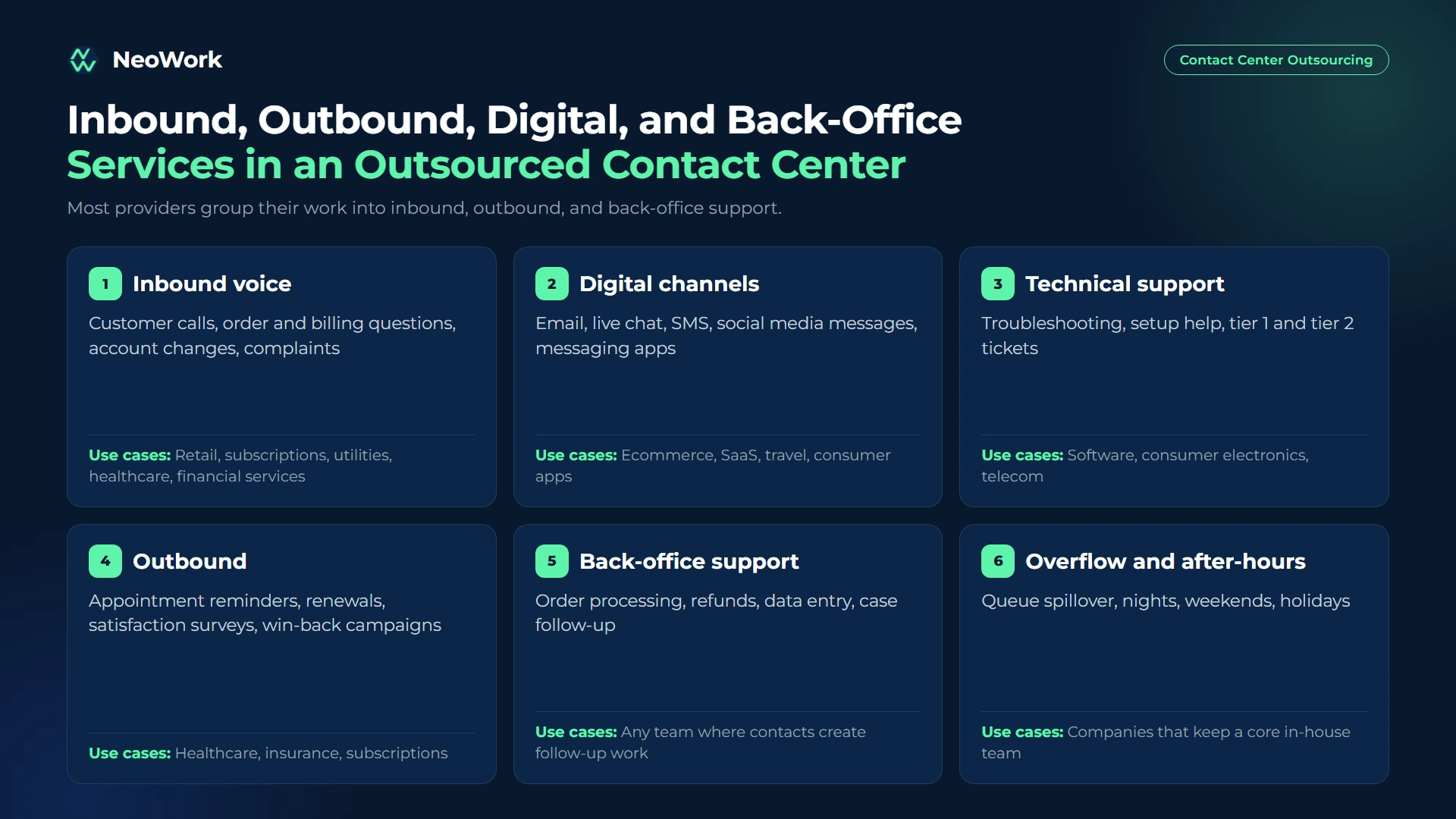
Service Type Typical Interactions Common Use Cases
Inbound voice Customer calls, order and billing questions, account changes, complaints Retail, subscriptions, utilities, healthcare, financial services
Digital channels Email, live chat, SMS, social media messages, messaging apps Ecommerce, SaaS, travel, consumer apps
Technical support Troubleshooting, setup help, tier 1 and tier 2 tickets Software, consumer electronics, telecom
Outbound Appointment reminders, renewals, satisfaction surveys, win-back campaigns Healthcare, insurance, subscriptions
Back-office support Order processing, refunds, data entry, case follow-up Any team where contacts create follow-up work
Overflow and after-hours Queue spillover, nights, weekends, holidays Companies that keep a core in-house team
Contact center outsourcing services map showing inbound voice, digital channels, technical support, outbound calls, back-office support, and overflow coverage

Build Your Contact Center Team Without the Overhead

At NeoWork, we build dedicated customer support teams that answer your calls, chats, emails, and messages as if they sat in your office. Our teammates work inside your helpdesk, CRM, and phone system, follow your playbooks, and represent your brand voice.

We take care of everything behind the team: recruiting, onboarding, benefits, coaching, and ongoing teammate support. You get people who learn your product and stay with your customers, without the cost and management load of building a contact center yourself.

What we bring:

  • Dedicated agents and full support teams trained on your product, policies, and tone
  • A 3.2% candidate selectivity rate, so only top applicants talk to your customers
  • Industry-leading 91% annualized teammate retention rate, which keeps product knowledge on your team
  • Coverage across time zones, including nights, weekends, and seasonal peaks

Contact us to share your channels, volumes, and service goals. We will outline the team structure that fits and how quickly we can get it live.

Benefits of Outsourcing Your Contact Center

  • Lower cost per contact: Providers spread facilities, telephony, workforce management tools, and supervision across many agents, and nearshore or offshore locations have lower hourly rates than onshore hiring.
  • Flexible capacity: Seats can be added for launches and holiday peaks and scaled back afterward, instead of carrying a team sized for your busiest week.
  • Longer coverage hours: Teams in other time zones make 24/7 or extended-hours support practical without night-shift premiums.
  • Faster ramp-up: An experienced provider already has recruiting pipelines, training frameworks, and QA processes, so a new program can go live in weeks instead of months.
  • Multilingual support: Providers with hubs in different regions can staff Spanish, Portuguese, French, or other languages without separate local hiring.
  • Operational discipline: Mature providers bring workforce management, quality scorecards, and reporting that smaller in-house teams often lack.

Contact Center Outsourcing Models

Two decisions shape every engagement: where the agents are located, and whether they work only on your account.

Готовая HTML-таблица в стиле NeoWork: темно-синий фон, серо-голубой текст, тонкие светлые границы. Все данные сохранены без изменений, таблица адаптирована под ширину страницы. ```
Model How It Works Best For Trade-Offs
Onshore Agents in the same country as your customers Regulated industries, complex or high-value conversations Highest cost per hour
Nearshore Agents in a nearby country with overlapping time zones, such as Latin America for US companies Real-time voice and chat with strong cultural alignment Mid-range cost, smaller talent pools in niche languages
Offshore Agents in distant regions such as the Philippines or India High-volume support, 24/7 coverage, cost-sensitive programs Time zone gaps for management, needs strong training on context
Dedicated team Agents work only on your account, inside your tools Brands that want consistency, deep product knowledge, and control Fixed monthly cost per seat
Shared agents Agents split time across several clients Low or unpredictable volume, simple FAQs, after-hours overflow Less product knowledge, less brand consistency

Many companies blend models: a nearshore dedicated team handles real-time voice and chat during business hours, while an offshore team covers nights, email backlog, and back-office follow-up. Our dedicated team model is built for this kind of setup, where the agents feel like an extension of your own team.

How Much Does Contact Center Outsourcing Cost?

The biggest cost drivers are agent location, channel mix, language requirements, hours of coverage, and how complex the conversations are. Common pricing structures include:

  • Per hour: You pay for agent hours worked or scheduled. Pricing guides published in 2026 by JustCall and Retell AI put onshore US rates at roughly 25 to 45 US dollars per agent hour, nearshore at around 8 to 24, and offshore at around 5 to 16, depending on language and complexity.
  • Per seat or per FTE: A fixed monthly cost for each full-time agent, which makes budgeting predictable and suits dedicated teams.
  • Per minute or per contact: Billing by talk time or by handled interaction, common for overflow and variable-volume programs.
  • Outcome-based: Fees tied to sales, retention saves, or resolution targets, usually layered on top of a base rate.

When comparing quotes, ask what is included: supervision ratios, QA, workforce management, technology licenses, training time, and reporting. A low hourly rate with extra fees for every one of those items often costs more than an all-in seat price. You can see how we structure dedicated teams on our pricing page.

Contact Center KPIs to Put in the Contract

Clear service levels give you and the provider a shared definition of good performance. These are the metrics most contact center agreements track.
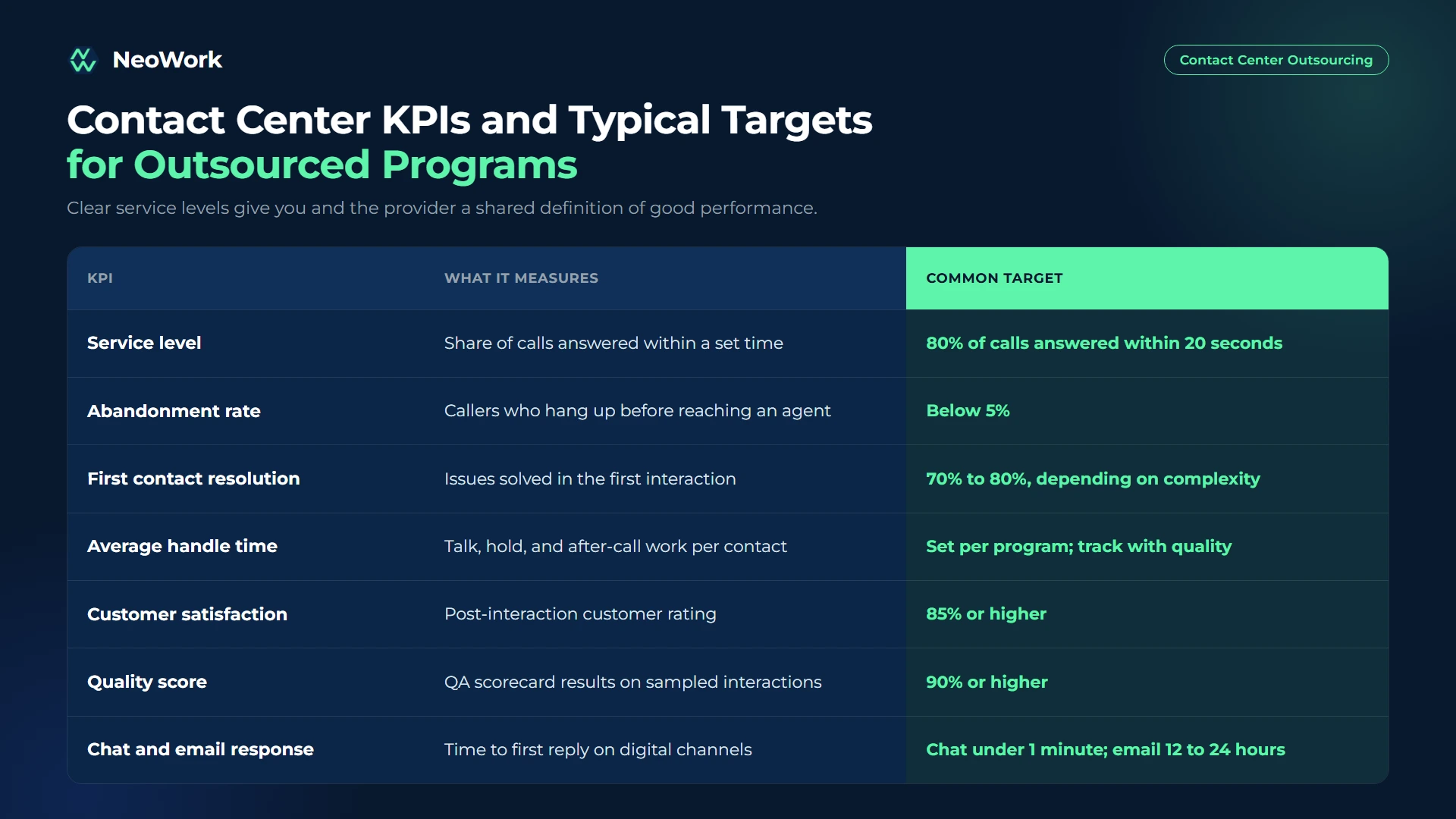
KPI What It Measures Common Target
Service level Share of calls answered within a set time 80% of calls answered within 20 seconds (the classic 80/20 standard)
Abandonment rate Share of callers who hang up before reaching an agent Below 5%
First contact resolution (FCR) Share of issues solved in the first interaction 70% to 80%, depending on complexity
Average handle time (AHT) Talk, hold, and after-call work per contact Set per program; track alongside quality, not alone
Customer satisfaction (CSAT) Post-interaction customer rating 85% or higher for most programs
Quality score Internal QA scorecard results on sampled interactions 90% or higher
Email and chat response time Time to first reply on digital channels Under 1 minute for chat, under 12 to 24 hours for email
Contact center outsourcing KPI chart with typical targets for service level, abandonment rate, first contact resolution, CSAT, quality score, and response times

Avoid making average handle time the main target. Agents pushed to keep calls short tend to transfer or rush customers, which lowers resolution rates and satisfaction. Pairing AHT with FCR and CSAT gives a more honest picture of performance.

How to Outsource Your Contact Center Step by Step

  1. Map your contact volume. Pull at least three to six months of data by channel, hour, and contact reason. This drives staffing, schedules, and pricing.
  2. Define the scope. Decide which channels, contact types, languages, and hours move to the provider and which stay in-house, such as escalations or VIP accounts.
  3. Document your knowledge. Update your knowledge base, macros, escalation paths, and refund or exception policies before training starts.
  4. Shortlist and evaluate providers. Compare industry experience, location options, attrition, security certifications, and references from clients of similar size.
  5. Set up tools and access. Give agents individual logins to your helpdesk, CRM, and phone system with role-based permissions, and agree on data handling rules.
  6. Train and pilot. Start with one channel or contact type, review interactions daily, and calibrate QA scoring together before expanding.
  7. Scale and review. Add channels and hours as KPIs hold, and run weekly performance reviews plus a monthly business review.

Questions Worth Asking Any Provider

  • What is your annual agent attrition rate, and how do you keep knowledge on the account when someone leaves?
  • Will our agents be dedicated to us or shared with other clients?
  • How do you forecast and schedule for seasonal peaks?
  • Which security and compliance standards do you follow, such as PCI DSS for payments or HIPAA for health data?
  • How are QA scores calibrated between your team and ours?
  • How quickly can you add or remove agents, and what notice do you need?

Common Contact Center Outsourcing Mistakes

  • Choosing on hourly rate alone. The cheapest provider often has the highest turnover, and constant retraining shows up in customer satisfaction.
  • Outsourcing broken processes. If your refund policy or escalation path is unclear in-house, it will be worse with an external team. Fix it first.
  • Treating agents as outsiders. Agents who never hear about product updates, promotions, or outages cannot answer customers well. Include them in internal updates.
  • Measuring speed instead of outcomes. Handle time targets without resolution and satisfaction targets push the wrong behavior.
  • Skipping the pilot. Moving every channel at once leaves no room to fix training gaps before customers notice.

Final Thoughts

Contact center outsourcing works best when it is built around customer outcomes as well as cost targets. Start with clear data on volumes and contact reasons, choose the location and staffing model that matches the kind of conversations you handle, and put resolution and satisfaction metrics in the contract alongside speed.

The strongest partnerships treat the outsourced team as part of the company: same tools, same updates, same standards. If you want a contact center team that works that way from day one, see how we build customer experience teams at NeoWork.

FAQ

What is the difference between a call center and a contact center?

A call center handles phone calls only. A contact center handles phone plus digital channels such as email, live chat, SMS, social media, and messaging apps, usually with a shared customer history across channels.

How much does it cost to outsource a contact center?

Costs depend mainly on location, channels, languages, and complexity. Pricing guides published in 2026 cite roughly 25 to 45 US dollars per agent hour onshore in the US, about 8 to 24 nearshore, and about 5 to 16 offshore. Dedicated teams are usually billed as a fixed monthly cost per agent.

Is it better to outsource nearshore or offshore?

Nearshore works well for real-time voice and chat that needs time zone overlap and close cultural alignment. Offshore offers lower costs and easy 24/7 coverage. Many companies combine both, using each for the channels and hours it handles best.

How long does it take to launch an outsourced contact center?

A focused program with one or two channels can often launch in three to six weeks, covering recruiting, training, and a pilot. Multi-channel, multilingual, or regulated programs typically take longer.

Can an outsourced contact center use our own software?

Yes. Most providers can work inside your existing helpdesk, CRM, and telephony platform, which keeps data in your systems and makes reporting consistent with your in-house team.

Will outsourcing hurt our customer experience?

Not if the provider is chosen and managed well. Dedicated agents, thorough product training, shared QA standards, and CSAT and resolution targets in the contract are what keep experience consistent.

Which contact center functions should stay in-house?

Many companies keep complex escalations, key account management, and policy decisions in-house, while outsourcing high-volume tier 1 contacts, after-hours coverage, and back-office follow-up.

Topics
No items found.

Contact Center Outsourcing Guide: How It Works in 2026

Paper
Calendar Icon
Oct 29, 2026
Ann

Quick Summary: Contact center outsourcing is when a company hands some or all of its customer interactions (phone, email, live chat, SMS, and social messaging) to an external provider that supplies trained agents, workforce management, quality assurance, and reporting. Grand View Research values the global call and contact center outsourcing market at about 110 billion US dollars in 2026, with forecasts of double-digit growth through the early 2030s. Most programs combine a location model (onshore, nearshore, or offshore) with a staffing model (dedicated or shared agents), are priced per hour, per seat, or per contact, and are measured on service level, first contact resolution, and CSAT.

Customer contact volume rarely stays flat. A product launch, a billing change, a holiday season, or a single outage can double inbound volume overnight, and building an in-house contact center sized for those peaks means paying for idle seats the rest of the year. At the same time, customers now expect answers on whichever channel they pick, often outside business hours.

That combination is why many growing companies now use contact center outsourcing as a standard operating model rather than a one-off cost cut. But the term covers a wide range of arrangements, from a handful of overflow chat agents to a multi-site operation running every channel in several languages. The right setup depends on your volume, channels, and customer experience standards.

What Is Contact Center Outsourcing?

Contact center outsourcing is a type of business process outsourcing (BPO) in which a company contracts a third-party provider to manage inbound and outbound customer interactions across multiple channels. The provider is responsible for staffing, training, scheduling, quality monitoring, and performance reporting, while the client usually keeps ownership of policies, brand voice, escalation rules, and customer data.

The difference between a call center and a contact center is the channel mix. A call center handles voice only. A contact center handles voice plus digital channels such as email, chat, SMS, social media, and messaging apps, ideally with a shared view of the customer so conversations can move between channels without starting over.

What Services Does an Outsourced Contact Center Handle?

Most providers group their work into inbound, outbound, and back-office support. The table below shows what typically falls into each category.

Service Type Typical Interactions Common Use Cases
Inbound voice Customer calls, order and billing questions, account changes, complaints Retail, subscriptions, utilities, healthcare, financial services
Digital channels Email, live chat, SMS, social media messages, messaging apps Ecommerce, SaaS, travel, consumer apps
Technical support Troubleshooting, setup help, tier 1 and tier 2 tickets Software, consumer electronics, telecom
Outbound Appointment reminders, renewals, satisfaction surveys, win-back campaigns Healthcare, insurance, subscriptions
Back-office support Order processing, refunds, data entry, case follow-up Any team where contacts create follow-up work
Overflow and after-hours Queue spillover, nights, weekends, holidays Companies that keep a core in-house team
Contact center outsourcing services map showing inbound voice, digital channels, technical support, outbound calls, back-office support, and overflow coverage

Build Your Contact Center Team Without the Overhead

At NeoWork, we build dedicated customer support teams that answer your calls, chats, emails, and messages as if they sat in your office. Our teammates work inside your helpdesk, CRM, and phone system, follow your playbooks, and represent your brand voice.

We take care of everything behind the team: recruiting, onboarding, benefits, coaching, and ongoing teammate support. You get people who learn your product and stay with your customers, without the cost and management load of building a contact center yourself.

What we bring:

  • Dedicated agents and full support teams trained on your product, policies, and tone
  • A 3.2% candidate selectivity rate, so only top applicants talk to your customers
  • Industry-leading 91% annualized teammate retention rate, which keeps product knowledge on your team
  • Coverage across time zones, including nights, weekends, and seasonal peaks

Contact us to share your channels, volumes, and service goals. We will outline the team structure that fits and how quickly we can get it live.

Benefits of Outsourcing Your Contact Center

  • Lower cost per contact: Providers spread facilities, telephony, workforce management tools, and supervision across many agents, and nearshore or offshore locations have lower hourly rates than onshore hiring.
  • Flexible capacity: Seats can be added for launches and holiday peaks and scaled back afterward, instead of carrying a team sized for your busiest week.
  • Longer coverage hours: Teams in other time zones make 24/7 or extended-hours support practical without night-shift premiums.
  • Faster ramp-up: An experienced provider already has recruiting pipelines, training frameworks, and QA processes, so a new program can go live in weeks instead of months.
  • Multilingual support: Providers with hubs in different regions can staff Spanish, Portuguese, French, or other languages without separate local hiring.
  • Operational discipline: Mature providers bring workforce management, quality scorecards, and reporting that smaller in-house teams often lack.

Contact Center Outsourcing Models

Two decisions shape every engagement: where the agents are located, and whether they work only on your account.

Готовая HTML-таблица в стиле NeoWork: темно-синий фон, серо-голубой текст, тонкие светлые границы. Все данные сохранены без изменений, таблица адаптирована под ширину страницы. ```
Model How It Works Best For Trade-Offs
Onshore Agents in the same country as your customers Regulated industries, complex or high-value conversations Highest cost per hour
Nearshore Agents in a nearby country with overlapping time zones, such as Latin America for US companies Real-time voice and chat with strong cultural alignment Mid-range cost, smaller talent pools in niche languages
Offshore Agents in distant regions such as the Philippines or India High-volume support, 24/7 coverage, cost-sensitive programs Time zone gaps for management, needs strong training on context
Dedicated team Agents work only on your account, inside your tools Brands that want consistency, deep product knowledge, and control Fixed monthly cost per seat
Shared agents Agents split time across several clients Low or unpredictable volume, simple FAQs, after-hours overflow Less product knowledge, less brand consistency

Many companies blend models: a nearshore dedicated team handles real-time voice and chat during business hours, while an offshore team covers nights, email backlog, and back-office follow-up. Our dedicated team model is built for this kind of setup, where the agents feel like an extension of your own team.

How Much Does Contact Center Outsourcing Cost?

The biggest cost drivers are agent location, channel mix, language requirements, hours of coverage, and how complex the conversations are. Common pricing structures include:

  • Per hour: You pay for agent hours worked or scheduled. Pricing guides published in 2026 by JustCall and Retell AI put onshore US rates at roughly 25 to 45 US dollars per agent hour, nearshore at around 8 to 24, and offshore at around 5 to 16, depending on language and complexity.
  • Per seat or per FTE: A fixed monthly cost for each full-time agent, which makes budgeting predictable and suits dedicated teams.
  • Per minute or per contact: Billing by talk time or by handled interaction, common for overflow and variable-volume programs.
  • Outcome-based: Fees tied to sales, retention saves, or resolution targets, usually layered on top of a base rate.

When comparing quotes, ask what is included: supervision ratios, QA, workforce management, technology licenses, training time, and reporting. A low hourly rate with extra fees for every one of those items often costs more than an all-in seat price. You can see how we structure dedicated teams on our pricing page.

Contact Center KPIs to Put in the Contract

Clear service levels give you and the provider a shared definition of good performance. These are the metrics most contact center agreements track.

KPI What It Measures Common Target
Service level Share of calls answered within a set time 80% of calls answered within 20 seconds (the classic 80/20 standard)
Abandonment rate Share of callers who hang up before reaching an agent Below 5%
First contact resolution (FCR) Share of issues solved in the first interaction 70% to 80%, depending on complexity
Average handle time (AHT) Talk, hold, and after-call work per contact Set per program; track alongside quality, not alone
Customer satisfaction (CSAT) Post-interaction customer rating 85% or higher for most programs
Quality score Internal QA scorecard results on sampled interactions 90% or higher
Email and chat response time Time to first reply on digital channels Under 1 minute for chat, under 12 to 24 hours for email
Contact center outsourcing KPI chart with typical targets for service level, abandonment rate, first contact resolution, CSAT, quality score, and response times

Avoid making average handle time the main target. Agents pushed to keep calls short tend to transfer or rush customers, which lowers resolution rates and satisfaction. Pairing AHT with FCR and CSAT gives a more honest picture of performance.

How to Outsource Your Contact Center Step by Step

  1. Map your contact volume. Pull at least three to six months of data by channel, hour, and contact reason. This drives staffing, schedules, and pricing.
  2. Define the scope. Decide which channels, contact types, languages, and hours move to the provider and which stay in-house, such as escalations or VIP accounts.
  3. Document your knowledge. Update your knowledge base, macros, escalation paths, and refund or exception policies before training starts.
  4. Shortlist and evaluate providers. Compare industry experience, location options, attrition, security certifications, and references from clients of similar size.
  5. Set up tools and access. Give agents individual logins to your helpdesk, CRM, and phone system with role-based permissions, and agree on data handling rules.
  6. Train and pilot. Start with one channel or contact type, review interactions daily, and calibrate QA scoring together before expanding.
  7. Scale and review. Add channels and hours as KPIs hold, and run weekly performance reviews plus a monthly business review.

Questions Worth Asking Any Provider

  • What is your annual agent attrition rate, and how do you keep knowledge on the account when someone leaves?
  • Will our agents be dedicated to us or shared with other clients?
  • How do you forecast and schedule for seasonal peaks?
  • Which security and compliance standards do you follow, such as PCI DSS for payments or HIPAA for health data?
  • How are QA scores calibrated between your team and ours?
  • How quickly can you add or remove agents, and what notice do you need?

Common Contact Center Outsourcing Mistakes

  • Choosing on hourly rate alone. The cheapest provider often has the highest turnover, and constant retraining shows up in customer satisfaction.
  • Outsourcing broken processes. If your refund policy or escalation path is unclear in-house, it will be worse with an external team. Fix it first.
  • Treating agents as outsiders. Agents who never hear about product updates, promotions, or outages cannot answer customers well. Include them in internal updates.
  • Measuring speed instead of outcomes. Handle time targets without resolution and satisfaction targets push the wrong behavior.
  • Skipping the pilot. Moving every channel at once leaves no room to fix training gaps before customers notice.

Final Thoughts

Contact center outsourcing works best when it is built around customer outcomes as well as cost targets. Start with clear data on volumes and contact reasons, choose the location and staffing model that matches the kind of conversations you handle, and put resolution and satisfaction metrics in the contract alongside speed.

The strongest partnerships treat the outsourced team as part of the company: same tools, same updates, same standards. If you want a contact center team that works that way from day one, see how we build customer experience teams at NeoWork.

FAQ

What is the difference between a call center and a contact center?

A call center handles phone calls only. A contact center handles phone plus digital channels such as email, live chat, SMS, social media, and messaging apps, usually with a shared customer history across channels.

How much does it cost to outsource a contact center?

Costs depend mainly on location, channels, languages, and complexity. Pricing guides published in 2026 cite roughly 25 to 45 US dollars per agent hour onshore in the US, about 8 to 24 nearshore, and about 5 to 16 offshore. Dedicated teams are usually billed as a fixed monthly cost per agent.

Is it better to outsource nearshore or offshore?

Nearshore works well for real-time voice and chat that needs time zone overlap and close cultural alignment. Offshore offers lower costs and easy 24/7 coverage. Many companies combine both, using each for the channels and hours it handles best.

How long does it take to launch an outsourced contact center?

A focused program with one or two channels can often launch in three to six weeks, covering recruiting, training, and a pilot. Multi-channel, multilingual, or regulated programs typically take longer.

Can an outsourced contact center use our own software?

Yes. Most providers can work inside your existing helpdesk, CRM, and telephony platform, which keeps data in your systems and makes reporting consistent with your in-house team.

Will outsourcing hurt our customer experience?

Not if the provider is chosen and managed well. Dedicated agents, thorough product training, shared QA standards, and CSAT and resolution targets in the contract are what keep experience consistent.

Which contact center functions should stay in-house?

Many companies keep complex escalations, key account management, and policy decisions in-house, while outsourcing high-volume tier 1 contacts, after-hours coverage, and back-office follow-up.

Topics

No items found.
Blue gradient banner with rounded corners at the top.
CTA Hexagon LeftCTA Hexagon LeftCTA Hexagon RightCTA Hexagon Right Mobile

Navigate the shadows of tech leadership – all while enjoying the comfort food that binds us all.

CTA Hexagon LeftCTA Hexagon LeftCTA Hexagon RightCTA Hexagon Right Mobile

Book a consultation

Build your team with NeoWork

Talk to us about how we staff and manage high-performing remote teams for companies like yours.