


Updated:
Oct 30
2026





Quick Summary: Python team augmentation means adding external Python engineers, individually or as a small pod, to your in-house team so they work in your codebase, join your sprints, and report to your leads. It's one of the fastest ways to add backend, data, machine learning, or AI capability without months of recruiting. Python has held the top spot in the TIOBE Index of programming language popularity for several years, which keeps demand for experienced engineers high. This guide covers the Python roles companies augment most, engagement models, how rates vary by region, how to vet candidates, and how to manage an augmented team day to day.
Here's the thing about hiring Python developers: the job title hides several very different jobs. One company wants Django features shipped faster, another needs data pipelines that stop breaking at 3 a.m., and a third has been told by leadership to "add AI" to the product by next quarter.
Team augmentation can solve all three, but only if you're clear about which Python work you actually need. This guide walks through the roles, the models, and the practical steps that make augmented Python engineers productive quickly.
Python team augmentation is an engagement model where a provider supplies dedicated Python engineers who become part of your team. They work from your backlog, follow your coding standards, take part in code reviews, and deploy through your pipelines. The provider handles recruitment, employment, payroll, and continuity if someone leaves.
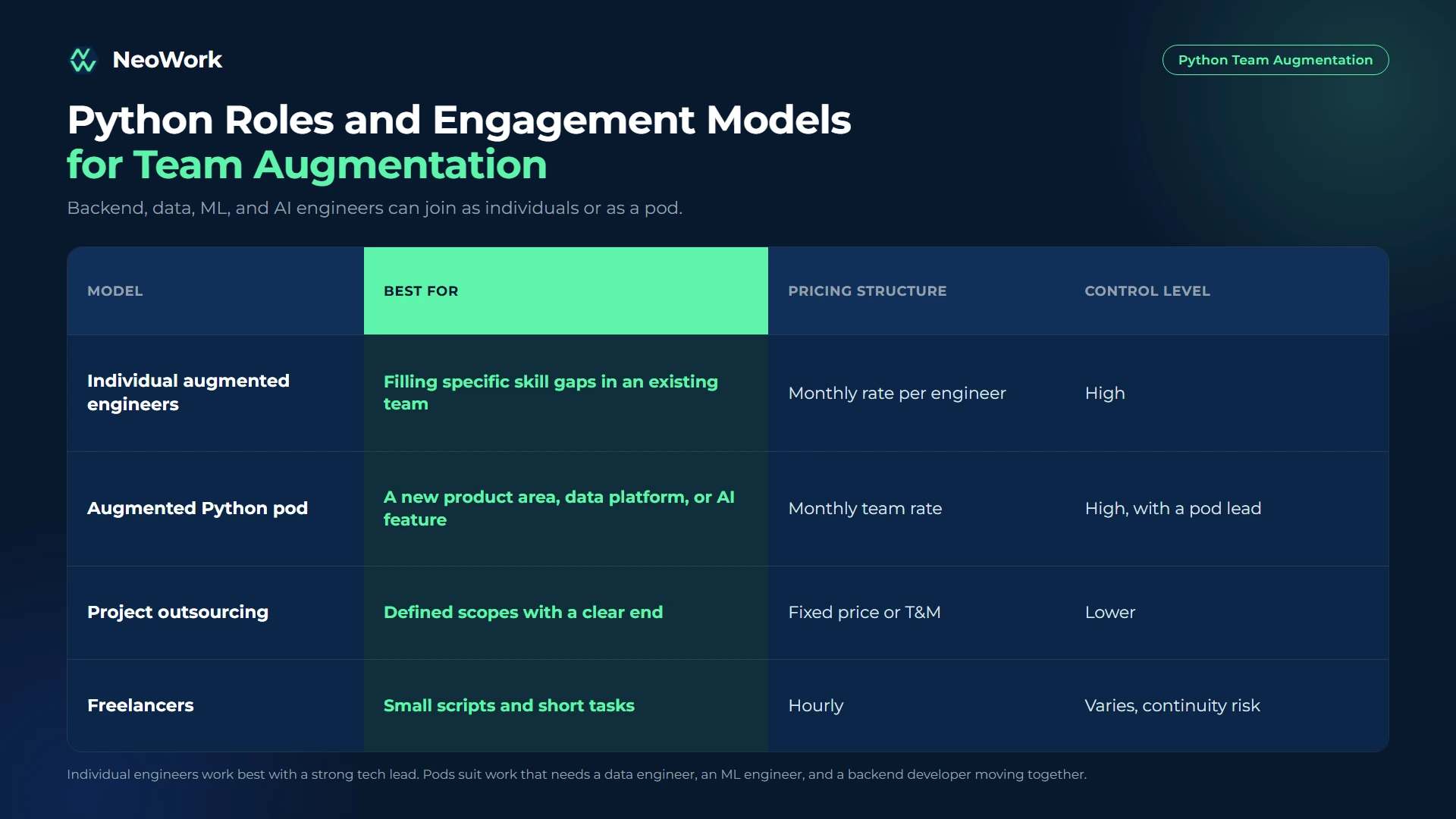
Unlike project outsourcing, where a vendor manages its own team and delivers a defined scope, augmentation keeps direction and knowledge inside your company. You decide what gets built; the augmented engineers help you build it.
Backend Python engineers build web applications and APIs with Django, FastAPI, or Flask, design database schemas, and connect products to payment, CRM, and partner systems. They're the most commonly requested profile.
Data engineers build and maintain pipelines with tools like Airflow, dbt, and Spark, model data in cloud warehouses, and add quality checks so reports can be trusted. Companies usually call for them when dashboards disagree or pipelines fail silently.
ML engineers take models out of notebooks and into production, with monitoring, retraining, and MLOps tooling. They bridge the gap between data science experiments and reliable product features.
AI engineers build features on top of large language models: retrieval-augmented search, assistants, document processing, and agents. Strong candidates care as much about evaluation, cost, and safety as about prompts.

Python team augmentation helps companies add backend, data, and AI engineering capacity without building every role in-house. At NeoWork, we provide dedicated Python engineers through individual contributor and team structures, including AI engineering talent. We handle recruitment, benefits, training, and ongoing engagement, while our teammates integrate into your systems, tools, and daily workflows. Our industry-leading 91% annualized teammate retention rate and 3.2% candidate selectivity rate reflect our focus on selective hiring and long-term team stability.
Our Python team augmentation model offers:
Contact NeoWork to add Python capacity that fits your existing team.
Individual engineers work best when there's already a strong tech lead to direct them. Pods make more sense when the work needs several roles moving together, such as a data engineer, an ML engineer, and a backend developer shipping one feature.
Rates move with seniority, specialization, and currency shifts, so it's better to think in relative terms and confirm current numbers with shortlisted providers.
ML and AI engineers usually cost more than backend or automation engineers in every region, simply because demand is higher. See how we structure dedicated roles on our pricing page.
Price is the easiest thing to compare and often the worst thing to optimize for. A few areas tell you much more about real ability.
Test the specialization you need. A backend candidate should explain how they'd find and fix slow Django queries. A data candidate should know what to do when a pipeline succeeds but the numbers are wrong. An AI candidate should describe how they'd evaluate an assistant before launch.
Ask about logging, monitoring, testing with pytest, and deployments. Engineers who've only worked in notebooks or tutorials often struggle in real codebases.
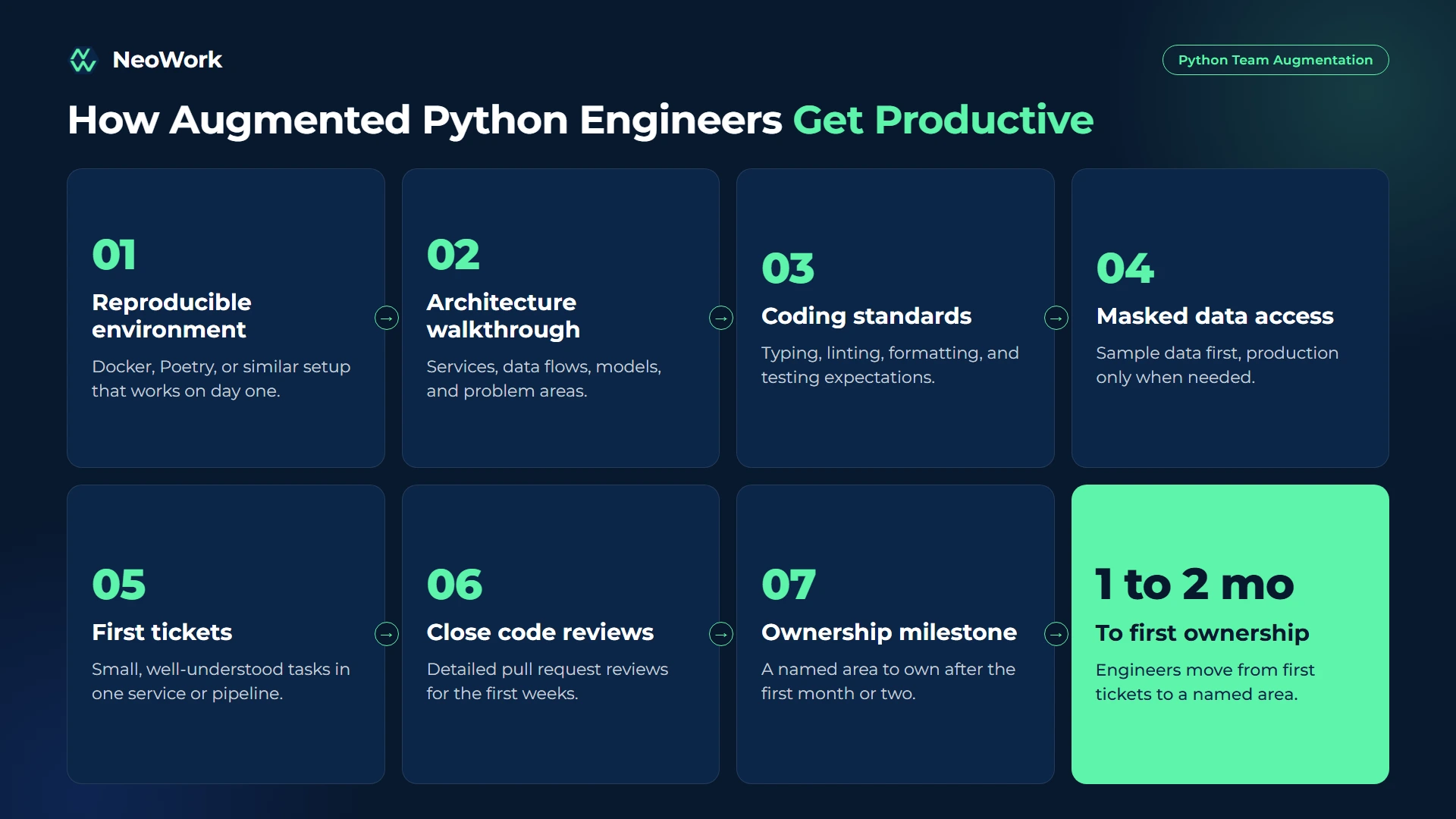
Signing the contract is the easy part. Augmented engineers become productive fastest when they're treated like the rest of the team: same standups, same code reviews, same documentation. Make sure local environments are reproducible on day one, and start with small, well-understood tickets before handing over bigger areas.
Data access deserves special attention. Data and AI engineers often need real data, but it's safer to start with masked or sample data and expand access only when a task requires it, through named accounts and logged access.
AI is the biggest force behind Python hiring right now. Companies that experimented with large language models in 2024 and 2025 are moving those experiments into production, and that requires engineers who can handle retrieval, evaluation, cost control, and monitoring, not just prompts.
Data infrastructure is the second driver. AI features are only as good as the data behind them, so demand for data engineers who can build reliable pipelines and clean data models has grown alongside AI work. Meanwhile, backend Python keeps evolving: FastAPI has become a common choice for new APIs, and typed Python with tools like mypy is increasingly expected in professional codebases.
Augmentation works best when someone inside the company can set direction and review work. If there's no technical lead at all, augmented engineers can end up waiting for decisions or building in different directions. In that situation, it's usually better to hire or contract a lead first, or to start with a project-based vendor that brings its own management.
It's also not ideal for very short, isolated tasks. A one-week script or a small data cleanup is often handled more efficiently by a freelancer. Augmentation pays off when the work lasts months and the knowledge built along the way matters to your business.
Individual augmented engineers work best when your team already has a strong technical lead, clear conventions, and a backlog ready to go. They slot into existing squads and add capacity within a sprint or two, without changing how the team is organized.
A pod makes more sense when the work needs several specializations at once. Shipping an AI feature, for example, may require a data engineer to prepare the data, an AI engineer to build retrieval and evaluation, and a backend engineer to integrate it into the product. A pod with its own lead coordinates that work internally, so your existing leads don't have to manage three new people in three different areas. Many companies start with one or two individuals, then move to a pod once the roadmap becomes clearer.
Python team augmentation works best when you hire for a specialization, not just a language. Be specific about whether you need backend, data, ML, or AI skills, vet for production experience, and give augmented engineers the same context and standards as your own team.
So before contacting providers, write down the work that's waiting and the skills it requires. That one page will make every conversation that follows faster and more useful.

Quick Summary: Python team augmentation means adding external Python engineers, individually or as a small pod, to your in-house team so they work in your codebase, join your sprints, and report to your leads. It's one of the fastest ways to add backend, data, machine learning, or AI capability without months of recruiting. Python has held the top spot in the TIOBE Index of programming language popularity for several years, which keeps demand for experienced engineers high. This guide covers the Python roles companies augment most, engagement models, how rates vary by region, how to vet candidates, and how to manage an augmented team day to day.
Here's the thing about hiring Python developers: the job title hides several very different jobs. One company wants Django features shipped faster, another needs data pipelines that stop breaking at 3 a.m., and a third has been told by leadership to "add AI" to the product by next quarter.
Team augmentation can solve all three, but only if you're clear about which Python work you actually need. This guide walks through the roles, the models, and the practical steps that make augmented Python engineers productive quickly.
Python team augmentation is an engagement model where a provider supplies dedicated Python engineers who become part of your team. They work from your backlog, follow your coding standards, take part in code reviews, and deploy through your pipelines. The provider handles recruitment, employment, payroll, and continuity if someone leaves.
Unlike project outsourcing, where a vendor manages its own team and delivers a defined scope, augmentation keeps direction and knowledge inside your company. You decide what gets built; the augmented engineers help you build it.
Backend Python engineers build web applications and APIs with Django, FastAPI, or Flask, design database schemas, and connect products to payment, CRM, and partner systems. They're the most commonly requested profile.
Data engineers build and maintain pipelines with tools like Airflow, dbt, and Spark, model data in cloud warehouses, and add quality checks so reports can be trusted. Companies usually call for them when dashboards disagree or pipelines fail silently.
ML engineers take models out of notebooks and into production, with monitoring, retraining, and MLOps tooling. They bridge the gap between data science experiments and reliable product features.
AI engineers build features on top of large language models: retrieval-augmented search, assistants, document processing, and agents. Strong candidates care as much about evaluation, cost, and safety as about prompts.
Python team augmentation helps companies add backend, data, and AI engineering capacity without building every role in-house. At NeoWork, we provide dedicated Python engineers through individual contributor and team structures, including AI engineering talent. We handle recruitment, benefits, training, and ongoing engagement, while our teammates integrate into your systems, tools, and daily workflows. Our industry-leading 91% annualized teammate retention rate and 3.2% candidate selectivity rate reflect our focus on selective hiring and long-term team stability.
Our Python team augmentation model offers:
Contact NeoWork to add Python capacity that fits your existing team.
Individual engineers work best when there's already a strong tech lead to direct them. Pods make more sense when the work needs several roles moving together, such as a data engineer, an ML engineer, and a backend developer shipping one feature.
Rates move with seniority, specialization, and currency shifts, so it's better to think in relative terms and confirm current numbers with shortlisted providers.
ML and AI engineers usually cost more than backend or automation engineers in every region, simply because demand is higher. See how we structure dedicated roles on our pricing page.
Price is the easiest thing to compare and often the worst thing to optimize for. A few areas tell you much more about real ability.
Test the specialization you need. A backend candidate should explain how they'd find and fix slow Django queries. A data candidate should know what to do when a pipeline succeeds but the numbers are wrong. An AI candidate should describe how they'd evaluate an assistant before launch.
Ask about logging, monitoring, testing with pytest, and deployments. Engineers who've only worked in notebooks or tutorials often struggle in real codebases.
Signing the contract is the easy part. Augmented engineers become productive fastest when they're treated like the rest of the team: same standups, same code reviews, same documentation. Make sure local environments are reproducible on day one, and start with small, well-understood tickets before handing over bigger areas.
Data access deserves special attention. Data and AI engineers often need real data, but it's safer to start with masked or sample data and expand access only when a task requires it, through named accounts and logged access.
AI is the biggest force behind Python hiring right now. Companies that experimented with large language models in 2024 and 2025 are moving those experiments into production, and that requires engineers who can handle retrieval, evaluation, cost control, and monitoring, not just prompts.
Data infrastructure is the second driver. AI features are only as good as the data behind them, so demand for data engineers who can build reliable pipelines and clean data models has grown alongside AI work. Meanwhile, backend Python keeps evolving: FastAPI has become a common choice for new APIs, and typed Python with tools like mypy is increasingly expected in professional codebases.
Augmentation works best when someone inside the company can set direction and review work. If there's no technical lead at all, augmented engineers can end up waiting for decisions or building in different directions. In that situation, it's usually better to hire or contract a lead first, or to start with a project-based vendor that brings its own management.
It's also not ideal for very short, isolated tasks. A one-week script or a small data cleanup is often handled more efficiently by a freelancer. Augmentation pays off when the work lasts months and the knowledge built along the way matters to your business.
Individual augmented engineers work best when your team already has a strong technical lead, clear conventions, and a backlog ready to go. They slot into existing squads and add capacity within a sprint or two, without changing how the team is organized.
A pod makes more sense when the work needs several specializations at once. Shipping an AI feature, for example, may require a data engineer to prepare the data, an AI engineer to build retrieval and evaluation, and a backend engineer to integrate it into the product. A pod with its own lead coordinates that work internally, so your existing leads don't have to manage three new people in three different areas. Many companies start with one or two individuals, then move to a pod once the roadmap becomes clearer.
Python team augmentation works best when you hire for a specialization, not just a language. Be specific about whether you need backend, data, ML, or AI skills, vet for production experience, and give augmented engineers the same context and standards as your own team.
So before contacting providers, write down the work that's waiting and the skills it requires. That one page will make every conversation that follows faster and more useful.





