


Updated:
Oct 30
2026





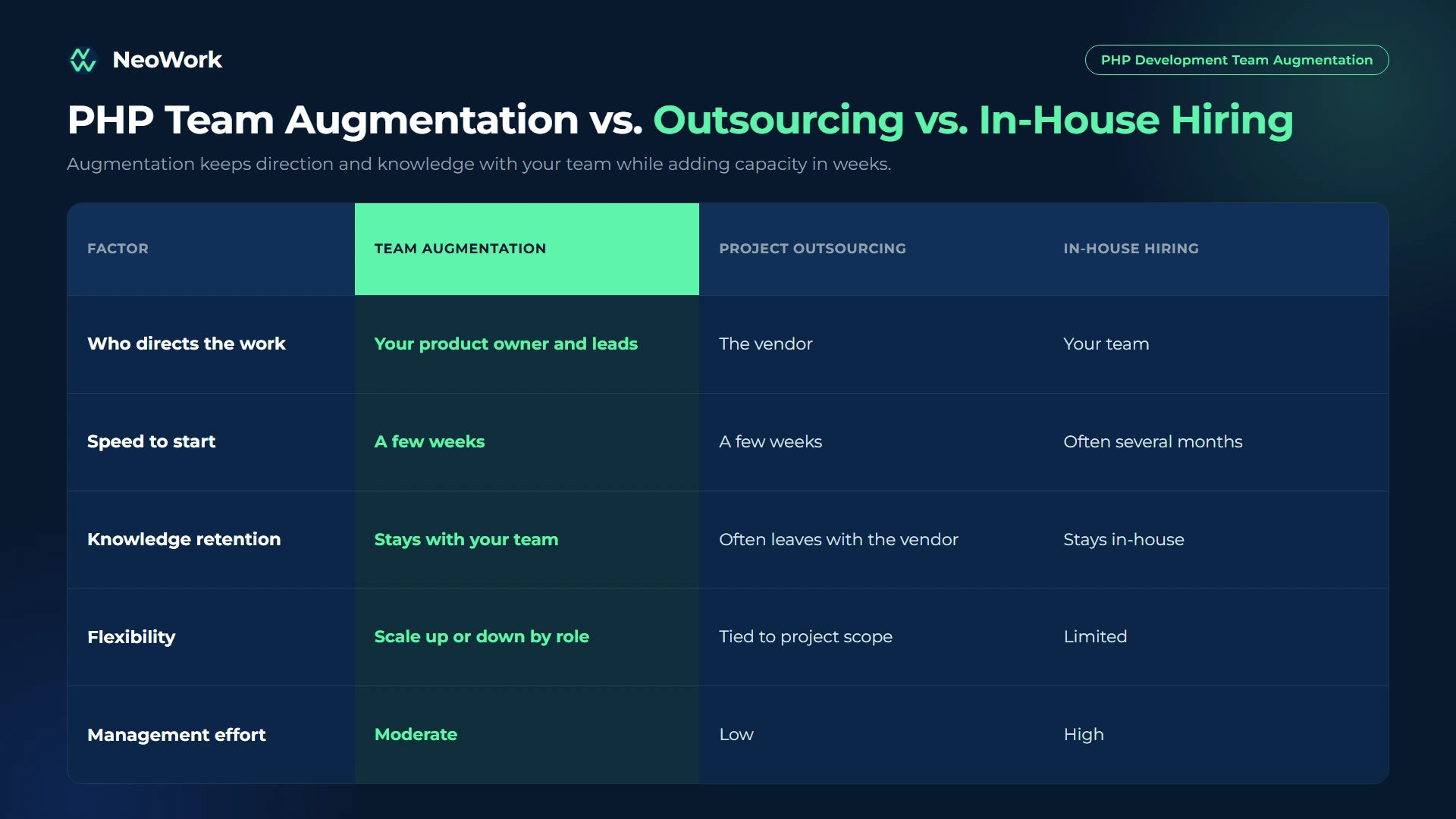
Quick Summary: PHP development team augmentation means adding a dedicated group of external PHP developers, usually with a tech lead and QA, to work inside your existing engineering setup. Instead of hiring one developer at a time, companies bring in a ready-made team that follows their processes, tools, and roadmap. With PHP still running roughly 70% of websites whose server-side language W3Techs can detect, demand for experienced Laravel and Symfony teams stays high. This guide covers how augmented PHP teams are structured, what they cost, how they compare with outsourcing and in-house hiring, and how to avoid the mistakes that slow teams down.
Most companies don't set out to build a PHP team from scratch. They have a platform that has grown for years, a roadmap that keeps getting longer, and an engineering lead who has spent months trying to hire senior Laravel developers without much luck.
That's usually the moment team augmentation enters the conversation. It's a faster way to add delivery capacity than recruiting locally, and it keeps far more control in-house than handing the whole project to an agency. But it only works when the team is set up properly, and that's what this guide is about.
PHP development team augmentation is an engagement model where a provider supplies a dedicated, cross-functional PHP team that works exclusively on your product. The team joins your sprint planning, works in your repositories, and follows your coding standards, while the provider handles recruitment, employment, payroll, and benefits.
Adding individual developers fills seats. Adding a team adds a working unit. A typical augmented team arrives with its own tech lead who coordinates daily work, reviews code, and keeps delivery predictable, so your internal leads aren't stuck managing five separate contractors. That difference matters most when the work involves a whole product area, a modernization program, or a codebase taken over from an agency.
The reasons tend to cluster around speed, skills, and focus. Here's what usually pushes companies toward a dedicated PHP team:
Product ownership almost always stays in-house. The augmented team decides how to build things; your product owner decides what gets built and in which order.

PHP development team augmentation helps companies add delivery capacity for product development, modernization, and maintenance without building every role in-house. At NeoWork, we provide dedicated PHP developers and complete teams that integrate into your repositories, tools, and sprint process. We handle recruitment, benefits, training, and ongoing engagement, while our teammates work as part of your engineering organization. Our industry-leading 91% annualized teammate retention rate and 3.2% candidate selectivity rate reflect our focus on selective hiring and long-term team stability.
Our PHP development team model offers:
Contact NeoWork to build a PHP team around your roadmap.
There's no single price tag, because cost depends on team size, seniority, framework expertise, and location. What stays fairly consistent is how providers structure the pricing.
When comparing quotes, look at the full cost of hiring the same people internally: months of recruiting, benefits, equipment, and the time before new hires become productive. A slightly higher monthly team rate often looks very different against that baseline. You can see how dedicated teams are structured on our pricing page.
When different stakeholders send tickets straight to individual developers, the tech lead can't plan and the coordination you paid for disappears. Route all work through one backlog and one product owner.
Teams that start building before they understand an old PHP platform tend to add technical debt from the first sprint. A short discovery phase almost always pays for itself.
Without agreed coding standards, static analysis with PHPStan or Psalm, and automated tests in CI, a growing team produces inconsistent code faster than anyone can review it.
Teams that never hear why a feature matters build exactly what the ticket says and nothing more. Inviting them to demos and roadmap discussions leads to better decisions and earlier warnings.
Not every company needs a full augmented team. A few signals suggest the investment will pay off rather than add overhead:
If two or more of these apply, a dedicated team with its own lead will usually deliver more than the same budget spent on individual contractors.
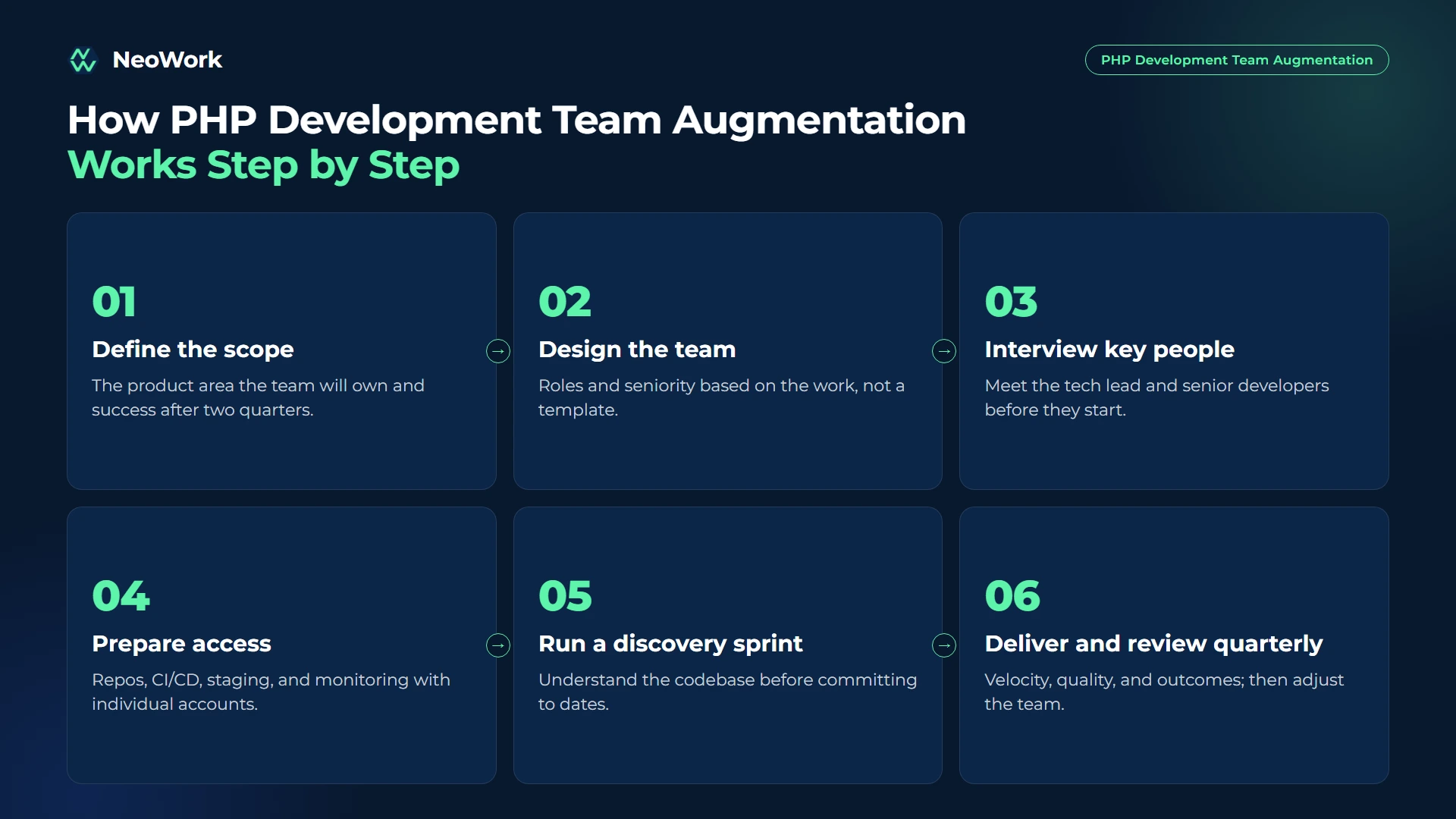
The first month is about access, environments, and understanding. Every team member should have a working local setup, the tech lead should produce a short architecture overview with known risks, and the team should merge a handful of small fixes to prove the workflow works end to end. Expect little visible feature output; that's normal and healthy.
By the second month, the team should release its first real milestone, whether that's a feature, a module, or the first step of a modernization plan. Automated tests start to appear around the areas the team touches, and sprint demos become a regular rhythm with your stakeholders.
By the end of the third month, the team should own a clear area of the product, deliver at a predictable pace, and raise risks before they become problems. This is also the right time for a first quarterly review of quality, velocity, and team composition.
Modern PHP looks very different from the PHP many teams remember. PHP 8 releases brought major performance gains, typed properties, enums, and readonly classes, which makes well-maintained PHP codebases far easier to work with than legacy ones. Laravel continues to dominate new projects, while Symfony remains common in long-lived enterprise systems.
That shift changes what companies look for in augmented teams. Experience upgrading from older versions, introducing static analysis, and building automated test coverage is now as valuable as raw feature delivery. Teams that can modernize while shipping are the ones in highest demand.
PHP development team augmentation works best when the work needs more than extra hands: a new product area, a modernization program, or a codebase that needs a real owner. A dedicated team with its own lead can deliver all of that without months of recruiting.
Before signing anything, get clear on what the team will own, how work will flow through your backlog, and which standards it must follow. That clarity is what turns an augmented team into a real extension of your engineering organization.

Quick Summary: PHP development team augmentation means adding a dedicated group of external PHP developers, usually with a tech lead and QA, to work inside your existing engineering setup. Instead of hiring one developer at a time, companies bring in a ready-made team that follows their processes, tools, and roadmap. With PHP still running roughly 70% of websites whose server-side language W3Techs can detect, demand for experienced Laravel and Symfony teams stays high. This guide covers how augmented PHP teams are structured, what they cost, how they compare with outsourcing and in-house hiring, and how to avoid the mistakes that slow teams down.
Most companies don't set out to build a PHP team from scratch. They have a platform that has grown for years, a roadmap that keeps getting longer, and an engineering lead who has spent months trying to hire senior Laravel developers without much luck.
That's usually the moment team augmentation enters the conversation. It's a faster way to add delivery capacity than recruiting locally, and it keeps far more control in-house than handing the whole project to an agency. But it only works when the team is set up properly, and that's what this guide is about.
PHP development team augmentation is an engagement model where a provider supplies a dedicated, cross-functional PHP team that works exclusively on your product. The team joins your sprint planning, works in your repositories, and follows your coding standards, while the provider handles recruitment, employment, payroll, and benefits.
Adding individual developers fills seats. Adding a team adds a working unit. A typical augmented team arrives with its own tech lead who coordinates daily work, reviews code, and keeps delivery predictable, so your internal leads aren't stuck managing five separate contractors. That difference matters most when the work involves a whole product area, a modernization program, or a codebase taken over from an agency.
The reasons tend to cluster around speed, skills, and focus. Here's what usually pushes companies toward a dedicated PHP team:
Product ownership almost always stays in-house. The augmented team decides how to build things; your product owner decides what gets built and in which order.
PHP development team augmentation helps companies add delivery capacity for product development, modernization, and maintenance without building every role in-house. At NeoWork, we provide dedicated PHP developers and complete teams that integrate into your repositories, tools, and sprint process. We handle recruitment, benefits, training, and ongoing engagement, while our teammates work as part of your engineering organization. Our industry-leading 91% annualized teammate retention rate and 3.2% candidate selectivity rate reflect our focus on selective hiring and long-term team stability.
Our PHP development team model offers:
Contact NeoWork to build a PHP team around your roadmap.
There's no single price tag, because cost depends on team size, seniority, framework expertise, and location. What stays fairly consistent is how providers structure the pricing.
When comparing quotes, look at the full cost of hiring the same people internally: months of recruiting, benefits, equipment, and the time before new hires become productive. A slightly higher monthly team rate often looks very different against that baseline. You can see how dedicated teams are structured on our pricing page.
When different stakeholders send tickets straight to individual developers, the tech lead can't plan and the coordination you paid for disappears. Route all work through one backlog and one product owner.
Teams that start building before they understand an old PHP platform tend to add technical debt from the first sprint. A short discovery phase almost always pays for itself.
Without agreed coding standards, static analysis with PHPStan or Psalm, and automated tests in CI, a growing team produces inconsistent code faster than anyone can review it.
Teams that never hear why a feature matters build exactly what the ticket says and nothing more. Inviting them to demos and roadmap discussions leads to better decisions and earlier warnings.
Not every company needs a full augmented team. A few signals suggest the investment will pay off rather than add overhead:
If two or more of these apply, a dedicated team with its own lead will usually deliver more than the same budget spent on individual contractors.
The first month is about access, environments, and understanding. Every team member should have a working local setup, the tech lead should produce a short architecture overview with known risks, and the team should merge a handful of small fixes to prove the workflow works end to end. Expect little visible feature output; that's normal and healthy.
By the second month, the team should release its first real milestone, whether that's a feature, a module, or the first step of a modernization plan. Automated tests start to appear around the areas the team touches, and sprint demos become a regular rhythm with your stakeholders.
By the end of the third month, the team should own a clear area of the product, deliver at a predictable pace, and raise risks before they become problems. This is also the right time for a first quarterly review of quality, velocity, and team composition.
Modern PHP looks very different from the PHP many teams remember. PHP 8 releases brought major performance gains, typed properties, enums, and readonly classes, which makes well-maintained PHP codebases far easier to work with than legacy ones. Laravel continues to dominate new projects, while Symfony remains common in long-lived enterprise systems.
That shift changes what companies look for in augmented teams. Experience upgrading from older versions, introducing static analysis, and building automated test coverage is now as valuable as raw feature delivery. Teams that can modernize while shipping are the ones in highest demand.
PHP development team augmentation works best when the work needs more than extra hands: a new product area, a modernization program, or a codebase that needs a real owner. A dedicated team with its own lead can deliver all of that without months of recruiting.
Before signing anything, get clear on what the team will own, how work will flow through your backlog, and which standards it must follow. That clarity is what turns an augmented team into a real extension of your engineering organization.





