
Green glowing circular pattern with concentric rings and faint hexagonal grid on the left side.
Blue abstract hexagonal pattern with glowing circular gradient edges on a black background.Glowing greenish-blue hexagonal pattern with concentric circular gradients on a black background.

React Team Augmentation Guide: How It Works in 2026

Calendar Icon
Published:
Oct 29
2026
,
Updated:
Oct 30
2026
Ann
Facebook IconInstagram Icon

Build your team with NeoWork

Talk to us about how we staff and manage high-performing remote teams for companies like yours.

Get a React Team Augmentation Quote

Quick Summary: React team augmentation is when a company adds external React developers, or a complete frontend pod, to its own engineering team to ship product features faster, rebuild user interfaces, or scale web and mobile apps. The augmented developers work in your repositories, design system, and sprint process under your leadership. React remains one of the two most used web technologies in Stack Overflow's 2025 Developer Survey, used by more than 40% of respondents, so the talent pool is large, but experienced React engineers who know modern patterns such as Server Components, Next.js, and strong TypeScript are still in high demand. This guide covers React roles you can add, when augmentation makes sense, how to vet React developers, what it costs, and how to onboard them.

Frontend work has become more complex than ever. Product teams expect fast, accessible interfaces, design systems need to stay consistent across products, frameworks like Next.js blur the line between frontend and backend, and React Native teams want to share code with the web. At the same time, product roadmaps grow faster than frontend teams can hire.

React team augmentation helps you add experienced engineers quickly while keeping your architecture, standards, and product decisions in-house. This guide explains how to do it without slowing your existing team down.

What Is React Team Augmentation?

React team augmentation is an engagement model in which a provider supplies dedicated React developers who join your product team. They work from your backlog, follow your component and coding conventions, take part in design reviews, code reviews, and sprint ceremonies, and deploy through your pipelines. The provider handles recruiting, employment, and continuity.

You can add individual frontend engineers to existing squads or a pod (for example, a senior React lead, two developers, and a QA engineer) to own a feature area, a redesign, or a migration.
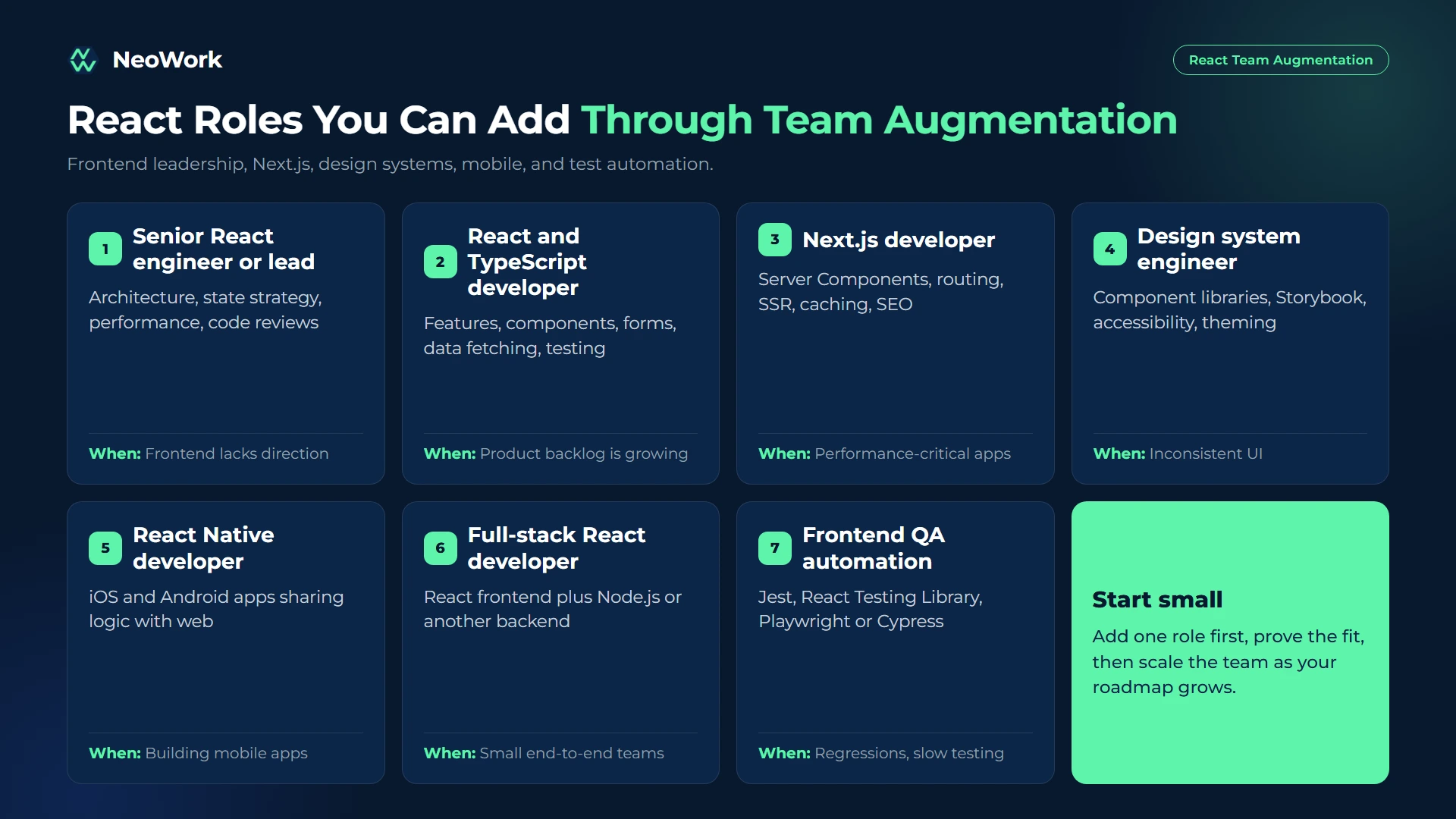
React Roles You Can Add

Role What They Do When You Need One
Senior React engineer or frontend lead Architecture, state management strategy, performance, code reviews, mentoring Your frontend lacks senior direction
React and TypeScript developer Feature development, components, forms, data fetching, testing Product backlog is growing
Next.js developer Server Components, routing, server-side rendering, caching, SEO Marketing sites, ecommerce, or performance-critical apps
Design system engineer Component libraries, Storybook, accessibility, theming Inconsistent UI across products
React Native developer iOS and Android apps sharing logic with web Building or scaling mobile apps
Full-stack React developer React frontend plus Node.js or another backend Small teams shipping end-to-end features
Frontend QA automation engineer Jest, React Testing Library, Playwright or Cypress tests Regressions and slow manual testing
React team augmentation roles including senior React engineer, React and TypeScript developer, Next.js developer, design system engineer, React Native developer, full-stack React developer, and frontend QA engineer

Add Senior React Developers to Your Product Team

At NeoWork, we help companies add dedicated React developers and complete frontend teams that work inside their codebase, design system, and sprint process. We recruit for the React, TypeScript, and framework skills you need, onboard developers into your workflows, and handle employment, benefits, and ongoing teammate support.

Our model includes:

  • Dedicated React developers or pods that join your squads and code reviews
  • A 3.2% candidate selectivity rate, with hands-on React and TypeScript assessments
  • Industry-leading 91% annualized teammate retention rate, so product knowledge stays on the team
  • Team size that grows or shrinks with your roadmap

Contact us to share your frontend stack and roadmap. We will propose developer profiles and a team setup that fit.

When React Team Augmentation Makes Sense

The most straightforward case is a frontend-heavy roadmap. New product surfaces, dashboards, onboarding flows, and settings pages all need frontend work, and when backend capacity is fine but the frontend is the bottleneck, adding React developers directly increases what the product team can ship each sprint.

Rebuilds and migrations are the second common reason. Moving from an older framework, from class components, or from Create React App to Next.js or Vite is a large, focused effort that competes with feature work for the same people. A dedicated pod can carry the migration while the rest of the team keeps shipping, which avoids the familiar situation where migrations stall at sixty percent done.

Specialist needs are the third. Performance and SEO problems require engineers who understand rendering strategies, bundle size, and Core Web Vitals. Inconsistent UI across products usually means a design system needs dedicated owners. And companies launching mobile apps often find that React Native developers can reuse a surprising amount of knowledge and code from the existing web application.

React Team Augmentation vs. Other Models

Model Who Manages Delivery Best For Trade-Offs
Team augmentation Your product and engineering leads Ongoing product development and scaling capacity Needs internal technical ownership
Project outsourcing The vendor Fixed-scope builds such as a marketing site Less control, knowledge leaves after launch
Freelancers Your team Small, isolated UI tasks Inconsistent quality and availability
In-house hiring Your team Core long-term roles Slow hiring for senior engineers

If you want to compare provider locations, see our overviews of nearshore staff augmentation companies and remote team augmentation companies.

How to Vet React Developers

  • Modern React fundamentals: Hooks, component composition, effects and their pitfalls, and React 19 features.
  • TypeScript: Typing props, generics, and API responses rather than relying on "any".
  • State and data: When to use local state, context, a store such as Redux Toolkit or Zustand, and server-state tools such as TanStack Query.
  • Rendering strategies: Client rendering, server-side rendering, static generation, and Server Components in Next.js.
  • Performance: Memoization, code splitting, bundle analysis, and Core Web Vitals.
  • Accessibility: Semantic HTML, keyboard navigation, ARIA, and screen reader testing.
  • Testing: React Testing Library, Jest or Vitest, and end-to-end tests with Playwright or Cypress.
  • Practical task: Building a small feature from a design, or reviewing a real pull request, shows more than algorithm puzzles.

How Much Does React Team Augmentation Cost?

React developer rates depend on seniority, specialization (Next.js, React Native, design systems), and location. Common pricing models:

  • Monthly rate per developer: A fixed fee for each dedicated full-time engineer.
  • Monthly team rate: One price for a full frontend pod.
  • Hourly rate: For part-time or short engagements.

Because the React talent pool is large and global, you can find strong engineers in nearshore and offshore markets at significantly lower rates than onshore hiring. The key is vetting for real senior experience. See how we structure dedicated teams on our pricing page.
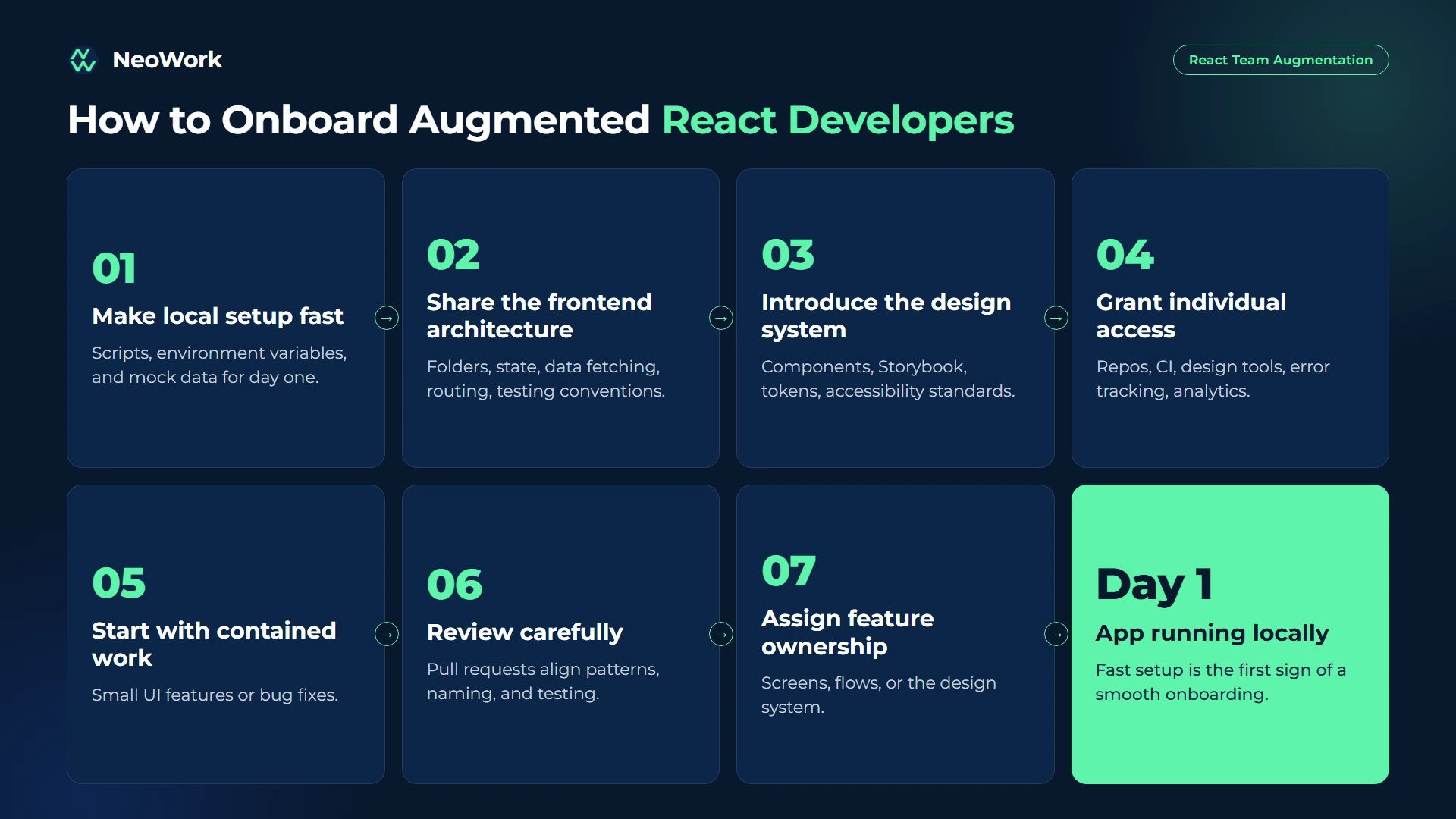
How to Onboard Augmented React Developers

React team augmentation onboarding steps from repository setup and design system walkthrough to first components, code review, feature ownership, and performance review
  1. Make local setup fast. Provide clear scripts, environment variables, and mock data so developers can run the app on day one.
  2. Share the frontend architecture. Explain folder structure, state management, data fetching, routing, and testing conventions.
  3. Introduce the design system. Walk through components, Storybook, tokens, and accessibility standards.
  4. Grant individual access. Repositories, CI, design tools, error tracking, and analytics with role-based permissions.
  5. Start with contained work. Small UI features or bug fixes help developers learn the codebase.
  6. Review carefully. Use pull request reviews to align on patterns, naming, and testing.
  7. Assign feature ownership. Once productive, give developers ownership of screens, flows, or the design system.

Questions Worth Asking Any Provider

  • How do you test React and TypeScript skills?
  • Do your developers have Next.js or React Native experience?
  • Can we interview developers before they start?
  • How much working-hour overlap will we have?
  • How do you handle replacements and knowledge transfer?
  • Who owns the code and intellectual property?

Common React Team Augmentation Mistakes

The most common mistake is adding developers before agreeing on frontend conventions. Without shared patterns for state, data fetching, styling, and file structure, every new developer introduces a slightly different approach, and the codebase becomes harder to work in with every sprint. A short conventions document, enforced through code review, prevents most of this.

Skipping the design system has a similar effect on the user interface. One-off components lead to inconsistent UI, duplicated code, and slower development over time. Accessibility is another area that suffers when it is postponed: fixing it late is far more expensive than building it in from the start, and in some markets it is also a legal requirement.

Weak testing lets frontends break quietly with every release, and the problem grows as more developers contribute. Finally, hiring on framework buzzwords rather than fundamentals is a trap in a fast-moving ecosystem. Libraries change every year; strong fundamentals and real product experience are what make a developer valuable for the long term.

Final Thoughts

React team augmentation is one of the fastest ways to add frontend capacity and expertise without long hiring cycles. It works best when you vet developers on modern React, TypeScript, and testing, give them a clear architecture and design system, and treat them as part of your product team.

If your frontend roadmap needs more hands, explore our software development teams at NeoWork.

FAQ

What is React team augmentation?

It is a model where an external provider supplies dedicated React developers who join your product team, work in your codebase and design system, and follow your processes.

Is React still the right choice in 2026?

For most web products, yes. React is used by more than 40% of developers in Stack Overflow's 2025 survey, has a huge ecosystem, and is the foundation of frameworks such as Next.js and React Native.

Can augmented developers work on Next.js and React Native?

Yes. Many React developers specialize in Next.js for web or React Native for mobile. Define the specialization you need when requesting candidates.

How do I vet React developers?

Assess hooks and component design, TypeScript, state and data management, rendering strategies, performance, accessibility, and testing through practical tasks and code reviews.

How much does React team augmentation cost?

Most providers charge a monthly rate per developer, a monthly team rate, or an hourly rate. Cost depends on seniority, specialization, and location.

How quickly can augmented React developers start?

Candidates can often be presented within days, and developers usually contribute within their first sprint if local setup and documentation are in place.

Should I add individual developers or a frontend pod?

Add individuals to existing squads to increase capacity. Add a pod when you want a group to own a redesign, a migration, a design system, or a new product area.

Topics
No items found.

React Team Augmentation Guide: How It Works in 2026

Paper
Calendar Icon
Oct 29, 2026
Ann

Quick Summary: React team augmentation is when a company adds external React developers, or a complete frontend pod, to its own engineering team to ship product features faster, rebuild user interfaces, or scale web and mobile apps. The augmented developers work in your repositories, design system, and sprint process under your leadership. React remains one of the two most used web technologies in Stack Overflow's 2025 Developer Survey, used by more than 40% of respondents, so the talent pool is large, but experienced React engineers who know modern patterns such as Server Components, Next.js, and strong TypeScript are still in high demand. This guide covers React roles you can add, when augmentation makes sense, how to vet React developers, what it costs, and how to onboard them.

Frontend work has become more complex than ever. Product teams expect fast, accessible interfaces, design systems need to stay consistent across products, frameworks like Next.js blur the line between frontend and backend, and React Native teams want to share code with the web. At the same time, product roadmaps grow faster than frontend teams can hire.

React team augmentation helps you add experienced engineers quickly while keeping your architecture, standards, and product decisions in-house. This guide explains how to do it without slowing your existing team down.

What Is React Team Augmentation?

React team augmentation is an engagement model in which a provider supplies dedicated React developers who join your product team. They work from your backlog, follow your component and coding conventions, take part in design reviews, code reviews, and sprint ceremonies, and deploy through your pipelines. The provider handles recruiting, employment, and continuity.

You can add individual frontend engineers to existing squads or a pod (for example, a senior React lead, two developers, and a QA engineer) to own a feature area, a redesign, or a migration.

React Roles You Can Add

Role What They Do When You Need One
Senior React engineer or frontend lead Architecture, state management strategy, performance, code reviews, mentoring Your frontend lacks senior direction
React and TypeScript developer Feature development, components, forms, data fetching, testing Product backlog is growing
Next.js developer Server Components, routing, server-side rendering, caching, SEO Marketing sites, ecommerce, or performance-critical apps
Design system engineer Component libraries, Storybook, accessibility, theming Inconsistent UI across products
React Native developer iOS and Android apps sharing logic with web Building or scaling mobile apps
Full-stack React developer React frontend plus Node.js or another backend Small teams shipping end-to-end features
Frontend QA automation engineer Jest, React Testing Library, Playwright or Cypress tests Regressions and slow manual testing
React team augmentation roles including senior React engineer, React and TypeScript developer, Next.js developer, design system engineer, React Native developer, full-stack React developer, and frontend QA engineer

Add Senior React Developers to Your Product Team

At NeoWork, we help companies add dedicated React developers and complete frontend teams that work inside their codebase, design system, and sprint process. We recruit for the React, TypeScript, and framework skills you need, onboard developers into your workflows, and handle employment, benefits, and ongoing teammate support.

Our model includes:

  • Dedicated React developers or pods that join your squads and code reviews
  • A 3.2% candidate selectivity rate, with hands-on React and TypeScript assessments
  • Industry-leading 91% annualized teammate retention rate, so product knowledge stays on the team
  • Team size that grows or shrinks with your roadmap

Contact us to share your frontend stack and roadmap. We will propose developer profiles and a team setup that fit.

When React Team Augmentation Makes Sense

The most straightforward case is a frontend-heavy roadmap. New product surfaces, dashboards, onboarding flows, and settings pages all need frontend work, and when backend capacity is fine but the frontend is the bottleneck, adding React developers directly increases what the product team can ship each sprint.

Rebuilds and migrations are the second common reason. Moving from an older framework, from class components, or from Create React App to Next.js or Vite is a large, focused effort that competes with feature work for the same people. A dedicated pod can carry the migration while the rest of the team keeps shipping, which avoids the familiar situation where migrations stall at sixty percent done.

Specialist needs are the third. Performance and SEO problems require engineers who understand rendering strategies, bundle size, and Core Web Vitals. Inconsistent UI across products usually means a design system needs dedicated owners. And companies launching mobile apps often find that React Native developers can reuse a surprising amount of knowledge and code from the existing web application.

React Team Augmentation vs. Other Models

Model Who Manages Delivery Best For Trade-Offs
Team augmentation Your product and engineering leads Ongoing product development and scaling capacity Needs internal technical ownership
Project outsourcing The vendor Fixed-scope builds such as a marketing site Less control, knowledge leaves after launch
Freelancers Your team Small, isolated UI tasks Inconsistent quality and availability
In-house hiring Your team Core long-term roles Slow hiring for senior engineers

If you want to compare provider locations, see our overviews of nearshore staff augmentation companies and remote team augmentation companies.

How to Vet React Developers

  • Modern React fundamentals: Hooks, component composition, effects and their pitfalls, and React 19 features.
  • TypeScript: Typing props, generics, and API responses rather than relying on "any".
  • State and data: When to use local state, context, a store such as Redux Toolkit or Zustand, and server-state tools such as TanStack Query.
  • Rendering strategies: Client rendering, server-side rendering, static generation, and Server Components in Next.js.
  • Performance: Memoization, code splitting, bundle analysis, and Core Web Vitals.
  • Accessibility: Semantic HTML, keyboard navigation, ARIA, and screen reader testing.
  • Testing: React Testing Library, Jest or Vitest, and end-to-end tests with Playwright or Cypress.
  • Practical task: Building a small feature from a design, or reviewing a real pull request, shows more than algorithm puzzles.

How Much Does React Team Augmentation Cost?

React developer rates depend on seniority, specialization (Next.js, React Native, design systems), and location. Common pricing models:

  • Monthly rate per developer: A fixed fee for each dedicated full-time engineer.
  • Monthly team rate: One price for a full frontend pod.
  • Hourly rate: For part-time or short engagements.

Because the React talent pool is large and global, you can find strong engineers in nearshore and offshore markets at significantly lower rates than onshore hiring. The key is vetting for real senior experience. See how we structure dedicated teams on our pricing page.

How to Onboard Augmented React Developers

React team augmentation onboarding steps from repository setup and design system walkthrough to first components, code review, feature ownership, and performance review
  1. Make local setup fast. Provide clear scripts, environment variables, and mock data so developers can run the app on day one.
  2. Share the frontend architecture. Explain folder structure, state management, data fetching, routing, and testing conventions.
  3. Introduce the design system. Walk through components, Storybook, tokens, and accessibility standards.
  4. Grant individual access. Repositories, CI, design tools, error tracking, and analytics with role-based permissions.
  5. Start with contained work. Small UI features or bug fixes help developers learn the codebase.
  6. Review carefully. Use pull request reviews to align on patterns, naming, and testing.
  7. Assign feature ownership. Once productive, give developers ownership of screens, flows, or the design system.

Questions Worth Asking Any Provider

  • How do you test React and TypeScript skills?
  • Do your developers have Next.js or React Native experience?
  • Can we interview developers before they start?
  • How much working-hour overlap will we have?
  • How do you handle replacements and knowledge transfer?
  • Who owns the code and intellectual property?

Common React Team Augmentation Mistakes

The most common mistake is adding developers before agreeing on frontend conventions. Without shared patterns for state, data fetching, styling, and file structure, every new developer introduces a slightly different approach, and the codebase becomes harder to work in with every sprint. A short conventions document, enforced through code review, prevents most of this.

Skipping the design system has a similar effect on the user interface. One-off components lead to inconsistent UI, duplicated code, and slower development over time. Accessibility is another area that suffers when it is postponed: fixing it late is far more expensive than building it in from the start, and in some markets it is also a legal requirement.

Weak testing lets frontends break quietly with every release, and the problem grows as more developers contribute. Finally, hiring on framework buzzwords rather than fundamentals is a trap in a fast-moving ecosystem. Libraries change every year; strong fundamentals and real product experience are what make a developer valuable for the long term.

Final Thoughts

React team augmentation is one of the fastest ways to add frontend capacity and expertise without long hiring cycles. It works best when you vet developers on modern React, TypeScript, and testing, give them a clear architecture and design system, and treat them as part of your product team.

If your frontend roadmap needs more hands, explore our software development teams at NeoWork.

FAQ

What is React team augmentation?

It is a model where an external provider supplies dedicated React developers who join your product team, work in your codebase and design system, and follow your processes.

Is React still the right choice in 2026?

For most web products, yes. React is used by more than 40% of developers in Stack Overflow's 2025 survey, has a huge ecosystem, and is the foundation of frameworks such as Next.js and React Native.

Can augmented developers work on Next.js and React Native?

Yes. Many React developers specialize in Next.js for web or React Native for mobile. Define the specialization you need when requesting candidates.

How do I vet React developers?

Assess hooks and component design, TypeScript, state and data management, rendering strategies, performance, accessibility, and testing through practical tasks and code reviews.

How much does React team augmentation cost?

Most providers charge a monthly rate per developer, a monthly team rate, or an hourly rate. Cost depends on seniority, specialization, and location.

How quickly can augmented React developers start?

Candidates can often be presented within days, and developers usually contribute within their first sprint if local setup and documentation are in place.

Should I add individual developers or a frontend pod?

Add individuals to existing squads to increase capacity. Add a pod when you want a group to own a redesign, a migration, a design system, or a new product area.

Topics

No items found.
Blue gradient banner with rounded corners at the top.
CTA Hexagon LeftCTA Hexagon LeftCTA Hexagon RightCTA Hexagon Right Mobile

Navigate the shadows of tech leadership – all while enjoying the comfort food that binds us all.

CTA Hexagon LeftCTA Hexagon LeftCTA Hexagon RightCTA Hexagon Right Mobile

Book a consultation

Build your team with NeoWork

Talk to us about how we staff and manage high-performing remote teams for companies like yours.