
Green glowing circular pattern with concentric rings and faint hexagonal grid on the left side.
Blue abstract hexagonal pattern with glowing circular gradient edges on a black background.Glowing greenish-blue hexagonal pattern with concentric circular gradients on a black background.

Enterprise Security Team Augmentation Guide 2026: Models, Costs & Governance

Calendar Icon
Published:
Oct 29
2026
,
Updated:
Oct 30
2026
Ann
Facebook IconInstagram Icon

Build your team with NeoWork

Talk to us about how we staff and manage high-performing remote teams for companies like yours.

Get an Enterprise Security Team Augmentation Quote

Quick Summary: Enterprise security team augmentation means adding dedicated, multi-role security teams from an external provider to an enterprise security organization, so programs like security operations, cloud security, identity, and compliance get the people they need while strategy and risk ownership stay with the CISO. Gartner forecasts worldwide information security spending of roughly 244 billion US dollars in 2026, and the 2025 ISC2 Cybersecurity Workforce Study found that 95% of security teams report at least one skills gap. This guide explains which security functions enterprises augment, how augmentation compares with MSSPs and in-house hiring, what it costs, how to govern external teams, and how to pick the right provider.

Ask any CISO what keeps them up at night and the answer usually isn't a single threat. It's the gap between the number of programs they're accountable for and the number of people they can actually staff them with. A zero trust rollout, a SOC expansion, and a new audit framework can all land in the same quarter.

Hiring your way out of that gap rarely works fast enough. That's why more large organizations are adding complete security teams from external partners, not just individual contractors. Here's how that model works and how to run it safely.

What Is Enterprise Security Team Augmentation?

Enterprise security team augmentation is an engagement model where a provider supplies dedicated security teams, each with a lead and a mix of roles, that work inside an enterprise security organization. The teams follow the enterprise's policies, use its tools, and report into its security leadership. The provider handles recruitment, employment, training, and continuity.

It sits between two familiar options. Individual staff augmentation fills single seats and leaves coordination to internal managers. Managed security services deliver an outsourced service using the provider's own processes. Team augmentation gives you a working unit that operates like an internal team, under your governance.

Why Demand for Augmented Security Teams Keeps Growing

The workforce problem has changed shape. ISC2's 2025 findings point out that skills shortages, not just headcount, are now the main risk, with AI security and cloud security near the top of the list of missing skills. Enterprises don't just need more people; they need specific combinations of skills for specific programs, and they need them quickly.

At the same time, security budgets keep rising and boards expect visible progress on programs they've funded. Building a new internal team for each initiative can take a year of recruiting. Augmented teams can start within weeks and report against the same metrics as internal staff, which makes them a practical way to turn budget into capability.
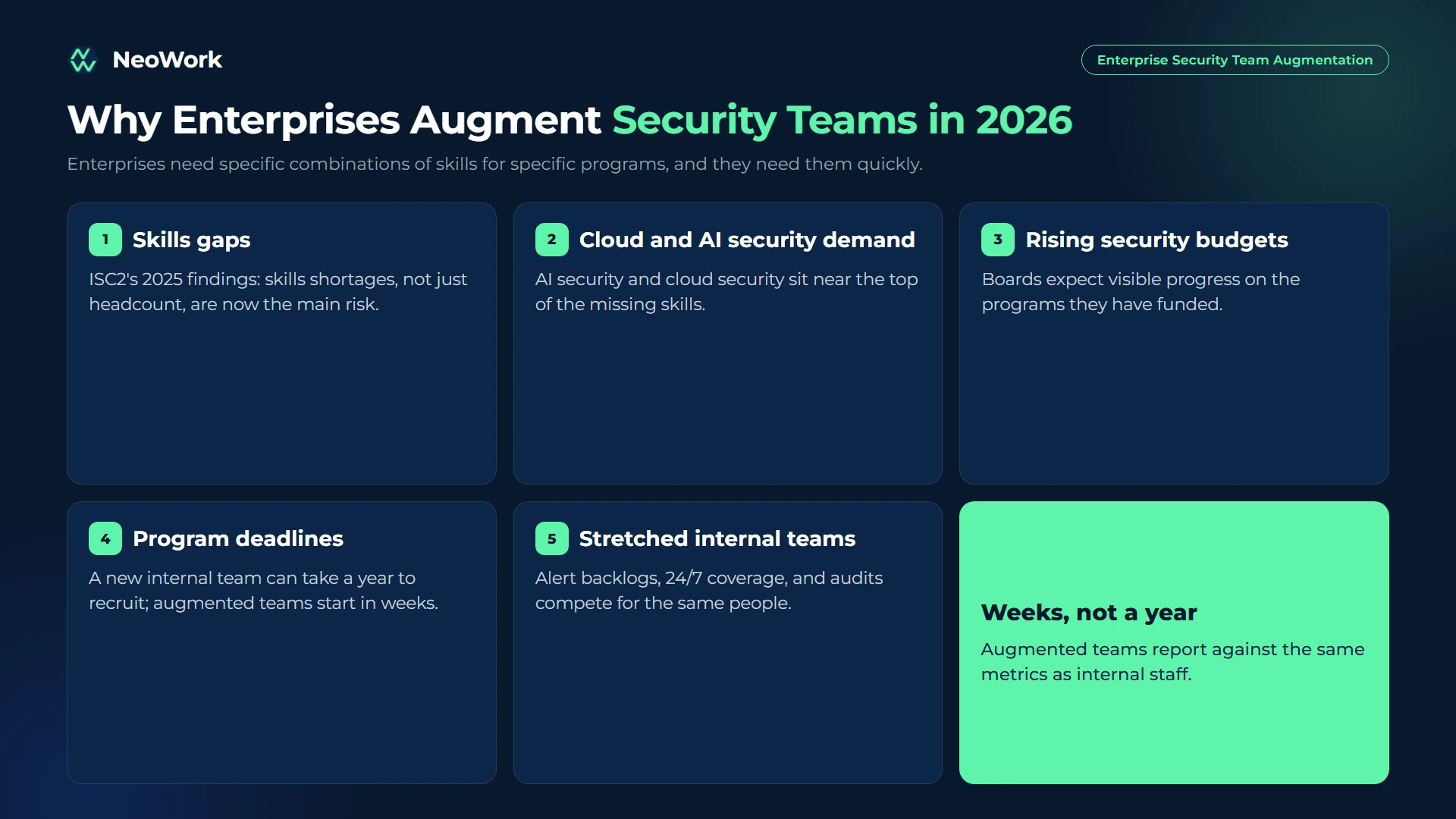
Enterprise security team augmentation drivers including skills gaps, rising security budgets, program deadlines, cloud and AI security demand, and internal team burnout

Which Security Functions Enterprises Augment

Function Typical Team Roles Why Enterprises Augment It
Security operations (SOC) SOC lead, tier 1 to 3 analysts, detection engineers Alert backlogs and 24/7 coverage needs
Cloud security Cloud security architect, cloud security engineers Fast cloud growth and misconfiguration risk
Identity and access management IAM architect, IAM engineers, access review analysts Zero trust programs and privileged access control
Application security AppSec lead, security engineers, DevSecOps engineers Security reviews can't keep pace with development
GRC and audit readiness GRC lead, compliance analysts, vendor risk analysts New frameworks and audit deadlines
Vulnerability management Program lead, analysts, remediation coordinators Growing backlogs across business units

Strengthen Enterprise Security Teams with NeoWork

Enterprise security team augmentation helps organizations add capacity to security and IT operations programs without building every role in-house. At NeoWork, we provide dedicated technical teammates who work inside your tools, policies, and reporting lines. We handle recruitment, benefits, training, and ongoing engagement, while our teammates integrate into your security workflows. Our industry-leading 91% annualized teammate retention rate and 3.2% candidate selectivity rate reflect our focus on selective hiring and long-term team stability.

Our enterprise security support model offers:

  • dedicated technical and security operations teammates
  • integration with your tools and processes
  • recruitment and ongoing teammate support

Contact NeoWork to add security capacity that fits your existing programs.

Augmentation vs. MSSP vs. In-House Hiring

Factor Team Augmentation MSSP or MDR In-House Hiring
Who controls processes Your security leadership The provider Your security leadership
Business context High Lower, shared across clients High
Speed to start Weeks Weeks Months
Flexibility Scale by program Tied to service contract Limited
Best for Programs needing coordinated roles Standardized 24/7 services Core leadership roles

Most mature security programs combine all three: in-house leaders own strategy, an MDR provider covers round-the-clock detection, and augmented teams take on specific programs such as cloud security or identity.

What Enterprise Security Team Augmentation Costs

Pricing depends on roles, seniority, certifications, clearances, coverage hours, and location, so ranges vary widely. Most providers use one of four structures: a monthly team rate, per-role monthly rates, shift-based pricing for 24/7 monitoring, or program-based pricing with defined milestones for initiatives like an IAM rollout.

Senior architects, detection engineers, and cloud specialists cost noticeably more than tier 1 analysts. When comparing options, factor in the cost of leaving a program understaffed, not just the rate card. A delayed identity program or an alert backlog has its own price, even if it never shows up on an invoice.

Governance and Access Control: The Part You Can't Skip

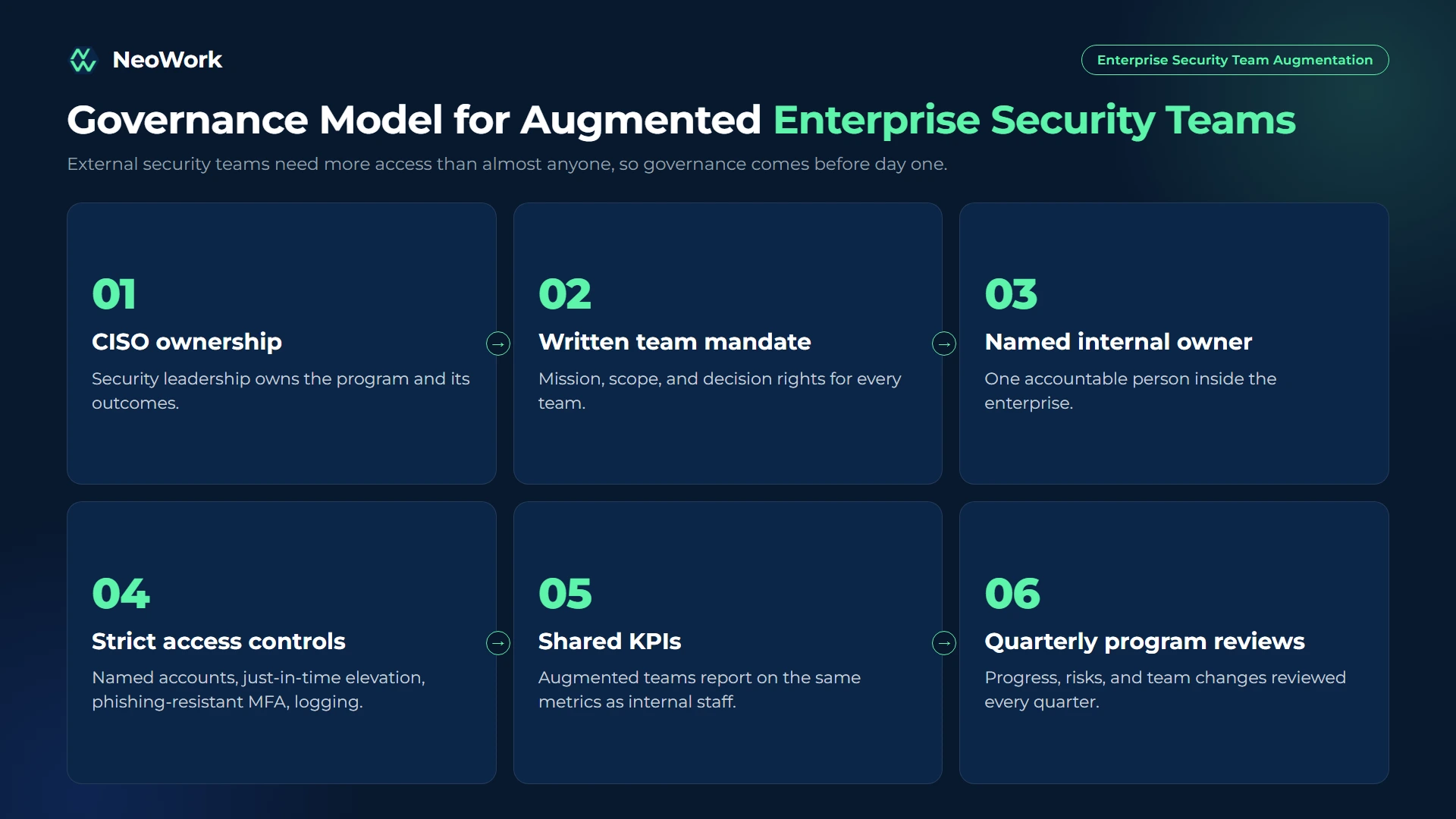
External security teams often need more access than almost anyone else in the company, so governance has to be designed before day one. Every team needs a written mandate with its mission, scope, decision rights, and a named internal owner. Without that, teams either stall or act outside their remit, and in security both are expensive.

Access controls should be the strictest in the organization:
  • Named accounts: No shared credentials, ever.
  • Least privilege: Just-in-time elevation instead of standing admin rights.
  • Strong authentication: Phishing-resistant MFA and managed devices for sensitive systems.
  • Logging: Privileged actions recorded and reviewed.
  • Offboarding: Access removed the same day someone leaves.
Enterprise security team augmentation governance model showing CISO ownership, team mandate, named internal owner, access controls, shared KPIs, and quarterly program reviews

How to Choose an Enterprise Security Augmentation Partner

Criteria What to Ask
Relevant experience Have you staffed teams for programs similar to ours?
Screening How do you vet candidates technically and through background checks?
Security practices How do you protect our credentials and data on your side?
Coverage Can you support follow-the-sun or 24/7 operations?
Continuity How do you replace team members without disrupting operations?
Ways of working Will your teams follow our policies, tools, and reporting formats?

Risks and Trade-Offs to Weigh

  • Knowledge drain: If findings and configurations aren't documented in your systems, knowledge leaves with the team.
  • Blurred accountability: Augmented teams execute programs, but risk decisions must stay with internal leaders.
  • Access creep: Permissions granted for a project often outlive it unless reviewed regularly.
  • Integration effort: Even strong teams need time to learn your environment and tooling.

Building a Security Team Charter

Every augmented security team should start with a short written charter. It doesn't need to be long, but it does need to answer the questions that cause friction later. A good charter covers:

  • Mission: the program outcome the team exists to deliver.
  • Scope: which systems, business units, and activities are included and excluded.
  • Decision rights: what the team can decide alone and what needs approval.
  • Escalation paths: who to contact for incidents, access issues, and policy questions.
  • Reporting: which metrics are reported, how often, and to whom.
  • Exit criteria: what done looks like, or how the engagement will be reviewed.

Charters take a few hours to write and save weeks of confusion. They also make it much easier to show auditors and leadership how external teams are governed.

Measuring Success: KPIs by Program

  • SOC: mean time to detect, mean time to respond, alert backlog, and false positive rate.
  • Cloud security: open critical misconfigurations, guardrail coverage, and time to remediate.
  • Identity: MFA and SSO coverage, privileged accounts under control, and access review completion.
  • Application security: critical findings per release, time to fix, and share of repositories with scanning.
  • GRC: controls tested, audit findings closed, and vendor assessments completed on time.

Reporting these in the same format as internal teams keeps leadership focused on one security program rather than a separate vendor scorecard.

Real-World Scenario: Scaling a SOC Without a Hiring Spree

Picture a mid-sized enterprise whose internal SOC covers business hours only. Alerts that arrive overnight wait until morning, and the backlog grows every week. Hiring enough analysts for round-the-clock coverage would take most of a year.

Instead, the CISO adds an augmented SOC team with a lead and analysts in another time zone. The team follows the same runbooks, works in the same SIEM, and escalates to the internal on-call lead for anything serious. Within a quarter, overnight alerts are triaged within the agreed window and internal analysts spend more time on threat hunting and detection engineering instead of clearing queues.

Questions to Ask Before You Sign

  • Team leadership: who leads the team day to day, and what programs have they led before?
  • Vetting: how are candidates tested technically, and which background checks are standard?
  • Credential handling: how does the provider protect your access, data, and devices on its side?
  • Continuity: how quickly are team members replaced, and how is knowledge handed over?
  • Flexibility: how much notice is needed to grow, shrink, or refocus a team?

Clear answers to these questions usually separate providers that have run real enterprise security programs from those that simply place individual contractors.

FAQ: Enterprise Security Team Augmentation

What is enterprise security team augmentation?

It's adding dedicated, multi-role security teams from an external provider to an enterprise security organization, working under its governance and tools.

How is it different from cyber security staff augmentation?

Staff augmentation adds individual specialists. Team augmentation adds a coordinated team with a lead that can own a program such as a SOC or identity initiative.

Is team augmentation better than an MSSP?

They solve different problems. An MSSP runs a standardized service with its own processes; augmented teams work under your processes and build knowledge inside your organization.

Which programs should be augmented first?

Start with a program that has clear goals and measurable outcomes, such as SOC coverage, cloud security posture, or an identity rollout.

How do you keep external security teams accountable?

With a written mandate, a named internal owner, shared KPIs, regular reviews, and access controls that log and limit what each person can do.

How long does it take to stand up an augmented team?

Often a few weeks, though background checks and access provisioning can add time for sensitive programs.

Can augmented teams handle incidents?

They can detect, triage, and support response, but incident declaration and major decisions should stay with your security leadership.

Final Thoughts

Enterprise security team augmentation gives CISOs a practical way to staff critical programs without waiting a year for hiring to catch up. It works when each team has a clear mandate, a named owner, strict access controls, and metrics that fit into the wider security program.

Start with one well-defined program, measure the results honestly, and expand from there. That approach builds capacity without sacrificing control.

Topics
No items found.

Enterprise Security Team Augmentation Guide 2026: Models, Costs & Governance

Paper
Calendar Icon
Oct 29, 2026
Ann

Quick Summary: Enterprise security team augmentation means adding dedicated, multi-role security teams from an external provider to an enterprise security organization, so programs like security operations, cloud security, identity, and compliance get the people they need while strategy and risk ownership stay with the CISO. Gartner forecasts worldwide information security spending of roughly 244 billion US dollars in 2026, and the 2025 ISC2 Cybersecurity Workforce Study found that 95% of security teams report at least one skills gap. This guide explains which security functions enterprises augment, how augmentation compares with MSSPs and in-house hiring, what it costs, how to govern external teams, and how to pick the right provider.

Ask any CISO what keeps them up at night and the answer usually isn't a single threat. It's the gap between the number of programs they're accountable for and the number of people they can actually staff them with. A zero trust rollout, a SOC expansion, and a new audit framework can all land in the same quarter.

Hiring your way out of that gap rarely works fast enough. That's why more large organizations are adding complete security teams from external partners, not just individual contractors. Here's how that model works and how to run it safely.

What Is Enterprise Security Team Augmentation?

Enterprise security team augmentation is an engagement model where a provider supplies dedicated security teams, each with a lead and a mix of roles, that work inside an enterprise security organization. The teams follow the enterprise's policies, use its tools, and report into its security leadership. The provider handles recruitment, employment, training, and continuity.

It sits between two familiar options. Individual staff augmentation fills single seats and leaves coordination to internal managers. Managed security services deliver an outsourced service using the provider's own processes. Team augmentation gives you a working unit that operates like an internal team, under your governance.

Why Demand for Augmented Security Teams Keeps Growing

The workforce problem has changed shape. ISC2's 2025 findings point out that skills shortages, not just headcount, are now the main risk, with AI security and cloud security near the top of the list of missing skills. Enterprises don't just need more people; they need specific combinations of skills for specific programs, and they need them quickly.

At the same time, security budgets keep rising and boards expect visible progress on programs they've funded. Building a new internal team for each initiative can take a year of recruiting. Augmented teams can start within weeks and report against the same metrics as internal staff, which makes them a practical way to turn budget into capability.

Enterprise security team augmentation drivers including skills gaps, rising security budgets, program deadlines, cloud and AI security demand, and internal team burnout

Which Security Functions Enterprises Augment

Function Typical Team Roles Why Enterprises Augment It
Security operations (SOC) SOC lead, tier 1 to 3 analysts, detection engineers Alert backlogs and 24/7 coverage needs
Cloud security Cloud security architect, cloud security engineers Fast cloud growth and misconfiguration risk
Identity and access management IAM architect, IAM engineers, access review analysts Zero trust programs and privileged access control
Application security AppSec lead, security engineers, DevSecOps engineers Security reviews can't keep pace with development
GRC and audit readiness GRC lead, compliance analysts, vendor risk analysts New frameworks and audit deadlines
Vulnerability management Program lead, analysts, remediation coordinators Growing backlogs across business units

Strengthen Enterprise Security Teams with NeoWork

Enterprise security team augmentation helps organizations add capacity to security and IT operations programs without building every role in-house. At NeoWork, we provide dedicated technical teammates who work inside your tools, policies, and reporting lines. We handle recruitment, benefits, training, and ongoing engagement, while our teammates integrate into your security workflows. Our industry-leading 91% annualized teammate retention rate and 3.2% candidate selectivity rate reflect our focus on selective hiring and long-term team stability.

Our enterprise security support model offers:

  • dedicated technical and security operations teammates
  • integration with your tools and processes
  • recruitment and ongoing teammate support

Contact NeoWork to add security capacity that fits your existing programs.

Augmentation vs. MSSP vs. In-House Hiring

Factor Team Augmentation MSSP or MDR In-House Hiring
Who controls processes Your security leadership The provider Your security leadership
Business context High Lower, shared across clients High
Speed to start Weeks Weeks Months
Flexibility Scale by program Tied to service contract Limited
Best for Programs needing coordinated roles Standardized 24/7 services Core leadership roles

Most mature security programs combine all three: in-house leaders own strategy, an MDR provider covers round-the-clock detection, and augmented teams take on specific programs such as cloud security or identity.

What Enterprise Security Team Augmentation Costs

Pricing depends on roles, seniority, certifications, clearances, coverage hours, and location, so ranges vary widely. Most providers use one of four structures: a monthly team rate, per-role monthly rates, shift-based pricing for 24/7 monitoring, or program-based pricing with defined milestones for initiatives like an IAM rollout.

Senior architects, detection engineers, and cloud specialists cost noticeably more than tier 1 analysts. When comparing options, factor in the cost of leaving a program understaffed, not just the rate card. A delayed identity program or an alert backlog has its own price, even if it never shows up on an invoice.

Governance and Access Control: The Part You Can't Skip

External security teams often need more access than almost anyone else in the company, so governance has to be designed before day one. Every team needs a written mandate with its mission, scope, decision rights, and a named internal owner. Without that, teams either stall or act outside their remit, and in security both are expensive.

Access controls should be the strictest in the organization:

  • Named accounts: No shared credentials, ever.
  • Least privilege: Just-in-time elevation instead of standing admin rights.
  • Strong authentication: Phishing-resistant MFA and managed devices for sensitive systems.
  • Logging: Privileged actions recorded and reviewed.
  • Offboarding: Access removed the same day someone leaves.
Enterprise security team augmentation governance model showing CISO ownership, team mandate, named internal owner, access controls, shared KPIs, and quarterly program reviews

How to Choose an Enterprise Security Augmentation Partner

Criteria What to Ask
Relevant experience Have you staffed teams for programs similar to ours?
Screening How do you vet candidates technically and through background checks?
Security practices How do you protect our credentials and data on your side?
Coverage Can you support follow-the-sun or 24/7 operations?
Continuity How do you replace team members without disrupting operations?
Ways of working Will your teams follow our policies, tools, and reporting formats?

Risks and Trade-Offs to Weigh

  • Knowledge drain: If findings and configurations aren't documented in your systems, knowledge leaves with the team.
  • Blurred accountability: Augmented teams execute programs, but risk decisions must stay with internal leaders.
  • Access creep: Permissions granted for a project often outlive it unless reviewed regularly.
  • Integration effort: Even strong teams need time to learn your environment and tooling.

Building a Security Team Charter

Every augmented security team should start with a short written charter. It doesn't need to be long, but it does need to answer the questions that cause friction later. A good charter covers:

  • Mission: the program outcome the team exists to deliver.
  • Scope: which systems, business units, and activities are included and excluded.
  • Decision rights: what the team can decide alone and what needs approval.
  • Escalation paths: who to contact for incidents, access issues, and policy questions.
  • Reporting: which metrics are reported, how often, and to whom.
  • Exit criteria: what done looks like, or how the engagement will be reviewed.

Charters take a few hours to write and save weeks of confusion. They also make it much easier to show auditors and leadership how external teams are governed.

Measuring Success: KPIs by Program

  • SOC: mean time to detect, mean time to respond, alert backlog, and false positive rate.
  • Cloud security: open critical misconfigurations, guardrail coverage, and time to remediate.
  • Identity: MFA and SSO coverage, privileged accounts under control, and access review completion.
  • Application security: critical findings per release, time to fix, and share of repositories with scanning.
  • GRC: controls tested, audit findings closed, and vendor assessments completed on time.

Reporting these in the same format as internal teams keeps leadership focused on one security program rather than a separate vendor scorecard.

Real-World Scenario: Scaling a SOC Without a Hiring Spree

Picture a mid-sized enterprise whose internal SOC covers business hours only. Alerts that arrive overnight wait until morning, and the backlog grows every week. Hiring enough analysts for round-the-clock coverage would take most of a year.

Instead, the CISO adds an augmented SOC team with a lead and analysts in another time zone. The team follows the same runbooks, works in the same SIEM, and escalates to the internal on-call lead for anything serious. Within a quarter, overnight alerts are triaged within the agreed window and internal analysts spend more time on threat hunting and detection engineering instead of clearing queues.

Questions to Ask Before You Sign

  • Team leadership: who leads the team day to day, and what programs have they led before?
  • Vetting: how are candidates tested technically, and which background checks are standard?
  • Credential handling: how does the provider protect your access, data, and devices on its side?
  • Continuity: how quickly are team members replaced, and how is knowledge handed over?
  • Flexibility: how much notice is needed to grow, shrink, or refocus a team?

Clear answers to these questions usually separate providers that have run real enterprise security programs from those that simply place individual contractors.

FAQ: Enterprise Security Team Augmentation

What is enterprise security team augmentation?

It's adding dedicated, multi-role security teams from an external provider to an enterprise security organization, working under its governance and tools.

How is it different from cyber security staff augmentation?

Staff augmentation adds individual specialists. Team augmentation adds a coordinated team with a lead that can own a program such as a SOC or identity initiative.

Is team augmentation better than an MSSP?

They solve different problems. An MSSP runs a standardized service with its own processes; augmented teams work under your processes and build knowledge inside your organization.

Which programs should be augmented first?

Start with a program that has clear goals and measurable outcomes, such as SOC coverage, cloud security posture, or an identity rollout.

How do you keep external security teams accountable?

With a written mandate, a named internal owner, shared KPIs, regular reviews, and access controls that log and limit what each person can do.

How long does it take to stand up an augmented team?

Often a few weeks, though background checks and access provisioning can add time for sensitive programs.

Can augmented teams handle incidents?

They can detect, triage, and support response, but incident declaration and major decisions should stay with your security leadership.

Final Thoughts

Enterprise security team augmentation gives CISOs a practical way to staff critical programs without waiting a year for hiring to catch up. It works when each team has a clear mandate, a named owner, strict access controls, and metrics that fit into the wider security program.

Start with one well-defined program, measure the results honestly, and expand from there. That approach builds capacity without sacrificing control.

Topics

No items found.
Blue gradient banner with rounded corners at the top.
CTA Hexagon LeftCTA Hexagon LeftCTA Hexagon RightCTA Hexagon Right Mobile

Navigate the shadows of tech leadership – all while enjoying the comfort food that binds us all.

CTA Hexagon LeftCTA Hexagon LeftCTA Hexagon RightCTA Hexagon Right Mobile

Book a consultation

Build your team with NeoWork

Talk to us about how we staff and manage high-performing remote teams for companies like yours.