
Green glowing circular pattern with concentric rings and faint hexagonal grid on the left side.
Blue abstract hexagonal pattern with glowing circular gradient edges on a black background.Glowing greenish-blue hexagonal pattern with concentric circular gradients on a black background.

Content Moderation Outsourcing Guide: How It Works in 2026

Calendar Icon
Published:
Oct 29
2026
,
Updated:
Oct 30
2026
Ann
Facebook IconInstagram Icon

Build your team with NeoWork

Talk to us about how we staff and manage high-performing remote teams for companies like yours.

Get a Content Moderation Outsourcing Quote

Quick Summary: Content moderation outsourcing is when a platform or brand contracts an external team to review user-generated content (text, images, video, live streams, reviews, listings, and ads) against its policies and the law, then approve, remove, label, or escalate it. Research Nester estimates the content moderation services market at about 13.9 billion US dollars in 2026, growing at roughly 13% a year, driven by more user-generated content and stricter rules such as the EU Digital Services Act and the UK Online Safety Act. Most platforms combine AI triage with human review, and the main engagement options are a dedicated moderation team, a shared service, escalation-only support, or full trust and safety operations.

Any product that lets users post something needs moderation. That includes social apps and forums, but also marketplaces with listings, dating apps with profiles, games with chat, ecommerce sites with reviews, and AI products with user prompts and outputs. As volume grows, a few people checking reports in their spare time stops working: harmful content stays up too long, good content gets removed by mistake, and regulators start asking how decisions are made.

Outsourcing gives you trained moderators, documented workflows, and coverage around the clock. It also comes with responsibilities on both sides: clear policies, data protection, and moderator wellbeing.

What Is Content Moderation Outsourcing?

Content moderation outsourcing is the practice of delegating the review of user-generated content to a third-party team that applies your community guidelines, terms of service, and legal requirements. The outsourced moderators decide whether content stays up, comes down, gets restricted or labeled, or goes to a specialist for escalation, and they document each decision.

The platform keeps ownership of the policies, the final say on edge cases, and the relationship with regulators. The partner provides the people, the processes, the quality checks, and the reporting.
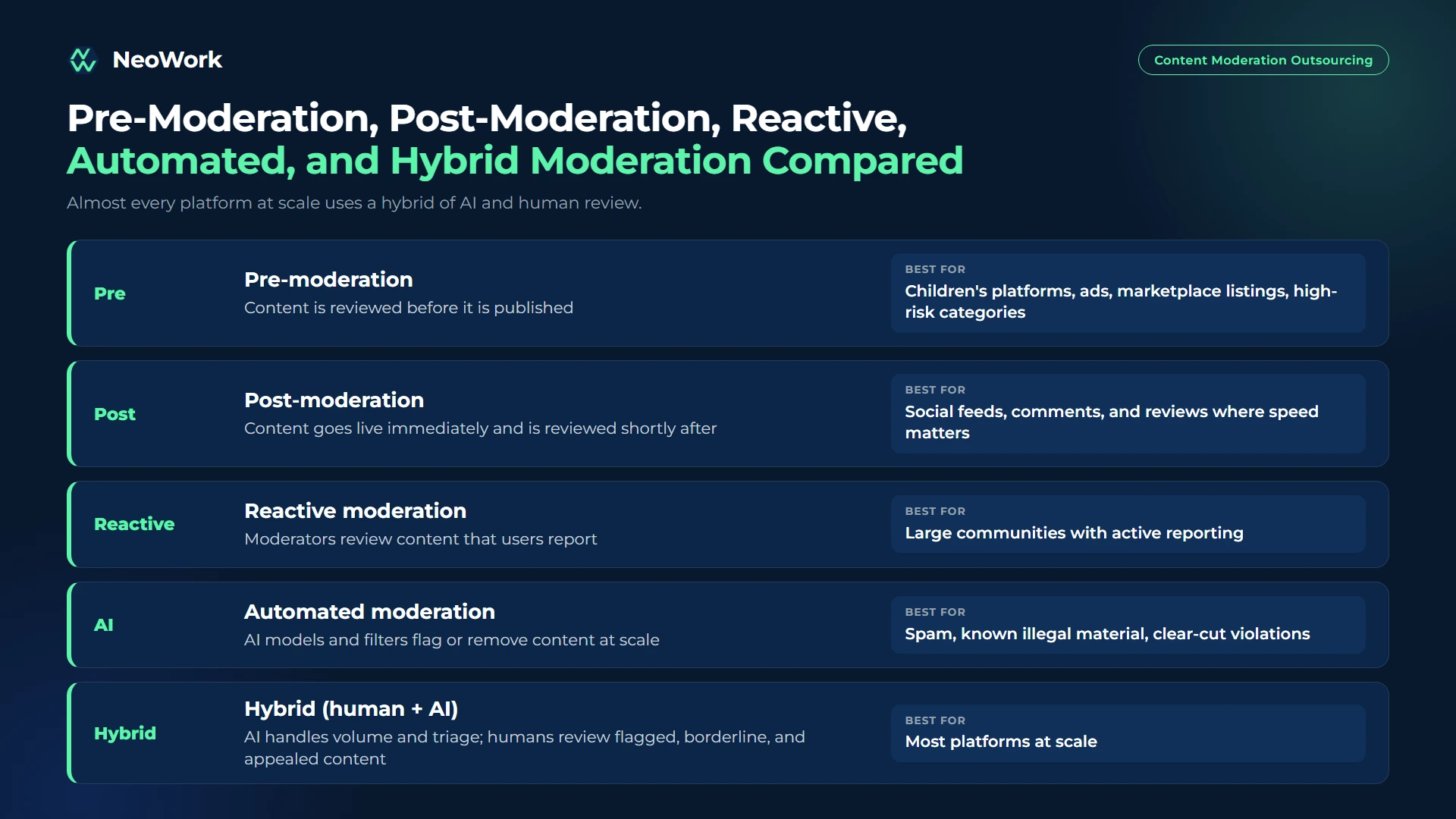
Types of Content Moderation

Method How It Works Best For
Pre-moderation Content is reviewed before it is published Children's platforms, ads, marketplace listings, high-risk categories
Post-moderation Content goes live immediately and is reviewed shortly after Social feeds, comments, and reviews where speed matters
Reactive moderation Moderators review content that users report Large communities with active reporting
Automated moderation AI models and filters flag or remove content at scale Spam, known illegal material, clear-cut violations
Hybrid (human + AI) AI handles volume and triage; humans review flagged, borderline, and appealed content Most platforms at scale
Content moderation outsourcing methods compared, including pre-moderation, post-moderation, reactive moderation, automated AI moderation, and hybrid human and AI review

In practice, almost every platform at scale uses a hybrid approach. AI is fast and consistent on obvious cases, but it struggles with context, sarcasm, slang, regional references, and new types of abuse. Human moderators handle those judgment calls and also produce the labeled decisions that improve the AI over time.

Scale Moderation With a Team You Can Trust

At NeoWork, we build dedicated content moderation teams that review user-generated content against your policies, inside your own moderation tools and queues. Our moderators learn your guidelines in depth, escalate edge cases the way you define, and document decisions so your trust and safety team always has a clear record.

We take care of recruiting, onboarding, benefits, and ongoing teammate support, so your team can focus on policy and safety strategy while we keep the queues moving.

What we bring:

  • Dedicated moderators trained on your community guidelines and escalation rules
  • A 3.2% candidate selectivity rate, screening for judgment, attention to detail, and resilience
  • Industry-leading 91% annualized teammate retention rate, which keeps policy knowledge and accuracy high
  • Coverage across time zones, including nights, weekends, and event-driven spikes

Contact us to share your content types, volumes, and policies. We will propose a moderation team setup and rollout plan.

What Content Can Be Moderated by an Outsourced Team?

  • Text: Comments, posts, chat messages, reviews, usernames, bios, and AI prompts or outputs.
  • Images: Profile photos, listing images, user uploads, memes, and screenshots.
  • Video and live streams: Uploaded clips, livestreams, and short-form video, often with time-coded decisions.
  • Marketplace listings: Prohibited items, counterfeits, misleading claims, and pricing abuse.
  • Ads and sponsored content: Policy and legal compliance before ads go live.
  • Accounts and profiles: Fake accounts, impersonation, spam networks, and age checks.

Why Companies Outsource Content Moderation

  • Volume grows faster than headcount: User-generated content scales with users, not with your team size.
  • Around-the-clock coverage: Harmful content posted at 3 a.m. needs a response before morning. Distributed teams make 24/7 review practical.
  • Regulatory pressure: The EU Digital Services Act requires platforms to run notice-and-action processes and give users a statement of reasons for moderation decisions, and the UK Online Safety Act adds duties around illegal and harmful content. Both require documented, consistent decisions.
  • Language and cultural coverage: Moderating in many languages and regions needs native speakers who understand local context.
  • Specialized wellbeing support: Experienced providers have structures to protect moderators who review disturbing material.

Content Moderation Outsourcing Models

Model How It Works Best For Trade-Offs
Dedicated moderation team Moderators work only on your platform, in your tools, with your policies Platforms with nuanced policies or sensitive communities Fixed monthly cost per moderator
Shared moderation service Moderators review content for several clients Small volumes and simple rules Less depth on your specific policies
Escalation-only support Partner reviews AI-flagged or user-reported content only Platforms with strong automated filtering Depends on the quality of your AI triage
Full trust and safety operations Partner runs moderation, appeals, reporting, and policy feedback loops Large platforms without in-house operations capacity Requires strong oversight and governance

Moderation work also produces labeled data. If you are training or fine-tuning AI classifiers, the same team can often support AI training and data labeling, which keeps labels consistent with your actual policies.

How Much Does Content Moderation Outsourcing Cost?

Price depends on content type, volume, required speed, languages, and how sensitive the material is. Common structures include:

  • Per moderator (FTE): A fixed monthly fee for each dedicated moderator. Predictable and best for steady volumes and complex policies.
  • Per hour: Billing for moderator hours, useful for flexible or event-based coverage.
  • Per item: A fee per image, post, video minute, or listing reviewed. Works for well-defined, high-volume queues.
  • Hybrid: A base team plus per-item pricing for overflow.

Video, live streams, and graphic material cost more than text because they take longer to review and require more wellbeing support. Multilingual coverage also adds cost. See how we structure dedicated teams on our pricing page.
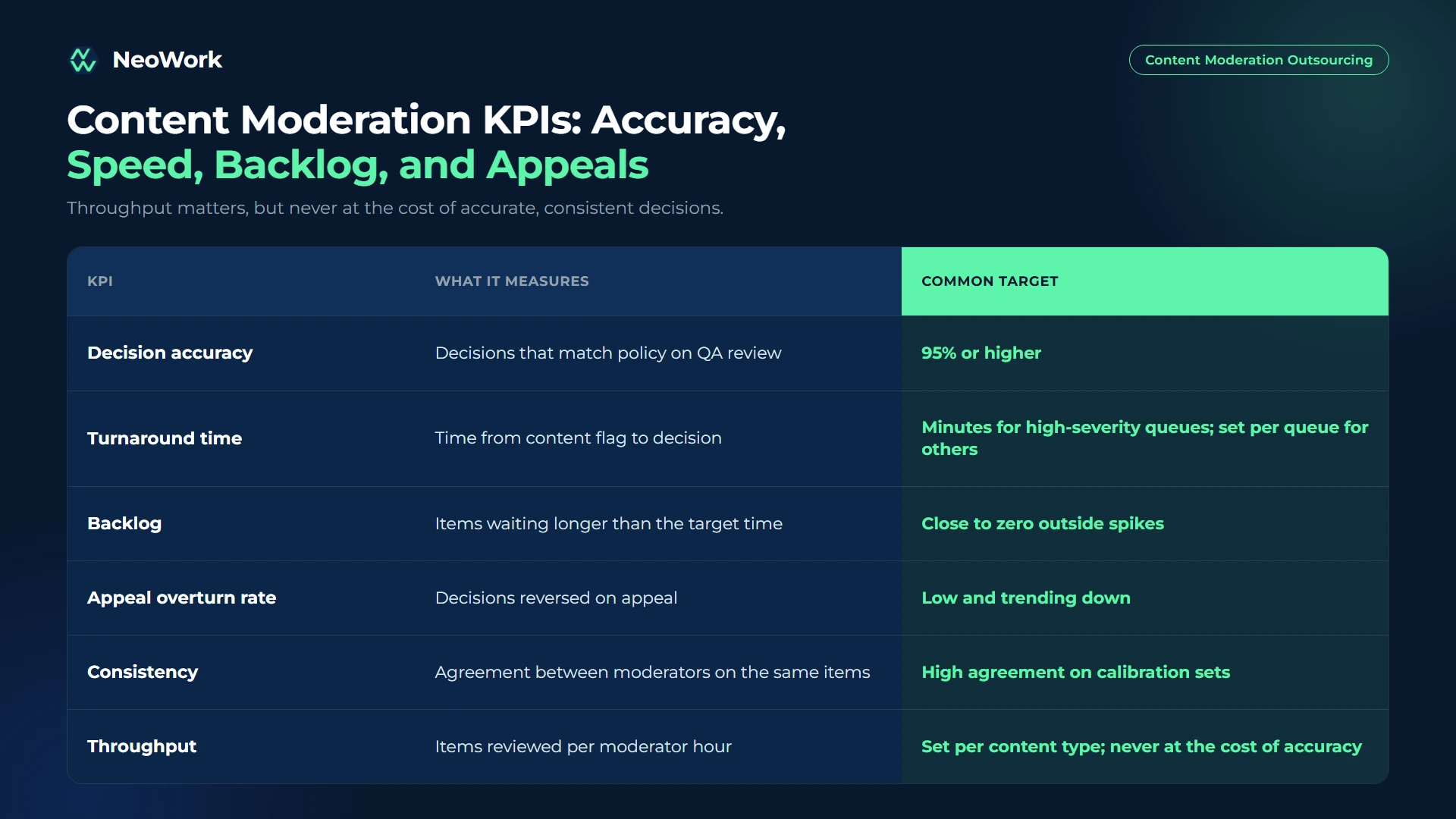
Content Moderation KPIs to Track

KPI What It Measures Common Target
Decision accuracy Share of decisions that match policy on QA review 95% or higher
Turnaround time Time from content flag to decision Minutes for high-severity queues; set per queue for others
Backlog Items waiting longer than the target time Close to zero outside spikes
Appeal overturn rate Share of decisions reversed on appeal Low and trending down
Consistency Agreement between moderators on the same items High agreement on calibration sets
Throughput Items reviewed per moderator hour Set per content type; never at the cost of accuracy
Content moderation outsourcing KPI chart with targets for decision accuracy, turnaround time, backlog, appeal overturn rate, consistency, and throughput

Moderator Wellbeing: What to Expect From a Partner

Content moderators can be exposed to violent, abusive, and disturbing material. A responsible partner treats wellbeing as part of the service. Ask for:

  • Limits on continuous exposure time and rotation between high- and low-severity queues
  • Tool features such as blurring, greyscale, muted audio, and thumbnails for graphic content
  • Access to counseling or mental health support
  • Resilience training during onboarding and regular check-ins
  • Clear opt-out paths from the most severe queues

Wellbeing also affects quality: burnout drives attrition and inconsistent decisions, which lower accuracy.

How to Outsource Content Moderation Step by Step

  1. Write or update your policies. Moderators can only be as consistent as your guidelines. Include definitions, examples, and edge cases.
  2. Map your queues. Separate content by type, severity, language, and required turnaround time.
  3. Decide the human-AI split. Define what automation removes on its own, what it flags, and what always goes to a human.
  4. Choose the partner and model. Check experience with your content types, languages, security standards, and wellbeing programs.
  5. Set up secure tooling. Give moderators individual accounts with limited data access, and agree on data protection and retention rules.
  6. Train and calibrate. Run calibration sets until agreement with your internal reviewers is high, then go live on one queue.
  7. Monitor and refine. Review accuracy, appeals, and new abuse patterns weekly, and feed findings back into policies and AI models.

Questions Worth Asking Any Provider

  • Which content types, languages, and regions do you moderate today?
  • How do you measure and report decision accuracy?
  • What wellbeing support do your moderators receive?
  • How do you handle escalations of illegal content and law enforcement requests?
  • How do you protect user data and comply with GDPR and other privacy rules?
  • How fast can you add moderators for a launch or crisis?

Common Content Moderation Outsourcing Mistakes

  • Vague policies. Rules like "no offensive content" lead to inconsistent decisions. Moderators need precise definitions and examples.
  • Optimizing only for speed. High throughput targets push moderators to guess. Accuracy and consistency should come first.
  • Relying on AI without human review. Automation misses context and new tactics, and over-removal frustrates legitimate users.
  • Ignoring wellbeing. Unsupported moderators burn out, which raises attrition and lowers quality.
  • No feedback loop. Moderators see abuse trends first. If their insights never reach policy and product teams, the same problems keep returning.

Final Thoughts

Content moderation outsourcing works when policy, people, and technology are designed together. Keep ownership of your rules and edge cases, let AI handle the volume it handles well, and rely on trained human moderators for context and judgment. Measure accuracy and consistency alongside speed, and choose a partner that takes moderator wellbeing seriously.

Set up this way, outsourcing gives you faster decisions, safer communities, and documented decisions you can show regulators. If you are ready to scale moderation, see how we build dedicated teams at NeoWork.

FAQ

KPI What It Measures Common Target
Decision accuracy Share of decisions that match policy on QA review 95% or higher
Turnaround time Time from content flag to decision Minutes for high-severity queues; set per queue for others
Backlog Items waiting longer than the target time Close to zero outside spikes
Appeal overturn rate Share of decisions reversed on appeal Low and trending down
Consistency Agreement between moderators on the same items High agreement on calibration sets
Throughput Items reviewed per moderator hour Set per content type; never at the cost of accuracy

Topics
No items found.

Content Moderation Outsourcing Guide: How It Works in 2026

Paper
Calendar Icon
Oct 29, 2026
Ann

Quick Summary: Content moderation outsourcing is when a platform or brand contracts an external team to review user-generated content (text, images, video, live streams, reviews, listings, and ads) against its policies and the law, then approve, remove, label, or escalate it. Research Nester estimates the content moderation services market at about 13.9 billion US dollars in 2026, growing at roughly 13% a year, driven by more user-generated content and stricter rules such as the EU Digital Services Act and the UK Online Safety Act. Most platforms combine AI triage with human review, and the main engagement options are a dedicated moderation team, a shared service, escalation-only support, or full trust and safety operations.

Any product that lets users post something needs moderation. That includes social apps and forums, but also marketplaces with listings, dating apps with profiles, games with chat, ecommerce sites with reviews, and AI products with user prompts and outputs. As volume grows, a few people checking reports in their spare time stops working: harmful content stays up too long, good content gets removed by mistake, and regulators start asking how decisions are made.

Outsourcing gives you trained moderators, documented workflows, and coverage around the clock. It also comes with responsibilities on both sides: clear policies, data protection, and moderator wellbeing.

What Is Content Moderation Outsourcing?

Content moderation outsourcing is the practice of delegating the review of user-generated content to a third-party team that applies your community guidelines, terms of service, and legal requirements. The outsourced moderators decide whether content stays up, comes down, gets restricted or labeled, or goes to a specialist for escalation, and they document each decision.

The platform keeps ownership of the policies, the final say on edge cases, and the relationship with regulators. The partner provides the people, the processes, the quality checks, and the reporting.

Types of Content Moderation

Method How It Works Best For
Pre-moderation Content is reviewed before it is published Children's platforms, ads, marketplace listings, high-risk categories
Post-moderation Content goes live immediately and is reviewed shortly after Social feeds, comments, and reviews where speed matters
Reactive moderation Moderators review content that users report Large communities with active reporting
Automated moderation AI models and filters flag or remove content at scale Spam, known illegal material, clear-cut violations
Hybrid (human + AI) AI handles volume and triage; humans review flagged, borderline, and appealed content Most platforms at scale
Content moderation outsourcing methods compared, including pre-moderation, post-moderation, reactive moderation, automated AI moderation, and hybrid human and AI review

In practice, almost every platform at scale uses a hybrid approach. AI is fast and consistent on obvious cases, but it struggles with context, sarcasm, slang, regional references, and new types of abuse. Human moderators handle those judgment calls and also produce the labeled decisions that improve the AI over time.

Scale Moderation With a Team You Can Trust

At NeoWork, we build dedicated content moderation teams that review user-generated content against your policies, inside your own moderation tools and queues. Our moderators learn your guidelines in depth, escalate edge cases the way you define, and document decisions so your trust and safety team always has a clear record.

We take care of recruiting, onboarding, benefits, and ongoing teammate support, so your team can focus on policy and safety strategy while we keep the queues moving.

What we bring:

  • Dedicated moderators trained on your community guidelines and escalation rules
  • A 3.2% candidate selectivity rate, screening for judgment, attention to detail, and resilience
  • Industry-leading 91% annualized teammate retention rate, which keeps policy knowledge and accuracy high
  • Coverage across time zones, including nights, weekends, and event-driven spikes

Contact us to share your content types, volumes, and policies. We will propose a moderation team setup and rollout plan.

What Content Can Be Moderated by an Outsourced Team?

  • Text: Comments, posts, chat messages, reviews, usernames, bios, and AI prompts or outputs.
  • Images: Profile photos, listing images, user uploads, memes, and screenshots.
  • Video and live streams: Uploaded clips, livestreams, and short-form video, often with time-coded decisions.
  • Marketplace listings: Prohibited items, counterfeits, misleading claims, and pricing abuse.
  • Ads and sponsored content: Policy and legal compliance before ads go live.
  • Accounts and profiles: Fake accounts, impersonation, spam networks, and age checks.

Why Companies Outsource Content Moderation

  • Volume grows faster than headcount: User-generated content scales with users, not with your team size.
  • Around-the-clock coverage: Harmful content posted at 3 a.m. needs a response before morning. Distributed teams make 24/7 review practical.
  • Regulatory pressure: The EU Digital Services Act requires platforms to run notice-and-action processes and give users a statement of reasons for moderation decisions, and the UK Online Safety Act adds duties around illegal and harmful content. Both require documented, consistent decisions.
  • Language and cultural coverage: Moderating in many languages and regions needs native speakers who understand local context.
  • Specialized wellbeing support: Experienced providers have structures to protect moderators who review disturbing material.

Content Moderation Outsourcing Models

Model How It Works Best For Trade-Offs
Dedicated moderation team Moderators work only on your platform, in your tools, with your policies Platforms with nuanced policies or sensitive communities Fixed monthly cost per moderator
Shared moderation service Moderators review content for several clients Small volumes and simple rules Less depth on your specific policies
Escalation-only support Partner reviews AI-flagged or user-reported content only Platforms with strong automated filtering Depends on the quality of your AI triage
Full trust and safety operations Partner runs moderation, appeals, reporting, and policy feedback loops Large platforms without in-house operations capacity Requires strong oversight and governance

Moderation work also produces labeled data. If you are training or fine-tuning AI classifiers, the same team can often support AI training and data labeling, which keeps labels consistent with your actual policies.

How Much Does Content Moderation Outsourcing Cost?

Price depends on content type, volume, required speed, languages, and how sensitive the material is. Common structures include:

  • Per moderator (FTE): A fixed monthly fee for each dedicated moderator. Predictable and best for steady volumes and complex policies.
  • Per hour: Billing for moderator hours, useful for flexible or event-based coverage.
  • Per item: A fee per image, post, video minute, or listing reviewed. Works for well-defined, high-volume queues.
  • Hybrid: A base team plus per-item pricing for overflow.

Video, live streams, and graphic material cost more than text because they take longer to review and require more wellbeing support. Multilingual coverage also adds cost. See how we structure dedicated teams on our pricing page.

Content Moderation KPIs to Track

KPI What It Measures Common Target
Decision accuracy Share of decisions that match policy on QA review 95% or higher
Turnaround time Time from content flag to decision Minutes for high-severity queues; set per queue for others
Backlog Items waiting longer than the target time Close to zero outside spikes
Appeal overturn rate Share of decisions reversed on appeal Low and trending down
Consistency Agreement between moderators on the same items High agreement on calibration sets
Throughput Items reviewed per moderator hour Set per content type; never at the cost of accuracy
Content moderation outsourcing KPI chart with targets for decision accuracy, turnaround time, backlog, appeal overturn rate, consistency, and throughput

Moderator Wellbeing: What to Expect From a Partner

Content moderators can be exposed to violent, abusive, and disturbing material. A responsible partner treats wellbeing as part of the service. Ask for:

  • Limits on continuous exposure time and rotation between high- and low-severity queues
  • Tool features such as blurring, greyscale, muted audio, and thumbnails for graphic content
  • Access to counseling or mental health support
  • Resilience training during onboarding and regular check-ins
  • Clear opt-out paths from the most severe queues

Wellbeing also affects quality: burnout drives attrition and inconsistent decisions, which lower accuracy.

How to Outsource Content Moderation Step by Step

  1. Write or update your policies. Moderators can only be as consistent as your guidelines. Include definitions, examples, and edge cases.
  2. Map your queues. Separate content by type, severity, language, and required turnaround time.
  3. Decide the human-AI split. Define what automation removes on its own, what it flags, and what always goes to a human.
  4. Choose the partner and model. Check experience with your content types, languages, security standards, and wellbeing programs.
  5. Set up secure tooling. Give moderators individual accounts with limited data access, and agree on data protection and retention rules.
  6. Train and calibrate. Run calibration sets until agreement with your internal reviewers is high, then go live on one queue.
  7. Monitor and refine. Review accuracy, appeals, and new abuse patterns weekly, and feed findings back into policies and AI models.

Questions Worth Asking Any Provider

  • Which content types, languages, and regions do you moderate today?
  • How do you measure and report decision accuracy?
  • What wellbeing support do your moderators receive?
  • How do you handle escalations of illegal content and law enforcement requests?
  • How do you protect user data and comply with GDPR and other privacy rules?
  • How fast can you add moderators for a launch or crisis?

Common Content Moderation Outsourcing Mistakes

  • Vague policies. Rules like "no offensive content" lead to inconsistent decisions. Moderators need precise definitions and examples.
  • Optimizing only for speed. High throughput targets push moderators to guess. Accuracy and consistency should come first.
  • Relying on AI without human review. Automation misses context and new tactics, and over-removal frustrates legitimate users.
  • Ignoring wellbeing. Unsupported moderators burn out, which raises attrition and lowers quality.
  • No feedback loop. Moderators see abuse trends first. If their insights never reach policy and product teams, the same problems keep returning.

Final Thoughts

Content moderation outsourcing works when policy, people, and technology are designed together. Keep ownership of your rules and edge cases, let AI handle the volume it handles well, and rely on trained human moderators for context and judgment. Measure accuracy and consistency alongside speed, and choose a partner that takes moderator wellbeing seriously.

Set up this way, outsourcing gives you faster decisions, safer communities, and documented decisions you can show regulators. If you are ready to scale moderation, see how we build dedicated teams at NeoWork.

FAQ

KPI What It Measures Common Target
Decision accuracy Share of decisions that match policy on QA review 95% or higher
Turnaround time Time from content flag to decision Minutes for high-severity queues; set per queue for others
Backlog Items waiting longer than the target time Close to zero outside spikes
Appeal overturn rate Share of decisions reversed on appeal Low and trending down
Consistency Agreement between moderators on the same items High agreement on calibration sets
Throughput Items reviewed per moderator hour Set per content type; never at the cost of accuracy

Topics

No items found.
Blue gradient banner with rounded corners at the top.
CTA Hexagon LeftCTA Hexagon LeftCTA Hexagon RightCTA Hexagon Right Mobile

Navigate the shadows of tech leadership – all while enjoying the comfort food that binds us all.

CTA Hexagon LeftCTA Hexagon LeftCTA Hexagon RightCTA Hexagon Right Mobile

Book a consultation

Build your team with NeoWork

Talk to us about how we staff and manage high-performing remote teams for companies like yours.