
Green glowing circular pattern with concentric rings and faint hexagonal grid on the left side.
Blue abstract hexagonal pattern with glowing circular gradient edges on a black background.Glowing greenish-blue hexagonal pattern with concentric circular gradients on a black background.

Customer Care Outsourcing Guide: How It Works in 2026

Calendar Icon
Published:
Oct 29
2026
,
Updated:
Oct 30
2026
Ann
Facebook IconInstagram Icon

Build your team with NeoWork

Talk to us about how we staff and manage high-performing remote teams for companies like yours.

Get a Customer Care Outsourcing Quote

Quick Summary: Customer care outsourcing is when a company partners with an external team to handle customer conversations across email, chat, phone, and social channels, with the goal of resolving issues, keeping customers happy, and protecting long-term loyalty. Success is measured by how customers feel after the interaction as well as by cost: Zendesk benchmark data shows that more than half of consumers will switch to a competitor after a single bad experience. The main levers are a dedicated team, a written tone of voice guide, clear decision rights for agents, and metrics such as CSAT, customer effort, and retention.

Customer care is where customers find out whether your brand keeps its promises. A delayed refund, a confusing answer, or a cold reply can undo months of marketing. Yet for most growing companies, care is also the function that is hardest to staff: volume is unpredictable, customers expect fast replies around the clock, and good agents take time to hire and train.

Outsourcing can solve the staffing problem when the partner treats care as relationship work rather than ticket processing and keeps the warmth, consistency, and product knowledge that bring customers back.

What Is Customer Care Outsourcing?

Customer care outsourcing is the delegation of customer-facing service and support to a third-party team that represents your brand. The outsourced team answers questions, solves problems, processes requests such as returns and account changes, and follows up to make sure customers are satisfied.

Customer care is often used interchangeably with customer service and customer support, but there is a useful distinction:

  • Customer service is the act of answering a customer's request.
  • Customer support usually refers to solving problems, often technical ones.
  • Customer care is the broader practice of looking after the customer relationship: empathy, proactive communication, retention, and the overall experience across every interaction.

When you outsource customer care, you trust a partner with how customers feel about your brand.
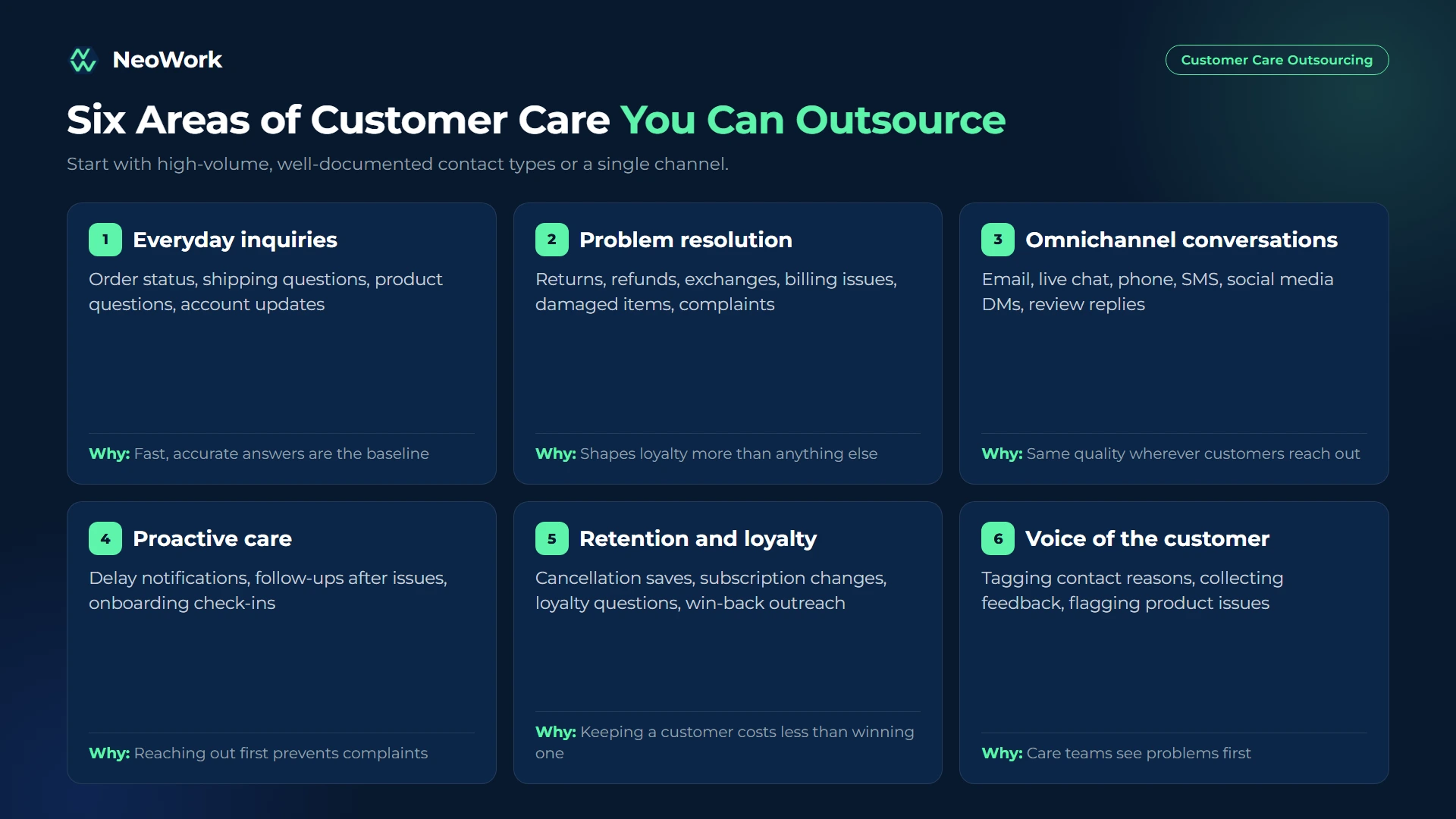
What Customer Care Tasks Can You Outsource?

Area Typical Tasks Why It Matters
Everyday inquiries Order status, shipping questions, product questions, account updates Fast, accurate answers are the baseline customers expect
Problem resolution Returns, refunds, exchanges, billing issues, damaged items, complaints How problems are handled shapes loyalty more than anything else
Omnichannel conversations Email, live chat, phone, SMS, social media DMs, review replies Customers expect the same quality wherever they reach out
Proactive care Delay notifications, follow-ups after issues, onboarding check-ins Reaching out first prevents complaints and builds trust
Retention and loyalty Cancellation saves, subscription changes, loyalty program questions, win-back outreach Keeping a customer is cheaper than acquiring a new one
Voice of the customer Tagging contact reasons, collecting feedback, flagging product issues Care teams see problems before anyone else does
Customer care outsourcing scope showing everyday inquiries, problem resolu

Customer Care That Sounds Like Your Brand

At NeoWork, we build dedicated customer experience teams that care for your customers the way you would. Our teammates learn your products, your policies, and your tone of voice, then work inside your helpdesk and communication tools as part of your team.

We handle recruiting, onboarding, benefits, coaching, and ongoing teammate support, so you can grow your care team without growing your management overhead.

What we bring:

  • Dedicated care specialists trained on your brand voice, products, and policies
  • A 3.2% candidate selectivity rate, hiring for empathy and communication as well as skill
  • Industry-leading 91% annualized teammate retention rate, so customers keep talking to people who know them
  • Coverage across email, chat, phone, and social, including evenings, weekends, and peak seasons

Contact us to tell us about your customers, channels, and the experience you want to deliver. We will design a care team around it.

Why Companies Outsource Customer Care

  • Customers expect speed: Zendesk's CX Trends 2026 report found that 88% of customers expect faster responses than they did a year earlier. Meeting that across channels and time zones is hard with a small in-house team.
  • Volume is unpredictable: Launches, promotions, shipping delays, and holidays create spikes that a flexible outsourced team can absorb.
  • Hiring and training take time: Good care agents are hard to find. A partner with an established hiring process gets qualified people in place faster.
  • Extended hours become affordable: Teams in other time zones cover evenings and weekends without overtime or night shifts.
  • Leaders can focus on improvement: When daily queues are covered, in-house CX leaders can work on policies, self-service, and fixing the root causes of contacts.

How to Keep Your Brand Voice When You Outsource

A common concern about outsourcing care is that customers will notice the change. These practices help prevent it:

  • Write a tone of voice guide. Include words you use and avoid, how formal to be, how to apologize, and real examples of great replies.
  • Give agents decision power. Define what agents can do without approval, such as refunds up to a set amount or free shipping on a replacement. Customers hate hearing "let me check with someone."
  • Share context, not just scripts. Agents who understand why a policy exists explain it better. Brief the team on launches, promotions, and known issues before customers ask.
  • Use dedicated agents. People who work only on your brand learn its products and customers. Shared agents switching between clients rarely sound consistent.
  • Review conversations together. Calibrate quality scoring with the partner using real tickets so both teams agree on what "great" looks like.

Customer Care Outsourcing Models

Model How It Works Best For Trade-Offs
Dedicated care team Agents work only on your brand, in your tools, with your processes Brands where experience and loyalty drive revenue Fixed monthly cost per teammate
Shared care service Agents handle several brands from a common queue Low volume, simple questions Less product knowledge and brand consistency
Overflow and after-hours Partner covers spikes, nights, and weekends Brands with a strong in-house daytime team Requires excellent handoffs between teams
Channel-specific Partner owns one channel, such as chat or social Testing outsourcing or adding a new channel Customers may get different experiences across channels

For brands that compete on experience, the dedicated model is usually the best fit. It is the closest thing to an in-house team, without the hiring and HR workload. If your care work also includes public replies on social channels, it can make sense to pair it with social media management so the tone stays consistent everywhere.

How Much Does Customer Care Outsourcing Cost?

Costs depend on location, channels, languages, hours, and how complex your customer issues are. The common pricing structures are:

  • Per agent per month: A fixed cost for each dedicated teammate. Predictable and the standard for dedicated care teams.
  • Per hour: Billing for agent hours, often used for flexible or seasonal programs.
  • Per interaction: A fee per ticket, chat, or call, best for low or unpredictable volume.
  • Performance-based add-ons: Bonuses tied to CSAT, retention saves, or other outcomes on top of a base rate.

Nearshore and offshore teams can cost significantly less than onshore hiring, but the cheapest option is rarely the best value in customer care. Compare partners on cost per resolved conversation and on the satisfaction and retention results they can show, not only the hourly rate. Our pricing page shows how we structure dedicated teams.

Customer Care Metrics That Matter

Metric What It Tells You Common Target
Customer satisfaction (CSAT) How customers rate a specific interaction 85% to 90% or higher
Net Promoter Score (NPS) How likely customers are to recommend you overall Track trend; compare with industry benchmarks
Customer Effort Score (CES) How easy it was to get help Majority rating the experience as easy
First contact resolution Share of issues solved without follow-up 70% to 80%
First response time How fast customers hear back Under 1 minute for chat, a few hours for email, under 1 hour for social
Quality score QA review of tone, accuracy, and policy 90% or higher
Retention and save rate Share of at-risk customers kept Set per business model
Customer care outsourcing metrics chart showing CSAT, NPS, customer effort score, first contact resolution, response time, quality score, and retention targets

How to Outsource Customer Care Step by Step

  1. Map your customer journey. List where customers reach out, why, and how often. Tag contact reasons if you have not already.
  2. Define what great care looks like. Write your service standards, tone guide, and the decisions agents can make on their own.
  3. Choose what to outsource first. Start with high-volume, well-documented contact types or a single channel.
  4. Select a partner. Look for experience with brands like yours, dedicated staffing, low attrition, and references.
  5. Train for context. Go beyond scripts: product demos, customer personas, and real conversations from your history.
  6. Pilot and calibrate. Review conversations daily in the first weeks and align quality scoring with the partner.
  7. Close the feedback loop. Use contact reasons and customer feedback from the care team to fix product, policy, and website issues.

Questions Worth Asking Any Partner

  • How do you hire for empathy and communication skills?
  • Will our agents be dedicated to our brand?
  • How do you train agents on tone of voice and keep it consistent?
  • What decisions can agents make without escalation?
  • How do you share customer feedback and contact trends with us?
  • What is your agent retention rate?

Common Customer Care Outsourcing Mistakes

  • Outsourcing to cut costs only. Care chosen purely on price tends to feel scripted, and customers notice.
  • Scripts instead of judgment. Rigid scripts make conversations robotic. Give principles, examples, and clear limits instead.
  • No escalation path for upset customers. Frustrated or high-value customers need a fast route to someone who can make exceptions.
  • Ignoring what the care team hears. Contact reasons are free product research. Not acting on them keeps contact volume high.
  • Treating the partner as a vendor. Teams that are excluded from company updates cannot speak confidently for the brand.

Final Thoughts

Customer care outsourcing works when the partner is chosen for how well they look after customers as well as for price. Invest in a clear tone guide, give agents the context and authority to solve problems, and measure satisfaction, effort, and retention alongside speed.

Handled that way, an outsourced care team becomes an extension of your brand that customers trust. If that is the kind of team you want, see how we work with growing companies at NeoWork.

FAQ

What is customer care outsourcing?

Customer care outsourcing is the practice of hiring an external team to manage customer conversations and relationships on your behalf across channels such as email, chat, phone, and social media, with a focus on satisfaction and loyalty.

Is customer care the same as customer service?

They overlap, but customer care is broader. Customer service focuses on answering requests, while customer care covers the whole relationship, including empathy, proactive communication, and retention.

Will customers know that care is outsourced?

Not if the team is dedicated to your brand, trained on your tone of voice, and works in your tools. Consistent quality reviews and shared context keep conversations indistinguishable from an in-house team.

How much does it cost to outsource customer care?

Pricing is usually per dedicated agent per month, per hour, or per interaction. Total cost depends on location, channels, languages, and coverage hours. Compare partners on cost per resolved conversation and satisfaction results, not just hourly rates.

Which channels can an outsourced care team cover?

Most partners cover email, live chat, phone, SMS, social media messages, and review responses. Many brands start with one or two channels and add more once quality is proven.

How do I measure an outsourced care team?

Track CSAT, first contact resolution, response times, and quality scores for daily performance, and NPS, customer effort, and retention for long-term impact.

What should stay in-house?

Policy decisions, high-level escalations, key accounts, and CX strategy usually stay in-house. Daily conversations, follow-ups, and routine requests are the best fit for outsourcing.

Topics
No items found.

Customer Care Outsourcing Guide: How It Works in 2026

Paper
Calendar Icon
Oct 29, 2026
Ann

Quick Summary: Customer care outsourcing is when a company partners with an external team to handle customer conversations across email, chat, phone, and social channels, with the goal of resolving issues, keeping customers happy, and protecting long-term loyalty. Success is measured by how customers feel after the interaction as well as by cost: Zendesk benchmark data shows that more than half of consumers will switch to a competitor after a single bad experience. The main levers are a dedicated team, a written tone of voice guide, clear decision rights for agents, and metrics such as CSAT, customer effort, and retention.

Customer care is where customers find out whether your brand keeps its promises. A delayed refund, a confusing answer, or a cold reply can undo months of marketing. Yet for most growing companies, care is also the function that is hardest to staff: volume is unpredictable, customers expect fast replies around the clock, and good agents take time to hire and train.

Outsourcing can solve the staffing problem when the partner treats care as relationship work rather than ticket processing and keeps the warmth, consistency, and product knowledge that bring customers back.

What Is Customer Care Outsourcing?

Customer care outsourcing is the delegation of customer-facing service and support to a third-party team that represents your brand. The outsourced team answers questions, solves problems, processes requests such as returns and account changes, and follows up to make sure customers are satisfied.

Customer care is often used interchangeably with customer service and customer support, but there is a useful distinction:

  • Customer service is the act of answering a customer's request.
  • Customer support usually refers to solving problems, often technical ones.
  • Customer care is the broader practice of looking after the customer relationship: empathy, proactive communication, retention, and the overall experience across every interaction.

When you outsource customer care, you trust a partner with how customers feel about your brand.

What Customer Care Tasks Can You Outsource?

Area Typical Tasks Why It Matters
Everyday inquiries Order status, shipping questions, product questions, account updates Fast, accurate answers are the baseline customers expect
Problem resolution Returns, refunds, exchanges, billing issues, damaged items, complaints How problems are handled shapes loyalty more than anything else
Omnichannel conversations Email, live chat, phone, SMS, social media DMs, review replies Customers expect the same quality wherever they reach out
Proactive care Delay notifications, follow-ups after issues, onboarding check-ins Reaching out first prevents complaints and builds trust
Retention and loyalty Cancellation saves, subscription changes, loyalty program questions, win-back outreach Keeping a customer is cheaper than acquiring a new one
Voice of the customer Tagging contact reasons, collecting feedback, flagging product issues Care teams see problems before anyone else does
Customer care outsourcing scope showing everyday inquiries, problem resolu

Customer Care That Sounds Like Your Brand

At NeoWork, we build dedicated customer experience teams that care for your customers the way you would. Our teammates learn your products, your policies, and your tone of voice, then work inside your helpdesk and communication tools as part of your team.

We handle recruiting, onboarding, benefits, coaching, and ongoing teammate support, so you can grow your care team without growing your management overhead.

What we bring:

  • Dedicated care specialists trained on your brand voice, products, and policies
  • A 3.2% candidate selectivity rate, hiring for empathy and communication as well as skill
  • Industry-leading 91% annualized teammate retention rate, so customers keep talking to people who know them
  • Coverage across email, chat, phone, and social, including evenings, weekends, and peak seasons

Contact us to tell us about your customers, channels, and the experience you want to deliver. We will design a care team around it.

Why Companies Outsource Customer Care

  • Customers expect speed: Zendesk's CX Trends 2026 report found that 88% of customers expect faster responses than they did a year earlier. Meeting that across channels and time zones is hard with a small in-house team.
  • Volume is unpredictable: Launches, promotions, shipping delays, and holidays create spikes that a flexible outsourced team can absorb.
  • Hiring and training take time: Good care agents are hard to find. A partner with an established hiring process gets qualified people in place faster.
  • Extended hours become affordable: Teams in other time zones cover evenings and weekends without overtime or night shifts.
  • Leaders can focus on improvement: When daily queues are covered, in-house CX leaders can work on policies, self-service, and fixing the root causes of contacts.

How to Keep Your Brand Voice When You Outsource

A common concern about outsourcing care is that customers will notice the change. These practices help prevent it:

  • Write a tone of voice guide. Include words you use and avoid, how formal to be, how to apologize, and real examples of great replies.
  • Give agents decision power. Define what agents can do without approval, such as refunds up to a set amount or free shipping on a replacement. Customers hate hearing "let me check with someone."
  • Share context, not just scripts. Agents who understand why a policy exists explain it better. Brief the team on launches, promotions, and known issues before customers ask.
  • Use dedicated agents. People who work only on your brand learn its products and customers. Shared agents switching between clients rarely sound consistent.
  • Review conversations together. Calibrate quality scoring with the partner using real tickets so both teams agree on what "great" looks like.

Customer Care Outsourcing Models

Model How It Works Best For Trade-Offs
Dedicated care team Agents work only on your brand, in your tools, with your processes Brands where experience and loyalty drive revenue Fixed monthly cost per teammate
Shared care service Agents handle several brands from a common queue Low volume, simple questions Less product knowledge and brand consistency
Overflow and after-hours Partner covers spikes, nights, and weekends Brands with a strong in-house daytime team Requires excellent handoffs between teams
Channel-specific Partner owns one channel, such as chat or social Testing outsourcing or adding a new channel Customers may get different experiences across channels

For brands that compete on experience, the dedicated model is usually the best fit. It is the closest thing to an in-house team, without the hiring and HR workload. If your care work also includes public replies on social channels, it can make sense to pair it with social media management so the tone stays consistent everywhere.

How Much Does Customer Care Outsourcing Cost?

Costs depend on location, channels, languages, hours, and how complex your customer issues are. The common pricing structures are:

  • Per agent per month: A fixed cost for each dedicated teammate. Predictable and the standard for dedicated care teams.
  • Per hour: Billing for agent hours, often used for flexible or seasonal programs.
  • Per interaction: A fee per ticket, chat, or call, best for low or unpredictable volume.
  • Performance-based add-ons: Bonuses tied to CSAT, retention saves, or other outcomes on top of a base rate.

Nearshore and offshore teams can cost significantly less than onshore hiring, but the cheapest option is rarely the best value in customer care. Compare partners on cost per resolved conversation and on the satisfaction and retention results they can show, not only the hourly rate. Our pricing page shows how we structure dedicated teams.
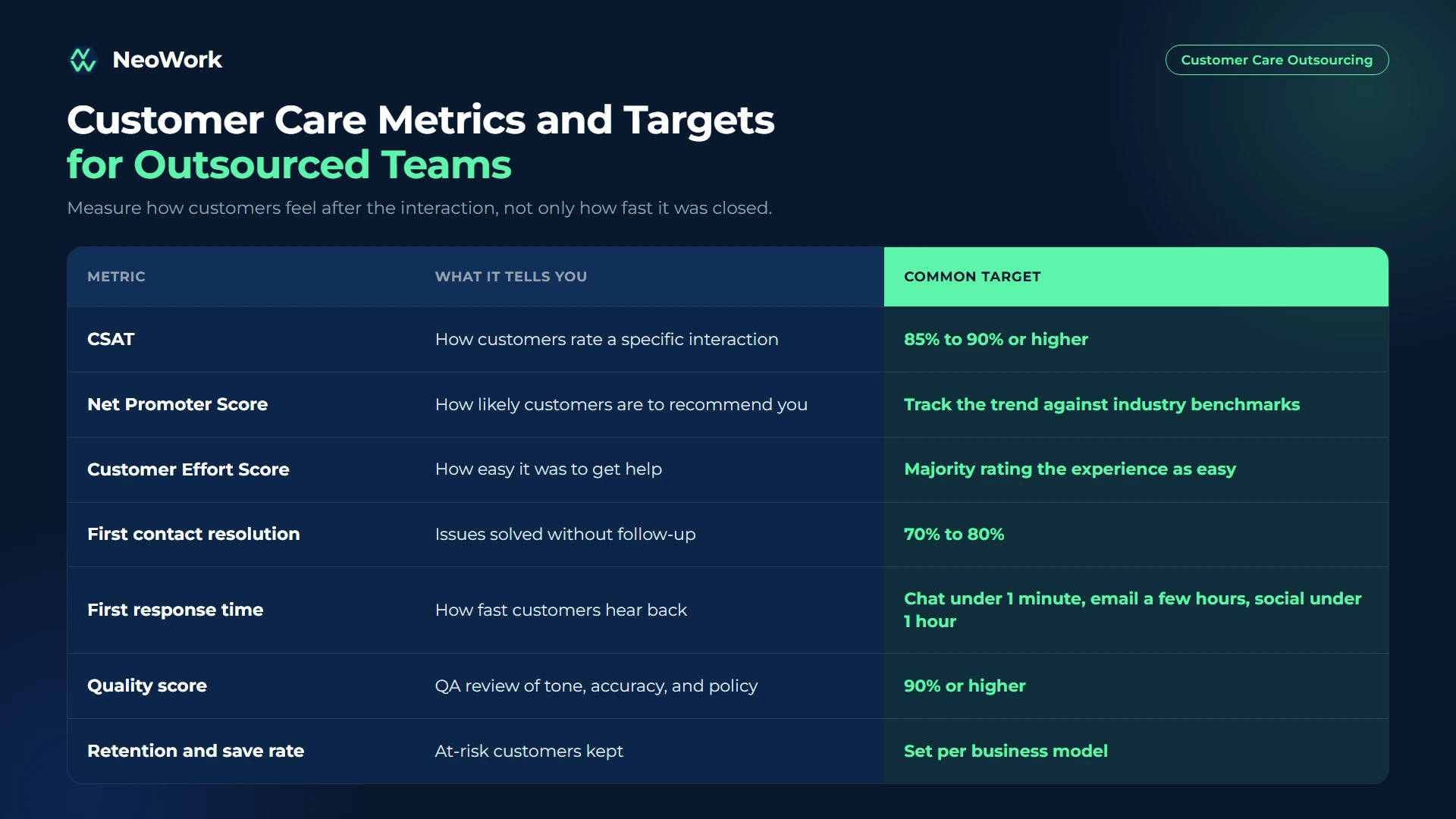
Customer Care Metrics That Matter

Metric What It Tells You Common Target
Customer satisfaction (CSAT) How customers rate a specific interaction 85% to 90% or higher
Net Promoter Score (NPS) How likely customers are to recommend you overall Track trend; compare with industry benchmarks
Customer Effort Score (CES) How easy it was to get help Majority rating the experience as easy
First contact resolution Share of issues solved without follow-up 70% to 80%
First response time How fast customers hear back Under 1 minute for chat, a few hours for email, under 1 hour for social
Quality score QA review of tone, accuracy, and policy 90% or higher
Retention and save rate Share of at-risk customers kept Set per business model
Customer care outsourcing metrics chart showing CSAT, NPS, customer effort score, first contact resolution, response time, quality score, and retention targets

How to Outsource Customer Care Step by Step

  1. Map your customer journey. List where customers reach out, why, and how often. Tag contact reasons if you have not already.
  2. Define what great care looks like. Write your service standards, tone guide, and the decisions agents can make on their own.
  3. Choose what to outsource first. Start with high-volume, well-documented contact types or a single channel.
  4. Select a partner. Look for experience with brands like yours, dedicated staffing, low attrition, and references.
  5. Train for context. Go beyond scripts: product demos, customer personas, and real conversations from your history.
  6. Pilot and calibrate. Review conversations daily in the first weeks and align quality scoring with the partner.
  7. Close the feedback loop. Use contact reasons and customer feedback from the care team to fix product, policy, and website issues.

Questions Worth Asking Any Partner

  • How do you hire for empathy and communication skills?
  • Will our agents be dedicated to our brand?
  • How do you train agents on tone of voice and keep it consistent?
  • What decisions can agents make without escalation?
  • How do you share customer feedback and contact trends with us?
  • What is your agent retention rate?

Common Customer Care Outsourcing Mistakes

  • Outsourcing to cut costs only. Care chosen purely on price tends to feel scripted, and customers notice.
  • Scripts instead of judgment. Rigid scripts make conversations robotic. Give principles, examples, and clear limits instead.
  • No escalation path for upset customers. Frustrated or high-value customers need a fast route to someone who can make exceptions.
  • Ignoring what the care team hears. Contact reasons are free product research. Not acting on them keeps contact volume high.
  • Treating the partner as a vendor. Teams that are excluded from company updates cannot speak confidently for the brand.

Final Thoughts

Customer care outsourcing works when the partner is chosen for how well they look after customers as well as for price. Invest in a clear tone guide, give agents the context and authority to solve problems, and measure satisfaction, effort, and retention alongside speed.

Handled that way, an outsourced care team becomes an extension of your brand that customers trust. If that is the kind of team you want, see how we work with growing companies at NeoWork.

FAQ

What is customer care outsourcing?

Customer care outsourcing is the practice of hiring an external team to manage customer conversations and relationships on your behalf across channels such as email, chat, phone, and social media, with a focus on satisfaction and loyalty.

Is customer care the same as customer service?

They overlap, but customer care is broader. Customer service focuses on answering requests, while customer care covers the whole relationship, including empathy, proactive communication, and retention.

Will customers know that care is outsourced?

Not if the team is dedicated to your brand, trained on your tone of voice, and works in your tools. Consistent quality reviews and shared context keep conversations indistinguishable from an in-house team.

How much does it cost to outsource customer care?

Pricing is usually per dedicated agent per month, per hour, or per interaction. Total cost depends on location, channels, languages, and coverage hours. Compare partners on cost per resolved conversation and satisfaction results, not just hourly rates.

Which channels can an outsourced care team cover?

Most partners cover email, live chat, phone, SMS, social media messages, and review responses. Many brands start with one or two channels and add more once quality is proven.

How do I measure an outsourced care team?

Track CSAT, first contact resolution, response times, and quality scores for daily performance, and NPS, customer effort, and retention for long-term impact.

What should stay in-house?

Policy decisions, high-level escalations, key accounts, and CX strategy usually stay in-house. Daily conversations, follow-ups, and routine requests are the best fit for outsourcing.

Topics

No items found.
Blue gradient banner with rounded corners at the top.
CTA Hexagon LeftCTA Hexagon LeftCTA Hexagon RightCTA Hexagon Right Mobile

Navigate the shadows of tech leadership – all while enjoying the comfort food that binds us all.

CTA Hexagon LeftCTA Hexagon LeftCTA Hexagon RightCTA Hexagon Right Mobile

Book a consultation

Build your team with NeoWork

Talk to us about how we staff and manage high-performing remote teams for companies like yours.