


Updated:
Oct 30
2026





Quick Summary: Cyber security staff augmentation is when an organization adds external security professionals (SOC analysts, incident responders, cloud security engineers, penetration testers, GRC analysts, and more) to its own security team, working under its own leadership and inside its own tools. It closes skill gaps faster than hiring and keeps control in-house, unlike a fully managed security service. The need is real: the 2025 ISC2 Cybersecurity Workforce Study found that 95% of security teams have at least one skills gap, 59% describe their gaps as critical or significant, and 88% have experienced at least one significant security consequence because of a skills shortage. This guide covers which roles to augment, how it compares with MSSPs and MDR, how to vet and secure augmented staff, what it costs, and how to onboard them safely.
Security teams rarely have the people they need. Alerts pile up in the SIEM, cloud environments grow faster than anyone can review them, audit deadlines arrive with half the evidence missing, and every new AI or SaaS tool adds another attack surface. Hiring experienced security professionals is slow and expensive, and the skills you need this quarter may be different from the ones you needed last year.
Staff augmentation lets you add specific security skills on demand while keeping decisions, data, and accountability inside your organization. This guide explains how to do it without creating new risks.
Cyber security staff augmentation is a model in which a provider supplies individual security professionals who join your security team on a full-time or part-time basis. They work under your CISO or security manager, follow your policies and runbooks, and use your security stack. The provider handles recruiting, employment, and benefits.
It differs from outsourced security services in one important way: you keep control. A managed security service provider (MSSP) or managed detection and response (MDR) vendor runs a service on your behalf using its own processes and tools. Augmented staff become part of your team and work the way your team works.
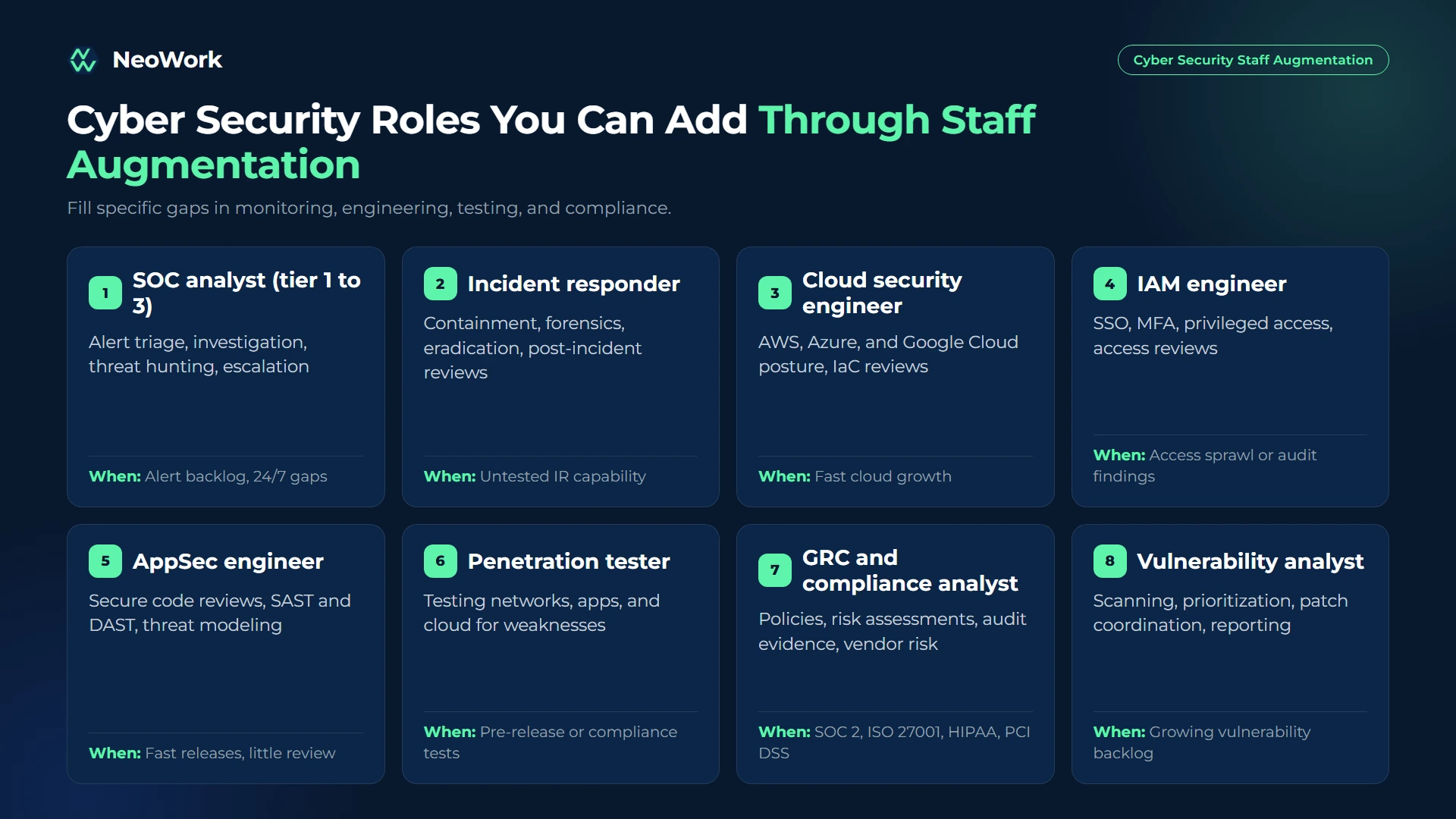

At NeoWork, we help companies add dedicated technical specialists who work inside their tools and processes as part of their team. For security and IT operations, that means vetted people who follow your policies, work your queues, and report to your leaders, while we handle recruiting, onboarding, benefits, and ongoing teammate support.
Our model includes:
Contact us to tell us which skills your security team is missing. We will outline the profiles and timeline that fit.
Many organizations combine models: an MDR service for round-the-clock detection, augmented engineers for cloud security and IAM projects, and in-house leadership owning strategy and risk.
Start with certifications that match the role, because they provide a common baseline. Security+ or CySA+ are typical for analysts, OSCP is a strong signal for penetration testers, cloud provider security certifications suit cloud engineers, and CISSP or CISM are expected for senior and GRC roles. Certifications alone, however, say little about how someone performs during a real incident at two in the morning.
Practical assessments tell you much more. Ask analysts to triage a set of sample alerts and explain their reasoning. Ask cloud engineers to review a real-looking configuration and identify the riskiest issues. Ask penetration testers to walk through a past engagement, including how they reported findings to people who were not security experts. Confirm hands-on experience with your specific SIEM, EDR, cloud security, and ticketing tools, since every platform has its own quirks.
Because these roles involve privileged access, thorough background screening is essential, and some industries require additional checks. Finally, pay attention to communication under pressure. Incident work requires clear, calm reporting to both technical teams and executives, and that skill is as important as technical depth.
Augmented security staff often need privileged access. Treat their access with the same discipline you apply to your own team:
Cost depends on role, seniority, certifications, required clearances, coverage hours, and location. Senior incident responders, penetration testers, and cloud security architects cost more than tier 1 analysts. Common pricing models:
Compare the total cost with the time and expense of hiring the same skills internally, and with the risk of leaving the gap open. See how we structure dedicated roles on our pricing page.
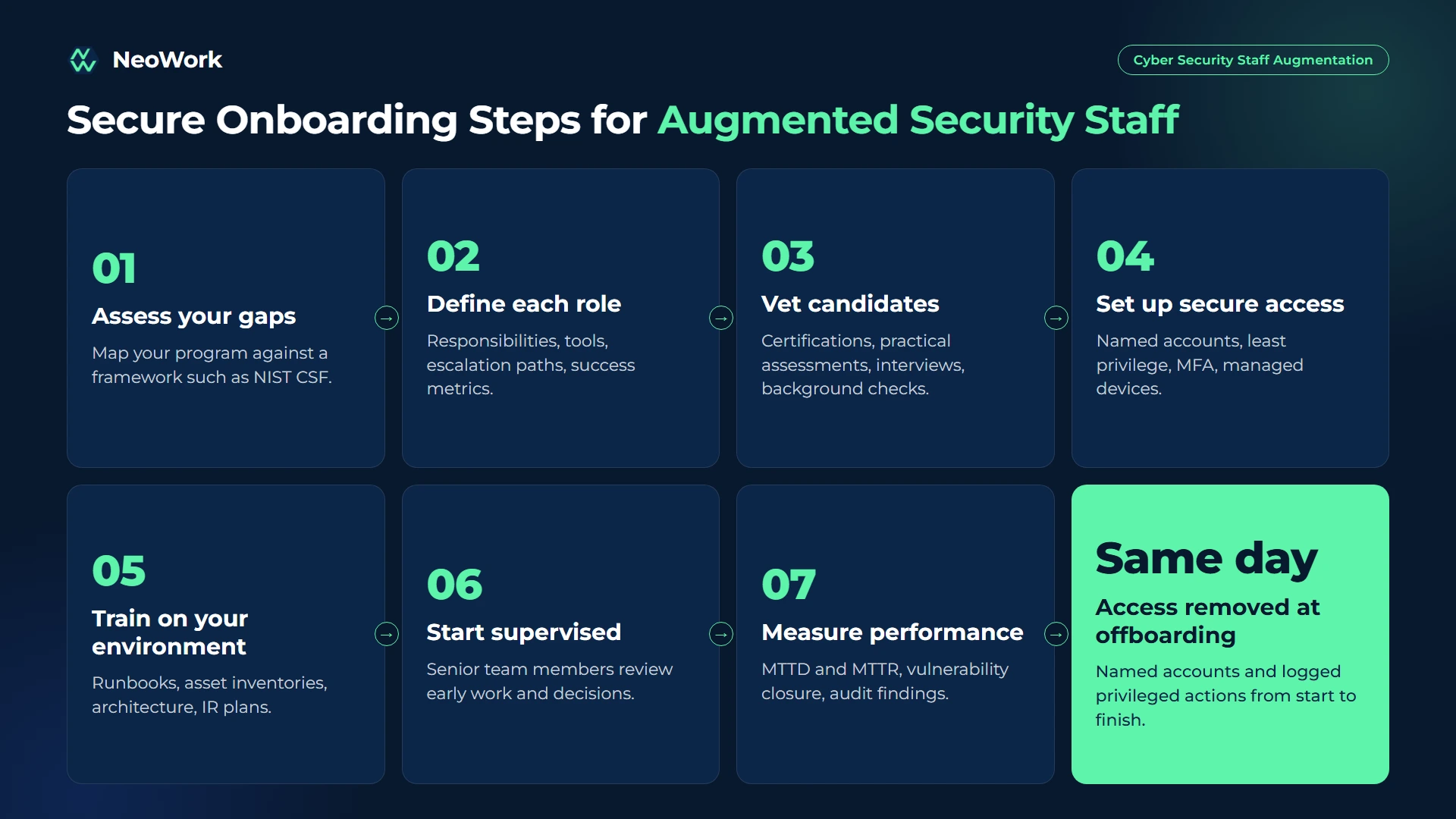
The most serious mistake is granting shared or excessive access. Augmented staff should never use shared admin accounts or keep standing privileged access they do not need, and any security team that allows this is creating exactly the kind of risk it exists to prevent.
A second mistake is bringing in augmented analysts without runbooks. Without documented procedures, they either escalate everything, which overwhelms senior staff, or handle incidents inconsistently, which creates gaps. A related problem is treating augmentation as a strategy. Augmented staff fill gaps and add capacity, but strategy, risk ownership, and accountability must stay with internal leaders.
Finally, knowledge transfer is often an afterthought. Findings, configuration changes, and lessons learned should be documented continuously so that the knowledge remains when an engagement ends. And as with any technical role, hiring on certifications alone tends to disappoint; practical assessments are what separate capable practitioners from good test-takers.
Cyber security staff augmentation is one of the most practical answers to a skills shortage that is not going away. It works best when internal leaders own the strategy, roles are clearly defined, candidates are vetted thoroughly, and access is controlled tightly. Combined with the right managed services, it gives you the coverage and expertise of a much larger team.
If you need to add technical specialists to your security or IT operations, explore our technical support engineers and IT teams at NeoWork.

Quick Summary: Cyber security staff augmentation is when an organization adds external security professionals (SOC analysts, incident responders, cloud security engineers, penetration testers, GRC analysts, and more) to its own security team, working under its own leadership and inside its own tools. It closes skill gaps faster than hiring and keeps control in-house, unlike a fully managed security service. The need is real: the 2025 ISC2 Cybersecurity Workforce Study found that 95% of security teams have at least one skills gap, 59% describe their gaps as critical or significant, and 88% have experienced at least one significant security consequence because of a skills shortage. This guide covers which roles to augment, how it compares with MSSPs and MDR, how to vet and secure augmented staff, what it costs, and how to onboard them safely.
Security teams rarely have the people they need. Alerts pile up in the SIEM, cloud environments grow faster than anyone can review them, audit deadlines arrive with half the evidence missing, and every new AI or SaaS tool adds another attack surface. Hiring experienced security professionals is slow and expensive, and the skills you need this quarter may be different from the ones you needed last year.
Staff augmentation lets you add specific security skills on demand while keeping decisions, data, and accountability inside your organization. This guide explains how to do it without creating new risks.
Cyber security staff augmentation is a model in which a provider supplies individual security professionals who join your security team on a full-time or part-time basis. They work under your CISO or security manager, follow your policies and runbooks, and use your security stack. The provider handles recruiting, employment, and benefits.
It differs from outsourced security services in one important way: you keep control. A managed security service provider (MSSP) or managed detection and response (MDR) vendor runs a service on your behalf using its own processes and tools. Augmented staff become part of your team and work the way your team works.
At NeoWork, we help companies add dedicated technical specialists who work inside their tools and processes as part of their team. For security and IT operations, that means vetted people who follow your policies, work your queues, and report to your leaders, while we handle recruiting, onboarding, benefits, and ongoing teammate support.
Our model includes:
Contact us to tell us which skills your security team is missing. We will outline the profiles and timeline that fit.
Many organizations combine models: an MDR service for round-the-clock detection, augmented engineers for cloud security and IAM projects, and in-house leadership owning strategy and risk.
Start with certifications that match the role, because they provide a common baseline. Security+ or CySA+ are typical for analysts, OSCP is a strong signal for penetration testers, cloud provider security certifications suit cloud engineers, and CISSP or CISM are expected for senior and GRC roles. Certifications alone, however, say little about how someone performs during a real incident at two in the morning.
Practical assessments tell you much more. Ask analysts to triage a set of sample alerts and explain their reasoning. Ask cloud engineers to review a real-looking configuration and identify the riskiest issues. Ask penetration testers to walk through a past engagement, including how they reported findings to people who were not security experts. Confirm hands-on experience with your specific SIEM, EDR, cloud security, and ticketing tools, since every platform has its own quirks.
Because these roles involve privileged access, thorough background screening is essential, and some industries require additional checks. Finally, pay attention to communication under pressure. Incident work requires clear, calm reporting to both technical teams and executives, and that skill is as important as technical depth.
Augmented security staff often need privileged access. Treat their access with the same discipline you apply to your own team:
Cost depends on role, seniority, certifications, required clearances, coverage hours, and location. Senior incident responders, penetration testers, and cloud security architects cost more than tier 1 analysts. Common pricing models:
Compare the total cost with the time and expense of hiring the same skills internally, and with the risk of leaving the gap open. See how we structure dedicated roles on our pricing page.
The most serious mistake is granting shared or excessive access. Augmented staff should never use shared admin accounts or keep standing privileged access they do not need, and any security team that allows this is creating exactly the kind of risk it exists to prevent.
A second mistake is bringing in augmented analysts without runbooks. Without documented procedures, they either escalate everything, which overwhelms senior staff, or handle incidents inconsistently, which creates gaps. A related problem is treating augmentation as a strategy. Augmented staff fill gaps and add capacity, but strategy, risk ownership, and accountability must stay with internal leaders.
Finally, knowledge transfer is often an afterthought. Findings, configuration changes, and lessons learned should be documented continuously so that the knowledge remains when an engagement ends. And as with any technical role, hiring on certifications alone tends to disappoint; practical assessments are what separate capable practitioners from good test-takers.
Cyber security staff augmentation is one of the most practical answers to a skills shortage that is not going away. It works best when internal leaders own the strategy, roles are clearly defined, candidates are vetted thoroughly, and access is controlled tightly. Combined with the right managed services, it gives you the coverage and expertise of a much larger team.
If you need to add technical specialists to your security or IT operations, explore our technical support engineers and IT teams at NeoWork.





