

.avif)
.avif)

Data Entry Outsourcing Guide: Cut Costs and Errors in 2026


.svg)

Quick Summary: Data entry outsourcing means handing repetitive data-related tasks — entry, cleaning, validation, digitization — to a specialized external team so internal staff can focus on higher-value work. Done right, it typically lowers labor costs, speeds up turnaround, and reduces errors through dedicated quality checks. The key to success is picking the right partner, defining a clear pricing model, and putting security and communication safeguards in place before the first file ever changes hands.
Somewhere in almost every company, someone is retyping numbers from a scanned invoice into a spreadsheet. It's tedious, it's slow, and it's exactly the kind of task that quietly eats hours nobody budgeted for. That's the gap data entry outsourcing was built to close.
This guide walks through what data entry outsourcing actually involves, when it makes sense, how to choose a provider, and what tends to go wrong when businesses skip the planning stage. No fluff — just the practical stuff decision-makers actually need before signing a contract.
What Is Data Entry Outsourcing?
Data entry outsourcing is the practice of contracting an outside company or freelance team to handle data-related tasks that would otherwise sit on an internal employee's desk. That can mean typing information from paper forms into a database, transcribing audio, cleaning up messy spreadsheets, or converting scanned documents into searchable, structured records.
It's not just about typing faster. A good outsourcing partner brings process — quality checks, version control, and workflows built specifically around volume data handling. Internal teams rarely have the bandwidth to build that infrastructure just for a task that isn't their core business.

Why Businesses Outsource Data Entry
The reasons companies outsource tend to cluster around three things: money, time, and accuracy. Here's how each one plays out in practice.
Cost Savings
Hiring, training, and retaining full-time data entry staff carries overhead that goes well beyond salary — benefits, office space, software licenses, management time. Outsourcing converts that fixed cost into a variable one, scaling up or down as workload changes.
Time Savings
Freeing internal staff from repetitive entry work lets them focus on analysis, customer service, or strategy — the tasks that actually require their expertise. A specialized team, meanwhile, can usually process high volumes faster simply because it's what they do all day.
Accuracy and Scalability
Reputable outsourcing providers build error-checking into their workflow — double-entry verification, automated validation rules, and dedicated QA reviewers. That structure is hard to replicate with a small in-house team juggling multiple responsibilities. And when volume spikes (say, during tax season or a product launch), an outsourced team can scale headcount far faster than an internal hiring process ever could.
Types of Data Entry Services You Can Outsource
Not every provider covers every service, so it helps to know the landscape before shopping around.
- Document data entry: converting invoices, forms, or contracts into digital records.
- Online/offline data entry: populating databases, CRMs, or web catalogs.
- Data cleaning and deduplication: fixing inconsistent formatting, removing duplicate records.
- Data mining and web research: pulling structured information from public sources.
- Image and PDF-to-text conversion: OCR-assisted digitization of scanned material.
- Catalog and product data entry: updating e-commerce listings, pricing, and inventory fields.

Organize Data Entry Work with NeoWork
Data entry outsourcing helps companies manage recurring information updates, records processing, document handling, and administrative workflows. NeoWork provides remote teammates who can support structured data entry tasks within the client’s existing systems and processes. NeoWork handles recruitment, benefits, training, and ongoing engagement, while teammates follow the client’s tools, procedures, and quality requirements. Its 91% annualized teammate retention rate and 3.2% candidate selectivity rate reflect a focus on selective hiring and longer-term team stability.
NeoWork's data entry outsourcing model offers:
- data entry and records support
- integration with the client’s tools and processes
- recruitment and ongoing teammate support
Contact NeoWork to add data entry support for recurring operational work.
Step-by-Step Process to Outsource Data Entry Successfully
- Define the scope: what data, what format, what volume, what deadline.
- Shortlist 3–5 providers based on relevant experience and reviews.
- Request a paid trial batch — never judge quality from a sales pitch alone.
- Sign an NDA and confirm security measures before sharing real data.
- Set a communication schedule and a clear escalation path for errors.
- Review the pilot output against agreed accuracy benchmarks.
- Scale the engagement once quality and turnaround meet expectations.
How to Choose a Data Entry Outsourcing Partner
This is where most projects succeed or fail. A cheap vendor with sloppy quality control ends up costing more once someone has to fix the errors.
Experience and Domain Expertise
Medical records, legal documents, and financial data all carry different formatting rules and compliance requirements. A provider with relevant industry experience needs far less hand-holding.
Data Security and Compliance
Ask directly about encryption standards, access controls, and how the provider handles regulations relevant to the data type — HIPAA for healthcare records, GDPR for EU customer data, and so on. Get this in writing before sharing a single file.
Pricing Models
Providers typically price work one of three ways, and each suits a different kind of project.
Common Challenges and How to Avoid Them
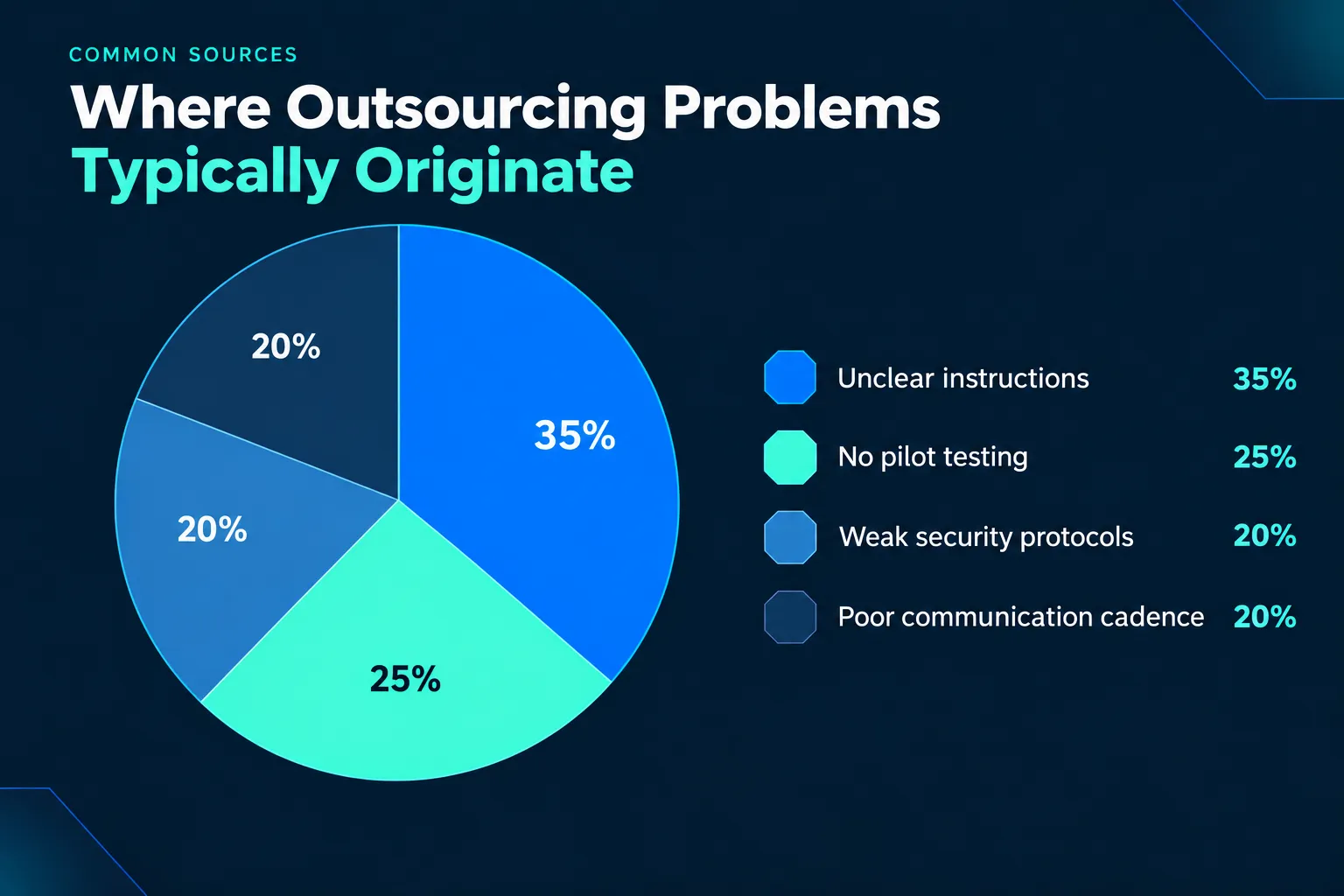
Outsourcing data entry isn't risk-free. Most problems trace back to a handful of recurring issues rather than anything exotic.
- Unclear instructions: ambiguous formatting rules lead to inconsistent output. Fix this with a detailed style guide and sample files upfront.
- Weak security practices: sensitive data sent without NDAs or encrypted channels is a real exposure. Insist on documented security protocols.
- No pilot phase: committing to a large contract before testing quality on a small batch is a common — and avoidable — mistake.
- Poor version control: without a clear system, teams end up working from outdated files. Shared, version-tracked platforms solve this.
Security and Compliance Considerations
Data entry often involves sensitive information, including customer records, financial figures, employee details, and medical data. Before signing a contract, confirm how the provider stores files, transfers data, and limits access to authorized staff.
Ask whether the provider uses encryption, role-based access controls, secure file-sharing systems, and activity logs. It is also important to understand whether subcontractors will handle any part of the work and what security standards apply to them.
The contract should explain how long data is retained, when files are deleted, and how information is returned or transferred when the project ends. It should also define breach notification procedures and the provider's responsibilities if data is exposed.
Reputable vendors should be willing to share security certifications, audit reports, data-retention policies, and compliance documentation. Hesitation, vague answers, or an unwillingness to put these commitments in writing should be treated as a serious warning sign.
What Does Data Entry Outsourcing Cost?
Pricing varies widely based on task complexity, data volume, and the provider's location.
Simple, High-Volume Work
Basic data entry with clear rules and large volumes usually sits at the lower end of per-record or hourly pricing.
Specialized Data Entry
Work such as medical coding, legal transcription, or financial data processing usually costs more because it requires industry knowledge, stricter quality controls, and added compliance measures.
Provider Location
Offshore providers often charge less than nearshore or onshore teams, but differences in communication, time zones, and oversight can affect the total cost.
Compare Itemized Quotes
Rather than relying on a fixed estimate, request detailed quotes from several providers. Compare setup fees, minimum volumes, quality checks, turnaround times, and any extra charges alongside the base rate. Check each vendor's official pricing page for current rates before budgeting.
The Role of AI and Automation
Automation tools — OCR, intelligent document processing, and validation scripts — now handle a growing share of the grunt work that used to require manual typing. But raw automation still struggles with messy handwriting, inconsistent formats, and judgment calls. That's exactly why most outsourcing providers now pair automated pre-processing with human review rather than replacing people outright. The combination tends to produce better accuracy than either approach alone.
Final Thoughts
Data entry outsourcing isn't a magic fix, but it's one of the more reliably effective ways to reclaim internal time and reduce error rates on repetitive work. The businesses that get the most out of it treat vendor selection seriously — running pilots, checking security practices, and setting clear expectations before scaling up.
Start small. Pick one repetitive, well-defined task, test a provider on a limited batch, and measure the results against what it was costing internally. From there, scaling the relationship is a far easier decision to make.
FAQ: Data Entry Outsourcing
Topics
Data Entry Outsourcing Guide: Cut Costs and Errors in 2026

Quick Summary: Data entry outsourcing means handing repetitive data-related tasks — entry, cleaning, validation, digitization — to a specialized external team so internal staff can focus on higher-value work. Done right, it typically lowers labor costs, speeds up turnaround, and reduces errors through dedicated quality checks. The key to success is picking the right partner, defining a clear pricing model, and putting security and communication safeguards in place before the first file ever changes hands.
Somewhere in almost every company, someone is retyping numbers from a scanned invoice into a spreadsheet. It's tedious, it's slow, and it's exactly the kind of task that quietly eats hours nobody budgeted for. That's the gap data entry outsourcing was built to close.
This guide walks through what data entry outsourcing actually involves, when it makes sense, how to choose a provider, and what tends to go wrong when businesses skip the planning stage. No fluff — just the practical stuff decision-makers actually need before signing a contract.
What Is Data Entry Outsourcing?
Data entry outsourcing is the practice of contracting an outside company or freelance team to handle data-related tasks that would otherwise sit on an internal employee's desk. That can mean typing information from paper forms into a database, transcribing audio, cleaning up messy spreadsheets, or converting scanned documents into searchable, structured records.
It's not just about typing faster. A good outsourcing partner brings process — quality checks, version control, and workflows built specifically around volume data handling. Internal teams rarely have the bandwidth to build that infrastructure just for a task that isn't their core business.
Why Businesses Outsource Data Entry
The reasons companies outsource tend to cluster around three things: money, time, and accuracy. Here's how each one plays out in practice.
Cost Savings
Hiring, training, and retaining full-time data entry staff carries overhead that goes well beyond salary — benefits, office space, software licenses, management time. Outsourcing converts that fixed cost into a variable one, scaling up or down as workload changes.
Time Savings
Freeing internal staff from repetitive entry work lets them focus on analysis, customer service, or strategy — the tasks that actually require their expertise. A specialized team, meanwhile, can usually process high volumes faster simply because it's what they do all day.
Accuracy and Scalability
Reputable outsourcing providers build error-checking into their workflow — double-entry verification, automated validation rules, and dedicated QA reviewers. That structure is hard to replicate with a small in-house team juggling multiple responsibilities. And when volume spikes (say, during tax season or a product launch), an outsourced team can scale headcount far faster than an internal hiring process ever could.
Types of Data Entry Services You Can Outsource
Not every provider covers every service, so it helps to know the landscape before shopping around.
- Document data entry: converting invoices, forms, or contracts into digital records.
- Online/offline data entry: populating databases, CRMs, or web catalogs.
- Data cleaning and deduplication: fixing inconsistent formatting, removing duplicate records.
- Data mining and web research: pulling structured information from public sources.
- Image and PDF-to-text conversion: OCR-assisted digitization of scanned material.
- Catalog and product data entry: updating e-commerce listings, pricing, and inventory fields.
Organize Data Entry Work with NeoWork
Data entry outsourcing helps companies manage recurring information updates, records processing, document handling, and administrative workflows. NeoWork provides remote teammates who can support structured data entry tasks within the client’s existing systems and processes. NeoWork handles recruitment, benefits, training, and ongoing engagement, while teammates follow the client’s tools, procedures, and quality requirements. Its 91% annualized teammate retention rate and 3.2% candidate selectivity rate reflect a focus on selective hiring and longer-term team stability.
NeoWork's data entry outsourcing model offers:
- data entry and records support
- integration with the client’s tools and processes
- recruitment and ongoing teammate support
Contact NeoWork to add data entry support for recurring operational work.
Step-by-Step Process to Outsource Data Entry Successfully
- Define the scope: what data, what format, what volume, what deadline.
- Shortlist 3–5 providers based on relevant experience and reviews.
- Request a paid trial batch — never judge quality from a sales pitch alone.
- Sign an NDA and confirm security measures before sharing real data.
- Set a communication schedule and a clear escalation path for errors.
- Review the pilot output against agreed accuracy benchmarks.
- Scale the engagement once quality and turnaround meet expectations.
How to Choose a Data Entry Outsourcing Partner
This is where most projects succeed or fail. A cheap vendor with sloppy quality control ends up costing more once someone has to fix the errors.
Experience and Domain Expertise
Medical records, legal documents, and financial data all carry different formatting rules and compliance requirements. A provider with relevant industry experience needs far less hand-holding.
Data Security and Compliance
Ask directly about encryption standards, access controls, and how the provider handles regulations relevant to the data type — HIPAA for healthcare records, GDPR for EU customer data, and so on. Get this in writing before sharing a single file.
Pricing Models
Providers typically price work one of three ways, and each suits a different kind of project.
Common Challenges and How to Avoid Them
Outsourcing data entry isn't risk-free. Most problems trace back to a handful of recurring issues rather than anything exotic.
- Unclear instructions: ambiguous formatting rules lead to inconsistent output. Fix this with a detailed style guide and sample files upfront.
- Weak security practices: sensitive data sent without NDAs or encrypted channels is a real exposure. Insist on documented security protocols.
- No pilot phase: committing to a large contract before testing quality on a small batch is a common — and avoidable — mistake.
- Poor version control: without a clear system, teams end up working from outdated files. Shared, version-tracked platforms solve this.
Security and Compliance Considerations
Data entry often involves sensitive information, including customer records, financial figures, employee details, and medical data. Before signing a contract, confirm how the provider stores files, transfers data, and limits access to authorized staff.
Ask whether the provider uses encryption, role-based access controls, secure file-sharing systems, and activity logs. It is also important to understand whether subcontractors will handle any part of the work and what security standards apply to them.
The contract should explain how long data is retained, when files are deleted, and how information is returned or transferred when the project ends. It should also define breach notification procedures and the provider's responsibilities if data is exposed.
Reputable vendors should be willing to share security certifications, audit reports, data-retention policies, and compliance documentation. Hesitation, vague answers, or an unwillingness to put these commitments in writing should be treated as a serious warning sign.
What Does Data Entry Outsourcing Cost?
Pricing varies widely based on task complexity, data volume, and the provider's location.
Simple, High-Volume Work
Basic data entry with clear rules and large volumes usually sits at the lower end of per-record or hourly pricing.
Specialized Data Entry
Work such as medical coding, legal transcription, or financial data processing usually costs more because it requires industry knowledge, stricter quality controls, and added compliance measures.
Provider Location
Offshore providers often charge less than nearshore or onshore teams, but differences in communication, time zones, and oversight can affect the total cost.
Compare Itemized Quotes
Rather than relying on a fixed estimate, request detailed quotes from several providers. Compare setup fees, minimum volumes, quality checks, turnaround times, and any extra charges alongside the base rate. Check each vendor's official pricing page for current rates before budgeting.
The Role of AI and Automation
Automation tools — OCR, intelligent document processing, and validation scripts — now handle a growing share of the grunt work that used to require manual typing. But raw automation still struggles with messy handwriting, inconsistent formats, and judgment calls. That's exactly why most outsourcing providers now pair automated pre-processing with human review rather than replacing people outright. The combination tends to produce better accuracy than either approach alone.
Final Thoughts
Data entry outsourcing isn't a magic fix, but it's one of the more reliably effective ways to reclaim internal time and reduce error rates on repetitive work. The businesses that get the most out of it treat vendor selection seriously — running pilots, checking security practices, and setting clear expectations before scaling up.
Start small. Pick one repetitive, well-defined task, test a provider on a limited batch, and measure the results against what it was costing internally. From there, scaling the relationship is a far easier decision to make.
FAQ: Data Entry Outsourcing
Topics
Related Blogs
Related Podcasts


.webp)

.webp)
.webp)



