

.avif)
.avif)

Data Science Outsourcing Guide: Benefits & Risks 2026


.svg)

Data science outsourcing connects businesses with external experts to handle analytics, machine learning, and data infrastructure projects. This approach can reduce costs by 40-60% while accessing specialized talent, but requires careful partner selection and clear communication protocols to succeed.
Data drives every competitive advantage today. According to McKinsey research, retailers using data analytics to their full potential could increase their operating margins by more than 60%. But here's the problem: building an in-house data science team costs a fortune, and the talent shortage isn't getting any easier.
That's where outsourcing comes in. Companies now outsource everything from predictive analytics to machine learning model development. The U.S. Bureau of Labor Statistics projects that the health care and social assistance sector will be the fastest growing industry sector through 2033.
This guide breaks down how data science outsourcing works, what it costs, and how to avoid the mistakes that sink most partnerships.
What Is Data Science Outsourcing?
Data science outsourcing means hiring external specialists—either individuals or teams—to handle your analytics, machine learning, or data infrastructure projects. Instead of recruiting full-time employees, companies partner with offshore or nearshore service providers who deliver specific capabilities.
The scope varies wildly. Some businesses outsource narrow tasks like data cleaning or visualization. Others hand off entire analytics departments to external partners who manage everything from data engineering pipelines to predictive model deployment.
Common outsourced services include:
- Data engineering and pipeline development
- Predictive modeling and machine learning
- Business intelligence and dashboard creation
- Data warehousing and architecture design
- Natural language processing projects
- Computer vision applications
- Statistical analysis and A/B testing
- Consulting and data strategy development
The MIT Sloan Management Review points out that analytics outsourcing requires a carefully constructed relationship. It's not just about sending tasks overseas and waiting for results.
How Data Science Outsourcing Works
The process typically follows a predictable pattern, though details vary based on project complexity and partner capabilities.
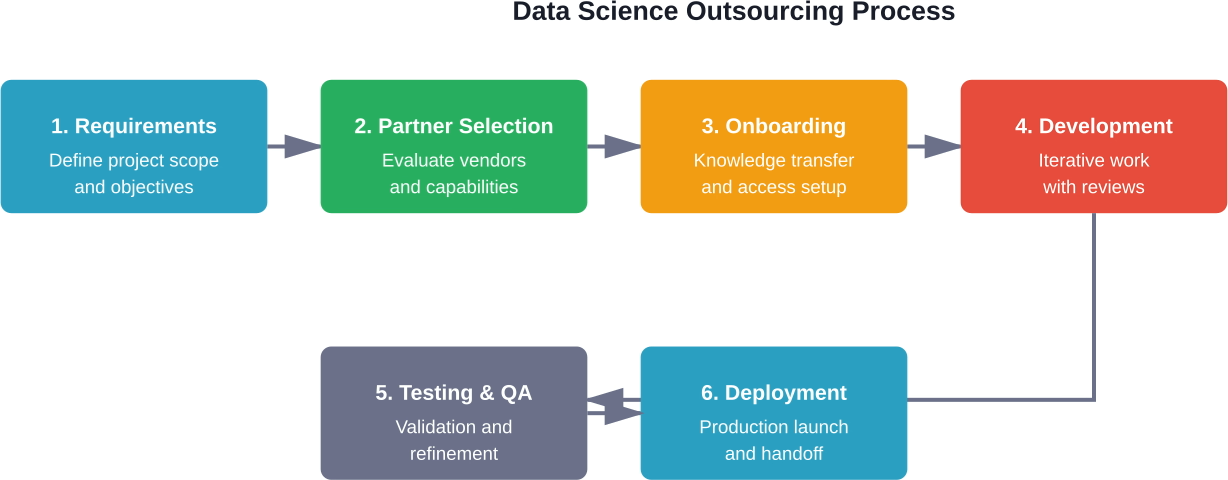
Requirements Definition
Everything starts with clarity. What problems need solving? What data exists? What outcomes matter?
Vague requirements kill outsourcing projects. The partner needs to understand business context, technical constraints, and success metrics before any work begins.
Partner Selection and Contracting
This stage determines whether the project succeeds or fails. Companies evaluate potential partners based on technical expertise, industry experience, communication capabilities, and cost structure.
Smart organizations run small pilot projects before committing to large engagements. A two-week trial reveals more about partner quality than any amount of sales presentations.
Knowledge Transfer and Setup
The outsourced team needs access to data systems, documentation, and subject matter experts. This phase often takes longer than expected because data environments are messier than internal teams admit.
Security protocols get established here too. Data access permissions, encryption standards, and compliance requirements all need agreement before development starts.
Development and Iteration
Work happens in sprints with regular check-ins. Weekly or bi-weekly reviews keep projects aligned with business needs as requirements inevitably evolve.
The best partnerships involve frequent communication. Time zone differences matter less than establishing clear communication protocols and documentation standards.
The Strategic Advantages of Outsourcing Data Science
Cost savings get all the attention, but they're not the only reason companies outsource analytics work.
Dramatic Cost Reduction
The numbers are compelling. According to data from outsourcing providers, companies can reduce costs by 40-60% compared to building in-house teams. That's not just salaries—it includes office space, equipment, benefits, and training costs.
Senior data scientists in developed markets command significantly higher salaries than offshore equivalents, with cost savings of 40-60% commonly reported.
Access to Specialized Expertise
Data science moves fast. New techniques, frameworks, and tools emerge constantly. Outsourcing partners who work across multiple clients stay current with industry best practices in ways that internal teams often can't.
Need computer vision expertise for a six-month project? Hiring a full-time specialist makes no sense. Outsourcing provides exactly the expertise needed, exactly when it's needed.
Scalability and Flexibility
Projects don't run at constant intensity. Requirements spike during new product launches or strategic initiatives, then drop during maintenance phases.
Outsourced teams scale up or down without the HR complications of hiring and layoffs. This flexibility matters especially for startups and mid-sized companies without large analytics departments.
Faster Time to Market
Recruiting data scientists takes months. Outsourcing partners often start within weeks. For time-sensitive projects, that speed advantage justifies higher hourly rates.
The U.S. Bureau of Labor Statistics projects employment in the professional, scientific, and technical services sector to grow by 1.1 million jobs through 2033, a growth rate of 0.6% annually, which is faster than the 0.3% average for all occupations.
The Risks and Challenges Nobody Talks About
Outsourcing isn't magic. It introduces complexity that sinks projects when handled poorly.
Quality Control Problems
Distance makes quality harder to assess. Community discussions frequently mention discovering that outsourced work needs significant rework after delivery.
Code might function but fail to follow best practices. Models might meet accuracy targets on paper but perform poorly in production. Documentation might technically exist but provide zero useful context.
Communication Barriers
Time zones create coordination headaches. Language differences—even when everyone speaks English—lead to misunderstandings about requirements and priorities.
The real challenge isn't language fluency. It's the cultural context that gets lost in translation. What "high priority" means, how to escalate problems, when to ask clarifying questions—these norms vary across cultures.
Data Security and Compliance
Sharing sensitive data with external partners introduces risk. Regulations like GDPR, HIPAA, and CCPA impose strict requirements on data handling that become harder to enforce across organizational boundaries.
Academic research on data outsourcing emphasizes the truthfulness-privacy trade-off inherent in sharing data with external processors. Technical solutions exist, but they add complexity.
Knowledge Drain
When external teams handle all analytics work, internal staff don't develop data science capabilities. The company becomes dependent on the outsourcing partner for insights that should inform core business decisions.
This dependency works fine until the partnership ends. Then companies discover they can't maintain or extend the systems built by external teams.
Hidden Costs
Lower hourly rates don't always mean lower total costs. Projects take longer when teams work across time zones and cultural boundaries. Management overhead increases. Rework multiplies.
The MIT Sloan Management Review research emphasizes that analytics outsourcing requires substantial management attention to succeed—attention that has opportunity costs.
Choosing the Right Data Science Partner
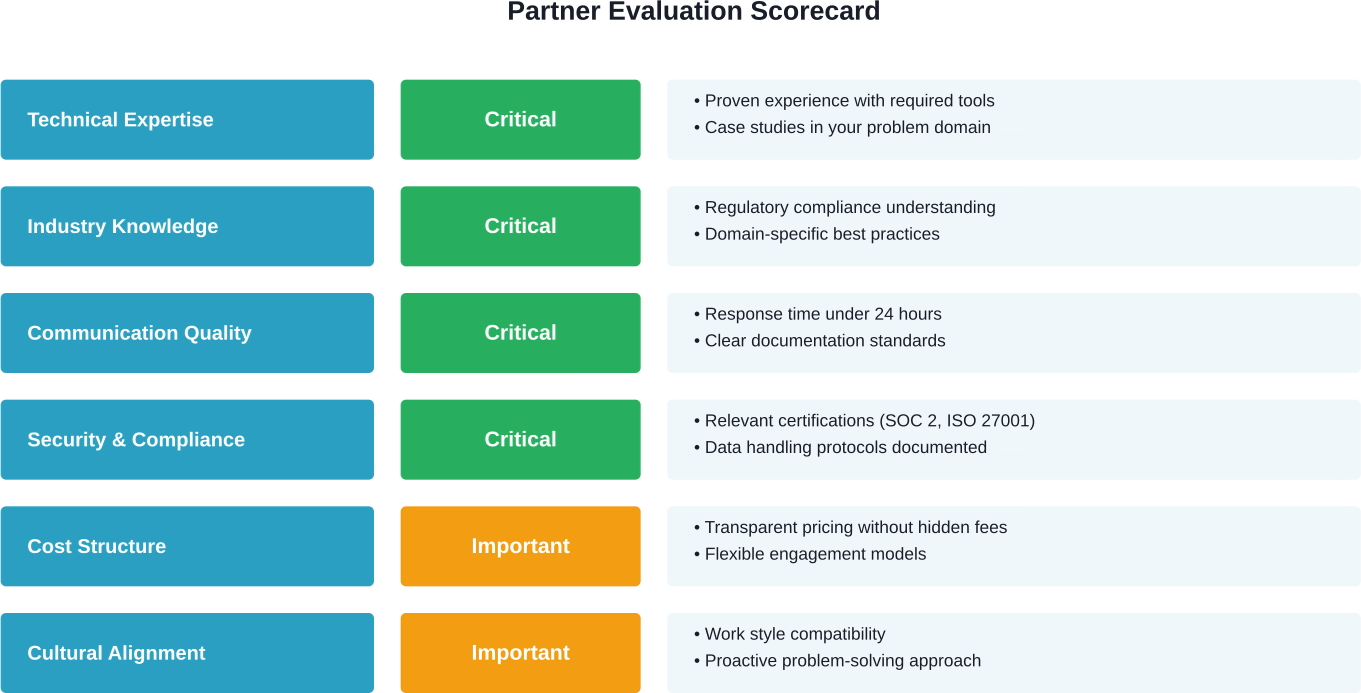
Partner selection determines outcomes more than any other factor. Companies that rush this decision pay for it later.
Technical Capabilities Assessment
Does the partner have proven expertise in the specific tools and techniques the project requires? Generic data science capabilities aren't enough. Look for demonstrated experience with the exact technology stack and problem domain.
Request case studies from similar projects. Ask about their approach to model validation, code quality, and documentation. Check which cloud platforms and analytics tools they're proficient with.
Industry Experience Matters
Healthcare analytics differs fundamentally from retail analytics or financial services. Domain knowledge affects everything from data preparation to model interpretation.
Partners with industry experience understand regulatory requirements, common data quality issues, and business context without lengthy explanations.
Communication Infrastructure
How does the partner handle project management? What tools do they use for collaboration? How quickly do they respond to questions?
Evaluate communication during the sales process. If they're slow or unclear before signing a contract, they won't improve afterward.
Security and Compliance Credentials
Verify certifications relevant to the industry. SOC 2, ISO 27001, and HIPAA compliance matter if handling sensitive data. Don't just check boxes—understand their actual security practices.
Ask how they handle data access, where they store information, and what happens to data after project completion.
Cultural Fit and Values
Technical skills matter, but cultural alignment determines day-to-day working relationships. Does the partner's communication style match organizational norms? Do they ask good questions? Do they push back when requirements don't make sense?
The best partners act as advisors, not just order-takers.
Hire Dedicated Data Science Support Through NeoWork

If you’ve tried outsourcing data science projects but keep running into turnover, delays, or uneven skill levels, NeoWork offers an alternative: vetted professionals embedded into your team long term. Instead of sourcing contractors one by one, you get remote specialists who work consistently within your data workflows.
NeoWork handles recruiting, vetting, onboarding, and ongoing staffing so you don’t have to manage multiple individual hires. Their approach emphasizes careful selection and continuity, with a 3.2% candidate selectivity rate and a 91% annualized teammate retention rate. That translates to data analysts and engineers who stay aligned with your models, tools, and long-term goals.
Book a call with NeoWork to map out dedicated data science support for your 2026 outsourcing plan.
Best Practices for Managing Outsourced Projects
Signing a contract doesn't guarantee success. Active management makes the difference between projects that deliver value and those that drain budgets.
Start Small, Then Scale
Never commit to a major project with an unproven partner. Run a small pilot—two to four weeks—that tests both technical capabilities and working relationship dynamics.
Pilots reveal problems before they become expensive. Communication issues, quality concerns, or misaligned expectations surface quickly in compressed timeframes.
Establish Clear Success Metrics
Define what "done" looks like before work begins. Model accuracy targets, performance benchmarks, code quality standards, and documentation requirements all need explicit agreement.
Vague objectives like "improve customer insights" lead to disappointment. Specific metrics like "predict churn with 85% accuracy" create accountability.
Create Communication Rhythms
Weekly status meetings maintain alignment. Daily async updates prevent surprises. Quarterly business reviews ensure strategic objectives stay on track.
But don't over-schedule. Too many meetings kill productivity. Find the minimum viable communication cadence that keeps everyone informed without constant interruptions.
Build Hybrid Teams
The most successful arrangements blend internal and external talent. Internal staff provide business context, domain expertise, and institutional knowledge. External specialists bring technical depth and fresh perspectives.
This hybrid model mitigates knowledge drain risks while maximizing flexibility. Internal team members learn from external experts, building long-term capability.
Implement Rigorous Code Review
All code should undergo review by internal technical staff or independent auditors. Check for security vulnerabilities, performance issues, and maintainability problems.
Community discussions emphasize that AI-generated or outsourced code often requires significant refinement. Plan for this in project timelines and budgets.
Document Everything
Require comprehensive documentation as a deliverable, not an afterthought. External teams should document data schemas, model architectures, deployment procedures, and troubleshooting guides.
Good documentation enables knowledge transfer and reduces dependence on specific individuals.
In-House vs. Outsourced: Making the Right Choice
Outsourcing isn't always the answer. Some situations favor building internal capabilities.
Strategic analytics that directly drive competitive advantage should generally stay in-house. When data science becomes a core competency—like at Amazon or Netflix—outsourcing makes less sense.
But most companies aren't data science businesses. For them, outsourcing provides access to capabilities they need occasionally without the overhead of permanent teams.
The AI Factor: How Automation Changes Outsourcing
Generative AI is reshaping data science work itself. According to U.S. Bureau of Labor Statistics analysis, AI primarily affects occupations whose core tasks can be replicated by current AI technology, though it may also increase demand for technical roles that develop and maintain AI systems.
Research from academic institutions shows that according to research, code generation with AI assistance can reduce development time significantly, with estimates suggesting code that takes 10 hours manually might be generated in 2-3 hours.
This changes the outsourcing equation. Simple data manipulation tasks that previously required human developers can now be automated. Outsourced teams increasingly focus on higher-value work: model architecture design, business problem translation, and complex system integration.
The skill mix shifts too. Partners need expertise in prompt engineering, AI system integration, and quality control for AI-generated outputs.
Regional Considerations: Where to Outsource
Geography affects cost, quality, and communication dynamics. Popular outsourcing destinations include India, Eastern Europe, Latin America, and Southeast Asia.
India offers the largest talent pool and lowest costs but faces communication challenges due to time zone differences with North America. Eastern Europe provides strong technical skills with better timezone overlap but higher rates. Latin America offers proximity to U.S. time zones with moderate costs.
Southeast Asian countries, particularly Vietnam, are recognized in the outsourcing industry as emerging data science hubs with growing technical capabilities and competitive pricing.
Location matters less than it used to. Remote collaboration tools make distributed work feasible regardless of geography. Focus on partner capabilities first, location second.
Common Mistakes That Kill Outsourcing Projects
Most failures follow predictable patterns. Avoid these mistakes:
Insufficient Requirements Definition
Vague project briefs guarantee disappointment. External teams can't read minds. If requirements are unclear internally, outsourcing won't fix that problem—it will amplify it.
Inadequate Data Preparation
Outsourced teams can't fix fundamentally broken data. If internal systems lack proper instrumentation, data quality is poor, or business logic is undocumented, address these issues before outsourcing.
As any data professional knows, data cleaning consumes the majority of project time. Expecting external teams to solve data quality problems that internal teams couldn't fix is unrealistic.
Price-Only Selection
Choosing the cheapest bid almost always backfires. Quality correlates with price in professional services. Rock-bottom rates signal inexperienced teams, poor quality control, or unsustainable business models.
Neglecting Change Management
Outsourcing affects internal teams. Employees worry about job security. Processes change. Resistance emerges. Without proper change management, even technically successful projects fail to deliver business value because nobody uses them.
Ignoring Time Zone Realities
Twelve-hour time differences don't disappear through wishful thinking. Either accept async communication patterns or select partners with significant overlap in working hours.
Final Thoughts on Data Science Outsourcing
Data science outsourcing works when approached strategically. The cost savings are real—40-60% reductions compared to in-house teams according to industry data. Access to specialized talent accelerates projects that would otherwise stall waiting for perfect internal hires.
But outsourcing isn't autopilot. It requires active management, clear requirements, and realistic expectations. The partnerships that succeed combine external technical depth with internal business context.
Start small. Run pilots before major commitments. Build hybrid teams that transfer knowledge while leveraging external expertise. Document everything. Establish clear metrics and communication rhythms.
The future points toward even more distributed work. As AI automates routine tasks, outsourced teams will focus on higher-value activities: strategic analysis, complex system design, and business problem solving.
Companies that master outsourcing relationships gain flexibility and capability without the overhead of large permanent teams. Those that treat it as a simple cost-cutting exercise usually end up disappointed.
The difference? Understanding that outsourcing isn't about eliminating the need for internal expertise—it's about strategically augmenting it.
Ready to explore data science outsourcing for your organization? Start by mapping which capabilities are truly strategic versus supporting. Identify specific projects where external expertise would accelerate progress. Then find partners who demonstrate not just technical skills, but genuine understanding of your industry and business challenges.
The right partnership transforms data from overwhelming complexity into competitive advantage.
Frequently Asked Questions
Topics
Data Science Outsourcing Guide: Benefits & Risks 2026

Data science outsourcing connects businesses with external experts to handle analytics, machine learning, and data infrastructure projects. This approach can reduce costs by 40-60% while accessing specialized talent, but requires careful partner selection and clear communication protocols to succeed.
Data drives every competitive advantage today. According to McKinsey research, retailers using data analytics to their full potential could increase their operating margins by more than 60%. But here's the problem: building an in-house data science team costs a fortune, and the talent shortage isn't getting any easier.
That's where outsourcing comes in. Companies now outsource everything from predictive analytics to machine learning model development. The U.S. Bureau of Labor Statistics projects that the health care and social assistance sector will be the fastest growing industry sector through 2033.
This guide breaks down how data science outsourcing works, what it costs, and how to avoid the mistakes that sink most partnerships.
What Is Data Science Outsourcing?
Data science outsourcing means hiring external specialists—either individuals or teams—to handle your analytics, machine learning, or data infrastructure projects. Instead of recruiting full-time employees, companies partner with offshore or nearshore service providers who deliver specific capabilities.
The scope varies wildly. Some businesses outsource narrow tasks like data cleaning or visualization. Others hand off entire analytics departments to external partners who manage everything from data engineering pipelines to predictive model deployment.
Common outsourced services include:
- Data engineering and pipeline development
- Predictive modeling and machine learning
- Business intelligence and dashboard creation
- Data warehousing and architecture design
- Natural language processing projects
- Computer vision applications
- Statistical analysis and A/B testing
- Consulting and data strategy development
The MIT Sloan Management Review points out that analytics outsourcing requires a carefully constructed relationship. It's not just about sending tasks overseas and waiting for results.
How Data Science Outsourcing Works
The process typically follows a predictable pattern, though details vary based on project complexity and partner capabilities.
Requirements Definition
Everything starts with clarity. What problems need solving? What data exists? What outcomes matter?
Vague requirements kill outsourcing projects. The partner needs to understand business context, technical constraints, and success metrics before any work begins.
Partner Selection and Contracting
This stage determines whether the project succeeds or fails. Companies evaluate potential partners based on technical expertise, industry experience, communication capabilities, and cost structure.
Smart organizations run small pilot projects before committing to large engagements. A two-week trial reveals more about partner quality than any amount of sales presentations.
Knowledge Transfer and Setup
The outsourced team needs access to data systems, documentation, and subject matter experts. This phase often takes longer than expected because data environments are messier than internal teams admit.
Security protocols get established here too. Data access permissions, encryption standards, and compliance requirements all need agreement before development starts.
Development and Iteration
Work happens in sprints with regular check-ins. Weekly or bi-weekly reviews keep projects aligned with business needs as requirements inevitably evolve.
The best partnerships involve frequent communication. Time zone differences matter less than establishing clear communication protocols and documentation standards.
The Strategic Advantages of Outsourcing Data Science
Cost savings get all the attention, but they're not the only reason companies outsource analytics work.
Dramatic Cost Reduction
The numbers are compelling. According to data from outsourcing providers, companies can reduce costs by 40-60% compared to building in-house teams. That's not just salaries—it includes office space, equipment, benefits, and training costs.
Senior data scientists in developed markets command significantly higher salaries than offshore equivalents, with cost savings of 40-60% commonly reported.
Access to Specialized Expertise
Data science moves fast. New techniques, frameworks, and tools emerge constantly. Outsourcing partners who work across multiple clients stay current with industry best practices in ways that internal teams often can't.
Need computer vision expertise for a six-month project? Hiring a full-time specialist makes no sense. Outsourcing provides exactly the expertise needed, exactly when it's needed.
Scalability and Flexibility
Projects don't run at constant intensity. Requirements spike during new product launches or strategic initiatives, then drop during maintenance phases.
Outsourced teams scale up or down without the HR complications of hiring and layoffs. This flexibility matters especially for startups and mid-sized companies without large analytics departments.
Faster Time to Market
Recruiting data scientists takes months. Outsourcing partners often start within weeks. For time-sensitive projects, that speed advantage justifies higher hourly rates.
The U.S. Bureau of Labor Statistics projects employment in the professional, scientific, and technical services sector to grow by 1.1 million jobs through 2033, a growth rate of 0.6% annually, which is faster than the 0.3% average for all occupations.
The Risks and Challenges Nobody Talks About
Outsourcing isn't magic. It introduces complexity that sinks projects when handled poorly.
Quality Control Problems
Distance makes quality harder to assess. Community discussions frequently mention discovering that outsourced work needs significant rework after delivery.
Code might function but fail to follow best practices. Models might meet accuracy targets on paper but perform poorly in production. Documentation might technically exist but provide zero useful context.
Communication Barriers
Time zones create coordination headaches. Language differences—even when everyone speaks English—lead to misunderstandings about requirements and priorities.
The real challenge isn't language fluency. It's the cultural context that gets lost in translation. What "high priority" means, how to escalate problems, when to ask clarifying questions—these norms vary across cultures.
Data Security and Compliance
Sharing sensitive data with external partners introduces risk. Regulations like GDPR, HIPAA, and CCPA impose strict requirements on data handling that become harder to enforce across organizational boundaries.
Academic research on data outsourcing emphasizes the truthfulness-privacy trade-off inherent in sharing data with external processors. Technical solutions exist, but they add complexity.
Knowledge Drain
When external teams handle all analytics work, internal staff don't develop data science capabilities. The company becomes dependent on the outsourcing partner for insights that should inform core business decisions.
This dependency works fine until the partnership ends. Then companies discover they can't maintain or extend the systems built by external teams.
Hidden Costs
Lower hourly rates don't always mean lower total costs. Projects take longer when teams work across time zones and cultural boundaries. Management overhead increases. Rework multiplies.
The MIT Sloan Management Review research emphasizes that analytics outsourcing requires substantial management attention to succeed—attention that has opportunity costs.
Choosing the Right Data Science Partner
Partner selection determines outcomes more than any other factor. Companies that rush this decision pay for it later.
Technical Capabilities Assessment
Does the partner have proven expertise in the specific tools and techniques the project requires? Generic data science capabilities aren't enough. Look for demonstrated experience with the exact technology stack and problem domain.
Request case studies from similar projects. Ask about their approach to model validation, code quality, and documentation. Check which cloud platforms and analytics tools they're proficient with.
Industry Experience Matters
Healthcare analytics differs fundamentally from retail analytics or financial services. Domain knowledge affects everything from data preparation to model interpretation.
Partners with industry experience understand regulatory requirements, common data quality issues, and business context without lengthy explanations.
Communication Infrastructure
How does the partner handle project management? What tools do they use for collaboration? How quickly do they respond to questions?
Evaluate communication during the sales process. If they're slow or unclear before signing a contract, they won't improve afterward.
Security and Compliance Credentials
Verify certifications relevant to the industry. SOC 2, ISO 27001, and HIPAA compliance matter if handling sensitive data. Don't just check boxes—understand their actual security practices.
Ask how they handle data access, where they store information, and what happens to data after project completion.
Cultural Fit and Values
Technical skills matter, but cultural alignment determines day-to-day working relationships. Does the partner's communication style match organizational norms? Do they ask good questions? Do they push back when requirements don't make sense?
The best partners act as advisors, not just order-takers.
Hire Dedicated Data Science Support Through NeoWork
If you’ve tried outsourcing data science projects but keep running into turnover, delays, or uneven skill levels, NeoWork offers an alternative: vetted professionals embedded into your team long term. Instead of sourcing contractors one by one, you get remote specialists who work consistently within your data workflows.
NeoWork handles recruiting, vetting, onboarding, and ongoing staffing so you don’t have to manage multiple individual hires. Their approach emphasizes careful selection and continuity, with a 3.2% candidate selectivity rate and a 91% annualized teammate retention rate. That translates to data analysts and engineers who stay aligned with your models, tools, and long-term goals.
Book a call with NeoWork to map out dedicated data science support for your 2026 outsourcing plan.
Best Practices for Managing Outsourced Projects
Signing a contract doesn't guarantee success. Active management makes the difference between projects that deliver value and those that drain budgets.
Start Small, Then Scale
Never commit to a major project with an unproven partner. Run a small pilot—two to four weeks—that tests both technical capabilities and working relationship dynamics.
Pilots reveal problems before they become expensive. Communication issues, quality concerns, or misaligned expectations surface quickly in compressed timeframes.
Establish Clear Success Metrics
Define what "done" looks like before work begins. Model accuracy targets, performance benchmarks, code quality standards, and documentation requirements all need explicit agreement.
Vague objectives like "improve customer insights" lead to disappointment. Specific metrics like "predict churn with 85% accuracy" create accountability.
Create Communication Rhythms
Weekly status meetings maintain alignment. Daily async updates prevent surprises. Quarterly business reviews ensure strategic objectives stay on track.
But don't over-schedule. Too many meetings kill productivity. Find the minimum viable communication cadence that keeps everyone informed without constant interruptions.
Build Hybrid Teams
The most successful arrangements blend internal and external talent. Internal staff provide business context, domain expertise, and institutional knowledge. External specialists bring technical depth and fresh perspectives.
This hybrid model mitigates knowledge drain risks while maximizing flexibility. Internal team members learn from external experts, building long-term capability.
Implement Rigorous Code Review
All code should undergo review by internal technical staff or independent auditors. Check for security vulnerabilities, performance issues, and maintainability problems.
Community discussions emphasize that AI-generated or outsourced code often requires significant refinement. Plan for this in project timelines and budgets.
Document Everything
Require comprehensive documentation as a deliverable, not an afterthought. External teams should document data schemas, model architectures, deployment procedures, and troubleshooting guides.
Good documentation enables knowledge transfer and reduces dependence on specific individuals.
In-House vs. Outsourced: Making the Right Choice
Outsourcing isn't always the answer. Some situations favor building internal capabilities.
Strategic analytics that directly drive competitive advantage should generally stay in-house. When data science becomes a core competency—like at Amazon or Netflix—outsourcing makes less sense.
But most companies aren't data science businesses. For them, outsourcing provides access to capabilities they need occasionally without the overhead of permanent teams.
The AI Factor: How Automation Changes Outsourcing
Generative AI is reshaping data science work itself. According to U.S. Bureau of Labor Statistics analysis, AI primarily affects occupations whose core tasks can be replicated by current AI technology, though it may also increase demand for technical roles that develop and maintain AI systems.
Research from academic institutions shows that according to research, code generation with AI assistance can reduce development time significantly, with estimates suggesting code that takes 10 hours manually might be generated in 2-3 hours.
This changes the outsourcing equation. Simple data manipulation tasks that previously required human developers can now be automated. Outsourced teams increasingly focus on higher-value work: model architecture design, business problem translation, and complex system integration.
The skill mix shifts too. Partners need expertise in prompt engineering, AI system integration, and quality control for AI-generated outputs.
Regional Considerations: Where to Outsource
Geography affects cost, quality, and communication dynamics. Popular outsourcing destinations include India, Eastern Europe, Latin America, and Southeast Asia.
India offers the largest talent pool and lowest costs but faces communication challenges due to time zone differences with North America. Eastern Europe provides strong technical skills with better timezone overlap but higher rates. Latin America offers proximity to U.S. time zones with moderate costs.
Southeast Asian countries, particularly Vietnam, are recognized in the outsourcing industry as emerging data science hubs with growing technical capabilities and competitive pricing.
Location matters less than it used to. Remote collaboration tools make distributed work feasible regardless of geography. Focus on partner capabilities first, location second.
Common Mistakes That Kill Outsourcing Projects
Most failures follow predictable patterns. Avoid these mistakes:
Insufficient Requirements Definition
Vague project briefs guarantee disappointment. External teams can't read minds. If requirements are unclear internally, outsourcing won't fix that problem—it will amplify it.
Inadequate Data Preparation
Outsourced teams can't fix fundamentally broken data. If internal systems lack proper instrumentation, data quality is poor, or business logic is undocumented, address these issues before outsourcing.
As any data professional knows, data cleaning consumes the majority of project time. Expecting external teams to solve data quality problems that internal teams couldn't fix is unrealistic.
Price-Only Selection
Choosing the cheapest bid almost always backfires. Quality correlates with price in professional services. Rock-bottom rates signal inexperienced teams, poor quality control, or unsustainable business models.
Neglecting Change Management
Outsourcing affects internal teams. Employees worry about job security. Processes change. Resistance emerges. Without proper change management, even technically successful projects fail to deliver business value because nobody uses them.
Ignoring Time Zone Realities
Twelve-hour time differences don't disappear through wishful thinking. Either accept async communication patterns or select partners with significant overlap in working hours.
Final Thoughts on Data Science Outsourcing
Data science outsourcing works when approached strategically. The cost savings are real—40-60% reductions compared to in-house teams according to industry data. Access to specialized talent accelerates projects that would otherwise stall waiting for perfect internal hires.
But outsourcing isn't autopilot. It requires active management, clear requirements, and realistic expectations. The partnerships that succeed combine external technical depth with internal business context.
Start small. Run pilots before major commitments. Build hybrid teams that transfer knowledge while leveraging external expertise. Document everything. Establish clear metrics and communication rhythms.
The future points toward even more distributed work. As AI automates routine tasks, outsourced teams will focus on higher-value activities: strategic analysis, complex system design, and business problem solving.
Companies that master outsourcing relationships gain flexibility and capability without the overhead of large permanent teams. Those that treat it as a simple cost-cutting exercise usually end up disappointed.
The difference? Understanding that outsourcing isn't about eliminating the need for internal expertise—it's about strategically augmenting it.
Ready to explore data science outsourcing for your organization? Start by mapping which capabilities are truly strategic versus supporting. Identify specific projects where external expertise would accelerate progress. Then find partners who demonstrate not just technical skills, but genuine understanding of your industry and business challenges.
The right partnership transforms data from overwhelming complexity into competitive advantage.
Frequently Asked Questions
Topics
Related Blogs
Related Podcasts


.webp)

.webp)
.webp)



